GST Updates ( 25 Nov 2016)


GST got your tongue?


November 25, 2016
GST got your tongue?
Developments on the goods and services tax (GST) front in the last week or so have not been particularly encouraging. First, in the meeting of state finance ministers on November 20, no consensus emerged on the issue of ‘dual control’ of businesses by the Centre and the states.

Second, the GST Council meeting scheduled for November 25 has now been deferred to December 2 and 3, apparently to have time to deliberate on the feedback received by the states on the revised GST draft laws circulated to them earlier this month.

This conflict around ‘dual control’ over taxpayers is inherent in the dual GST structure that has been opted for. While the structure envisages ‘duality’ at each stage, industry — rightly — wants a single authority (either central or state) to deal with them for audit and scrutiny. Resolving this conflict will require innovative thinking and strong political will.

For starters, it might be worthwhile to consider choosing only a small percentage of dealers for audit and scrutiny selected on the basis of their risk profile rather than arriving at a formula to segregate the entire universe of registered taxpayers, which is expected to be around 10 million.

The other option could be to divide on asectoral basis. For example, the service sector having large and pan-India footprints (telecom, banking, insurance, etc) could be administered by the Centre, while retail could be with the states. Whatever be the mode of this split, as long as industry is not required to deal with multiple authorities, it should be acceptable to India Inc.

The more critical step would be the finalisation of GST laws. The initial draft falls short of India Inc’s expectations and it wants a relook at a few fundamental aspects of the laws.

First, there is a growing consensus that rules for the service sector need to be significantly simplified. Even if ademand for a single centralised registration for the sector is not acceptable, the service sector industry would expect flexibility in terms of issuing and receiving invoices at a location of their choice, given that anyway state GST would eventually accrue to the Further, the proposal of applying GST on inter-branch supply of services is also extremely complex to implement. It needs to be reviewed.

The other proposal that requires reconsideration is the principle of vendor invoice matching, in which the buyer doesn’t get the credit of GST paid to vendors unless the latter provides the details on the GST Network (GSTN) system and pays GST. While the mechanism of online reconciliation of the vendor’s records with that of the purchaser would help in expanding the tax net and in shrinking the parallel economy, to penalise the customer for non-compliance of the vendor is seemingly inequitable.

Any large company deals with hundreds of vendors and to ensure their compliances would be extremely difficult. This is particularly the case in the initial period, when the smaller vendors may not be geared up in terms of changes in their IT system and processes. This could also hit the small and medium-sized enterprises (SME) sector hard, as large companies may want to deal with bigger vendors only.

Therefore, till the time industry gears up to dealing with such elaborate reconciliations, appropriate relaxations should be incorporated in the law. Also, in keeping with the commitment to do away with ‘Inspector raj’, the seemingly sweeping powers sought to be given to the tax authorities with respect to penalties, prosecution, etc, need to be rationalised.

Finally, it is important that the thinking while dealing with GST moves from ‘what happens today’ to ‘what should ideally happen’. There are lot of lessons and case studies available from other countries that need to be incorporated in the law. The examples could include allowing GST grouping for affiliate entities, and the utilisation of surplus Central GST against income-tax liability. After all, GST is not an incremental change. It’s a quantum leap in tax reforms.

With demonetisation starts a tectonic shift from vote-buying politics to clientelism

Following the demonetisation move, bank unions have withdrawn their strike for a couple of months till normalcy returns. Many common people are silently exchanging their honestly earned money in banks and post offices.

In stark contrast, most political parties are up in arms, making it about the politics of black money. Demonetisation, however, represents a possible tectonic shift in India’s politics: from the naked politics of votebuying to the subtler one of clientelism. Political parties that wish to remain in contention in the future need to heed this shift. Otherwise, they risk sinking into oblivion.

In Cash or in Kind

‘Vote buying’ and ‘voter clientelism’ are common phenomena. Both are ways through which political parties influence voters to vote for them. During the 2014 Lok Sabha election, the Election Commission seized over 100 kg of heroin, 50 kg of opium and thousands of litres of illicit alcohol in Punjab. Similarly, media reported agents of political parties coming to neighbourhoods in the wee hours of the morning with rice sacks filled with cash. These are examples of “vote buying”.

Clientelism, on the other hand, does not involve distribution of cash or its use to provide voters with goodies. It involves providing benefits such as ajob in a public sector undertaking if the particular candidate gets elected and becomes a minister in the government. Widespread hiring in Indian Railways and the indiscriminate introduction of passenger trains in Biharand Bengal under the stewardships of several railway ministers represent examples of crude clientelism.

Clientelism represents a complicated social undertaking that depends on a dense network of interactions between the politicians and their vote banks. The politicians must be sure that the voters they deliver benefits to will vote as promised during polls. The voters, on their part, must be sure that when they return a politician to power, he will deliver the promised benefits.

Research in economics and political science shows that while clientelism works particularly well for incumbents, vote-buying is more effective for challengers. Note that clientelism induces ‘bought’ voters to vote for the ‘buying’ candidate because the former can receive the agreed upon benefit of a job or a bank branch in their village only if the particular candidate is elected. Clearly, incumbents are in a better position to offer credible clientelistic proposals. They hold the public sector resources and allocations before polls.

In contrast, vote-buying is a necessary but sufficient condition for winning elections. Voters, particularly in the lower economic strata of society, expect to be paid in order to consider voting for the party that makes such a payment. If they do not get such a payment from party A, they will definitely not vote for party A’s candidate.

Therefore, both party A and party B would have to pay the voter to remain in contention. So, the voter will receive cash or kind from both parties A and B and then decide whom to vote for. If party A gives more cash than party B, then party A stands a better chance.

Because the incumbent political party can practise clientelism — which, importantly, does not require the use of black money — while challengers have to indulge in vote-buying — which does require using large amounts of unaccountable money — most political parties are upset at the latest demonetisation move.

Bribe Market Matures

In fact, this framework explains the demonetisation move itself. The BJP under Narendra Modi was voted to power by an increasingly aspirational class of voters who were tired of corruption, especially during the UPA rule. So, demonetisation represents aclientelistic quid pro quo, although asubtle one, by the BJP to fulfil these aspirations of its voter base.

The good news, however, is that this clientelistic move signifies the coming together — and coming of age — of a voter group that is tired of corruption. This shift from the naked politics of vote-buying to the subtle politics of clientelism is a natural progression that occurs as countries mature both economically and politically.

For instance, even in the US, the world’s most prosperous democracy, the election of Donald Trump as president represents the success of a clientelistic proposal to protect domestic manufacturing jobs from being taken away by globalisation and immigration. Similarly, clientelistic proposals characterise politics in several other advanced economies.

This shift from vote-buying to clientelism presents an important lesson for political parties. Because the aspirational class that is tired of corruption comprises primarily younger voters, the influence of this voter group will only increase over time. In contrast, the group of voters that does not detest the status quo comprises primarily older voters who have grown accustomed to the old ways of politics in the country. This group will progressively shrink. Source -http://blogs.economictimes.indiatimes.com [25-11-2016]


GST stalemate: Why Centre can’t expect cooperation after concealing data from states

November 25, 2016
GST stalemate: Why Centre can’t expect cooperation after concealing data from states

The crucial meeting of the GST council that was to happen on 25 November has been cancelled. No new date had been finalised, as of 24 November. Prior to the postponement, the GST negotiations between the state finance ministers and the Union government had hit a roadblock after it was exposed that the Union government had been allegedly concealing true data from the state finance ministers during a large part of the negotiations . The present stalemate is around the issue of jurisdiction on the service taxpayers in the under Rs 1.5 crore revenue category. That the Union government has presented misleading data to state finance ministers that hugely under represents the actual taxpayer base size is a prettyserious affair. It’s not surprising that it didn’t make big letter headlines given how the Delhi-based think-tanks anda segment of the business media is cheering for the Union government’s side in the GST negotiations. This sort of thing should have ended the GST negotiations altogether, but the state governments have greater faith in cooperative federalism than the Union government had.

Now that this is out in the open, Arun Jaitley is finding it difficult to defend the Union’s claims on a tax base that he earlier took for granted, given the allegedly misleading information that was fed by the Union government officials to the state finance ministers. Now, those “gains” by the Union government, based on allegedly previously concealed information, is suddenly up for negotiation and grabs. The future of this negotiation will decide a very crucial issue of federalism in the Indian Union – would the states retain any serious amount of revenue autonomy at all or will they become total beggars seeking alms in the court of the New Delhi Empire.

Let us understand the implications of this alleged concealment of data. The crucial issue is, who will control the service tax base for entities under the Rs 1.5 crore annual revenue threshold. This is not a theoretical argument but one that is premised on numbers – the most crucial among which is the actual size of this under Rs 1.5 crore revenue service tax payer base. In the initial meeting of the GST council, service taxpayer data supplied by the Union government to the state finance ministers showed a service taxpayer base of 11 lakh.

Negotiations thus happened on the basis of this number, which the state finance ministers in good faith believed to be true. One does not expect that in a crucial forum like the GST council, the Union government would be concealing real information and feed allegedly misleading information. Based on that 11 lakh number and its estimated revenue corpus, the states were magnanimous to the Union and decided to let the Union government retain control of the under Rs 1.5 crore annual revenue service tax base. Everything changed turned out that this 11 lakh number that was supplied by the Union government to the state finance ministers was deemed to be misleading by them.

New data available with the state finance ministers suggest that the actual service taxpayer base with below Rs 1.5 crore annual revenue is almost 31 lakh! That is almost 3 times the number that the Union government fed the state finance ministers earlier. Chairman of the empowered group of state finance ministers, West Bengal’s Finance Minister Amit Mitra has directly accused the Union government of concealing service taxpayer information from the states. A three-times increase in tax payer base has very different revenue implications. On the basis of that, a majority of the states have now proposed that for the under Rs 1.5 crore revenue class, state governments will have full control of both goods and service taxes, while for the over Rs 1.5 crore slab, there will be dual control and revenue sharing between the States and the Union.

Any entity whose bluff has been called out so directly would be embarrassed and would respond directly to the serious allegations that have been raised. Not, so the Union government. It has refused to agree to the formula proposed by a majority of the states, including Kerala, Bengal, Tamil Nadu, Bihar, Delhi, Odisha and others. Thus the stalemate continues. It is unfortunate when a 31 percent vote share government has the power to hold at ransom the united political decision of a majority of state governments. That is a fundamental flaw in the federal structure of the Indian Union.

In the 4 November meeting of the GST council, the state finance ministers wanted updated data on assesses of service tax, excise and VAT. Without giving updated data to state finance ministers on such crucial matters, what is the point of a GST council meeting? Was the Union government thinking that the GST council will be a tea-drinking, rubber-stamp club for New Delhi’s decisions? After the state finance ministers raised a cry based on the new data on service taxpayer base, the Union government tried to counter that by calling for a “re-opening” of the settled decision.

The goods and services issues are not equivalent. The service taxpayer base issue was “settled” earlier based on false date. Updated data that shows the actual base to be nearly 3 times larger than what the Union government’s earlier allegedly misleading numbers showed has resulted in this justified calls for negotiations from a majority of the states. There has been no such corresponding allegation of concealment from the states about the goods taxpayer base.

The Union government has retained the right to impose cess at will. Thus, it has a rate elastic source of revenue. The state governments, on the other hand, after GST proposals, have not been left with any elastic source of revenue. Thus, Union will generate its own revenue in response to what it deems as an emergency. The states will have to go with a begging bowl to Delhi in a similar situation. This is unjust and a blow to the powers and dignity of the states.

Also, the upper slab of luxury goods, which represents a whopping 25 percent of the total indirect tax base, has been forcibly kept low on Union government’s insistence since it wants to add cess over it, which it does not have to share with the states. Thus, Union already wants to deprive states from their legitimate revenue claims in the top-most tier. Either states should also have the power to impose cess or the highest slab has to be revised upwards significantly to squeeze the space for Union cess. Otherwise this becomes another way where states will be deprived of their rightful revenue.

One hopes that the BJP will not be so shameless to introduce the GST bill as a money bill and silence the Opposition in Rajya Sabha. This too after getting immense cooperation extended by most of the opposition in spite of many reservations and concerns about GST that the opposition had voiced during the parliamentary GST debate. The states, by agreeing to GST, have given up exclusive revenue powers. By dangling deadlines and roll out dates and its pressure tactics via big corporate controlled industry bodies, the Union will try to force the state into a dishonourable and damaging settlement.

It is up to the states to stand up to this blackmail coming from same Union government that has allegedly misled state governments by giving wrong information during crucial GST council meeting. This is about the future federalism in the Indian Union and preservation of the basic structure of the Constitution of India. If the state governments do not have exclusive control over any part of the tax-payer base, it will mean that the federal structure of the Indian Union will be damaged permanently. Any union government that misleads state government by concealing revenue data does not have any moral or ethical right to claim jurisdiction over the revenue sources situated in states. Source – www.firstpost.com [25-11-2016]

Companies may be forced to pass on benefits to consumers under GST


November 25, 2016
Companies may be forced to pass on benefits to consumers under GST
India Inc will have to pass on any benefits derived from the proposed Goods and Services Tax (GST) to consumers in the form of reduced prices or face penal provisions, according to the draft law, which has proposed an anti-profiteering clause.

An authority would be created or empowered under GST law to ensure that companies do not pocket gains in lieu of input tax credits or lower rates, according to the draft law circulated to state governments.

“The central government may by law constitute an authority, or entrust an existing authority constituted under any law, to examine whether input tax credits availed by any registered taxable person or the reduction in the price on account of any reduction in the tax rate have actually resulted in a commensurate reduction in price of the said goods and or services supplied by him,” the draft says.

The authority will be empowered to impose penalties. ET had reported on such a provision in its September 19 edition.

The draft law will be taken up for consideration at a meeting of the GST Council scheduled on December 2-3.

The meeting was postponed from November 25 after state governments sought changes to the draft and the council will take it up after officials thrash out those issues.

The provision is drawn from the Malaysian GST framework, rolled out in 2015, that provided for a separate anti-profiteering law to ensure that companies and traders do not get undue benefits from the sudden lowering of the tax rate and make consumers suffer price shocks. Malaysian tax authorities keep a check on sudden spikes in profit reported in quarterly earnings after the GST roll out.

The centre and the states have been keen to ensure that the benefits from seamless input credits and removal of levies under the new indirect tax regime is passed on to consumers.

The GST structure has four rates – 5%, 12%, 18% and 28%. The effective tax incidence will fall when producers get seamless input tax credit and the cascading of taxes is removed. Many consumer durables could see the effective tax decline by a few percentage points.

There has been some apprehension among policymakers about companies absorbing the tax benefits and not passing them on to consumers.

The empowered committee of state finance ministers had raised this issue at a meeting with the industry on GST some time ago. Companies and industries have been known to pocket tax advantages.
“It was seen when VAT was introduced… It is observed when tax cuts are introduced in the official. Companies usually raise prices before the budget and then reduce it marginally if a tax is cut, without passing on the actual benefit to consumers. Some experts are not enthused by the idea.

“While the idea is to protect the consumers, considering the practical challenges on implementation, it might be counterproductive. It could lead to complex paperwork and unwarranted litigation. The experience in Malaysia on a similar provision has also not been encouraging,” said   Source – http://economictimes.indiatimes.com [25-11-2016]
GST Updates (24 Nov 2016)


GST Council meet postponed to December 2-3


November 24, 2016
GST Council meet postponed to December 2-3

The crucial meeting of the GST Council on November 25 to finalise the legislation for the new tax regime has been put off to December 2-3 after some states sought changes to the draft circulated by the Centre.

The meeting was to discuss the draft laws and also the contentious issue of administration of the regime. The committee of officials from the Centre and states will, however, meet on November 25 to finalise the three draft legislations for Central Goods and Services Tax (CGST), Integrated Goods and Services Tax (IGST) and compensation law.

“States desired some more time to internally deliberate on revised draft of the laws within their respective state(s),” a finance ministry statement said on Wednesday.

States have suggested certain changes to the procedure for returns in the model GST law and in the wordings of the compensation law, an official said.

The CGST, IGST and State Goods and Services Tax (SGST) laws deal with the process of returns, registration and refunds as well as jurisdiction. The compensation law will specify how states will be recompensed for revenue loss during the initial five years, on account of GST rollout. The Centre is, however, confident of introducing the legislations in the ongoing winter session of Parliament that ends on December 16.

The issue of division of tax administration would be decided politically by the members of GST Council. The states want administrative rights over both goods and services providers up to a turnover of Rs 1.5 crore. But the Centre is keen on a vertical division under which it will cover a certain percentage of assessees while rest will be assessed by states.

On November 16, the Centre had circulated the draft legislation among states. Subsequently, on November 21-22, the committee of central and state officers discussed the legislation and the changes suggested by states. The GST Council has already agreed on a four-slab structure — 5%, 12%, 18% and 28% — along with a cess on luxury and ‘sin’ goods such as tobacco. Source – http://economictimes.indiatimes.com [24-11-2016]

State tax officers’ strike disrupts work

November 24, 2016
Work was affected in some commercial tax offices across the country today due to a day-long pen-down strike by tax officers of various state governments.

The strike call was given by the All India Confederation of Commercial Taxes Association (AICCTA), which claims to represent over 36,000 gazetted officers and about 2 lakh Class-III and IV employees in support of their demand of having a fair share in the administration of taxes under the GST regime.

Uttarakhand Commercial Tax Service Association President Yashpal Singh, who is also head of the NCR chapter of AICCTA, said the strike was successful in most states and a considerable number of employees participated in the protest.

The confederation is seeking complete authority relating to monitoring, audit, assessment and enforcement activities provided either under the GST Act or the Integrated Goods and Services Tax — to be levied on all inter-state supplies of goods and services.

GST is a single tax to be levied on supply of goods and services, right from the manufacturer to the consumer. Source -www.business-standard.com [24-11-2016]

WB Commercial Tax Dept to help MSMEs in migration from VAT to GST system

November 24, 2016
Kolkata, Nov 23 (KNN)The Goods & Services Tax Network (GSTN) has started migrating existing VAT payers into GST system to allot a provisional Identification Number.
The Directorate of Commercial Taxes, West Bengal, in a letter to the industry associations has said that the dealers registered under the West Bengal Value Added Tax Act, 2003, would be able to log into GST common web portal and furnish required information for GST enrolment from November 30, 2016 to December 15, 2016.

In this regard, the department has called upon the MSME entrepreneurs interested in knowing the procedure of enrolment to attend a presentation on November 25, 2016, at Conference Hall, Annex-III (new Building), 1st Floor, 14, Beliaghata Road, Kolkata-700015.

Several presentations have already been made by the department at several places outside Kolkata for different stake-holders. Source – http://knnindia.co.in [24-11-2016]


GST Council meeting cancelled, new date yet to be announced

November 23, 2016
The goods and services tax (GST) council meeting on Friday has been cancelled. The new dates are yet to be finalized.

“GST Council meeting on November 25 cancelled; new date yet to be finalised,” reported PTI on Wednesday.

The GST Council meeting has now been cancelled twice in November. It was initially scheduled on 9-10 November, which was later deferred to 24-25 November.

The centre and the states had struck a consensus on the rates and structure of the ambitious tax reform earlier this month. The GST council finalized a multi-tier GST rate structure.

Items of mass consumption will be levied 5% and luxury and sin goods will be charged 28% plus cess. In between are two standard rates of 12% and 18% Source – http://www.livemint.com [23-11-2016]


GST progress held up by inter-state sales issue

November 24, 2016
A provision in the draft integrated goods and services tax (GST) law that says only the central government will have administrative power over all traders engaged in inter-state sales may disrupt the government’s plan to bring supporting GST legislation in the winter session of Parliament.

States such as West Bengal and Tamil Nadu have sought to change this provision to empower the states to control traders engaged in inter-state sales.

The GST council’s approval for supporting legislation may hinge on the acceptance of this demand by the centre, said people familiar with the discussions on GST.

So far, the centre and the states have not arrived at a consensus on the sharing of administrative powers under the proposed GST regime.

Pending a solution, the central GST (CGST) and the state GST (SGST) draft laws propose to bring in a generic clause allowing cross empowerment. The SGST law has a provision empowering central authorities and the CGST law has one empowering state authorities to administer taxpayers.

However, the Integrated GST (IGST) law, which deals with inter-state sales, only empowers the centre to preside over IGST proceedings.

States fear that the clause in IGST will lead to dual control as around 30-35% of the estimated 80 million plus traders who are expected to come under GST’s ambit carry out inter-state sales. This percentage increases to 80% if one takes into account both purchases and sales.

“Since IGST deals with movement of goods through various states and no one state will have jurisdiction on the entire supply chain, the centre argues that IGST traders should be under its domain. It has also cited the fact that states may have an incentive to influence a dealer to register his supplies as local supplies rather than inter-state supplies,” said a person familiar with the development. “But the states are countering these arguments (by) arguing that the use of technology negates the centre’s arguments,” the person added, asking not to be identified.

The GST council meeting, scheduled for 25 November, has been postponed till the first week of December as the final changes to the three draft laws—CGST , IGST and SGST—and the compensation law are being put together. The compensation law allows states to be compensated for any loss of revenue in the first five years of GST.

A senior government official, who asked not to be identified, expressed confidence that the government will be able to get the supporting legislation passed in the ongoing session of Parliament.

The centre may bring the CGST and the IGST bills as money bills to ensure their smooth passage in both Houses of Parliament, the official said, adding that a final decision will be taken after the GST council vets both the bills.

The government aims to implement GST from 1 April 2017, but for achieving this deadline, these bills need to be passed in the ongoing winter session.

A finance ministry statement said the GST council meeting has been rescheduled to 2-3 December after states sought some more time to “internally deliberate on revised draft of the laws”.

State and central government officials will meet on 25 November to finalize the draft GST bills and the compensation bill, following which it will be presented to the GST council next week, the statement added.

“Ideally, the industry would want that there is no dual control following the passage of the GST bill. But if it cannot be wished away, then a clear mechanism needs to be created so that for the same case or issue, a scenario does not occur where there are multiple inquiries, audits and investigations,” said Bipin Sapra, tax partner at advisory. auditing and business consulting firm Ernst and Young (EY). Source – www.livemint.com [24-11-2016]

GST to help developers shift focus to affordable housing

November 23, 2016
The Goods and Services Tax (GST) is likely to make real estate developers shift focus to high volume, low to medium housing. Affordable housing costs could fall and those for the premium segment could rise, says a white paper titled Decoding GST and Real Estate Regulation by RICS, , a self-regulatory professional body for qualifications and standards in land, property, construction and associated environment issues.

The Real Estate (Regulation and Development) Act (RERA), 2016, will help ensure that real estate projects get completed on time. Provisions in the Act such as imposition of similar penal interest for developers and homebuyers will incentivise timely delivery of projects, it says.

“GST will lower real estate costs for the affordable segment of housing while increasing costs for the premium segment. A large part of the real estate market – almost 70% is skewed towards middle to high income segment of housing. We might see developers (especially smaller ones) shift focus to low income housing to gain from GST,” says Sachin Sandhir, global managing director – Emerging Business, RICS.

The white paper explores the nuances of the impact of GST and RERA on the real estate sector and examines specifically if there are any issues that could cause ambiguities or discrepancies in the sector.

“An attempt has been made in the real estate act to balance the requirements of all the key stakeholders, namely consumers, developers as well as real estate agents. We expect much more professionalism… as we start progressing on the implementation of this act and ultimately, we may have a situation where projects are delivered as per the timelines. Two of the states, Gujarat and UP, also notified the rules before October 31 and many states are also in the advanced stage. We expect that the implementation of the act will start at the field level at the earliest and the benefits will start accruing to the sector, consumers, developers, everyone,” says Rajiv Ranjan, joint secretary, (housing), ministry of housing and urban alleviation, government of India while releasing the white paper.

The white paper concludes that GST by itself cannot be treated as a panacea for real estate market woes – both for the buyer as well as for the seller or developer. Broader policies in land and housing/ commercial stock management, ensuring availability of appropriate financing resources etc will be just as important to leverage the opportunity posed by GST, it says. Source -www.hindustantimes.com [23-11-2016]

Not only demonetisation, GST to also hit unorganised players


November 23, 2016
Not only demonetisation, GST to also hit unorganised players: Girish Pai, Nirmal Bang

In a chat wth ET NowGirish Pai, Head of Research, Nirmal Bang Institutional Equities says over the last week or probably 10 days, IT index has outperformed the domestic plays and I think that wll continue for some time. Edited excerpts

ET Now: What is the sense, what have been you telling clients to do this fall”? Invest selectively? I know you have been bearish on certain pockets but I do not quite know what your market view was, what have you told your clients to do in the recent fall?

Girish Pai: I think it is going to be painful in the near term but obviously in the long term, it is positive. The question is when does a long term really start? Does it start two quarters down the road, does it start four quarters down the road or even beyond that because I think few things need to be taken into consideration. It is not just demonetisation, GST is also going to come in 1st of April 2017 and there is a Real Estate Regulation Act which is going to be coming through around the same time. So I would think that three-four things coming together which will going to lead to some kind of tumult in the business, in the economy once and which is going to lead to some kind of slowdown beyond just demonetisation that could be a bit unsettling.

On top of it, we have been basically talking about cash related black money. Now the government is saying that they are going to go after gold and jewellery and real estate and stuff like that. There could be a negative wealth impact also coming from those particular aspects which I do not think the market has taken into consideration. This could probably set back the big discretionary consumption or big ticket discretionary consumption play coming back quickly.

So I would probably think that earnings recovery is going to be a little bit more delayed than what the market is currently anticipating.

But having said that, we continue to believe in some of the same stories that we have pushed in the past. We still think that some of the NBFC plays which have got massive cuts of 25, 30, 35% in recent times still look good. Especially, the gold financiers, the microfmance institutions because they address customers, consumers who are low ticket value consumers in one sense and SKS or a Bharat Financial inclusion probably finances consumers or players out there who run businesses which are very essential to the needs of a particular area so I would be focussed on those kind of stocks.

ET Now: What about consumer durables that is a basket that has gotten hit albeit for the right reasons? Any channel checks which suggest some pick up or otherwise and are the price cuts pricing in the earnings cuts that will come in?

Girish Pai: I cannot speak specifically of consumer durables. We had a call with I would say a semi-urban retailer V-Mart yesterday and we had some very interesting insights out there because that the semi-urban retail is fairly unorganised at this point in time. So there seems to be a massive hit out there in the semi-urban retail sector which is almost like unorganised sector and forms almost 90% of the space. But what we have seen is organised players like V-Mart for instance seems to be gaining a lot of market share/. The overarching theme that one would probably play going forward in the economy where there is a fairly large unorganised sector – be it retail, be it plywood, be it in ceramics, be it in NBFCs. There are various pockets of economy where there is very large share of unorganised players which will get hit not only because of demonetisation but also because of GST.
These are the spaces that I would probably look at for investing.

ET Now: Are you excited about some of the capital good and engineering businesses related to infrastructure? Do you think that investment linked businesses are picking up?

Girish Pai: I think they are picking up in pockets, I do not think it is a broad-based investment recovery as yet. It is picking in the road side, in the railways side. I would not get too excited about it. I do not think it is a broad-based recovery as things stand right now. I think what we will probably have to happen is I think the government will have to probably pitch in a little bit more than what it has done thus far. I think the investment growth that was kind of pencilled in into the budget for FY17 has not been too great.
Going forward into FY18, the spending has to be lot larger than what is going to happen in FY17 because I think there is going to be a down draft from consumption which has to be negated. The government will probably spend a lot more on the infrastructure side which could lead to higher orders coming through for some of these companies.

ET Now: What is it that you like if not at this time and if not at these levels then may be at a later time at better entry points? What is it that you would look out for to buy if the opportunity arose?

Girish Pai: We would like to look at auto. The demand in the near term is going to get hit quite a bit but I think unlike some of the other areas of consumption where it is perishable consumption, here we have a situation where you can at best put off consumption by a few quarters. So I would bet on both two-wheelers especially Hero Honda as a stock that we like. Maruti is another stock that we like though I would probably play Maruti a little later than Hero Honda. Probably Maruti will recover later than Hero Honda. So auto is a space we like, we also like tractor companies out there.
In the financial space we like consumer facing banks I think they have a fairly diversified portfolio yes there will be some pain coming through from a possibly the LAP portfolio because I think the secondary market in real estate is going to take a fairly good hit and good result in some issues in terms of asset quality.
In the NBFC space, we like the MFIs and we like the gold financiers. So we continue to like Bharat Financial inclusion as well as Manappuram and Muthoot. These have taken fairly sharp hits if anywhere between 25 and 35% ever since the demonetisation was announced. So these are the kind of stocks we would look at in terms of buying into with a two plus year time frame. I do not think one should if one has to get into these with a slightly shorter time frame I would look at a better price point may be if market is going to go down by another 5-10% that would probably be giving me a lot more margin of safety for buying into some of these stocks. We could probably get a fairly swift bounce in some of the stocks but if you are buying now I think one would have a two plus year kind of time frame for some decent returns to come through.

ET Now: You would still be bearish on IT that view would not have changed?

Girish Pai: On IT, my sense is that while we have seen pressure on or we will see pressure on earnings in the domestic oriented sectors. So what has kind of played out over the last nine, eleven months is basically a situation where people have played for domestic revival, people have played for the Seventh Pay Commission, a good monsoon, lower interest rates and stuff like that.
Basically a lot of the stocks which were domestic oriented did very well under the expectation that earnings are going to pick up where as with demonetisation we have situation where earnings will have to pegged back quite a bit and one really does not know to what extent. Under such a scenario, we have IT which has been an underperformer for a while now and people have been paring earnings for quite some time is not facing an incremental pressure as things stand, right.
So we have seen over the last week or probably 10 days, IT index has outperformed the domestic plays and I think that will continue for some time. So if you want to play a tactical game in the very near term which could be maybe three, six month timeframe to hide from the probably pressures on earnings that are going to come through on the domestic front, yes I think IT could be an area to get into but I do not think that that is a sector I would bet on from a structural perspective.
I think there are a lot of structural pressures that the industry– I have highlighted this in past many times, I think it will continue to face even going forward. And on the cyclical while there is some buzz about economy picking up in the US on the back of infrastructure spending by Trump and stuff like that. I have my serious doubts about that because I think Republican Party has been fiscal hawk, it has not allowed Obama to spend too much in the last five, six years. So unless you see a completely different Republican Party I doubt whether a lot of the proposals in terms of very steep tax cuts and higher spending that Trump is indicating will go through. And my other big worry is with protectionist measures that Trump is planning to take up going forward.
I would probably think that some of the multinational, the American multinationals will probably have to rejig their operations and will probably have to spend a lot more, their margins could potentially come under pressure if they have to shift operations from China and India and elsewhere back to the US and there could be some kind of rethink in terms of the spending that they have to do in IT services. Source – http://economictimes.indiatimes.com [23-11-2016]

GST Updates (22 Nov 2016)


IRS officers demand GST assessments by Centre

November 22, 2016
The Indian Revenue Service (Customs and Central Excise) officers’ association wants the centre to firmly control service tax assessees under the Goods and Services Tax (GST) having a turnover of less than 1.5 crore. This concern has been raised after a few states like Tamil Nadu demanded control over them.

In a letter to Finance Minister Arun Jaitley, they apprehended a rise in black money and tax evasion if states are given control over such assesses.

Other than West Bengal, Kerala, Tamil Nadu, Bihar, Delhi and Odisha, commercial tax officers all over the country working under the state government’s jurisdiction have supported demands for controlling service taxpayers having lesser turnover than Rs. 1.5 crore.
The move towards GST is aimed at simplifying the tax structure, widening the tax base, reducing tax-evasion and incentivising the honest tax payers. It is supposed to be a win-win situation for all the stakeholders including the taxpayers, Central and state government.
The association representing 2000 IRS officers said that the very root and premise of the GST is in conflict with the proposal of state governments controlling assesses with a revenue turnover of less than 1.5 crore. Tax evasion will become rampant and there will be chaos and confusion amongst assesses due to different interpretations of issues.
The letter also states the despair and anguish of the 200 young IRS officers who were recruited every year since 2008 to implement GST Source – www.newindianexpress.com [22-10-2016]


GST Bill proposes new anti-profiteering measure


November 22, 2016
The revised Goods and Services Tax (GST) Bill draft has proposed a new anti-profiteering measure under the new tax regime and the Centre may constitute an authority to oversee the benefits being passed on.

Quoting sources, Sapna Das of CNBC-TV18 reports that the proposed authority may also prescribe penalty against profiteering.

Subsidies provided by Centre and states are to be kept out of GST and the tax is likely to be levied on supply of services by intermediaries, sources said. Source – www.moneycontrol.com [22-10-2016]


Centre conducts sensitisation seminar on GST

November 21, 2016
Racing against time to meet GST deadline, the Centre today held a sensitisation workshop for over 400 officials on the new indirect tax regime which Cabinet Secretary P K Sinha described as moving away from tax exemptions to seamless flow of credit and tax payments.

The workshop, held a day before an informal meeting of state Finance Ministers to discuss administrative control issues, was organized to sensitize these officers about the key features of the Goods and Services Tax (GST).

Speaking at the workshop, Sinha said GST is an important milestone in the concept of cooperative federalism where the Centre and States have come together to address an important national issue of present complex indirect tax regime in the country.

The successful implementation of GST can lead to this model of cooperative federalism being replicated in other spheres, he said, highlighting “GST reform process would lead to a move from the regime of tax exemptions in various sectors of economy to a regime of seamless flow of credit and payment of tax”

Sinha was addressing the seminar organized by the GST Council, in which more than 400 senior officers including Secretaries of various Ministries/Departments of the Government of India participated, an official statement said.

The Cabinet Secretary also urged the senior officers to be fully prepared for roll-out of GST and be in touch with various stakeholders to address their concerns for smooth implementation of GST.

The seminar was also addressed by the Revenue Secretary Hasmukh Adhia. A presentation on the salient features of GST was made by Chairman CBEC, Najib Shah.

The seminar concluded with a session on ‘Questions and Answers’ in which clarifications were given to many queries particularly pertaining to sectors of exports, transport, real estate, railways and airlines etc, it added. Source -http://timesofindia.indiatimes.com [21-11-2016]


GST Updates (21 Nov 2016)

Centre conducts sensitisation seminar on GST


November 21, 2016

Racing against time to meet GST deadline, the Centre today held a sensitisation workshop for over 400 officials on the new indirect tax regime which Cabinet Secretary P K Sinha described as moving away from tax exemptions to seamless flow of credit and tax payments.

The workshop, held a day before an informal meeting of state Finance Ministers to discuss administrative control issues, was organized to sensitize these officers about the key features of the Goods and Services Tax (GST).

Speaking at the workshop, Sinha said GST is an important milestone in the concept of cooperative federalism where the Centre and States have come together to address an important national issue of present complex indirect tax regime in the country.

The successful implementation of GST can lead to this model of cooperative federalism being replicated in other spheres, he said, highlighting “GST reform process would lead to a move from the regime of tax exemptions in various sectors of economy to a regime of seamless flow of credit and payment of tax”

Sinha was addressing the seminar organized by the GST Council, in which more than 400 senior officers including Secretaries of various Ministries/Departments of the Government of India participated, an official statement said.

The Cabinet Secretary also urged the senior officers to be fully prepared for roll-out of GST and be in touch with various stakeholders to address their concerns for smooth implementation of GST.

The seminar was also addressed by the Revenue Secretary Hasmukh Adhia. A presentation on the salient features of GST was made by Chairman CBEC, Najib Shah.
The seminar concluded with a session on ‘Questions and Answers’ in which clarifications were given to many queries particularly pertaining to sectors of exports, transport, real estate, railways and airlines etc, it added. Source -http://timesofindia.indiatimes.com [21-11-2016]


Power politics hits GST post Centre’s demonetisation move


November 21, 2016

With the banknote crisis sharpening the political divide, the Centre and states on Sunday virtually refused to move an inch from their stated positions on the separation of administrative powers in the proposed Goods and Services Tax (GST) regime.

After marathon deliberations with state finance ministers, Union Finance Minister Arun Jaitley said “meeting remained incomplete and discussions will continue on November 25”. States alleged that the Centre, which wanted a vertical split of the near-10-million indirect tax assessee base, had only turned more adamant.

With a predictably acrimonious Parliament looking less likely than a few days ago to pass the central GST, integrated GST and compensation-for-states Bills, the Centre’s plan to roll out the comprehensive indirect tax, which will subsume excise, service tax and local levies, from April next year, is indeed threatened.

Kerala finance minister Thomas Isaac told FE: “We had a prolonged discussion from 10am to 3pm. A number of key states have the view that there must a combination of horizontal and vertical split of responsibility. We are discussing about number of dealers and how much (of the base) would be exclusively under the control of the state governments, and what would be a fair division of work between states and the Centre. We couldn’t reach an agreement.”

Isaac added: “The Centre wants a share of the small dealers, who have been exclusively serviced by the states except for the service providers. We fear that this will only create unnecessary problems.”

The political leadership has, however, given the bureaucrats a brief, and officials of both central and state governments will meet on Monday to work out a solution. At Sunday’s meeting, state FMs from West Bengal, UP, Tamil Nadu, Kerala and Uttarakhand have insisted on an exclusive control over small taxpayers, with annual revenue below R1.5 crore, for both goods and services.

They feel states have the infrastructure deployment at the grassroot level and small taxpayers are familiar with local authorities. The central government, on the other hand, is not in favour of the demand as it wants a single-registration regime for ease to service taxpayers.

Instead of horizontally splitting the taxpayers — those with R1.5-crore revenue with states and those above with Centre — it has proposed to divide the entire taxpayer base vertically wherein the taxpayers are divided between the Centre and the states in a fixed proportion. As a compromise, it is willing to give states an administrative power over 2/3rd of the taxpayer base if service tax continues to be administered by the Centre.

There are five options being discussed for the division of administrative powers : 1) a pure turnover-based division where taxpayers with turnover below R1.5 crore would be administered by the states and the larger ones by the Centre, however, this is not acceptable to states as bulk of the tax revenue comes from the second category; 2) below R1.5-crore revenue taxpayers with states and others under cross-empowerment (the Centre won’t agree on this as it is a skewed distribution; 3) the second option tweaked to keep all service taxpayers with the Centre (this option is put on the backburner as it was recognised to create jurisdictional problems for businesses which supply a substantial mix of goods and services; 4) cross-empowerment where every year both the Centre and states will decide who will audit whom on the basis of risk parameters; 5) a complete vertical division for three years, including for audit, with a Centre-state ratio of 4:6; with a mirror image approach favouring the Centre for over R1.5-crore revenue taxpayers.

At its last meeting, the GST Council had agreed on a four-slab structure – 5, 12, 18 and 28 percent — along with an additional cess on luxury and `sin’ goods, such as tobacco, to raise the funds for the Centre to compensate the states. The council is yet to take a call on the rate on precious metals, including gold, but sources say 3-4% rate is under active consideration. Source -www.financialexpress.com [21-11-2016]


With GST on the anvil, system ripe for a change


November 21, 2016

With GST on the anvil, system ripe for a change: YV Reddy

The timing of the government’s demonetisation move was perfect coming when the goods and services tax (GST) is all set to be implemented, former Reserve Bank of India governor YV Reddy has said, and suggested more changes to target black money.

“It is a historic moment. There is bound to be paradigm shift in the economic and political system. With the GST on the anvil, the system is ripe for a change,” Reddy told ET.

“However, to take it forward, contract enforcement and judicial processes will have to play active role,” he said. “It is impossible to have a big change without some inconvenience and some temporary disruptions,” said Reddy who is now chairman of the 14th Finance Commission.

It is possible that black money is merely a symptom of a deeper disease, and that disease is very complex, Reddy said recently.

Black money is defined as “assets or resources that have neither been reported to the public authorities at the time of their generation nor disclosed at any point of time during their possession” as per the white paper on the subject tabled in the Parliament in May, 2012.

But there are no official estimates on its quantum in the system.

Explaining the nuances of the issue, Reddy said it was easy to grow from low income economy to a middle income economy on relation-based, or personal contact-based, system when scale of operations are small and trade is largely localised.

“In such a setting, networks of information flows, norms of behaviour and sanctions for deviants may already be present from the social environment, or can develop quickly as people interact economically among themselves,” he said. “Therefore, self enforcing governance is feasible. But for a sustained growth, rule-based governance must prevail over relation based ones.”

Black money, according to Reddy, is not merely an issue of taxation or non-declaration or committing crime and imposing punishment. It is manifestation of a bigger problem of governance. “In countries that are moving from relation-based systems to rule-based systems, there are challenges,” he said.

Interestingly, people urge severe actions by government precisely in those countries where governments are reputed to be weak in governance, Reddy said. Source – http://economictimes.indiatimes.com [21-11–2016]


Informal meeting of GST Council on issue of tax jurisdiction remains inconclusive


November 21, 2016

The Centre and states today failed to reach a consensus on who will control which set of assessees under GST.

The GST Council will meet again on November 25 to work out the modalities.

The informal meeting of Union Finance Minister and his state counterparts was called to break the political deadlock on sharing of administrative control under the proposed goods and services tax (GST) regime.

“The meeting has remained incomplete. Discussions will continue on November 25,” Finance Minister Arun Jaitley told reporters after the meeting.

Today’s meeting, which came ahead of the formal meeting of the all powerful GST Council on November 25, was held after the Centre and states were deadlocked over the issue at two previous meetings.

The government aims to roll out GST, which will subsume excise, service tax and local levies, from April next year Officers of both central and state governments will meet tomorrow and try to workout a solution.

States like Uttarakhand, West Bengal, Uttar Pradesh, Tamil Nadu and Kerala have insisted on exclusive control over small businesses, which earn less than Rs 1.5 crore in annual revenue, for both goods and services.

They feel states have infrastructure deployment at grassroot level and small taxpayers are familiar with state authorities.

The Centre, on the other hand, is unagreeable to the demand as it wants single registration mechanism for ease to service taxpayers.

Instead of horizontally splitting the taxpayers — tax payers with Rs 1.5 crore revenue with states and those above with Centre — it has proposed to divide entire taxpayer base vertically, wherein taxpayers are divided between the Centre and states in a fixed proportion.

As a compromise, it is willing to give states administrative power over 2/3rd of the taxpayer base, with service tax continuing to be administered by Centre.

An official said the informal meeting was held sans civil servants to arrive at a political solution. Source – www.business-standard.com [21-11-2016]


GST updates (19 Nov 2016)


Government unlikely to bring GST bills soon

November 19, 2016
Government unlikely to bring GST bills soon

The government is keen to push the passage of three legislations related to the main GST bill in the ongoing Winter session, as Parliamentary nod for these bills is must for rolling out GST from the target date of April 1, 2017.

With the united opposition attacking the ruling dispensation in Parliament over the demonetisation issue, the government is unlikely to bring three bills related to GST in the coming days and hopeful of pushing them in latter half of the Winter session which began on Thursday.

The government is keen to push the passage of three legislations related to the main GST bill in the ongoing Winter session, as Parliamentary nod for these bills is must for rolling out GST from the target date of April 1, 2017.

The three bills related to GST are–the Central Goods and Services Tax Bill, the Integrated Goods and Services Tax Bill, the Goods and Services Tax (Compensation for Loss of Revenue) Bill.

The government is hopeful of passage of the three GST bills in the Winter session, which are likely to be introduced in either third or fourth week of the session, a source said.

As per the GST Constitution Amendment Bill, which was notified on September 17, 2016, the government is required to complete the process of implementation of GST within a year.

The all powerful GST Council, which is chaired by the Finance Minister and has representations from state, had already decided on a four-tier rate structure–5, 12, 18 and 28 per cent–with a cess over and above the peak rate for luxury and demerit goods.

The issue of dual control, which deals with who will control which set of assessees under GST, has been holding back the negotiations between the Centre and the states.

The government has listed total nine bills which also includes Surrogacy (Regulation) Bill for introduction, consideration and passage.

The government has listed 10 pending bills including HIV AIDS Prevention and Control bill, Mental Health Care bill, Maternity Benefit Amendment bill, Prevention of Corruption (amendment) bill and Consumer Protection bill for consideration and passing as these bills have already been introduced in Parliament. Source – http://auto.economictimes.indiatimes.com [19-11-2016]


GST seminar to help govt. officers educate industry

November 19, 2016
Ahead of next week’s Goods & Services Tax (GST ) Council meeting, Cabinet Secretary P.K. Sinha has asked all the officers of the rank of joint secretary and above in all Central government departments to attend an interactive seminar on GST on Saturday. “Impact of GST will be felt by all sectors… various stakeholders need to be familiarised with the new taxation system to ensure smooth transition,” Mr. Sinha said in a letter to all the secretaries. “Senior officials can contribute to this in a major way by educating the different stakeholders,” he said. An official statement on the seminar said introduction of GST is the most important reform in the indirect tax system in the country. “Indirect tax structure in India is highly complex with hidden costs for trade and industry. Non-uniformity across the States, cascading of taxes due to ‘tax on tax’ and multiplicity of taxes in the current tax laws are huge deterrents for the businesses  Source -www.thehindu.com [19-11-2016]


Duty sop in GST holds key to Foxconn’s Nokia unit takeover

November 19, 2016

Duty sop in GST holds key to Foxconn’s Nokia unit takeover

Taiwanese phone maker Foxconn’s plans to take over the shuttered Nokia factory near Chennai rest on a tax structure as India moves into the GST regime. Foxconn had shut its India plant near Chennai after Nokia exited the business of making phones in late 2014 following a large tax demand.

Its second innings had begun with a promise to start 10-12 factories across the country with an investment chest of Rs 12,000-crore ($2-billion). However, its comeback was through a small factory in Andhra Pradesh’s Sri City Special Economic Zone.

FOXCONN’S RETURN

Producing for a range of Chinese brands like Xiaomi, Foxconn’s return coincided with a new tax structure that favoured foreign contract manufacturers to make locally instead of importing completely built units into India.

Now, at its seminal point of its second entry through taking over a now-defunct Nokia Chennai plant, Foxconn is faced with a gnawing uncertainty over whether the duty differential dispensation will exist at all in the GST regime.

In a proposal accessed by ET, Pankaj Mohindroo, president, Fast Track Task Force, wrote to the Department of Electronics and IT(DeitY) in August, saying: “The duty differential dispensation remains at the heart of the current momentum in mobile handsets and components’ manufacturing…”

GST AND FOXCONN

In last year’s budget, the centre imposed a 12.5% countervailing duty on mobile phones that would be imported, strengthening the case of global corporations like Foxconn to set shop in India to serve the Indian market.

Since the Goods and Services Tax (GST) will subsume all state taxes such as the value-added tax -for which manufacturers can claim exemptions-retention of the duty differential becomes key for Foxconn to survive and expand in India.

In the one year after the centre incentivised domestic manufacturing, about 35 smartphone factories and 15 component manufacturers have set up shop, creating 50,000 jobs.

ALL ABOUT THE DEAL

An official aware of developments connected to Foxconn said: “The Nokia factory deal is four-way the centre, the state, Nokia and Foxconn at four corners, with all of them having something to contribute to the deal.”

“From the centre’s part, all the tax concessions that triggered local manufacturing need to remain. Otherwise, it really is going to spoil the deal for Foxconn-not just for the Nokia plant but for the entire industry,” the official added.

Sources aware of the Nokia-Foxconn negotiations say that currently, negotiations are taking place on the sops that Tamil Nadu is willing to offer and the valuations of the 212-acre factory that was shut for overtwo years.

Queries on the issue sent by ETto Foxconn remain unanswered.

Tamil Nadu government officials maintain that the state government is aware of Foxconn angling for the takeover and is liaising with the Centre to making it happen.

TAX ADVANTAGE

The Union government’s Make in India campaign seeks to grab a portion of foreign investments flowing into China for the country’s cheap electronics manufacturing prowess.

The tax advantage has been seen pivotal to this effort.

Tax experts, however, believe that the coming of the GST will only help India gain an edge against China in the exports market.
Sachin Menon, head of indirect tax, KPMG, said: “With the goods and service tax proposing to refund entire input taxes, as opposed to partial refund of input taxes under the current regime, it will help India to be competitive even in the export market.” Source – http://economictimes.indiatimes.com [19-11-2016]


GST to reduce margins

November 19, 2016
The logistics & real estate industries could see their profitability indented if the abatement of tax is not continued under the GST regime.

Whilst industries in general will benefit by GST and will see margin expansion, those like the services that have lower tax rates could see margins contract. It could also bring down prices of products as it would eliminate multiple taxes or ‘taxes on taxes’. Industries like cement and auto manufacturers stand to benefit from lower GST tax rates, while those that could be impacted negatively due to GST include the cotton and downstream value chain and apparel segment of the textile industry and print media, which are currently either tax exempted or subject to concessional rates of taxes.

The logistics and real estate industries could see their profitability indented if the abatement of tax is not continued under the GST regime, while the impact on the infrastructure industry with high value contracts spanning across years would have to be assed contract-wise.

Analysing the pros and cons of the four-rate tax slabs -5 per cent, 12 per cent, 18 per cent and 28 per cent of the GST, India Ratings and Research (Ind-Ra), says the practise of “kaccha bills” which lead to leakages due to non-payment of taxes would be eliminated as the users of input supply would insist on tax invoices to claim the input credit. Source – www.asianage.com[19-11-2016]

Cash Deposits: Tax implications


Cash Deposits can’t be shown as income in ITR under Sec.115BBE


November 18, 2016[2016] 75 taxmann.com 198 (Article)


The provisions of section 115BBE are as under:
The Finance Act, 2012 inserted section 115BBE in the Income-Tax Act (‘the Act’) to tax unaccounted money represented by the additions covered by sections 68(Cash credits), 69(Unexplained investments), 69A(Unexplained money, etc.), 69B(Amount on investments, etc., not fully disclosed in books of account), 69C(Unexplained expenditure, etc.)  and 69D(Amount borrowed or repaid on hundi) at flat 30% without any deductions or basic threshold exemption limit.

Section 115BBE provides that where the total income of an assessee includes any income referred to in section 68, section 69, section 69A, section 69B, section 69C or section 69D, the income-tax payable shall be the aggregate of— (a)the amount of income-tax calculated on income referred to in section 68, section 69, section 69A, section 69B, section 69C or section 69D, at the rate of thirty per cent; and (b)the amount of income-tax with which the assessee would have been chargeable had his total income been reduced by the amount of income referred to in clause (a).

Section 115BBE further provides that notwithstanding anything contained in the Act, no deduction in respect of any expenditure or allowance shall be allowed to the assessee under any provision of the Act in computing his income referred to in (a) above.

Section 115BBE was enacted “In order to curb the practice of laundering of unaccounted money by taking advantage of basic exemption limit.

From the above, the following position emerges:
Section 115BBE refers to sections 68,69A, 69B, 69C and 69D

Sections 68 to 69D nowhere contemplate voluntary disclosures made in ITR by the assessee

Sections 68 to 69D contemplate additions for unaccounted/unexplained income detected by the AO during search or survey or scrutiny. This is clear from the words “where any sum is found credited in the books of an assessee”(section 68), “Where in any financial year the asssessee is found to be the owner of any money, bullion, jewellery or other valuable article”(section 69A)

Thus, section 115BBE read with sections 68 to 69D nowhere envisage a voluntary disclosure scheme where past unaccounted income can be declared by assessee in current ITR by paying 30% flat tax. If section 1155BBE is to be construed as a voluntary disclosure scheme, there was no need for Income Disclosure Scheme, 2016 or one-time window under the Black Money Act, 2015 for foreign black money.
Section 115BBE can be invoked only by AO and cannot be invoked by assessee to show huge cash deposits in bank as income in ITR at special tax rate of 30% under Section 115BBE.


No tax free status for all cash deposits up to Rs.2.5 lakhs


November 18, 2016[2016] 75 taxmann.com 197 (Article)


1. Deposits up to Rs. 2,50,000 have not been given any blanket tax-free status. Only such deposits will not be reported to the Income-tax Department by banks/post offices.
At Present:
A. The regular threshold exemption limit for individuals (other than resident senior citizens and super-senior citizens) is Rs. 2,50,000.
B. If the individual is a resident and senior citizen (aged 60 or more but less than 80), then it is Rs. 3,00,000.
C. If the individual is a resident and super-senior citizen (aged 80 years or more), it is Rs. 5,00,000.
D. If total income for any year exceeds this limit, it will be taxed as per applicable slabs.
E. If individual is found to be the owner of any money, bullion, jewellery or other valuable article and same is not recorded in any books of account of the individual and the source of acquisition is not satisfactorily explained, amount will be charged at flat 30% without regard to above threshold exemption limit.
F. If any individual deposits cash exceeding Rs. 50,000, on any one day, in account in bank or post office, PAN is required. This requirement of PAN for cash deposit also applies if aggregate deposits in bank account from 09-11-2016 to 30-12-2016 exceeds Rs. 2,50,000 in the aggregate.
G. Bank and Post office will have to report on or before 31-01-2017 cash deposits during the period 09th November, 2016 to 30th December, 2016 aggregating to:
Rs. 12,50,000 or more in one or more current account of a person; or
Rs. 2,50,000 or more in one or more accounts (other than a current account of a person)
The following clarifications in Press Release dated 10-11-2016 may be noted:
“Q.1 A lot of small businessmen, housewives, artisans, workers may have some cash lying as their savings at home, will the Income-tax Department ask questions if the same is deposited in banks?

A.1: Such group of people as mentioned in the question need not worry about such small amount of deposits up to Rs.1.5 or 2 lacs, since it would be below the taxable income. There will be no harassment by Income Tax Department for such small deposits made.”

Q.2: Will the Income-tax Department be getting reports of cash deposits made during this period? If so, will the current threshold of reporting requirement of reporting cash deposits of more than Rs. 10 lacs will only continue?

A.2: We would be getting reports of all cash deposited during the period of 10th November to 30th December, 2016 above a threshold of Rs. 2.5 lacs in every account. The department would do matching of this with income returns filed by the depositors. And suitable action may follow.

2. Tax-free status is for those whose total income does not exceed threshold limit of Rs. 2,50,000/Rs. 3,00,000/Rs. 5,00,000. One can imagine that savings of people with meagre income are not likely to exceed this amount. If they can prove they saved higher amount because they live in joint family and other family members have more income, then even higher cash deposits will not be taxed.
3. Housewives can even get exemption for higher cash deposits if it is savings out of pin money given to them by husbands for their expenses. Only that it will have to be established that husband is regular ITR-filer and has disclosed sufficient incomes and made sufficient cash withdrawals or transfers through banking channels to wife
4. Those whose cash deposits during the period 09-11-2016 to 30-12-2016 do not exceed Rs. 2,50,000 will not be picked up for scrutiny automatically as no reporting of the same is done by banks/post offices. But if their returns are picked up for scrutiny on random basis, this deposit can be examined and taxed at 30% under section 115BBE if not satisfactorily explained. There is as yet no instruction from department to AOs to ignore demonetized notes deposited in bank account up to Rs. 2,50,000 during scrutiny assessment.
5. Again it is not as if you have Rs. 10 lakhs in old notes and you have four bank accounts and you deposit Rs. 2.5 lakhs in each of the 4 accounts, your Rs. 10 lakhs has become tax-free. Your accounts may not be reported by bank/post office to ITD. But if your return is picked up in scrutiny at random, all four bank accounts will be called for and checked and if you fail to explain source of the amounts satisfactorily, then you will be taxed flat 30% on Rs. 10,00,000 without allowing for any regular threshold exemption limit as above. The Income-tax Department may also come to know about all deposits below the threshold limit, if Income-tax Returns forms introduce a new column asking for maximum balance during the year in each bank account.


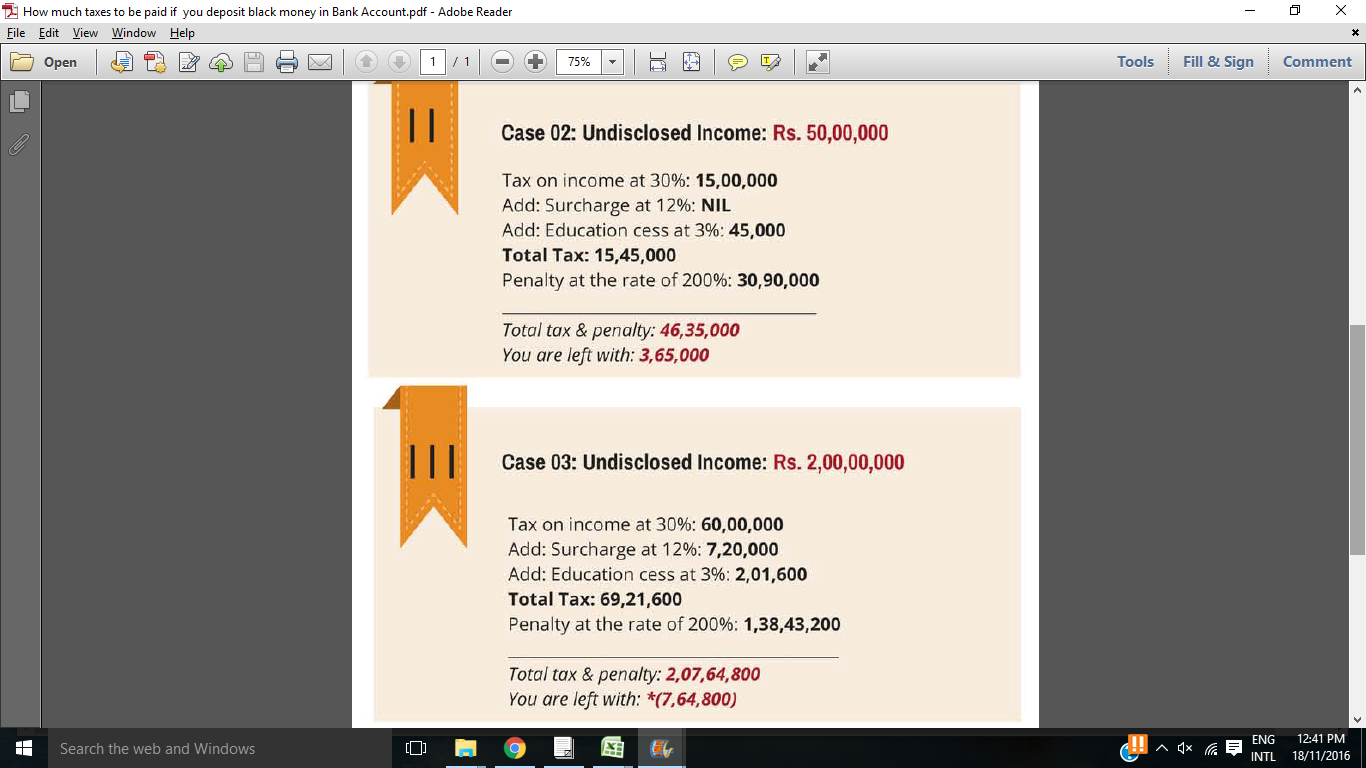
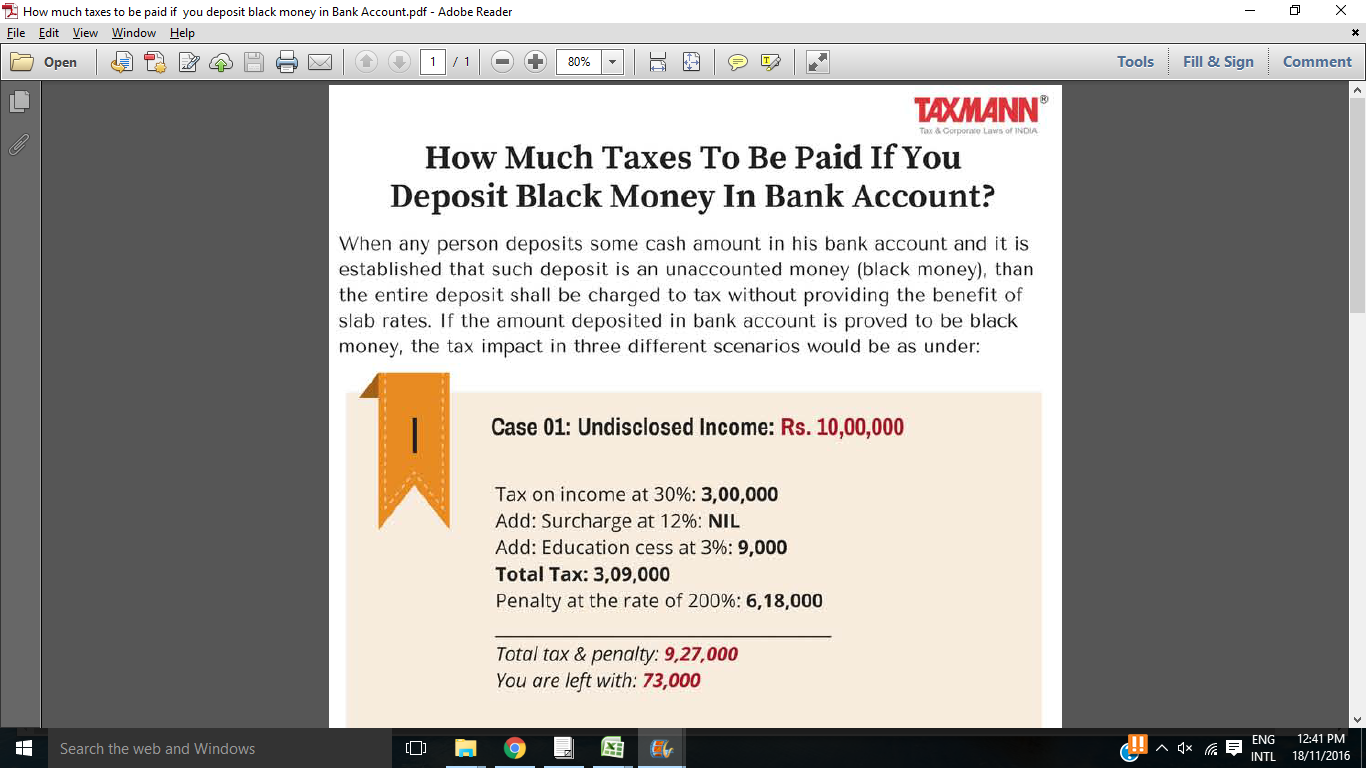
Cash deposits in old currency may attract 200% penalty


Introduction
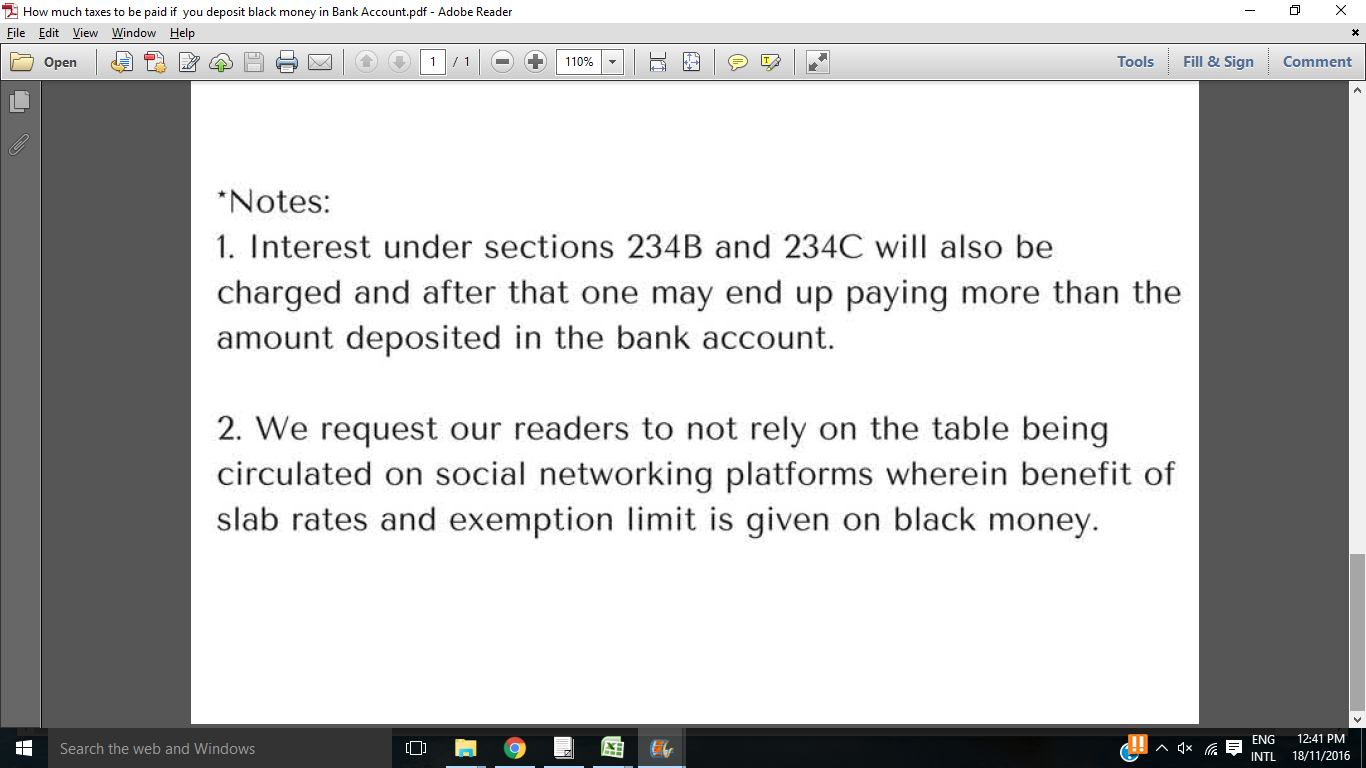
1. The opportunity to declare undisclosed income under Income Declaration Scheme, 2016 and pay 45% on the same expired on 30th September, 2016. If demonetized high denomination notes deposited in bank account pertain to cash in hand declared under IDS, 2016, there would be no problem. But what if IDS has not been availed? Can the assessee simply deposit undisclosed income in form of demonetized notes in his bank account, quantify tax liability @ 30%, pay advance tax and show the same in ITR of FY 2016-17 (current financial year) without attracting penalty of 200% under section 270A for misreporting?
Penalty under Section 270A
2. Salient features of penalty u/s 270A are as under:
Section 270A providing for “Penalty for under reporting and misreporting of income” was inserted in Income-Tax Act,1961 by the Finance Act,2016 with effect from Assessment Year 2017-18.

Section 270A(1) provides that “The Assessing Officer or the Commissioner (Appeals) or the Principal Commissioner or Commissioner may, during the course of any proceedings under this Act, direct that any person who has under-reported his income shall be liable to pay a penalty in addition to tax, if any, on the under-reported income”.

The words “may…..direct that any person who has under-reported his income shall be liable to pay a penalty” are significant. Imposition of penalty under section 270A is discretionary and not mandatory in view of the word “may” used in sub-section (1).

Where no return is furnished, income is said to be under-reported if the income assessed exceeds the maximum income not chargeable to tax .

Where return has been furnished, the starting point for determining whether there is under-reporting is an arithmetical calculation ascertaining difference between two figures-between income assessed or reassessed and income earlier assessed or as per return processed. If the former figure exceeds the latter, income is said to be under-reported

The amount of under-reported income shall be, in a case where income has been assessed for the first time, if return has been furnished, the difference between the amount of income assessed and the amount of income determined under clause (a) of sub-section (1) of section 143.

In a case where no return has been furnished, the amount of under-reported income shall be (A)the amount of income assessed, in the case of a company, firm or local authority; and (B) the difference between the amount of income assessed and the maximum amount not chargeable to tax, in a case not covered in item (A)

In any other case, under-reported income shall be the difference between the amount of income reassessed or recomputed and the amount of income assessed, reassessed or recomputed in a preceding order

Where under-reported income is in consequence of misreporting, the penalty shall be equal to 200% of the amount of tax payable on under-reported income[Section 270A(8)]

Where there is only under-reporting without mis-reporting, the penalty shall be 50% of amount of tax payable on under-reported income[Section 270A(7]

Levy of penalty is discretionary but amount of penalty is not discretionary.

In a fit case, the authorities may decide not to impose penalty. But if they decide to impose, then they must impose the mandatory quantum as per section 270A(7)/(8)-no more and no less.

Section 270A(9) provides that misreporting of income shall cover the following cases (and hence liable to 200% penalty):

(i) misrepresentation or suppression of facts;
(ii) failure to record investments in the books of account;
(iii) claim of expenditure not substantiated by any evidence;
(iv) recording of any false entry in the books of account;
(v) failure to record any receipt in books of account having a bearing on total income; and,
(vi) failure to report any international transaction or any transaction deemed to be an international transaction or any specified domestic transaction.
From the above provisions of section 270A, the following points emerge:
Now misreporting per se will not attract penalty under section 270A @ 200%..To attract the penalty @ 200%, misreporting should result in assessed income being more than what is determined on processing under section 143(1)(a).

There is a view that when unaccounted income in the form of demonetized notes is banked and same is shown in ITR for FY 2016-17 as “income from other sources” and tax @ 30% is paid thereon, the assessed tax will not exceed the tax as per return processed u/s 143(1)(a) and hence no penalty is imposable under section 270A. This view seems to be based on Press Release dated 10-11-2016 which contains replies by the Revenue Secretary. Q.No.3 in the Press Release clarifies that if huge cash deposits do not match with income declared, then it will be a case of tax evasion attracting penalty.

If huge cash deposit is reported in ITR for AY2017-18, it can not be said to be “not matching with income not declared.

However, one should pay careful attention to Q.No.2 of press release which says that all deposits exceeding Rs.2.5 lacs during 10th November to 30th December 2016 will be reported to Department and “The department would do matching of this with income returns filed by the depositors. And suitable action may follow.” As per amended Rule 114E , cash deposits during the period 09-11-2016 to 30-12-2016 aggregating to Rs.12,50,000 or more in current account or aggregating to Rs.2,50,000 or more in savings account will be reported by banks to tax dept. up to January 31, 2017.

Thus, Department will match cash deposits with returns filed for past assessment years upto and including AY 2016-17 in January 2017 itself. If such deposits not matching with the past returns, notices may be sent out by February 2017 itself. In appropriate cases, surveys and raids may take place also. If that happens, assessee may not get a chance to execute this plan of showing cash deposits in ITR of AY 2017-18. If assessee is not able to explain it as current income of FY 2016-17, then it may attract 200% penalty under Section 270A.

Further, Department will not accept a disproportionate spurt compared to preceding year as current year’s income unless satisfactorily explained. The Finance Minister clarified in Rajya Sabha as under:

Sir, there is an existing law which would apply. I think what Mr. Gujral is referring to is when somebody declares it as a part of his current income and when current income is taxable at the rates provided in the Income Tax Act. But if the current income suddenly becomes 5,000 per cent of last year’s income, will it be treated as current income or otherwise?”

For instance, if someone declares a total income of Rs.10 lakhs in preceding year and declares a huge amount of Rs.3.15 crores including a huge cash deposit of say Rs.3.0 crores, the Department is unlikely to accept that the huge cash deposit is from current year’s income unless the spurt in economic activity is satisfactorily explained by assessee. Further in such cases, Department may not even wait till ITR of current year is filed and based on report by bank it may initiate survey or search or even issue notice calling for explanation or details.

Declaring past years’ income as current year’s income will amount to making of false statement in verification and would attract prosecution under section 277.
Conclusion
3. The strategy of declaring huge cash deposits in bank as current year’s income and paying tax on it is fraught with risks and assessee may end up with proceedings for past years being reopened with resultant huge interest and penalties for past years besides prosecution. Another thing to be noted is merely showing income does not fulfill assessee’s obligations under the Act as can be seen from a conspectus of various provisions of the Act. Assessee is obliged to also disclose and establish (i) source (ii) manner of deriving income and (iii) period in which derived. In other words a ‘full and true disclosure’ is contemplated. Further, disclosure of huge cash deposit may result in investigations under indirect tax laws such as VAT/Service Tax/Excise for evasion of those taxes also.
(SRINIVASAN ANAND G.CA) November 18, 2016 [2016] 75 taxmann.com 174 (Article)


Receipt of cash in new currency on selling a property would also invite penalty


In CIT v. A.M. Fazil [2012] 22 taxmann.com 238 (Ker.), the Court observed that ” unless prohibition is introduced against cash transactions particularly in sale of property, in film industry and the like at least for payments over a certain limit in cash, black money generation and circulation cannot be controlled because the disincentives on cash dealings contained under the various provisions of the Income-tax Act have failed to achieve the objective.” Accordingly, the Finance Act, 2015 amended sections 269SS and 271D of the Income-tax Act, 1961 (hereinafter referred to as ‘the Act’). Section 269SS, as amended, prohibits acceptance of Rs. 20,000 or more for any transaction of transfer of immovable property otherwise than by an account payee cheque or account payee bank draft or use of electronic clearing system through a bank account. The prohibition applies whether the sum is received as advance or otherwise. In terms of section 271D, violation of this prohibition attracts a penalty equal to the amount accepted or received
Following situations can arise where a seller receives property sale proceeds in cash off the record (i.e., in black)
Case 1: Seller sold the property and received part of it in black prior to demonetization and declared it in IDS
If seller had already declared the black component in IDS and old demonetized notes were deposited from this declared amount, seller will get immunity from penalty and prosecution under IT Act, 1961 and, hence, he will not be liable for penalty under section 271D. Also there would be no liability for capital gains tax.
Case 2: Seller sold the property and received part of it in black prior to demonetization and had not declared it in IDS
If the seller of property deposits the black component of sale price (received in cash) in bank account and explains it as consideration for sale of property, he is liable to pay capital gains tax with reference to total consideration including black. He will also be visited with a penalty under section 271D equal to the amount of cash accepted or received by him. What is more unlike IDS declaration which is confidential , these explanations given by seller that it is black component of sales price can be forwarded to Stamp Duty authorities for action.
Case 3: Seller has entered into agreement to sell prior to demonetization and received advance (bayana) in old notes prior to demonetization, i.e., on or before 8thNovember, 2016 and had not declared it in IDS
Seller can deposit in bank. However, he will be liable to pay capital gains tax with reference to total consideration including black. He will also be visited with a penalty under section 271D equal to the amount of cash accepted or received by him. What is more unlike IDS declaration which is confidential, these explanations given by seller that it is black component of sales price can be forwarded to Stamp Duty authorities for action.
Case 4: Seller has entered into agreement to sell post demonetization (unlikely as real estate deals have been hit) and received advance (bayana) in old notes post demonetization, i.e., on or after 9th November, 2016

The deal is illegal as cash ceased to be legal tender.

GST Updates (17 November 2016)


Draft GST bills circulated with states no rates details

November 17, 2016
The Centre has circulated the draft goods and services tax (GST) Bills with the states, but it does not contain the four-slab rates agreed to by the GST Council earlier. The Union government has also circulated the draft compensation Bill with states.
With a heated debate on in Parliament over the government’s demonetisation move, the Centre is likely to introduce the Central GST and integrated GST Bills in late November or early December in the ongoing session in the form of money Bills  – http://www.business-standard.com[17-11-2016]

No rates in draft GST Bills that Centre circulates with states

November 17, 2016
The Centre has circulated the draft goods and services tax (GST) Bills with the states, but it does not contain the four-slab rates agreed to by the GST Council earlier. The Union government has also circulated the draft compensation Bill with states.

With a heated debate on in Parliament over the government’s demonetisation move, the Centre is likely to introduce the Central GSTand integrated GST Bills in late November or early December in the ongoing session in the form of money Bills, a move that may draw flak from the Opposition.

The GST Council, a body having representation from the Centre and states, will discuss these Bills on November 24 and 25.

While the Centre and the states have already decided on four-tier GSTrates – five%, 12%, 18% and 28% – these rates did not find mention in the GST Bills, sources said.

“Rates are not a part of the Bills at the moment. Most probably, powers will be taken to notify exemptions and rates. Even today, the Central Board of Excise and Customs notifies these,” one of the sources said.

It has also not yet been decided how to ring-fence these rates, one of the crucial demands of the Congress, sources added. “There is no finality as of now on how rates will be ring fenced.”

The Centre will have to clear CGST, IGST and compensation Bills in Parliament and states SGST Bill in their respective assemblies before GST could be rolled out from April 1, 2017.

States will be given seven days to suggest changes or improvement to the draft laws for GST, after which these will be taken up by the GST council, sources said.

The Centre is likely to introduce the CGST and IGST Bills in the second half of the winter session – November-end or early-December. With the Opposition attacking the ruling dispensation in Parliament over the demonetisation issue, the government is unlikely to bring three Bills related to GST in the coming days.

CGST and IGST Bills are likely to be money Bills, a source in the Parliamentary Affairs Ministry said. This might draw criticism from the Opposition, which wants it to be tabled as finance Bill because the Rajya Sabha, where they have an upper hand, does not have the power to shoot down money Bills.

The GST Compensation Bill will provide legal backing to the Centre’s promise to compensate states if their revenue growth rate falls below 14% in the first five years of the GST rollout. The base year for calculating the revenue of a state has been decided as 2015-16.

The compensation law would have the taxes subsumed and the revenue forgone by each state on account ofGST rollout.

It will give the details on how the Centre plans to raise funds for compensating the revenue loss. The Centre and states had earlier agreed on around 28% tax on high-end cars, tobacco, pan masala and aerated drinks to compensate states. Also, clean energy cess would not be subsumed into GST and would be used for funding compensation. Once the requirement of compensation is over in five years of the GST rollout, these cesses would cease to exist.

The Bill would also specify how much revenue is being raised from which item by way of levy of cess and also the way it is reimbursed to the states, leaving no room for ambiguity.

It would also specify at the end of five years if there is a surplus in the cess pool and in what proportion it should be allocated between the Centre and states. Source – http://www.business-standard.com [16-11-2016]

GST offers opportunity to ‘go digital’

November 17, 2016
The countdown to the roll-out of the goods and services tax, or GST, has begun. The government, enterprises, regulators and consumers are gearing up to handle the tax implications of “one-country one-market structure”. A lot has already been written about how enterprises can prepare for GST. However, in my opinion, GST is not just a financial reform, but a broader business reform. It has the potential to relook at how enterprises conduct their business in India.

With GST, enterprises have an opportunity to revamp systems, go beyond the physical constraints of supply chain, and focus on what matters the most for any business—customer experience! It doesn’t just stop there. With delinking of the physical footprint from direct tax implications, enterprises can use this opportunity to move beyond physical structures, ‘go digital’ and provide digital experiences.

But first, why digital? Digital is the norm in today’s era as consumers respond more when they have better digital experiences. A recent study conducted by SAP concludes that a great digital experience directly correlates with customer loyalty and advocacy.

The outcomes of the study indicate that consumers who are delighted with a brand’s digital experience are almost 10 times more likely to remain loyal than those dissatisfied with it. Moreover, consumers ‘delighted’ with the digital experience of a brand are significantly more likely to recommend the brand, to the tune of positive 77%, versus a negative 60% for dissatisfied experience. A poor digital experience these days causes more harm to a brand than just a lost sale. Negative word of mouth in digital spreads faster and wider, resulting in ‘switching economy’. A successful digital experience strategy lends enterprises the ability to serve customer needs through personalization.

What has GST got to do with the digital experience? GST has a much wider impact on the way enterprises will conduct business in India. It is change from physical to digital. As enterprises take steps to comply with the GST regime, they must use new agile models of sourcing and delivery through a better supply chain.
Free up working capital: The other big benefit of GST is to free up working capital. A recent study from CARE Ratings concluded that GST could help to reduce logistics costs by up to 20% from current levels. These potential savings can help the enterprises to build a digital footprint instead of the traditional route of investing in new offices for a bigger physical footprint.

Level playing field: One of the direct implications of GST that I foresee is the level playing field that GST provides for enterprises of all sizes. Imagine what the Indian Premier League (IPL) did to Indian cricket. Today, we see players from across the world getting uniform exposure on a globally competitive platform. Similarly, GST unifies and simplifies tax structures across all Indian states, ensuring enterprises of reduced barriers to entry and allowing the ability to compete equally.

Bigger play for SMEs: For small and medium enterprises (SMEs) that are usually more cash-strapped, there is potential to save and reinvest in growth and redefine business prospects.

Personalization and real-time pricing strategy: More information allows enterprises to use sophisticated analytics tools, offer personalized experiences to a diversified base of customers that opens up opportunities for pricing strategies to be more real time and tailored for various business segments.

As businesses take steps to adapt to the new GST regime, it is an opportunity to ‘go digital’ and redefine the business processes. Source – http://www.livemint.com [17-11-2016]

Government shares 3 draft GST Bills with states for consultation

November 17, 2016
The Central government has circulated three draft Bills relating to the Goods and Services Tax (GST) with states for consultation, a senior government official said adding that these will be taken up for discussion in next GST Council meeting on November 24-25.

The GST Council will have to clear Central GST (CGST), Integrated GST (IGST) and the compensation Bills before they can be introduced in the Winter Session of Parliament, which commenced Wednesday. States have time of over a week to give their views on the three draft laws relating to GST.

The Centre and the states have already decided on a four-tier GST rates— 5 per cent, 12 per cent, 18 per cent and 28 per cent-— but is yet to decide on the issue of cross empowerment to avoid dual control.
On November 10, Lok Sabha had listed three draft Bills relating to GST for introduction in the Winter Session of Parliament.

The constitutional amendment enabling rollout of the indirect tax regime was passed by Parliament in August, following which it became an Act in September after ratification by 16 out of 31 states and state legislatures. The government aims to introduce GST, which will subsume excise, service tax, VAT and other local levies, from April 1, 2017. Source -http://indianexpress.com [16-11-2016]

Government unlikely to bring GST bills soon

November 17, 2016
With the united opposition attacking the ruling dispensation in Parliament over the demonetisation issue, the government is unlikely to bring three bills related to GST in the coming days and hopeful of pushing them in latter half of the Winter session which began today.

The government is keen to push the passage of three legislations related to the main GST bill in the ongoing Winter session, as Parliamentary nod for these bills is must for rolling out GST from the target date of April 1, 2017.

The three bills related to GST are-the Central Goods and Services Tax Bill, the Integrated Goods and Services Tax Bill, the Goods and Services Tax (Compensation for Loss of Revenue) Bill.

The government is hopeful of passage of the three GST bills in the Winter session, which are likely to be introduced in either third or fourth week of the session, a source said.

As per the GST Constitution Amendment Bill, which was notified on September 17, 2016, the government is required to complete the process of implementation of GST within a year.

The all powerful GST Council, which is chaired by the Finance Minister and has representations from state, had already decided on a four-tier rate structure-5, 12, 18 and 28 per cent-with a cess over and above the peak rate for luxury and demerit goods.

The issue of dual control, which deals with who will control which set of assessees under GST, has been holding back the negotiations between the Centre and the states.

The government has listed total nine bills which also includes Surrogacy (Regulation) Bill for introduction, consideration and passage.

The government has listed 10 pending bills including HIV AIDS Prevention and Control bill, Mental Health Care bill, Maternity Benefit Amendment bill, Prevention of Corruption (amendment) bill and Consumer Protection bill for consideration and passing as these bills have already been introduced in Parliament. Source – http://www.financialexpress.com [16-11-2016]


Govt in favour of cross empowerment without limits

November 17, 2016
The government is in favour of not splitting jurisdiction over the taxpayers but rather is batting for cross empowerment without limits. The logic offered is that the Centre estimates only 3-5 percent of the tax payers may be audited under the Goods and Services Tax.

The Winter Session of parliament will be mainly focussed on the GST. The revised draft GST model laws were sent to states for comments on Tuesday. The draft GST compensation bill will be sent soon.

The states are in favour of horizontal division of the assessees. However the government is against both horizontal or vertical division of taxpayers. Source – http://www.moneycontrol.com [16-11-2016]

GST Updates (16 Nov 2016)


As Centre Readies GST Bill, Subramanian Swamy to Move SC Against GST Network

November 16, 2016

Three bills on the much-awaited Goods & Services Tax (GST) will see light of day in the winter session of Parliament beginning Wednesday, but the government’s prestige legislation is all set to hit a Subramanian Swamy block.

The BJP Rajya Sabha MP has objected to private players being involved in setting up the infrastructure of the Goods and Services Tax Network (GSTN) and told News18 that he will take up the matter in the Supreme Court.

This comes at a time when the Centre and state governments have finally come together in agreement over GST and come out with a four slab structure.

Swamy said he is approaching the Supreme Court as he feared sensitive GST data might fall into the hands of private players and “foreign interests” if the Centre goes ahead with the current structure.

“I have sent half a dozen letters to the Prime Minister in this connection. He has acknowledged it. I have also sent the copies to BJP president Amit Shah, Home Minister Rajnath Singh and the Defence Minister Manohar Parrikar,” Swamy told News18.

“The GSTN will be controlled by private players with majority foreign shareholder organisations like HDFC Ltd, HDFC Bank Ltd, LIC Housing Finance Ltd, ICICI Bank Ltd and NSE Strategic Investment Corp Ltd. No opportunity was given to Indian companies with majority Indian shareholdings and nationalised banks to become shareholders. It poses a serious threat. I am challenging it before the Supreme Court in the national interest,” he said.

According to Swamy, in 2011 when Pranab Mukherjee was Finance Minister, the Centre had decided that GSTN would be owned by three government stakeholders: the Central government, the state governments and the Centre-owned National Securities Depository Limited (NSDL). Training his guns on former finance minister P Chidambaram, Swamy said that he had dropped NSDL and added five private players making it look like a private body for profits.

The Constitution Amendment Select Committee of the Rajya Sabha in its report accessed by News18 has expressed serious concerns over the structure of GSTN. The report said, “The committee noted that the non government shareholding in GSTN is dominated by private banks, and this is not desirable. It recommended that the non-government institution shareholding be limited to public sector banks and financial institutions.”

Swamy has forwarded all his correspondence on the GSTN with the Centre to President Pranab Mukherjee, informing him that he was free for any consultation on the subject. He said that the Comptroller and Auditor General had no jurisdiction over the GSTN in its current form and it could lead to a huge scam. He has also questioned the rationale behind outsourcing computer programming to private IT companies alleging that mandatory procedures were not followed before awarding such contracts.

“I once again strongly urge the Prime Minister Modi to direct the complete stay of all operations of the presently constituted GSTN. At the same time I will also be moving the SC seeking cancellation of it,” he said. Source – www.news18.com [15-11-2016]


Passage of GST bill could take a hit over Modi’s demonetisation move

November 16, 2016
Will the Opposition’s onslaught against the Centre over the demonetisation affect the passage of the goods and service tax (GST) bill?

A confident government may bring the GST bill by early next week in Rajya Sabha, indicating it is not perturbed at the ongoing protests against another of its financial reforms — the demonetisation scheme.

The Centre wants to pass the GST bill to roll out the new tax regime from April 1, 2017. The proposed tax, which will absorb local levies and indirect taxes, has already missed many deadlines.

“We are getting the Constitution amended for GST on which discussions have been on since long… since Congress’ time. I am confident that we will do those amendments and pass the GST,” home minister Rajnath Singh said recently.

But for the Congress, the priority is to corner the BJP-led NDA over the demonetisation of 1,000 and 500 rupee notes. “Right now, the main issue is the surgical jumla (drama) of the demonetisation by Prime Minister Narendra Modi. The GST is not in our radar screen,” said Congress strategist and Rajya Sabha MP, Jairam Ramesh.

Even as the government may not require the Opposition’s support to pass the GST legislation, a united opposition might as well delay the passage of the bill through chaos and ruckus in the House. The Rajya Sabha may not get a chance to vote on the GST bill as the government is likely to introduce it as a money bill — such bills do not require the approval of the Upper House.

“I think the GST is a forgotten issue. Let us first see if the session runs or not. Then only the possibility of GST being passed arises,” said Ramesh.

In the last session, the government managed to pass the Constitution amendment bill on the GST as the Congress and other opposition parties came on board. Now, with a hostile opposition gunning for the BJP-led government, it might be a tricky situation for pushing the GST bill.

“Thousands of ‘rich’ and ‘corrupt’ persons standing in queue. The poor are cheering from their homes! Banks are doling out cash to citizens. That is proof that ‘Achhe Din’ has arrived! Millions of working people standing in queue. Long live productivity,” former finance minister P Chidambaram on Tuesday tweeted, taking potshots at the government. Source -www.hindustantimes.com [16-11-2016]

Congress expresses opposition to 4-tier GST rate structure

November 15, 2016
Ahead of the winter session of Parliament, Congress on Monday expressed its opposition to the proposed four-tier Goods and Services Tax (GST) rate structure which goes up to 28 per cent, insisting that it would hit hard the common man “Congress has always been insisting that the rate should not be more than 18 per cent as it would lead to rise in inflation and burden the common man”.

“Now it is being revealed that Narendra Modi and Arun Jaitleywho were having ambivalent position on the GST (when in the opposition) are now talking of a tax of 27 per cent”, party’s chief spokesman Randeep Surjewala told reporters.

He said that the Congress would “certainly oppose” the multiple rates of the GST up to 28 per cent as it would “break the back of the common man”.

Earlier this month, the GST Council, overcoming opposition from some states finalised a multiple-slab rate structure, including the cess, for the new indirect tax The quantum of cess on each of these will depend on the current incidence of tax.

While on nearly half of the consumer inflation basket, including food grains, the GST will be at 0 per cent, ultra luxuries, demerit and sin goods, will attract a cess for a period of five years on top of the 28 per cent GST.

The highest slab of 28 per cent will include white goods and all those items on which the current rate of incidence varies from 30-31 per cent.

Centre will have to pass the CGST and IGST bills in Parliament at the earliest to meet the deadline of roll out of GST from April 1 next year Source – http://www.indianexpress.com [14-11-2016]

State tax officers demand fair share in GST

November 15, 2016
State tax officers demand fair share in GST

In a unique way of protest, about 2.36 lakh officers and employees working with commercial and sales tax departments of various states will work on Sunday to press for their demand of having a fair share in the administration of taxes under the proposed Goods and Services Tax (GST).

The All India Confederation of Commercial Taxes Association (AICCTA) said its members will also go on day-long pen down strike on November 23 if their demands are not accepted by the government.

The confederation has decided that all its members will work on November 20, which is Sunday, to protest the way the administration of GST has been planned by the Centre.

“It is a positive form of protest by working on a general holiday,” the employees’ body said.
Union Finance Minister Arun Jaitley has called an informal meeting of state finance ministers to discuss the matters of dual control and cross empowerment on Sunday.

Earlier this week, different delegations of the confederation met finance ministers of various states to seek their support.

The confederation claims to represent over 36,000 Gazetted officers and about two lakh employees of Class-Ill and-IV categories.

The confederation has sought complete authority relating to monitoring, audit, assessment and enforcement activities provided either under the GST Act or under the Integrated Goods and Services Tax-to be levied on all inter-state supplies of goods and services.

“It is also demanded that the state authorities should also be empowered under IGST Actto administer matters relating to interstate transactions,” as per a memorandum submitted to the Finance Ministry.

The officers’ body has sought representation of officers from the states in GST council secretariat.

“It is demanded that the GST council provide sufficient funds to the states to establish a uniform infrastructural and networking system,” it said.

The confederation has said that they would not work on November 23 to protest against non-implementation of its demands and for a just and fair tax administration under the GST regime.

The proposed GST is a single tax on supply of goods and services, right from the manufacturer to the consumer.  Source -http://economictimes.indiatimes.com [14-11-2016]

State tax officers demand fair share in GST

November 15, 2016
State tax officers demand fair share in GST

In a unique way of protest, about 2.36 lakh officers and employees working with commercial and sales tax departments of various states will work on Sunday to press for their demand of having a fair share in the administration of taxes under the proposed Goods and Services Tax (GST).

The All India Confederation of Commercial Taxes Association (AICCTA) said its members will also go on day-long pen down strike on November 23 if their demands are not accepted by the government.

The confederation has decided that all its members will work on November 20, which is Sunday, to protest the way the administration of GST has been planned by the Centre.

“It is a positive form of protest by working on a general holiday,” the employees’ body said.
Union Finance Minister Arun Jaitley has called an informal meeting of state finance ministers to discuss the matters of dual control and cross empowerment on Sunday.

Earlier this week, different delegations of the confederation met finance ministers of various states to seek their support.

The confederation claims to represent over 36,000 Gazetted officers and about two lakh employees of Class-Ill and-IV categories.

The confederation has sought complete authority relating to monitoring, audit, assessment and enforcement activities provided either under the GST Act or under the Integrated Goods and Services Tax-to be levied on all inter-state supplies of goods and services.

“It is also demanded that the state authorities should also be empowered under IGST Actto administer matters relating to interstate transactions,” as per a memorandum submitted to the Finance Ministry.

The officers’ body has sought representation of officers from the states in GST council secretariat.

“It is demanded that the GST council provide sufficient funds to the states to establish a uniform infrastructural and networking system,” it said.

The confederation has said that they would not work on November 23 to protest against non-implementation of its demands and for a just and fair tax administration under the GST regime.

The proposed GST is a single tax on supply of goods and services, right from the manufacturer to the consumer.  Source -http://economictimes.indiatimes.com [14-11-2016]

Reporting of cash deposit (from 09 Nov 2016 to 30 Dec 2016) N/N. 104/2016 dated 15 Nov 2016


Amendment in Rule 114B for compulsory quoting of pan in case of cash deposit exceeding Rs. 50000 in a single day or aggregating to more then Rs.  2.5 lakh during the period from 09.11.2016 till 30.12.2016.

Amendment in Rule 114E for filing AIR report as required under section 285BA of Income Tax Act, 1961 for reporting by banking company and a cooperative bank on account of aggregate cash deposits in one or more current account of a person in excess of Rs. 12.5 lakhs or Rs. 2.5 lakh or more in one or more account of a person during 09.11.2016 till 30.12.2016.

GOVERNMENT OF INDIA
MINISTRY OF FINANCE
DEPARTMENT OF REVENUE
CENTRAL BOARD OF DIRECT TAXES

NOTIFICATION No. 104/2016-Income Tax
New Delhi, the 15th November, 2016

G.S.R 1068(E).- In exercise of the powers conferred by section 285BA, read with section 295 of the Income-tax Act, 1961 (43 of 1961), the Central Board of Direct Taxes hereby makes the following rules further to amend the Income-tax Rules, 1962, namely:-
1. (1) These rules may be called the Income–tax (30th Amendment) Rules, 2016.
(2) They shall come into force from the date of their publication in the Official Gazette.
2. In the Income-tax Rules, 1962 (hereinafter referred to as the said rules), in rule 114B, in the Table, for serial number 10 and entries relating thereto the following serial number and entries shall be substituted, namely:-
Sl. No. Nature of transaction Value of transaction
(1) (2) (3)
“10.
Deposit with,-
(i) a banking company or a co- operative bank to which the Banking Regulation Act, 1949 (10 of 1949), applies (including any bank or banking institution referred to in
section 51 of that Act);
(ii) Post Office.
Cash deposits,-
(i) exceeding fifty thousand rupees during any one day; or
(ii) aggregating to more than two lakh fifty thousand rupees during the period 09th November, 2016 to 30th December, 2016.”.
3. In the said rules, in rule 114E, ̶
(i) in sub-rule (2), in the Table, after serial number 11 and entries relating thereto the following serial number and entries shall be inserted, namely:-
Sl. No. Nature and value of transaction Class of person (reporting person)
(1) (2) (3)
“12.
Cash deposits during the period 09th November, 2016 to 30th December, 2016 aggregating to ̶
(i) twelve lakh fifty thousand rupees or more, in one or more current account of a person; or
(ii) two lakh fifty thousand rupees or more, in one or more accounts (other than a current account) of a person.
(i) A banking company or a co-operative bank to which the Banking Regulation Act, 1949 (10 of 1949) applies (including any bank or banking institution referred to in section 51 of that Act);
(ii) Post Master General as referred to in clause (j) of section 2 of the Indian Post Office Act, 1898 (6 of 1898).”;
(ii) in sub-rule (5), the following proviso shall be inserted, namely:-
“Provided the statement of financial transaction in respect of the transactions listed at serial number (12) in the Table under sub-rule (2), shall be furnished on or before the 31st day of January, 2017.”

[Notification No. 104/2016]
[F.No.370142/32/2016-TPL]
(Dr. T.S. Mapwal)
Under Secretary to the Government of India
Note:- The principal rules were published vide notification S.O. 969 (E), dated the 26th March, 1962 and last amended vide notification S.O.3399(E), dated 07th November, 2016.