Advisory to file pending returns before expiry of three years (GST Updates 9th Sept 2025)

As per the Finance Act,2023 (8 of 2023), dt. 31-03-2023, implemented w.e.f 01-10-2023 vide Notification No. 28/2023 – Central Tax dated 31th July, 2023, the taxpayers shall not be allowed file their GST returns after the expiry of a period of three years from the due date of furnishing the said return under Section 37 ( Outward Supply), Section 39 (payment of liability), Section 44 ( Annual Return) and Section 52 (Tax Collected at Source). These Sections cover GSTR-1, GSR-1A, GSTR 3B, GSTR-4, GSTR-5, GSTR-5A, GSTR-6, GSTR 7, GSTR 8 and GSTR 9 or 9C.

Hence, above mentioned returns will be barred for filing after expiry of three years. The said restriction will be implemented on the GST portal from September 2025 Tax period. Which means any return for which due date was three years back or more and hasn’t been filed till September Tax period will be barred from Filling. In this regard an advisory was already issued by GSTN on 29th October, 2024

Illustration : For ease of reference and better clarity, the latest GST returns that will be barred from filing w.e.f 1st October 2025 are detailed in the table below:

GST FormsBarred Period (w.e.f. 1st October,2025)
GSTR-1/IFFAugust-2022
GSTR-1QApril-June 2022
GSTR-3B/MAugust-2022
GSTR-3BQApril-June 2022
GSTR-4FY 2021-22
GSTR-5August-2022
GSTR-6August-2022
GSTR-7August-2022
GSTR-8August-2022
GSTR-9/9CFY 2020-21

Hence, the taxpayers are once again advised to reconcile their records and file their GST Returns as soon as possible if not filed till now.

Thanking You,
Team GSTN

Lean Systems Demystified: Meaning, Types, Benefits, and Global Examples You Must Know

Introduction to Lean Systems

Lean System is a management philosophy focused on creating the most value for customers while minimizing waste—a principle that originated from the renowned Toyota Production System123. Imagine organizing your kitchen: you remove unused gadgets, keep essential tools handy, and arrange items to cook faster without any unnecessary steps. That’s Lean in action—eliminate what’s not needed and focus energy where it counts.

The core idea is simple: identify and remove anything that doesn’t directly contribute value to the customer. By doing so, businesses become more efficient, flexible, and responsive—embracing continuous improvement as a way of working145.

Types of Lean Systems

Modern Lean combines time-tested practices with practical tools. Here are the most widely recognized types:

Just-in-Time (JIT)

  • Key Idea: Produce and deliver products exactly when needed, in the amount needed—no more, no less.
  • Application: Used in production lines and supply chains to cut excess inventory and improve flow.
  • Tool Example: Kanban cards/signals.

Kanban System

  • Key Idea: A visual workflow management tool that signals what, when, and how much to produce or move6.
  • Application: Widely used to manage inventory, manufacturing, software development, and project tasks.
  • Tool Example: Kanban boards.

Kaizen (Continuous Improvement)

  • Key Idea: Small improvements every day—by everyone.
  • Application: From factory floors to customer service desks, encouraging teams to suggest and implement changes.
  • Tool Example: Kaizen events, suggestion systems.

5S System

  • Key Idea: Sort, Set in Order, Shine, Standardize, and Sustain for a clean, organized, efficient workplace7.
  • Application: Any environment—offices, plants, hospitals—to reduce waste and increase safety.

Value Stream Mapping

  • Key Idea: Diagramming every step in a process to spot and eliminate steps that don’t add value.
  • Application: Used to identify bottlenecks or waste in manufacturing, logistics, or administrative workflow.

Lean Six Sigma

  • Key Idea: Integrates Lean’s waste reduction with Six Sigma’s defect and variability control.
  • Application: Used for process improvement and problem-solving, often in quality management.
  • Comparison: Lean focuses on “speed and flow” (waste), while Six Sigma tackles “consistency and quality” (variability); together, they maximize efficiency and reliability6.
Comparison of Major Types of Lean Systems

Comparison of Major Types of Lean Systems

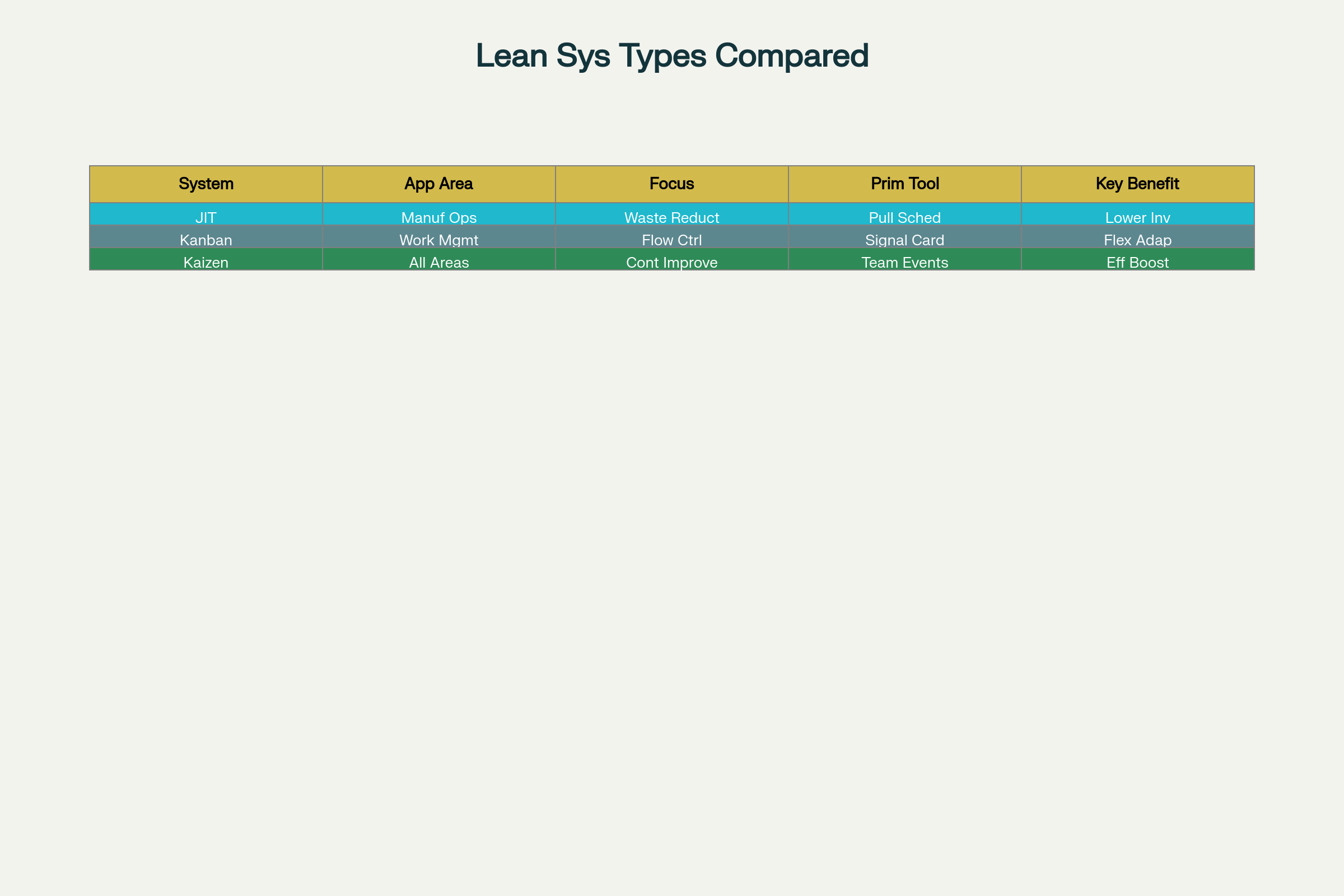
Comparative Table: Major Types of Lean Systems

TypeMajor ApplicationFocusKey ToolsKey Benefits
JITManufacturing, PharmaInventory ReductionKanban, JITLow inventory, cost
KanbanProduction, ServicesWorkflow ManagementKanban boardVisual control, flow
KaizenAll departmentsContinuous ImprovementSuggestion boxTeam empowerment

Benefits of Lean Systems

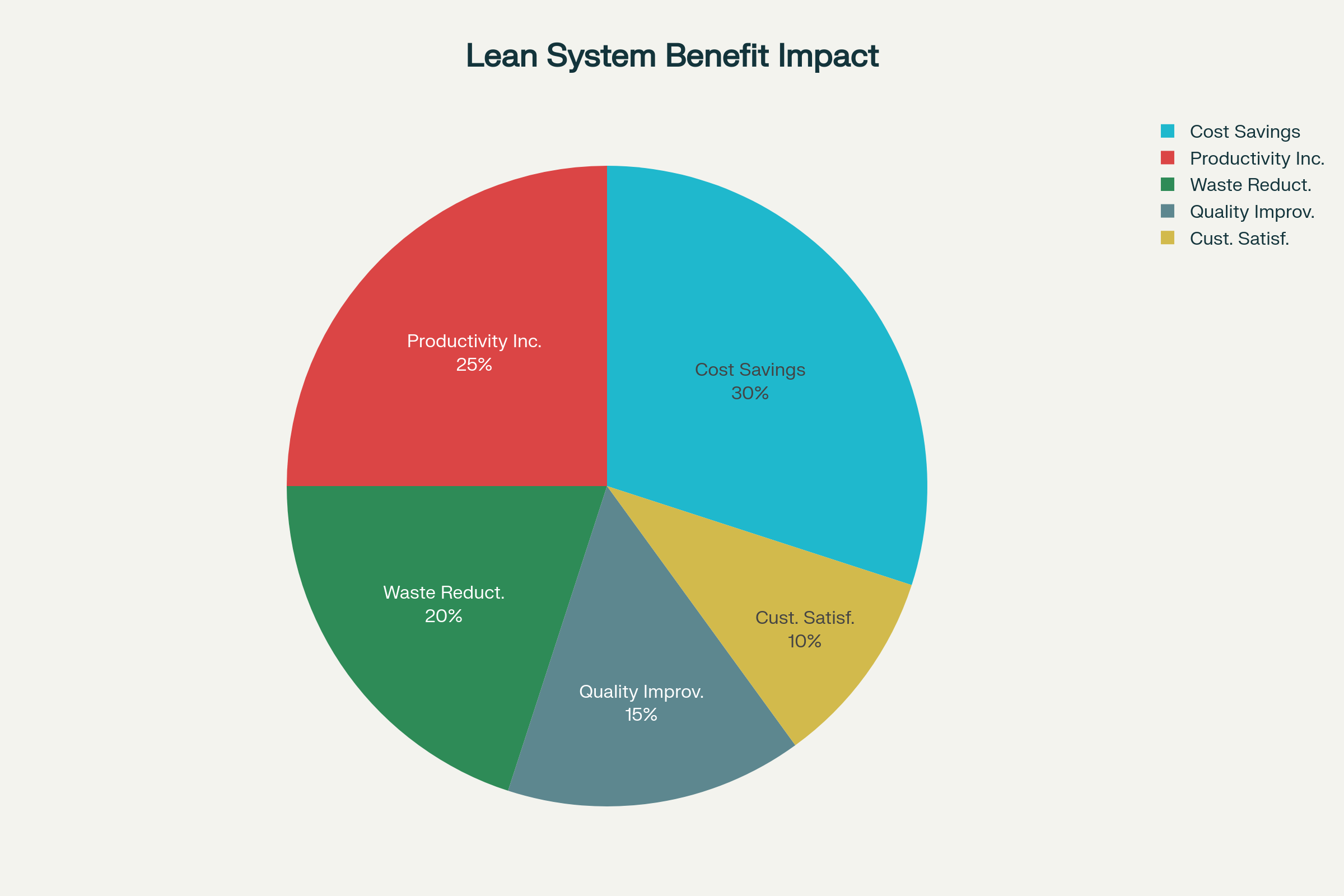
Implementing Lean doesn’t just cut costs—it transforms performance across the board58910:

  • Reduction in operational costs: Less inventory, fewer errors, less rework bring major savings.
  • Faster production cycle time: Shorter lead times and faster responses to customer demand.
  • Improved product quality: Quality is built into each step, reducing defects.
  • Higher customer satisfaction: Consistent quality and prompt delivery strengthen loyalty.
  • Better team collaboration: Lean empowers employees to find and solve problems.
Impact Distribution of Key Benefits of Lean System Implementation

Impact Distribution of Key Benefits of Lean System Implementation

Problems Addressed by Lean Systems

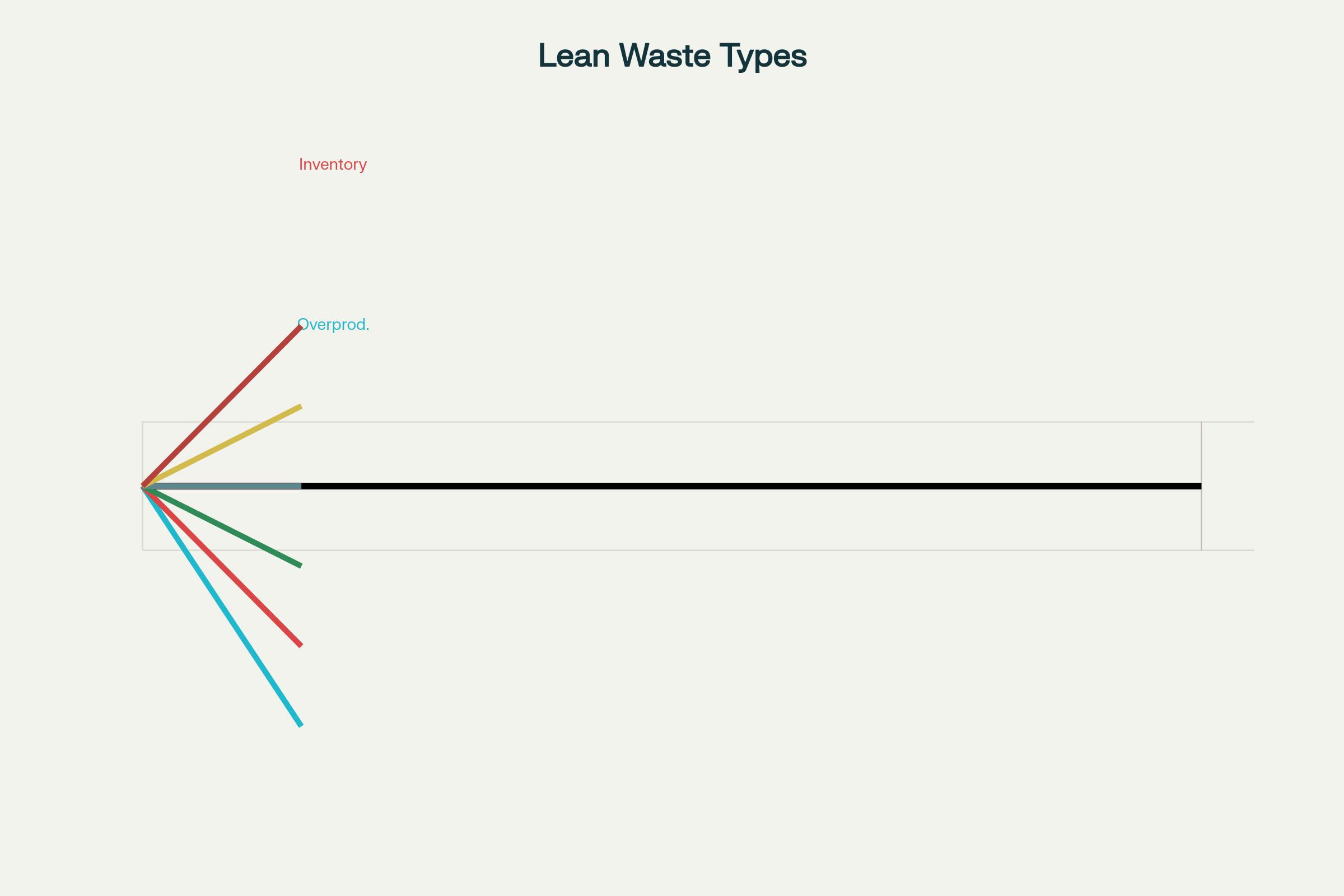
Lean tackles many of the root causes of inefficiency and frustration in organizations today, including1112:

  • Overproduction: Making more than what’s needed.
  • Inventory waste: Excess material or products waiting around.
  • Motion waste: Unnecessary moving of people or equipment.
  • Defects/rework: Errors or mistakes that require fixing.
  • Waiting time: Idle time while people or machines wait for work.
  • Underutilized talent: Not making the most of employees’ skills.
Ishikawa Diagram of Wastes Tackled by Lean Systems

Ishikawa Diagram of Wastes Tackled by Lean Systems

Infographic: Ishikawa (Fishbone) Diagram—Wastes Lean Tackles

5 Global Companies Successfully Using Lean Systems (Recent Examples)

Here’s proof that Lean makes a difference:

CompanyYear/PeriodLean System UsedOutcome/Result
ToyotaOngoingKaizen, JITContinues to lead in quality & agility13
Amazon2022–24Lean warehousing, Robotics, 5SFaster deliveries, high warehouse efficiency
Nike2020–23Lean manufacturing, 5S (Asia)Reduced waste, better worker engagement13
Intel2021–25Lean Six Sigma, KaizenShorter chip cycle time, defect reduction13
Boeing2021–24Value Stream MappingImproved assembly line productivity

Conclusion

Today’s most competitive organizations rely on Lean to reduce waste, improve quality, and delight customers. The best part? Lean principles are not just for big manufacturers—even small businesses can get started by decluttering, standardizing, and making tiny daily improvements in their workflow.

What’s slowing you down or wasting effort? Apply the Lean mindset—start small, but start now!

Sources:

  1. https://asq.org/quality-resources/lean
  2. https://www.beewatec.com/en/blog/what-is-lean-definition-lean-management-methods-and-principles
  3. https://theleanway.net/what-is-lean
  4. https://en.wikipedia.org/wiki/Lean_manufacturing
  5. https://www.planview.com/resources/articles/essential-principles-lean-system/
  6. https://www.simplilearn.com/lean-methodology-article
  7. https://www.manutan.com/blog/en/glossary/lean-management-definition-and-tools
  8. https://kaizen.com/insights/definition-advantages-lean-management/
  9. https://www.mingosmartfactory.com/the-top-7-benefits-of-lean-manufacturing/
  10. https://www.iobeya.com/blog/5-key-benefits-lean-management/
  11. https://geoleanusa.com/5-manufacturing-problems-that-can-be-solved-with-lean/
  12. https://blog.kainexus.com/improvement-disciplines/lean/7-wastes-of-lean/everyday-examples-of-the-8-wastes-of-lean
  13. https://shoplogix.com/nine-companies-that-use-lean-manufacturing/
  14. https://theleanway.net/The-Five-Principles-of-Lean
  15. https://www.wevalgo.com/know-how/lean-management/lean-methods-tools
  16. https://www.asme.org/topics-resources/content/7-examples-of-lean-manufacturing-in-action
  17. https://www.leanproduction.com/top-25-lean-tools/
  18. https://www.machinemetrics.com/blog/lean-manufacturing-problems-and-solutions
  19. https://www.learnleansigma.com/continuous-improvement/lean-manufacturing/
  20. http://www.leansystemsinc.com/lean_defined.html

Handling of Inadvertently Rejected records on IMS (FAQs)

Question 1: How can a recipient avail ITC of wrongly rejected Invoices/ Debit notes/ECO-Documents in IMS as corresponding GSTR-3B of same tax period was also filed by recipient?

Answer: In such cases recipient can request to the corresponding supplier to report the same record (without any change) in same return period’s GSTR-1A or respective amendment table of subsequent GSTR-1/IFF. Thus, recipient can avail the ITC basis on amended record by accepting such record on IMS and recomputing GSTR-2B on IMS. Here the recipient will get ITC of complete amended value as original record was rejected by the recipient.

However, recipient will be able to take ITC for the again furnished document by the supplier, as stated above, only in the GSTR-2B of the concerned tax-period.

Question 2: If any original record is rejected by the recipient and supplier furnishes the same record in GSTR-1A of same tax period or in the amendment table of GSTR-1/IFF of subsequent period, till the specified time limit, then what impact it will have on supplier’s liability?

Answer: In case supplier had furnished an original record in GSTR-1/IFF but the same record was rejected wrongly by the recipient in IMS. In such cases supplier on noticing the same in the supplier’s view of IMS dashboard or on request of recipient, may furnish the same record again (without any change) in GSTR-1A of same tax period or in the amendment table of GSTR-1/IFF in any subsequent period, till the specified time limit, then the liability of supplier will not increase. As amendment table take delta value only. Thus, in present case of same values, differential liability increase will be zero.

Question 3: As a recipient taxpayer, how to reverse ITC of wrongly rejected Credit note in IMS as the corresponding GSTR-3B has already been filed?

Answer: In such cases recipient can request the concerned supplier to furnish the same Credit note (CN) without any change in the same return period’s GSTR-1A or in amendment table of subsequent period’s GSTR-1/IFF. Now recipient can reverse the availed ITC based on the amended CN by accepting the CN on IMS. Hence, the recipient’s ITC will get reduced with complete amended value, as soon as the recipient recomputes GSTR-2B on IMS. The reduced value is same as that of the value of original CN as in this case the complete original CN was rejected by the recipient.

Question 4: If any original Credit note was rejected by the recipient and supplier furnishes the same credit note in GSTR-1A of same tax period or in the amendment table of GSTR-1/IFF of any future tax-period, till the specified time limit, then what impact it will have on supplier’s liability?

Answer: At first instant the supplier’s liability will be added back in the open GSTR-3B return, because of original credit note rejection by the recipient. However, as the supplier furnishes the same credit note in GSTR-1A of same tax period or in amendment table of GSTR-1/IFF in any subsequent period, supplier’s liability for this amendment will get reduced again corresponding to the value of amended CN (which in this case is same as original). Thus, net effect on liability of supplier will be only once.

(Source: GST Portal update 19 June 2025)

आपके सोशल मीडिया अकाउंट्स, डिजिटल तस्वीरें और डेटा: पहले से तय करें कि इन डिजिटल संपत्तियों का उत्तराधिकारी कौन होगा

आज के डिजिटल युग में, हमारी डिजिटल संपत्तियाँ – जैसे सोशल मीडिया अकाउंट्स, ईमेल, क्लाउड स्टोरेज में तस्वीरें और दस्तावेज़ – हमारे जीवन का अहम हिस्सा बन चुकी हैं। इस लेख में बताया गया है कि इन संपत्तियों की उत्तराधिकार योजना बनाना क्यों ज़रूरी है और इसके लिए क्या कदम उठाने चाहिए।

मुख्य बिंदु:

  1. डिजिटल संपत्तियाँ केवल डेटा नहीं, भावनात्मक धरोहर भी हैं
    जैसे प्रसिद्ध फ़ोटोजर्नलिस्ट रघु राय की इंदिरा गांधी की तस्वीरें आज ऐतिहासिक महत्व रखती हैं, उसी तरह आम लोगों की डिजिटल फोटोज, ब्लॉग्स या वीडियोज़ भी आने वाली पीढ़ियों के लिए मूल्यवान हो सकते हैं।
  2. ‘पासवर्ड की पहेली’
    अधिकतर लोगों के डिजिटल अकाउंट्स पासवर्ड से सुरक्षित होते हैं, लेकिन मृत्यु के बाद यदि किसी को पासवर्ड नहीं पता, तो उनकी महत्वपूर्ण जानकारी खो सकती है।
    सलाह: एक विश्वसनीय व्यक्ति को पासवर्ड की जानकारी (या उसका स्थान) बताकर रखें, या किसी पासवर्ड मैनेजर का उपयोग करें।
  3. Legacy Contact की सुविधा का उपयोग करें
    Facebook और Google जैसे प्लेटफ़ॉर्म आपको “Legacy Contact” या “Trusted Contact” जोड़ने की सुविधा देते हैं, जो आपकी मृत्यु के बाद आपके अकाउंट को मैनेज कर सकते हैं।
    यह एक प्रभावी तरीका है अपनी डिजिटल पहचान को नियंत्रित करने का।
  4. भारत में डिजिटल संपत्ति के लिए स्पष्ट कानून नहीं हैं
    भारत में फिलहाल ऐसा कोई विशेष कानून नहीं है जो डिजिटल संपत्ति के उत्तराधिकार को नियमित करता हो।
    हालांकि, आप एक अनौपचारिक “डिजिटल वसीयत” (Digital Will) बना सकते हैं जिसमें आप तय करें कि कौन-कौन सी डिजिटल संपत्ति किसे मिलेगी।
  5. पहले से योजना बनाना है अत्यंत आवश्यक
    डिजिटल संपत्ति के लिए कोई कानूनी विवाद न हो, इसके लिए:
    • अकाउंट्स की सूची बनाएं
    • पासवर्ड मैनेजर का उपयोग करें
    • भरोसेमंद व्यक्ति को जानकारी दें
    • डिजिटल वसीयत या निर्देश तैयार करें

निष्कर्ष:

जैसे हम भौतिक संपत्तियों (जमीन-जायदाद) की वसीयत बनाते हैं, वैसे ही डिजिटल संपत्तियों की उत्तराधिकार योजना बनाना भी आज के समय में बेहद जरूरी है। इससे न केवल भविष्य की उलझनों से बचा जा सकता है, बल्कि आपकी भावनात्मक और रचनात्मक डिजिटल विरासत भी सुरक्षित रहती है।

Summary of Ministry of Corporate Affairs Announcement on Corporate governance & CSR

Summary of Ministry of Corporate Affairs Announcement

1. Strengthening Corporate Governance and Transparency:

The Companies Act, 2013, contains provisions for ensuring corporate governance and transparency in company management.

It mandates compliance through key managerial personnel, the Board of Directors, and shareholders.


2. Maintenance and Disclosure Requirements:

Companies are required to maintain financial records, returns, and registers.

Notices, explanatory statements, and financial reports must be shared with shareholders.

Annual filings with the Registrar ensure regulatory oversight.


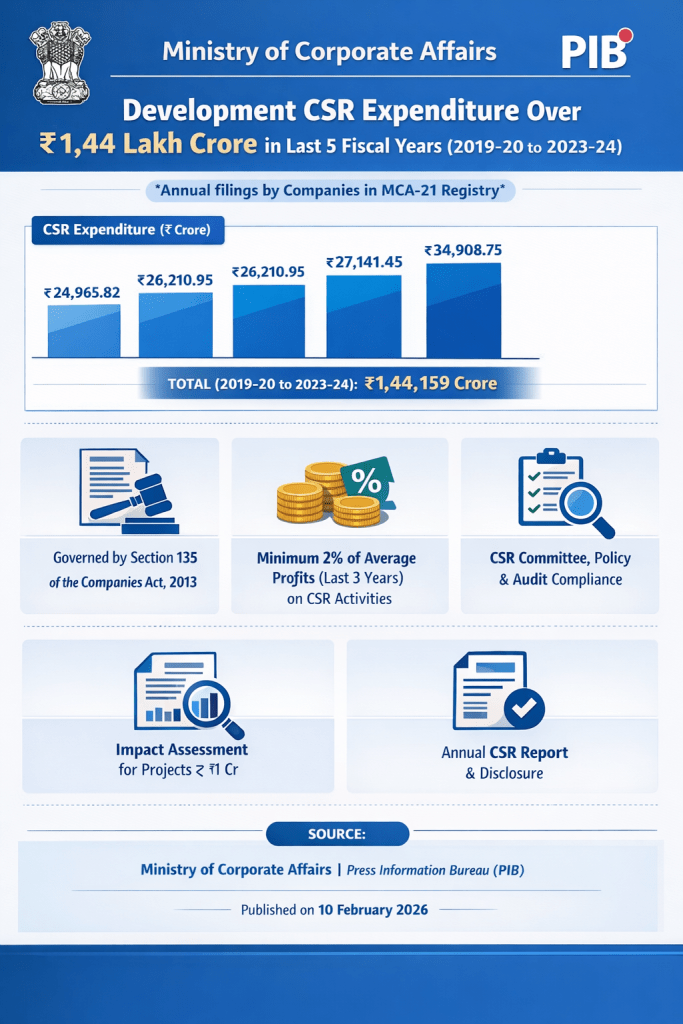
3. Corporate Social Responsibility (CSR) Provisions:

Section 135 of the Companies Act, Schedule VII, and CSR Policy Rules, 2014, provide the legal framework for CSR.

CSR activities must align with the eligible activities listed in Schedule VII.


4. CSR Governance and Monitoring:

CSR is board-driven, with decisions based on the CSR Committee’s recommendations.

Companies must report CSR activities annually in the MCA21 registry.

CSR expenditure details must be included in the Annual Financial Statements.


5. Audit and Compliance:

Auditors are required to report any unspent CSR amounts under CARO, 2020, applicable from FY 2021-22.

Companies must publish their CSR Committee composition, CSR Policy, and approved projects on their websites.


6. Enforcement and Accountability:

Non-compliance with CSR provisions results in regulatory action under the Act.

The legal framework ensures the effective use of CSR funds and maintains corporate transparency.


7. Government Statement:

Minister of State Shri Harsh Malhotra provided this information in a written reply in the Lok Sabha. (11 March 2025)

Gujarat High Court Rules on Deloitte’s Challenge to Income Tax Reassessment Notice

Gujarat High Court Rules on Deloitte’s Challenge to Income Tax Reassessment Notice


Key Highlights:

Petitioner: M/s. Deloitte Haskins & Sells

Issue: Challenge to Section 148 notice under Income Tax Act, 1961

Allegation: Escaped income from foreign entities (Spain & Japan)

Claim: Reassessment initiated without new tangible material

Court’s View: Reassessment cannot be based on a mere “change of opinion”


Gujarat High Court is reviewing whether the Income Tax Department’s actions violated principles of natural justice.

The Gujarat High Court recently addressed a *writ petition filed under Article 226 of the Constitution by “M/s. Deloitte Haskins & Sells,”* a partnership firm practicing as chartered accountants. The firm challenged a notice issued under Section 148 of the Income Tax Act, 1961, seeking its quashing and an injunction against further proceedings by the Income Tax Department. The case centered on alleged escaped income from foreign entities, including payments received from Spain and Japan, and the department’s failure to address the petitioner’s objections before proceeding with reassessment.

*Key Points:*

*1. Challenge to Section 148 Notice:*

The petitioner contested the validity of the notice issued under Section 148, arguing that the reassessment was initiated based on a mere “change of opinion” without any new tangible material. The Gujarat High Court has previously held that reassessment cannot be initiated on a mere change of opinion for material already scrutinized in previous assessments.


*2. Alleged Escaped Income:*

The reassessment pertained to alleged escaped income from foreign entities, including payments received from Spain and Japan. The petitioner maintained that all relevant details were furnished during the original assessment, and no new information had surfaced to justify the reassessment.

*3. Non-Consideration of Objections:*

The petitioner asserted that the Income Tax Department proceeded with the reassessment without addressing the objections raised, violating principles of natural justice. The Gujarat High Court has previously invalidated assessment orders due to violations of procedural requirements under Section 144B, emphasizing the necessity of considering taxpayers’ objections.

*Court’s Decision:*

While the specific outcome of this particular case is not detailed in the available sources, the Gujarat High Court has consistently ruled that:

*Reassessment notices under Section 148 cannot be issued based on a mere change of opinion for material already scrutinized in previous assessments.*

*Procedural lapses, such as failing to consider taxpayers’ objections, can render assessment orders invalid.*


*These precedents suggest that the court may favor the petitioner’s stance if similar circumstances apply.*

Enhancements in Biometric Functionality for Directors (GST updates)


Date: March 3, 2025

The GST Network (GSTN) has introduced a new facility allowing certain Promoters/Directors of businesses to complete their Biometric Authentication at any GST Suvidha Kendra (GSK) in their Home State, instead of only at the jurisdictional GSK.

Who Can Avail This?

Applicable to Promoters/Directors listed in the Promoter/Partner tab for the following businesses:

Public Limited Company

Private Limited Company

Unlimited Company

Foreign Company


Key Highlights:

1. If selected for Biometric Authentication, an intimation email will be sent to the applicant, providing the option to choose a GSK in their Home State.


2. This is a one-time selection and cannot be changed after confirmation.


3. Currently available in 33 States/UTs; will soon extend to Uttar Pradesh, Assam, and Sikkim.


4. Upon selection, a confirmation email with a slot booking link will be sent.


5. The biometric process, including photo capture and authentication, must be completed at the chosen GSK.


6. If Biometric Authentication has already been completed, re-verification is not required.


7. If the Promoter/Director and Primary Authorized Signatory (PAS) are the same person, the home-state option is not available—they must visit the designated jurisdictional GSK instead.


8. This facility is optional; Promoters/Directors may still visit their jurisdictional GSK if preferred.


Taxpayers are advised to follow these guidelines for a smooth GST registration process.

Mandatory HSN codes in GSTR -1/1A from Jan 2025 II GST Advisory 09 Jan 2025

https://youtu.be/Ghbm2EsJJ9c?si=xf-jdBFsQGP9E892

*Jan 9th, 2025*


After successful implementation of Phase-I & Phase-II now :

👉Phase-III regarding Table 12 of GSTR-1 & 1A is being implemented, from return period January 2025.

👉Manual entry of HSN has been replaced by choosing correct HSN from given Drop down.

👉Table-12 has been bifurcated into two tabs namely B2B and B2C, to report these supplies separately.

👉Validation regarding values of the supplies and tax amounts involved in the same, have also been introduced for both the tabs of Table-12.

👉In initial period these validations have been kept in warning mode only, which means failing the validation will not be a blocker for filling of GSTR-1& 1A.

Ministry of Corporate Affairs : Year End Review-2024


Prime Minister Internship Scheme Launched to Provide 1 Crore Internships in Top Companies Over Five Years

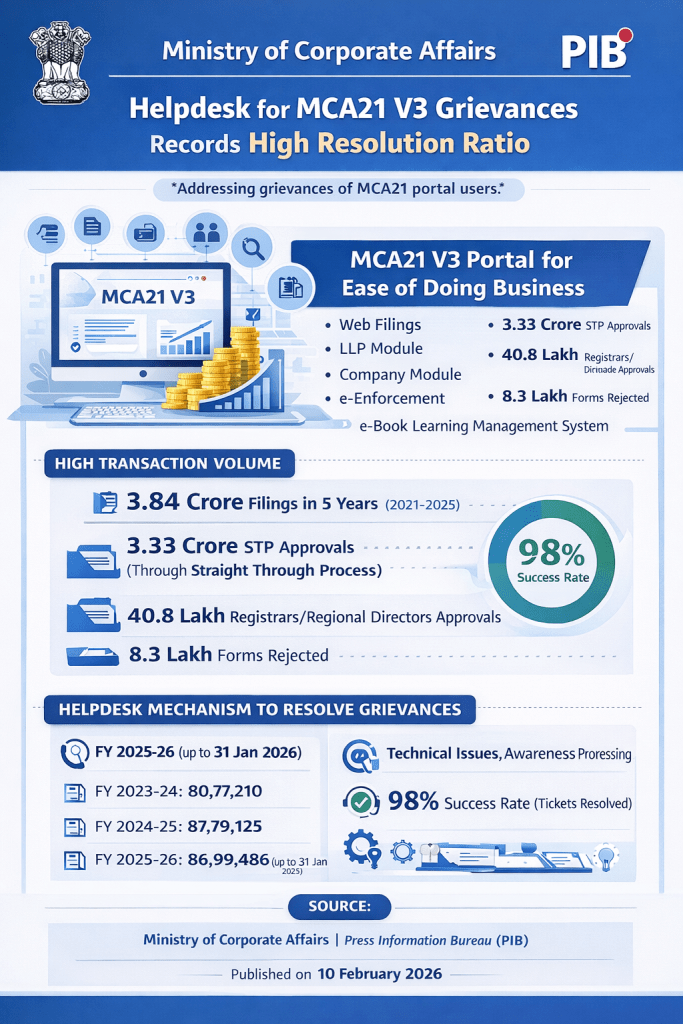
Successful Migration of MCA21 from Version 2 to Version 3 for Streamlined Compliance

Jan Vishwas Initiatives Simplify Share Transmission and Lost Share Certificate Processes, Eliminates Surety Requirements for Duplicate Physical Security Certificates

IEPFA Launches Enhanced Grievance Redressal Mechanism with Multilingual IVRS Facility

Integrated Technology Platform Proposed Under Insolvency and Bankruptcy Code for Better Efficiency

IBC Resolves Rs. 10.22 Lakh Crore Default Cases Pre-Admission with Record Resolution Rates

Competition Commission of India (CCI) Disposes 99% of Combination Cases by September 2024

Central Processing Centre (CPC) Launched for Nationwide E-Form Processing

CPACE Reduces Corporate Exit Processing Time to 90 Days

Amendments Introduced in Indian Accounting Standards (Ind AS 116 and Ind AS 117)

Faceless Adjudication Mechanism Introduced for Decriminalized Corporate Defaults


The major initiatives and achievements of the Ministry of Corporate Affairs during the Year 2024 are as follows:

Prime Minister’s Internship Scheme – Pilot Project

The Prime Minister’s Internship Scheme in Top Companies has been announced in the Budget 2024 aiming to provide internship opportunities to one crore youth in top 500 companies over five years.
Through this Scheme, youth will gain exposure to real-life business environment, across varied professions and employment opportunities.
The interns will be provided with financial assistance of Rs. 5,000 per month, of which Rs. 4500 would be disbursed by the union government, and Rs. 500 per month would be paid by the company from its CSR funds.
Additionally, a one-time grant of Rs. 6,000 for incidentals would be disbursed by Ministry of Corporate Affairs (MCA) to each intern, upon joining the place of internship.
Duration of the internship under the PM Internship Scheme is of 12 months.
A Pilot Project of the Scheme, targeted at providing 1.25 lakh internship opportunities during FY 2024-25, has been launched on 3rd October 2024 through an online portal, accessible at http://www.pminternship.mca.gov.in.
Partner companies have posted approximately 1.27 lakh internship opportunities on the portal.
Approximately 4.87 lakh youths have completed their KYC and registered themselves on the portal.
Approximately 6.21 lakh applications have been received against 1.27 lakh Internship Opportunities. The selection process for internship is ongoing.


Migration of MCA V2 to V3: Enhancing Efficiency and Compliance

IEPFA has successfully migrated forms from MCA 21 Version 2 to Version 3, introducing significant improvement to streamline the compliance process.
The number of compliance forms has been reduced from 5 to 3, simplifying submission requirements for companies.
Additionally, the process of transferring funds has been made fully online, with all company forms now integrated into a Straight Through Process (STP), eliminating the need for manual intervention.
To further facilitate this change, a dedicated dashboard has been implemented for Nodal Officers, allowing them to easily track and file verification reports for claims.


Major Initiative Under Jan Vishwas

(1)-Recognition of Legal Heirship Certificate for Share Transmission

The legal heirship certificate has been officially recognized as a valid instrument for registering the transmission of shares. This important development, applicable to shares transferred to the IEPF by companies under Section 124(6) of the Companies Act, 2013, eliminates the need for a monetary threshold.
This reform significantly reduces the burdens on individuals by removing the requirement to obtain a succession certificate, letter of administration, or probate of a will. As a result, beneficiaries can save both time and costs that were previously associated with civil court procedures. This initiative not only simplifies the transmission process for shares but also enhances accessibility and efficiency for families experiencing complexities of inheritance.


(2)Simplification of Processes for Lost Share Certificates

In a progressive move aimed at claimants, the requirement to file an FIR for the loss of physical share certificates for securities valued up to Rs. 5 lakhs have been eliminated. This change streamlines the process for individuals who may have lost their share certificates, reducing the bureaucratic hurdles they face.


(3)Elimination of Surety Requirements for Duplicate Physical Security Certificates

In a significant reform, the requirement for sureties when applying for duplicate physical security certificates has been eliminated for all values. This crucial change aims to simplify the process for claimants who may need to replace lost or damaged certificates, thus removing unnecessary barriers and enhancing accessibility.


Enhanced Grievance Redressal Mechanism

IEPFA has augmented its grievance redressal mechanism to provide a more effective and user-friendly experience for stakeholders.
The Authority has introduced an intuitive call centre solution equipped with Interactive Voice Response System (IVRS) facilities available in six languages, ensuring accessibility for a diverse audience.
Additionally, the call centre operates through a convenient five-digit short code – 14453, simplifying the process for users to seek assistance and address their concerns. This enhancement reflects IEPFA’s commitment to improving communication and support for claimants, ensuring that their grievances are addressed swiftly and efficiently.


To enhance accessibility, increase interactivesness; bring financial inclusiveness and engagement with stakeholders, IEPFA successfully conducted

Niveshak Sunwai Initiatives in Mumbai and Ahmedabad;
Niveshak Panchayat: Bridging the Gap Between Claimants and IEPFA;
Niveshak Didi: Empowering Women through Financial Literacy;
Niveshak Saarthi: Embracing Financial Inclusivity.


Setting of an Integrated Technology Platform under the IBC:

The Government is considering setting up an Integrated Technology Platform under the Insolvency and Bankruptcy Code, 2016.
It may provide for an integrated case management system for processes under the IBC, automated processes to file applications with the Adjudicating Authority, delivery of notices, enable interaction of Insolvency Professions with stakeholders, storage of records of the corporate debtor, and incentivise effective participation of stakeholders.
The Integrate Technology Platform would lead to better transparency, minimisation of delays, effective decision making and better oversight of the processes by the authorities.


Achievements/performance of the Insolvency and Bankruptcy Code, 2016:

The IBC has introduced a new era of transparency and fairness in insolvency resolutions.
It ensures equitable treatment of all stakeholders, with a clear and predictable resolution process.
Till March 2024, 28,818 applications for initiation of CIRPs, having underlying default of Rs. 10.22 lakh crore were resolved before their admission. This is attributed to the behavioural change in debtor creditor relationship effectuated by the Code.
Till September 2024, 1068 CIRPs have culminated in resolution plans, achieving on average 86.13% of the fair value of the Corporate Debtor (CD). Creditors have realised Rs. 3.55 lakh crore under the said resolution plans.
By June 2024, the IBC successfully navigated 3,409 CDs through the insolvency process, with 1068 achieving resolutions through plans and the remainder through appeals, reviews, settlements, or withdrawals. The resolution of these CDs has led to a realization rate of over 161% against liquidation value. The average expense incurred in the resolution processes is remarkably low, standing at only 1.37% of the liquidation value and 0.83% of the resolution value.


Competition Commission of India (CCI) achievements:

Since its inception, the Competition Commission of India (CCI) has received 1289 antitrust matters (Sections 3 & 4) and has disposed of 1157 (90% approx.) cases till September, 2024.
Further, from January 2024 to September 2024, the Commission received 30 new cases and disposed 30 cases (including carry forward cases from previous year).
The Commission considered and approved mergers and acquisitions relating to various sectors of the economy such as Financial Markets, Power & Power Generation, Pharmaceuticals & Healthcare, and Digital Markets.
Since its inception, the Commission has received 1191 combination matters (Sections 5 & 6) and has disposed of 1179 (99 % approx.). Further, from January 2024 to September 2024, the Commission received 91 new cases and disposed 101 cases (including carry forward cases from previous year). Seventeen (17) letters were issued to the parties out of Two hundred and ninety-one (291) transactions seen in Media scanning.


CCI initiated a Study on “Competition Issues in Renewable Energy Sector across BRICS Nations”.

The study report is being prepared based on inputs received from the competition authorities of BRICS nations.


Increased Compliance and Filing Rates:

Over the past two years, the Ministry has significantly improved compliance with Section 148 of the Companies Act, 2013.
This progress is evident from a substantial increase in the filings of e-Form CRA-2(Intimation of Appointment of Cost Auditor) and e-Form CRA-4 (Filing of Cost Audit Report). Specifically, there has been a 35% increase in e-Form CRA-2 filings and a 36% rise in e-Form CRA-4 filings in the fiscal year 2023-24 compared to2021-22.


Proactive Advisory Initiatives:

From the financial year 2023-24, the Ministry has proactively issued regular advisories to companies, emphasizing the importance of adhering to the prescribed timelines for filing Cost Audit Reports.
This initiative has led to a 14% increase in the timely submission of Cost Audit Reports during 2023-24 compared to the previous year.


Examination of Existing Framework of Cost Audit and its Rules:

To review the existing framework of Cost Records and Cost Audit and to improve the usefulness of the Cost Audit Reports in various sectors of the economy, a Committee was constituted in October, 2023 by MCA.
The Committee’s report has been placed on the website of MCA inviting comments from the stakeholders.
Based on the stakeholders comments, recommendations of the Committee will be examined and framework governing Cost Record and Audit will be amended.


Newly established office i.e., Central Processing Centre (CPC) in the year 2024.

The Central Processing Centre (CPC) was launched in 2024. CPC was established for discharging or carrying out the function of processing and disposal of such e-forms, as may be prescribed under the provisions of the Companies Act, 2013.
The CPC shall also exercise functional jurisdiction of processing and disposal of e-forms and all related matters pertaining to statutory compliances under the Companies Act, 2013 having territorial jurisdiction all over India and any other e-forms as may be notified by the Central Government, filed along with the prescribed fee as provided in the Companies (Registration of Offices and Fees) Rules, 2014″.


Empowering the Regional Directors

Rule 25A of Companies and (Compromises, Arrangements Amalgamations) Rules, 2016 [CAA Rules] has been amended on 9th Sep. 2024 (effective from 17.9.2024) empowering the Regional Directors (RDs) to approve petitions for mergers between a holding company incorporated outside India with a wholly owned subsidiary incorporated in India in a time bound manner, instead of NCLT.
The Ministry has also issued Companies (Listing of Equity Shares in Permissible Jurisdictions) Rules, 2024 on 24th January, 2024 to allow Indian companies to list their equity shares on Gift IFSC International stock exchanges. The “Direct Listing of Equity Shares of Companies Incorporated in India on International Exchanges Scheme” has also been issued by D/o Economic Affairs.


Amendment in Companies (Indian Accounting Standards) Rules, 2015 has been effected to bring changes in Ind AS 116 and introduction of Ind AS 117 as follows:

Ind AS 116: Amendment in Ind AS 116 has been made vide G.S.R. 554(E) dated 09.09.2024, which involves the treatment of leaseback transactions. A new paragraph, 102A, has been added to Ind AS 116, for right-of-use assets and lease liabilities arising from sale and leaseback transactions.
Ind AS 117: Vide the notification no. G.S.R. 492 (E) dated 12th August 2024, the Indian Accounting Standard (Ind AS) 117 has been introduced, in respect of insurance contracts.


Centre established for Processing Accelerated Corporate Exit (CPACE)

Fulfilling budget and announcement (2022-23), a Centre established for Processing Accelerated Corporate Exit (CPACE) for expeditious processing of applications filed for voluntary closure of companies, with an aim of bringing down the number of days taken for such closure from about 2 years to less than 6 months.
Since commencement of C-PACE on 01.05.2021, the average number of days for closure has reduced to about 90 days during the FY 2023-24. It is now centralized and the applications filed for voluntary closure of L.L.Ps are also with C-PACE to ensure their expeditious processing as well.
The CPACE for processing closure applications of LLPs was notified on 05th August, 2024 effective from 27th August, 2024.Since inception on 27th August, 2024 and upto 7th December, 2024, 4640 applications of LLP closure have been disposed of by the CPACE.


Amendments in Companies Act, 2013, and L.L.P Act 2008,

Through gradual amendments in Companies Act, 2013, and L.L.P Act 2008, 63 provisions have been decriminalized bringing defaults under such provisions under in-house adjudication mechanism. At present, Registrar of Companies (RoC) are adjudicating cases of defaults, wherein representatives of corporates have to attend hearings ‘in person’. The adjudication mechanism has been made electronic and faceless to eliminate interactions in person during adjudicatory process at RoC level.
****

NB/AD

Release Id :-2088711