FAQs on GST applicability on ‘pre-packaged and labelled’ goods (Press release 18 July 2022)

The changes relating to GST rate, in pursuance of recommendations made by the GST Council in its 47th meeting, came into effect from today, 18th of July, 2022. One such change is moving from imposition of GST on specified goods when bearing a registered brand or brand in respect of which an actionable claim or enforceable right in a court of law is available to imposition of GST on such goods when “pre-packaged and labelled”.

Certain representations have been received seeking clarification on the scope of this change, particularly in respect of food items like pulses, flour, cereals, etc. (specified items falling under the Chapters 1 to 21 of the Tariff), as has been notified vide notification No. 6/2022-Central Tax (Rate), dated the 13th of July, 2022, and the corresponding notifications for SGST and IGST.

Following are the Frequently asked Questions (FAQ) to clarify certain doubts/queries regarding the GST levy on ‘pre-packaged and labelled’ goods which came into effect from today, 18th of July, 2022:

Question 1 What change has been made with respect to packaged and labelled commodity with effect from the 18th July, 2022?

Clarification

Prior to 18th of July, 2022, GST applied on specified goods when they were put up in a unit container and were bearing a registered brand name or were bearing brand name in respect of which an actionable claim or enforceable right in a court of law is available. With effect from the 18th July 2022, this provision undergoes a change and GST has been made applicable on supply of such “pre-packaged and labelled” commodities attracting the provisions of Legal Metrology Act, as detailed in subsequent questions. For example, items like pulses, cereals like rice, wheat, and flour (aata), etc., earlier attracted GST at the rate of 5% when branded and packed in unit container (as mentioned above). With effect from 18.7.2022, these items would attract GST when “prepackaged and labelled”. Additionally, certain other items such as Curd, Lassi, puffed rice etc. when “prepackaged and labelled” would attract GST at the rate of 5% with effect from the 18th July, 2022.


Essentially, this is a change in modalities of imposition of GST on branded specified goods to “pre-packaged and labelled” specified goods.


[Please refer to notification No. 6/2022-Central Tax (Rate) and corresponding notification under respective SGST Act, IGST Act]

Question 2 What is the scope of ‘pre- packaged and labelled’ for the purpose of GST levy on food items like pulses, cereals, and flours?

For the purposes of GST, the expression ‘pre- packaged and labelled’ means a ‘pre-packaged commodity’ as defined in clause (l) of section 2 of the Legal Metrology Act, 2009, where the package in which the commodity is pre- packed, or a label securely affixed thereto is required to bear the declarations under the provisions of the Legal Metrology Act and the rules made thereunder.

Clause (l) of section 2 of the Legal Metrology Act reads as below:


(l) “pre-packaged commodity” means a commodity which without the purchaser being present is placed in a package of whatever nature, whether sealed or not, so that the product contained therein has a pre- determined quantity.

Thus, supply of such specified commodity having the following two attributes would

attract GST:


(i) It is pre-packaged; and

(ii) It is required to bear the declarations under the provisions of the Legal Metrology Act, 2009 (1 of 2010) and the rules made thereunder.


However, if such specified commodities are supplied in a package that do not require declaration(s)/compliance(s) under the Legal Metrology Act, 2009 (1 of 2010), and the rules made thereunder, the same would not be treated as pre-packaged and labelled for the purposes of GST levy


In the context of food items (such as pulses, cereals like rice, wheat, flour etc), the supply of specified pre-packaged food articles would fall within the purview of the definition of ‘pre-packaged commodity’ under the Legal Metrology Act, 2009, and the rules made thereunder, if such pre-packaged and labelled packages contained a quantity upto 25 kilogram [or 25 litre] in terms of rule 3(a) of Legal Metrology (Packaged Commodities) Rules, 2011, subject to other exclusions provided in the Act and the Rules made thereunder.

Question 3. What is the scope of this coverage taking into account various exclusion(s) provided under the Legal Metrology Act and the rules made thereunder?

For such commodities (food items- pulses, cereals, flour, etc.), rule 3 (a) of Chapter-II of Legal Metrology (Packaged Commodities) Rules, 2011, prescribes that package of commodities containing quantity of more than 25 kg or 25 litre do not require a declaration to be made under rule 6 thereof. Accordingly, GST would apply on such specified goods where the pre-packaged commodity is supplied in packages containing quantity of less than or equal to 25 kilogram.


Illustration: Supply of pre-packed atta meant for retail sale to ultimate consumer of 25 Kg shall be liable to GST. However, supply of such a 30 Kg pack thereof shall be exempt from levy of GST.


Thus, it is clarified that a single package of these items [cereals, pulses, flour etc.] containing a quantity of more than 25 Kg/25 litre would not fall in the category of pre-packaged and labelled commodity for the purposes of GST and would therefore not attract GST.

Question 4. Whether GST would apply to a package that contains multiple retail packages. For example, a package containing 10 retail packs of flour of 10 Kg each?

Clarification

Yes, if several packages intended for retail sale to ultimate consumer, say 10 packages of 10 Kg each, are sold in a larger pack, then GST would apply to such supply. Such package may be sold by a manufacturer through distributor. These individual packs of 10 Kg each are meant for eventual sale to retail consumer.

However, a package of say rice containing 50 Kg (in one individual package) would not be considered a pre-packaged and labelled commodity for the purposes of GST levy, even if rule 24 of Legal Metrology (Packaged Commodities) Rules, 2011, mandates certain declarations to be made on such wholesale package.

Question 5. At what stage would GST apply on such supplies, i.e., whether GST would apply on specified goods sold by manufacturer/producer to wholesale dealer who subsequently sells it to a retailer?

GST would apply whenever a supply of such goods is made by any person, i.e. manufacturer supplying to distributor, or distributor/dealer supplying to retailer, or retailer supplying to individual consumer. Further, the manufacturer/wholesaler/retailer would be entitled to input tax credit on GST charged by his supplier in accordance with the Input Tax Credit provisions in GST.


A supplier availing threshold exemption or composition scheme would be entitled to exemption or composition rate, as the case may be, in usual manner.

Question 6. Whether tax is payable if such goods are purchased in packages of up to 25 kg/25liters by a retailer, but the retailer sells it in loose quantities in his shop for any reason?

GST applies when such goods are sold in pre- packaged and labelled packs. Therefore, GST would apply when prepackaged and labelled package is sold by a distributor/ manufacturer to such retailer. However, if for any reason, retailer supplies the item in loose quantity from such package, such supply by retailer is not a supply of packaged commodity for the purpose of GST levy.

Question 7. Whether tax is payable if such packaged commodities are supplied for consumption by industrial consumers or institutional consumers?

Supply of packaged commodity for consumption by industrial consumer or institutional consumer is excluded from the purview of the Legal Metrology Act by virtue of rule 3 (c) of Chapter-II of Legal Metrology (Packaged Commodities) Rules, 2011. Therefore, if supplied in such manner as to attract exclusion provided under the said rule 3(c),it will not be considered as pre-packaged and labelled for the purposes of GST levy.

Question 8. ‘X’ is a rice miller who sells packages containing 20 kg rice but not making the required declaration under legal metrology Act and the Rules made thereunder (although the said Act and the rules requires him/her to make a declaration), would it still be considered as pre-packaged and labelled and therefore be liable to GST?

Yes, such packages would be considered as pre-packaged and labelled commodity for the purposes of GST as it requires making a declaration under the Legal Metrology (Packaged Commodities) Rules, 2011 (rule 6 thereof). Hence, miller ‘X’ would be required to pay GST on supply of such package(s).

Question 9. Any other relevant issue?


The Legal Metrology Act and the rules made thereunder prescribe criterion(s) for exclusion (as stated above) and provides certain exemptions under rule 26 of Legal Metrology (Packaged Commodities) Rules, 2011. It is reiterated therefore that, if supplied in such manner as to attract exclusion, or such exemption, the item shall not be treated as pre- packaged commodities for the purposes of GST levy.

Tele-Law service is being made free of cost for citizens from this year (Press release 16 July 2022)

Tele-Law service is being made free of cost for citizens from this year- Shri Kiren Rijiju


MoU exchanged between Department of Justice and NALSA on Integrated Delivery of Legal Services

Under the provision of the MoU, NALSA to provide services of 700 lawyers, in each district exclusively for Tele-Law program

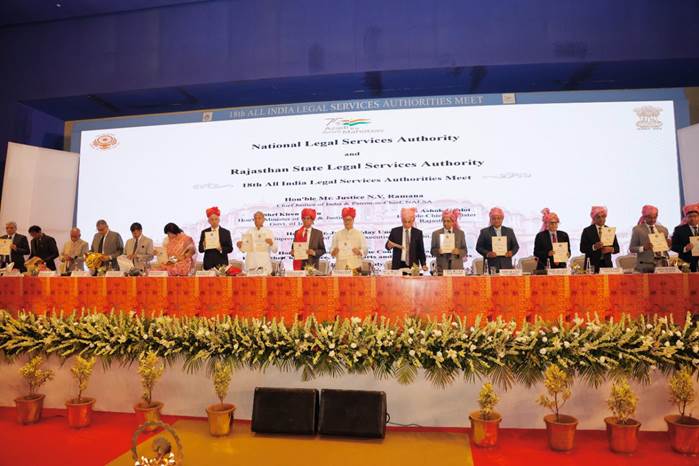
“From this year, Tele-Law service is being made free of cost for citizens in the country,” announced Shri Kiren Rijiju, Minister of Law and Justice at the 18th All India Legal Services Meet at Jaipur today. Tele–Law mainstreams legal aid to the marginalized seeking legal help by connecting them with the Panel Lawyers through the tele/video-conferencing infrastructure available at Common Service Centers (CSCs) across 1 lakh Gram Panchayats. For easy and direct access Tele- Law Mobile Application (both Android and IoS) has also been launched in 2021 and it is presently available in 22 scheduled languages. Benefitting from this digital revolution, Tele-Law has widened the outreach of legal services to 20 Lakh + beneficiaries in just five years.

https://static.pib.gov.in/WriteReadData/userfiles/image/image001J9SQ.jpg

https://static.pib.gov.in/WriteReadData/userfiles/image/image002B563.jpg

During the event, Department of Justice, Ministry of Law & Justice and National Legal Services Authority (NALSA) exchanged Memorandum of Understanding (MoU) on Integrated Delivery of Legal Services. The Union Minister said that the MoU is symbolic of our joint commitment to advance the cause of Justice for All and establish the Rule of Law as the greatest unifying factor among the citizens. Under the provision of the MoU, NALSA would provide the services of 700 lawyers, in each district exclusively for the Tele-Law program. These empanelled lawyers would now also act as referral lawyers and also assist in strengthening the mechanism for dispute avoidance and dispute resolution at the pre-litigation stage. Shri Kiren Rijiju expressed his confidence that the association will help in reaching out to 1 crore beneficiaries in no time.

Addressing the event, Shri Kiren Rijiju, underscored the need of decongestion of jails through release of undertrials. NALSA through its SLSAs and DLSAs is already working in this regard through Under Trial Review Committee (UTRCs) by making available free legal aid/legal counsel to the undertrials. During last year a total of 21,148 meetings of UTRCs were held resulting in release of 31,605 undertrial inmates.

The Minister appealed the State Legal Services Authorities to further intensify their efforts to provide legal counsel/aid to the under-trial prisoners so that in co-ordination with the Under Trial review Committee maximum number of undertrial prisoners are released. He further appealed the High Courts to ensure during this period regular meetings of UTRC headed by the concerned District Judge so that maximum number of undertrial prisoners languishing in our jails are recommended for release before 15th August 2022. He said that the release of undertrial prisoners may be seen in the context that as part of the celebration of “Azadi ka Amrit Mahotsav” Government of India has already decided to grant Special Remission to prisoners for which the guidelines have already been issued by Ministry of Home affairs.


In his concluding remarks, Shri Kiren Rijiju said that access to justice has been recognized as an integral part of our legal framework prescribed under the Constitution of India. And to achieve, realize this vision and build on the work accomplished so far, there needs to be greater collaboration between legal services authorities and various departments and agencies of the government.

Centre amends the Legal Metrology (Packaged Commodities) Rules 2011 for ease of doing business and reducing the compliance burden for the electronic industries

Centre amends the Legal Metrology (Packaged Commodities) Rules 2011 for ease of doing business and reducing the compliance burden for the electronic industries


The amendment to allow the industry to declare the information in the digital form through the QR Code

The Department of Consumer Affairs vide the Legal Metrology (Packaged Commodities), (Second Amendment) Rules 2022 has allowed the electronic products to declare certain mandatory declarations through the QR Code for a period of one year, if not declared in the package itself.

This amendment will allow the industry to declare the elaborated information in the digital form through the QR Code. It will allow important declarations to be declared effectively on the label in the package while the other descriptive information can be conveyed to the Consumer through the QR Code.

The Department to enable greater use of technology in this digital era to declare the mandatory declaration through the QR Code which can be scanned to view the declarations like address of the manufacturer or packer or importer, the common or generic name of the commodity, the size and dimension of the commodity& customer care details except the telephone number & e-mail address.

Earlier, all the prepackaged commodities including the electronic products are required to declare all the mandatory declarations as per the Legal Metrology (Packaged Commodities), Rules 2011 on the package.

Press Release 16th July 2022

Bengaluru ROC Adjudication order for violation of Section 118 of the Companies Act 2013 in the matter of Syscon Instruments Private Limited (Order dated 07 July 2022)

*Bengaluru ROC Adjudication order for violation of Section 118 of the Companies Act 2013 in the matter of Syscon Instruments Private Limited*


https://youtu.be/tKATMWALJ_Q


*Non Compliance:*

All appointments made at any of the meetings shall be included in the minutes of meeting (Section 118(3)) & other sub sections of section 118 of the Companies Act 2013


Download copy

https://acrobat.adobe.com/link/review?uri=urn:aaid:scds:US:8554490d-1372-308b-a900-6782879670f8


Income tax raid on a Pharmaceutical Group in Bengaluru (Press release 13th July 2022)

Income Tax Department carried out search and seizure operations on 06.07.2022 on a major Bengaluru-based pharmaceutical group, engaged in the business of manufacturing and marketing of pharmaceutical products and Active Pharmaceutical Ingredients (API). The group has presence in over 50 countries. The search action covered around 36 premises spread across 9 States.

During the course of the search operations, substantial incriminating evidence, in the form of documents and digital data, has been found and seized. The initial gleaning of the evidence has revealed that the group has been debiting in its books of account unallowable expenses on account of distribution of freebies to the medical professionals under the head “Sales and Promotion”. These freebies included travel expenses, perquisites and gifts etc. to doctors and medical professionals for promoting the group’s products under the heads “Promotion and Propaganda”, “Seminars and Symposiums”, “Medical Advisories” etc. The evidence indicates that the group has adopted unethical practices to promote its products/ brands. The quantum of such freebies detected is estimated to be around Rs. 1000 crore.

The group is also found to have claimed artificially inflated deduction under special provisions in respect of certain incomes, by resorting to suppression of expenses and over-appropriation of revenue to the unit eligible for such deduction.  Various other means of tax evasion, including inadequate allocation of research and development expenses to eligible units and inflated claim of weighted deduction under section 35 (2AB), have also been detected. The quantum of tax sought to be evaded through such means is estimated at over Rs. 300 crore.

Instances of violation of provisions of tax deduction at source under section 194C of the Income-tax Act, 1961 have also been detected in respect of transactions under contracts entered into with the third-party bulk drug manufacturers.

During the search action, unaccounted cash amounting to Rs. 1.20 crore and unaccounted gold and diamond jewellery worth more than Rs. 1.40 crore have also been seized.  

Further investigations are in progress.

Income Tax raid in Delhi and Mumbai based group, engaged in the business of hospitality, marble, lights trading and real estate (Press release 15 July 2022)

Income Tax Department carried out a search and seizure operation on 07.07.2022 on a Delhi and Mumbai based group, engaged in the business of hospitality, marble, lights trading and real estate. A total of 18 premises across Delhi, Mumbai and Daman were covered during the search action.

During the course of the search operation, a large number of incriminating evidences in the form of hard copy documents and digital data have been found and seized. These evidences indicate that the group has parked its undisclosed money abroad in certain low tax jurisdictions. The group, through Malaysia based web of companies, has finally invested the funds in its hospitality business in India. It is estimated that quantum of such funds exceeds Rs. 40 crore.

The evidence gathered indicates that the group has invested in a few companies abroad, which have been incorporated specially for commodity trading. The net worth of one such company including its profits earned has not been disclosed by the group in its ITRs for the relevant period. Further, it has been detected that the promoter of the group has invested in an immovable property in foreign jurisdiction which has also not been disclosed in his Income tax return. Besides these, certain offshore entities, set up for commodity trading, have been identified, which have also not been declared.

The search action also revealed that the group was involved in out-of-books cash sales in its India operations. In its trading business of marble and lights, seized evidences indicate unaccounted cash sales to the extent of 50% to 70% of the total sales. Undisclosed excess stock of Rs. 30 crore has also been found.

In its hospitality business, unaccounted sales have been detected more specifically in banquet division.

So far, undeclared jewellery valued at Rs. 2.5 crore has been seized. Further investigations are in progress.

Simplified regulatory framework for e-commerce exports of jewellery through courier mode (Press release 14 July 2022)

A simplified regulatory framework for e-commerce exports of jewellery through courier mode has been issued on 30.06.2022 by the Central Board of Indirect Taxes and Customs (CBIC) in the form of a Standard Operating Procedure (SOP).

The SOP details the handling, movement and procedural aspects for such exports, based on electronic declarations, through International Courier Terminals.

The framework keeps in view the need for uniformity of action by Customs that brings certainty for the trade. It also addresses a unique requirement of the e-commerce Eco-system for re-import of rejects in certain cases to the prescribed extent.

It may be recalled that the implementation of simplified framework was announced by Union Finance Minister Smt. Nirmala Sitharaman in this year’s Budget speech. Following this, the CBIC held wide-ranging consultations with stakeholders, such as industry associations, members of the trade, e-commerce operators, authorised couriers and the customs field formations, before finalizing the SOP. A period of one month has been provided for transition. The first phase begins with exports through Bengaluru, Delhi and Mumbai locations.

Click CBIC Circular No 09/2022-Customs dated 30.06.2022 to view the SOP and Notification.

Cuttack ROC penalty order for the violation of Section 102 & Co. (Share capital and Debentures) Rules,2014 in the matter of InDNA LifeScience Pvt. Ltd. Dated 08th July 2022

*Cuttack ROC penalty order for the violation of Section 102 & Co. (Share capital and Debentures) Rules,2014 in the matter of InDNA LifeScience Pvt. Ltd. Dated 08th July 2022*

https://youtu.be/XUBNZ_4hkI4

*Nature of Contravention*

Failure to attached explanatory statement in Form MGT-14

*Penalty imposed*

INR 50,000/- each on three directors


*Download copy* 👇

https://acrobat.adobe.com/link/review?uri=urn:aaid:scds:US:94e111f9-7712-3921-a60f-a1d441f13991

DRI unearths Customs duty evasion of Rs. 4389 crore by Oppo India (Press release 13 July 2022)

During an investigation pertaining to M/s Oppo Mobiles India Private Limited (hereinafter referred to as ‘Oppo India’), a subsidiary company of “Guangdong Oppo Mobile Telecommunications Corporation Ltd”, China (hereinafter referred to as ‘Oppo China’), the Directorate of Revenue Intelligence (DRI) has detected Customs duty evasion of around Rs 4,389 crore. Oppo India is engaged in the business of manufacturing, assembling, wholesale trading, distribution of mobile handsets and accessories thereof, across India. Oppo India deals in various brands of mobile phones, including Oppo, OnePlus and Realme.

During the course of investigation, searches were conducted by DRI at the office premises of Oppo India and residences of its key management employees, which led to the recovery of incriminating evidence indicating wilful mis-declaration in the description of certain items imported by Oppo India for use in the manufacture of mobile phones. This mis-declaration resulted in wrongful availment of ineligible duty exemption benefits by Oppo India amounting to Rs 2,981 crore. Among others, senior management employees and domestic suppliers of Oppo India were questioned, who in their voluntary statements accepted the submission of wrongful description before the Customs Authorities at the time of import.

Investigation also revealed that Oppo India had remitted / made provisions for payment of ‘Royalty’ and ‘Licence Fee’ to various multinational companies, including those based in China, in lieu of use of proprietary technology/brand/IPR license etc. The said ‘Royalty’ and ‘Licence Fees’ paid by Oppo India were not being added in the transaction value of the goods imported by them, in violation of Section 14 of the Customs Act, 1962, read with Rule 10 of the Customs Valuation (Determination of Value of Imported Goods) Rules 2007. The alleged duty evasion by M/s Oppo India on this account is Rs. 1,408 crore.

A sum of Rs 450 crore has been voluntarily deposited by Oppo India, as partial differential Customs duty short paid by them.

After completion of the investigation, a Show Cause Notice has been issued to Oppo India demanding Customs duty amounting to Rs. 4,389 crore. The said Notice also proposes relevant penalties on Oppo India, its employees and Oppo China, under the provisions of the Customs Act, 1962.

DGGI Gurugram arrests one person for fraudulently availing ITC and evading GST of Rs 52.04 crore (Press release 13th July 2022)

The Gurugram Zonal Unit (GZU) of Directorate General of GST Intelligence (DGGI), has arrested one person under the provisions of the GST Act on charges of availment of Input Tax Credit on the strength of goods-less invoices.

An intelligence was developed by the officers of DGGI Gurugram Zonal Unit wherein it was gathered that M/s AKS Electrical and Elecronics Ltd. located at S-1 & S-15, Bulandshahar Road, Industrial Area, Ghaziabad, Uttar Pradesh, was engaged in availment & issuance of fake/ bogus ITC without the underlying supply of goods. It was further observed that they had made huge purchases in a particular year from M/s Abhishek Industries against whom an investigation with regard to availment of ineligible ITC from various non-existent entities has already been undertaken by this office.

Based on the verifications, evidences and statements recorded, it appeared that M/s AKS Electrical and Electronics Ltd., Ghaziabad was involved in availment of inadmissible Input Tax Credit on the strength of goods-less invoices received from various including firms M/s Abhishek Industries without actual supply of goods. The quantum of such inadmissible ITC prima facie availed by M/s AKS Electrical and Electronics Ltd. turns out to be of more than Rs 52 crore.

Director of M/s AKS Electrical and Electronics Ltd. was arrested on 06.07.2022 for which a judicial remand of 14 days was granted.