योगः कर्मसु कौशलम् (“yogaḥ karmasu kauśalam“)
“A man engaged in devotional service rids himself of both good and bad reactions even in this life. Therefore strive for yoga, which is the art of all work.”
Simplifying your business ideas, structures, functionalities, relations & operations
योगः कर्मसु कौशलम् (“yogaḥ karmasu kauśalam“)
“A man engaged in devotional service rids himself of both good and bad reactions even in this life. Therefore strive for yoga, which is the art of all work.”
The fourth anniversary of introduction of GST, the GST Day, 2021, was marked by Central Board of Indirect Taxes and Customs (CBIC) and all its field offices across India here today. The national level programme was organised by CBIC through virtual mode on the digital platform which was attended by all field formations. GST with enhanced revenue collections for last eight months has been instrumental in building an Aatma Nirbhar Bharat. The year marked enhanced taxpayer facilitation with COVID-19 relief packages being announced to ease the burden of compliance. As part of the programme 31 officers were awarded with the GST Day commendation certificate across all zones and to one officer posthumously.
In a message on GST Day 2021, Union Minister for Finance & Corporate Affairs Smt. Nirmala Sitharaman said that it is a matter of great satisfaction that we have overcome most challenges, including two waves of unprecedented COVID-19 pandemic, in providing stability to this new tax regime. The Finance Minister was happy to note the buoyant tax collections which crossed Rs. 1 lakh crore for eight months in a row with record GST collection of Rs. 1.41 lakh crore in April, 2021. The enhanced revenue collection in recent months should now be the “new normal, She added.
Smt. Sitharaman appreciated CBIC effort in recognising more than 54,000 GST taxpayers for their contribution to nation building on the eve of four years of implementation of GST. Taxpayers facilitation during pandemic involved two COVID-19 relief packages covering late fee waiver, interest rate reduction, relaxation of timelines and conducting refund drives to enhance liquidity in the hands of taxpayer. Further, GST rates on vaccines, essential medicines and products/services used for prevention and treatment of COVID-19 were also reduced.
The Finance Minister condoled the loss of 189 personnel and remembered their contribution to the national effort and noted the effort of CBIC in releasing a book “Shraddhanjali” to pay homage to these departed souls. Smt. Sitharaman also congratulated all awardees of ‘Commendation Certificate’ for their exceptional contribution in GST administration.
In his message, Minister of State for Finance & Corporate Affairs Shri Shri Anurag Singh Thakur expressed gratitude to trade and industry, specially MSMEs, whose continuous support and feedback has helped the Government in steadily improving GST laws, procedures and systems over last four years. Shri Thakur condoled the loss of many precious lives from the GST family to COVID-19 pandemic. Shri Thakur congratulated all officers selected for commendation certificate for their dedication, hard work and the spirit of serving the nation.
In his virtual message played during the programme, Shri Bibek Debroy, Chairman, Prime Minister Economic Advisory Council, highlighted that GST is a work in progress which is improving by each passing day. GST has cut down on large number of indirect taxes, brought down litigations and removed inter-state restrictions. During the programme, video messages of eminent personalities from various fields were also played.
Chairman CBIC Shri M. Ajit Kumar lauded the efforts of CBIC officers in facilitating taxpayers during the pandemic and use of technology to ensure minimum physical interaction. He appreciated the taxpayers for coming back strong post covid and ensuring V-shaped recovery of economy. CBIC effort in recognising more than 54,000 GST taxpayers for their contribution to nation building is a testimony to the fact that their support to GST is imminent. CBIC Members highlighted the automation done over the years in GST processes and exhorted the officers to enhance the use of technology. Sh. Vivek Johri, Member GST appreciated the DGARM reports and MIS generated which is used by field formations to increase revenue collections.
MoF Press release dated 01st July 2021
The involvement of women as science leaders seems to be increasing. The percentage of women leading research projects has increased by 4 percent over two years, said a recent government report.
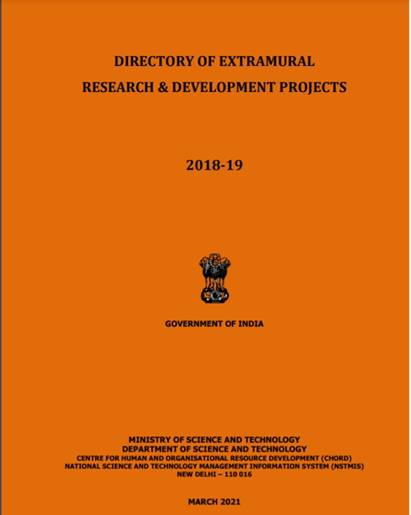
Women Principal Investigators (PIs) participation in research that received Extramural Research (EMR) support (support through peer-reviewed competitive grant mechanism) was 28% during 2018-19, as compared to 24% during 2016-17, according to the Directory of Extramural Research & Development (R&D) Project 2018-19 report released by the government recently.
The report also showed that extramural R&D support or R&D support through peer-reviewed competitive grant mechanisms by the central government was Rs. 2091.04 Crore in 2018-19 as compared to Rs. 2036.32 Crore in 2017-18 — an increase of Rs. 54.72 Crore over the previous year. The number of projects supported has increased, as has the number of PIs. A total of 3839 PIs undertook 4616 projects in comparison to 3491 PIs undertaking 4137 projects during 2017-18.
Of this support, 64% of the projects were received by 8 states, including Tamil Nadu, Delhi, Karnataka, Kerala, Maharashtra, Telangana, Uttar Pradesh, and West Bengal, accounting for 71 % of the share of funding.
The 22 Indian Institute of Technologies (IITs) combined received 822 projects – the maximum number, with highest financial support of Rs. 449.25 Crore, followed by 26 National Institute of Technology (NITs) combined, which received 191 projects with financial support of Rs. 55.83 Crore. The maximum financial support went to Engineering and Technology, while the maximum number of projects went to Biological Sciences.
The Department of Science and Technology (DST) accounted for the maximum Extramural Research (EMR) support of Rs. 1392.21 Crore (67%), followed by the Department of Biotechnology (DBT) with Rs. 341.37 Crore (16%). The two Departments together contributed to 83% of the total extramural R&D funding in India.
The Scientific and Technological (S&T) activities play a vital role in the economic, social, and physical development of a country. Scientific and technological research needs huge investments and calls for judicious utilization of scarce resources like finance, trained manpower, raw materials, and so on. Data collection and analysis pertaining to resources devoted to S&T, therefore, assumes significant importance. The growth of S&T, its performance, and its impact on society and economy are indicators to assess the effectiveness of planning and policy formulation.
Extramural Research and Development (R&D) projects support is a peer-reviewed competitive grant mechanism of the Central Government to promote, catalyze and advance R&D and innovation in the country and provides special encouragement to scientists to pursue a research career. Centre for Human and Organisational Resource Development (CHORD) division, formerly known as the National Science and Technology Management Information System (NSTMIS) division of DST, has been collating, analyzing, and disseminating information on Extramural Research and Development projects funded by various scientific agencies. CHORD has been entrusted with the task of building the information base on a continuous basis on resources devoted to scientific and technological activities for policy planning in the country.
Directory of Extramural R&D projects approved for funding by selected Central Government Departments/Agencies is being published by DST annually since 1990-91. The present directory, twenty-ninth in the series, is an outcome of the efforts made for the projects funded during the year 2018-19 by various scientific agencies of the Government. This directory contains information on 4616 R&D projects approved for funding by 16 scientific agencies/departments during 2018-19.
Detailed Report: https://dst.gov.in/sites/default/files/EM_Directory_2018_19_0.pdf
https://dst.gov.in/sites/default/files/EM_Directory_2017-18_0.pdf
*
Ministry of Science & Technology Press release dated 02 July 2021
Highest ever merchandise exports in a quarter (Q1 2021-22, USD 95 billion) in the history of India
India sets a target of USD 400 billion merchandise exports in 2021-22
Despite COVID-19, labour-intensive sectors (engineering goods, rice, marine products, etc.) saw a rapid export growth
Highest ever FDI inflow of USD 81.72 billion in 2020-21
Number of startups recognised by DPIIT goes up to 50,000, spread across 623 districts
Shri Piyush Goyal said, “the world sees India as the trusted and reliable partner”
Ministry of Commerce & Industry Press release dated 02 July 2021
The Minister of Commerce & Industry, Railways and Consumer Affairs, Food & Public Distribution, Shri Piyush Goyal held a press conference today to showcase the achievements of the Ministry of Commerce and Industry in Q1 (April – June) of 2021-22. He mentioned how an ambitious target of USD 400 billion exports has been set for 2021-22.
Shri Piyush Goyal said that sector specific interventions, involvement of all the stakeholders and functioning of the Government as a whole helped in achieving the growth. Simplification of procedures, extension of timelines and licences, all of that has resulted in the record performance of exports, he added. He specially thanked the Hon’ble Prime Minister Shri Narendra Modi ji for leading from the front, and holding discussions with various stakeholders through webinars after the Union budget, and encouraging everyone to put in their best.
Shri Piyush Goyal further said that the performance of the services sector has also been excellent, and despite the pandemic, almost 97% of 2019-20 service export levels were achieved in the last FY. He said that after deliberations with the stakeholders, he is confident that USD 350 billion service exports can be achieved by 2025, and may even go up to USD 500 billion very soon.
The press conference was also attended by Ministers of State for Commerce & Industry, Shri Som Parkash and Shri Hardeep Singh Puri. The Secretaries of the Department of Commerce and DPIIT then briefed the media about the achievements of their respective departments.
Highest Ever Merchandise Exports in the history of India
Highest ever merchandise exports of USD 95 billion in Q1 of 2021-22 has been achieved in the history of India. This is 85% higher than exports of Q1 of 2020-21 and 18% higher than the exports of Q1 of 2019-20. It is also 16% more than the previous highest Q1 exports of 2018-19 (USD 82 billion) and is higher than the earlier peak of exports in Q4 of 2020-21 (USD 90 billion).
Labour intensive sectors seeing rapid export growth
Several Labour-Intensive sectors have seen a rapid export growth. The exports in the engineering goods sector has increased by USD 5.2 billion over Q1 of 2019-20. Likewise, Rice exports growth has remained positive since May 2020 and rose by 37% in Q1 of 2021-22 compared to Q1 of 2019-20
India’s Exports Performance Vis-a-vis Major Economies in April 2021
India showcased robust export performance in April 2020 compared to major economies of the world. As compared to April 2019, India’s exports growth during April 2021 was higher than other major advanced economies like European Union, Japan, USA, Republic of Korea & United Kingdom
Record FDI Inflows
India received the highest ever FDI inflow in 2020-21 of USD 81.72 billion. This is higher by 10% compared to USD 74.39 billion achieved in 2019-20. The positive momentum continues with FDI inflow of USD 6.24 billion during April 2021, which is 38% higher than April 2020.
Startup India
Number of startups recognised by DPIIT has crossed 50,000 and is spread across 623 districts in India. With these startups nearly 1.8 lakh formal jobs have been created by 16,000+ recognised startups in 2020-21. Several times more have benefited from the Startup ecosystem.
Reducing Compliance Burden
To improve the ease of doing business and reduce the compliance burden 6,426 compliances have been reduced in Phase-I. 3,177 compliances are being been reduced in Phase II. The timeline for Phase I was 31st March 2021 & Phase II is 15th August 2021.
Investment Clearance Cell
The National Single Window System is a one-stop digital platform to obtain clearances & approvals. In the phase-1 of integration, 43 Depts/Ministries & 14 States Single Window Systems are being on-boarded. The pre-launch version is undergoing extensive testing and we are gearing up for a soft launch.
The Hon’ble Minister concluded by saying that the world sees India as the trusted and reliable partner, and has more confidence in India’s capability to provide quality products and services on time. With the goods and services gaining momentum, a large number of employment opportunities will be generated, the economy will strengthen, revenues will increase, and the government will be able to help the disadvantaged sections in a more substantive manner.
***
YB/SS
In a consistent effort to crackdown on prices of essential commodities like pulses, Govt. of India has issued a landmark order imposing stock limits on Pulses applicable to wholesales, retailers, millers and importers
Stock Limits and Movement Restrictions on Specified Foodstuffs (Amendment) Order, 2021 has been issued with immediate effect from today i.e. 2nd July 2021.
Under the visionary leadership of Hon’ble PM Narendra Modi, Govt. of India has formulated a multi-pronged strategy to ensure that the prices of the pulses remain controlled
As a result of above series of consistent actions by Government of India, declining trend in the prices of pulses and oilseeds is being witnessed
Highest ever total production of major pulses amounting to 255.8 LMT in 2020-21 with Gram (126.1 LMT) and Moong Dal (26.4 LMT) particularly breaking all of their past records of production
Targeted size of pulses buffer to be maintained in FY 2021-22 under the Price Stabilisation Fund (PSF) has been raised to 23 LMT
To enable real-time monitoring of price of pulses, a web portal has been developed to keep a check on the undesirable practice of hoarding
To soften the prices of edible oils, a mechanism has been institutionalized to monitor the speedy clearance of food commodities at ports
Changes have been made in import policy by shifting Tur, Urad and Moong from restricted category to free category
Average dwell time for clearances of consignments has come down to 6.9 days from 10 to 11 days in case of pulses and 3.4 days in case of edible oils
In a consistent effort to crackdown on prices of essential commodities like pulses, Government of India has issued a landmark order where it has imposed stock limits on pulses applicable to wholesales, retailers, millers and importers. The Removal of Licensing Requirements, Stock Limits and Movement Restrictions on Specified Foodstuffs (Amendment) Order, 2021 has been issued with immediate effect from today i.e. 2nd July 2021
Under this order, stock limits have been prescribed for all pulses except Moong until 31st October 2021 for all States/UTs. Stock limit will be 200 MT (provided there should not be more than 100 MT of one variety) for wholesalers, 5 MT for retailers and it will be the last 3 months of production or 25% of annual installed capacity, whichever is higher, for the millers. Lastly, for importers, the stock limit will be the same as that of wholesaler for stocks held/imported prior to 15th May 2021 and for stocks imported after 15th May 2021, stock limit applicable on wholesalers will apply after 45 days from date of customs clearance. It has also been stated that if the stocks of entities exceed the prescribed limits, they have to be declared on the online portal (fcainfoweb.nic.in) of Department of Consumer Affairs and have to be brought within the prescribed limit within 30 days of the notification of this order.
As a result of a series of consistent actions taken by the Government of India, a declining trend in the prices of pulses and edible oils is being witnessed. Additionally, in the past 6 years, the highest ever total production of major pulses amounting to 255.8 LMT took place in 2020-21 with Gram (126.1 LMT) and Moong Dal (26.4 LMT) particularly breaking all of their past records of production. Since the entire country has been reeling under the impact of the pandemic, the Government has been committed to adopting timely measures and has substantially alleviated the concerns and anguish of the common man. This development has been received with widespread relief by all the sections of the society.
Taking its vision for an ‘Aatmanirbhar Bharat’ forward, the Government of India has formulated a multi-pronged strategy to ensure that the prices of essential commodities like pulses remain controlled. As a part of the Price Monitoring Scheme under which the central government assists the state/UT governments in setting up price monitoring centres, there has been a 50% increase (57 centres in 2014 to 114 centres in 2020) in the number of such price monitoring centres. Incidentally, within the first three months of 2021 itself, 22 more centres have been added. This step will ensure that the reporting of data on prices from all across the country becomes more representative.
As a part of a large-scale digitisation effort, with a commitment to improve the quality of price data, a mobile app was launched by the government on 1st January 2021 to report on prices on a daily basis from the price monitoring centres while showing an actual market location and a dashboard has been developed to generate analysis of price trends and projections. Also, the services of a marketing agency are being utilised to assess the ground level situation.
A mechanism for retail intervention was introduced in 2020-21 to enhance the immediate impact of released pulses from the buffer to cool down retail prices. Moong, Urad and Tur Dal were offered to the States/UTs for supply through retail outlets such as FPS, Consumer Cooperative Society outlets etc. Costs related to milling/processing, transportation, packaging & service charge of NAFED were borne by the Department itself. Additionally, during October, 2020 and January, 2021, 2 LMT of Tur Dal was disposed of through Open Market Sales to control the prices. Furthermore, pulses have also been supplied for welfare and nutrition programmes at MSP for Tur and at 5% discount on MSP in case of Chana.
More recently, guided by the principle that buffer should be built through increased procurement from farmers during bumper production and released to cool down during periods of volatility, effective interventions in the form of increased procurement and increased buffer stock targets were made for price stabilisation. Targeted size of pulses buffer to be maintained in FY 2021-22 under the Price Stabilisation Fund (PSF) has been raised to 23 LMT and chana buffer has been increased to 10 LMT. Also, under the PSF, procurement of 1 LMT of summer moong at MSP is being undertaken in Madhya Pradesh as the quantity offered by the state for procurement under Price Support Scheme (PSS) exceeded the quantity approved for it. This move will increase the income of the farmers as they will receive remunerative prices for their produce and ensure that they do not reduce their area of cultivation for that crop during next season.
In March-April, there was a sustained increase in the price of pulses. The need for an urgent policy decision was felt to send the right signal to the market. For the first time ever, a mechanism has been adopted to declare the real time stock of pulses all over the country, for keeping a check on the undesirable practice of hoarding, which leads in turn to artificial scarcity and price escalation. In order to enable real-time monitoring of the prices of the pulses and ensure transparency, a web portal has been developed by the government to declare the stocks held by different stockholders. States/UTs were requested by the government on 14th May 2021 to register and declare the pulses stocks of Millers, importers, dealers and stockists under the EC Act, 1955. This step has received a positive response as so far there have been 7001 registrations and stocks worth 28.31 lakh MT have been declared.
Parallely, to enhance the domestic availability and smoothen the inflow of pulses import, changes have been made in import policy by shifting Tur, Urad and Moong from restricted category to free category for the period from 15th May 2021 to 31st October 2021. Additionally, 5-year MoUs have been signed with Myanmar for annual import of 2.5 LMT of Urad and 1 LMT of Tur, with Malawi for annual import of 1 LMT of Tur, and MoU with Mozambique for annual import of 2 LMT Tur has been extended by another 5 years. These MoUs will ensure predictability in the quantity of pulses being produced abroad and exported to India, thus benefiting both India and the pulse exporting country.
Moreover, to soften the prices of edible oils, a mechanism has been institutionalized involving nodal offices of the Customs department, FSSAI, Plant Quarantine division to monitor the speedy clearance of food commodities like Crude Palm Oil (CPO) at shipping ports. Also, to protect the interest of consumers, the duty of CPO has been cut by 5% from 30th June 2021 until 30th September 2021. Pertinently, this reduction is only valid until September as the government is committed to protecting the interest of its farmers as well. This reduction will bring down the effective tax rate on CPO to 30.25% from the earlier 35.75% and will, in turn, bring down the retail prices of edible Oils. Further, the duty on Refined palm oil/Palmolein has been reduced to 37.5% from 45%.
A revised import policy for Refined Bleached Deodorized (RBD) Palm Oil and RBD Palmolein has been put in place from 30th June 2021 under which they have been removed from restricted to free category. To further support streamlined and smooth processes at the ports, particularly to speed up clearances delayed due to COVID-19, Standard Operating Procedure for faster clearance of consignments of imports of pulses and edible oils have been prepared. The average dwell time for clearances of consignments has come down to 6.9 days from 10 to 11 days in case of pulses and 3.4 days in case of edible oils.
Despite the disruption of the supply chain and other economic consequences due to the pandemic, the government has proactively taken all possible steps to ensure easy access and uninterrupted supply of essential commodities to all of its citizens across the nation. It will continue to work in mission-mode to cater to the needs of its people and take its vision of ‘Self-reliant India’ forward by not only focusing on building its domestic capability but by aligning its policies like the National Oilseeds Mission with foreign trade.
Ministry of Consumer Affairs, Food & Public Distribution Press release dated 02 July 2021
The Prime Minister, Shri Narendra Modi has lauded Uttar Pradesh’s efforts to increase investment and improving the ease of doing business in last four years.
Commenting on a tweet by the office of Uttar Pradesh Chief Minister, the Prime Minister underlined the fact that rural areas and small towns are also witnessing these achievements.
उत्तर प्रदेश ने पिछले चार वर्षों के दौरान निवेश बढ़ाने और ‘Ease of Doing Business’ को सुधारने में उल्लेखनीय प्रयास किए हैं। गौर करने वाली बात यह है कि छोटे शहर और ग्रामीण इलाके भी इन उपलब्धियों के साक्षी बन रहे हैं। https://t.co/FR4n7zTuCd— Narendra Modi (@narendramodi) July 2, 2021
****
PMO office
DS/AK
Six technology innovation platforms launched for development of technologies for globally competitive manufacturing in India.
Innovation in high-end technology creates wealth for the country, we must innovate for our needs and lead India towards an ‘AatmaNirbhar Bharat’: Shri Prakash Javadekar
Minister of Heavy Industries and Public Enterprises Shri Prakash Javadekar today inaugurated (through virtual mode) six Technology Innovation Platforms which will focus on development of technologies for the globally competitive manufacturing in India.
Launched 6 technology innovation platforms that will help derive India-specific solutions in the capital goods sector.
Innovation in high-end technology creates wealth for the Country. PM @narendramodi Ji has a vision and mission for enhanced investment in research & innovation. pic.twitter.com/pM9eAHwgtJ— Prakash Javadekar (@PrakashJavdekar) July 2, 2021
Shri Javadekar said that these platforms are the gift to the nation during the celebration of ‘AzadikaAmrutMahotsav-Celebration of 75 Years of Independence’ and will help in bringing all India’s technical resources and the concerned Industry on to one platform to kick start and facilitate identification of technology problems faced by Indian Industry and crowd source solutions for the same.
The Minister further stated that this will facilitate the development of the key ‘mother’ manufacturing technologies’ indigenously through ‘Grand Challenges’ on the Platforms to help achieve the vision of an Aatmanirbhar Bharat and a globally competitive manufacturing sector in India.
A nation that innovates progresses and prospers. The technology innovation platforms launched today will further boost an #AatmaNirbharBharat in technology solutions and will drive India to emerge as a Technology and Innovation Hub of the World. pic.twitter.com/WpVExaHXG9— Prakash Javadekar (@PrakashJavdekar) July 2, 2021
The Six Technology Platforms have been developed by IIT Madras,Central Manufacturing Technology Institute (CMTI), International Centre for Automotive Technology(iCAT), Automotive Research Association of India(ARAI),BHEL and HMT in association with IIScBanglore. These platforms will focus on development of technologies for the globally competitive manufacturing in India.
These platforms will facilitate industry (including OEMs, Tier 1 Tier 2 & Tier 3 companies & Raw Material Manufacturers), start-ups, domain experts/professionals, R&D institutions and academia (colleges & universities), to provide technology solutions, suggestions, expert opinions etc. on issues involving manufacturing technologies. Further, it will facilitate exchange of knowledge with respect to research & development and other technological aspects. Over 39000 Students, Experts, Institutes, Industries and labs have already registered on these platforms.
Following are the links to register on the six Technology Platforms:
Ministry of Heavy Industries & Public Enterprises Press Release dated 02 July 2021
GK
Ministry of Micro,Small & Medium Enterprises issued Press release today 02 July 2021 on inclusion of Retail and Wholesale trades as MSMEs.
Minister of MSME and Road Transport and Highways Shri Nitin Gadkari today announced revised guidelines for MSMEs with inclusion of Retail and Wholesale trades as MSMEs. In a Tweet he said under the leadership of PM Shri Narendra Modi Ji, we are committed to strengthening of MSME and make them engines for economic growth. Shri Gadkari said the revised guidelines will benefit 2.5 Crore Retail and Wholesale Traders. He said Retail and wholesale trade were left out of the ambit of MSME, now under the revised guidelines, retail and wholesale trade will also get benefit of priority sector lending under RBI guidelines.
With the revised guidelines the Retail and wholesale trades will be now be allowed to register on Udyam Registration Portal.
Majority of the members OECD/G20 Inclusive Framework on Base Erosion and Profit Shifting(including India)adoptedyesterday ahigh-level statement containing an outline of a consensus solution to address the tax challenges arising from the digitalisation of the economy.
The proposed solution consists of two components- Pillar One which is about reallocation of additional share of profit to the market jurisdictions and Pillar Two consisting of minimum tax and subject to tax rules.
Some significant issues including share of profit allocation and scope of subject to tax rules, remain open and need to be addressed. Further, the technical details of the proposal will be worked out in the coming months and a consensus agreement is expected by October.
The principles underlying the solution vindicates India’s stand for a greater share of profits for the markets, consideration of demand side factors in profit allocation, the need to seriously address the issue of cross border profit shifting and need for subject to tax rule to stop treaty shopping.
India is in favour of a consensus solution which is simple to implement and simple to comply. At the same time, the solution should result in allocation of meaningful and sustainable revenue to market jurisdictions, particularly for developing and emerging economies. India will continue to be constructively engaged for reaching a consensus based ready to implement solution with Pillar one and Pillar two as a package by October and contribute positively for the advancement of the international tax agenda.
*******
Ministry of Finance Press Release date 02 July 2021
RM/MV/KMN
Minister of Commerce & Industry, Railways and Consumer Affairs, Food & Public Distribution, Shri Piyush Goyal chaired a meeting for the review of 20 large-scale infrastructure projects with issues enlisted for resolution, with the Project Monitoring Group on the 29th of June, 2021. Shri Som Prakash, Minister of State for Commerce and Industry, Secretary, Department for Promotion of Industry and Internal Trade (DPIIT), Chief Secretaries of Governments of Bihar, Haryana and Tamil Nadu, and Additional Chief Secretary, Industries of Government of Maharashtra participated through Video Conference. Senior officials of key Central Ministries including Railways, Petroleum and Natural Gas, Road Transport and Highways, Environment, Forest and Climate Change were also present to discuss issues affecting the progress of work and timely completion of these critical projects.
The Minister of Commerce and Industry reviewed 59 issues in 20 critical infrastructure projects with anticipated investment value of nearly ₹2.7 lakh crores. This includes 11 projects previously reviewed under PRAGATI by the Hon’ble Prime Minister.
Among the projects reviewed, a few notable names are as follows:
Shri Goyal issued directions and timelines to ensure expeditious resolution of pending issues for timely commissioning of projects. The Minister also emphasized the importance of regular multi-level monitoring of infrastructure projects that are critical to the economic growth and employment generation in the country.
*****
Ministry of Commerce & Industry Press Release dated 02 July 2021
YB/SS
 Business So Simple