Please refer YouTube link on News Analysis on above topics:
Author: Business So Simple
Hi, I am business consultant working with a team of Chartered Accountants, Company Secretaries, Lawyers & MBAs.
Companies (Indian Accounting Standards) Amendment Rules 2021 MCA notification dated 18th June 2021
MCA has notified the Companies (Indian Accounting Standards) Amendment Rules, 2021 to further amend the Companies (Indian Accounting Standards) Rules,2015. New amendments will be effective from date of publication in official Gazette.
As per amendment rules following Ind AS has been amended : 1. Ind AS 101 First-time Adoption of Indian Accounting Standards 2. Ind AS 102 Share-based Payment 3.Ind AS 103 Business Combinations 4. Ind AS 104 Insurance Contracts , 5. Ind AS 105 Non-current Assets Held for Sale and Discontinued Operations 6. Ind AS 106 Exploration for and Evaluation of Mineral Resources 7. Ind AS 107 Financial Instruments: Disclosures 8. Ind AS 108 Operating Segments, 9. Ind AS 109 Financial Instruments 10. Ind AS 111 Joint Arrangements 11. Ind AS 114 Regulatory Deferral Accounts 12. Ind AS 115 Revenue from Contracts with Customers 13. Ind AS 116 Leases 14. Ind AS 1 Presentation of Financial Statements 15. Ind AS 8 Accounting Policies, Changes in Accounting Estimates and Errors 16. Ind AS 12 Income Taxes 17. Ind AS 16 Property, Plant and Equipment 18. Ind AS 27 Separate Financial Statements 19. Ind AS 34 Interim Financial Reporting 20. Ind AS 37 Provisions, Contingent Liabilities and Contingent Assets 21. Ind AS 38 Intangible Assets 22. Ind AS 40 Investment Property
Refer copy of MCA notification on https://mca.gov.in/content/mca/global/en/home.html
Finance Ministry refutes news media reports of alleged black money held by Indians in Switzerland, Information sought from Swiss Authorities to verify increase/decrease of deposits
Ministry of Finance issued Press release today (19th June 2021) says that :
Certain reports have appeared in the media on 18.06.2021 stating that funds of Indians in Swiss Banks have risen to over Rs 20,700 crore (CHF 2.55 billion) at the end of 2020 from Rs 6,625 crore (CHF 899 million) at the end of 2019, reversing a 2 year declining trend. It has also been stated that this is also the highest figure of deposits in the last 13 years.
Media reports allude to the fact that the figures reported are official figures reported by banks to Swiss National Bank (SNB) and do not indicate the quantum of much debated alleged black money held by Indians in Switzerland. Further, these statistics do not include the money that Indians, NRIs or others might have in Swiss banks in the names of third–country entities.
However, the customer deposits have actually fallen from the end of 2019. The funds held through fiduciaries has also more than halved from end of 2019. The biggest increase is in “Other amounts due from customers”. These are in form of bonds, securities and various other financial instruments.
It is pertinent to point out that India and Switzerland are signatories to the Multilateral Convention on Mutual Administrative Assistance in Tax Matters (MAAC) and both countries have also signed the Multilateral Competent Authority Agreement (MCAA) pursuant to which, the Automatic Exchange of Information (AEOI) is activated between the two countries for sharing of financial account information annually for calendar year 2018 onwards.
Exchanges of Financial Account information in respect of residents of each country have taken place between both countries in 2019 as well as 2020. In view of the existing legal arrangement for exchange of information of financial accounts (which has a significant deterrent effect on tax evasion through undisclosed assets abroad), there does not appear to be any significant possibility of the increase of deposits in the Swiss banks which is out of undeclared incomes of Indian residents.
Further, the following factors could potentially explain the increase in deposits:
- Increase in the deposits held by Indian companies in Switzerland owing to increased business transactions
- Increase in deposits owing to the business of Swiss Bank branches located in India
- Increase in Inter- bank transactions between Swiss and Indian Banks
- A capital increase for a subsidiary of a Swiss Company in India and
- Increase in the liabilities connected with the outstanding derivative financial instruments
The Swiss Authorities have been requested to provide the relevant facts along with their view on possible reasons for increase/decrease in the light of the media reports highlighted above.
****
RM/MV/KMN
Inclusion of Independent director in databank of Independent Directors after payment of additional fees, in case of delay in applying/renewal (MCA Notification dated 18th June 2021)
MCA has issued notification on 18th June 2021 by Companies (Creation and
Maintenance of databank of Independent Directors) Amendment Rules, 2021 inserting sub rule 8 in Companies (Creation and Maintenance of databank of Independent Directors) Rules, 2019.
As per new sub rule 8,
In case of delay on the part of an individual in applying to the institute under sub-rule (7) for inclusion of his name in the data bank or in case of delay in filing an application for renewal thereof, the institute shall allow such inclusion or renewal, as the case may be, under rule 6 of the Companies (Appointment and Qualification of Directors) Rules, 2014 after charging a further fees of one thousand rupees on account of such delay.”.
Refer rule 3(7) as below
(7) The Indian Institute of Corporate Affairs, shall with the prior approval of the Central Government, fix a reasonable fee to be charged from :-
(a) individuals for inclusion of their names in the data bank of independent directors; and
(b) companies for providing the information on independent directors available on the data bank.
Refer rule 6 of the Companies (Appointment and Qualification of Directors) Rules, 2014
[6. Compliances required by a person eligible and willing to be appointed as an independent director.
(1) Every individual –
(a) who has been appointed as an independent director in a company, on the date of commencement of the Companies (Appointment and Qualification of Directors) Fifth Amendment Rules, 2019, shall within a period of 7[thirteen months] from such commencement; or
(b) who intends to get appointed as an independent director in a company after such commencement, shall before such appointment,
apply online to the institute for inclusion of his name in the data bank for a period of one year or five years or for his life-time, and from time to time take steps as specified in sub-rule (2), till he continues to hold the office of an independent director in any company:
Provided that any individual, including an individual not having DIN, may voluntarily apply to the institute for inclusion of his name in the data bank.
(2) Every individual whose name has been so included in the data bank shall file an application for renewal for a further period of one year or five years or for his life-time, within a period of thirty days from the date of expiry of the period upto which the name of the individual was applied for inclusion in the data bank, failing which, the name of such individual shall stand removed from the data bank of the institute:
Provided that no application for renewal shall be filed by an individual who has paid life-time fees for inclusion of his name in the data bank.
(3) Every independent director shall submit a declaration of compliance of sub-rule (1) and sub-rule (2) to the Board, each time he submits the declaration required under sub-section (7) of section 149 of the Act.
(4) Every individual whose name is so included in the data bank under sub-rule (1) shall pass an online proficiency self-assessment test conducted by the institute within a period of 8[Two years from] the date of inclusion of his name in the data bank, failing which, his name shall stand removed from the databank of the institute:
9[Provided that an individual shall not be required to pass the online proficiency self-assessment test when he has served for a total period of not less than three years as on the date of inclusion of his name in the data bank,-
(A) as a director or key managerial personnel, as on the date of inclusion of his name in the databank, in one or more of the following, namely:-
(a) listed public company; or
(b) unlisted public company having a paid-up share capital of rupees ten crore or more; or
(c) body corporate listed on any recognized stock exchange or in a country which is a member State of the Financial Action Task Force on Money Laundering and the regulator of the securities market in such member State is a member of the International Organization of Securities Commissions; or
(d) bodies corporate incorporated outside India having a paid-up share capital of US$ 2 million or more; or
(e) statutory corporations set up under an Act of Parliament or any State Legislature carrying on commercial activities; or
(B) in the pay scale of Director or above in the Ministry of Corporate Affairs or the Ministry of Finance or Ministry of Commerce and Industry or the Ministry of Heavy Industries and Public Enterprises and having experience in handling the matters relating to corporate laws or securities laws or economic laws; or
(C) in the pay scale of Chief General Manager or above in the Securities and Exchange Board or the Reserve Bank of India or the Insurance Regulatory and Exchange Board or the Reserve Bank of India or the Insurance Regulatory and Development Authority of India or the Pension Fund Regulatory and Development Authority and having experience in handling the matters relating to corporate laws or securities laws or economic laws :
Provided further that for the purpose of calculation of the period of three years referred to in the first proviso,any period during which an individual was acting as a director or as a key managerial personnel in two or more companies or bodies corporate or statutory corporations at the same time shall be counted only once.]
Explanation: For the purposes of this rule,-
(a) the expression “institute” means the ‘Indian Institute of Corporate Affairs at Manesar’ notified under sub-section (1) of section 150 of the Companies Act, 2013 as the institute for the creation and maintenance of data bank of Independent Directors;
(b) an individual who has obtained a score of not less than 10[fiftypercent]. in aggregate in the online proficiency self-assessment test shall be deemed to have passed such test;
(c) there shall be no limit on the number of attempts an individual may take for passing the online proficiency self-assessment test.
Rationalisation of tax provisions for NGOs/NPOs
Rationalisation of tax provisions for NGOs/NPOs
To enjoy tax-exempt status in respect of their income, the NPOs must comply with certain pre-requisites such as obtaining the registration with the tax authorities, and spending on charitable activities at least up to the prescribed thresholds.
Not-for-profit organizations (NPOs) are private entities that pursue activities to promote the interest of the poor, protect the environment, and undertake various social welfare services for the benefit of the public at large.
In India, an NPO can be constituted in the form of a trust, society, or a company. All three forms are widely prevalent in the country. To encourage charitable activities, Indian tax law grants tax exemption to these philanthropic organizations. However, to enjoy tax-exempt status in respect of their income, the NPOs must comply with certain pre-requisites such as obtaining the registration with the tax authorities, and spending on charitable activities at least up to the prescribed thresholds. The activities of these organizations are largely funded by voluntary contributions. The Indian tax law allows the donor to claim the donation made to such exempt entities as an eligible deduction from its income, up to specified limits, irrespective of the tax category of such donor. However, these institutions are required to obtain a separate approval to qualify as ‘eligible donee’ and enable the donor to claim the deduction.
In the past few years, the government has made several changes in the laws governing the NPOs. Recently, some amendments were done in Income-tax Act related to NPOs vide Finance Act 2021.
One of the key changes is to streamline the tax registration and approval process for the NPOs. In the past, different tax officers adopted different yardsticks while granting approval for tax-exempt status. Every application was treated differently because of which NPOs faced some practical challenges.
On the other hand, it was also becoming difficult for the tax authorities to keep a check on the nature of activities undertaken by such entities. Thus, to standardize this process, the government has introduced a new scheme of registration and approval for the NPOs. While these changes were brought in a year ago, due to the ongoing pandemic, the implementation was deferred till 1 April 2021. The new framework not only covers the registration process but also changes the way donors can claim the benefit of tax deduction, which is discussed below.
New scheme of registration and approval for the NPOs-Key Highlights
— All existing as well as new NPOs must obtain registration under the new scheme to be eligible to claim tax exemption going forward. Even approval for ‘eligible donee’ is required to be re-validated as per the new norms. Applications for revalidation by NPO already approved should be made by 30 June 2021.
— Application for registration/ approval must be made online through the income-tax portal.
— Entities making an application for the first time may move an application even before the commencement of the activities. Provisional registration will be given in such cases. Subsequently, this should be converted into normal registration within the prescribed timelines.
— A Unique Registration Number will be allotted for each NPO upon granting of approval. This is in addition to Permanent Account Number (PAN) i.e. unique tax identification number required to be obtained under the domestic tax laws.
Undisposed applications
Applications made under the old scheme and pending for disposal as on 1 April 2021 shall be deemed to be applications made under the new scheme. Such applicants are not required to apply afresh under the new scheme. However, it is pertinent to note that detailed guidelines on how such pending applications will be considered under the new scheme by the tax administration while granting registration/ approval are awaited.
Introduction of validity period
Under the erstwhile provisions, approval once granted was perpetual unless specifically cancelled/surrendered. Now, all registration/approval shall be valid for a defined time.
Provisional registration shall be valid for a period of three years. Once activities are commenced, then such provisional registration needs to be converted into full-fledged approval within six months. In any case, normal registration should be applied at least six months before the expiry of provisional registration.
A normal registration shall be valid for a period of five years (including the period for which an NPO was provisionally registered). Thereafter, NPOs will have to get their registration renewed every five years to continue enjoying the tax benefits.
Disposal of application
Re-validation and provisional registration cases will be granted registration based on documents submitted at the time of making the application. No additional information is likely to be called upon by the tax authorities in such cases. However, all requests for renewals or conversion of provisional to normal registration etc. are likely to be subject to detailed scrutiny.
The department is obligated to dispose off the applications promptly. Further, an application can be rejected only after allowing the applicant to explain the case and recording reasons for such rejection, as applicable.
Incorrect or incomplete applications may lead to rejection of an application. This may happen even in the case of re-validation and provisional registration.
Also, if it is subsequently noticed by the tax authorities that the details submitted, or claims made by the organisations are incorrect, the department may cancel the registration. Such cancellation would be effective from the date of grant of registration/ approval. Hence, the NPOs should exercise caution while furnishing any information and/ or details along with the application and ensure that it is complete and accurate in all respects.
First-time applicant and renewals
At the stage of conversion of provisional into normal registration, tax authorities are likely to examine the nature of activities carried out by NPO in detail. Hence, necessary information/details should be kept ready to substantiate the information submitted in the application.
Also, NPOs are required to apply for renewal every five years. This would facilitate the tax authorities to re-examine the affairs of NPOs and satisfy themselves about the genuineness of the activities carried out by them.
NPOs should ensure their activities are always as per their charitable objectives. This should be supported by robust documentation. Further, adherence to compliances even under other governing laws is also important and may be examined at the time of renewal. The intention is to reduce roving inquiries made into the day-to-day affairs of tax-exempt entities, and instead focus on substantiating the key objectives for the which the NPO has been formed.
Filing a statement of donation
As discussed above, every NPO accepting donations will have to seek separate approval to be considered as ‘eligible donee’. Under the erstwhile mechanism, the NPOs were required to obtain such approval only once and did not have any further reporting obligations in respect of donations received. Going forward, all such entities will have to submit an Annual Statement in respect of donations received during the year with effect from the financial year 2021-22. It is intended to make the details of donations available in the centralized tax records of the taxpayer/donor basis this statement. The objective is to aid the donor in claiming the benefit at the time of filing his tax return. A deduction would be likely be available only for donations appearing in the tax records of donors. It seems that the process flow would be like one for withholding tax. This should help plug loopholes and help genuine donors in claiming the tax benefits. This will be possible through facilitation of one-on-one matching between donations received by exempt entities and donations claimed by the donor.
Key features of annual statement
— Reporting is required in respect of each receipt. Details of donors such as name, address, and the prescribed identification number are required to be reported. Furnishing incomplete details of donors may lead to denial of the tax benefit in the hands of the donor. On the other hand, this could have potential exposure of such donations being treated as “anonymous donation”, which would be taxable at a higher rate in the hands of donee.
— Donations of all kinds i.e. whether received in cash, kind or through cheque/ electronic payments should be reported. It is worth noting that cash donations over `2,000/- and donations in kind are not considered as eligible deduction.
— The annual statement can be rectified to correct mistakes. However, a detailed process for making such rectification is yet to be announced.
— A certificate of donation shall be issued to each donor. This certificate is likely to get generated based on the annual statement filed by the donee. Detailed procedure in respect of a generation of such certificate is yet to be announced.
— Delay in submission of annual statement or issuance of certificate may attract late fee and penalty.
The introduction of new scheme, interlinking of the eligible donation benefit with the annual statement is a welcome move. The changes introduced by the government shall ensure transparency in the functioning of the NPOs and their philanthropic activities to ensure that the intent is met both in law and spirit.
(Sources: Live Mint, https://incometaxindia.gov.in)
For Video refer YouTube Link
Ministry of Corporate affairs eases rules for board meetings conducted through virtual mode
Amid the coronavirus pandemic, MCA amended new rules shifting from physical board meetings to meeting through virtual mode. MCA has amended the Companies (Meetings of Board and its Powers) Rules, 2014, omitting Rule 4 by Companies (Meetings of Board and its Powers) Amendment Rules, 2021 vide MCA Notification dated 15th June 2021.
To curb the difficulties for corporates to conduct Board meetings during an outbreak of the Covid pandemic, MCA had granted relaxation from the above restriction in a phased manner up to June 30, 2021. Now the said restriction is permanently deleted.
Rule 4 of Companies (Meetings of Board and its Powers) Rules, 2014 related to restriction of conducting Board Meeting through Video Conferencing/Other Audio-Visual Means for selected agenda items.
In Rule 4 there are those matters not to be dealt with in a meeting through video conferencing or other audio-visual means-
(i) the approval of the annual financial statements;
(ii ) the approval of the Board’s report;
(iii) the approval of the prospectus;
(iv) the Audit Committee Meetings for consideration of financial statement including consolidated financial statement, if any, to be approved by the Board under sub-section (1) of Section 134 of the Act; and
(v) the approval of the matter relating to amalgamation, merger, demerger, acquisition and takeover.
Due to the COVID pandemic, MCA granted relaxation for conduction meeting through VC till 30th June 2021, which now permanently allows virtual resolutions on matters referred in rule 4. Boards of Directors of the Companies can now approve annual financial statements, Board’s report, Prospectus and matters related to mergers, amalgamations, at meetings held through video conferencing and other audio-visual means. No physical presence of director is required more.
This step would go a long way in ensuring that the hurdles faced by companies are reduced and business can be carried on smoothly with the aid of technology. Permitting audio-visual means for all matters will also enable companies to fulfil compliances promptly and will thereby ease the pressure on stakeholders.
For video, refers YouTube Link https://youtu.be/80Y3bP6t0Rw
Ministry of Micro, Small and Medium Enterprises Extends Validity of Udyog Aadhaar Memorandum from 31st March, 2021 to 31st December, 2021
Ministry of MSME issued Press release on Thursday, 17th June 2021 extending Validity of Udyog Aadhaar Memorandum from 31st March, 2021 to 31st December, 2021
Posted Date:- Jun 17, 2021
Ministry of Micro, Small and Medium Enterprises has issued an amendment to the original notification No. S.O. 2119 (E) dated 26.06.2020 vide 2347(E) dated 16.06.2021, extending the validity of EM Part-II and UAMs from 31.03.2021 to 31.12.2021. This would facilitate the holders of EM Part-II and UAMs to avail benefits of the provisions under various existing schemes and incentives including Priority Sector Lending benefits of MSME.
Considering the hardships faced by MSMEs during the prevailing COVID-19 situation and the representations received from the various MSME associations, financial institutions and Government departments dealing with the interest of MSME Sector, the said amendment has been carried out.
It is expected that existing EM Part-II and UAM holders would be able to migrate to the new system of Udyam Registration, which was launched on 1st July, 2020, and would avail the benefits of Government Schemes, thereby paving the way for strengthening MSMEs and leading to their faster recovery, boost to their economic activity and creation of jobs.
Interested enterprises can register on https://udyamregistration.gov.in free of cost and without any documents. Only PAN and Aadhaar are required for registration on the Udyam portal. So far, this portal has facilitated registration and classification of 33,16,210 enterprises as on 17.06.2021 (5.26.43 PM).
*****
MJPS / RR
Shri Gangwar reiterates commitment to improve employment outcomes for the youth in India, Ministry of Labour and Employment and UNICEF Sign Statement of Intent
Ministry of Labour & Employment has issued Press release today (17 June 2021).

Shri Gangwar reiterates commitment to improve employment outcomes for the youth in India
Ministry of Labour and Employment and UNICEF Sign Statement of IntentPosted Date:- Jun 17, 2021
Union Minister of State for Labour & Employment (Independent Charge) Shri Santosh Gangwar has said that India is committed to improve employment outcomes for all youth in India, including women and vulnerable section of the people, through an enduring, long-term commitment for better opportunities. He said, the Government is making all-out efforts to improve the bridge between education and employment, and to prepare young people for the future of work. A number of policies and schemes have been undertaken for upliftment of the youth through skills development, employment generation, and entrepreneurship programs.
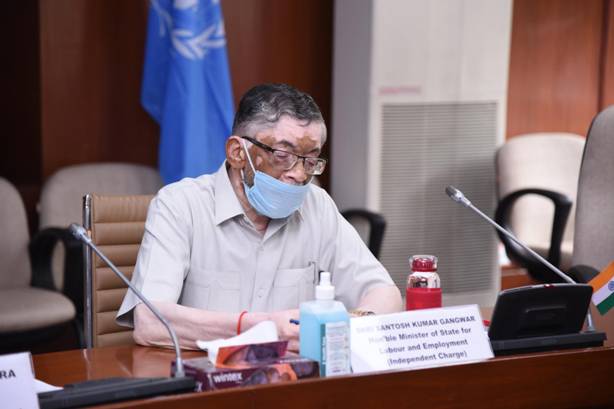
Union Minister of State for Labour & Employment (Independent Charge) Shri Santosh Gangwar addressing the gathering on the occasion of signing of Statement of Intent between the Ministry of Labour and Employment and UNICEF
Speaking after the signing of Statement of Intent between the Ministry of Labour and Employment and UNICEF here today, the minister said, by leveraging the strengths of the Ministry, UNICEF and associated network members, we hope to enable abundant choices for our young generation to contribute and shape our country’s future. Appreciating the idea of partnership between the Ministry and UNICEF for empowering our youths to gain relevant skills and guidance, Shri Gangwar said, the collaboration is a starting point to facilitate direct dialogue and feedback mechanism between youth and other stakeholders including policy makers.
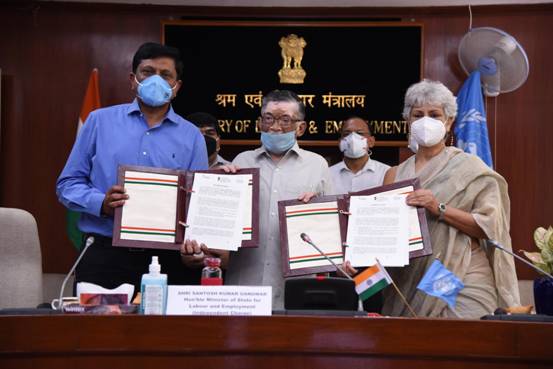
Union Minister of State for Labour & Employment (Independent Charge) Shri Santosh Gangwar, Secretary (Labour & Employment), Shri Apurva Chandra, and Country Representative of UNICEF, Dr Yasmin Ali Haque after signing the Agreement.
Shri Gangwar said, India is a country of young people. According to Census 2011, every fifth person in India is a youth (15-24 years). He said, the National Career Service (NCS), launched in 2015, caters to the employment and career needs of the youth. It provides a variety of employment related services like career counseling, vocational guidance, information on skill development courses, apprenticeship, internships etc.
The Minister informed that NCS has taken a number of initiatives to mitigate the challenges in the labour market due to COVID-19 and the consequent lockdown of the economy. Online Job Fairs are being organized to bridge the gap between job seekers and employers where the complete cycle from job posting to selection of candidate can be completed on the portal. A Special link for Work from Home Jobs and Online Trainings has been created on NCS portal to give direct access to job-seekers to such jobs. All these facilities on NCS are free of cost.
Shri Gangwar expressed hope that in the next three years, both UNICEF and Ministry of Labour & Employment will make great achievement in the areas of collaboration and empowerment of Indian youth to face the future confidently.
Secretary (Labour & Employment), Shri Apurva Chandra, Special Secretary (Labour & Employment) and DGE, Ms Anuradha Prasad, Country Representative of UNICEF, Dr Yasmin Ali Haque, and senior officers from the Ministry and UNICEF India were present on the occasion.
Driven by its mission to deliver results for children, UNICEF has come together with its public and private sector partners to establish the YuWaah, Generation Unlimited (in short GenU) as a partnership in India. GenU is a global multi-stakeholder platform that aims to prepare young people to transition to productive work and active citizenship. In India, by 2030 YuWaah aims to ensure, the following, namely: – (a) Build pathways for 100 million young people to aspirational economic opportunities; (b) Facilitate 200 million young people to gain relevant skills for productive lives and the future of work; and (c) Partner with 300 million young people as changemakers and create spaces for developing their leadership.
The Statement of Intent intends to provide a platform for cooperation between MoLE and UNICEF to leverage the existing mainstreamed initiatives of both parties in select states to co-create and implement solutions at scale to tackle the employment and skilling challenges for adolescents and youth in India, with focus on vulnerable population including young people with special needs, youth leaving care institutions, migrant youth, victims of child labour, violence, child marriage and trafficking and like other matter. Areas of collaboration include: 1. Create linkages with aspirational economic opportunities, that is, connecting young people with employment opportunities, including building pathways to connect them with jobs, self-employment, entrepreneurship, apprenticeships and internships. For this, innovative solutions and technology platforms will be engaged to maximize the scale and reach. 2. Upskilling of young people on 21stcentury skills including life skills, financial skills, digital skills, vocations skills and foundational skills through online and offline channels and support them through self-learning, for their productive lives and the future of work. 3. Strengthening National Career Service (NCS) by forming a coalition of partners to engage on the following areas: (a) Promotion of NCS among job seekers and employers through YuWaah networks. (b)Integration of career guidance sessions or videos, or both by successful entrepreneurs and professionals. (c)Updating Career Information on NCS Portal related to sectors and job roles. (d)Integration of E-learning courses for job readiness of young people. (e)Exploring value additions for Model Career Centers and Employment Exchanges like: D2X (Direct to Employment Exchange) classes on job readiness. (f)Integration with NCS portal for connecting with jobseekers. MoLE may provide the necessary API interfaces to the YuWaah to connect with the job seekers. MoLE may facilitate the necessary integration and exchange of data base of candidates under the various categories of NCS Portal with the Partner Institution (YuWaah). (g)Career Counselling and Vocational Guidance, that is to say that the Network of Career Counsellors and Model Career Centres are integral component of the NCS. Qualified counselors are empaneled with NCS and over 200 Model Career Centres have been established to provide the Career Counselling, Vocational Guidance, Skill Gap Analysis, organizing Job Fairs and like other matters (h)Identifying solutions for assessing jobseekers registered on NCS portal, for better job-matching 4. Support in Job forecasting by exploring the gaps in job forecasting and work towards predicting which sectors or /jobs, or both of the economy are strengthening or weakening to build linkages to focus needs for skilling. 5. Supporting direct dialogue and the establishment of a feedback mechanism between youth and policy stakeholders towards ensuring that schemes and programmes are consistent with young people’s priorities and aspirations (via the online Ureport and youth-led multi-stakeholder consultations).
****
MJPS/MS/jk
Journey of Women Scientists: From Break in Career to become Patent Professionals
Ministry of Science & Technology issued Press Release today (17th June 2021): Journey of Women Scientists- From Break in Career to become Patent Professionals
An inspiring journey of 100 women scientists who returned to science after a break in career has been documented into a book form. The women scientists featured here had to discontinue their pursuit of career in science due to family responsibilities and social reasons. The book, which chronicles their journey to restart their career despite several obstacles, can be a beacon of light for moreIndian women in similar situations.
Knowledge Involvement in Research Advancement through Nurturing (KIRAN) division (now WISE-KIRAN) of the Department of Science & Technology (DST) supports women with break-in careers to return to science through the Women Scientists Scheme (WOS). Through various components of Women Scientists Scheme (WOS), DST addresses challenges confronted by those women who had a break in their career and desire to return to mainstream science. The booklet presents select stories of women who completed their training under WOS-C component of this scheme and are now achieving greater heights in their careers.
Booklet contains 100 success stories of women scientist scheme trainees which captures the lives of women who succeeded despite all odds in life. Booklet is available in both digital and print versions. I know there are many more success stories in the scheme which will be made visible to all in coming years,” said Prof Ashutosh Sharma, Secretary, DST.
Besides the women’s journey, the book includes details like qualification, specialization, present employment status, experience, and information about technical qualification in Intellectual Property Rights (IPR) attained by each woman after completing training.
WOS-C is a flagship scheme of the department and a recipient of Nari Shakti Puraskar, 2015 (Rani Lakshmibai Award) conferred by the Hon’ble President of India.WOS-C is implemented by TIFAC, New Delhi, an autonomous organization under DST. Inthe program, one-year long training is provided to women, having qualifications in science/engineering/medicine or allied areas in the field of IPRs and their management. Selection is through an All-India level online examination followed by an interview. Women between the age ranges of 27 to 45 years can avail the benefit of this scheme. Women are trained in nuances of patent filing and prosecution as well as other patent-related work.
Training has successfully developed a pool of women geared to create, protect and manage Intellectual Property in India. About 800 women have been trained in 11 batches, and about 270 women are registered Patent Agents. Many women have started their own IP firms as well and have become entrepreneurs. The scheme has made the women technically and financially confident, and many women of the middle ages who were earlier sitting at home are now beaming IP professionals.
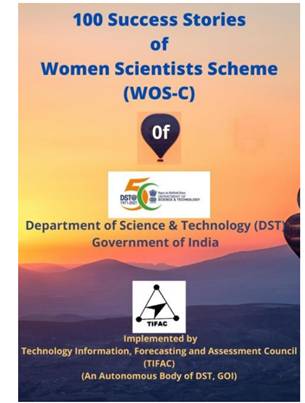
The booklet is available on DST website: https://dst.gov.in
****
SS/RP (DST Media Cell)
Pune based start-up all set to bring non-toxic, gentler, long lasting hand sanitiser to the market
Ministry of Science & Technology issued Press release today (17th June 2021)
An environment friendly hand sanitizer that is gentle on the hands and does not dry them, will soon be available in the market. The alcohol free, aqueous, non-inflammable and non-toxic hand sanitizer has been developed from Silver Nanoparticles by a Pune based start-up.
Recurrent drying up of hands due to repeated application of hand sanitizers is a challenge which people have faced during the COVID 19 pandemic.
The hand sanitizer developed by WeinnovateBiosolutions prolongs antimicrobial activity thus obviating the need for repeated applications.Silver nanoparticles give slow and sustained release of silver ions to kill microorganisms that come in contact. Besides, it can be stored in ambient conditions.
It has successfully completed Central Drugs Standards Control Organisation (CDSCO) approved clinical trial for the hand sanitizer and demonstrated high efficiency in killing viruses.
WeinnovateBiosolutionswas supported by CAWACH 2020 grant of National Science and Technology Entrepreneurship Development Board (NSTEDB) under the Department of Science and Technology (DST) and incubated at Entrepreneurship Development Centre (Venture Centre), Pune. They developed the colloidal silver solution-based hand sanitiser. The technologyoperates on the ability of the silver nanoparticles to prevent the synthesis of viral negative-strand RNA and viral budding.
“We are very confident of the study outcomes and waiting to get the license for our hand sanitiser formulation from CDSCO, India. We are sure that such innovation will push India towards its ‘Atmanirbhar Bharat’ mission and make India a self-sustained nation to face such pandemics in future”, said Dr. Anupama Engineer, Cofounder & COO WeinnovateBiosolutions.
Silver nanoparticles have been found to be an effective antiviral which act against many deadly viruses like HIV, Hepatitis B, Herpes simplex virus, Influenza virus, and so on. Recent reports have suggested the role of Glutathione capped-Ag2S NCs (Silver nanoclusters) in inhibiting the proliferation of Coronavirus by preventing the synthesis of viral negative-strand RNA and viral budding. Thecolloidal silver on which the technology of the sanitizers of WeinnovateBiosolutions is based can help arrest Covid -19 spread by blocking the RNA replication and infectivity by blocking the surface glycoproteins.
A study to evaluate the efficacy of hand sanitiser on different types of viruses is also currently underway by the group.


****
SS/RP (DST Media Cell)
 Business So Simple