IBBI amends Insolvency and Bankruptcy Board of India (Grievance and Complaint Handling Procedure) Regulations, 2017 and the Insolvency and Bankruptcy Board of India (Inspection and Investigation) Regulations, 2017 (MCA updates 15 June 2022)

With a view to put in place, a streamlined and swift complaint handling procedure, the Insolvency and Bankruptcy Board of India notified the Insolvency and Bankruptcy Board of India (Grievance and Complaint Handling Procedure) (Amendment) Regulations, 2022 and the Insolvency and Bankruptcy Board of India (Inspection and Investigation) (Amendment) Regulations, 2022 to amend the Insolvency and Bankruptcy Board of India (Grievance and Complaint Handling Procedure) Regulations, 2017 and the Insolvency and Bankruptcy Board of India (Inspection and Investigation) Regulations, 2017.

The Insolvency and Bankruptcy Code, 2016 (Code) read with Insolvency and Bankruptcy Board of India (Grievance and Complaint Handling Procedure) Regulations, 2017 provide mechanism for redressal of complaints and grievances filed against insolvency professionals, insolvency professional agencies and information utilities. Further the Code read with Insolvency and Bankruptcy Board of India (Inspection and Investigation) Regulations, 2017 provide mechanism for carrying out inspections and investigations on insolvency professional agencies, insolvency professionals and information utilities and passing orders by Disciplinary Committee.

The mechanism of complaint/ grievance redressal and subsequent enforcement action has been amended to have expeditious redressal and also to avoid placing undue burden on the service providers. To curtail such delays and to ensure expeditious and result oriented enforcement mechanism, the Amendment Regulations provides for following:

  • Revisions in various timelines related to enforcement process provided in the (Grievance and Complaint Handling Procedure) Regulations, 2017 and (Inspection and Investigation) Regulations, 2017 for addressing the issue of delay in present mechanism.
  • Effective participation of IPAs in regulating the IPs through examination of grievances received against IPs.
  • Intimation to Committee of Creditor (CoC)/ Adjudicating Authority (AA) about the outcome of Disciplinary Committee (DC) order.

The Amendment Regulations are effective from 14th June, 2022. These are available at www.ibbi.gov.in.

MCA Press Release dated 15th June 2022

Compliance requirements applicable on Small Companies under the Companies Act, 2013

Small Companies defined as a company with a paid-up capital of INR 2 crore or less, and turnover of INR 20 crore or less. Small companies enjoy various advantages over other companies in compliance matters. Let’s see what are the compliance requirements applicable on Small companies:

1. Disclosures by a Director of his Interest:

Section & Rules:  Section 184(1)& Rule 9(1)of Companies(Meetings ofBoard and itsPowers) Rules,2014.

Applicable Form:  Form MBP-1

Particulars:  Every director shall at the first meeting of the Board in which he participates as a director and

thereafter at the first meeting in every financial year or whenever there is any change in the disclosures already made, then at the first Board meeting held after such change, disclose his concern or interest in other entities which shall include the shareholding.

Such notices shall be kept at the registered office and be preserved for a period of eight years from the end of the financial year to which it relates in the custody of the company secretary of the company or any other person authorized by the Board. 

2.  Disqualification of Directors : 

Section & Rules:  Section 164(2) & 143(3)(g) & Rule 14(1) of Companies (Appointment and Qualification of Directors)Rules, 2014

Applicable Form:  Form DIR-8

Particulars:  

No person who is or has been a director of a company which—

(a) has not filed financial statements/ annual returns for any continuous period of 3 financial years; or

(b) has failed to repay the deposits accepted by it or  pay interest thereon or to redeem any debentures on the due date or pay interest due thereon or pay any dividend declared and such failure to pay or redeem continues for one year or more, shall be eligible to be re-appointed as a director of that company or appointed in other company for a period of five years from the date on which the said company fails to do so.

Every director shall inform to the company concerned about his disqualification under subsection (2) of section 164, if any, before he is appointed or re- appointed.  

3.  Annual Return:   

Section & Rules:  Section 92(4) & (1) & Rule 11 (1) of Companies (Management And administration) Rules, 2014

Applicable Form:  E-form MGT- 7A

Particulars:  

Every Company shall file its Annual Return within 60 days of holding of AGM or where no AGM is held in any year within 60 days from the date on which the AGM should have been held together with the statement specifying the reasons for not holding the AGM with such fees as may be prescribed. The Central Government may prescribe abridged form of annual return for small company.

Annual Return of every Small Company shall be signed by the company secretary, or where there is no

company secretary, by the director of the company.

Small Company shall file annual return from the financial year 2020-2021 onwards in Form No.MGT-7A.

4.  Placing of the annual return on website 

Section & Rules:  Section 92(3) & 134(3)(a) & Rule 12(1) of the Companies (Management and Administration) Rules, 2014.

Applicable Form:  E-form MGT- 7A

Particulars:  

Every company is required to place a copy of annual return on its website and the web link where annual return has been placed will be required to be mentioned in the Board’s Report.

Section 92 (3) shall not apply in case of Specified IFSC Private Company – vide Notification No. G.S.R. 9 (E) Dated 4th January, 2017.

5. Financial Statement  

Section & Rules:  Section 137 & Rule 12(1) of Companies (Accounts) Rules, 2014

Applicable Form:  E-form AOC- 4 & E-form AOC- 4 CFS

Particulars:    

Company is required to file its financial statements, including consolidated financial statement along with all the documents required to be or attached to such financial statements, duly adopted at the AGM of the company with the Registrar within 30 days of the date of AGM or in case financial statements are adopted in the adjourned AGM, within 30 days of the date of adjourned AGM.

If annual general meeting is not held for any year, the financial statements along with the documents required to be attached under sub-section (1) of section 137 duly signed along with the statement of facts and reasons for not holding the annual general meeting shall be with the Registrar within 30 days of the last date before which the annual general meeting should have been held.

6. Board’s Report 

Section & Rules:  Section 134 & Rule 8 of the Companies (Accounts) Rules, 2014

Applicable Form:  NA

Particulars:    

Board’s Report shall be prepared mentioning all the information required to be included in it for Small Company under Section 134. It should be signed by the “Chairperson” authorized by the Board, where he is not so authorized by at least two Directors one of whom shall be a managing director or by the director where there is one director.

7. Circulation of Financial Statement & other

Section & Rules:  Section 136

Applicable Form:  NA

Particulars:    

Company shall send to all the members of the Company, all trustees for the debenture holders and to all persons being the persons so entitled, a copy of approved Financial Statements (including consolidated Financial Statements, if any auditor’s report and every other document required by law to be annexed/

attached to the financial statements) at least 21 clear days before the Annual General Meeting.

(Shorter Notice pursuant to section 101(1).

In case of private company which is a small company, Section 101 shall apply, unless otherwise specified in respective sections or the articles of the company provide otherwise.

8.   Notice of AGM

Section & Rules : Section 101 & Rule 18 of the Companies (Management and Administration) Rules, 2014 &

SS- 2

Particulars:     Every Notice of Annual General Meeting shall be prepared as perSection 101 of Companies Act, 2013 and Secretarial Standard – 2.

9.    Sending of Notice of AGM

Section & Rules :  Section 101 & SS – 2

Particulars:     Notice of Annual General Meeting shall be sent to all the Directors, Members, Auditors, legal representative of any deceased member and the assignee of an insolvent member.

10.  Board Meetings

Section & Rules :  Section 173 (5) & SS-1

Particulars:     Every Small Company shall hold at least one (1) meeting of the Board of Directors in each half of a calendar year and the gap between the two meetings shall not be less than 90 days.

11. Notice of Board Meeting

Section & Rules: Section 173 (3) & SS-1

Particulars: A meeting of the Board shall be called by giving not less than 7 days’ notice in writing to every director at his address registered with the company and such notice shall be sent by hand delivery or by post or by electronic means.

However, meeting of the Board may be called at shorter notice to transact urgent business.

12.  Appointment of Auditor

Section & Rules : Section 139(1) & Rule 4(2) of the Companies (Audit and Auditors) Rules, 2014.

Form : E-form ADT-1

Particulars: Auditor shall be appointed for 5 years in the AGM. The company shall inform the auditor concerned of his or its appointment, and also file a notice of such appointment with the Registrar within

15 days of the meeting in

13. Register of Members

Section & Rules : Section 88 & Rule 3 of the Companies (Management and Administration) Rules, 2014.

Form MGT.1 &

Form MGT.2

Company shall keep & maintain the following mandatory Registers:

• Register of Members,

• Register of debenture-holders,

• Register of any other security holders.

Benefits/ Privileges for small companies

1.  Lesser Penalties

 Lesser penalties for Small Companies under Section 446B of the Companies Act, 2013: – If a small company fails to comply with the provisions of section 92(5), section 117(2) or section 137(3), such company and officer in default of such company shall be liable to a penalty which shall not be more than one half of the penalty specified in such sections.  

2. Lesser Fees

Fees for filings and other formalities u/s. 403 of the Companies Act, 2013 is also comparatively lower for the small companies.

3 . No Certification by the Professional on E Forms

The companies are required to file the various E Forms pertaining to filing of Balance Sheets, Annual Returns, and various other event based e forms. If we look from the corporate point of view, the companies shall not be required to get the E Forms being certified from the Practicing Professionals.

 4. Holding of Board Meetings:

A Small Company can hold only 2 Board meetings in a calendar year i.e. one board meeting in each half of the calendar year. However the gap between the two board meetings should not be less than 90 days. So in case of Small Companies, the Board is not required to conduct 4 meetings in a year as it is applicable in case of companies other than small and OPC companies

5. Signing of an Annual Return:

In case of Small Company, the Annual Return can be signed by Company Secretary alone or if there is no CS, by a single Director only.

6. Cash Flow Statements :

 A Small company does not require to maintain a Cash flow statement as a part of its Financial Statements. So while filing of Balance Sheet with Registrar of Companies, companies shall not be required to attach the CASH Flow Statements along with the Financial Statements

7. Abridged Director Report and Annual Return

For small companies, the format of director report is not vast rather an abridged Director Report shall also be sufficient. The format has already been prescribed by the Ministry for abridged Director Reports for Small Companies and One Persons Companies. Matters to be included in Board’s Report mention in Rule -8 of companies (Accounts) Rules, 2014 not apply for small company.

8. Fast Track Merger Process

The merger process between small companies is less cumbersome and less expensive and hence, on a fast track basis as compared to the other one

9. No Auditor Retire By Rotation

Every Private Limited company having a capital more than Rs. 20 crore is required to rotate its auditor after a term of 5 years. But being a small company, having capital less than 20 crore, shall never be required to rotate its auditor according to Section 139(2) of Companies Act 2013. Please Note that Section 139(2) of the Company Act 2013, which mandates the rotation of auditors every 5 years (individual auditors) and every 10 years (firm of auditors).

 10. Need not to have Internal Financial Control Report

A Small Company does not require to report in its Audit Report regarding Internal Financial controls and the operating effectiveness of the company.
No ads promoting online betting, Ministry issues advisory to media

Ministry of Information & Broadcasting issued Press release on 13th June 2022 :

No ads promoting online betting, Ministry issues advisory to media.

Online betting ads on online and social media not to target Indian audience

‘Betting poses significant financial, socio-economic risk for consumers’

Ministry of Information and Broadcasting has today issued an advisory to print, electronic and digital media to refrain from advertising online betting platforms. The advisory comes in light of instances of a number of advertisements of online betting websites/platforms appearing in print, electronic, social and online media.

Betting and gambling, illegal in most parts of the country, pose significant financial and socio-economic risk for the consumers, especially youth and children, the advisory states. It has further added that these advertisements on online betting have the effect of promoting this largely prohibited activity. “The advertisements of online betting are misleading, and do not appear to be in strict conformity with the Consumer Protection Act 2019, Advertising Code under the Cable Television Networks Regulation Act, 1995, and advertisement norms under the Norms of Journalistic Conduct laid down by the Press Council of India under the Press Council Act, 1978”, it has stated.

The advisory has been issued in larger public interest, and it has advised the print and electronic media to refrain from publishing advertisements of online betting platforms. It has also advised the online and social media, including the online advertisement intermediaries and publishers, to not display such advertisements in India or target such advertisements towards the Indian audience.

On 4th December, 2020, the Ministry of Information & Broadcasting had issued an advisory to Private Satellite TV channels to adhere to the Advertising Standards Council of India (ASCI) guidelines on advertisements of online gaming which contained specific Do’s and Dont’s for print and audio-visual advertisements of online gaming.

The detailed advisory can be read at the below link:

Income Tax Department aims to spread tax literacy among children through games, puzzles and comics (MOF updates 12 June 2022)

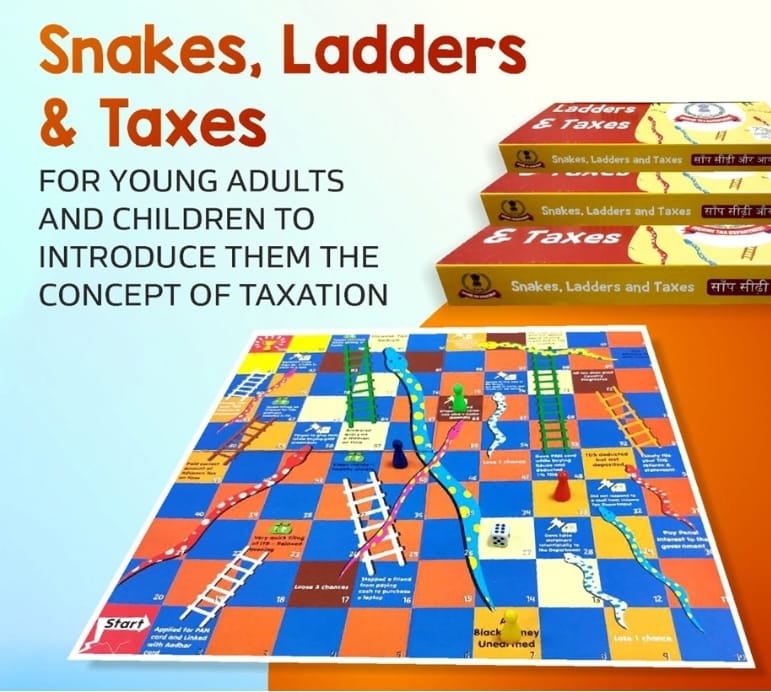
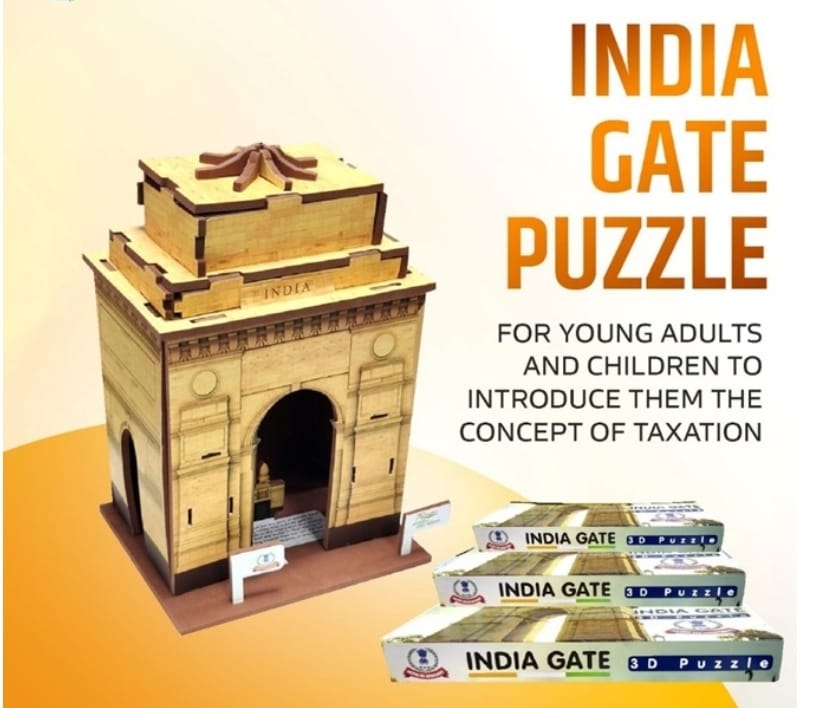
Moving beyond text based literature, awareness seminars and workshops, the Central Board of Direct Taxes (CBDT) has adopted a novel approach to spread tax literacy through ‘learn by play’ methods.  CBDT has brought out products to introduce concepts related to taxation, often perceived to be complicated, to high school students through board Games, puzzles and comics. 

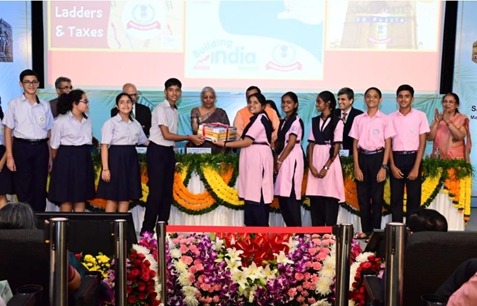
Kick-starting this initiative, Union Finance Minister Nirmala Sitharaman launched a series of communication and outreach products aimed at spreading financial and tax awareness at the Closing Ceremony of the Azadi Ka Amrit Mahotsav Iconic Week in Panaji, Goa on Saturday evening. She termed the next 25 years as Amrit Kaal, and said youth would play a major role in shaping the new India. Smt. Sitharaman also distributed the first sets of the games to select school students present at the event. 

The novel products brought out by the CBDT are as follows : 


Snakes, Ladders and Taxes :  This board game introduces good and bad habits in respect of tax events and financial transactions. The game is simple, intuitive and educational with good habits being rewarded through ladders and bad habits penalized by snakes.

Building India :   This collaborative game introduces the concept of importance of paying taxes through the use of 50 memory cards based on infrastructure and social projects.  The game aims to convey the message that taxation is collaborative in nature and not competitive. 

India Gate – 3D Puzzle :  This game consists of 30 pieces, each containing information about various terms and concepts related to taxation.  The pieces when connected together will build a 3-dimensional structure of India Gate conveying the message that taxes build India. 


Digital Comic Books – Income Tax Department has collaborated with Lot Pot Comics to spread awareness about concepts of income and taxation among children and young adults. The messages are given by the immensely popular cartoon characters of Motu-Patlu, through their bone tickling dialogues. 
 
These products will be initially distributed to schools through the network of Income Tax offices spread across India.  A proposal to distribute these games through bookstores is also being worked out.

***

PIB Mum -001/DVK/CY

Follow us on social media: @PIBMumbai  Image result for facebook icon /PIBMumbai    /pibmumbai  pibmumbai@gmail.comRelease Id :-1833259

Press Release dated 12 June 2022

Evolution of Revolution – Sustainability, Environment-Social-Governance (ESG), Corporate Social Responsibility (CSR) in a new paradigm shift (MCA updates 12 June 2022)

Thousands of industry leaders have witnessed a revolutionary evolution of ESG and CSR at the campus of Indian Institute of Corporate Affairs (IICA), IMT Maneasr. About 30 top companies exhibited their practices in the sphere of sustainability, Environment-Social-Governance (ESG), and Corporate Social Responsibility (CSR).

School of Business Environment (SoBE) in IICA has set the right directions for companies to be more responsible in their approach towards the society, economy and environment. IICA is a think tank under the Ministry of Corporate Affairs working towards strengthening the ESG-CSR ecosystem in the country among its other initiatives.
 

Shri Rao Inderjit Singh, Union Minister of State for Corporate Affairs was the Chief Guest in the event and participated virtually. He said that Ministry’s contribution in promoting Good Corporate Governance has further facilitated ease of doing business in the country. Government lays strong emphasis on the reinforcement of ‘minimal government & maximum governance’, public trust and ease of doing business. The Government has repealed over 25000 compliances and nearly 1500 union laws. The Amrit Kaal will focus on the next phase of Ease of Doing Business (EoDB 2.0) and Ease of Living and the government following the goal of ‘trust-based governance’ to improve the productive efficiency of capital and human resources. He emphasised that Sustainable Development is now recognized as Fundamental Right of the people. The Supreme Court of India has held that sustainable development is to be treated as an integral part of life under article 21 of the Constitution of India. Hence, complying with the principle of sustainable development is a constitutional mandate. He said that as an Individual everyone has a  great responsibility on their Shoulders. Until individual mindset don’t change Massive revolution are difficult in achieving the SDG Goals.

Shri Rajesh Verma, Secretary, Ministry of Corporate Affairs said that Ministry of Corporate Affairs has made remarkable contributions by introducing Corporate Social Responsibility (CSR) mandate under the Companies Act, and the National Voluntary Guidelines on Social, Environmental and Economic Responsibilities of Business and also an updated version of National Guidelines on Responsible Business Conduct (NGRBC). The Securities and Exchange Board of India (SEBI) has mandated Business Responsibility and Sustainability (BRSR) reporting on top 1000 listed companies by market capitalization. The foundation of BRSR is inspired by the Ministry of Corporate Affairs’ Report on Business Responsibility Reporting (BRR) and National Guidelines on Responsible Business Conduct. 

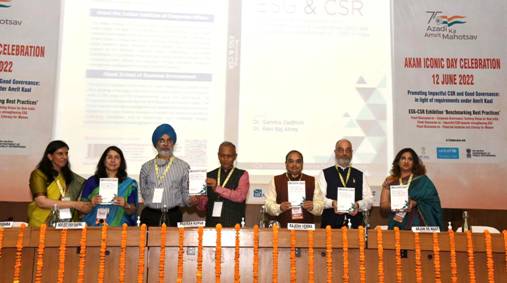
Secretary, Corporate Affairs released a book titled “Benchmarking ESG & CSR” a compilation of the case studies on identified practices on sustainable development projects by companies through their ESG and CSR initiatives. The book was edited by Dr. Garima Dadhich and Dr. Ravi Raj Atrey. An essay competition was also organized by IICA, three winners received awards for their best essays by the Secretary, Corporate Affairs. In a Panel discussion on Corporate Governance, Shri Inderdeep Singh Dhariwal, Joint Secretary MCA Chairing the Technical Session 1 spoke about the youth’s contribution towards the revolutionary change of the Corporate Governance. Sh Manoj Pandey Joint Secretary emphasised on Women’ Financial Literacy during the 2nd Technical Session, while Chairing.

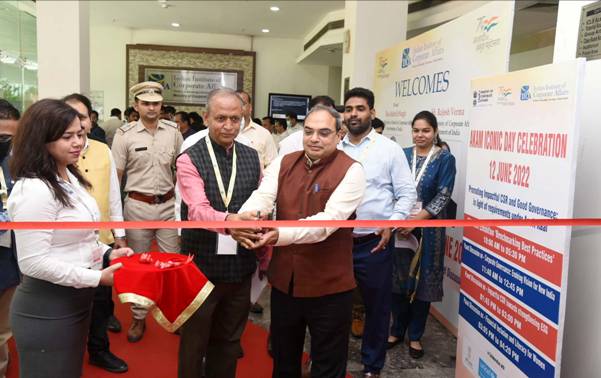
Shri Praveen Kumar, Director General and CEO, IICA in his welcome address said that , It is well-known that economy is the backbone of any nation and one of the key drivers of this backbone is the corporate sector. They have played a significant role in the remarkable Indian Growth story and they would have to continue their exceptional contribution to ensure that the economy keeps attaining greater heights. The Ministry of Corporate Affairs (MCA) provides the enabling framework for corporates in order to make them effective contributors to national development. The IICA is the only institution that has a mandate to strengthen corporate affairs in the country.  30 Exhibitors working on ESG-SDG-CSR exhibited their best practices being carried out by them. The Exhibition was inaugurated by Secretary MCA Sh Rajesh Verma. Around 30 Companies participated and exhibited their Best Practices.

Ms Nandita Mishra and other panellists also expressed their views during the technical Sessions.

During the Inaugural programme  winners of the Essay competition were announced .  Topic of the Essay Competition was “Corporate Governance : Evolving Vision For  New India” . The contest was open for the students and young professionals upto the age of 30 years in Bilingual language i.e. Hindi or in English. Tremendous response for this competition was received in terms of entries. 3rd Prize Mr Sartaj Singh 2nd Prize  Ms Nandini Agarwal and the !st prize to Mr Samyak Sanghvi from Ahmedabad were felicitated with the cash prize and a certificate.

In the Technical session on Impactful CSR towards strengthening ESG, Ms Anita Shah Akella, Joint Secretary, Ministry of Corporate Affairs Chairing the technical session stated that Corporate have been playing a key role by making contributions for the betterment of society through their CSR initiatives. Presently they are witnessing a transitional approach from CSR to ESG in their functioning. A women centric approach, a gender sensitive approach, is required in any initiative, particularly when we talk about the CSR and ESG aspects. Particularly the governance aspects of ESG should focus on Women’s Rights in an organizational setting. Other dignified speakers in the panel were Ms Naina Lal Kidwai, Ms Namita Vikas, Dr Inderjeet Singh, Mr. Shrabjeet Sahota, Dr.Suranjali Tondon, Ms Neetu Ahuja and Dr. Garima Dadhich. The panel concluded that to achieve a paradigm shift in ESG and CSR may be destined through such initiatives of the IICA which motivate those doing good work and inspires others to follow. IICA’s upcoming Certified ESG Professional Course will also be a landmark in this sector in country. I

In another technical session emphases was made on Financial Inclusion and Literacy of Women. Dr. Naveen Sirohi, emphasised on importance of women empowerment and financial literacy. The speakers were Shri Manoj Pandey, Joint Secretary, MCA, Sushmita Phukon, Seema Singh, and Namita Vikas. 

Mr Arjan De Wagt Deputy Representative Unicef India, Smt Nandita Mishra – Economic Adviser MCA, Mr Agrim Kaushal Adviser DPE and Shri Vishram Kumar Meena, Additional Dy Commissioner Gurugram also graced the programme.

The event ‘Promoting Impactful CSR and Good Governance’ was organised in collaboration with NITI Aayog, Department of Public Enterprises and Unicef India in light of requirements under Amrit Kaal. The programme was facilitated by Dr Garima Dadhich, Head of School of Business Environment in support with Dr Lata Suresh Head KRC, Dr Ravi Raj Atrey and Ms Sudha Rajagopalan under the able guidance of Shri Praveen Kumar DG & CEO, IICA.

Our dedicated contributions today will witness a great revolutionary change tomorrow and will have far reaching impacts day after, said Dr. Garima Dadhich and Dr. Ravi Raj Atrey Faculty of School of Business Environment in IICA during an interview describing about the book which was released during  the Inaugural session.

Dr Lata Suresh was the master of ceremony during the event who is also a media coordinator.

Press Release dated 12 June 2022

Amendment in Companies (Appointment and Qualification of Directors) Rules, 2014 (MCA Notification dated 10 June 2022)

In exercise of the powers conferred by section 149 read with section 469 of the Companies Act, 2013 (18 of 2013), the Central Government hereby makes the following rules further to amend the Companies (Appointment and Qualification of Directors) Rules, 2014, namely: –

1. Short title and commencement.- (1) These rules may be called the Companies (Appointment and Qualification of Directors) Second Amendment, Rules, 2022. (2) They shall come into force on the date of their publication in the Official Gazette.

2. In the Companies (Appointment and Qualification of Directors) Rules, 2014, in rule 6, after sub-rule (4), the following sub-rule shall be inserted, namely: –

“(5) Any individual whose name has been removed from the databank under sub-rule (4), may apply for restoration of his name on payment of fees of one thousand rupees and the institute shall allow such restoration subject to the following conditions, namely :-

(i) his name shall be shown in a separate restored category for a period of one year from the date of restoration within which, he shall be required to pass the online proficiency self-assessment test and thereafter his name shall be included in the databank, only, if he passes the said online proficiency self-assessment test and in such case, the fees paid by him at the time of initial registration shall continue to be valid for the period for which the same was initially paid; and

(ii) in case he fails to pass the online proficiency self-assessment test within one year from the date of restoration, his name shall be removed from the data bank and he shall be required to apply afresh under sub-rule (1) for inclusion of his name in the databank.”.

CCPA may charge penalty of Rs 10 lakh and for subsequent contravention, Rs 50 Lakh for violation of misleading advertisements guidelines (Press release 10th June 2022)

Centre issues ‘Guidelines on Prevention of Misleading Advertisements and Endorsements for Misleading Advertisements, 2022’


Guidelines aims at protecting consumers from misleading advertisements and protect the consumers’ right

CCPA may charge penalty of Rs 10 lakh and for subsequent contravention, Rs 50 Lakh for violation

The Central Consumer Protection authority (CCPA) under the Department of Consumer Affairs has notified ‘Guidelines for Prevention of Misleading Advertisements and Endorsements for Misleading Advertisements, 2022’ with an objective to curb misleading advertisements and protect the consumers, who may be exploited or affected by such advertisements.

The guidelines seek to ensure that consumers are not being fooled with unsubstantiated claims, exaggerated promises, misinformation and false claims. Such advertisements violates various rights of consumers such as right to be informed, right to choose and right to be safeguarded against potentially unsafe products and services.

The CCPA has been established under section 10 of the Consumer Protection Act, 2019 for regulating matters relating to violation of the rights of the consumers, unfair trade practices and false or misleading advertisements which are prejudicial to the interests of public and consumers and to promote, protect and enforce the rights of consumers as a class.

In exercise of the powers conferred by section 18 of the Consumer Protection Act, 2019, to CCPA, the Guidelines were notified

Misleading advertisement has already been defined under section 2(28) of the Consumer Protection Act, 2019.

The present guidelines define “bait advertisement”, “surrogate advertisement” and clearly provides what constitutes as “free claim advertisements”.

Keeping in view the sensitiveness and vulnerability of children and severe impact advertisements make on the younger minds, several preemptive provisions have been laid down on advertisements targeting children. Guidelines forbid advertisements from exaggerating the features of product or service in such manner as to lead children to have unrealistic expectations of such product or service and claim any health or nutritional claims or benefits without being adequately and scientifically substantiated by a recognized body.  Guidelines says that advertisement targeting children shall not feature any personalities from the field of sports, music or cinema for products which under any law requires a health warning for such advertisement or cannot be purchased by children.

Disclaimers in advertisements play a pivotal role from consumer perspective since, in a way it limits the responsibility of the company. Therefore, guidelines stipulates that disclaimer shall not attempt to hide material information with respect to any claim made in such advertisement, the omission or absence of which is likely to make the advertisement deceptive or conceal its commercial intent and shall not attempt to correct a misleading claim made in an advertisement. Further, it provides that, a disclaimer shall be in the same language as the claim made in the advertisement and the font used in a disclaimer shall be the same as that used in the claim.

Similarly, clear Guidelines are laid for duties of manufacturer, service provider, advertiser and advertising agency, due diligence to be carried out before endorsing and others. Guidelines aims to protect consumer’s interest through bringing in more transparency and clarity in the way advertisements are being published, so that, consumers are able to make informed decisions based on facts rather than false narratives and exaggerations. 

Penalty for violating the Guidelines are also clearly outlined. CCPA can impose penalty of upto 10 lakh rupees on manufacturers, advertisers and endorsers for any misleading advertisements. For subsequent contraventions, CCPA may impose a penalty of upto 50 lakh rupees. The Authority can prohibit the endorser of a misleading advertisement from making any endorsement for upto 1 year and for subsequent contravention, prohibition can extend upto 3 years.

The Guidelines can be viewed at

Release Id :-1832906