More than 3.82 lakh companies struck off till financial year 2020-21 in Special Drives taken by Registrar of Companies (MCA Press Release 15th March 2022)

Under the Special Drives taken by Registrar of Companies, 3,82,875 number of companies ware struck off u/s 248 (1) of the Companies Act till the financial year 2020-21. This was stated by Union Minister of State for Corporate Affairs Shri Rao Inderjit Singh in a written reply to a question in Rajya Sabha today.

Explaining further, the Minister stated that there is no definition of the term “Shell Company” in the Companies Act, 2013 (the Act). It normally refers to a company without active business operation or significant assets, which in some cases are used for illegal purpose such as tax evasion, money laundering, obscuring ownership, benami properties etc. The Special Task Force set up by the Government to look into the issue of “Shell Companies” has, inter-alia, recommended the use of certain red flag indicators as alerts for identification of suspected Shell Companies.

The Minister stated that the Government has undertaken Special Drives for identification and strike off Companies by invoking the provisions of section 248 (1) of the Companies Act.

Giving more details, the Minister stated that the Registrar of Companies (RoC) struck off those companies after following the due process of law from the Register of companies when RoC has reasonable cause to believe that those companies are not carrying on any business or operation for a period of two, immediately preceding financial years. The RoC also verifies that such company has not made any application within such period for obtaining the status of a dormant company under Section 455 of the Act.
FSSAI ACTION AGAINST COMPANIES SELLING ADULTERATED FOOD ITEMS (Press release 15th March 2022)

Section 38, Sub-Section (3) of Food Safety and Standards Act, 2006 provides that where any sample is taken, its cost calculated at the rate at which the article is usually sold to the public shall be paid to the person from whom it is taken. Accordingly, Food Safety Officers while lifting food samples for enforcement and surveillance activities actually purchase it from the Food Business Operators engaged in any food related activities i.e. manufacturing, wholesaling, retailing etc.

The results of enforcement action carried out in a particular financial year are reflected in the Annual Report of FSSAI which is placed in public domain i.e on the website of FSSAI for general information of the public after it is laid in the both Houses of Parliament.

Implementation & enforcement of provisions of Food Safety and Standards Act, 2006 primarily lies with States/UTs Governments. Regular surveillance, monitoring, inspection and sampling of food articles including honey is carried out by food safety officials of States/UTs and where the samples are found non-conforming action is initiated under penal provisions of the Food Safety and Standards Act. Action for misleading advertisements/claims is also taken under the penal provisions of the FSS Act. 

The Union Minister of State for Health and Family Welfare, Dr. Bharati Pravin Pawar stated this in a written reply in the Rajya Sabha today.

DATA OF REGISTERED Farmer Producer Organizations(FPOs) (Press release 15th March 2022)

The State wise details of Farmer Producer Organizations(FPOs) registered through various agencies including those under the Central Sector Scheme(CSS) for Formation and Promotion of 10,000 FPOs are at Annexure – I. Further under the new FPO scheme, 421 FPOs have been registered by different Implementing Agencies(IAs) in Aspirational Districts as on 09.03.2022. The details are at Annexure-II.

Under the said Central Sector Scheme (CSS), an amount of Rs. 14.05 Crores has been transferred to 352 FPOs towards matching equity grant. The state-wise details are enclosed at Annexure – III. Furthermore, the FPO Management Cost is also disbursed by the Department to the concerned Implementing Agencies for onward transferring to the respective FPOs. So far, a total of Rs. 108.82 Crores has been released as FPO Management Cost under 10,000 FPOs scheme.

As per operational guidelines of the aforesaid Central Sector Schemes (CSS), women farmers’ participation as shareholders of FPOs is preferred and in the Board of Directors (BoD) and Governing Body (GB), as the case may be, there shall be adequate representation of women farmer member(s) and there should be minimum one woman member.

So far, 225 women FPOs have been promoted by different Implementing Agencies as on 09.03.2022.

Refer list

DATA OF REGISTERED FPOs

https://pib.gov.in/PressReleaseIframePage.aspx?PRID=1806232&RegID=3&LID=1

People will get land records in their own language soon

People will get land records in their own language soon, says Shri Giriraj Singh


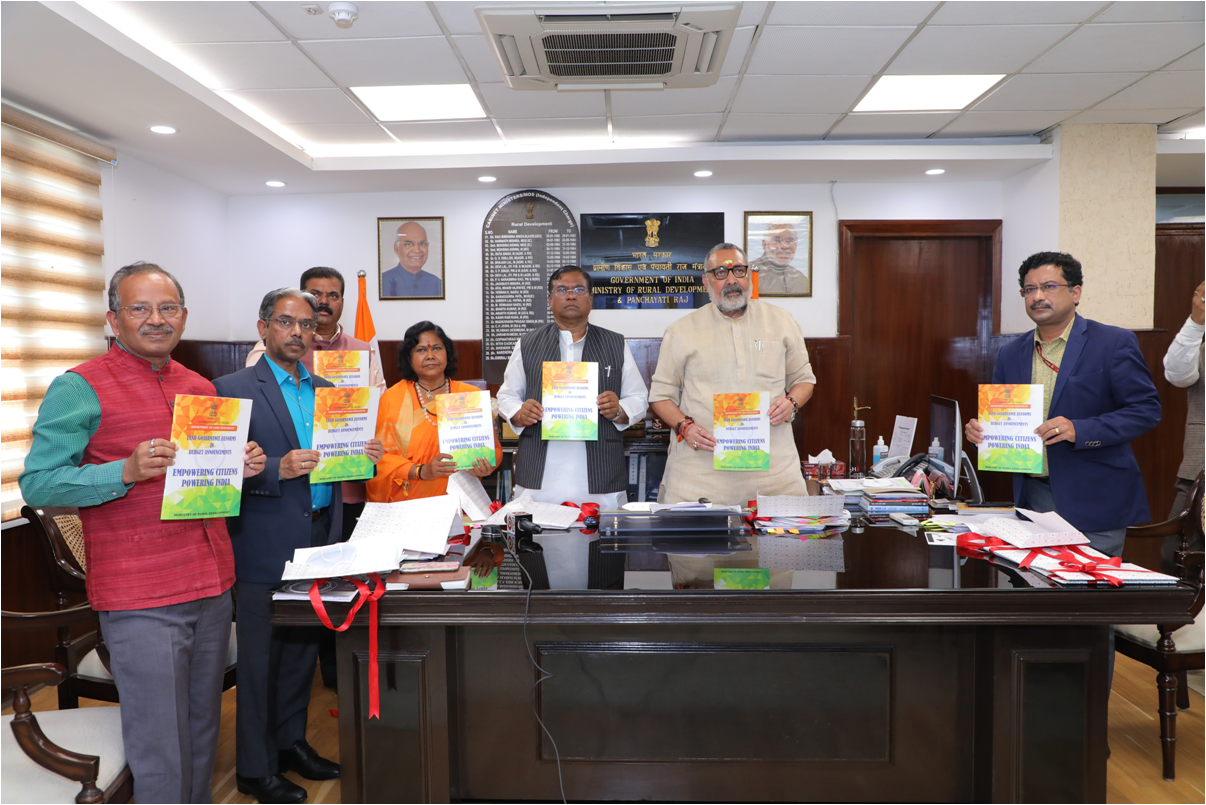
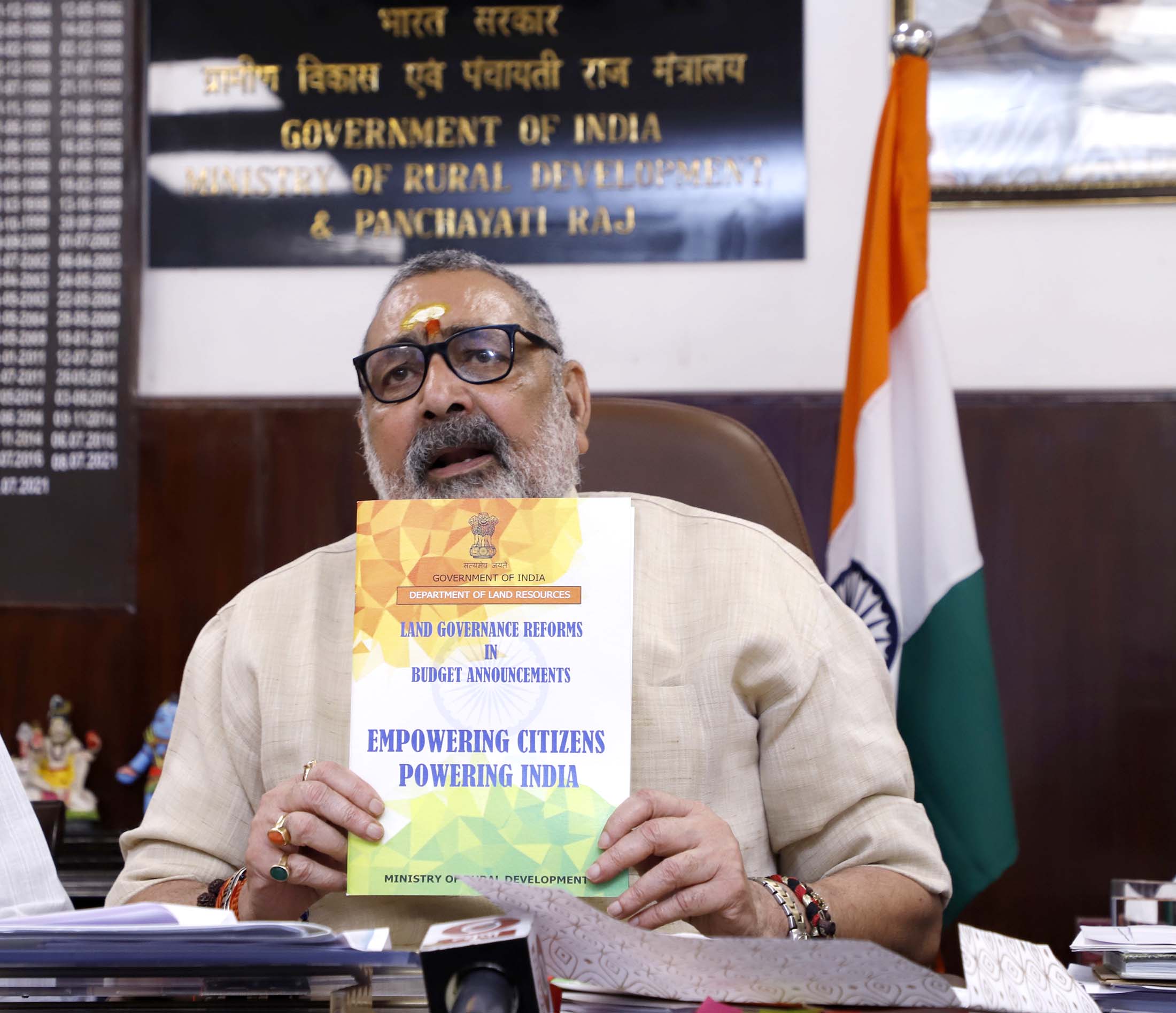
Union Minister Shri Giriraj Singh releases e-book on Land Governance Reforms announced in Budget

State Governments got a significant increase in the land revenue through the use of NGDRS software: Shri Giriraj Singh

Press Release posted Date:- Mar 14, 2022

Union Minister for Rural Development and Panchayati Raj Shri Giriraj Singh announced that soon, people in the country will be able to get their land records in their own language. He said that the Department of Land Resources, MoRD will plan to roll out the multilingual software from April 2022. After that, the land records will be available in 22 languages. The Minister was speaking after releasing an e-book on  Land Governance Reforms announced in Budget titled “Empowering Citizens-Powering India.”

Speaking on the NGDRS software developed indigenously, Shri Giriraj Singh said that the NGDRS software costs around 4 crores to the government but the use of this software resulted in increasing land revenue by the State Governments. The Minister said that State NGDRS is being implemented in 13 States which will be benefitted to 22 crore people. Till now, 30.9 lakh documents registered through the system from which revenue of more than 16 thousand crores has been received.

The Minister said that after the rollout of ULPIN (Unique Land Parcel  Identification Number) in the country, No one can take away the rights of the poor. Linking ULPIN with PAN, Aadhar, land records, Courts and banking system, will get rid of corruption and fraud in land matters. So far, ULPIN is rolled out in 14 States. The Minister also requested State Governments to spread awareness about the land reforms amongst people.

The contents of the e-book are related to Unique Land Parcel Identification Number (ULPIN), National Generic Document Registration System (NGDRS) and Multilingual Land Records – to break the linguistic barrier in land records. There has been tangible transparency in land records information and management after the adoption of digital technology by the Department of Land Resources. A Unique Land Identification Number (ULPIN) to each land parcel is being assigned to land Parcels to prevent fraudulent and Benami property transactions. Further Digitization of Land Records will empower citizens and India for Atmanirbhar Bharat- the vision of Prime Minister. Moreover, the updated land records will reduce the time for payment of compensation and provide rehabilitation and resettlement benefit for land acquisition considerably. The Multilingual Land Records will facilitate access of information for the prospective individuals in his regional and mother languages.

Union Minister of State for Steel and Rural Development, Shri Faggan Singh Kulaste, Minister of State for Rural Development Sadhvi Niranjan Jyoti, Minister of State for Panchayati Raj, Shri Kapil Moreshwar Patil, Secretary, Department of Land Resources Shri Ajay Tirkey and Secretary, Department of Rural Development Shri Nagendra Nath Sinha, Shri Sonmoni Borah, Joint Secretary, DoLR were also present on the occasion.

Global Entrepreneurship Monitor (GEM) (Press release 14th March 2022)

The Global Pandemic is once in a life-time disruption that has created serious adverse impacts on lives and livelihood in economies all around the world. Almost every major economy in the world was impacted and each country including India had to bear the cost of economic contractions, livelihood loss and increased healthcare expenditure. However, India has responded with great resilience and has emerged as one of the fastest rebounding economies in the World. As per the Economic Survey 2021-22, Covid-19 pandemic has had an adverse impact on most sectors of the economy. Government of India responded with a series of calibrated measures aimed at protecting the lives and livelihoods of most vulnerable and small businesses like the Micro, Small and Medium Enterprise (MSME) segment. India has become third largest start-up ecosystem in the world after US and China with over 60,000 start-ups. India created 42 Unicorn in the year 2021 alone.

The Global Entrepreneurship Monitor (GEM) is an international project which seeks to provide information on the entrepreneurial landscape of countries. GEM carries out survey-based research on entrepreneurship and entrepreneurship ecosystems around the world and is being led by Entrepreneurship Development Institute of India, Ahmedabad.

As per Global Entrepreneurship Monitor (GEM) India Report (21-22), India’s entrepreneurial activity expanded in 2021, with its Total Entrepreneurial Activity rate(percentage of adults (aged 18–64) who are starting or running a new business) increased to 14.4% in 2021, up from 5.3% in 2020.

Further, Established Business Ownership rate (percentage of adults (aged 18–64) who are currently the owner-manager of an established business, i.e. owning and managing a business that has paid salaries, wages or any other payments to the owners, for more than 42 months)increased to 8.5%, from 5.9% in 2020. Boom in early-stage entrepreneurial activity for India in 2021 may be due to the pent-up demand and subsequent opportunities generated by the reduction in COVID-19 risk that damaged the Indian economy in 2020.

Ministry of Skill Development and Entrepreneurship (MSDE) is implementing various programmes to encourage entrepreneurship in the country as mentioned below:-

  1. Pilot project, ‘Economic Empowerment of Women Entrepreneurs and Startups by Women (WEE)’ is being implemented in collaboration with Deutsche Gesellschaftfür Internationale Zusammenarbeit (GIZ) Germany to pilot incubation and acceleration programmes for women micro entrepreneurs, enabling them to start new businesses and scale up existing enterprises in Maharashtra and other States, viz.Rajasthan, Telangana, Uttar Pradesh and North Eastern region of the country.
  2. Pilot Project on Entrepreneurship Development (PM YUVA) has been launched in November, 2019 for creating an enabling ecosystem through entrepreneurship education, training, advocacy and easy access to entrepreneurship network, for students and alumni of skill training institutes viz. Industrial Training Institutes (ITIs), Polytechnics, Pradhan Mantri Kaushal Kendra (PMKK) and Jan Shikshan Sansthan (JSS). The scheme covers 10 States including Maharashtra and 2 Union Territories.
  3. Entrepreneurship Promotion and Mentoring of Micro and Small Businesses in Six Holy Cities: The project seeks to catalyse local entrepreneurial activities through involvement of potential and existing entrepreneurs, through entrepreneurship awareness, education and mentoring in Pandharpur, Puri, Varanasi, Haridwar, Kollur and Bodh Gaya.
  4. Apart from above, in order to enhance the employability of female workers, the Government is providing training to them through a network of Women Industrial Training Institutes, National Skill Training Institutes, PMKVY Centers and Pradhan Mantri Kaushal Kendras.

This information was given by the Minister of State for Skill Development and Entrepreneurship, Shri Rajeev Chandrasekhar in a written reply in the Lok Sabha today.

Microfinance Loan (RBI Master Direction dated 14th March 2022)

A microfinance loan is defined as a collateral-free loan given to a household having annual household income up to ₹3,00,000. For this purpose, the household shall mean an individual family unit, i.e., husband, wife and their unmarried children.

In exercise of the powers conferred by Section 21, Section 35A and Section 56 of the Banking Regulation Act, 1949; Chapter IIIB of the Reserve Bank of India Act, 1934; and Sections 30A and Section 32 of the National Housing Bank Act, 1987, the Reserve Bank, being satisfied that it is necessary and expedient in the public interest so to do, hereby, issues the directions hereinafter specified.

1. Short Title and Commencement

1.1 These directions shall be called the Reserve Bank of India (Regulatory Framework for Microfinance Loans) Directions, 2022.

1.2 These directions shall be effective from April 01, 2022, subject to stipulations as at paragraphs 5.3 and 9.3.

2. Applicability

2.1 The provisions of these directions shall apply to the following entities:

I. All Commercial Banks (including Small Finance Banks, Local Area Banks, and Regional Rural Banks) excluding Payments Banks;

II. All Primary (Urban) Co-operative Banks/ State Co-operative Banks/ District Central Co-operative Banks; and

III All Non-Banking Financial Companies (including Microfinance Institutions and Housing Finance Companies).

2.2 The entities mentioned at points 2.1(i) to 2.1(iii) above are hereafter referred to as ‘Regulated Entities (REs)’ for the purpose of these directions.

https://m.rbi.org.in//Scripts/NotificationUser.aspx?Id=12256&Mode=0

CGST Delhi officials bust a syndicate of 7 firms in GST evasion of more than Rs 85 crore (Press release 11th March 2022)

Through extensive analysis of E-way bills, CGST Delhi East Commissionerate had busted a syndicate of five firms who were engaged in availing and utilising fake Input Tax Credit (ITC) of Goods and Services Tax (GST).

During further investigation it was found that this syndicate was using two more entities namely, M/s Shree Mahaveer International and M/s Gravity Enterprises. A communication was also received from GST, Gujarat State that a car bearing registration no. DL8CAS5941, registered in the name of one of the syndicate firm M/s Blue Water Expotrade Private Limited was intercepted by them in Ahmedabad. FastTags of Trucks were affixed on the car to create false movement of export goods from Delhi to Mundra port. The E-way bills in respect of the fake supply were issued by M/s Shree Mahaveer International.

Search was conducted at residential premises of Shri Rakesh Kumar Jain, proprietor in M/s Shree Mahaveer International and Partner in M/s Gravity Enterprises on 10th March 2022. Shri Rakesh Kumar Jain in his voluntary statement admitted that bogus invoices were received and issued from these syndicate firms without actual supply of goods.

It was evident that Shri Rakesh Kumar Jain was using multiple firms to avail and pass on fake ITC on bogus invoices and E-Way Bills without actual supply of goods. The quantum of GST evaded by him is more than Rs. 85 crore.

Therefore, he was arrested on 10th March 2022 for committing offences specified under Section 132(1)(b)&(c) of the CGST Act, 2017 and produced before Metropolitan Magistrate Patiala House Courts, New Delhi.

Investigation by CGST Delhi (East) Commissionerate so far has unearthed fake ITC racket by seven firms namely, M/s Vibe Tradex, M/s Prime Mark Expotrade Private Limited, M/s Blue Water Expotrade India Private Limited, M/s Transglobe Tradex Private Limited, M/s Tirupati Overseas, M/s Shree Mahaveer International & M/s Gravity Enterprises. Further investigation in the case is under progress.

Reserve Bank clarifies on the mode of receipt of complaints under Reserve Bank – Integrated Ombudsman Scheme 2021(RB-IOS)

RBI Press release 09th March 2022

Instances of misinformation being spread through certain sections of the social media about the Reserve Bank – Integrated Ombudsman Scheme 2021 (RB-IOS) have come to the notice of the RBI. These messages are conveying to public at large to lodge their complaints against entities regulated by RBI through third parties for a charge/fee or otherwise for early redress of grievances.

It is clarified that RBI does not have any such arrangement with any entity for redress of grievances against the Regulated Entities (REs). RBI has laid down a cost free grievance redress mechanism under RB-IOS which does not involve payment of fees or charges in any form or manner. Customers having grievances against REs for deficiency in services, which is not redressed satisfactorily or in a timely manner by the REs can directly lodge their complaint on the Complaint Management System (CMS) portal (https://cms.rbi.org.in) or by e-mail at crpc@rbi.org.in or in physical mode at the ‘Centralised Receipt and Processing Centre’ (CRPC) set up at RBI, 4th Floor, Sector 17, Chandigarh – 160017.

Complainants having queries on RB-IOS or desiring information relating to their complaints lodged through the above methods, can reach the Contact Centre of RBI at toll-free #14448 (currently available from 9:30 am to 5:15 pm on working days) in Hindi, English and nine regional languages (Bengali, Gujarati, Kannada, Odia, Malayalam, Marathi, Punjabi, Tamil and Telugu). The status of complaints can also be tracked on the CMS portal.

(Yogesh Dayal)     
Chief General Manager

Press Release: 2021-2022/1836

Action against Paytm Payments Bank Ltd under section 35 A of the Banking Regulation Act, 1949 (RBI Press Release 11th March 2022)

RBI Press Release 11th March 2022

Reserve Bank of India has today, in exercise of its powers, inter alia, under section 35A of the Banking Regulation Act, 1949, directed Paytm Payments Bank Ltd to stop, with immediate effect, onboarding of new customers. The bank has also been directed to appoint an IT audit firm to conduct a comprehensive System Audit of its IT system. Onboarding of new customers by Paytm Payments Bank Ltd will be subject to specific permission to be granted by RBI after reviewing report of the IT auditors.

This action is based on certain material supervisory concerns observed in the bank.

(Yogesh Dayal)     
Chief General Manager