All the stakeholders are hereby informed that the Registrar of Companies and the Regional Directors of the Ministry of Corporate Affairs at all locations have been directed by the Ministry to enter all cases of complaints against the Companies and the LLPs, Inspections, Inquiries, Investigations and Prosecutions in the MCA Electronic registry i.e., MCA21 before issuing any letter, notice, order etc. Thereafter, a Service Request Number (SRN) is generated. They have also been directed to mention such SRN mandatorily in all such communications to Companies, LLPs, their officers, auditors, etc., on all communications. Therefore, all stakeholders are advised to treat any such communication received without SRN as unauthorised which need not be responded further. Any instance of such communication received without mentioning SRN may be brought to the notice of the Office of the Director General of Corporate Officer (DGCoA) at email dgcoa@mca.gov.in along with the copy of communication
23-02-2022
Form CSR-2 (Report on Corporate Social Responsibility) notified vide Companies (Accounts) Amendment Rules, 2022 dated 11th February 2022 is available for filing purposes now under MCA Services -Company services-CSR-2
12-02-2022
Important Communication: In our continuous endeavor to serve you better, the Ministry of Corporate Affairs is launching a new way of e-filing for LLP on MCA21 portal. All LLP filings going forward will be web based. This application is proposed to be launched on 06th Mar 2022 at 12:00 AM. To facilitate this implementation stakeholders are advised to plan as per the following: a. LLP e-Filings on MCA21 portal will be disabled from 25th Feb 2022 12:00 AM. All stakeholders are advised to ensure that there are no SRNs in pending payment status. b. Offline payments for LLP using Bank Challan and Pay later option would be stopped from 19th Feb 2022 12:00 AM. Please note that during 19th Feb 2022 12:00 AM to 25th Feb 2022 12:00 AM, payments for LLP will be accepted only through online mode (Credit/Debit Card and Net Banking). c. DSC association and new user registration on MCA21 portal will be stopped on 25th Feb 2022 12:00 AM. These services will resume in new application with LLP launch. d. Please note that there will not any interruption in filling of Company forms.
01-02-2022
As a part of celebration of Azadi Ka Amrit Mahotsav (AKAM), NFRA is organizing a Quiz on “Auditing and Accounting Standards in India” on the myGOV portal from 24.12.2021 to 26.01.2022 (https://quiz.mygov.in/quiz/quiz-on-auditing-and-accounting-standards-in-india)
24-12-2021
Stakeholders are requested to actively participate in the Azadi Ka Amrit Mahotsav related activities at https://amritmahotsav.nic.in/competitions.htm
23-11-2021
Ministry of Corporate Affairs had flagged the DINs of Directors found to be disqualified under sub-section 2(a) of section 164 of the Companies Act, 2013 w.e.f. 1st November 2016 for a period of five years. This is for the information of all the concerned that DINs eligible to be de-flagged on expiry of the period of disqualification are in the process of verification. Necessary action shall be taken shortly.
10-11-2021
Form MGT-7/MGT-7A is likely to be revised on MCA21 Company Forms Download page w.e.f 14th October, 2021. Stakeholders are advised to check the latest version before filing.
13-10-2021
New eform MGT-7A and revised eform MGT-7 in line with the Companies (Management and Administration) Amendment Rules, 2021 is now available for filing under MCA21 Company forms download page. Stakeholders are advised to check the latest version before filing.
17-07-2021
In line with the extension provided in General Circular 11/2021 issued by the Ministry of Corporate Affairs, stakeholders shall be allowed to file various forms due for filing between 1st April 2021 to 31st July 2021 under the Companies Act 2013 or LLP Act, 2008 without payment of additional fees up to 31st August 2021. Please refer the list of forms under Latest News Section.
01-07-2021
In line with the extension provided in General Circular 12/2021 issued by the Ministry of Corporate Affairs, Additional Fee/Ad valorem fee in respect of Charge documents viz. CHG-1 and CHG-9 shall be calculated after excluding No. of days between 01st April 2021 to 31st July 2021 based on the event date entered in the form.
01-07-2021
eform CFSS-2020 may be filed till 31st August 2021. Stakeholders may please note and plan accordingly.
01-07-2021
The Ministry has issued General Circular Number 06/2021 and Number 07/2021 on 3rd May, 2021 allowing stakeholders to file various forms due for filing during 01/4/2021 to 31/05/2021 under the Companies Act, 2013/LLP Act, 2008 by 31st July, 2021 without payment of additional fees. The changes required in the MCA-21 System to implement this decision are being made and stakeholders would be informed in this regard in due course through a similar Notice. The stakeholders may, therefore, plan accordingly.
03-05-2021
CSR-1 Form is now available for filing as eForm. Stakeholders may please take note and plan accordingly.
01-04-2021
Eform INC-6 revised as per Companies (Incorporation) Second Amendment Rules, 2021 is now available for filing. Stakeholders may please take note and plan accordingly.
01-04-2021
Stakeholders are hereby informed that the Central Government, in Ministry of Corporate Affairs, under section 67(1) of LLP Act, 2008 will be extending Sub- sections (1) to (11) of section 90, Sub- sections (1) and (2) of section 164 , Sub-sections (1) and (3) to (6) of section 165, Sub-section (1) to (3) of section 167, Sub-section (5) of section 206, sub-section (3) of section 207, Sub-sections (1) to (3) of section 252 and Sub-sections (1) to (4) of Section 439 of the Companies Act, 2013 to limited liability Partnerships with modification and adaptation soon. Accordingly, limited liability Partnerships, Partners and Designated partners thereof are advised to take note of the same for appropriate action
17-02-2021
Stakeholders may please note that Scheme for condonation of delay for companies restored between 01 December 2020 and 31 December 2020 u/s 252 vide circular no. 03/2021 shall come into effective from 01st February 2021.Companies which have obtained orders of Hon?ble NCLT under section 252 of CA 2013 dated between 01 December 2020 and 31 December 2020 are requested to approach the concerned jurisdictional ROCs along with copy of NCLT order, challan copy towards payment of cost as imposed by Hon?ble NCLT to avail the benefit of the scheme and/to mark the company’s status from ?Strike off? to ?Active?.Further, to avoid last minute rush and any hardship in filing documents on the MCA21 portal, stakeholders are advised to approach the ROCs at the earliest and shall not wait till the last date
27-01-2021
New ?Extend? functionality shall be introduced as part of SPICe+ Part A in line with Rule 9A ?Extension of reservation of name in certain cases’ of the Companies (Incorporation) Third Amendment Rules, 2020 with effect from 26th January 2021.Stakeholders may kindly note and plan accordingly
25-01-2021
CFSS-2020 Form is now available for filing as eForm. Stakeholders may please take note and plan accordingly.
16-01-2021
Stakeholders may note that portal maintenance activity has been completed and site is available for filings
10-01-2021
Stakeholders may please note that there is no change in the additional fee logic of eform MGT-7 and AoC-4/AOC-4 XBRL/AOC-4 CFS/AOC-4 NBFC for the FY 2019-20 w.e.f 01 January 2021 since extension was provided to all the companies for conducting AGM and not for filing the form. Hence, the due date of form filing shall be computed based on the actual date of AGM or due date/extended due date of AGM as the case may be. Post 31st December 2020, additional fee shall be applicable from the actual date of AGM or due date/extended due date of AGM + 30/60 days as the case may be and Rs.100 per day shall be charged starting from such day even if such date falls prior to 31st December 2020.
07-01-2021
All the stakeholders are hereby informed that the Registrar of Companies and the Regional Directors of the Ministry of Corporate Affairs at all locations have been directed by the Ministry to enter all cases of complaints against the Companies and the LLPs, Inspections, Inquiries, Investigations and Prosecutions in the MCA Electronic registry i.e., MCA21 before issuing any letter, notice, order etc. Thereafter, a Service Request Number (SRN) is generated. They have also been directed to mention such SRN mandatorily in all such communications to Companies, LLPs, their officers, auditors, etc., on all communications. Therefore, all stakeholders are advised to treat any such communication received without SRN as unauthorised which need not be responded further. Any instance of such communication received without mentioning SRN may be brought to the notice of the Office of the Director General of Corporate Officer (DGCoA) at email dgcoa@mca.gov.in along with the copy of communication
23-02-2022
Form CSR-2 (Report on Corporate Social Responsibility) notified vide Companies (Accounts) Amendment Rules, 2022 dated 11th February 2022 is available for filing purposes now under MCA Services -Company services-CSR-2
12-02-2022
Important Communication: In our continuous endeavor to serve you better, the Ministry of Corporate Affairs is launching a new way of e-filing for LLP on MCA21 portal. All LLP filings going forward will be web based. This application is proposed to be launched on 06th Mar 2022 at 12:00 AM. To facilitate this implementation stakeholders are advised to plan as per the following: a. LLP e-Filings on MCA21 portal will be disabled from 25th Feb 2022 12:00 AM. All stakeholders are advised to ensure that there are no SRNs in pending payment status. b. Offline payments for LLP using Bank Challan and Pay later option would be stopped from 19th Feb 2022 12:00 AM. Please note that during 19th Feb 2022 12:00 AM to 25th Feb 2022 12:00 AM, payments for LLP will be accepted only through online mode (Credit/Debit Card and Net Banking). c. DSC association and new user registration on MCA21 portal will be stopped on 25th Feb 2022 12:00 AM. These services will resume in new application with LLP launch. d. Please note that there will not any interruption in filling of Company forms.
01-02-2022
As a part of celebration of Azadi Ka Amrit Mahotsav (AKAM), NFRA is organizing a Quiz on “Auditing and Accounting Standards in India” on the myGOV portal from 24.12.2021 to 26.01.2022 (https://quiz.mygov.in/quiz/quiz-on-auditing-and-accounting-standards-in-india)
24-12-2021
Stakeholders are requested to actively participate in the Azadi Ka Amrit Mahotsav related activities at https://amritmahotsav.nic.in/competitions.htm
23-11-2021
Ministry of Corporate Affairs had flagged the DINs of Directors found to be disqualified under sub-section 2(a) of section 164 of the Companies Act, 2013 w.e.f. 1st November 2016 for a period of five years. This is for the information of all the concerned that DINs eligible to be de-flagged on expiry of the period of disqualification are in the process of verification. Necessary action shall be taken shortly.
10-11-2021
Form MGT-7/MGT-7A is likely to be revised on MCA21 Company Forms Download page w.e.f 14th October, 2021. Stakeholders are advised to check the latest version before filing.
13-10-2021
New eform MGT-7A and revised eform MGT-7 in line with the Companies (Management and Administration) Amendment Rules, 2021 is now available for filing under MCA21 Company forms download page. Stakeholders are advised to check the latest version before filing.
17-07-2021
In line with the extension provided in General Circular 11/2021 issued by the Ministry of Corporate Affairs, stakeholders shall be allowed to file various forms due for filing between 1st April 2021 to 31st July 2021 under the Companies Act 2013 or LLP Act, 2008 without payment of additional fees up to 31st August 2021. Please refer the list of forms under Latest News Section.
01-07-2021
In line with the extension provided in General Circular 12/2021 issued by the Ministry of Corporate Affairs, Additional Fee/Ad valorem fee in respect of Charge documents viz. CHG-1 and CHG-9 shall be calculated after excluding No. of days between 01st April 2021 to 31st July 2021 based on the event date entered in the form.
01-07-2021
eform CFSS-2020 may be filed till 31st August 2021. Stakeholders may please note and plan accordingly.
01-07-2021
The Ministry has issued General Circular Number 06/2021 and Number 07/2021 on 3rd May, 2021 allowing stakeholders to file various forms due for filing during 01/4/2021 to 31/05/2021 under the Companies Act, 2013/LLP Act, 2008 by 31st July, 2021 without payment of additional fees. The changes required in the MCA-21 System to implement this decision are being made and stakeholders would be informed in this regard in due course through a similar Notice. The stakeholders may, therefore, plan accordingly.
03-05-2021
CSR-1 Form is now available for filing as eForm. Stakeholders may please take note and plan accordingly.
01-04-2021
Eform INC-6 revised as per Companies (Incorporation) Second Amendment Rules, 2021 is now available for filing. Stakeholders may please take note and plan accordingly.
01-04-2021
Stakeholders are hereby informed that the Central Government, in Ministry of Corporate Affairs, under section 67(1) of LLP Act, 2008 will be extending Sub- sections (1) to (11) of section 90, Sub- sections (1) and (2) of section 164 , Sub-sections (1) and (3) to (6) of section 165, Sub-section (1) to (3) of section 167, Sub-section (5) of section 206, sub-section (3) of section 207, Sub-sections (1) to (3) of section 252 and Sub-sections (1) to (4) of Section 439 of the Companies Act, 2013 to limited liability Partnerships with modification and adaptation soon. Accordingly, limited liability Partnerships, Partners and Designated partners thereof are advised to take note of the same for appropriate action
17-02-2021
Stakeholders may please note that Scheme for condonation of delay for companies restored between 01 December 2020 and 31 December 2020 u/s 252 vide circular no. 03/2021 shall come into effective from 01st February 2021.Companies which have obtained orders of Hon?ble NCLT under section 252 of CA 2013 dated between 01 December 2020 and 31 December 2020 are requested to approach the concerned jurisdictional ROCs along with copy of NCLT order, challan copy towards payment of cost as imposed by Hon?ble NCLT to avail the benefit of the scheme and/to mark the company’s status from ?Strike off? to ?Active?.Further, to avoid last minute rush and any hardship in filing documents on the MCA21 portal, stakeholders are advised to approach the ROCs at the earliest and shall not wait till the last date
27-01-2021
New ?Extend? functionality shall be introduced as part of SPICe+ Part A in line with Rule 9A ?Extension of reservation of name in certain cases’ of the Companies (Incorporation) Third Amendment Rules, 2020 with effect from 26th January 2021.Stakeholders may kindly note and plan accordingly
25-01-2021
CFSS-2020 Form is now available for filing as eForm. Stakeholders may please take note and plan accordingly.
16-01-2021
Stakeholders may note that portal maintenance activity has been completed and site is available for filings
10-01-2021
Stakeholders may please note that there is no change in the additional fee logic of eform MGT-7 and AoC-4/AOC-4 XBRL/AOC-4 CFS/AOC-4 NBFC for the FY 2019-20 w.e.f 01 January 2021 since extension was provided to all the companies for conducting AGM and not for filing the form. Hence, the due date of form filing shall be computed based on the actual date of AGM or due date/extended due date of AGM as the case may be. Post 31st December 2020, additional fee shall be applicable from the actual date of AGM or due date/extended due date of AGM + 30/60 days as the case may be and Rs.100 per day shall be charged starting from such day even if such date falls prior to 31st December 2020.
07-01-2021
All the stakeholders are hereby informed that the Registrar of Companies and the Regional Directors of the Ministry of Corporate Affairs at all locations have been directed by the Ministry to enter all cases of complaints against the Companies and the LLPs, Inspections, Inquiries, Investigations and Prosecutions in the MCA Electronic registry i.e., MCA21 before issuing any letter, notice, order etc. Thereafter, a Service Request Number (SRN) is generated. They have also been directed to mention such SRN mandatorily in all such communications to Companies, LLPs, their officers, auditors, etc., on all communications. Therefore, all stakeholders are advised to treat any such communication received without SRN as unauthorised which need not be responded further. Any instance of such communication received without mentioning SRN may be brought to the notice of the Office of the Director General of Corporate Officer (DGCoA) at email dgcoa@mca.gov.in along with the copy of communication
23-02-2022
Form CSR-2 (Report on Corporate Social Responsibility) notified vide Companies (Accounts) Amendment Rules, 2022 dated 11th February 2022 is available for filing purposes now under MCA Services -Company services-CSR-2
12-02-2022
Important Communication: In our continuous endeavor to serve you better, the Ministry of Corporate Affairs is launching a new way of e-filing for LLP on MCA21 portal. All LLP filings going forward will be web based. This application is proposed to be launched on 06th Mar 2022 at 12:00 AM. To facilitate this implementation stakeholders are advised to plan as per the following: a. LLP e-Filings on MCA21 portal will be disabled from 25th Feb 2022 12:00 AM. All stakeholders are advised to ensure that there are no SRNs in pending payment status. b. Offline payments for LLP using Bank Challan and Pay later option would be stopped from 19th Feb 2022 12:00 AM. Please note that during 19th Feb 2022 12:00 AM to 25th Feb 2022 12:00 AM, payments for LLP will be accepted only through online mode (Credit/Debit Card and Net Banking). c. DSC association and new user registration on MCA21 portal will be stopped on 25th Feb 2022 12:00 AM. These services will resume in new application with LLP launch. d. Please note that there will not any interruption in filling of Company forms.
01-02-2022
As a part of celebration of Azadi Ka Amrit Mahotsav (AKAM), NFRA is organizing a Quiz on “Auditing and Accounting Standards in India” on the myGOV portal from 24.12.2021 to 26.01.2022 (https://quiz.mygov.in/quiz/quiz-on-auditing-and-accounting-standards-in-india)
24-12-2021
Stakeholders are requested to actively participate in the Azadi Ka Amrit Mahotsav related activities at https://amritmahotsav.nic.in/competitions.htm
23-11-2021
Ministry of Corporate Affairs had flagged the DINs of Directors found to be disqualified under sub-section 2(a) of section 164 of the Companies Act, 2013 w.e.f. 1st November 2016 for a period of five years. This is for the information of all the concerned that DINs eligible to be de-flagged on expiry of the period of disqualification are in the process of verification. Necessary action shall be taken shortly.
10-11-2021
Form MGT-7/MGT-7A is likely to be revised on MCA21 Company Forms Download page w.e.f 14th October, 2021. Stakeholders are advised to check the latest version before filing.
13-10-2021
New eform MGT-7A and revised eform MGT-7 in line with the Companies (Management and Administration) Amendment Rules, 2021 is now available for filing under MCA21 Company forms download page. Stakeholders are advised to check the latest version before filing.
17-07-2021
In line with the extension provided in General Circular 11/2021 issued by the Ministry of Corporate Affairs, stakeholders shall be allowed to file various forms due for filing between 1st April 2021 to 31st July 2021 under the Companies Act 2013 or LLP Act, 2008 without payment of additional fees up to 31st August 2021. Please refer the list of forms under Latest News Section.
01-07-2021
In line with the extension provided in General Circular 12/2021 issued by the Ministry of Corporate Affairs, Additional Fee/Ad valorem fee in respect of Charge documents viz. CHG-1 and CHG-9 shall be calculated after excluding No. of days between 01st April 2021 to 31st July 2021 based on the event date entered in the form.
01-07-2021
eform CFSS-2020 may be filed till 31st August 2021. Stakeholders may please note and plan accordingly.
01-07-2021
The Ministry has issued General Circular Number 06/2021 and Number 07/2021 on 3rd May, 2021 allowing stakeholders to file various forms due for filing during 01/4/2021 to 31/05/2021 under the Companies Act, 2013/LLP Act, 2008 by 31st July, 2021 without payment of additional fees. The changes required in the MCA-21 System to implement this decision are being made and stakeholders would be informed in this regard in due course through a similar Notice. The stakeholders may, therefore, plan accordingly.
03-05-2021
CSR-1 Form is now available for filing as eForm. Stakeholders may please take note and plan accordingly.
01-04-2021
Eform INC-6 revised as per Companies (Incorporation) Second Amendment Rules, 2021 is now available for filing. Stakeholders may please take note and plan accordingly.
01-04-2021
Stakeholders are hereby informed that the Central Government, in Ministry of Corporate Affairs, under section 67(1) of LLP Act, 2008 will be extending Sub- sections (1) to (11) of section 90, Sub- sections (1) and (2) of section 164 , Sub-sections (1) and (3) to (6) of section 165, Sub-section (1) to (3) of section 167, Sub-section (5) of section 206, sub-section (3) of section 207, Sub-sections (1) to (3) of section 252 and Sub-sections (1) to (4) of Section 439 of the Companies Act, 2013 to limited liability Partnerships with modification and adaptation soon. Accordingly, limited liability Partnerships, Partners and Designated partners thereof are advised to take note of the same for appropriate action
17-02-2021
Stakeholders may please note that Scheme for condonation of delay for companies restored between 01 December 2020 and 31 December 2020 u/s 252 vide circular no. 03/2021 shall come into effective from 01st February 2021.Companies which have obtained orders of Hon?ble NCLT under section 252 of CA 2013 dated between 01 December 2020 and 31 December 2020 are requested to approach the concerned jurisdictional ROCs along with copy of NCLT order, challan copy towards payment of cost as imposed by Hon?ble NCLT to avail the benefit of the scheme and/to mark the company’s status from ?Strike off? to ?Active?.Further, to avoid last minute rush and any hardship in filing documents on the MCA21 portal, stakeholders are advised to approach the ROCs at the earliest and shall not wait till the last date
27-01-2021
New ?Extend? functionality shall be introduced as part of SPICe+ Part A in line with Rule 9A ?Extension of reservation of name in certain cases’ of the Companies (Incorporation) Third Amendment Rules, 2020 with effect from 26th January 2021.Stakeholders may kindly note and plan accordingly
25-01-2021
CFSS-2020 Form is now available for filing as eForm. Stakeholders may please take note and plan accordingly.
16-01-2021
Stakeholders may note that portal maintenance activity has been completed and site is available for filings
10-01-2021
Stakeholders may please note that there is no change in the additional fee logic of eform MGT-7 and AoC-4/AOC-4 XBRL/AOC-4 CFS/AOC-4 NBFC for the FY 2019-20 w.e.f 01 January 2021 since extension was provided to all the companies for conducting AGM and not for filing the form. Hence, the due date of form filing shall be computed based on the actual date of AGM or due date/extended due date of AGM as the case may be. Post 31st December 2020, additional fee shall be applicable from the actual date of AGM or due date/extended due date of AGM + 30/60 days as the case may be and Rs.100 per day shall be charged starting from such day even if such date falls prior to 31st December 2020.
07-01-2021
All the stakeholders are hereby informed that the Registrar of Companies and the Regional Directors of the Ministry of Corporate Affairs at all locations have been directed by the Ministry to enter all cases of complaints against the Companies and the LLPs, Inspections, Inquiries, Investigations and Prosecutions in the MCA Electronic registry i.e., MCA21 before issuing any letter, notice, order etc. Thereafter, a Service Request Number (SRN) is generated. They have also been directed to mention such SRN mandatorily in all such communications to Companies, LLPs, their officers, auditors, etc., on all communications. Therefore, all stakeholders are advised to treat any such communication received without SRN as unauthorised which need not be responded further. Any instance of such communication received without mentioning SRN may be brought to the notice of the Office of the Director General of Corporate Officer (DGCoA) at email dgcoa@mca.gov.in along with the copy of communication
23-02-2022
Form CSR-2 (Report on Corporate Social Responsibility) notified vide Companies (Accounts) Amendment Rules, 2022 dated 11th February 2022 is available for filing purposes now under MCA Services -Company services-CSR-2
12-02-2022
Important Communication: In our continuous endeavor to serve you better, the Ministry of Corporate Affairs is launching a new way of e-filing for LLP on MCA21 portal. All LLP filings going forward will be web based. This application is proposed to be launched on 06th Mar 2022 at 12:00 AM. To facilitate this implementation stakeholders are advised to plan as per the following: a. LLP e-Filings on MCA21 portal will be disabled from 25th Feb 2022 12:00 AM. All stakeholders are advised to ensure that there are no SRNs in pending payment status. b. Offline payments for LLP using Bank Challan and Pay later option would be stopped from 19th Feb 2022 12:00 AM. Please note that during 19th Feb 2022 12:00 AM to 25th Feb 2022 12:00 AM, payments for LLP will be accepted only through online mode (Credit/Debit Card and Net Banking). c. DSC association and new user registration on MCA21 portal will be stopped on 25th Feb 2022 12:00 AM. These services will resume in new application with LLP launch. d. Please note that there will not any interruption in filling of Company forms.
01-02-2022
As a part of celebration of Azadi Ka Amrit Mahotsav (AKAM), NFRA is organizing a Quiz on “Auditing and Accounting Standards in India” on the myGOV portal from 24.12.2021 to 26.01.2022 (https://quiz.mygov.in/quiz/quiz-on-auditing-and-accounting-standards-in-india)
24-12-2021
Stakeholders are requested to actively participate in the Azadi Ka Amrit Mahotsav related activities at https://amritmahotsav.nic.in/competitions.htm
23-11-2021
Ministry of Corporate Affairs had flagged the DINs of Directors found to be disqualified under sub-section 2(a) of section 164 of the Companies Act, 2013 w.e.f. 1st November 2016 for a period of five years. This is for the information of all the concerned that DINs eligible to be de-flagged on expiry of the period of disqualification are in the process of verification. Necessary action shall be taken shortly.
10-11-2021
Form MGT-7/MGT-7A is likely to be revised on MCA21 Company Forms Download page w.e.f 14th October, 2021. Stakeholders are advised to check the latest version before filing.
13-10-2021
New eform MGT-7A and revised eform MGT-7 in line with the Companies (Management and Administration) Amendment Rules, 2021 is now available for filing under MCA21 Company forms download page. Stakeholders are advised to check the latest version before filing.
17-07-2021
In line with the extension provided in General Circular 11/2021 issued by the Ministry of Corporate Affairs, stakeholders shall be allowed to file various forms due for filing between 1st April 2021 to 31st July 2021 under the Companies Act 2013 or LLP Act, 2008 without payment of additional fees up to 31st August 2021. Please refer the list of forms under Latest News Section.
01-07-2021
In line with the extension provided in General Circular 12/2021 issued by the Ministry of Corporate Affairs, Additional Fee/Ad valorem fee in respect of Charge documents viz. CHG-1 and CHG-9 shall be calculated after excluding No. of days between 01st April 2021 to 31st July 2021 based on the event date entered in the form.
01-07-2021
eform CFSS-2020 may be filed till 31st August 2021. Stakeholders may please note and plan accordingly.
01-07-2021
The Ministry has issued General Circular Number 06/2021 and Number 07/2021 on 3rd May, 2021 allowing stakeholders to file various forms due for filing during 01/4/2021 to 31/05/2021 under the Companies Act, 2013/LLP Act, 2008 by 31st July, 2021 without payment of additional fees. The changes required in the MCA-21 System to implement this decision are being made and stakeholders would be informed in this regard in due course through a similar Notice. The stakeholders may, therefore, plan accordingly.
03-05-2021
CSR-1 Form is now available for filing as eForm. Stakeholders may please take note and plan accordingly.
01-04-2021
Eform INC-6 revised as per Companies (Incorporation) Second Amendment Rules, 2021 is now available for filing. Stakeholders may please take note and plan accordingly.
01-04-2021
Stakeholders are hereby informed that the Central Government, in Ministry of Corporate Affairs, under section 67(1) of LLP Act, 2008 will be extending Sub- sections (1) to (11) of section 90, Sub- sections (1) and (2) of section 164 , Sub-sections (1) and (3) to (6) of section 165, Sub-section (1) to (3) of section 167, Sub-section (5) of section 206, sub-section (3) of section 207, Sub-sections (1) to (3) of section 252 and Sub-sections (1) to (4) of Section 439 of the Companies Act, 2013 to limited liability Partnerships with modification and adaptation soon. Accordingly, limited liability Partnerships, Partners and Designated partners thereof are advised to take note of the same for appropriate action
17-02-2021
Stakeholders may please note that Scheme for condonation of delay for companies restored between 01 December 2020 and 31 December 2020 u/s 252 vide circular no. 03/2021 shall come into effective from 01st February 2021.Companies which have obtained orders of Hon?ble NCLT under section 252 of CA 2013 dated between 01 December 2020 and 31 December 2020 are requested to approach the concerned jurisdictional ROCs along with copy of NCLT order, challan copy towards payment of cost as imposed by Hon?ble NCLT to avail the benefit of the scheme and/to mark the company’s status from ?Strike off? to ?Active?.Further, to avoid last minute rush and any hardship in filing documents on the MCA21 portal, stakeholders are advised to approach the ROCs at the earliest and shall not wait till the last date
27-01-2021
New ?Extend? functionality shall be introduced as part of SPICe+ Part A in line with Rule 9A ?Extension of reservation of name in certain cases’ of the Companies (Incorporation) Third Amendment Rules, 2020 with effect from 26th January 2021.Stakeholders may kindly note and plan accordingly
25-01-2021
CFSS-2020 Form is now available for filing as eForm. Stakeholders may please take note and plan accordingly.
16-01-2021
Stakeholders may note that portal maintenance activity has been completed and site is available for filings
10-01-2021
Stakeholders may please note that there is no change in the additional fee logic of eform MGT-7 and AoC-4/AOC-4 XBRL/AOC-4 CFS/AOC-4 NBFC for the FY 2019-20 w.e.f 01 January 2021 since extension was provided to all the companies for conducting AGM and not for filing the form. Hence, the due date of form filing shall be computed based on the actual date of AGM or due date/extended due date of AGM as the case may be. Post 31st December 2020, additional fee shall be applicable from the actual date of AGM or due date/extended due date of AGM + 30/60 days as the case may be and Rs.100 per day shall be charged starting from such day even if such date falls prior to 31st December 2020.
07-01-2021
VIEW MORE
Information Corn
Author: Business So Simple
Hi, I am business consultant working with a team of Chartered Accountants, Company Secretaries, Lawyers & MBAs.
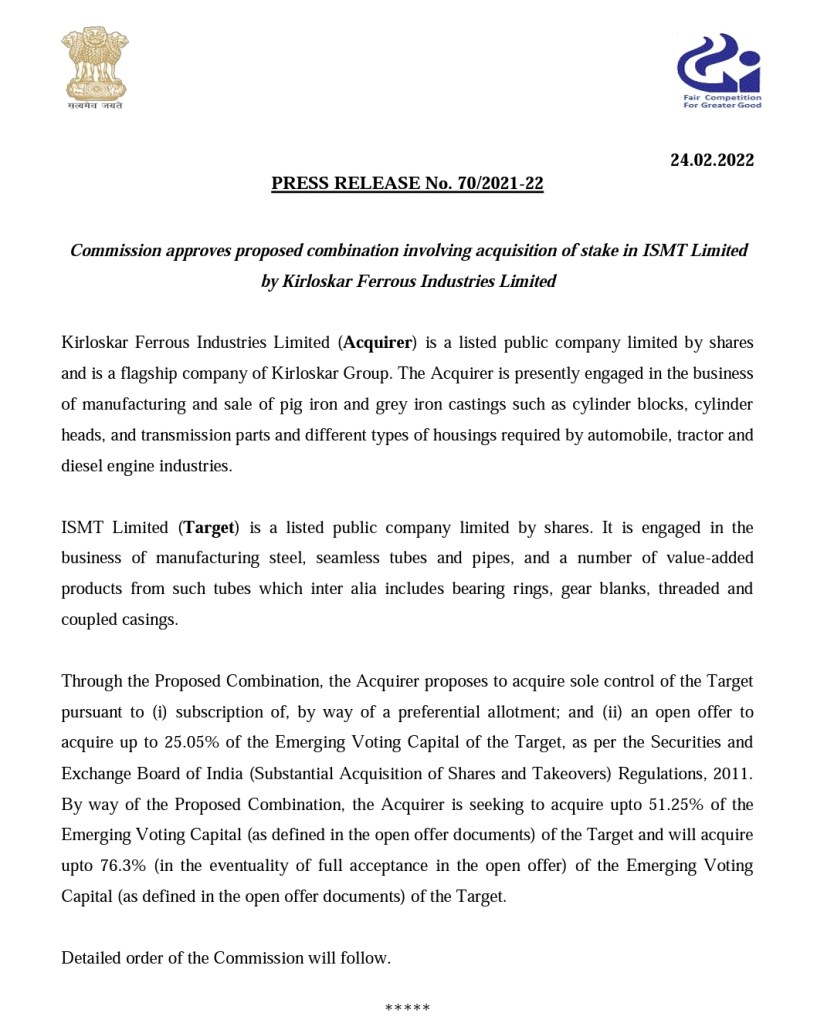
Commission approves proposed combination involving acquisition of stake in ISMT Limited by Kirloskar Ferrous Industries Limited (CCI Press Release 24 Feb 2022)
2 held by Faridabad CGST Commissionerate for issuing fake invoices of over Rs 200 crore and availing involving fraudulent ITC of Rs 31.85 crore (Press release 24th Feb 2022)
Central Goods and Services Tax (CGST) Commissionerate, Faridabad, of Panchkula CGST Zone, on 23.02.2022 arrested two persons for running a fake billing racket, involving five (5) dummy firms, dealing in trading of iron scrap, registered in Faridabad, Haryana, for issuance of fake invoices of over Rs 200 crore without actual supply of goods and availing and passing fraudulent Input Tax Credit (ITC) amounting to Rs. 31.85 crore.
A team of officers of Anti-Evasion, CGST Commissionerate, Faridabad, conducted simultaneous searches at 5 places in Faridabad on 22nd February, 2022. During the investigation, it was found that the said firms have been availing and passing on fraudulent Input Tax Credit based on bogus / fake invoices without actual supply of goods.
As per Section 132 of CGST Act 2017, issuance of an invoice or bill without supply of goods or services and wrongful availment or utilization of Input Tax Credit is a cognizable and non-bailable offence if the amount is over Rs. 5 crore.
Both the proprietors of the said firms have accepted that they have availed and passed on fraudulent ITC of Rs. 31.85 crore, without actual supply of goods to inter-state recipients and have accepted the total GST liability of Rs. 31.85 crore during initial investigation. The quantum may increase in future.
Therefore, both the accused have been arrested under Section 69 of Central Goods and Services Tax Act, 2017 for committal of offences under Section 132(1)(b), 132(1) (c) & 132 (5) of the CGST Act, 2017. They were produced before the CJM Court, Faridabad, on 23.02.2022 and were remanded to 14 days Judicial Custody.
Further investigation in the case is underway.
Delhi South CGST unearths fake invoicing racket of Rs 611 crore involving tax evasion of 38.5 crore (Press release 24 Feb 2022)
A specific intelligence was developed by the officers of Delhi South CGST Commissionerate concerning certain bogus firms that were created solely for the purpose of generating fake invoices and passing ineligible input tax credit along the chain.
Searches and inspections were conducted across locations spread across Delhi, unearthing a cartel running 54 bogus firms registered in Delhi –NCR region that were engaged in fake invoicing and circular trading. Incriminating documents such as rubber stamps and letter heads of various firms, mobile phones, laptops etc. have been seized from the search premises.
Preliminary enquiry conducted so far into these transactions has revealed fake invoicing of around Rs. 611 crores and tax evasion of over Rs. 38.5 crores. The members of cartel in their Confessional statements have accepted their roles in managing these bogus firms.
The persons behind these bogus firms hatched the conspiracy to defraud the government and committed offences specified under section 132(1)(b) and 132(1)(c) of the CGST Act 2017 which are cognizable and nonbailable. Three key persons of the cartel namely Sh. Ankit Gupta, the mastermind managing these bogus firms and two of his accomplice Sh. Rabiendra Singh and Sh. Rajendra Singh has been arrested on 23.02.2022. The accused were produced before the Duty Magistrate following which they have been remanded to judicial custody for 14 days.
Further investigation is under progress.
Upcoming GSTR-1/IFF enhancements
Upcoming GSTR-1/IFF enhancements
23/02/2022
Upcoming GSTR-1 enhancements & improvements :
- The statement of outward supplies in FORM GSTR-1 is to be furnished by all normal taxpayers on a monthly or quarterly basis, as applicable. Quarterly GSTR-1 filers have also been provided with an optional Invoice Furnishing Facility (IFF) for reporting their outward supplies to registered persons (B2B supplies) in the first two months of the quarter. Continuous enhancements & technology improvements in GSTR-1/IFF have been made from time to time to enhance the performance & user-experience of GSTR-1/IFF, which has led to improvements in Summary Generation process, quicker response time, and enhanced user-experience for the taxpayers.
- The previous phase of GSTR-1/IFF enhancement was deployed on the GST Portal in November 2021. In that phase, new features like the revamped dashboard, enhanced B2B tables, and information regarding table/tile documents count were provided. In continuation to the same, the next Phase of the GSTR-1/IFF improvements would be implemented shortly on the Portal.
- GSTR-1/IFF can be viewed as usual by navigating in the following manner :
Return Dashboard > Selection of Period > Details of outward supplies of goods or services GSTR-1 > Prepare Online
The following changes are being done in this phase of the GSTR-1/IFF enhancements : - Removal of ‘Submit’ button before filing : The present two-step filing of GSTR-1/IFF involving ‘Submit’ and ‘File’ buttons will be replaced with a simpler single-step filing process . The upcoming ‘File Statement’ button will replace the present two-step filing process and will provide taxpayers with the flexibility to add or modify records till the filing is completed by pressing the ‘File Statement’ button.
- Consolidated Summary : Taxpayers will now be shown a table-wise consolidated summary before actual filing of GSTR-1/IFF. This consolidated summary will have a detailed & table-wise summary of the records added by the taxpayers. This will provide a complete overview of the records added in GSTR-1/IFF before actual filing.
- Recipient wise summary : The consolidated summary page will also provide recipient-wise summary, containing the total value of the supplies & the total tax involved in such supplies for each recipient. The recipient-wise summary will be made available with respect to the following tables of GSTR-1/IFF, which have counter-party recipients :
- The functionality will be made available on the GST Portal shortly, and the same will be intimated to taxpayers. For detailed advisory & sample screenshots of the upcoming GSTR-1/IFF improvements & enhancements, please click here
Thanking you,
Team GSTN.
What is “penalty” u/CGST/SGST Act ? What are general disciplines followed while imposing penalties?
Penalty :
The word “penalty” has not been defined in the CGST/SGST Act but judicial pronouncements and principles of jurisprudence have laid down the nature of a penalty as:
a) a temporary punishment or a sum of money imposed by statute, to be paid as punishment for the commission of a certain offence;
b) a punishment imposed by law or contract for doing or failing to do something that was the duty of a party to do.
General disciplines followed while imposing penalties
The levy of penalty is subject to a certain disciplinary regime which is based on jurisprudence, principles of natural justice and principles governing international trade and agreements. Such general discipline is enshrined in section 126 of the Act. Accordingly:-
a) no penalty is to be imposed without issuance of a show cause notice and proper hearing in the matter, affording an opportunity to the person proceeded against to rebut the allegations levelled against him,the penalty is to depend on the totality of the facts and circumstances of the case,
b) the penalty imposed is to be commensurate with the degree and severity of breach of the provisions of the law or the rules alleged,
c) the nature of the breach is to be specified clearly in the order imposing the penalty,
d) the provisions of the law under which the penalty has been imposed is to be specified.
Section 126 further specifies that, in particular, no substantial penalty is to be imposed for:-
a) any minor breach (minor breach has been defined as a violation of the provisions in a case where the tax involved is less than Rs.5000), or
b) a procedural requirement of the law, or
c) an easily rectifiable mistake/omission in documents (explained in the law as an error apparent on record) that has been made without fraudulent intent or gross negligence.
Further, wherever penalty of a fixed amount or a fixed percentage has been provided in the CGST/SGST Act, the same shall apply.
FM chairs post-Budget meeting with heads of Banks, NBFCs and Financial Institutions (Press release 22 Feb 2022)
Finance Minister Nirmala Sitharaman chairs post-Budget meeting with heads of Banks, NBFCs and Financial Institutions
Finance Minister exhorts all banks to sign up to Account Aggregator Framework, says it will improve credit flow and promote digital lending
Meeting emphasizes that Benefits of digital banking should reach every nook and corner of the country in a consumer-friendly manner
Union Minister for Finance and Corporate Affairs Smt. Nirmala Sitharaman chaired a post-budget meeting with heads of Banks, Non-Banking Financial Institutions (NBFCs) and Financial Institutions in Mumbai today.
The meeting was attended by Union Minister of State for Finance Dr. Bhagwat Kishanrao Karad; Shri Sanjay Malhotra, Secretary, Department of Financial Services; Shri Ajay Seth, Secretary, Department of Economic Affairs and Dr. V. Anantha Nageswaran, Chief Economic Adviser. The heads of all Public Sector banks, select Private Sector Banks, NBFCs and Financial Institutions were also present in the meeting.
Underscoring the importance of information sharing and collaboration, the Finance Minister exhorted all the banks to sign up to the Account Aggregator model which would facilitate seamless flow of credit for small borrowers and promote digital lending. The Minister directed that pilots for Account Aggregator model and cashflow-based lending may be replicated in different regions around the country including in the North Eastern Region, on the lines of the initiative by two banks in Varanasi district.
The meeting deliberated on the various budget announcements in the context of PM GatiShakti, Defence, Telecom, Manufacturing & exports, Emergency Credit Line Guarantee Scheme (ECLGS) and tax concessions to new manufacturing units and start-ups, which offer new opportunities to the financial sector. The meeting discussed various schemes/programmes such as subordinated debt to MSMEs, KCC, Aatma Nirbhar Bharat Schemes and credit outreach programme which provided immediate relief to the borrowers and the banks, from the impact of the COVID-19 pandemic. ECLGS, which has been enhanced to Rs. 5 lakh crore and extended up to 31.3.2023, was also discussed.
It was emphasised that digital banking, digital payments and fintech innovations are an opportunity for banks to find new ways to reduce the cost of intermediation and provide cost-effective services and that the benefits of digital banking should reach every nook and corner of the country in a consumer-friendly manner.
It was further stressed that banking industry should target to open accounts of unbanked adults under Jan Dhan Yojana and ensure Insurance/Pension coverage to all eligible adults.
It was highlighted in the meeting that with a record profit of Rs. 1.22 lakh crore in FY 20-21 and Rs. 0.79 lakh crore in HY 21-22, declining Gross NPA figures to 6.90% (as on Sep’21) from all-time high of 11.20% (as on Mar ’18) and sufficient buffers with all time high CRAR of 16.5% (as on Sep ’21) against the regulatory mandate of 11.5%, banks are in a strong position to support future growth, enabling the country’s economy for a take-off.
The way forward for stepping-up the lending activity and building a conducive credit environment for businesses and individuals was also stressed upon in the meeting.
Deactivation of DIN of the Directors is not automatic (Calcutta High Court – 14th Feb 2022)
Satya Narayan Banik Vs Union of India (Calcutta High Court) dated 11/02/2022
The writ petitioners are aggrieved by cessation of office as directors of one M/s. Hahnemann International Pvt. Ltd. The disqualification happened by operation of Section 164 (2) for not filing balance sheets and annual returns for a continuous period of three years from the year 2014-15.
The ROC has also deactivated the Director Identification Number of the petitioners for which the petitioners are aggrieved by.
The petitioners have advanced a three-fold argument challenging such disqualification.
(i) That they were not permitted to avail the benefit of the “Company’s Fresh Start Scheme of 2020” despite applying by letter dated 11th November, 2020.
(ii) That the petitioners were not afforded a prior hearing before the disqualification as a directors and were hence denied principles of Natural Justice.
(iii) The Registrar of Companies is not authorized to deactivate their Director Identification Numbers (DIN) of the and that such activation of DIN pursuant to the disqualification is not automatic.
On the power of the ROC to deactivate the DIN of the petitioners it would be necessary to go into whether the provisos to the two Section 164(2) and 167(1), introduced subsequently by amendment.
Citing reference of Yashodhara decision (Karnataka HC)
I find considerable force in the argument of petitioners’ counsel as, on 01.11.2016, when the petitioners were disqualified, while they had to vacate the office of the director, it necessarily referred to the defaulting company under Section 164(2) of the Act. But, realizing the fact that if all the directors in the defaulting company had to vacate office, then such Board of Directors would be bereft of directors and would lead to an absurd situation, the proviso was inserted to the effect that a director of a defaulting company shall not vacate office of the director in the defaulting company. Therefore, the said portion of the proviso could be construed to be clarificatory in nature and therefore, would have a retrospective effect.
But, while saying so, the proviso also states that a director of a defaulting company would vacate office of the director in all other companies in which he is a director. The same was not envisaged under Section 167(1)(a) of the Act prior to insertion of the proviso, but by the insertion of the proviso such an immediate consequence is also envisaged. It has also been held above that such a consequence cannot be held to be arbitrary or in violation of Article 14 and 19(1) of the Constitution, but the proviso having come into force on 07th May 2018 cannot have a retrospective operation so as to affect the petitioners herein who were all disqualified on 01.11.2016 i.e., prior to 07th May 2018.
The proviso to Section 167(1)(a) of the Act is not ultra vires Articles 14 and 19(1)(g) of the Constitution. The words “provided that where he incurs disqualification under sub-Section (2) of Section 164, the office of the director shall become vacant…………. , other than the company which is in default under that sub-Section” being clarificatory in nature has retrospective operation, while the words “in all the companies” being introduced for the first time by way of proviso, pursuant to Amendment Act, 2017, has prospective operation and the proviso would apply only to those directors who sustain a disqualification pursuant to 07.05.2018. While saying so, the doctrine of severability as applicable to interpretation of statutes is applied.
Under the proviso to Section 167(1) (a) of the Act, the director of a defaulting company continues to hold the office of Director despite disqualification, his DIN cannot be cancelled. On the issue of cancellation of DIN, reference was made to Companies (Appointment and Qualification of Directors) Rules, 2014. Under Rule 14, the consequences of disqualification of directors under Section 164(2) of the Act are mentioned. That every director shall inform to the company concerned about his disqualification under sub-Section (2) of Section 164 of the Act in Form DIR-8 before he is appointed or re-appointed. Further, whenever a company fails to file the financial statements or annual returns, or fails to repay any deposit, interest, dividend, or fails to redeem its debentures, as specified in sub-Section (2) of Section 164, the company shall immediately file Form DIR-9, to the Registrar furnishing therein the names and address of all the directors of the Company during the relevant financial year.
That cancellation or surrender or deactivation of DIN is stipulated in Rule 11. It is contended that Rule 11 does not permit cancellation of or deactivation of DIN on account of disqualification of a director under Section 164(2) of the Act at all. That DIN could be cancelled on account of the death of a director or a director being declared as a person of unsound mind by a competent Court or being adjudicated as a insolvent or for other reasons, but, not for suffering a disqualification under Section 164(2) of the Act.
DIN cannot be cancelled on account of a disqualification sustained under Section 164(2) of the Act, but at the same time the company must comply with filing Form DIR-9.
It is, therefore, held that deactivation of the DIN of the petitioners is not automatic.
In view of the above the DIN of the petitioners shall be revived subject to the company having filed DR-9 within prescribed or extended tidme. The said DIN shall not be applied to entitle the petitioners to act as directors in any other company.
Judgement copy
https://acrobat.adobe.com/link/review?uri=urn:aaid:scds:US:c39708e9-2616-3249-8619-d657f26d4bbf
Delhi HC upheld suspension of FCRA registration of Commonwealth Human Rights Initiative for alleged violations of FCRA
Delhi HC upheld suspension of FCRA registration of Commonwealth Human Rights Initiative for alleged violations of FCRA
Commonwealth Human Rights Initiative Vs Union of India (Delhi High Court) dated 14/02/2022
Violations:
👉 The activities / projects for which foreign contribution has been received and utilised have not been given in the prescribed Point 3(a) in FC-4 Form in AR for the FYs 2018-2019.
👉 The bank account No.600510110004721, Bank of India, New Delhi opened on February 18, 2016, has not been intimated online to the Ministry and there is a flow of foreign contribution in this bank account.
👉 One utilisation account through which the Association has been utilizing foreign contribution has not been intimated in ARs for the FYs 2016-2017 and 2017-2018.
👉 The association has refunded some foreign contributions back to the donor in FYs 2013-2014 and to 2014-2015 in violation of Section 8(1)(a) of the FCRA, 2010.
Copy of judgment
Link: http://164.100.69.66/jupload/dhc/VKR/judgement/14-02-2022/VKR14022022CW64002021_230104.pdf
https://acrobat.adobe.com/link/review?uri=urn:aaid:scds:US:71986547-00f5-3528-98bd-44396c42cb4c
Cryptocurrencies – An assessment (RBI dated 14th Feb 2022)
Cryptocurrencies – An assessment
(Keynote address delivered by Shri T Rabi Sankar, Deputy Governor, Reserve Bank of India – February 14th, 2022 – at the Indian Banks Association 17th Annual Banking Technology Conference and Awards)
Shri Goel, Chairman IBA, Shri Mehta, Chief Executive IBA, Prof Phatak, Chairman of Awards Jury, members of the Jury, MDs and CEOs and other senior functionaries of banks, ladies and gentlemen
Let me begin by congratulating the winners of the IBA Banking Technology Awards. It is indeed a privilege to be among so august an audience and so learned a gathering and be able to talk about an issue of momentous significance – how to deal with cryptocurrencies. Crypto technology and Web 3.0 is dominating the mind-space not just among the technology community but the financial industry as well. Cryptocurrencies, as per their proponents, have the potential to play a critical role in how finance pans out in the future; indeed, there is open speculation about whether finance as we know it and banking as we know it can survive the rise of cryptocurrencies. In this talk I will try and give you my assessment of cryptocurrencies and what they mean for our financial system.
Introduction
2. As many of you would already know, cryptocurrencies and other crypto products (like non-fungible tokens or NFTs) are being hailed as the innovations that would usher in decentralized finance or DeFi, which are blockchain applications geared to disrupt the traditional financial system. The basic purpose of blockchain, or more generally the distributed ledger, the technology on which these crypto-products run, is to make financial intermediation, and therefore banks, redundant.
3. What might have escaped the attention of the common man, is that cryptos might be more than just a technology, they appear to embody an ideology as well. A Financial Times video characterizes the success of Bitcoin, the first and most popular cryptocurrency, to “healthy dissent, base greed, lofty idealism, and sheer fear of missing out”2. The same FT video also says “Cryptos embody a core tenet of anarchism, co-operation in the absence of centralised authority”. The class of crypto products are fundamentally designed to bypass the established financial system, and on a larger scale Government itself. Some enthusiasts even claim that cryptocurrencies can usher in a separation of money and State, like separation of Church and State. Some refer to it as ‘freedom’ money. Or, as Nassim Nicholas Taleb is quoted to have written in the Time3 magazine, bitcoin is an insurance policy against an Orwellian future. It may thus not be adequate, from a regulatory point of view, to treat cryptos as just another type of currency or asset or commodity but also as a potential social movement.
Cryptocurrency Basics
4. Let us briefly, and in very general terms, understand the basics of cryptocurrencies.
5. When a transaction is made using paper currency, all that the receiver needs to check is that the currency is not counterfeit. Thus, it is the receiver who authenticates the instrument of payment. This arrangement generally works, except for those few instances when the receiver fails to detect a counterfeit currency. In the case of digital transactions, the authentication of the payment is done by an intermediary like a bank, because almost all electronic transactions are transfer of money from one bank account to another. This arrangement also works as the bank certifies that the sender has adequate balance in her account to cover the transaction.
6. Some people felt that intermediation by banks is avoidable. Either they felt that banks are not trustworthy, or they considered that the cost charged by banks is excessive, or they were not comfortable with their transactions being tracked. Guided by the idea that cash remains one of the best ways to exercise free speech (refer footnote 3), their solution was to create their own private currency and a transaction arrangement or network that bypassed banks or any other financial or social institution. The basic problem they had to get over was as follows – since electronic money (just some lines of code) can be easily replicated, in the absence of a trust institution like a bank, how does the network ensure that the same currency is not spent again, and again. This was called the ‘double spending problem’.
7. The first ‘person’ to effectively solve this problem was one Satoshi Nakamoto, a fictional person or persons or corporate or any other entity, no one knows as yet. And bitcoin was born. He did this by creating the blockchain. On a blockchain, when a transaction occurs, it is broadcast to all computers on the network. A set of new transactions, called a block, are authenticated by an agreed consensus mechanism, and then the validated transaction block is added to the previous chain of blocks. Every block is linked to the previous block, making double spending difficult because it would involve changing every subsequent block. Bitcoin was followed by many others, like ether, cardano, dogecoin, tether, stellar etc. Collectively they are called cryptocurrencies. The prefix ‘crypto-‘ refers to the fact that cryptography is used to generate or authenticate transactions.
8. The defining characteristics of cryptocurrencies are: –
- That cryptocurrencies are decentralized systems where transactions are authenticated by participants themselves by consensus. They are designed to bypass the financial system and all its controls. They cannot be traced or confiscated or frozen by Governments.
- They are anonymous – transactions are verified, but not the purposes or counterparties of transactions.
- They are borderless – that is, they work over the internet without any physical existence.
9. While Bitcoin started more than a decade back in 2008, until 5 years ago, total market capitalisation of all cryptocurrencies was only $20 billion (February 2017). This went up to $289 billion in February 2020 and thereafter exploded to reach a peak of $2.9 trillion in November 2021. Currently (Feb 09, 2022) it stands at $1.98 trillion. Bitcoin accounts for 42% of this market capitalisation, the top two cryptocurrencies account for 61% while the top five account for 71%. The total number of cryptocurrencies is at 17,436 and the total number of crypto exchanges is 458.4.
A criitical assessment of cryptocurrencies
10. With that brief, and somewhat simplistic, introduction to cryptocurrencies, we will now take a deeper look at the exact nature of cryptocurrencies and their implications, particularly in the context of the current debate in India on the topic. The starting point is to get a clear understanding on (a) What precisely is a cryptocurrency, (b) What useful economic role does a cryptocurrency play, and (c) What, if any, are the risks it poses to the society and economy?
(i) What precisely is a cryptocurrency?
11. A cryptocurrency is designed to be a currency, but does it really function like a currency as we understand it. Firstly, currency always has an issuer, usually a trusted entity like the sovereign. Even when gold is used as a currency, the gold coins had to be issued by a sovereign entity. Secondly, historically, a currency has always been either a commodity with intrinsic value or a debt instrument. Cryptocurrencies do not conform to this understanding of a currency as they do not have an issuer, they are not an instrument of debt, or commodities nor do they have any intrinsic value. Currency needs trust, not everything that can be trusted is a currency. So even if technology (as in a blockchain) provides the trust for cryptocurrencies, they can at best perform the role of a currency within the private and closed environment of that cryptocurrency. They do not, and should not, automatically become a currency for the larger society.
12. Some countries tend to treat cryptocurrencies as a financial asset. This is also problematic because all financial assets have underlying cash flows and need to be some person’s liability. Cryptocurrencies are neither any person’s liability nor do they have any underlying cash flows. They are not financial assets, by definition.
13. There is also an effort to treat cryptocurrencies as a commodity. But commodities are tangible and have utility; cryptocurrencies have neither. There is this somewhat awkward attempt to equate some of them with gold, hence limiting their supply like natural resources, or creating them through mining. Limiting supply by design is not the same thing as limited supply in nature (like gold) because (a) design can always be modified and hence such limitation is artificial, and (b) even if one cryptocurrency has limited supply, that limitation does not work for all cryptocurrencies taken together. Further the fact that gold is mined does not in itself make it money, it has to be stamped and issued by a sovereign to make it money.
14. If cryptocurrencies are neither a currency in the usual sense of the term, nor a financial asset nor a physical asset what are they? The proponents have improvised to call them as digital assets. Even that is doubtful as cryptocurrencies do not have any underlying use, like for instance car hiring softwares or a core banking systems, or, for that matter, smartphones. That basically leads to the conclusion that it is an electronic code (with no practical use) which has created enough hype such that people are willing to pay money to buy ownership rights to that electronic code, seemingly on the hope that someone else would buy it at a higher price in future. What started off as a medium of exchange has appeal similar to that of a speculative asset.
15. As a store of value, cryptocurrencies like bitcoin have given impressive returns so far, but so did tulips in 17th century Netherlands. Cryptocurrencies are very much like a speculative or gambling contract working like a Ponzi scheme. In fact, it has been argued that the original scheme devised by Charles Ponzi in 1920 is better than cryptocurrencies from a social perspective5. Even Ponzi schemes invest in income earning assets. A bitcoin is akin to a zero-coupon perpetual; it’s like you paid money to buy a bond which pays no interest and which will never pay back the principal. A bond with similar cash flows would be valued at zero, which, in fact, can be argued as the fundamental value of a cryptocurrency. If everything eventually returns to its equilibrium value, then the prognosis for investors in cryptocurrencies is not a happy one.
(ii) What useful social or economic role does a cryptocurrency play?
16. If cryptocurrencies are actually intended to revolutionize finance, we need to understand what precise role they play in finance. An equity share enables a business to mobilize risk capital, a bond enables a company/Government to borrow money, a mutual fund enables retail investors to diversify their portfolio, derivatives enable users to manage their risk and so on. Every financial instrument exists to serve a basic purpose quite distinct from its use as an investment asset. What is the basic role played by cryptocurrencies? Since it claims to be a currency, does it perform the functions of a currency? The answer is that the volatility of many cryptocurrencies precludes them as an efficient medium of exchange. Besides, a priori there is no ground to believe that people place the same trust in them as they do in legal tender currencies. While there is anecdotal evidence of businesses using bitcoins, there really is no reliable data available; by all indications their use as a currency appears to be negligible.
17. Are cryptocurrencies useful as a store of value? Given the surge in value of some cryptocurrencies, it has been argued that they are. A closer look exposes that argument. Think of any store of value – they are either currencies, or financial assets or commodities which are tangible and have intrinsic value (works of art like paintings also have historical, aesthetic and scarcity value). We have seen that cryptocurrencies are none of these. Notwithstanding their current valuations, if a threshold number of people decide to opt out, the entire values can easily collapse to nothing.
18. For all the hype about a revolutionary innovation, cryptocurrencies themselves do not appear to be designed to meet any need in the finance space that is currently not being met or to meet existing needs more efficiently. The innovation, if at all, is of distributed ledger, which, contrary to the claims of proponents, can flourish even if cryptocurrencies themselves are banned across the world.
(iii) What, if any, are the risks posed to a society or an economy?
19. The fundamental risks of cryptocurrencies are two – they are intended to be private currencies and they are structured to evade Government control with respect to financial integrity standards such as KYC, AML/CFT etc. Let us examine each of these two points in a little more detail.
Impact of private currencies or currency like products on the economy
20. Historically, private currencies have resulted in instability and therefore have evolved into fiat currencies over centuries. The retrograde step back to private currencies cannot be taken simply because technology allows it (it always did, actually) without any consideration for the dislocation it causes to the legal, social and economic fabric of society. Every private currency will eventually replace the Rupee to some extent. Consequently, the role of the Rupee as a currency will be undermined. With one or more private currencies being allowed, there would be parallel currency system(s) in the country. Thus, increased acceptance of cryptocurrencies would result in effective ‘Dollarization’ of our economy6. Dollarization, it is well understood, would undermine the ability of authorities to control money supply or interest rates, as monetary policy would not have any impact on the non-Rupee currencies or payment instruments. When that happens, India loses not just its currency, a defining feature of its sovereignty, but its policy control of the economy. With loss of traction for monetary policy, the ability to control inflation would be materially weakened.
21. Given a choice, people may like to hold at least a part of their deposits in convertible currencies like the US Dollar or Euro. Cryptocurrencies priced in these convertible currencies would provide such an opportunity. If private currencies are permitted, the banking system’s ability to mobilise deposits in Rupees, and consequently, the ability to create credit, would diminished. Credit creation in convertible currencies would be impervious to monetary policy. In the extreme case where a major part of deposits and credit shift to cryptocurrencies, the result would be a weakened, even crumbling, banking system, impairing financial stability.
22. There are already indications that private cross-border flows are taking place in cryptocurrencies. If this trend is legitimised, a part of the flows related to trade payments, personal remittances or cross border investments would be made in these cryptocurrencies. As they are non-reserve currencies, this could have adverse implications for India’s foreign exchange reserves, which lend stability to the external sector. Besides, such cryptocurrency payments can take place outside the ambit of capital account regulations. This would adversely affect the integrity of the capital account regime, as policy control on capital flows would be eroded. The consequence of this on foreign exchange reserve accretion and exchange rate management raises serious macroeconomic stability issues.
23. It is important to appreciate that the concern with private currencies is not limited to bitcoin or just cryptocurrencies. The concern extends to any private currency, whether digital or physical, whether crypto-based or not. Stablecoins (which are simply cryptocurrencies that are less volatile) are being promoted globally, presumably because they are more stable than, say, bitcoin. We should in fact be more concerned about stablecoins because they would be more effective as currency than volatile cryptocurrencies. As the FT video cited above says “Stablecoins pegged to official currencies would increase, rather than dampen risks, if assets and liabilities were mismatched.”
Impact on global financial integrity standards
24. The very raison d’etre of cryptocurrencies is that they bypass established intermediation and control arrangements7 that ensure integrity of financial transactions, such as Know-Your-Customer regimes, Anti-Money Laundering (AML) and Combating the Financing of Terrorism (CFT) rules etc. The fact that they are anonymous, decentralized systems that operate purely virtually makes cryptocurrencies particularly attractive to illegal/illegitimate transactions which have been largely filtered out of the formal financial system. Total crimes using cryptocurrencies in 2021 was estimated to be $14 billion (Wall Street Journal, January 06, 2022). The amount itself is not much but the implications for the AML/CFT framework built painstakingly over the last two decades is rather substantial.
25. There are other important negative consequences of allowing cryptocurrencies into the formal financial system. We have already noted that there is no basis for valuation of cryptocurrencies. Since valuation is largely based on beliefs, and not on underlying value, it is bound to have a destabilizing effect on monetary stability of a country through large-scale wealth loss to investors (if it is adopted widely), even if it not allowed to be used as a currency.
26. The socially wasteful energy use of crypto infrastructure has been a subject of widespread discussion. About 900 new bitcoin a day require electricity worth $45m a day (refer footnote 5). By some estimates electricity use of bitcoins equaled that of the entire country of Switzerland8, in 2019.
27. From what we have seen so far, there does not appear to be any case to allow cryptocurrencies to be legitimized in India. Nonetheless various arguments have been extended to permit cryptocurrencies and subject them to close regulations. In the next section, we would examine the validity of these arguments.
Should cryptocurrencies be permitted and regulated in India
28. The basic arguments being made for regulating cryptocurrencies are as follows:
Blockchain or Distributed Ledger Technology is a promising technology where Indians might have a global edge. Banning cryptocurrencies would affect the absorption of DLT technology in India.
Most major countries are not banning cryptocurrencies, but are considering some kind of regulation.
Many Indians have already invested in cryptocurrencies and banning it may lead to wealth loss for them.
Banning in any case is unlikely to be effective because by its very nature cryptocurrencies can be acquired and traded in an anonymous manner.
29. Cryptocurrencies are typically native to a blockchain. For instance, bitcoin is the native coin (or token) of the Bitcoin blockchain, or, ether is the native currency of the Ethereum blockchain. They can be used as units of account to settle transactions or they can be used as tokens to reward work done in the blockchain, say, for mining. Either of these two functions do not appear to be essential to the basic function of a blockchain. It should be possible to maintain a blockchain without any native cryptocurrency if transactions are authenticated centrally. Even in case of private authentication through consensus mechanisms, accounts can be kept and rewards can be given in any legal tender currency. In other words, creating native cryptocurrencies is just one way of implementing a blockchain; it can be viewed as just one use case of the blockchain technology. To argue that banning cryptocurrencies would stunt the absorption of blockchain technology is therefore akin to saying that banning human cloning would kill innovations in biotechnology or banning nuclear weapons would hurt nuclear physics as a discipline. There are many other uses of blockchain technology or more generally, distributed ledger technology, that do not involve creation of a virtual currency. Thus, claims that cryptocurrencies must be permitted for blockchain technology to thrive are not sustainable.
30. An argument often advanced against banning cryptocurrencies is that advanced economies (AEs) are not resorting to such bans. While replicating the practices followed in AEs is often an acceptable route to reforms, as far as cryptocurrencies are concerned, it has to be noted that India is not similarly placed as AEs. We should particularly be alert to the possibility that these private currencies can be used for global strategic control. If, for example, some private currency substantially replaces the Rupee, the corporate which manages that cryptocurrency (or the country which has control of that corporate) can practically control India’s economic policy. There are a number of other reasons why it might be in the interest of AEs to not ban them, as below.
Almost all cryptocurrencies are priced in terms of Dollars (or potentially any of the freely convertible currencies). Wider adoption would actually result in wider use of these currencies. So cryptocurrencies are not a threat to convertible currencies as they are to the Rupee, which is not an international currency. Following the example of AEs in the matter of cryptocurrencies would effectively amount to working against the interest of the national currency.
Most cryptocurrencies are owned by businesses of AEs; therefore, better adoption of cryptocurrencies would add to their growth and employment. Significantly, it might be of advantage to the AEs if cryptocurrencies replace emerging market (EM) currencies as that would give AEs a better strategic control on the EMEs.
AEs have more mature markets which can withstand the potential disruption from cryptocurrencies. They are, therefore, in a better position to wait and watch.
AEs have quicker legal systems and hence concerns of misuse of cryptos can be addressed through the legal systems. In India, on the other hand none of the major instances of consumer exploitation have been redressed legally (e.g., the mis-selling of derivatives in mid 2000s).
AEs have the political power to control the crypto companies. The recent instance where the US recovered bitcoins from the hackers of the oil pipeline in US, is an example that notwithstanding claims of non-traceability of cryptocurrencies, AE Governments wield enough power to access the records. India or most other countries would lack such advantages.
31. Another argument often advanced is that so many Indians have already invested in cryptocurrencies and banning cryptocurrencies would lead to a loss of wealth for them. There are three reasons such arguments do not appear justified. One, banning in India does not mean investors would lose money, because they can be provided with a reasonable exit. Two, persons who have invested in these instruments are fully aware of the risks involved. Reserve Bank has been warning investors of the risks for nearly a decade. That an Inter-Ministerial Committee of the Government has recommended banning cryptocurrencies was widely known for the last three years, as was the fact that cryptocurrencies are not regulated products and there are no investor protection norms in place. Investors who have acquired these instruments have done so with their eyes wide open, at their own risk and do not warrant any regulatory dispensation. Three, there is no data to justify how many investors have invested in these instruments and what is the amount of investment. Data informally gathered in November seems to indicate that crypto investments by Indians is nowhere near to being significant (although the pace of growth could make it a concern in future). This data showed9 that four out of five investor accounts10 held investments of less than Rs.10,000, with an average holding size of Rs.1,566. Wealth loss, if at all it is a possibility, is likely to affect only a small fraction of these investors.
32. Interestingly, concentrated ownership appears to be characteristic of cryptocurrencies. As a January 2021 report published in The Telegraph11 points out: “According to industry data, around 13% of all Bitcoin sits in the hands of just over 100 individual accounts.” They are referred to “crypto whales”. Such concentrated ownership, usually by creators or initial investors, in what is touted to be (or at least hoped to be) the alternative monetary system, would make that system prone to manipulation.
33. That cryptocurrencies should not be banned because a ban is unlikely to be effective is a superficial argument. One might as well argue that drug trafficking is a rampant phenomenon despite a ban, and therefore drug trafficking should be legalised and regulated. If cryptocurrencies are banned, the vast majority of investors who are law abiding would desist from investing. Those few elements who would continue to invest will essentially be carrying out an illegal activity. Such exceptions should reinforce the need for a ban, rather than invalidate it.
34. It has also been argued by some that the concerns raised in allowing private currencies as a ‘medium exchange’ are valid. Therefore, they may not be allowed as legal tender but should be allowed as an investment asset. This argument appears to be made more with hope than with any real conviction. Not allowing them as currency would still amount to cryptocurrencies being used as store of value. ‘Store of value’ demand is a more substantial source of demand for a currency than transaction demand. One only needs to compare the volume of time deposits with transactional deposits to understand this. If a cryptocurrency is used as a store of value the same concerns arise again. Also, unlike the value of Rupee, which is anchored by monetary policy and its status as legal tender, the value of crypto assets rests solely on the expectation that others will also value and use them. Since valuation is largely based on beliefs that are not well anchored, it is bound to have a de-stabilising effect on the monetary and fiscal stability of a country, even while it is not permitted to operate as a legal tender.
35. There are other reasons why it would be futile to regulate cryptocurrencies. As discussed, cryptocurrencies are not currencies, or financial assets or real assets or even digital assets. Therefore, it cannot be regulated by any financial sector regulator. It is not possible to regulate something that one cannot define.
36. Cryptocurrencies are typically global products whose defining characteristic is that they are outside official control and they cannot be regulated by country-specific regulators. The Financial Stability Institute of the Bank for International Settlements identifies difficulties in regulating cryptos – such as the international nature of crypto transactions, absence of technological solutions to ensuring FATF’s ‘Travel Rule’, the problem of ‘unhosted wallets’, the fact that P2P transactions do not involve any entity subject to AML-CFT regulations, etc. Let us suppose India decides to regulate cryptocurrencies. How would it regulate and redress a case of mis-selling as it has no access to the ledger, nor to any audit trail. As it is not always possible to know of the persons who are the management for cryptocurrencies (e.g., bitcoin), at whom would the regulatory action be directed? If for any reason the entire system collapses what possible regulatory redressal exists for investors? These are questions with very uncomfortable implications that do not have satisfactory solutions.
Conclusion
37. We have seen that crypto-technology is underpinned by a philosophy to evade Government controls. Cryptocurrencies have specifically been developed to bypass the regulated financial system. These should be reason enough to treat them with caution. We have also seen that cryptocurrencies are not amenable to definition as a currency, asset or commodity; they have no underlying cash flows, they have no intrinsic value; that they are akin to Ponzi Schemes, and may even be worse. These should be reason enough to keep them away from the formal financial system. Additionally, they undermine financial integrity, especially the KYC regime and AML/CFT regulations and at least potentially facilitate anti-social activities. More substantially, they can (and if allowed most likely will) wreck the currency system, the monetary authority, the banking system, and in general Government’s ability to control the economy. They threaten the financial sovereignty of a country and make it susceptible to strategic manipulation by private corporates creating these currencies or Governments that control them. All these factors lead to the conclusion that banning cryptocurrency is perhaps the most advisable choice open to India. We have examined the arguments proffered by those advocating that cryptocurrencies should be regulated and found that none of them stand up to basic scrutiny.
38. Writing in the New York Times12 Adrian Chen noted as far back as 2013 that Bitcoin is built on a weird mix of speculative greed bolstered by a utopian cyberlibertarian ideology and likened it to a digital gold rush. Indeed, hyperbole continues to characterise all aspects of the crypto world. Crypto messaging does not appear to be directed at the rational or sensible. Global advertisements with themes such as the ‘fortune favours the brave’13 is reflected somewhat in our very own ‘lag ja re…kuch to badlega’. It would serve us well if the understanding about cryptocurrencies goes beyond the hype and gets rooted in reason and pragmatism.
 Business So Simple