BUDGET 2022 (Download all budget documents) -01st Feb 2022)

Key to Budget Document, 2022

https://www.indiabudget.gov.in/doc/Key_to_Budget_Document_2021.pdf

Budget Highlights (Key Features)

https://www.indiabudget.gov.in/doc/bh1.pdf

Annual Financial Statement
+

https://www.indiabudget.gov.in/#collapse2

Memorandum Explaining the Provisions in the Financial Bill

https://www.indiabudget.gov.in/doc/memo.pdf

Finance Bill

https://www.indiabudget.gov.in/doc/Finance_Bill.pdf

Statements of Fiscal Policy under the FRBM Act, 2003

https://www.indiabudget.gov.in/doc/frbm1.pdf

Output Outcome Framework for Schemes 2022-2023

https://www.indiabudget.gov.in/doc/OutcomeBudgetE2021_2022.pdf

Customs Notifications
+

https://www.indiabudget.gov.in/#custom

Implementation of Budget Announcements 2021-2022

https://www.indiabudget.gov.in/doc/impbud2020-21.pdf

Budget at a Glance
+

https://www.indiabudget.gov.in/#budget

Expenditure Profile
+

https://www.indiabudget.gov.in/#expen

Expenditure Budget

https://www.indiabudget.gov.in/#expenb

Ministry wise Summary of Budget Provisions

https://www.indiabudget.gov.in/doc/eb/sumsbe.pdf

All Statements of Budget Estimates

https://www.indiabudget.gov.in/doc/eb/allsbe.pdf

Finance Minister’s Speech

https://www.indiabudget.gov.in/#collapse1

Legal updates (Budget 2022)- 01st Feb 2022

International arbitration centre at GIFT City

Amendments in the IBC to be carried out to enhance the resolution process and facilitate cross border insolvency resolution

SEZ Act to go, new law to allow states to partner to enhance export performance

1,486 union laws were repealed last year for ease of doing business FM says.

Issuance of E-Passports will be rolled out in 2022-23

Social Welfare – Transliteration of land records in 8 languages will be rolled out

Tax updates (Budget 2022)-01 Feb 2022

Tax updates (Budget 2022)-01 Feb 2022

AMT is proposed to be reduced from 18% to 15% for co-operative society

Surcharge rate reduced from 12% to 7% on co-operative society having total income less than Rs. 10 crores

Income from the transfer of virtual digital asset shall be taxed at 30% with no deductions of expenses

New provision introduced for filing of an updated return within 2 years from the end of the relevant assessment year on payment of additional tax

Period of incorporation for eligible start-ups to claim the tax benefit is extended by 1 year

Maximum surcharge on long-term capital gain is capped at 15%

Surcharge or cess is not allowable as business expenditure:

Gift of cryptocurrencies to be taxed at receiver’s end

The government will tax income from digital asset transfers at 30%.

Gross GST collection for January 2022 is Rs 1.4 lakh crores approx, highest since the inception of GST: Says FM

Rs 1 lakh crore financial assistance to be provided to states in 2022-23 to catalyse investments, says FM

Existing tax benefits for startups, which were offered redemption of taxes for 3 consecutive years, to be extended by 1 more year.

Faceless proceedings under Customs is fully established

Customs Duty on Gems and Diamonds reduced to 5%

SEZ reforms in customs to be implemented by 30th Sept, 2022

Concessions provided on raw material for boosting manufacturing of Electronics Goods

Duty concessions provided to high growth electronic items

Proposals made for exempting few goods under Customs for promoting manufacturing of Capital goods

Economic times –

Biggest announcements for taxpayers 👉
Taxpayers can file an updated return on payment of taxes within two years from the end of relevant assessment year.

The new provision will ensure voluntary tax filing and reduce litigation, says FM

30% tax on proceeds of virtual/digital assets with no deductions other than cost of acquisition

No set off permitted against other income

1% TDS to be levied on payments made on transfer of digital assets

Deduction for employer contribution to NPS increased to 14% from 10% earlier for State govt employees on par with central govt employees

(Economic times)

Initiatives under AatmaNirbhar Bharat including structural and procedural reforms reinforce performance of the industrial sector, expected to grow by 11.8 percent in this financial year (Press release-31st Jan 2022)

Initiatives under AatmaNirbhar Bharat including structural and procedural reforms reinforce performance of the industrial sector, expected to grow by 11.8 percent in this financial year


Investor friendly FDI policy sets up new records in FDI inflows registering highest ever annual FDI inflow of 81.97 billion US$ in 2020-21

Gross bank credit to the industrial sector records growth of 4.1 percent

Production Link Incentive scheme (PLI) Scheme reduces transaction costs, improves ease of doing business

National Infrastructure Pipeline (NIP), National Monetization Plan (NMP) propel infrastructure investment

UDYAM Registration Portal and revision in the definition of the MSMEs enhance productivity, facilitating expansion and growth

Setting up of seven PM Mega Integrated Textiles Region and Apparel Parks (MITRA) notified with a total outlay of Rs. 4,445 crore

Government approves outlay of Rs. 76,000 crore for the development of semiconductors and display manufacturing ecosystem

Construction of National Highways/roads registers an increase of 30.2 percent over the previous year

1835 track km per year of new track length added by Indian Railways through new-lines and multi-tracking projects

Lakshya Bharat Portal launched to provide clear demand projections by oil and gas organizations

Ujjwala 2.0 launched to provide additional 1 crore LPG connections

Government liberalizes drone rules, revises PLI Scheme for growth in aviation sector

Maritime India Vision 2030, envisages coordinated and accelerated growth of India’s maritime sector, 100 years old Inland Vessel Act 1917 replaced with Inland Vessel Act 2021 ushering in a new era

Telecom Reforms to boost 4G proliferation, infuse liquidity and create an enabling environment for investment in 5G networks

India witness fastest rate of growth in renewable energy capacity growing by 2.9 times and solar energy expanding by over 18 times, Green Energy Corridor Projects initiated

Initiatives under AatmaNirbhar Bharat including structural and procedural reforms reinforce performance of the industrial sector, expected to grow by 11.8 perce

https://pib.gov.in/PressReleaseIframePage.aspx?PRID=1793805&RegID=3&LID=1

WITH REVIVAL OF ECONOMY, EMPLOYMENT INDICATORS BOUNCED BACK TO PRE-PANDEMIC LEVELS DURING LAST QUARTER OF 2020-21

WITH REVIVAL OF ECONOMY, EMPLOYMENT INDICATORS BOUNCED BACK TO PRE-PANDEMIC LEVELS DURING LAST QUARTER OF 2020-21


MONTHLY NET ADDITION IN EPF SUBSCRIPTIONS DURING 2021 SURPASS LEVELS OF CORRESPONDING MONTHS OF PRE-PANDEMIC YEAR 2019

DEMAND FOR MGNREGS WORK STABILIZES AFTER SECOND COVID SURGE BUT REMAINS HIGHER THAN PRE-PANDEMIC LEVEL

3 TIMES MORE ADDITIONAL WORKFORCE CREATED BETWEEN 2018-19 & 2019-20 AS COMPARED TO THE PREVIOUS PERIOD (2017-18 & 2018-19)

FEMALE WORKFORCE CONTRIBUTED TO 63 PERCENT OF ADDITIONAL WORKFORCE CREATED DURING 2018-19 AND 2019-20

The various indicators of employment have bounced back remarkably, after showing a decline during the first quarter of 2020-21, during the nationwide lockdown due to Covid pandemic. The Economic Survey 2021-22 which was tabled in the Parliament today by the Union Minister for Finance & Corporate Affairs, Smt Nirmala Sitharaman has analysed trends in labour market and the impact of Covid-19 on employment.

Trends in Urban Labour Market:

The Survey states that with the revival of the economy, the Unemployment Rate (UR), the Labour Force Participation Rate (LFPR) and the Worker Population Rate (WPR) almost reached their pre-pandemic levels during the last quarter of 2020-21 as per Periodic Labour Force Survey Data.
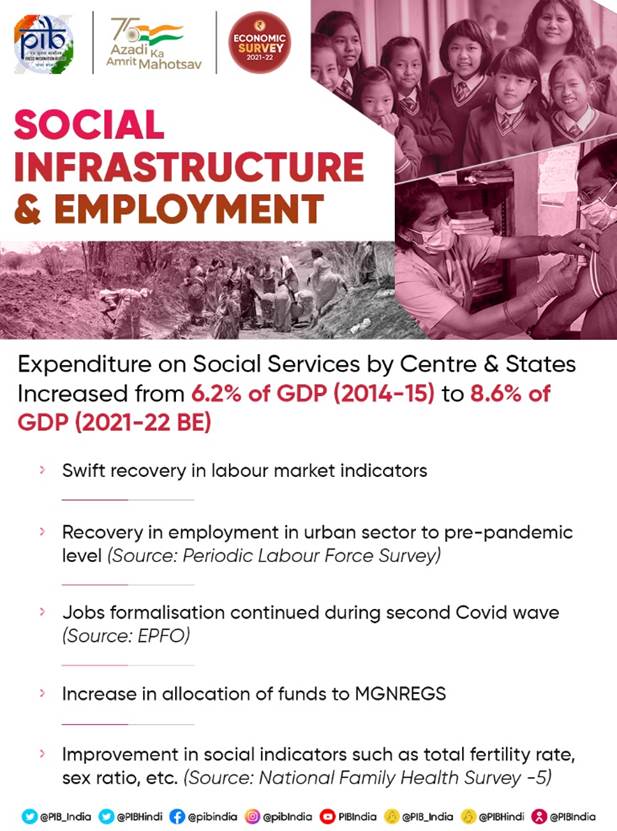
The Economic Survey also analyses trends in urban employment using Employees Provident Funds Organization (EPFO) payroll data. An analysis of the EPFO data suggests significant acceleration in formalization of the job market, during 2021. In fact, in November, 2021, the monthly net additional EPF subscription peaked with 13.95 lakh new subscribers, the highest in any given month since 2017, the Survey states. This translates into growth of 109.21 percent in EPF subscription from November, 2020. The Economic Survey further states that the monthly net addition in EPF subscriptions during 2021 has not only been higher than the corresponding monthly values in 2020 but they have also surpassed the levels of the corresponding months during pre-pandemic year 2019. 

Trends in Rural Labour Market:

            Economic Survey 2021-22 analyses trends in Rural Labour Market with the help of latest data on demand for work under Mahatma Gandhi National Rural Employment Guarantee Scheme (MGNREGS).

            The Survey observes that the MGNREGS employment peaked during the nationwide lockdown in 2020. However an interesting trend was observed for many migrant source states like West Bengal, Madhya Pradesh, Odisha, Bihar, in which the MGNREGS employment in most months of 2021 has been lower than the corresponding level in 2020. In contrast, the demand for MGNREGS employment has been higher for migrant recipient states like Punjab, Maharashtra, Karnataka and Tamil Nadu for most months in 2021 over 2020.

Giving further details, the Economic Survey points out that the demand for MGNREGS work has stabilized after the second Covid wave. It further states that the aggregate MGNREGS employment is still higher than pre-pandemic level. During the second Covid wave, demand for MGNREGS employment reached the maximum level of 4.59 crore persons in June 2021.

Long Term Trends in Employment using Annual PLFS Data:

            During PLFS 2019-20 (survey period from July 2019 to June 2020), employment at usual status continued to expand. Between 2018-19 and 2019-20, about 4.75 crore additional persons joined the workforce. This is about three times more than the employment created between 2017-18 and 2018-19. The rural sector contributed much more to this expansion relative to the urban sector (3.45 crore in rural sector and 1.30 crore in urban sector). Further, amongst the additional workers, 2.99 crore were females (63 percent). About 65 percent of the additional workers joined in 2019-20 were self employed. About 75 percent of the female workers who joined as self- employed were ‘unpaid family labour’. About 18 percent of the additional workers were Casual Labourer and 17 percent were ‘Regular Wage/Salaried Employee’. Further, the number of unemployed persons in 2019-20 has also decreased by 23 lakhs, constituted largely by males from the rural sector.

            With respect to industry wise employment in India, of the workers added in 2019-20, more than 71 percent were in agricultural sector. Among the new workers in the agriculture sector, females account for about 65 percent. Trade, hotel and restaurant sector accounted for a little over 22 percent of the new workers, in line with previous year’s trend where the sector represented more than 28 percent of the new workers. The share of manufacturing has declined from 5.65 percent of new workers added in 2018-19 to about 2.41 percent of new workers added in 2019-20, and so has that of construction from 26.26 percent to 7.36 percent.

Important Policy Measures to boost livelihoods:

The Economic Survey has highlighted several policy responses to boost livelihoods. These include Aatmanirbhar Bharat Rojgaar Yojana which was announced as a part of Aatmanirbhar 3.0 package to boost the economy, increase the employment generation in post Covid recovery phase and to incentivise creation of new employment alongwith the social security benefits and restoration of loss of employment during Covid-19 pandemic.

To boost employment and livelihood for returnee migrant workers, Garib Kalyan Rojgar Abhiyan was launched in June 2020. It focused on 25 target driven works to provide employment and create infrastructure in the rural areas of 116 districts 6 states with  resource envelope of Rs.50,000 Crore.

Similarly, allocation to MGNREGS in FY 2021-22 increased to Rs. 73,000 crore, from Rs. 61,500 crore in FY 2020-21. Allocation for FY 2021-22 has been enhanced to Rs.98000 crore so far. In FY 2021-22 over 8.70 crore individuals and 6.10 crore households were provided work so far.


The Survey also highlights several other social protection measures which have been stepped up like Pradhan Mantri Shramyogi Mandhan (PM-SYM) Yojana, National Pension Scheme for traders/shopkeepers/self employed persons, e-SHRAM portal to facilitate delivery of Social Security Schemes to workers and Labour Reforms for welfare of labour.

CENTRAL THEME OF ECONOMIC SURVEY 2021-22 IS THE “AGILE APPROACH” (Press Release 31 Jan 2022)

CENTRAL THEME OF ECONOMIC SURVEY 2021-22 IS THE “AGILE APPROACH”


PREFACE TAKES A BIRD’S EYE VIEW OF EVOLUTION OF ECONOMIC SURVEYS SINCE INDEPENDENCE

NEW CHAPTER DEMONSTRATES USE OF SATELLITE & GEO-SPATIAL IMAGES TO GAUGE VARIOUS ECONOMIC PHENOMENON

ECONOMIC SURVEY REVERTS TO A SINGLE VOLUME PLUS A SEPARATE VOLUME FOR STATISTICAL APPENDIX

The central theme of this year’s Economic Survey is the “Agile approach”, implemented through India’s economic response to the COVID-19 Pandemic shock. Informing further, the preface of Economic Survey states that the “Agile approach” is based on feed-back loops, real-time monitoring of actual outcomes, flexible responses, safety-net buffers and so on.

The Economic Survey 2021-22 tabled by the Union Minister for Finance & Corporate Affairs Smt. Nirmala Sitharaman in the Parliament today, argues that some form of feedback loop based policy-making was always possible, but the “Agile framework: is particularly relevant today because of the explosion of real-time data that allows for constant monitoring. Such information includes GST collections, digital payments, satellite photographs, electricity production, cargo movements, internal/external trade, infrastructure roll-out, delivery of various schemes, mobility indicators, to name just a few. Some of them are available from public platforms but many innovative forms of data are now being generated by the private sector. Short-term policy responses, therefore, the Survey states, can be tailored to an evolving situation rather than what a model may have predicted.

 Planning matters in this framework but mostly for scenario-analysis, identifying vulnerable sections, and understanding policy options rather than as a deterministic prediction of the flow of events. The Survey notes that the previous Economic Survey did briefly discuss this approach but it is a central theme for this Survey.

Another theme highlighted in this Economic Survey relates to the art and science of policy-making under conditions of extreme uncertainty. It is not just about the immediate disruptions and uncertainty caused by repeated waves of the COVID-19 pandemic, but also the longer-term uncertainty about the post-COVID world due to accelerated shifts in technology, consumer behaviour, supply-chains, geo-politics, climate change and a host of other factors. Not only are these individual factors difficult to forecast, the impact of their interactions are fundamentally unpredictable. The same recognition of uncertainty informs the longer-term supply-side strategy: the combination of policies that encourage economic flexibility through innovation, entrepreneurship and risk-taking on one hand, and simultaneously invests in resilient infrastructure, social safety-nets and macro-economic buffers on the other.

The Survey states that various policies of the Government of India are all about protection from or taking advantage of an uncertain future.  It expects its readers to recognise the links between seemingly disparate policies ranging from deregulation, process simplification, privatization, foreign exchange reserves accumulation, inflation-targeting, housing-for-all, green technology, the Insolvency and Bankruptcy Code, health insurance for the poor, financial inclusion, infrastructure spending, direct benefit transfers and so on.

The Preface also takes a bird’s eye view of the “great deal of evolution” of the Economic Surveys presented since the first Survey in 1950-51. The Survey charted out many permutations and combinations in terms of language, statistics, formats, topics, length, scope and prescriptions projected through the Economic Surveys. Interestingly, for more than a decade after 1st Survey, the Survey document was clubbed with the Union Budget.

Making a shift from the two-volume format of recent years to a single volume plus a separate volume for statistical tables, the Survey argues for smaller and terse document. Over the years, increasing voluminous state of the document has made it unwieldy with last year’s Economic Survey 2020-21 with almost 900 pages. Therefore, this year’s Survey reverts to a single volume plus a separate volume for the Statistical Appendix. The idea of having a separate volume for the statistical appendix is to give it a distinct identity as the one-stop source of authentic data. The Economic Survey hopes that it will evolve in the next few years to include new kinds of socio-economic data in line with the emphasis on a feedback loop approach.

Along with the sectoral chapters, this year’s Survey adds a new chapter that demonstrates the use of satellite and geo-spatial images to gauge various economic phenomenon – urbanisation, infrastructure, environmental impact, farming practices and so on.

Monthly Review of Accounts of Union Government of India upto month of December 2021 for Financial Year 2021-22

The Monthly Account of the Union Government of India upto the month of December, 2021 has been consolidated and reports published. The highlights are given below:-

The Government of India has received Rs. 17,61,692 crore (89.1% of corresponding BE 2021-22 of Total Receipts) upto December, 2021 comprising Rs. 14,73,809 crore Tax Revenue (Net to Centre), Rs. 2,59,414 crore of Non-Tax Revenue and Rs. 28,469 crore of Non Debt Capital Receipts. Non-Debt Capital Receipts consists of Recovery of Loans Rs. 19,105 crore and Miscellaneous Capital Receipts of Rs. 9,364 crore. Rs. 4,50,310 crore has been transferred to State Governments as Devolution of Share of Taxes by Government of India upto December, 2021. 

Total Expenditure incurred by Government of India is Rs. 25,21,058 crore (72.4% of corresponding BE 2021-22), out of which Rs. 21,29,414 crore is on Revenue Account and Rs. 3,91,644 crore is on Capital Account. Out of the Total Revenue Expenditure, Rs. 5,64,414 crore is on account of Interest Payments and Rs. 2,71,374 crore is on account of Major Subsidies.

Press Release dated 31st Jan 2022

Rs 1,38,394 crore Gross GST Revenue collected for January 2022

Rs 1,38,394 crore Gross GST Revenue collected for January 2022


GST collection crossed Rs 1.30 lakh crore mark for the 4th time

Revenues for the month of January 2022 15% higher than GST revenues in the same month last year and 25% higher than the GST revenues in January 2020Posted

Press Release date:- Jan 31, 2022

The gross GST revenue collected in the month of January 2022 till 3PM on 31.01.2022 is Rs 1,38,394 crore of which CGST is Rs 24,674 crore, SGST is Rs 32,016 crore, IGST is Rs 72,030 crore (including Rs 35,181 crore collected on import of goods) and cess is Rs 9,674 crore (including Rs 517 crore collected on import of goods). The highest monthly GST collection has been Rs 1,39,708 crore in the month of April 2021. Total number of GSTR-3B returns filed upto 30th January 2022 is 1.05 crore that includes 36 lakh quarterly returns.

The government has settled Rs 29,726 crore to CGST and Rs 24,180 crore to SGST from IGST as regular settlement. In addition, Centre has also settled Rs. 35,000 crore of IGST on ad-hoc basis in the ratio of 50:50 between Centre and States/UTs in this month. The total revenue of Centre and the States in the month of January 2022 after regular and ad-hoc settlements is Rs 71,900 crore for CGST and Rs 73,696 crore for the SGST. Centre also released GST compensation Rs 18,000 crore in January’2022 to States/UTs.

The revenues for the month of January2022 are 15%higher than the GST revenues in the same month last year and 25% higher than the GST revenues in January 2020. During the month, revenues from import of goods was 26% higher and the revenues from domestic transaction (including import of services) are 12% higher than the revenues from these sources during the same month last year.

This is for the fourth time GST collection has crossed Rs 1.30 lakh crore mark. 6.7 crore e-way bills were generated in the month of December 2021 which is 14% higher than 5.8 crore e-way bills generated in the month of November 2021. Coupled with economic recovery, anti-evasion activities, especially action against fake billers have been contributing to the enhanced GST. The improvement in revenue has also been due to various rate rationalization measures undertaken by the Council to correct inverted duty structure. It is expected that the positive trend in the revenues will continue in the coming months as well.