Central Government relaxes provisions of TDS u/s 194A of the Income-tax Act, 1961 in view of section of 10(26) of the Act (Ministry of Finance Press Release dated 17th Sept 2021)

The Central Government in exercise of the powers conferred by sub-section(1F) of section 197A of the Income-tax Act, 1961(“the Act”) notified that no deduction of tax shall be made on the following payment under section 194A of the Act, namely payment in the nature of interest, other than interest on securities, made by a Scheduled Bank (hereinafter the ‘payer’) located in a specified area to a member of Scheduled Tribe  (hereinafter the ‘receiver’) residing in any specified area as referred to in s.10(26) of the Act, subject to the following conditions:

  1. the payer satisfies itself that the receiver is a member of Scheduled Tribe residing in any specified area, and the payment as referred above is accruing or arising to the receiver as referred to in section 10(26) of the Act, during the previous year relevant for the assessment year in which the payment is made, by obtaining necessary documentary evidences in support of the same;
  2. the payer reports the above payment in the statements of deduction of tax as referred to in sub-section (3) of section 200 of the Act;
  3. the payment made or aggregate of payments made during the previous year does not exceed twenty lakh rupees.

           For the purposes of the said notification, ‘Scheduled Bank’ means a bank included in the Second Schedule of the Reserve Bank of India Act,1934.

Notification no. 110/2021 dated 17th September, 2021 has been issued. It is available on www.incometaxindia.gov.in and also on www.egazette.nic.in .

****

Measures for streamlining compliances in GST (45th GST Council Meeting dated 17th Sept 2021)

Refer YouTube video link


https://youtu.be/H0VJVlQoYrU

  1. Aadhaar authentication of registration to be made mandatory for being eligible for filing refund claim and application for revocation of cancellation of registration.
  2. Late fee for delayed filing of FORM GSTR-1 to be auto-populated and collected in next open return in FORM GSTR-3B.
  3. Refund to be disbursed in the bank account, which is linked with same PAN on which registration has been obtained under GST.
  4. Rule 59(6) of the CGST Rules to be amended with effect from 01.01.2022 to provide that a registered person shall not be allowed to furnish FORM GSTR-1, if he has not furnished the return in FORM GSTR-3B for the preceding month.
  5. Rule 36(4) of CGST Rules, 2017 to be amended, once the proposed clause (aa) of section 16(2) of CGST Act, 2017 is notified, to restrict availment of ITC in respect of invoices/ debit notes, to the extent the details of such invoices/ debit notes are furnished by the supplier in FORM GSTR-1/ IFF and are communicated to the registered person in FORM GSTR-2B.

FAQs regarding Central Government guarantee to back Security Receipts issued by NARCL for acquiring of stressed loan assets (MOF Press Release dated 16 Sept 2021)

  1. What isNational Asset Reconstruction Company Limited (NARCL)? Who has set it up?

NARCL has been incorporated under the Companies Act and has applied to Reserve Bank of India for license as an Asset Reconstruction Company (ARC). NARCL has been set up by banks to aggregate and consolidate stressed assets for their subsequent resolution. PSBs will maintain51% ownership inNARCL.

2. What is India Debt Resolution Company Ltd. (IDRCL)? Who has set it up?

IDRCL is a service company/operational entity which will manage the asset and engage market professionals and turnaround experts. Public Sector Banks (PSBs) and Public FIs will hold a maximum of 49% stake and the rest will be with private sector lenders.

3 Why is NARCL-IDRCL type structure needed when there are 28 existing ARCs?

Existing ARCs have been helpful in resolution of stressed assets especially for smaller value loans. Various available resolution mechanisms, including IBC have proved to be useful. However,considering the large stock of legacy NPAs, additional options/alternatives are needed and the NARCL-IRDCL structure announced in the Union Budget is this initiative.

4. Why is a Government Guarantee needed?

Resolution mechanisms of this nature which deal with a backlog of NPAs typically require a backstop from Government. This imparts credibility and provides for contingency buffers. Hence, GoI Guarantee of up to Rs 30,600 crore will back Security Receipts (SRs) issued by NARCL. The guarantee will be valid for 5 years. The condition precedent for invocation of guarantee would be resolution or liquidation. The guarantee shall cover the shortfall between the face value of the SR and the actual realisation. GoI’s guarantee will also enhance liquidity of SRs as such SRs are tradable.

5 How will NARCL and IDRCL work?

The NARCL will acquire assets by making an offer to the lead bank. Once NARCL’s offer is accepted, then, IDRCL will be engaged for management and value addition.

6 What benefit do banks get from this new structure?

It will incentivize quicker action on resolving stressed assets thereby helping in better value realization. This approach will also permit freeing up of personnel in banks to focus on increasing business and credit growth. As the holders of these stressed assets and SRs, banks will receive the gains. Further, it will bring about improvement in bank’s valuation and enhance their ability to raise market capital.

7 Why is it being set up now?

Insolvency and Bankruptcy Code (IBC), strengthening of Securitization and Reconstruction of Financial Assets and Enforcement of Securities Interest (SARFAESI Act) and Debt Recovery Tribunals, as well as setting up of dedicated Stressed Asset Management Verticals (SAMVs) in banks for large-value NPA accounts have brought sharper focus on recovery. In spite of these efforts, substantial amount of NPAs continue on balance sheets of banks primarily because the stock of bad loans as revealed by the Asset Quality Review is not only large but fragmented across various lenders. High levels of provisioning by banks against legacy NPAs has presented a unique opportunity for faster resolution.

8. Is the guarantee likely to be invoked?

Government guarantee will be invoked to cover the shortfall between the amount realised from the underlying assets and the face value of SRs issued for that asset, subject to overall ceiling of ₹30,600 crore, valid for 5 years. Since there shall be a pool of assets, it is reasonable to expect that realisation in many of them will be more than the acquisition cost.

9. How will Government ensure faster and timely resolution?

The GoI guarantee will be valid for five years and condition precedent for invocation of guarantee will be resolution or liquidation.Further, to disincentivize delay in resolution, NARCL has to pay a Guarantee fee which increase with passage of time.

10. What will be the capital structure of NARCL and how much will Government contribute?

Capitalization of NARCL would be through equity from banks and Non-Banking Financial Companies (NBFCs). it will also raise debt as required.The GoI guarantee will reduce upfront capitalization requirements.

11. What will be NARCL’s strategy for resolution of stressed assets?

NARCL is intended to resolve stressed loan assets above ₹500 crore each amounting to about ₹ 2 lakh crore. In phase I, fully provisioned assets of about Rs. 90,000 crores are expected to be transferred to NARCL, while the remaining assets with lower provisionswould be transferred in phase II.
Revamped Gold Monetisation Scheme, reduction in import duty of gold to help the industry to grow to the next level

Revamped Gold Monetisation Scheme, reduction in import duty of gold to help the industry to grow to the next level: Anupriya Patel


Reforms would help the industry to achieve export target of US$ 43.75 billion this year and gems and jewellery exports to USD 75 billion in coming years: Anupriya Patel

The Gems & Jewellery sector contributes around 7% to GDP and employs 5 million persons

The Gems & Jewellery sector is one of the important sectors of Indian Economy, with a contribution of around 7% to GDP, 10-12% share in country’s total merchandise export and being one of the leading sectors in terms of employment generation providing employment to approx. 5 million skilled and semi-skilled workforce.

The Minister of State for Commerce and Industry, Anupriya Patel said that she is pleased to learn that without any significant domestic production of raw materials, India has emerged as the leader in diamond manufacturing and export along with being one of largest exporter of other segments of industry such as gold jewellery, silver jewellery, coloured gemstones and synthetic stones. As such, gems and jewellery sector is an ideal example ‘Make in India’, the vision of Honourable Prime Minister.

She informed that the Gems and Jewellery sector has been one of the worst-hit sectors in India during the Covid-19 pandemic and its exports saw a record decline of (-) 98% in April 2020 due to the complete lockdown situation in the country.

However, the GJEPC, being apex body of gems and jewellery exporters, has undertaken prompt measures in terms of constantly interacting with the industry, understanding their requirements, and working closely with the government so as to chalk out the desired measures for supporting the industry in terms of sustaining, surviving and reviving back even amid a critical situation like Covid-19.

Consequent to such measures, the sector shown swift recovery as declining rate of gems and jewellery exports fell to (-) 6 % in Q3 as compared to (-) 72 % recorded in quarter 1  and in Q4 exports of the gems and jewellery witnessed a positive growth of around 15%. This trend has continued this year also and gems and jewellery exports achieved pre-Covid level of exports amounting US$ 9.2 billion in Q1 2021-22.

On the policy front, the Government has introduced a number of reforms, such as the revamped Gold Monetisation Scheme, reduction in import duty of gold, hallmarking, etc. which would help the industry to grow to the next level. Other issues flagged by GJEPC and industry from time to time are also being looked into and expected to be resolved soon.

She said that she’s sure this would not only help the industry to transform but will take the exports on a steep upward trajectory. This would help the industry to achieve export target of US$ 43.75 billion this year as well as to achieve goal of GJEPC to take gems and jewellery exports to USD 75 billion in coming years.

With support of the Government, GJEPC organized various virtual trade events last year like virtual Buyer Seller Meets, virtual IIJS, virtual International Gems & Jewellery Show (e-IGJS), India Global Connect, Webinars etc. These initiatives have helped the industry to bounce back quickly as the pandemic receded and global markets opened up.

She said that she has been informed that IIJS Premiere is the country’s largest B2B show in gems and jewellery sector and also the first show being organized by GJEPC in physical format after the onset of the COVID-19 pandemic. 

“I am confident that the show would provide platform to Indian jewellery manufacturers to showcase versatile jewellery crafted with the highest standards of design and finish and also to work with retailers, enabling them to gain insights into demand trends and product designs. On the other hand, the show would cater to the sourcing needs of the domestic and international buyers before the start of the festive season,” the MoS said.

She also wished the 37th edition of IIJS Premiere a tremendous success!

Ministry of Commerce & Industry Press Release dated 15th Sept 2021

DGGI Gurugram arrests 3 persons, including mastermind, commission agent and CA in racket of fictitious firms involving fake ITC of 121 crore (Ministry of Finance Press Release dated 15th Sept 2021)

The Directorate General of GST Intelligence (DGGI) Gurugram Zonal Unit (GZU), Haryana has arrested 3 persons including a CA on charges of creating and operating multiple fictitious firms on forged documents and passing large amounts of fake input tax credit by way of issuance of invoices without any actual receipt or supply of goods or services.

From the investigation conducted till date, it has been established that one of the arrested persons has created at least 13 firms and has been involved in availing and passing on of a total fraudulent ITC of Rs 121 crore.

It has also emerged that the person who had created the fake/dummy firms worked in tandem with a commission agent, who used to sell these goodless invoices to established firms for commission, both directly and through different brokers. The commission agent has also been arrested.

Further, in this chain from the financial movement it has emerged that established firms (end-users) would make transfers to these fake firms, from where the amounts would then be transferred to the account of a private limited company from where the CA in question would withdraw and return the said amount in cash after deducting the commission of his company as well as his own commission. The amounts of cash transactions ranged around Rs 30-40 lakh per day.

The investigation spanned multiple locations and based on verifications, evidence and statements recorded, it has appeared that the these three persons i.e. the creator of the fake firms, commission agent and the CA were operating in tandem orchestrating this racket of making fake firms on forged documents and having passed on fraudulent ITC amounting to Rs 121 crore (so far). Accordingly, they were arrested under the provisions of Section 69 read with Section 132 of the CGST Act, 2017 on 13.09.2021 and produced before CMM, Delhi, who ordered 14 days judicial custody.

Further investigations in the matter are under progress.

Meeting of BRICS Heads of Tax Authorities and Experts on Tax Matters held virtually under Chairship of India

The Heads of Tax Authorities of the BRICS countries, namely the Federative Republic of Brazil, the Russian Federation, the Republic of India, the People’s Republic of China and the Republic of South Africa held a virtual meeting here today under the Chairship of India.Shri Tarun Bajaj, Secretary, Revenue, Government of India, in his capacity as Head of Tax Authorities in India, presided over this meeting.

The BRICS Tax Authorities engaged in discussion on the challenges faced by BRICS tax administrations in the digital era, coupled with outbreak of COVID-19 pandemic, sharing experience and devising strategies to overcome those challenges. The broad theme of the meeting was redefining business processes of tax administration amidst challenges posed by COVID-19 and in the digital eraDuring the meetings, the tax authorities also exchanged opinions and views based on existing commitment to the principles of mutual respect, consolidation and continuity as stated in the XIII BRICS Summit, New Delhi Declaration issued on 9th September, 2021.

The meeting was preceded by meetings of the Tax Experts of BRICS countries on 13th & 14th September, 2021. In this meeting, the tax experts discussed potential areas of cooperation, exchanged views and the experiences. The discussion took place around relevant topics which include digitisation of tax administration, leveraging technology for tackling tax evasion, changing role of tax administration from enforcement to service, preparedness and strategies to deal with challenges of COVID-19 and evolution of tax administration to enhance voluntary compliance by taxpayers.

A communiqué was also issued at the conclusion of the Tax Heads meeting.

(Ministry of Finance Press Release dated 15th Sept 2021)

****

Secretary MSME underlines need for hand-holding support to MSMEs through capacity building trainings, exchange of best practices and technologies

Secretary MSME underlines need for hand-holding support to MSMEs through capacity building trainings, exchange of best practices and technologies


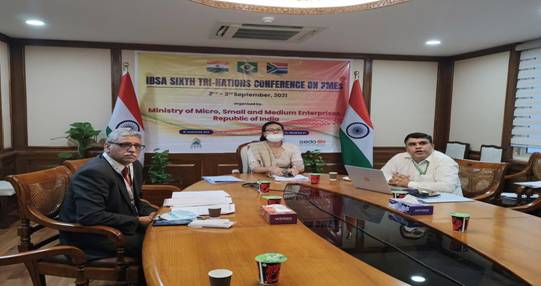
IBSA Conference calls for collective efforts towards better collaborations amongst the three nationsPosted Date:- Sep 08, 2021

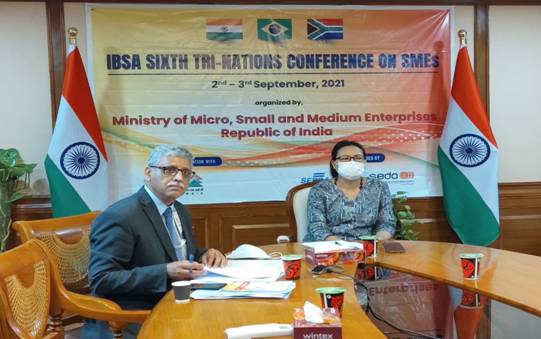
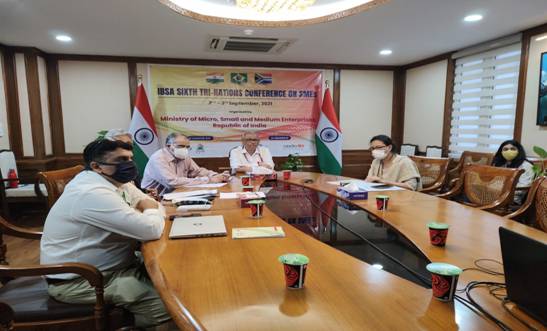
Secretary (MSME) Shri BB Swain has said that the IBSA forum plays an important role in creating awareness about the strengths, opportunities and challenges of MSMEs and help in creating markets for finished products and provide hand-holding support to MSMEs through capacity building trainings, exchange of best practices and technologies. Inaugurating the IBSA 6th Tri-nation Virtual Conference on Small and Medium sized Enterprises (SME), Shri Swain stated that these meetings are being held with the objective to promote trade, understand trade barriers, facilitate investments through collective efforts towards better collaborations amongst the three nations.

IBSA is a unique Forum which brings together India, Brazil and South Africa, three large democracies and major economies from three different continents, facing similar challenges.

The Conference was hosted by the Ministry of MSME last week in association with the National Small Industries Corporation Ltd (NSIC), Brazilian Micro and Small Business Support Service (SEBRAE), Department of Small Business Development (DSBD) and Small Enterprise Development Agency (SEDA), South Africa.


Mr. Vijayendra, CMD, NSIC during his address informed that the main theme of the 6th IBSA Conference was “Democracy for Demography and Development”. He briefed about the various topics of technical sessions to bediscussed.He emphasized that there is much to share and learn from each other’s experiences and best practices in terms of regulatory environment, technology support, access to finance and initiatives taken amid Covid-19 pandemic by IBSA members.

Mr. Eduardo Diogo- Director of Administration and Finance of (Brazilian Micro and Small Business Support Service) SEBRAE, Brazil said that despite the challenges faced due to Covid 19 pandemic, SMEs are still reinventing and generating employment and IBSA needs to work towards their sustainable development.

Mr. LindokuhleMkhumane, Director General,(Department of Small BusinessDevelopment)DSBD, South Africa emphasized that issues like poverty, inequality and unemployment can be addressed by promoting MSMEs. He said that youth and women should also be skilled to promote inclusivity.

Ms. Mercy Epao, Joint Secretary (SME), Ministry of MSME, talked about the contribution of MSME sector in India’s socio-economic development and various policy intervention of the Govt. of India to help the growth of MSMEs in India. She also spoke about the impact of Covid19 pandemic on the MSMEs.


The IBSA 6th Tri-Nations Virtual Conference had four Technical sessions divided into two days in which experts and senior officials from Ministry of MSME, Govt. of India; Brazilian Micro and Small Business Support Service (SEBRAE), Brazil; Department of Small Business Development (DSBD) & Small Enterprise Development Agency (SEDA), South Africa deliberated on various topics like- Enabling MSMEs in National Entrepreneurial Ecosystem, Innovation & Inclusivity, Integration into Global Value Chains, Sustainable Development: Preparedness of IBSA to deal with COVID-19 like crisis in future.

The conference is an important initiative to enhance cooperation amongst the IBSA members in MSME sector synergizing the competencies and inherent strengths of each country. A roadmap will be drawn based on the deliberations held during the sessions to strengthen MSMEs networking, to help overcome the challenges and make the MSMEs competitive on the global platform.

*****

Ministry of Micro,Small & Medium Enterprises Press Release dated 08th Sept 2021

MSME Tool Room CITD, Hyderabad bags Patent for “Anaar” (Fireworks) making Machine & another step towards Atma Nirbhar Bharat and Industrial Safety

The MSME Tool Room, Hyderabad,Central Institute of Tool Design (CITD) has obtained a patent for the invention entitled “AUTOMATIC MACHINE FOR THE PRODUCTION OF CONICAL SHAPED FIREWORKS” for 20 years from the 10th November,2015.

Central Institute of Tool Design signed an MOU with M/s. Standard Fireworks Pvt. Ltd.,(SFPL), Sivakasi and finalized orders worth Rs11.49 crorefor machines for automation processes for various firework projects.SFPL initially had placed an order worth Rs300 lakh for filling up of flower pots and packing, chakkar filling and chakkar winding.  As a first project, CITD has taken up for Module-1 (consisting of flower pot chemical filling and packing). The total project consists of 10 different stations like paper cutting & pasting, chemical filling, washer insertion &ramming, mud filling & sealing etc. 

The aim of project is to automate the entire above process for relieving human fatigue and to save human from hazardous environment. The entire process is minimal human intervention. Hence, it is safe for humans to handle the machine in Fireworks Industry.

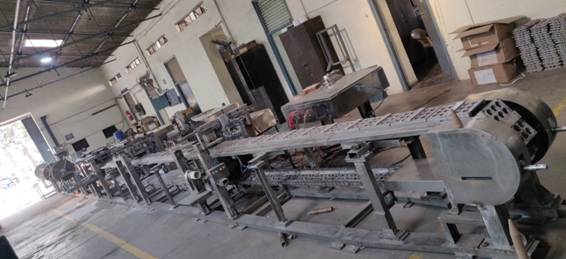
This is the first of its kind with fully indigenous technology. CITD and SFPL  had filed a joint patent  application for this innovation.The uniqueness of machine is that it completely works on pneumatic system for entire process of manufacturing. There is no electrical or electronics system used in process. Therefore, this can avoid most of the fire accidents in field of fireworks industries. Trials were conducted by customer with original chemical in flowerpots and attaining the target production cones of 120 pieces per minute.

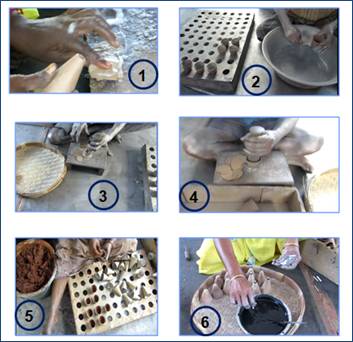
The Manual Process of Flowerpot making (Before automation) is shown below :

FLOWERPOT AUTOMATION (SPM)

The photograph of the Machine is given below

CITD is a Govt. of India organisation working under the administrative control of Ministry of MSME. It was established in the year 1968 and is a pioneering institution in training technical personnel in the field of Tool Design, CAD/CAM, Low Cost Automation etc. The Institute is conducting  training courses right from Diploma level to Post Graduation.

Ministry of Micro,Small & Medium Enterprises Press Release dated 10th Sept 2021