Dear Sir,
Please find below YouTube video link on MCA new rule for change of name u/s 16(3) of the Companies Act, 2013 II MCA Notification dated 22 July 2021
Regards,
Bipul Kumar
Simplifying your business ideas, structures, functionalities, relations & operations
Dear Sir,
Please find below YouTube video link on MCA new rule for change of name u/s 16(3) of the Companies Act, 2013 II MCA Notification dated 22 July 2021
Regards,
Bipul Kumar
A report on “Renewables Integration in India 2021” was jointly launched by Dr. Rakesh Sarwal, Additional Secretary, NITI Aayog & Mr. Keisuke Sadamori, Director of Energy Markets and Security, IEA on 22nd July, 2021. The report is based on the outcome of three states workshops held with the Governments of Maharashtra, Karnataka and Gujarat to understand the specific energy transition challenges faced by these renewable-rich states. The report uses IEA modelling results to show the effects of different flexibility options on the power system.
The report highlights that India’s power system can efficiently integrate renewables (175 GW by 2022 and 450 GW by 2030), but it would require identification of resources and proper planning, regulatory, policy and institutional support, energy storage and advance technology initiatives.
Indian states need to employ a wide range of flexibility options – such as demand response, more flexible operation of coal based power plants, storage, and grid improvements – to transition to cleaner electricity systems. Larger shares of renewables can be better managed by shifting time of use in agriculture. Time of Use (ToU) tariffs will be an effective tool to incentivise demand side management and encourage flexible consumption.
Mr. Keisuke Sadamori, the IEA Director of Energy Markets and Security, indicated that the joint report underscores IEA’s commitment to provide support to India with its clean energy transition agenda.
Launching the report, Dr. Rakesh Sarwal, Additional Secretary, NITI Aayog, said that the joint report provides useful suggestions for the states to consider to best manage their integration challenge.
Mr. Amitesh Kumar Sinha mentioned that after 2023-24, RE integration will become an issue and could be addressed through supply and demand side measures. He also emphasized the role of distributed solar which will play a major role in reducing integration challenges. Mr. Vivek Kumar Dewangan, Additional Secretary, Ministry of Power said that the report on renewables integration will serve as repository of vast knowledge for stakeholders in India. He highlighted Government’s policies on thermal power plant flexibility and strengthening of transmission network through green corridors and stressed on the need for cost effective solutions for storage technologies.
Mr. Dinesh Waghmare, Principal Secretary (Energy), Government of Maharashtra, stated that Ministry of Power proposed Market Based Economic Dispatch (MBED) model for better optimization of scheduling and economic dispatch of generation capacities purely on economic principles which will replace the current practice of Self Scheduling by Discom.
Dr. N Manjula, Managing Director, Karnataka Power Transmission Corporation Limited emphasized that to absorb maximum RE power, State has shifted 70% -80% agriculture load to the day time, providing incentives to industrial consumers for consuming more electricity and increasing State share in the Green Energy Trading (now, approx. 50%). All these measures have helped to reduce the curtailments, which is almost zero now. Government of Karnataka is in the process of bringing in new RE policy.
Mr. K V S Baba, Chairman and Managing Director, POSOCO stated that RE integration can start with proper resources planning and better implementation of technologies, such as Artificial Intelligence, base power system management and smart grid intervention.
Mr. Anand Kumar, Former Chairman, Gujarat Electricity Regulatory Commission was of the view that old regulations needs to be revised and regulatory commissions need to play more proactive role to implement the revised regulations. Smart meters, Time of the Day tariff and overall demand response program would be useful for RE load management.
Sh. Rajnath Ram, Adviser (Energy) concluded the meeting with remarks that the NITI Aayog looks forward to giving continuous support to the state governments in order to support their development plan for affordable, secure and clean power systems of the future.
*****
NITI Aayog Press Release 24 July 2021
World has waited long enough for the delivery of promised Climate finance and technologies at low cost: Shri Bhupender Yadav
We should not be shifting goalposts and setting new benchmarks for global climate ambition: India at G20 Climate Summit.
On the second and concluding day of the G20 summit, Shri Bhupender Yadav, Minister for Environment, Forest and Climate Change stressed that the G20 must respond to the call of science for urgent global climate action in this decade.
The G20 Energy and Climate Joint Ministerial Meeting held today at, Naples, Italy was attended virtually by the Indian delegation from the Ministry of Environment, Forest and Climate Change, and the Ministry of Power.
Speaking at different sessions on Climate Change, the Union Environment Minister underlined the need to cut absolute emissions rapidly while taking into account the Paris Agreement which emphasised on respective historical responsibilities, delivery of promised climate finance and technologies at low cost keeping in perspective per capita emissions, differences in per capita GDP and the unfinished agenda for sustainable development.
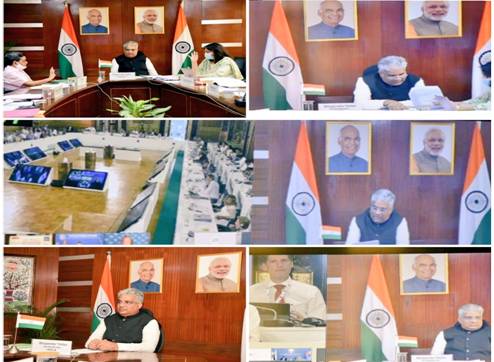
Shri Yadav stated that India remains steadfast in its commitments to join and lead efforts to combat climate change within the multilaterally agreed convention and its Paris Agreement.
The Minister mentioned about the vision of Prime Minister Shri Narendra Modi , installing 450 GW (Giga Watt) of RE (Renewable Energy) by 2030, enhanced ambition in bio-fuels, India’s NDCs (Nationally Determined Contributions) and various other initiatives taken by India on Urban Climate Action.
The Minister stressed, common but differentiated responsibilities to combat climate change, as per respective capabilities and national circumstances, lies at the heart of the UNFCCC & its Paris Agreement. “We should not be shifting goalposts and setting new benchmarks for global climate ambition”, said Shri Yadav and informed that under the visionary leadership of Prime Minister Shri Narendra Modi, India has exhibited exemplary resolve by achieving its pre 2020 voluntary commitment of reducing emission intensity.
“With increase in urbanization, it is important to create and preserve green spaces and protect biodiversity in urban areas” said the Environment Minister and informed that India’s Urban Climate Actions include Climate Smart Cities Assessment Framework, National Mission on Sustainable Habitat,Climate Center for Cities, Climate Smart Cities Alliance, Climate Practitioners India Network, Urban Forestry, etc.
India also welcomed the G20 works on Sustainable Recovery, Cities, Financial Flows, etc.
Ministry of Environment, Forest and Climate Change Press Release dated 24 July 2021
India has scored 90.32% in United Nation’s Economic and Social Commission for Asia Pacific’s (UNESCAP) latest Global Survey on Digital and Sustainable Trade Facilitation. The Survey hails this as a remarkable jump from 78.49% in 2019. The survey result can be accessed at(https://www.untfsurvey.org/economy?id=IND).
After evaluation of 143 economies, the 2021 Survey has highlighted India’s significant improvement in the scores on all 5 key indicators, as follows:
The Survey notes that India is the best performing country when compared to South and South West Asia region (63.12%) and Asia Pacific region (65.85%). The overall score of India has also been found to be greater than many OECD countries including France, UK, Canada, Norway, Finland etc. and the overall score is greater than the average score of EU. India has achieved a 100% score for the Transparency index and 66% in the “Women in trade” component.
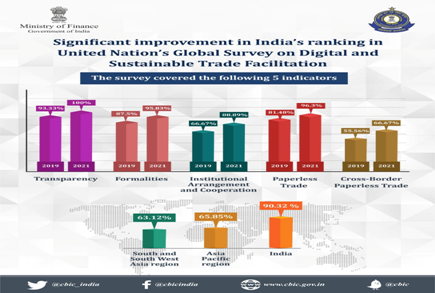
CBIC, has been at forefront of path breaking reforms under the umbrella of ‘Turant’ Customs to usher in a Faceless, Paperless and Contactless Customs by way of a series of reforms. This has had a direct impact in terms of the improvement in the UNESCAP rankingson digital and sustainable trade facilitation.
Further, during the Covid19 pandemic, Customs formations have made all efforts to expedite Covid related imports such as Oxygen related equipments, life-saving medicines, vaccines etc.A dedicated single window COVID-19 24*7 helpdesk for EXIM trade was created on the CBIC website to facilitate quick resolution of issue(s) faced by importers.
About the Survey:
The Global Survey on Digital and Sustainable Trade Facilitation is conducted every two years by UNESCAP. The 2021 Survey includes an assessment of 58 trade facilitation measures covered by the WTO’s Trade Facilitation Agreement. The Survey is keenly awaited globally as it evidences whether or not the trade facilitation measures being taken have the desired impact and helps draw comparison amongst countries. A higher score for a country also helps businesses in their investment decisions.
Ministry of Finance Press release dated Press Release Press Release dated 23 July 2021
National Small Industries Corporation, a PSU under the Ministry of MSME has a B2B MSME Global Mart Portal and efforts have been made to further strengthen activities under it. The salient features of the portal include online registration, web store management, multiple payment options, customer support through Call Centre and enhanced security features.
Khadi and Village Industries Commission (KVIC), a statutory body under the Ministry of Micro, Small and Medium Enterprises has ekhadiindia.com for B2C outreach, which enables all businesses to have a global reach with Interactivity, Immediacy and Ease of Adaptation.
The revenue generation from the portal depends on membership of the portal.
This information was given by Minister for Micro. Small and Medium Enterprises Shri Narayan Rane in a written reply in the Lok Sabha today.
Ministry of Micro,Small & Medium Enterprises Press Release dated 22 July 2021
All newspaper compilation from Economic times, Live mint & Financial express on Entrepreneurship, Taxation, Personal Finance & Succession planning. Refer link:
1. *Are Portfolio Management Fees Tax Deductible?*
2. *CBDT grants further relaxation in e-filing of Income Tax Forms to August 15*
3. *How NRIs are taxed in India*
https://www.livemint.com/money/personal-finance/how-nris-are-taxed-in-india-11626899587966.html
4. *90 unique problems related to new income tax e-filing portal reported: Govt*
5. *Reimagining the real estate sector in the new normal*
https://www.financialexpress.com/money/reimagining-the-real-estate-sector-in-the-new-normal/2294751/
6. *Health drives non-life insurers back to black in Q1, premia growth up 13.8%: Report*
7. *Investors should cap foreign market investments at 15-20%*
8. *Algorithm-based investing is cutting edge, but is it for you?*
All newspaper compilation from Economic times, Live mint & Financial express on Entrepreneurship, Taxation, Personal Finance & Succession planning. Refer link:
1. *How much tax do you pay on debt investments?*
3. *Infosys acknowledged technical issues in I-T portal, initial glitches mitigated: FinMin*
4. *What if you wanted to know how much Mukesh Ambani has in his account?*
5. *Fund industry has to better manage liquidity in crises*
6. *Family arrangement in writing can avoid dispute over property*
7. *‘ESG risks, opportunities must be focal point of investments’*
8. *Know how to invest in an initial share sale*
9. *Things to check before taking a pre-owned car loan*
10. *Fewer new EPF registrations in May*
https://www.financialexpress.com/money/fewer-new-epf-registrations-in-may/2294414/
11. *Why smallcaps should be part of your investment portfolio*
12. *New health insurance plan: HDFC ERGO Optima Secure offers 4 times sum insured at no extra cost*
13. * Unpaid overtime has soared since the beginning of the pandemic: Survey*
14. *Housing sales in Delhi NCR dip by 70% QoQ in April-June 2021: Report*
15. *New Fund Offer: Nippon India Flexi Cap Fund seeks to capture opportunities across market caps*
16. *City suburbs emerge most resilient office markets amid the pandemic*
17. *Not satisfied with FD rates? Know the risks and rewards of investing in Corporate Bonds*
18. *From PPF to NSC, best government savings schemes with their salient features*https://www.financialexpress.com/money/from-ppf-to-nsc-best-government-savings-schemes-with-their-salient-features/2294175/
The ideal man is he who, in the midst of the greatest silence and solitude, finds the intensest activity, and in the midst of the intensest activity finds the silence and solitude of the desert.
Intense activity is necessary; we must always work. We cannot live a minute without work. What then becomes of rest? Here is one side of the life struggle–work, in which we are whirled rapidly round. And here is the other–that of calm, retiring renunciation: everything is peaceful around, there is very little of noise and show, only nature with her animals and flowers and mountains. Neither of them is a perfect picture. A man used to solitude, if brought in contact with the surging whirlpool of the world, will be crushed by it; just as the fish that lives in the deep sea water, as soon as it is brought to the surface, breaks into pieces, deprived of the weight of water on it that had kept it together. Can a man who has been used to the turmoil and the rush of life live at ease if he comes to a quiet place? He suffers and perchance may lose his mind. The ideal man is he who, in the midst of the greatest silence
and solitude, finds the intensest activity, and in the midst of the intensest activity finds the silence and solitude of the desert. He has learnt the secret of restraint, he has controlled himself. He goes through the streets of a big city with all its traffic, and his mind is as calm as if he were in a cave, where not a sound could reach him; and he is intensely working all the time. That is the
ideal of Karma- Yoga, and if you have attained to that you have really learnt the secret of work.
-Swami Vivekananda
Indian Council of Agricultural Research (ICAR) is continuously working to upgrade technology and provide quality seeds to farmers. During this process the advancements made in the agricultural sciences both within India and outside are considered for their replication under the suitable farming situations. ICAR focuses on development/ adoption of new technologies such as- high yielding and multi-stress resistant/tolerant varieties/hybrids in major crops; multi-nutrients rich varieties of rice, wheat, maize, lentil and pearl millet and improved quality of mustard and soybean; blast resistant wheat varieties; transgenic varieties in cotton, pigeonpea and chickpea; exploitation of gene editing technology for improving desired traits in rice and wheat and development of extra-early/early maturing varieties of pulses especially mungbean and pigeonpea. During 2014 till January 2021, a total of 1575 varieties of 70 field crops have been developed which include 770 of cereals, 235 of oilseeds, 236 of pulses, 170 of fibre crops, 104 of forage crops, 52 of sugarcane and 8 of other crops. In addition, 288 varieties of horticultural crops have also been released and notified. Besides, 150 seed hubs in pulses and oilseeds have also been established in the country to produce and distribute quality seed of pulses and oilseeds. ICAR has developed several locations specific, cost effective, eco-friendly, socially acceptable scientific farming practices in farmers’ participatory mode addressing issues at ground level keeping in view the farmers’ resource availability, traditional indigenous technology. ICAR has developed several improved farm implements/machines, process protocols and value-added products to reduce input costs, drudgery and post-harvest losses in production post production agriculture.
For small holder farmers, ICAR has developed 60 Integrated Farming System (IFS) models including 8 Integrated Organic Farming System models for adoption in 22 states and 3 Union Territories. To promote organic farming in the country, 39 crops based 51 cropping systems have been developed, which are suitable for farming in 12 states. Government of India is promoting organic farming and zero budget natural farming under various schemes. These are traditional agricultural technologies which uses cattle and are beneficial for small farmers. Pramaparagat Krishi Vikas Yojana (PKVY) scheme provides an assistance of Rs. 50,000 per ha for three years to farmers to use organic inputs. Mission Organic Value Chain Development for North Eastern Region (MOVCDNER) provides Rs. 25,000 per ha for three years for farmers to use organic inputs. Also, this scheme has provision up to Rs. 2 crores for formation of FPOs, capacity building and post-harvest infrastructure.
Introduction of fuel driven farm equipment and tractors have ensured completing different farm operations within their timeliness and saved a lot of cost of operation with reduced drudgery. In order to prevent adverse effect of chemical fertilizers, the Council is advocating judicious use of chemical fertilizers through soil test based balanced and integrated nutrient management encompassing conjunctive use of both inorganic and organic sources of nutrients viz. FYM/Compost, biofertilizers, green manures etc. to the farmers.
This information was given in a written reply by the Union Minister of Agriculture and Farmers Welfare Shri Narendra Singh Tomar in Lok Sabha today.
****
Ministry of Agriculture & Farmers Welfare Press Release dated 20 July 2021
Ministry of Agriculture & Farmers Welfare
Posted Date:- Jul 20, 2021
The following steps have been taken by the Indian Council of Agricultural Research to make Krishi Vigyan Kendras (KVKs) more effective in the interest of farmers:
This information was given in a written reply by the Union Minister of Agriculture and Farmers Welfare Shri Narendra Singh Tomar in Lok Sabha today.
****
 Business So Simple