New e-Bill system to enable paperless submission and end to end digital processing of bills

Finance Minister Smt. Nirmala Sitharaman launches e-Bill system on 46th Civil Accounts Day


New e-Bill system to enable paperless submission and end to end digital processing of bills

Press Release posted Date:- Mar 02, 2022

The Union Minister for Finance & Corporate Affairs Smt. Nirmala Sitharaman launched the e-Bill system for Central Government Ministries on the 46th Civil Accounts Day here today.
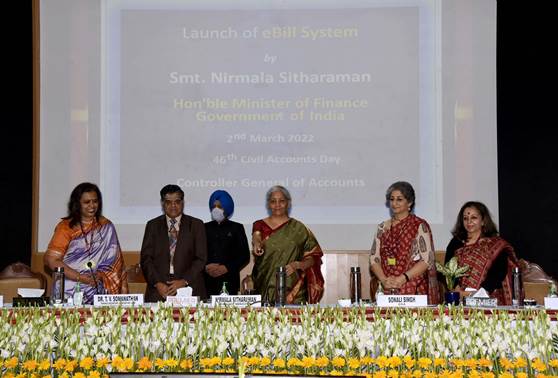
In a phased manner, the new system will make the entire process of submission and backend processing of bills completely paperless and transparent.  Thus, it is a major step forward in realizing the vision of “Digital India” and promoting ease of doing business. 

The objectives of the system are to:

a)         Provide convenience to all vendors/suppliers of the government to submit their bills/claims at anytime, from anywhere.

b)         Eliminate physical interface between suppliers and government officers.

c)         Enhance efficiency in processing of bills/claims.

d)         Reduce discretion in processing of bills through “First-In-First-Out”(FIFO) method.

Currently, the suppliers of various goods and services to the Government have to submit physical, ink signed copies of their bills to the respective Ministries/Departments/offices of the Government of India.  Similarly, the government employees also need to submit hard copies of their claims.  At the backend too, the processing of bills is done through a mixed system of physical and digital modes. So the suppliers/vendors or their representatives need to visit the offices to deliver bills.  Moreover, they are unable to track the status of processing of their bills. 

Under the newly launched e-Bill system, vendors/suppliers can upload their bills online along with supporting documents from the convenience of their homes/offices at any time through digital signature.  For those not having a digital signature, the facility of e-sign using Aadhaar has also been provided. So, the suppliers will no longer be required to visit the offices concerned for this purpose. 

At the backendtoo, the electronic bill received will be processed by the authorities digitally at every stage and finally, the payments will be credited digitally to the bank account of the vendor.  The vendor/supplier would be able to track the status of processing of their bills online.  Thus, the new system will bring in lot of efficiency and transparency in the system and is a big citizen-centric decision of the Government of India.

The e-Bill system has been developed by the Public Financial Management System (PFMS) Division in the office of the Controller General of Accounts in the Department of Expenditure, Ministry of Finance. The bills will be processed by First-In-First-Out (FIFO) method.

The system has been initially rolled out in the following nine Pay and Accounting Units of following nine Ministries/Departments:-

1)         PAO Ministry of Food Processing Industry

2)         PAO, Department of Pharmaceuticals, Ministry of Chemical and Fertiliser

3)         PAO, Department of Science and Technology, Ministry of Science and Technology

4)         PAO (CGA HQ), Department of Expenditure, Ministry of Finance

5)         PAO (PFMS Division), Department of Expenditure, Ministry of Finance

6)         PAO, Ministry of New and Renewable Energy

7)         PAO (Census), Ministry of Home Affairs

8)         PAO M/o Steel

9)         PAO (NIC), Ministry of Electronics and Information Technology

            The e-Bill system will be rolled out in other Ministries/Departments in a phased manner in 2022-23. 

In addition to promoting ease of doing business and brining convenience to lakhs of vendors/suppliers, the e-Bill system will be environment friendly, eliminating the need to submit crores of paper bills annually and will thus save tonnes of papers every year.  The e-Bill system has an elaborate digital storage facility for retrieval of documents and a robust audit trail.

****

MIGRATION OF FOREIGN COMPANIES TO INDIA

Ministry of Commerce & Industry Press Release dated 11th Feb 2022

Various initiatives/schemes have been launched by Government for promoting growth and attracting investment in India. The Make in India programme was launched on 25th September, 2014 with aim of facilitating enhanced investment, foster innovation, build best in class infrastructure, and make India a hub for manufacturing, design, and innovation. Continuous efforts are made under Investment Facilitation and Outreach for implementation of Make in India action plans to identify potential investors, support Indian Missions abroad and State Governments for organizing events, summits, road-shows and other promotional activities to attract investments in the country.

Measures have been taken to improve the country’s investment climate, as a result of which India jumped to 63rd place in World Bank’s Ease of Doing Business [EODB] ranking as per World Bank’s Doing Business Report (DBR) 2020 from a rank of 142 in 2014. Department for Promotion of Industry and Internal Trade (DPIIT), in consultation with the State Governments, has also started a comprehensive reform exercise in States and UTs under Business Reforms Action Plan (BRAP). All States/UTs in the country are ranked on the basis of reforms implemented by them on designated parameters. This exercise has helped in improving business environment across States.

An Empowered Group of Secretaries has been constituted to fast track investments in the country. Similarly Project Development Cells (PDCs) have been set up across Central Government Ministries/Departments to handhold investors and spur sectoral and economic growth. Further, a GIS-enabled India Industrial Land Bank has been launched to help investors identify their preferred location for investment. National Single Window System (NSWS) has also been soft launched in September, 2021 to facilitate clearances for investors.

Keeping in view India’s vision of becoming ‘Atmanirbhar’ and to enhance India’s manufacturing capabilities and exports, an outlay of INR 1.97 lakh crore (over US$ 26 billion) has been announced in Union Budget 2021-22 for Production Linked Incentives (PLI) schemes for 14 key sectors of manufacturing starting from fiscal year (FY) 2021-22. With the announcement of PLI Schemes, significant creation of production, employment, and economic growth is expected over the next 5 years and more.

Measures taken by the Government including on FDI Policy reforms have resulted in increased FDI inflows in the country year after year. India registered its highest ever annual FDI inflow of US$ 81.97 billion (provisional figures) in the financial year 2020-21 despite the COVID related disruptions. These trends in India’s FDI are an endorsement of its status as a preferred investment destination amongst global investors. In the last seven financial years  (2014-21), India has received FDI inflow worth US$ 440.27 billion which is nearly 58 percent of the FDI reported in the last 21 years (US$ 763.83 billion). This indicates increasing inclination of global companies to set up their business in India.

Government has taken various other steps in addition to ongoing schemes to boost domestic and foreign investments in India. These include measures to reduce compliance burden for industry, opportunities under National Infrastructure Pipeline, Reduction in Corporate Tax, Easing liquidity problems of NBFCs and Banks, Policy measures to boost domestic manufacturing through Public Procurement Orders, Phased Manufacturing Programme (PMP), etc.

Besides the above, activities are also undertaken through schemes/ programmes, by several Central Government Ministries / Departments and various State Governments from time to time. The details of these measures are not centrally maintained by Department for Promotion of Industry and Internal Trade.

This information was given by the Minister of State in the Ministry of Commerce and Industry, Shri Som Parkash, in a written reply in the Rajya Sabha today.

***

Entrepreneur -03rd Feb 2022

Implementation of Agriculture Export Policy

https://pib.gov.in/PressReleaseIframePage.aspx?PRID=1794842&RegID=3&LID=1

FDI Inflow

https://pib.gov.in/PressReleaseIframePage.aspx?PRID=1794840&RegID=3&LID=1

Export of Organic Foodgrains

https://pib.gov.in/PressReleaseIframePage.aspx?PRID=1794841&RegID=3&LID=1

Micro Entrepreneurs in Rural Areas

https://pib.gov.in/PressReleaseIframePage.aspx?PRID=1794837&RegID=3&LID=1

API Manufacturers

https://pib.gov.in/PressReleaseIframePage.aspx?PRID=1794836&RegID=3&LID=1

SBI-NCF-IGNCA sign MoU for Development of Atmanirbhar Bharat Centre for Design at Red Fort, Delhi

https://pib.gov.in/PressReleaseIframePage.aspx?PRID=1794907&RegID=3&LID=1

Previous Highest Ever yearly exports crossed in 10 months this year with figures touching USD 336 billion approximately

https://pib.gov.in/PressReleaseIframePage.aspx?PRID=1794817&RegID=3&LID=1

Initiatives under AatmaNirbhar Bharat including structural and procedural reforms reinforce performance of the industrial sector, expected to grow by 11.8 percent in this financial year (Press release-31st Jan 2022)

Initiatives under AatmaNirbhar Bharat including structural and procedural reforms reinforce performance of the industrial sector, expected to grow by 11.8 percent in this financial year


Investor friendly FDI policy sets up new records in FDI inflows registering highest ever annual FDI inflow of 81.97 billion US$ in 2020-21

Gross bank credit to the industrial sector records growth of 4.1 percent

Production Link Incentive scheme (PLI) Scheme reduces transaction costs, improves ease of doing business

National Infrastructure Pipeline (NIP), National Monetization Plan (NMP) propel infrastructure investment

UDYAM Registration Portal and revision in the definition of the MSMEs enhance productivity, facilitating expansion and growth

Setting up of seven PM Mega Integrated Textiles Region and Apparel Parks (MITRA) notified with a total outlay of Rs. 4,445 crore

Government approves outlay of Rs. 76,000 crore for the development of semiconductors and display manufacturing ecosystem

Construction of National Highways/roads registers an increase of 30.2 percent over the previous year

1835 track km per year of new track length added by Indian Railways through new-lines and multi-tracking projects

Lakshya Bharat Portal launched to provide clear demand projections by oil and gas organizations

Ujjwala 2.0 launched to provide additional 1 crore LPG connections

Government liberalizes drone rules, revises PLI Scheme for growth in aviation sector

Maritime India Vision 2030, envisages coordinated and accelerated growth of India’s maritime sector, 100 years old Inland Vessel Act 1917 replaced with Inland Vessel Act 2021 ushering in a new era

Telecom Reforms to boost 4G proliferation, infuse liquidity and create an enabling environment for investment in 5G networks

India witness fastest rate of growth in renewable energy capacity growing by 2.9 times and solar energy expanding by over 18 times, Green Energy Corridor Projects initiated

Initiatives under AatmaNirbhar Bharat including structural and procedural reforms reinforce performance of the industrial sector, expected to grow by 11.8 perce

https://pib.gov.in/PressReleaseIframePage.aspx?PRID=1793805&RegID=3&LID=1

CENTRAL THEME OF ECONOMIC SURVEY 2021-22 IS THE “AGILE APPROACH” (Press Release 31 Jan 2022)

CENTRAL THEME OF ECONOMIC SURVEY 2021-22 IS THE “AGILE APPROACH”


PREFACE TAKES A BIRD’S EYE VIEW OF EVOLUTION OF ECONOMIC SURVEYS SINCE INDEPENDENCE

NEW CHAPTER DEMONSTRATES USE OF SATELLITE & GEO-SPATIAL IMAGES TO GAUGE VARIOUS ECONOMIC PHENOMENON

ECONOMIC SURVEY REVERTS TO A SINGLE VOLUME PLUS A SEPARATE VOLUME FOR STATISTICAL APPENDIX

The central theme of this year’s Economic Survey is the “Agile approach”, implemented through India’s economic response to the COVID-19 Pandemic shock. Informing further, the preface of Economic Survey states that the “Agile approach” is based on feed-back loops, real-time monitoring of actual outcomes, flexible responses, safety-net buffers and so on.

The Economic Survey 2021-22 tabled by the Union Minister for Finance & Corporate Affairs Smt. Nirmala Sitharaman in the Parliament today, argues that some form of feedback loop based policy-making was always possible, but the “Agile framework: is particularly relevant today because of the explosion of real-time data that allows for constant monitoring. Such information includes GST collections, digital payments, satellite photographs, electricity production, cargo movements, internal/external trade, infrastructure roll-out, delivery of various schemes, mobility indicators, to name just a few. Some of them are available from public platforms but many innovative forms of data are now being generated by the private sector. Short-term policy responses, therefore, the Survey states, can be tailored to an evolving situation rather than what a model may have predicted.

 Planning matters in this framework but mostly for scenario-analysis, identifying vulnerable sections, and understanding policy options rather than as a deterministic prediction of the flow of events. The Survey notes that the previous Economic Survey did briefly discuss this approach but it is a central theme for this Survey.

Another theme highlighted in this Economic Survey relates to the art and science of policy-making under conditions of extreme uncertainty. It is not just about the immediate disruptions and uncertainty caused by repeated waves of the COVID-19 pandemic, but also the longer-term uncertainty about the post-COVID world due to accelerated shifts in technology, consumer behaviour, supply-chains, geo-politics, climate change and a host of other factors. Not only are these individual factors difficult to forecast, the impact of their interactions are fundamentally unpredictable. The same recognition of uncertainty informs the longer-term supply-side strategy: the combination of policies that encourage economic flexibility through innovation, entrepreneurship and risk-taking on one hand, and simultaneously invests in resilient infrastructure, social safety-nets and macro-economic buffers on the other.

The Survey states that various policies of the Government of India are all about protection from or taking advantage of an uncertain future.  It expects its readers to recognise the links between seemingly disparate policies ranging from deregulation, process simplification, privatization, foreign exchange reserves accumulation, inflation-targeting, housing-for-all, green technology, the Insolvency and Bankruptcy Code, health insurance for the poor, financial inclusion, infrastructure spending, direct benefit transfers and so on.

The Preface also takes a bird’s eye view of the “great deal of evolution” of the Economic Surveys presented since the first Survey in 1950-51. The Survey charted out many permutations and combinations in terms of language, statistics, formats, topics, length, scope and prescriptions projected through the Economic Surveys. Interestingly, for more than a decade after 1st Survey, the Survey document was clubbed with the Union Budget.

Making a shift from the two-volume format of recent years to a single volume plus a separate volume for statistical tables, the Survey argues for smaller and terse document. Over the years, increasing voluminous state of the document has made it unwieldy with last year’s Economic Survey 2020-21 with almost 900 pages. Therefore, this year’s Survey reverts to a single volume plus a separate volume for the Statistical Appendix. The idea of having a separate volume for the statistical appendix is to give it a distinct identity as the one-stop source of authentic data. The Economic Survey hopes that it will evolve in the next few years to include new kinds of socio-economic data in line with the emphasis on a feedback loop approach.

Along with the sectoral chapters, this year’s Survey adds a new chapter that demonstrates the use of satellite and geo-spatial images to gauge various economic phenomenon – urbanisation, infrastructure, environmental impact, farming practices and so on.

What are conditions for Food License ?

A food business operator must comply following conditions:

1. Form C ( License copy) must be displayed in a conspicuous location on the premises at all times.

2. Allowing Licensing Authorities to access the premises as needed.

3. Notify authorities of any changes or alterations to the license’s activity or content.

4. At least one technical expert should be hired to oversee the manufacturing process.

The person in charge of the production process must have at least a bachelor’s degree in science with chemistry, biochemistry, food and nutrition, or microbiology, or a bachelor’s degree or diploma in food technology, dairy technology, dairy microbiology, dairy chemistry, dairy engineering, oil technology, veterinary science, hotel management, and catering technology, or any other degree or diploma in any other discipline related to the business’s specific requirements from a recognized

5. Reporting : Submit a periodic yearly report (from April 1 to March 31) by May 31 of each year. Half-yearly returns for the collection, handling, and production of milk and milk products are also required (1st April to 31st September before 30th November and 1st October to 31st March).

6. Ensure that the unit does not create any products other than those listed in the license/registration.

7. Maintain factory sanitary and hygienic requirements, as well as worker hygiene, as stipulated in Schedule – 4 for the food industry category.

8. Separately keep track of production, raw material usage, and sales on a daily basis.

9.Ensure that the raw material source and standards are of the highest possible quality.

10. No Food Business Operator shall manufacture, store, expose for sale, or authorize the sale of any article of food in any premises that is not adequately isolated from any privy, urinal, sullage, drain, or place of storage of foul and waste matter to the satisfaction of the licensing authority.

11. Ensure Clean-In-Place systems (where applicable) for frequent machine and equipment cleaning.

12. Ensure that relevant chemical and/or microbiological contaminants in food products are tested as frequently as required in accordance with these regulations, based on historical data and risk assessment, to ensure the production and delivery of safe food, at least once every six months, through own or NABL accredited/FSSA notified labs.

13. Ensure that the proper temperature is maintained as much as feasible throughout the supply chain, including chilling, shipping, and storage, from the point of procurement or sourcing until it reaches the end customer.

14 Owners of hotels, restaurants, and other food stalls that sell or expose for sale savouries, sweets, or other food items must post a notice board with separate lists of the items cooked in ghee, edible oil, vanaspati, or other fats for the knowledge of potential buyers.

15. A notice board describing the nature of the items being exposed for sale must be displayed by a food business operator selling cooked or prepared meals.

16. Every manufacturer [including ghani operator] or wholesale dealer in butter, ghee, vanaspati, edible oils, Solvent extracted oil, de-oiled meal, edible flour, and any other fats shall keep a record of the quantity manufactured, received, or sold, the nature of the oil seed used, the quantity of de-oiled meal and edible flour used, and the destination of each consignment of the substances sent out from his factory or place of business.

Steps taken by Government to improve flow of credit to MSME sector (Press release dated 21st Dec 2021)

The Reserve Bank of India (RBI) vide circular dated 05.02.2021 and 05.05.2021, has allowed Scheduled Commercial Banks (SCBs) to deduct the amount equivalent to credit disbursed to New Micro Small and Medium Enterprises (MSMEs), who have not availed any credit facilities from banking_system as on 01.01.2021, from their Net Demand and Time Liabilities (NDTL) for calculation of the Cash Reserve Ratio (CRR). This was stated by Union Minister of State for Finance Dr Bhagwat Kisanrao Karad in a written reply to a question in Rajya Sabha.

The Minister stated that this exemption is available upto Rs 25 lakh per borrower, disbursed upto fortnight ending 31.12.2021, for a period of one year from date of origination of loan or the tenure of the loan, whichever is earlier.

The Minister listed out the measures taken by the Government for improving the flow of credit to MSME sector:

  1. The Emergency Credit Line Guarantee Scheme (ECLGS) was announced as part of the Aatma Nirbhar Bharat Package with the objective to help MSMEs and business enterprises to meet their operational liabilities and resume businesses in view of the distress caused by the COVID-19 crisis, by providing Lending Institutions 100 per cent guarantee against any losses suffered by them due to non-repayment by borrowers. As informed by National Credit Guarantee Trustee Company Limited, as on 10,12.2021, loans amounting to Rs. 3.09 lakh crore have been sanctioned under the Scheme.
  2. The psbloansin59minutes Portal was launched on 2nd November 2018 to facilitate in-principle approval of loans of up to Rs 1 crore (enhanced subsequently to Rs. 5 crore) to MSMEs without human intervention. As informed by SIDBI as on 30.11.2021, loans amounting to 79,285 crore were sanctioned on the portal.
  3. RBI operationalized TReDS in 2017 to solve the problem of delayed payments to MSMEs. TReDS is an electronic platform where receivables of MSMEs drawn against buyers (large corporates, PSUs, Government Departments, etc.) are financed through multiple financiers at competitive rates through an auction mechanism. As on 03.12.2021, 26.64 lakh invoices amounting to Rs 56,694.14 crore have been discounted since inception by the three entities on TReDS platform.
  4. Factoring transactions taking place through TReDS are eligible for classification under Priority Sector Lending (PSL). Further, loans sanctioned by banks to NBFC­ MFls and other MFls (Societies, trusts, etc.) which are members of RBI recognized SRO for the sector for on-lending to MSE sector, loans to registered NBFCs (other than MFls) for on-lending to MSMEs and bank finance to start-ups up to 50 crore also form a part of PSL. RBI has also permitted co-lending by Banks and NBFCs to Priority sector.
  5. Subordinate Debt scheme for Stressed MSMEs was approved on 01.06.2020. Under the scheme, banks provide promoters of stressed MSMEs with subordinate debt up to 15% of promoter’s stake or Rs. 75 lakh, whichever is lower to be infused as equity/quasi equity in the business.
  6. Pradhan Mantri Mudra Yojana (PMMY) scheme was launched on 08.04.2015 to provide access to institutional finance to unfunded Micro/Small business units with collateral free loans up to Rs 10 lakh for manufacturing, processing, trading, services and activities allied to agriculture and to help in creating income generating activities and employment.
  7. RBI had permitted one-time restructuring for MSME accounts vide circular dated 01.01.2019, 11.02.2020 and 06.08.2020. In view of the need to support the viable MSME entities on account of the fallout of COVID-19, it was decided to extend the facility for restructuring existing loans to MSMEs up to 50 crore classified as ‘standard’ without a downgrade in the asset classification subject to the conditions issued vide circular, dated 05.05.2021 and 04.06. 2021 on ‘Resolution Framework 2.0.
  8. For better transmission of monetary policy, RBI has advised banks to link all new floating rate loans to external benchmark for MSEs from 01.10.2019 and Medium enterprises from 01.04.2020.
  9. The Regulatory Retail Portfolio threshold to a single counterparty was increased from 5 crore to 7.5 crore enabling Banks to assign a lower risk weight of 75% to such exposure to MSME entities.

युवा उद्यमी हेनरी सिंगुरा ने मशरूम की खेती को एक सफल व्यावसायिक उद्यम के रूप में विकसित किया (Ministry of Micro,Small & Medium Enterprises Press Release dated 10th Dec 2021)

मिजोरम के श्री हेनरी सिंगुरा ने मशरूम की खेती को एक सफल व्यावसायिक उद्यम के रूप में विकसित किया है और अपने क्षेत्र के युवाओं को रोजगार के नए अवसर प्रदान किए हैं। हेनरी हमेशा से ही अपने आस – पास के लोगों के लिए कुछ करने की इच्छा रखते थे इसलिए उन्होंने वर्ष 2019 में फूड माइक्रो लैब की स्थापना की। सूक्ष्म, लघु एवं मध्यम उद्यम मंत्रालय की प्रधानमंत्री रोजगार सृजन कार्यक्रम (पीएमईजीपी) योजना ने उनके उद्यम को सफल बनाने में प्रमुख भूमिका निभाई है। हेनरी ने बताया है कि मिजोरम में मशरूम की खेती आमदनी का एक मुख्य स्रोत है। एक स्टार्टअप होने की वजह से धन का प्रबंधन करना हमारे सामने आने वाली प्रमुख समस्याओं में से एक थी। पीएमईजीपी योजना के तहत हमें ऋण और 35 फीसदी सब्सिडी मिली। इससे हमारे स्टार्टअप को काफी सहायता मिली है।

Choose road to success with Ministry of MSME like Henry did.#MSME #SCSTHUB #KVIC #NSIC #NSSH@NSICLTD @minmsme @kvicindia @IndianCoir pic.twitter.com/kcntLYmnVl— Ministry of MSME (@minmsme) December 10, 2021


हेनरी आज एक सफल उद्यमी के रूप में कार्य कर रहे हैं और अन्य लोगों को भी मशरूम की खेती करने का प्रशिक्षण दे रहे हैं। हेनरी की शुरुआती चुनौती थी अपने स्टार्टअप के लिए धन की व्यवस्था करना और इसके लिए उन्हें #पीएमईजीपी योजना के तहत #मिनिस्ट्रीऑफ़एमएसएमई का सहयोग मिला।

Revival of Exports (Press release dated 10th Dec 2021)

There are signs of revival of exports of the country. India’s overall exports (merchandise and services) has increased by 39.74% in 2021-22 (April-October) as compared to the corresponding period of previous year.

In order to boost India’s exports, the Government has taken several measures which include:

  1. The mid-term review (2017) of the Foreign Trade Policy (2015-20) was carried out and corrective measures were undertaken.
  2. Foreign Trade Policy (2015-20) extended by one year i.e. upto 31-3-2022 due to the COVID-19 pandemic situation.
  3. Assistance provided through several schemes to promote exports, namely, Trade Infrastructure for Export Scheme (TIES) and Market Access Initiatives (MAI) Scheme. 
  4. A Central Sector Scheme –‘Transport and Marketing Assistance for Specified Agriculture Products’–for providing assistance for the international component of freight to mitigate the freight disadvantage for the export of agriculture products.
  5. Remission of Duties and Taxes on Exported Products (RoDTEP) scheme and Rebate of State and Central Levies and Taxes (RoSCTL) Scheme have been launched with effect from 01.01.2021.
  6. Common Digital Platform for Certificate of Origin has been launched to facilitate trade and increase FTA utilization by exporters.
  7. Promoting and diversifying services exports by pursuing specific action plans for the 12 Champion Services Sectors.
  8. Promoting districts as export hubs by identifying products with export potential in each district, addressing bottlenecks for exporting these products and supporting local exporters/manufacturers to generate employment in the district.
  9. Active role of Indian missions abroad towards promoting India’s trade, tourism, technology and investment goals has been enhanced.
  10. Package announced in light of the Covidpandemic to support domestic industry through various banking and financial sector relief measures, especially for MSMEs, which constitute a major share in exports.

This information was given by the Minister of State in the Ministry of Commerce and Industry, Smt. Anupriya Patel, in a written reply in the Rajya Sabha today.