Startups (Ministry of Commerce & Industry Press Release dated 08th Dec 2021)

To promote startups across all the State/UTs, Government of India has launched Startup India initiative in 2016. This initiative aims at building a strong ecosystem for nurturing innovation and Startups in the country. In order to meet the objectives of the initiative, Government has launched various programmes to promote Startups across the country are as below:

  1. Startup India Action Plan: An Action Plan for Startup India was unveiled on 16th January 2016. The Action Plan comprises of 19 action items spanning across areas such as “Simplification and handholding”, “Funding support and incentives” and “Industry-academia partnership and incubation”. The Action Plan laid the foundation of Government support, schemes and incentives envisaged to create a vibrant startup ecosystem in the country.
  2. Startup India: The Way Ahead: Startup India: The Way Ahead at 5 years celebration of Startup India was unveiled on 16th January 2021 which includes actionable plans for promotion of ease of doing business for startups, greater role of technology in executing various reforms, building capacities of stakeholders and enabling a digital Aatmanirbhar Bharat.
  3. Startup India Seed Fund Scheme (SISFS): Easy availability of capital is essential for entrepreneurs at the early stages of growth of an enterprise. The capital required at this stage often presents a make or break situation for startups with good business ideas. The Scheme aims to provide financial assistance to startups for proof of concept, prototype development, product trials, market entry and commercialization. Rs. 945 crore has been sanctioned under the SISFS Scheme for period of 4 years starting from 2021-22. It will support an estimated 3,600 entrepreneurs through 300 incubators in the next 4 years.
  4. Fund of Funds for Startups (FFS) Scheme: The Government has established FFS with corpus of Rs. 10,000 crore, to meet the funding needs of startups. DPIIT is the monitoring agency and Small Industries Development Bank of India (SIDBI) is the operating agency for FFS. The total corpus of Rs. 10,000 crore is envisaged to be provided over the 14th and 15th Finance Commission cycles based on progress of the scheme and availability of funds. It has not only made capital available for startups at early stage, seed stage and growth stage but also played a catalytic role in terms of facilitating raising of domestic capital, reducing dependence on foreign capital and encouraging home grown and new venture capital funds.
  5. Ease of Procurement: To enable ease of procurement, Central Ministries/ Departments are directed to relax conditions of prior turnover and prior experience in public procurement for all Startups subject to meeting quality and technical specifications. Further, Government e-Marketplace (GeM) Startup Runway; a dedicated corner for startups to sell products & services directly to the Government.
  6. Self-Certification under Labour and Environmental laws: Startups are allowed to self-certify their compliance under 6 Labour and 3 Environment laws for a period of 3 to 5 years from the date of incorporatio
  7. .Income Tax Exemption for 3 years: Startups incorporated on or after 1st April 2016 can apply for income tax exemption. The recognised startups that are granted an Inter-Ministerial Board Certificate are exempted from income-tax for a period of 3 consecutive years out of 10 years since incorporation.
  8. Exemption for the Purpose Of Clause (VII)(b) of Sub-section (2) of Section 56 of the Act: A DPIIT recognized startup is eligible for exemption from the provisions of section 56(2)(viib) of the Income Tax Act.
  9. Startup India Hub: The Government launched a Startup India Online Hub on 19th June 2017 which is one of its kind online platform for all stakeholders of the entrepreneurial ecosystem in India to discover, connect and engage with each other. The Online Hub hosts Startups, Investors, Funds, Mentors, Academic Institutions, Incubators, Accelerators, Corporates, Government Bodies and more.
  10. National Startup Awards: National Startup Awards is an initiative to recognize and reward outstanding startups and ecosystem enablers that are building innovative products or solutions and scalable enterprises, with high potential of employment generation or wealth creation, demonstrating measurable social impact.
  11. International Access to Indian Startups: One of the key objectives under the Startup India initiative is to help connect Indian startup ecosystem to global startup ecosystems through various engagement models. This has been done though international Government to Government partnerships, participation in international forums and hosting of global events. Startup India has launched bridges with over 11 countries (Brazil, Sweden, Russia, Portugal, UK, Finland, Netherlands, Singapore, Israel, Japan, South Korea) that provides a soft-landing platform for startups from the partner nations and aid in promoting cross collaboration.
  12. Support for Intellectual Property Protection: Startups are eligible for fast-tracked patent application examination and disposal. The Government launched Start-ups Intellectual Property Protection (SIPP) which facilitates the startups to file applications for patents, designs and trademarks through registered facilitators in appropriate IP offices by paying only the statutory fees. Facilitators under this Scheme are responsible for providing general advisory on diff­erent IPRs, and information on protecting and promoting IPRs in other countries. The Government bears the entire fees of the facilitators for any number of patents, trademark or designs, and startups only bear the cost of the statutory fees payable. Startups are provided with an 80% rebate in filing of patents and 50% rebate in filling of trademark vis-a-vis other companies.
  13. Faster Exit for Startups: Ministry of Corporate A­ffairs has notified Startups as ‘fast track firms’ enabling them to wind up operations within 90 days vis-a-vis 180 days for other companies.

The Government of India as part of Startup India initiative has implemented Fund of Funds for Startups Scheme and Startup India Seed Fund Scheme to provide financial assistance through Alternative Investment Funds (AIFs) and incubators.

Fund of Funds for Startups (FFS) Scheme: A corpus of Rs. 10,000 crore has been sanctioned under the FFS Scheme, spread over 14th and 15th Finance Commission cycles. FFS Scheme does not directly provide financial assistance to startups, instead supports SEBI-registered Alternative Investment Funds (AIFs), who in turn invest money in growing Indian startups through equity and equity-linked instruments. AIFs supported under FFS are required to invest at least two times of the amount committed under FFS in startups

Startup India Seed Fund Scheme (SISFS): Rs. 945 crore has been sanctioned under the SISF Scheme for period of 4 years starting from 2021-22. 40% of total approved commitment is released as part of first installment to a selected incubator. Subsequent installments are released based on submission of proof of achievement of milestones.

Promoting women entrepreneurship has been a key national agenda for the Government. Out of the 58,000+ DPIIT recognised startups, 46% of them have at-least one-woman director. Further, under Startup India Seed Fund Scheme (SISFS), as on 06th December, 2021, 55 women-led startups have been sanctioned financial assistance.

Furthermore, under Fund of Funds for Startups (FFS) Scheme, as on 6th December, 2021, for 83 women led Startups, Rs. 1046.05 crore has been invested by the AIFs supported under the FFS Scheme.

This information was given by the Minister of State in the Ministry of Commerce and Industry, Shri SomParkash, in a written reply in the Lok Sabha today.
Single Window System (Ministry of Commerce & Industry Press Release 08th Dec 2021)

While presenting Budget 2020-21, Finance Minister announced plans to set up an Investment Clearance Cell (ICC) that will provide “end to end” facilitation and support to investors, including pre-investment advisory, provide information related to land banks and facilitate clearances at Centre and State level. The cell was proposed to operate through an online digital portal.

Subsequently, as per the mandate, DPIIT along with Invest India initiated the process of developing the portal as a National Single Window System (NSWS). Envisioned as a one-stop for taking all the regulatory approvals and services in the country, NSWS [www.nsws.gov.in] was soft-launched on 22nd September, 2021 by Commerce & Industry Minister.

This national portal integrates the existing clearance systems of various Ministries/ Departments of Government of India and State Governments without disruption to their existing IT portals.

Currently, approvals of 19 Ministries/ Departments and 10 States Single Window Systems have been on-boarded on the NSWS Portal. List of the onboarded Ministries/ Departments and States is as below:

Ministries/ Departments integrated with NSWS:

  1. M/o Corporate Affairs
  2. M/o Environment, Forest & Climate Change
  3. M/o Labour& Employment
  4. D/o Food & Public Distribution
  5. D/o Consumer Affairs
  6. M/o Health & Family Welfare (FSSAI & CDSCO)
  7. D/o Promotion of Industry and Internal Trade
  8. D/o Commerce
  9. D/o Telecommunications
  10. M/o Information & Broadcasting
  11. M/o Power
  12. M/o Railways
  13. D/o Biotechnology
  14. D/o Revenue
  15. M/o Civil Aviation
  16. M/o Agriculture & Farmers Welfare
  17. D/o Fisheries
  18. M/o Textiles
  19. M/o Petroleum and Natural Gas

States integrated with NSWS:

  1. Goa
  2. Gujarat
  3. Himachal Pradesh
  4. Odisha
  5. Uttar Pradesh
  6. Uttarakhand
  7. Punjab
  8. Karnataka
  9. Andhra Pradesh
  10. Telangana

The Know Your Approvals (KYA) Module is an information wizard which guides investors to identify an indicative list of requisite pre-operations approvals/ licenses applicable. This is facilitated by answering a series of questions which gets populated basis the information provided by the investor in the previous question. Post submission of the KYA questionnaire, the investors are able to view an indicative list of licenses pertaining to the Central/ State Governments that are applicable to them. The investors are also guided on these questions and their applicability/ purpose by an Information Toolbox. This is to enhance the ease of user experience and eliminate information asymmetry on this module.

The KYA service is live on NSWS with 544 approvals across concerned 32 Central Ministries/ Departments and 2715 approvals across 14 States. Total 3259 approvals are listed.

This information was given by the Minister of State in the Ministry of Commerce and Industry, Shri SomParkash, in a written reply in the Lok Sabha today.

Collaboration with Foreign Companies under Atmanirbhar Bharat (Ministry of Commerce & Industry Press Release dated 08th Dec 2021)

The Government announced Atmanirbhar Bharat Abhiyan – a special economic package of Rs20  lakh crore on 12.05.2020 with the aim of making the country self-reliant and to focus on local manufacturing. It focuses on preparing the country for tough competition in global supply chains, enhance the ease of doing business, empower MSMEs, attract investments including FDI and strengthen the policies for Make in India. The package comprises of several long-term Scheme/Programmes intended to make the country self-reliant. These Schemes/Programmes are being implemented by various Ministries/Department.

Government has taken a number of effective measures to make the country self-reliant. Some the key measures are: special economic and comprehensive package of Rs. 29.87 lakh crore, 34.5 percent increase in capital expenditure in Union Budget 2021-22, and relief Package of Rs. 6.29 lakh crore in June, 2021, Production-Linked Incentive (PLI) Scheme with an outlay of Rs. 1.97 Lakh Crore for 13 key sectors, Rs. 3 Lakh Crore Emergency Working Capital Facility for Businesses, including MSMEs, Rs. 45,000 crore Partial credit guarantee Scheme 2.0 for Liabilities of NBFCs/MFIs , Rs. 1 lakh crore Agri Infrastructure Fund for farm-gate infrastructure for farmers, launch of the PM GatiShaki – a National Master Plan for multi-modal connectivity, reducing compliance burden on citizen and business to simplify, decriminalize & remove redundant laws, a liberal and transparent policy for attracting Foreign Direct Investment (FDI), launch of the National Single Window System (NSWS) as a one-stop for taking all the regulatory approvals and services in the country, building a strong eco-system for nurturing innovation and Startups in the country with the help of schemes such as Fund of Funds for Startups Scheme (FFS), and Startup India Seed Fund Scheme (SISFS) schemes, achieving integration of India Industrial National Land Bank (GIS Land Bank) in states and Make in India for world.

No Global tenders are invited for Government tenders of uptoRs. 200 crore.  Beyond Rs. 200 crore, work by various central Ministries/Departments are undertaken based on merits of the proposal submitted by companies.

This information was given by the Minister of State in the Ministry of Commerce and Industry, Shri SomParkash, in a written reply in the Lok Sabha today.

‘Make In India’ Project (Ministry of Commerce & Industry Press release dated 08 Dec 2021)

‘Make in India’ is an initiative which was launched on 25th September, 2014 to facilitate investment, foster innovation, build best in class infrastructure, and make India a hub for manufacturing, design, and innovation. It is one of the unique ‘Vocal for Local’ initiatives that promoted India’s manufacturing domain to the world. The ‘Make in India’ initiative is not a State/ district/ city / area specific initiative, rather it is being implemented all over the country.

‘Make in India’ initiative has significant achievements and presently focuses on 27 sectors under Make in India 2.0. Department for Promotion of Industry and Internal Trade (DPIIT) is coordinating action plans for 15 manufacturing sectors, while Department of Commerce is coordinating 12 service sector plans.

The Government of India is making continuous efforts under Investment Facilitation, including financial assistance to Invest India, for implementation of Make in India action plans to identify potential investors. Support is being provided to Indian Missions abroad and State Governments for organizing events, summits, road-shows and other promotional activities to attract investment in the country under the Make in India banner.

Investment Outreach activities are being carried out for enhancing International co-operation for promoting Foreign Direct Investment (FDI) and to improve Ease of Doing Business (EoDB) in the country. Steps taken to improve Ease of Doing Business include simplification and rationalization of existing processes. As a result of the measures taken to improve the country’s investment climate, India jumped to 63rd place in World Bank’s Ease of Doing Business ranking as per World Bank’s Doing Business Report (DBR) 2020 from a rank of 142 in 2014.

DPIIT, in consultation with the State Governments, has also started a comprehensive reform exercise in States and UTs in December 2014. Under Business Reforms Action Plan (BRAP), all States/UTs in the country are ranked on the basis of reforms implemented by them on designated parameters. This exercise has helped in improving business environment across States.

Measures taken by the Government on FDI Policy reforms have resulted in increased FDI inflows in the country year after year. India registered its highest ever annual FDI inflow of US$ 81.97 billion (provisional figures) in the financial year 2020-21 despite the COVID related disruptions. These trends in India’s FDI are an endorsement of its status as a preferred investment destination amongst global investors. In the last seven financial years (2014-21), India has received FDI inflow worth US$ 440.27 billion which is nearly 58 percent of the FDI reported in the last 21 years (US$ 763.83 billion).

Government has taken various other steps in addition to ongoing schemes to boost domestic and foreign investments in India. These include improving the Ease of Doing Business, Reduction in Compliance Burden, the National Infrastructure Pipeline, Reduction in Corporate Tax, Easing liquidity problems of NBFCs and Banks, Policy measures to boost domestic manufacturing through Public Procurement Orders, Phased Manufacturing Programme (PMP), Schemes for Production Linked Incentives (PLI) of various Ministries, India Industrial Land Bank, Industrial Park Rating System etc. With the announcement of PLI Schemes, significant creation of production, employment, and economic growth is expected over the next 5 years and more.

Besides the above, activities under the initiative are also undertaken through schemes/ programmes, by several Central Government Ministries/ Departments and various State Governments from time to time. The details of these measures are not centrally maintained by Department for Promotion of Industry and Internal Trade (DPIIT).

This information was given by the Minister of State in the Ministry of Commerce and Industry, Shri SomParkash, in a written reply in the Lok Sabha today.

Assistance for Food Processing Industries (Ministry of Food Processing Industries Press Release dated 30 Nov 2021)

In order to ensure overall development of Food Processing Industries in the country including to deal with challenges arising out of COVID-19, Ministry Food Processing Industries (MoFPI) has undertaken a number of initiatives as part of the Aatmanirbhar Bharat Initiative, which includes –

  1. Centrally Sponsored -PM Formalisation of Micro Food Processing Enterprises Scheme (PMFME) for providing financial, technical and business support for setting up/upgradation of 2 lakh micro food processing enterprises across the country during five years from 2020-21 to 2024-25 based on One District One Product (ODOP) approach with an outlay of Rs.10,000 crore.
  2. The expansion in scope of “Operation Greens scheme” under Pradhan Mantri Kisan SAMPADA Yojana from Tomato, Onion & Potato (TOP) from Tomato, Onion and Potato (TOP) to all notified fruits & vegetables (TOTAL).
  3. Production Linked Incentive scheme (PLIS) for Food Processing Sector with an outlay of Rs 10,900 Crore to support creation of global food manufacturing champions and support Indian brands of food products in international market.

Union Home Secretary, vide Order No 40-3 / 2020- DM –I (A) dated15thApril, 2020 dated, addressed to all Chief Secretaries/Administrators of States/ Union Territories, exempted Food Processing Industries in rural areas, apart from various agriculture and related activities from lockdown restrictions, subject to adherence of prescribed COVID norms. In order to facilitate food processing units resume their operations, MoFPI had established a dedicated Grievance Cell and a Task Force during initial phase of outbreak of COVID-19 Pandemic itself to liaison with state authorities. A total of 585 industry related issues were resolved during the COVID lockdown period in 2020 by the Cell.

This information was given by Minister of State for M/o Food Processing Industries, Shri Prahlad Singh Patel in a written reply in Lok Sabha today

National Single Window System, Portal now hosts approvals across 18 Central Departments and another 14 Central Dept. & 5 States will be added by December’21 (Ministry of Commerce & Industry Press Release dated 27 Nov 2021)

National Single Window System, Portal now hosts approvals across 18 Central Departments and another 14 Central Dept. & 5 States will be added by December’21.” -Shri Piyush Goyal


Industrial Land Bank now Integrated with GIS systems of 17 states, the ILB has a database of more than 4,000 industrial parks mapped across an area of 5.5 lakh hectare of Land– Shri Goyal

New India will be powered by Aatmanirbhar Bharat & Ease of Doing Business, says Shri Piyush Goyal

“Government’s 5 ‘Is’ approach to make India self-reliant: Intent, Inclusion, Innovation, Infrastructure & Investment”

“Ideate in India, Innovate in India & Make in India – For the World”, Minister’s message to Industry

Union Minister of Commerce & Industry, Consumer Affairs, Food & Public Distribution and Textiles, Shri Piyush Goyal has said we have to find new ways of financing infrastructure. Addressing the CII National Conference on ‘Ease of Doing Business for Aatmanirbhar Bharat’, Shri Goyal said a New India will be powered by Aatmanirbhar Bharat & Ease of Doing Business (EoDB).

“The very fact that the Prime Minister spoke of going into the Top 50 just changed the way all of us looked at, – government and industry,” adding, “The Prime Minister is already edging us, – 50 was an initial target I set in the first term, now you have to be more ambitious, – you should be in the Top 25!” said Shri Goyal.

Noting that the Top 40 countries are “very highly Developed countries, Shri Goyal pointed out “piercing that curtain and then doing better than them is a Big Challenge!” “So! That’s what we are here for!” said Shri Goyal, quoting the Prime Minister.

Shri Goyal listed out the Government’s 5 ‘Is’ (Intent, Inclusion, Innovation, Infrastructure & Investment) approach to make India self-reliant. “Believe me! The most Developed countries and some of the countries who are currently on a fast trajectory of growth, if you study their growth story, you will find it one of their biggest pillars of growth story is Innovation! There are new ideas, new ways of doing things,” he said.

Quoting the Prime Minister Shri Narendra Modi, Shri Goyal said the ultimate aim of EoDB reforms is to achieve Ease of Living for citizens. “I think, today India means Business and the world recognizes that. With political stability, policy continuity, pro-growth & pro-business thinking in the Government and in our young entrepreneurs and the Startups, in our traditional businesses, this is the time to really go for it.”

Shri Goyal said the Government is undertaking five structural reforms for EoDB:

1. National Single Window System, – a one-stop-shop for approvals & clearances needed by investors & businesses. It includes Know Your Approval, Common Registration Form, Document repository, etc. Portal hosts approvals across 18 Central Departments & 9 States. Shri Urging all the industry stakeholders to use the NSWS and give feedback & suggestions, Goyal said, “Further, another 14 Central Dept. & 5 States will be added by December’21, but our ambition is much, much more.”

2. Industrial Land Bank, – a GIS-based portal, serving as a one-stop repository of all industrial infrastructure related information. Integrated with GIS systems of 17 states, the ILB has a database of more than 4,000 industrial parks mapped across an area of 5.5 lakh hectare of Land. “You will be amazed, Ladies & Gentlemen, there’s 1 lakh ha of land available for industry, for business across the country,” said Shri Goyal.

3. Regulatory Compliance Portal, – it’s a real-time dashboard under direct monitoring of the Cabinet Secretary to track progress. States & UTs have eliminated burdensome compliance by removal of unnecessary licenses, permissions, rationalization of renewals, self-regulation and self- certification should be the way forward.

4. State Reforms Action Plan (SRAP), – Centre working with the states trying to promote healthy competition in a spirit of cooperative federalism among states & led to digitization of procedures. Shri Goyal said, a 301-point State Reforms Action Plan, 2020 has been shared with the States/UTs covering 15 reform areas.

5. PM Gati Shakti, – launched to build next-Gen infrastructure, the Gati Shakti portal provides multimodal connectivity to ensure integrated & seamless connectivity. Underlining that Gati Shakti will break departmental silos & institutionalize holistic planning, Shri Goyal said all Departments will now have visibility of each other’s projects through a centralized portal.

Shri Goyal said our Industry will have to lead the way in India’s endeavour to become Aatmanirbhar. “I would like to emphasis on 4 points for enhanced industry contribution,” he said.

1. For Indian Inc to be the best, need to have a greater appetite for taking risks.

2. “Holistic solution” to commercial disputes problems.

3. Need to “Look beyond cost” for building a “Resilient Ecosystem”.

4. Greater focus on Innovation, Sustainability and “Brand India”.

Making a quote, “Opportunity does not knock, it presents itself when you are actively looking for it”, Shri Goyal said India today is the new land of opportunities, inviting the world to “Ideate in India, Innovate in India & Make in India – For the World.”

What is National Single Window System ? / All CG/SG approvals under one mouse click / Complete Business set up guidelines

Dear Sir,

Please find below YouTube video link on What is National Single Window System ? II All CG/SG approvals under one mouse click II Complete Business set up guidelines


https://youtu.be/lpV_U3bBmZE

Regards,
Bipul Kumar

India will be the next investment global hotspot (Ministry of Commerce & Industry Press Release dated 16 Nov 2021)

Shri Piyush Goyal says India will be the next investment global hotspot


Under Prime Minister Modi, India attracted a record FDI during last seven years, each year breaking the previous record for 7 years in a row – Shri Piyush Goyal

“‘Why India?’ to ‘Why Not India!’, and today ‘We must be in India!’, – Global sentiment has changed”

“More success stories here than anywhere in the world today; come, be a part of the unfolding India story” – Minister’s message to the CII National Conference on MNCs

The Minister for Commerce and Industry, Consumer Affairs, Food and Public Distribution and Textiles, Shri Piyush Goyal has said, as per a recent CII-Ernst & Young report, India will be the next investment global hotspot.

“We have the potential to attract an annual FDI in the range of $120- $160 billion by 2025. Last seven years we’ve seen a record FDI, each year breaking the previous record for 7 years in a row. And I do hope to see that continue looking at the major structural reforms, the fact that we have a proactive leader in Prime Minister Modi, willing to listen and willing to change with the changing times,” he said, addressing the 2nd edition of the CII National Conference on MNCs, 2021, through video conference today.

Shri Goyal said global sentiments have changed from ‘Why India?’ to ‘Why Not India!’, and today ‘We must be in India!’ “There are more success stories here than anywhere in the world today, 71 unicorns. Naukri Jobspeak Index for Oct’ 2021 reports a 43% growth in employment over the same month last year. Our Manufacturing PMI (is high) and Service PMI reached a decade high,” he said.

Shri Goyal said Government has introduced several key policy and business reforms for improving the investment climate. “The closest and most recent decision like the privatization of Air India which was successfully bid by the Tata group, the removal of that very, very unfortunate Retrospective Tax which has, I believe, cost us dear in terms of investment climate for many years, the kind of reforms in Mining, in the Coal sector, ones that we are hoping to do in Power, the huge Renewable Energy growth story in India, all of these things, I think, encourage us to look for a brighter future,” he said.

Shri Goyal said the National Single Window System (NSWS) has been launched to serve as a one-stop-shop for approvals and clearance needed by investors. “The portal hosts approvals across 18 Central departments and 9 States. Another 14 Central departments and 5 States will be added by December.”

Shri Goyal said India has all the right ingredients for the Multi-National Corporations (MNCs) and can help MNCs become more competitive at global level. “Diverse business landscape, rule of law & transparent systems, skilled workforce & low labour cost, no forced technology transfers.”

Encouraging the Indian MNCs to take ‘Brand India’ to the world and be ambassadors of India’s culture, quality and values, Shri Goyal said MNCs have been an integral part of India’s growth story and their contribution is immense.

“Whether it’s in terms of building highly skilled managerial talent, whether it’s building good business practices or good manufacturing practices in India, whether it’s the good Corporate Social Responsibility and such social initiatives that are taken up by many of our MNCs. Whether it’s skill development, I think, a huge contribution by the MNCs when it comes to skill development in India, and all of these have had a multiplier effect on the economy,” he said.

Shri Goyal stressed on promoting partnership between the Government and Industry. “This partnership is important more because in today’s time because it gives us ideas, it gives us thoughts, it gives us an opportunity to understand where you come from, what needs to be done and, I think, this partnership needs to be strengthened further as we go along.”

Quoting Prime Minister Modi, “Good and smart governance is needed to bring reforms. The world is a witness to how India is writing a new chapter of governance”, Shri Goyal invited entrepreneurs to be a part of the unfolding India story.

Key ideas and requests shared by states to facilitate investment promotion (MoF Press Release dated 15th Nov 2021)

  • Affidavit-based clearance system – ABCS by Karnataka and a similar system in UP to provideall clearances in a time-bound manner including plan approval, identification of land, conversion of land, environmental approvals and electricity supply for new enterprises. Affidavit based clearance is given upfront once basic infrastructure is in place and then the investor has 2 years to procure all approvals post-facto.
  • Transparent Mechanism for Investment Facilitation that involves sharing with states, leads of prospective investors who are in touch with GoI. More emphasis on adoption of technology and increase of digital infrastructure
  • Need for a clear-cut policy and SOPs on environment and forest clearances by Government of India, on the lines of ‘Eco-Economics’ and more powers to States under Forest/Environmental matters
  • Need to reassess the District Mineral Fund policy for fund utilization for leveraging across the entire state instead of confining it to a district. 
  • Fast-track clearance and approvals for externally-aided projects by GoI. Reimbursement requested in advance mode.
  • Similar approach to coastal zone regulations framework and application across all coastal states
  • Need for a legal reassessment and intervention on the legality of conversion of several different types of lands into industrial parks
  • Need for strengthening of the dispute resolution mechanism, post-award contract enforcement and of model concession agreements to strengthen infrastructure PPP ecosystem
  • Special emphasis on enhancing road connectivity in North Eastern states even as a lot of work has been done in this regard. These states are rich in resources such as bamboo, which can potentially be utilized in industry but cannot be sent as of now due to connectivity gaps in road and highways.
  • Instill greater increase in banking penetration as well as credit-deposit ratio in states vis-à-vis their dependent population. Moreover, even if in absence of new banking infrastructure, strengthening of existing banks in terms of manpower and systems should be able to address a critical gap.
  • GoI should engage with NE states to develop a State-specific International trade policy in North East depending on location (Look East, Look West, Look South etc)
  • Development of agri-specific infrastructure (GI labs, cold storage, farmer’s market) throughout the country, but especially in North East since a majority of population is dependent on agriculture.
  • Emphasis on increased air connectivity for Himalayan states to support tourism prospects.
  • Need for policy for offshore wind energy
  • Continuation of Centre’s Scheme of loan for capital expenditure beyond the current financial year

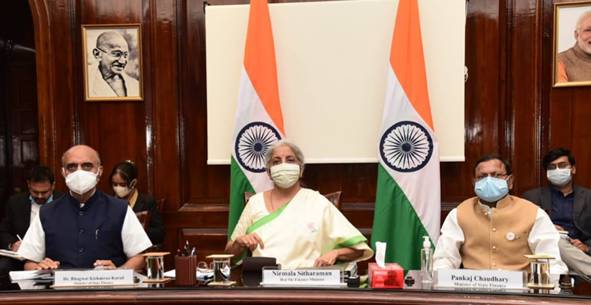
With a view to enhance the investment climate in the country in the wake of strong recovery and the opportunities accorded by a shift in geo-political realities post pandemic, Union Minister for Finance & Corporate Affairs Smt. Nirmala Sitharaman interacted with Chief Ministers and Finance Ministers of all States/ Lt Governors of UTs via virtual conference here today.

Image

The meeting was attended by Chief Ministers of Assam, Chhattisgarh, Goa, Haryana, Himachal Pradesh, Karnataka, Madhya Pradesh, Manipur, Meghalaya, Mizoram, Nagaland, Puducherry, Sikkim, Tripura, and Uttar Pradesh. Lt Governors of Jammu and Kashmir; Deputy Chief Ministers of Arunachal Pradesh, Bihar, and Delhi.  State Ministers of Andhra Pradesh, Gujarat, Kerala, Odisha, Punjab, Rajasthan, Tamil Nadu, Telangana, Uttarakhand, and West Bengal; State Government Officials of Ladakh, Maharashtra, Jharkhand, Andaman & Nicobar, Chandigarh, Dadra and Nagar Haveli & Daman and Diu, Lakshadweep along withSecretaries of GoI Line Ministries, Chief Secretaries and Finance Secretaries Secretary (Economic Affairs), Joint Secretaries (Economic Affairs) and other officials of Centre and State.

In her opening remarks, Finance Minister emphasized that the economy has been growing significantly post the second wave of pandemic and indicators such as imports, exports, PMI manufacturing, digital payments, etc. have already reached pre-pandemic levels. Smt. Sitharaman highlighted that with favourable international perception of India’s growth and in light of the structural, sectoral & financial, reforms undertaken by Government of India, global and domestic investors are upbeat about the investment attractiveness of the country.  States should leverage this opportunity to scale up investments and growth.

The Finance Minister also said that the Government of India has taken concrete steps to increase capital spending and drive an infrastructure and investment-led growth.  Benefits of higher investment in Infrastructure manifest in form of increased employment opportunities, access to market and materials, improved quality of life and empowerment of vulnerable sections. Union Budget FY 2021-22 has allocated Rs 5.54 lakh crore capital outlay, an increase of 34.5% over last year.  Additionally, around Rs 2 lakh crore allocation is for states and autonomous bodies for their capital expenditure.  Over and above this, a new incentive scheme was launched by GoI for states that could achieve at least 15 % of the target set for FY21-22 by the end of 1st quarter, 45% by end of 2nd quarter, 70 % by the end of 3rd quarter. States that achieve their targets become eligible for incremental borrowing. After the end of 1st quarter, 11 states got permission to mobilise an additional total amount of Rs 15,271 crore.

Smt. Sitharaman further said that the recently launched National Monetization Pipeline includes only Central government assets and State assets have been out of its purview as of now. Smt. Sitharaman suggested that there is a significant potentially monetizable asset base in states which could be leveraged to enhance the capital available for new infrastructure creation and other social sector pressing priorities. 

Smt. Sitharaman urged states to help India become the fastest growing economy in coming years, through facilitating investment attractiveness and expediting ease of doing business measures and undertake power reforms with regards to reduction in AT&C and ACS-RRR. Smt. Sitharaman further emphasized that since in many cases land is one of the major bottlenecks for project on-grounding, states must contrive to smoothen land acquisition procedures and create land banks to be tapped at the time of investment.

The Finance Minister urged the States to strengthen their urban local bodies (ULBs) in light of the fact that there has been decidedly a larger allocation to ULBs than earlier and are increasingly been encouraged to pursue resource mobilization.

Since infrastructure projects require technical assistance in addition to financial resources, Smt. Sitharaman said that GoI Line Ministries and DEA would extend all possible cooperation for technical or advisory assistance to states.  Moreover, the Viability Gap Funding provision will help finance socially relevant but financially unviable projects especially across social sectors.

The Finance Minister said that she is looking forward to listening from states and understand their ideas and plans in the direction of investment enhancement.  In the open interaction, States thanked GoI for organizing this consultative interaction. Each of the states enumerated the list of reforms and pro-active policies they are pursuing to establish good governance and to facilitate investments.

Following are the key ideas and requests shared by states to facilitate investment promotion:

  • Affidavit-based clearance system – ABCS by Karnataka and a similar system in UP to provideall clearances in a time-bound manner including plan approval, identification of land, conversion of land, environmental approvals and electricity supply for new enterprises. Affidavit based clearance is given upfront once basic infrastructure is in place and then the investor has 2 years to procure all approvals post-facto.
  • Transparent Mechanism for Investment Facilitation that involves sharing with states, leads of prospective investors who are in touch with GoI. More emphasis on adoption of technology and increase of digital infrastructure
  • Need for a clear-cut policy and SOPs on environment and forest clearances by Government of India, on the lines of ‘Eco-Economics’ and more powers to States under Forest/Environmental matters
  • Need to reassess the District Mineral Fund policy for fund utilization for leveraging across the entire state instead of confining it to a district. 
  • Fast-track clearance and approvals for externally-aided projects by GoI. Reimbursement requested in advance mode.
  • Similar approach to coastal zone regulations framework and application across all coastal states
  • Need for a legal reassessment and intervention on the legality of conversion of several different types of lands into industrial parks
  • Need for strengthening of the dispute resolution mechanism, post-award contract enforcement and of model concession agreements to strengthen infrastructure PPP ecosystem
  • Special emphasis on enhancing road connectivity in North Eastern states even as a lot of work has been done in this regard. These states are rich in resources such as bamboo, which can potentially be utilized in industry but cannot be sent as of now due to connectivity gaps in road and highways.
  • Instill greater increase in banking penetration as well as credit-deposit ratio in states vis-à-vis their dependent population. Moreover, even if in absence of new banking infrastructure, strengthening of existing banks in terms of manpower and systems should be able to address a critical gap.
  • GoI should engage with NE states to develop a State-specific International trade policy in North East depending on location (Look East, Look West, Look South etc)
  • Development of agri-specific infrastructure (GI labs, cold storage, farmer’s market) throughout the country, but especially in North East since a majority of population is dependent on agriculture.
  • Emphasis on increased air connectivity for Himalayan states to support tourism prospects.
  • Need for policy for offshore wind energy
  • Continuation of Centre’s Scheme of loan for capital expenditure beyond the current financial year

The meeting ended with vote of thanks to the chair.

Global Supply chains should not only be based only on cost but also on trust

Ministry of Commerce & Industry, Press Release dated 12 Nov 2021

Global Supply chains should not only be based only on cost but also on trust – Shri Piyush Goyal


Trade must grow in a mutually beneficial and collaborative way- Shri Goyal

Ensuring transparent, trustworthy and resilient supply chains is at the core of trade revival- Shri Goyal

India has proved its capability and emerged as a resilient and trusted partner to world nations during the pandemic

Shri Goyal delivers the “Keynote Address at Bank of America’s flagship Virtual Conference on the topic “Shifting supply chains globally: Could Make in India see success?”

The Minister for Commerce and Industry, Consumer Affairs, Food and Public Distribution and Textiles, Shri Piyush Goyal today said that COVID-19 highlighted that supply chains should not only be based on cost but also on trust. He opined that ensuring transparent, trustworthy and resilient supply chains is at the core of trade revival and added that India emerged as a source of resilience and a trusted partner during COVID-19. 

He was delivering the “Keynote Address at Bank of America’s flagship Virtual Conference on the topic “Shifting supply chains globally: Could Make in India see success?”, from New Delhi today.

The Minister said that supply and demand disruption brought on by the COVID-19 pandemic have forced manufacturers everywhere to reassess their supply chains. He added that India demonstrated its capacity and capability to the entire world by not only meeting all our international service commitments but also by becoming self-sufficient in production of critical medical supplies (PPEs, testing, masks).

Referring to India’s Pharmaceutical industry, Shri Piyush Goyal said that we are widely recognised as the “Pharmacy of the world” for providing medicines and vaccines to most countries in the world. Speaking of India’s success in implementing the largest vaccination drive in the world, the Minister said that with a plan to manufacture 5 billion doses of vaccine next year, India was aspiring to serve and secure all of the humanity.

Pointing towards the rising economic indicators, Shri Goyal said that India is back in action and the decade is shaping up to be a growth decade, with our exports surging and FDI in-flows and investments following a high growth trajectory. He said that trade must grow in a mutually beneficial and collaborative way.

It may be noted that our Merchandise exports in Apr-Oct 2021 was $ 232 bn (+54% over Apr-Oct 20 & +25% over Apr-Oct 19) and total FDI during the first 4 months of FY 21-22 is 62% more than that of the same period in FY 20-21. India now has 71 unicorns of which 67 were added since 2015.

Shri Goyal said that the Naukri Jobspeak Index for Oct’ 2021 reports a 43%

growth in employment over the same month last year and manufacturing PMI rose to 55.9 in October and service PMI reached a decade high of 58.4 in October. He opined that India has gained trust of global investors, with its investor friendly policies, removal of redundant laws and approvals through single window.

Underscoring India’s strengths as a supply chain alternative, the Minister said that India has a diverse business landscape, skilled workforce and relatively low labour cost. He spoke of India’s ambitious National Infrastructure Pipeline project and said that the new PM GatiShakti Master Plan would lend new life to India’s infrastructure planning and eventually help in reducing logistics cost to 5%.

He stressed that global sentiments are changing from ‘Why India’ to ‘Why not India’ to now “Make in India for the world’ and serving the world from India. “India’s time has come”, he added. He invited the world to ‘Come to India, Invest in India and Make in India, for the world’, and be a part of a large ecosystem of resilient supply chains.