Download judgment copy:
Category: Company Law
Company Law Articles, Video, PPT, Discussion, Expert Analysis
Judiciary updates-27th Oct 2021 (Income tax, GST & Corporate Laws)
SC: Nature of levy cannot be determined with nomenclature ascribed to Tax
Jalkal Vibhag Nagar Nigam dated SC 22 Oct 2021
Opinion under Section 83 of CGST Act should be strictly based upon material facts
Mutharamman & Co. (Madras HC dated 05/10/2021)
Section 12AA registration cannot be denied without examining the activities
ICRW Group Gratuity Trust Vs CIT (Exemption) (ITAT Delhi) dated 21/10/2021
ITAT explains basic conditions for Satisfaction of reimbursement Claim
Rieter Machine Works Limited Vs ACIT (ITAT Pune) dated 21/10/2021
No attribution of profit in absence of permanent establishment
ESPN Star Sports Mauritius Vs DCIT (ITAT Delhi) dated 20/10/2021
HC dismisses writ petition as petitioner is having alternative statutory remedy of appeal
Ankit Gupta Vs National Faceless Assessment Centre (Rajasthan High Court) dated 21/10/2021
Sec 138 NI Act: Complaint comes to an end Once Accused & Complainant Enter into a Settlement Agreement: SC
Gimpex Private Limited Vs Manoj Goel (Supreme Court of India) dated 08/10/2021
Authorities shall provide opportunity of hearing before arriving at any figure in demand Notice
Golden Trees Plantation Limited Vs Securities And Exchange Board of India (Gujarat High Court) dated 06/09/2021
Calculating limitation period for proceedings under IBC?
V Nagarajan Vs SKS Ispat and Power Ltd.& Ors. (Supreme Court of India) dated 21/10/2021
HC asks govt to keep vigil on ‘Rising Frauds in Aadhaar Enrollment
Naresh Kumar R.P. Vs State of Karnataka (Karnataka High Court) dated 30/09/2021
Benami Act, 1988, would not extend to properties purchased by the company
Kalyan Buildmart Pvt. Ltd. Vs Initiating Officer (Rajasthan High Court) dated 06/10/2021
Regards
Bipul Kumar
LLP Form 8 due date extended till 30.12.2021 (MCA General Circular No. 16/2021 dated 26 Oct 2021)
General Circular No. 16/2021
c-File No: Policy-01/2/2021-CI,V-MCA
Government of India
Ministry of Corporate Affairs
5th Floor, ‘A’ Wing, Shastri Bhawan,
Dr. R.P. Road, New Delhi – 110001.
Dated: 26.10.2021
To,
The DGCoA,
All Regional Directors,
All Registrar of Companies,
All Stakeholders.
Sub: – Relaxations in paying additional fees in case of delay in filing Form 8 (the Statement of Account and Solvency) by Limited Liability Partnerships upto 30th December, 2021 – reg.
Sir/Madam,
This Ministry has received a representation seeking extension of timeline for filing the Statement of Account and Solvency without paying additional fees by LLPs on account of challenges faced by the LLPs due to COVID-19 pandemic. As part of the Government’s constant efforts to promote ease of living and compliances for Micro, Medium and Small Enterprises doing business through the vehicle of LLP, it has been decided to allow LLPs to file Form 8 (the Statement of Account and Solvency) for the Financial Year 2020-2021 without paying additional fees upto 30th December, 2021.
2. This issues with the approval of the competent authority.
(Chandan Kumar)
Deputy Director (Policy)
Judiciary updates- Company Laws 13th Oct 2021
- NCLAT has power to grant case withdrawal under Rule 11 of NCLT Rules Anuj Tejpal Vs Rakesh Yadav (NCLAT Delhi) dated 07/07/2021
- Writ petition against an order of NCLT not maintainable before HC
Ideal Surgicals Vs National Company Law Tribunal (Kerala High Court) dated 02/07/2021
3. DIN of director cannot be deactivated merely for section 164(2) disqualification
Zacharta Maramkandathil Mohan Vs Union of India (Kerala High Court) dated 16/06/2021
4. For Cases admitted by NCLT all proceeding should be concluded by NCLT only
Shriraj Investment and Finance Ltd. & Ors. and Casper Consumer Electronics Pvt. Ltd. Vs Union of India & Anr. (Delhi High Court): W.P.(CRL) 1823/2020, & W.P.(CRL) 1414/2021 dated 14th Sept 2021
5. NCLAT set aside unsavoury observations/comments in NCLT order
Chalasani Udaya Sankar Vs Lexus Technologies Pvt. Ltd. (NCLAT Chennai) dated 13/07/2021
6. HC directs Official Liquidator to pay unsecured creditor with 4% interest Govt of India Vs Mewar Textiles And Ors (Rajasthan High Court, Jodhpur Bench) dated 20/07/2021
7. Statutory dues cannot be claimed if not exists in company’s approved RP for DHFL Piramal Capital (Housing Finance Ltd. Vs Administrator, Dewan Housing Finance Corporation Ltd. (NCLAT Delhi) dated 12/07/2021
8. Liquidation should be the last resort after proper evaluation & calibration Lotus City Plot Buyers Welfare Association Vs Three C Homes Pvt. Ltd dated 08/07/2021
9. Application to enforce shareholders right under board resolution is to be made before NCLT Jaiveer Singh Virk Vs Sir Sobha Singh & Sons Pvt. Ltd. (Delhi High Court) dated 01/03/2021
10. RoC cannot deactivate Director Identification Number (DIN) : HC
Baalu Renukadevi Vs Union of India (Madras High Court) dated 30/04/2021
Regards,
Bipul Kumar
Consultation Paper on Statutory Audit and Auditing Standards for Micro, Small and Medium Companies (MSMCs) ( MCA Press Release dated 29th Sept 2021)
India is unique among the big economies of the world in statutorily mandating compulsory audit for all companies, irrespective of their size and characteristics. In view of the significant role played by companies in India in the economic growth and development of the Nation, it is essential that the regulatory environment is conducive to support, and not burden, the growth in business and economic activities of these entities.
A preliminary analysis has been done by National Financial Reporting Authority (NFRA) on the key financial parameters of the companies registered in India from their MCA-21 filings and it is found that the fees paid to auditors by a large majority of Micro, Small and Medium Companies (MSMCs) are way below what an audit, when performed in compliance with the letter and spirit of the Standards of Auditing, would require.
Major economies of the world require statutory audit for small companies only in case some minimum criteria of public interest are satisfied. Even in India, income tax audit is now not compulsory where the turnover is Rs. 10 crore or less provided not more than 5% of the transactions are in cash. GST audit has also been completely done away with.
It is, therefore, appropriate to revisit the requirement of compulsory statutory audit for all companies irrespective of their size and/or public interest. NFRA has prepared a Consultation Paper explaining the issues involved and providing the data and information required for responding to the questions raised in an informed manner, with the objective to seek the comments/suggestions of the wider stakeholder group and the public at large on questions raised. The last date for receipt of comments is 10th November, 2021. The comments may be submitted by email at: comments-tac.paper@nfra.gov.in
NFRA’s Consultation Paper on Statutory Audit and Auditing Standards for Micro, Small and Medium Companies (MSMCs) can be accessed on NFRA’s website at:
https://nfra.gov.in/sites/default/files/NFRAConsultationPaperMSMCs.pdf
About NFRA
National Financial Reporting Authority (NFRA) was established by the Central Government in October 2018 under Section 132(1) of the Companies Act, 2013. An important function of NFRA under section 132(2)(a) of the Companies Act, 2013 is to make recommendation to Central Government on the formulation and laying down of accounting and auditing policies and standards for adoption by companies or class of companies or their auditors.
****
RM/KMNRelease Id :-1759494
NFRA issues Financial Reporting Quality Review Report of KIOCL Ltd. for FY 2019-20 (MCA Press Release dated 28th Sept 2021)
The National Financial Reporting Authority (NFRA) has issued a Financial Reporting Quality Review Report (FRQRR) in respect of KIOCL Ltd. for the financial year 2019-20.
The FRQRR is one of the two components of the Inspection Programme of the NFRA. The other component is the Audit Quality Review Report (AQRR).
The FRQRR focuses on the role of preparers, i.e., those responsible for the preparation of financial statements and reports in accordance with the applicable accounting standards. Therefore, the FRQRR evaluates how well the Chief Financial Officer, and the rest of the Management, and the Audit Committee, as well as the Board of Directors of the Company, have performed in preparing financial statements that show a true and fair view as required under the Companies Act, and in accordance with the applicable accounting standards.
The FRQRR concludes with an advisory to the preparers, highlighting the matters that need improvement. In case there are violations of accounting standards and the law that require action to be taken under the law, the matter is reported to the authorities who can take action.
The FRQRR in respect of KIOCL Ltd. is the first FRQRR issued by the NFRA. .
NFRA has prepared this FRQRR on the basis of examination of the financial statements of the Company for the Financial Year 2019-2020 and other information sought from the Company during the course of NFRA’s review.
NFRA Conclusions/Recommendations in respect of its observations have been categorized into ‘High’ and ‘Moderate’ Impact. Some of the main High Impact Non compliances w.r.t. to Accounting Standards on part of KIOCL are as follows:
- KIOCL’s accounting policy for Foreign Exchange (Fx) Forward Contracts is erroneous and it is non-compliant with the classification and measurement requirements of Ind AS 109, Financial Instruments (Ind AS 109).
- The accounting policy for a material element i.e. Revenue (with corresponding impact on related assets such as Trade Receivables, Inventories etc.) as stated in its statement of significant accounting policies is erroneous. This erroneous accounting policy raises questions over the reliability and accuracy of the financial statements of the Company.
- Adequate evidence, such as valuation reports, if any, have not been provided by KIOCL in respect of application of Indian Accounting Standard (Ind AS) 36, Impairment of Assets (Ind AS 36) in the case of the Blast Furnace Unit that was non-operational. Also, there is no evidence that impairment loss computations were considered/reviewed/ presented to Audit Committee and the Board of Directors (BoD) of the Company.
Many other errors have been noticed in disclosures in the Notes to Financial Statements. These disclosures are either not relevant or useful to the users of financial statements, and have the potential to obscure the material information in the financial statements.
NFRA has recommended that KIOCL examine if it is necessary to prepare and publish restated financial statements as per Ind AS 8 and Section 131 of the Companies Act, 2013.
The FRQRR can be seen on NFRA website on the URL:
https://nfra.gov.in/sites/default/files/FRQR%20Report%20KIOCL_1.pdf
****
RM/KMN
Release Id :-1758789
Regulatory Impact Assessment (RIA) for revision of existing Accounting Standards (Ministry of Corporate Affairs Press Release dated 28th Sept 2021)
In accordance with Rule 6 of National Financial Reporting Authority Rules, 2018, the Institute of Chartered Accountants of India (ICAI) has submitted to National Financial Reporting Authority (NFRA) an Approach Paper for revision of existing Accounting Standards of Companies that are not required to follow Indian Accounting Standards (Ind ASs). Alongwith the Approach Paper, the proposed texts of 18 revised Accounting Standards (ASs) out of a total of 32 revised ASs expected to be prescribed upon completion of this AS revision project was submitted by ICAI.
NFRA notes that most of the companies to which these proposed revised ASs will apply are Private Limited Companies. Many of the companies are of very small net worth or turnover or indebtedness or a combination of these. They would be mostly owned by small families, sometimes along with a small circle of friends and relatives. Therefore, public interest in the General Purpose Financial Statements (GPFSs) of these Companies would most likely be minimal. There are a number of Revised ASs which are very large and complex and may not be relevant and useful to the limited users of GPFSs of these Companies. The expected standard audit cost to perform reasonably good quality audit, performed in compliance with the letter and spirit of the Standards on Auditing (SAs) is significantly more than the presently reported audit fee ranges i.e., a very large percentage of AS Companies have reported Payment to Auditors of less than ₹ 25 thousand.
Based on the findings above, and persuaded by the limited extent of public interest in the GPFSs of AS Companies, and the need for enabling a regulatory environment conducive for their economic growth, NFRA has recommended to the ICAI that a Regulatory Impact Assessment be conducted of this revision proposal, duly including all the standard features of such a process, and, in particular, to take action as follows:
- The Approach Paper should be developed in a transparent manner after extensive nation-wide consultation with the primary stakeholders i.e., the Preparers – MSMCs (Micro, Small and Medium-size Companies) and Auditors – MSMPs (Micro, Small and Medium-size Practitioners). ICAI is requested to send NFRA the analysis of the public comments on the Approach Paper if the ICAI had performed any such public consultation in the past.
- Comprehensive study and research should be undertaken on the costs to the Preparers of compliance with these Revised ASs and their technical resource capacity, which should be evaluated against the likely benefits to all the stakeholders of AS Companies.
- ICAI should reconsider the Structure, Form and Contents of Revised ASs for AS Companies and align the same to the nature, size and complexity of the ASs, to their commercial needs, business size, capacity to comply with the prescribed standards, and relevance to their primary users.
ICAI’s Approach Paper and NFRA’s response to the ICAI Approach Paper have been posted on NFRA’s website at:
https://nfra.gov.in/sites/default/files/Letter%20to%20Secretary%20ICAI%20reg%20Recommendations%20of%20ICAI.pdf
****
RM/KMNRelease Id :-1758961
FAQs regarding Central Government guarantee to back Security Receipts issued by NARCL for acquiring of stressed loan assets (MOF Press Release dated 16 Sept 2021)
- What isNational Asset Reconstruction Company Limited (NARCL)? Who has set it up?
NARCL has been incorporated under the Companies Act and has applied to Reserve Bank of India for license as an Asset Reconstruction Company (ARC). NARCL has been set up by banks to aggregate and consolidate stressed assets for their subsequent resolution. PSBs will maintain51% ownership inNARCL.
2. What is India Debt Resolution Company Ltd. (IDRCL)? Who has set it up?
IDRCL is a service company/operational entity which will manage the asset and engage market professionals and turnaround experts. Public Sector Banks (PSBs) and Public FIs will hold a maximum of 49% stake and the rest will be with private sector lenders.
3 Why is NARCL-IDRCL type structure needed when there are 28 existing ARCs?
Existing ARCs have been helpful in resolution of stressed assets especially for smaller value loans. Various available resolution mechanisms, including IBC have proved to be useful. However,considering the large stock of legacy NPAs, additional options/alternatives are needed and the NARCL-IRDCL structure announced in the Union Budget is this initiative.
4. Why is a Government Guarantee needed?
Resolution mechanisms of this nature which deal with a backlog of NPAs typically require a backstop from Government. This imparts credibility and provides for contingency buffers. Hence, GoI Guarantee of up to Rs 30,600 crore will back Security Receipts (SRs) issued by NARCL. The guarantee will be valid for 5 years. The condition precedent for invocation of guarantee would be resolution or liquidation. The guarantee shall cover the shortfall between the face value of the SR and the actual realisation. GoI’s guarantee will also enhance liquidity of SRs as such SRs are tradable.
5 How will NARCL and IDRCL work?
The NARCL will acquire assets by making an offer to the lead bank. Once NARCL’s offer is accepted, then, IDRCL will be engaged for management and value addition.
6 What benefit do banks get from this new structure?
It will incentivize quicker action on resolving stressed assets thereby helping in better value realization. This approach will also permit freeing up of personnel in banks to focus on increasing business and credit growth. As the holders of these stressed assets and SRs, banks will receive the gains. Further, it will bring about improvement in bank’s valuation and enhance their ability to raise market capital.
7 Why is it being set up now?
Insolvency and Bankruptcy Code (IBC), strengthening of Securitization and Reconstruction of Financial Assets and Enforcement of Securities Interest (SARFAESI Act) and Debt Recovery Tribunals, as well as setting up of dedicated Stressed Asset Management Verticals (SAMVs) in banks for large-value NPA accounts have brought sharper focus on recovery. In spite of these efforts, substantial amount of NPAs continue on balance sheets of banks primarily because the stock of bad loans as revealed by the Asset Quality Review is not only large but fragmented across various lenders. High levels of provisioning by banks against legacy NPAs has presented a unique opportunity for faster resolution.
8. Is the guarantee likely to be invoked?
Government guarantee will be invoked to cover the shortfall between the amount realised from the underlying assets and the face value of SRs issued for that asset, subject to overall ceiling of ₹30,600 crore, valid for 5 years. Since there shall be a pool of assets, it is reasonable to expect that realisation in many of them will be more than the acquisition cost.
9. How will Government ensure faster and timely resolution?
The GoI guarantee will be valid for five years and condition precedent for invocation of guarantee will be resolution or liquidation.Further, to disincentivize delay in resolution, NARCL has to pay a Guarantee fee which increase with passage of time.
10. What will be the capital structure of NARCL and how much will Government contribute?
Capitalization of NARCL would be through equity from banks and Non-Banking Financial Companies (NBFCs). it will also raise debt as required.The GoI guarantee will reduce upfront capitalization requirements.
11. What will be NARCL’s strategy for resolution of stressed assets?
NARCL is intended to resolve stressed loan assets above ₹500 crore each amounting to about ₹ 2 lakh crore. In phase I, fully provisioned assets of about Rs. 90,000 crores are expected to be transferred to NARCL, while the remaining assets with lower provisionswould be transferred in phase II.
Government cautions stakeholders as 348 companies fail to meet requisite criteria for declaration as Nidhi company under Companies Act 2013 and Nidhi Rules 2014
Ministry of Corporate Affairs Press Release dated 24th Aug 2021
Under section 406 of the Companies Act, 2013 (CA, 2013) and Nidhi Rules, 2014 (as amended), companies incorporated as Nidhi Companies need to apply to the Central Government in form NDH-4 for declaration as a Nidhi Company.
It has been observed that companies have been applying to the Central Government for declaration as Nidhi under the CA, 2013 but of the 348 number of forms scrutinized upto 24.08.2021 not a single company could satisfy the requisite criteria for it to be declared as a Nidhi Company by the Central Government. There are large number of companies which though functioning as Nidhi Company have not yet applied to the Central Government for declaration as Nidhi Company which is violation of the CA, 2013 and Nidhi Rules, 2014.
Stakeholders are advised to verify the antecedents of the company functioning as a Nidhi company and ensure that the company has been declared as a Nidhi Company by the Central Government before becoming its member and depositing / investing their hard-earned money in such companies.
****
200 Van Dhan Producer companies planned to be set up during 2020-21 to 2025-26 with priority in Aspirational Districts.
200 Van Dhan Producer companies planned to be set up during 2020-21 to 2025-26 with priority in Aspirational Districts.
Jawadhu Hills Tribal Farmer Producer Company is an exemplary success story of Van Dhan Producer company
Posted Date:- Aug 13, 2021
Key Highlights:
- 200 Van Dhan Producer Companies planned to be set up in 27 States during 2020-21 to 2025-26.
- Jawadhu Hills Tribal Farmer Producer Company, a van dhan producer company, in less than 4 months, has sold processed products up to Rs 12 lakhs.

Keeping in line with the Hon’ble Prime Minister’s call for “Atmanirbhar Bharat” aligned to the slogan of “Be Vocal for Local Buy Tribal”, towards realizing the goal of “Sabka Saath, Sabka Vikas”, TRIFED has embarked upon an umbrella programme “Pradhan Mantri Janjatiya Vikas
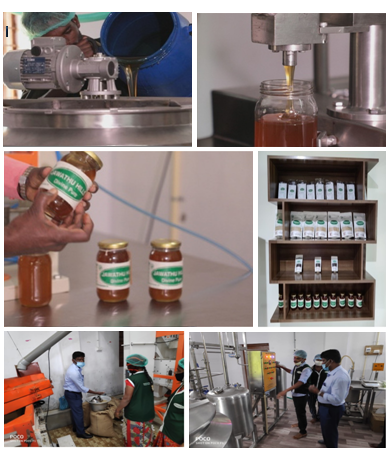
200 Van Dhan producer companies are planned to be set up in 27 States during 2020-21 to 2025-26 with priority in Aspirational Districts under Van Dhan programme of TRIFED. It is worth mentioning that a Van Dhan Producer company existing in Jawadhu Hills in Tiruvannamalai district, Tamil Nadu since 2020 is a noteworthy example of how this initiative benefits the tribals and promotes tribal entrepreneurship.
Situated in the Tiruvannamalai district of Tamil Nadu, Jawadhu hills is an extension of the Eastern Ghats. The Malayali tribal people constitute 92.60% of the total population in this block and their mainstay is through the non-timber forest produce and a variety of trees grown on this patta land such as tamarind, jackfruit, coconut, lemon and plantain and gooseberry.
To help these tribals empower themselves and gain better opportunities and market access, the Jawadhu Hills Tribal Farmer Producer Company was formed in 2020. It falls under theState Balanced Growth Fund for Value Addition of Non-Timber forest Product and Agricultural Products of Jawadhu hills, Tiruvannamalai District (SPV). The Company has been formed under the Companies Act 2013(18 of 2013) and is limited by shares. It consists of members of farmers interest groups, producer groups and self-help groups that have been formed at community level. The entire team of directors and key managerial persons of the FPO are tribals.
In less than a year, four manufacturing units have already been set up for the processing and packaging of tamarind, minor millet, and honey and pepper. The units, which are being run by the tribals, have started production in November 2020. The daily production capacity is 1 tonne. Up until now, in less than 4 months, the producer company has sold processed products up to Rs 12 lakhs. The FPO has already been registered as a seller in the Tribes India marketplace and has been selling nine of its processed produce through the platform, thus gaining a wider market for its goods.
124 tons of minor millets have been produced in the year, with a total of 9800 households cultivating minor millets. Around 17770 farmers are involved in its cultivation. The producer company will benefit around 17770 millet producing farmers.22 tons per year honey is produced in Jawadhu hill with a total of 2760 members involved in producing honey as a part of 120 SHGs. Therefore, the Jawadhu Hills producer company is targeting to improve the lives and livelihood of 2760 honey producers.9500 households and 300 SHGs are involved in Tamarind Production & Selling Process. More than 90 tonnes of tamarind are being produced in these hills.
Besides the farmer producer company, which was formed only in 2020, the tribals of the block were already members of existing Van Dhan Kendras in Tiruvannamalai district – Jawadhu VDVK, Jamunamarathur VDVK and Koottathur VDVK. These continue to be operational under the FPO. Tribals have been earning their livelihoods through the addition of value and processing non-timber forest produces or Minor forest produces through these VDVKs.
The Jawadhu Hills producer company has been formed with an aimto improve the quality of life and social status of tribals involved. This is an example of how the Van Dhan tribal start-up has been successful in improving the livelihoods and incomes of the tribal people across the country.
The Van Dhan tribal start-ups, a component of the same scheme, is a programme for value addition, branding & marketing of Minor Forest Produces by establishing Van Dhan Kendras to facilitate creation of sustainable livelihoods for the forest-based tribes. It has emerged as a source of employment generation for tribal gatherers and forest dwellers and the home-bound tribal artisans.
In less than two years, 37,904 Van Dhan Self Help Group (VDSHGs), subsumed into 2275 Van Dhan Vikas Kendra Clusters (VDVKCs) of 300 forest dwellers each, have been sanctioned by TRIFED as of date. As per TRIFED, a typical Van Dhan Self Help Group (VDSHG) includes 20 tribal members. 15 such VDSHG form 1 Van Dhan Vikas Kendra cluster. The Van Dhan Vikas Kendra Clusters provide the VDSHGeconomies of scale, livelihood and market-linkages, as well as entrepreneurship opportunities to nearly 6.67 lakh Tribal forest gatherers in 23 states and 2 UTs.

TRIFED is also expanding the Skills Development and Micro entrepreneurship programme, together with the Tribal Livelihoods program. Convergences with various Ministries and Departments such as Ministry of Rural Development (MoRD), Ministry of Small and Medium Enterprises (MSME), Ministry of Food Processing Industries (MoFPI), Ministry of AYUSH have been initiated by TRIFED all with the aim of improving sustainable livelihoods and income opportunities for these tribals.
With Ministry of Agriculture & Family Welfare, TRIFED will work towards the formation of 14 Honey FPOs in 8 States such as Chhattisgarh, Gujarat, Himachal Pradesh, Uttarakhand, Karnataka, Tamil Nadu, Andhra Pradesh and Odisha.
Ministry of Tribal Affairs Press Release dated 13 Aug 2021
 Business So Simple