LIST OF SECTIONS/RULES U/CA 2013 – REPLACING AFFIDAVITS WITH SELF-DECLARATION U/CA 2013 (The Company Law Committee Report)

1. Section 68(6) read with Rule 17(3), Companies (Share Capital and Debenture) Rules, 2014

Where a company proposes to buyback its shares/ securities under this section, an affidavit is required to be filed by two directors before the RoC and SEBI to the effect that the company will not be rendered insolvent for one year

2 Section 374(c)

Company registering under Chapter XXI Part I is required to file an affidavit from all members/ partners that in the event of registration, necessary documents or papers shall be submitted to the registering or other authority with which the company was earlier registered

3. Rule 7(4)(i), Companies (Incorporation) Rules, 2014

A company applying to convert into a One Person Company must apply for the RoC in the prescribed form. Such an application is required to be accompanied by an affidavit from the company’s directors confirming that all members and creditors of the company have given their consent for conversion.

4. Rule 8A(1)(j), Companies (Incorporation) Rules, 2014

A name including the phrase ‘Electoral Trust’ may be allowed for registration of companies to be formed under Section 8 of CA-13 following the Electoral Trusts Scheme, 2013, notified by the Central Board of Direct Taxes. For this purpose, the name application is required to be accompanied by an affidavit to the effect that the name obtained shall be only for registration of companies under the said scheme.

5. Rule 10(3)(b), Companies (Registration of Foreign Companies) Rules, 2014

Foreign companies must attach a translation of their documents, where such documents are not submitted to the RoC in English. Where the translation is done in India, it is required to be authenticated by an affidavit of a competent person, having adequate knowledge of both the original language and English, in the opinion of the RoC.

6. Rule 4(3)(iii), The Companies (Removal of Names of Companies from the Register of Companies) Rules, 2016

An application for removal of the name of a company under Section 248(2) of CA-13 made to the RoC is required to be accompanied by an affidavit, in the prescribed form, by every director of the company.

Key amendments proposed in CA 2013, LLP Act 2008 by The Company Law Committee (2022)

Key amendments proposed in CA 2013, LLP Act 2008 by The Company Law Committee (2022)

👉
I. Allowing certain companies to revert to the financial year followed in India;

II. Facilitating certain companies to communicate with their members in only electronic form;

III. Recognising issuance and holding of fractional shares, Restricted Stock Units and Stock Appreciation Rights;

IV. Easing the requirement of raising capital in distressed companies;

V. Replacing the requirement of furnishing affidavits with the filing of self certification/declaration;

VI. Clarifying the inclusion of ‘free reserves’ while determining the limit for buying back of a company’s equity shares;

VII. Prohibiting companies from recording trusts on their register of members;

VIII. Allowing companies to hold general meetings in virtual, physical or hybrid modes;

IX. Creating an electronic platform for maintenance of statutory registers by companies;

X. Clarifying provisions relating to Investor Education and Protection Fund;

XI. Strengthening the National Financial Reporting Authority;

XII. Reviewing and strengthening the audit framework and introducing mechanisms to ensure the independence of auditors;

XIII. Standardising the manner for auditors to provide qualifications;

XIV. Recognising and providing an enabling framework for the constitution of Risk Management Committees;

XV. Clarifying the tenure of independent directors;

XVI. Revising provisions relating to the disqualification and vacation of the office of directors;

XVII. Clarifying the procedure for the resignation of key managerial personnel;

XVIII. Strengthening the provisions relating to mergers and amalgamations;

XIX. Easing the restoration of struck off companies by enabling the Regional Director to allow restoration of names of companies in certain instances;

XX. Recognising Special Purpose Acquisition Companies and allowing such companies, which are incorporated in India, to list on permitted exchanges;

XXI. Prohibiting the conversion of co-operative societies into a company;

XXII. Modernising enforcement and adjudication activities through electronic mode;

XXIII. Strengthening the incorporation and governance framework for Nidhis;

XXIV. Removing ambiguities from present provisions under the Companies Act, 2013 through changes of drafting & consequential nature

XXV. The incorporation of Producer Limited Liability Partnerships under the Limited Liability Partnership Act, 2008 to ease incorporation and compliance requirements for producer organisations.

Regards,
Bipul Kumar

IBBI amends the Insolvency and Bankruptcy Board of India (Voluntary Liquidation Process) Regulations, 2017 (MCA Press release dated 08th April 2022)

The Insolvency and Bankruptcy Board of India notified the Insolvency and Bankruptcy Board of India (Voluntary Liquidation Process) (Amendment) Regulations, 2022 (Amendment Regulations) on 05th April, 2022.

The Insolvency and Bankruptcy Code, 2016 read with Insolvency and Bankruptcy Board of India (Voluntary Liquidation Process) Regulations, 2017 provide mechanism for voluntary liquidation of solvent corporate person. It has been noticed that there has been substantial delay in completion of voluntary liquidation process, though the process, in general, involve nil or negligible claims of creditors, fewer assets, if any, to be realized and few litigations, if any, to be concluded. To curtail such delay and ensure faster exit for firms, the Amendment Regulations modify timelines for some stipulated activities undertaken during the process as under:

  • The liquidator shall prepare the list of stakeholders within fifteen days (against the previously stipulated forty-five days) from the last date for receipt of claims, where no claim from creditors has been received till the last date for receipt of claims. 
  • The liquidator shall distribute the proceeds from realization within thirty days (against the previously stipulated six months) from the receipt of the amount to the stakeholders.
  • It has been further provided that the liquidator shall endeavour to complete the liquidation process of the corporate person within two hundred and seventy days from the liquidation commencement date, where the creditors have approved the resolution under section 59(3)(c) or regulation 3(1)(c), and ninety days from the liquidation commencement date in all other cases (against the previously stipulated 12 months in all situations). 

To provide summary of actions taken by the liquidator during the voluntary liquidation process, the Amendment Regulations specify a compliance certificate which is required to be submitted along with application under section 59(7) to the Adjudicating Authority, by the liquidator. It shall facilitate the Adjudicating Authority to adjudicate dissolution applications expeditiously. 

The Amendment Regulations are effective from 05th April, 2022. These are available at www.mca.gov.in and www.ibbi.gov.in.

Changes in Company Inspection Rules (Companies (Management & Administration ) Amendment Rules 2022 MCA Notification dated 06th April 2022)

Changes in Company Inspection Rules

Companies (Management & Administration ) Amendment Rules 2022 MCA Notification dated 06th April 2022)

MCA amends Companies ( Management and Administration) Rules 2014 . The following particulars of Registers, Index or Return of a member of a company shall not be available for inspection or taking extracts or copies under sub -section (3) of Section 94 of Companies Act 2013 namely

1 Address or Registered Address ( in case of body corporate)
2 Email id
3 Unique Identification Number
4 PAN

👉 Relevant section & rules

Rule 14 of Company (Management & amendment) Rules 2014

Section 94 of Companies Act, 2013

Section 88 of Companies Act, 2013

MCA (Ease of Doing Business) : Steps undertaken to ensure the quick registration of companies in India (Press release 30 March 2022)

The Government of India has undertaken a number of steps to ensure the quick registration of companies in India, which are as under:

1. A single integrated new web form called SPICe+ along with AGILE PRO-S has been deployed. This form provides eleven services related to ‘starting a           business’         namely (i) Name Reservation, (ii) Incorporation, (iii) Permanent            Account Number        (PAN), (iv) Tax Deduction Account Number (TAN), (v) Director    Identification Number (DIN), (vi) Employees’ Provident Fund Organisation             (EPFO)            Registration, (vii) Employees’ State Insurance Corporation (ESIC) Registration, (viii)             Goods and Services Tax (GST) number, (ix) Bank Account             Number, (x)    Profession Tax Registration (Mumbai, Kolkata and Karnataka), (xi)             Delhi   Shops and Establishment Registration.

2. Zero fee is now charged for incorporation of all companies with authorized           capital up to Rs. 15 lakh or with up to 20 members where no share capital is      applicable.

3. A Central Registration Centre (CRC) has been set up for name reservation and      incorporation of companies & Limited Liability Partnership (LLP) within 1 day.

4. The LLP Incorporation Form called FiLLiP has also been integrated with Central Board of Direct Taxes (CBDT) to provide PAN/TAN at the time of Incorporation   of         LLP itself.

5.  The Companies (Incorporation) Third Amendment Rules, 2020, now provide for   extension of reservation of name through a simple web service available at         http://www.mca.gov.in.


6. Provisions with regard to incorporation and functioning of One-Person      Companies      (OPCs) have been revised so as to incentivize incorporation of OPCs. Now,        Non-Resident Indians (NRIs) are also allowed to incorporate OPCs. OPCs are        now allowed to convert into private or public companies at any point of time. The       restrictions with regard to maximum amount of paid-up       capital and turnover for             OPCs have also been removed.

This information was given by the Minister of State in the Ministry of Commerce and Industry, Shri Som Parkash, in a written reply in the Lok Sabha today.

Cuttack ROC penalty order for violation of Section 92 & 137 of CA 2013 in the matter of KKDIL Nidhi Limited (Order dated 23rd March 2022)

Cuttack ROC penalty order for violation of Section 92 & 137 of CA 2013 in the matter of KKDIL Nidhi Limited (Order dated 23rd March 2022)

✒️ On the basis of Supplementary Inspcction Report under Section 206(5) of the CA, 2013 the Directorate directed ROC to take action under Section 92(5) and 137(3) of the Act for violation of Section 92(4) and 137(1) of the Act. Accordingly, ROC initiated Adjudication proceedings.

✒️ ROC order -. The offence is of serious nature since non-filing of Annual Accounts by the Company put itself out of reach of stakeholders/regulatory authorities and other concerned. The object of filing of Annual Return of company with the Public Domain is in the public interest, to enable the investors, public and whosoever interested in the company can access the fundamental information about the company and its management. Non-filing of this statutory return will result in denial of information to public about the company

✒️ The object of filing Financial Statements of a company with MCA Portal is to enable the interested public/investors/statutory agencies to access and know about the company’s state of affairs. The financial statements of a company so filed shall give a be and fair view of the state of affairs of the company. The said statements will become documents of public domain and the interested public can access the said statcments through MCA website to know the financial state of affairs of the company as on that date.

✒️ Total Penalty imposed: Rs. 32,42,600/-

Regards,
Bipul Kumar

NCLT- The Road Ahead (Press release 26th March 2022)

NCLT organised Colloquium on “NCLT- The Road Ahead”


Chief Justice (Retd.) Ramalingam Sudhakar exhorts use of Artificial Intelligence for speedier dispensing of justice and resolution under IBC

MCA Secretary commends NCLT for disposing off about 62,000 cases out of about 83,000 cases filed before it

IBBI Chairperson calls for standardization to fast track resolution of cases

The National Company Law Tribunal (NCLT) organized a national level Colloquium on the subject “NCLT- The Road Ahead”  here today.

Chief Justice (R) Ramalingam Sudhakar, President, NCLT; Shri Rajesh Verma, Secretary, Ministry of Corporate Affairs; and Shri Ravi Mital, Chairman, Indian Bankruptcy Board of India (IBBI) inaugurated the colloquium. Members of the Tribunal, both Judicial and Technical, representing 15 Benches across India also participated in the colloquium.
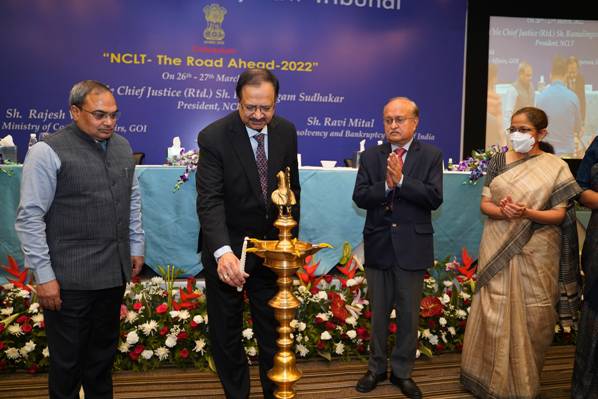
In his address as the chief guest, Chief Justice (Retd.) Ramalingam Sudhakar said that India is envisioning a multi-trillion dollar economy. Industry and commerce, crucial in the nation’s economy, are governed by Company Law besides other laws. Chief Justice (Retd.) Ramalingam Sudhakar stated that the Government has come out with [Insolvency & Bankruptcy Code (IBC)] code to resolve corporate issues to enable corporates of India to compete with the world. NCLT is the guardian of the corporate law and each of the Members has a role to play in the economic growth of the country. Today’s Colloquium will address effective and judicatious process and resolution, he stated.

While talking about Artificial Intelligence (AI), Chief Justice(R) Sudhakar concluded his address while stating that one aspect for early resolution is the development of Artificial Intelligence technology for speedier dispensing of justice. AI can be used in case resolution, especially in admission of cases, he suggested.

In is address, Shri Rajesh Verma, Secretary, MCA, stated that NCLT is an institution of pride and it has led to faster resolution of corporate disputes under the Company Act and the IBC. Praising NCLT’s performance during COVID-19, Shri Verma said that NCLT disposed of about 62,000 cases out of about 83,000 cases filed before it.

Enumerating the various achievements of NCLT, Shri Verma said that these include rescue of creditors, providing an orderly exit for companies under distress, helping creditors realize the value of their assets and behavioral change in both Creditors and Debtors. The IBC has been key in releasing entrepreneurship from honest business failures, which is important as we have the 3rd largest startup ecosystem in the world, he said.

Shri Verma emphasized that the IBC Code has seen a roller coaster ride with six amendments have been made in the main legislation so far. Shri Verma further stated that many provisions of IBC have come out unscathed when challenged (in the higher courts) and the Supreme Court of India had settled the jurisprudence on various aspects of this new law at an unprecedented pace and passion.

Shri Verma suggested that to enhance the effectiveness of IBC, introduction of a cross border insolvency framework in the IBC is being considered. Leveraging technology and filling up posts are two key factors in increasing the speed, he said.

In his address to the gathering, Shri Mital, Chairman, IBBI, stated that there are two corner stones of the IBC viz timelines in process and the control being given to creditors as against Debtors. He stated that with more standardization, the speed of resolution of cases can be increased. Shri Mital said that IBBI is always ready to collaborate with NCLT in simplification of the process of resolution.

Inaugural session was followed by the technical session, where Shri Sudhakar Shukla, Whole Time Member, IBBI and Prof. Charan Singh, CEO, EGROW Foundation, also participated. Members of the Tribunal covered other areas such as Aadmission of Petitions u/s 7 and 9 IBC, Oppression & Mismanagement, Avoidance Transactions, Insolvency & Voluntary Liquidation- Section 10 and Section 59, IBC, and Resolution Plan Approval etc.

About National Company Law Tribunal (NCLT)

The Central Government constituted the National Company Law Tribunal (NCLT) under section 408 of the Companies Act, 2013 w.e.f. 01st June 2016. In the first phase the Ministry of Corporate Affairs set up 11 Benches, one Principal Bench at New Delhi and ten Benches in various locations in India. As on today, there are 15 benches spread across India which are manned by 48 Members who hear cases related to the Companies Act and the Insolvency and Bankrupcy Code 2016.

NCLT is a quasi-judicial authority incorporated for dealing with corporate disputes under the Companies Act. It is the adjudicating authority for insolvency resolution process of companies and limited liability partnerships under the Insolvency and Bankruptcy Code, 2016.

Out of a total of 83838 cases filed before National Company Law Tribunal since its inception, 62506 (75%) cases have been disposed off by the Tribunal as on Feb 2022. The cases disposed off comprises of 39446 cases under Companies Act and 23060 cases under Insolvency Bankruptcy Code, 2016. Even during Covid-19, NCLT kept its doors open and decided large number of cases.

The NCLT has been instrumental in effective implementation and success of the IBC for orderly growth of the corporate sector.

IBBI admits 1,060 cases into corporate insolvency resolution process in around 2 years (Press release 22nd March 2022)

As per the information provided by Insolvency and Bankruptcy Board of India, in the years 2020-21 and 2021-22 (upto 31st December, 2021), 538 and 522 cases,

respectively, have been admitted into the corporate insolvency resolution process (CIRP) under the Insolvency and Bankruptcy Code, 2016. This was stated by Union Minister of State for Corporate Affairs Shri Rao Inderjit Singh in a written reply to a question in Rajya Sabha today.

Giving more details, the Minister gave details of action taken in the said cases as follows:-

Further details are available in public domain on www.ibbi.gov.in, which are periodically  updated, the Minister added.