World has waited long enough for the delivery of promised Climate finance and technologies at low cost:

World has waited long enough for the delivery of promised Climate finance and technologies at low cost: Shri Bhupender Yadav


We should not be shifting goalposts and setting new benchmarks for global climate ambition: India at G20 Climate Summit.

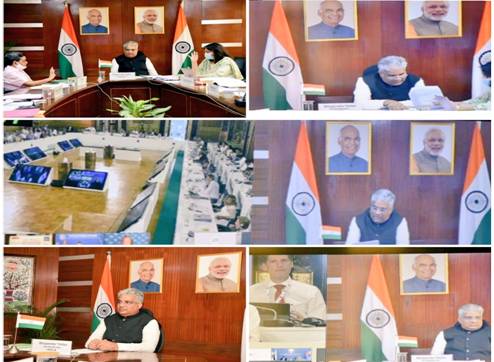
On the second and concluding day of the G20 summit, Shri Bhupender Yadav, Minister for Environment, Forest and Climate Change stressed that the G20 must respond to the call of science for urgent global climate action in this decade.

The G20 Energy and Climate Joint Ministerial Meeting held today at, Naples, Italy was attended virtually by the Indian delegation from the Ministry of Environment, Forest and Climate Change, and the Ministry of Power.

Speaking at different sessions on Climate Change, the Union Environment Minister underlined the need to cut absolute emissions rapidly while taking into account the Paris Agreement which emphasised on respective historical responsibilities, delivery of promised climate finance and technologies at low cost keeping in perspective per capita emissions, differences in per capita GDP and the unfinished agenda for sustainable development.

G20.jpg

Shri Yadav stated that India remains steadfast in its commitments to join and lead efforts to combat climate change within the multilaterally agreed convention and its Paris Agreement.

The Minister mentioned about the vision of Prime Minister Shri Narendra Modi , installing 450 GW (Giga Watt) of RE (Renewable Energy) by 2030, enhanced ambition in bio-fuels, India’s NDCs (Nationally Determined Contributions) and various other initiatives taken by India on Urban Climate Action.

The Minister stressed, common but differentiated responsibilities to combat climate change, as per respective capabilities and national circumstances, lies at the heart of the UNFCCC & its Paris Agreement. “We should not be shifting goalposts and setting new benchmarks for global climate ambition”, said Shri Yadav and informed that under the visionary leadership of Prime Minister Shri Narendra Modi, India has exhibited exemplary resolve by achieving its pre 2020 voluntary commitment of reducing emission intensity.

“With increase in urbanization, it is important to create and preserve green spaces and protect biodiversity in urban areas” said the Environment Minister and informed that India’s Urban Climate Actions include Climate Smart Cities Assessment Framework, National Mission on Sustainable Habitat,Climate Center for Cities, Climate Smart Cities Alliance, Climate Practitioners India Network, Urban Forestry, etc.

India also welcomed the G20 works on Sustainable Recovery, Cities, Financial Flows, etc.

Ministry of Environment, Forest and Climate Change Press Release dated 24 July 2021

One District One Focus Product Scheme

The One District One Focus Product (ODOFP) programme cover products of agriculture and allied sectors for 728 districts of the country. The Government has decided to converge resources from ongoing centrally sponsored schemes such as Mission for Integrated Development of Horticulture (MIDH), National Food Security Mission (NFSM), Rashtriya Krishi Vikas Yojana (RKVY), Paramparagat Krishi Vikas Yojana (PKVY), schemes of Ministry of Fisheries, Animal Husbandry and Dairying for ODOFP.

The Ministry of Food Processing Industries (MoFPI) provides financial support  under Centrally Sponsored Pradhan Mantri Formalisation of Micro Food Processing Enterprises Scheme (PM FME Scheme) for One District One Focus Product. PM FME provides financial, technical and business support for upgradation of existing micro food processing enterprises etc. The scheme adopts One District One Product (ODOP) approach to reap the benefits of scale in terms of procurement of inputs, availing common services and marketing of products.

The identified products have potential for both domestic demand and export. PM FME scheme envisages strengthening backward and forward linkages, provision of common facilities, incubation centres, training, research and development (R&D), marketing and branding. The enhanced capacity of processing and value addition in agriculture and allied sector products is for better price realization by the farmers. This scheme is being implemented for a period of five years from 2020-21 to 2024-25.

This information was given in a written reply by the Union Minister of Agriculture and Farmers Welfare Shri Narendra Singh Tomar in Lok Sabha today.

****

Ministry of Agriculture & Farmers Welfare Press Release dated 21 July 2021

National Project on Organic Farming

Under Capital investment Subsidy Scheme (CISS) of National Project on Organic Farming (NPOF), 100% assistance is provided to State Government / Government agencies for setting up of mechanized fruit/vegetable market Agro waste compost production unit  up to a maximum limit of Rs.190.00 lakh /unit (for 3000 Total Per Annum (TPA) capacity).  Similarly, for individuals/ private agencies assistance up to 33% of cost limit to Rs 63 lakh/unit as capital investment is provided. Under CISS until now, 12 Fruit and vegetable compost units have been established including 4 units in the State of Tamil Nadu and Rs. 148.332 lakh has been released to the State for this purpose.

Completed Projects of Production Units under CISS since 2012-13 till date (as per NABARD)

https://pib.gov.in/PressReleaseIframePage.aspx?PRID=1737286&RegID=3&LID=1

Ministry of Agriculture & Farmers Welfare Press Release dated 21 July 2021

Progress in Doubling Farmer Income

The strategy adopted by the Government for increasing the income is (i) higher volume of output through higher productivity (ii) lower cost of production and (iii) higher real remunerative returns on the farmers’ produce.

In case of production the farmers have been registering higher productivity across all segments of Agriculture. There has been record growth in total output of food grains, oilseeds, horticulture, milk and so on. The annual production under various sectors has increased appreciably as seen at the end of the year 2020-21. These include a food grains output of 303.34 MTs as against 252.23 MTs(2015-16); 326.58 MTs of fruits & vegetables as against 259.3 MTs (2015-16); 208 MTs of milk as against 155.49 MTs (2015-16).

Major emphasis has been on post-harvest management, which is  helping  farmers in getting better returns on their produce. These include e-NAM, new state marketing Act, direct trade, contract farming, FPOs, agri-logistics, food processing and so on besides healthier procurement operations.

Government’s emphasis on robust procurement of agricultural produce has also ensured better returns to farmers and served as an incentive. In addition to increases in procurement of paddy & wheat through FCI, the quantum of procurement of pulses & oilseeds has leap frogged since 2014-15. Under the new procurement scheme called PM-AASHA, NAFED has been procuring much more than before.

As of now, there is no latest estimate of annual income of farmers achieved and the percentage annual increase vis-a-vis the base year 2015-16. For the purpose of arriving at the average annual income for the year 2015-16, the DFI Committee extrapolated the NSSO survey based income estimates for the year 2012-13, and estimated that average farmers income stands at Rs. 96,703/- per year for the year 2015-16 at 2015-16 prices.

PM-KISAN is an ongoing and continuous Scheme. The entire responsibility of identification of beneficiaries rests with the State / UT Governments. An exclusive web-portal http://www.pmkisan.gov.in has been launched for the Scheme. The financial benefits are released to the beneficiaries on the basis of the data of farmers prepared and uploaded by them on the PM-KISAN web-portal. The data uploaded by the State/UT Governments undergoes three levels of validation. Data that passes all three levels of validation is then processed for the release of benefits. Any data that is found incorrect is sent back to the respective States/UTs for correction.

Budgetary allocations are made at the beginning of financial year based on the anticipated expenditure to be incurred in the financial year, however, any additional requirement of funds based on the actual expenditure is fulfilled by the Government by way of supplementary grants.

The Pradhan Mantri Kisan Samman Nidhi (PM-KISAN) Scheme is being implemented with a view to provide income support to all landholding farmer families across the country, to enable them to take care of expenses related to agriculture and allied activities as well as domestic needs.  The Scheme, effective from 1.12.2018, aims to provide a payment of Rs.6000/- per year for the farmers’ families with cultivable land holding, subject to certain exclusions.  The financial benefit of Rs.6000/- is being released by the Central Government in three 4-monthly instalments of Rs.2000/- over the year directly into the bank accounts of the eligible farmers under Direct Benefit Transfer mode. Any additional requirement of funds will be fulfilled by Government by way of supplementary grants. Central Government has been requesting State Governments from time to time so that all eligible farmers are covered under PM-KISSAN Scheme.

This information was given in a written reply by the Union Minister of Agriculture and Farmers Welfare Shri Narendra Singh Tomar in Lok Sabha today.

Ministry of Agriculture & Farmers Welfare Press Release dated 20 July 2021

Boosting Production of Pulses

The seed minikits of pulses are distributed to the farmers of major pulse growing States under the National Food Security Mission (NFSM). The district wise allocation and distribution of seed minikits is managed by the respective State Governments.

The Direct Benefit Transfer (DBT) is implemented by the States under the National Food Security Mission (NFSM). The States transfer the benefit to the targeted beneficiaries through DBT by using Aadhar enabled system. Many states viz., Gujarat, Tamil Nadu, Andhra Pradesh, Maharashtra etc have reported Aadhaar enabled distribution of seed minikits. The production and productivity of pulses under seed minikits programme is primarily monitored by State Government field functionaries and State Food Security Mission Executive Committee (SFSM-EC) headed by Chief Secretary/Agriculture Production Commissioner. Besides, field visits of seed minikits fields are also undertaken by National Level Monitoring Teams (NALMOTS) constituted by The Department of Agriculture & Farmers Welfare. As a result of the various interventions under NFSM-Pulses programme, the production of pulses has increased from 16.32 million metric tonnes in 2015-16 to 25.56 million metric tonnes in 2020-21 (3rd Advance Estimates). The productivity of pulses has also increased from 655 kg/ha to 878 kg/ha during the same period.

This information was given in a written reply by the Union Minister of Agriculture and Farmers Welfare Shri Narendra Singh Tomar in Lok Sabha today.

****

Ministry of Agriculture & Farmers Welfare Press Release dated 21 July 2021

Sustainble Agriculture

The Government has adopted several developmental programmes, schemes, reforms and policies that focus on higher incomes for the farmers and to promote Sustainable Agriculture and Farmers Prosperity. All these policies & programmes are being supported by higher budgetary allocations, non-budgetary financial resources by way of creating Corpus Funds like Micro Irrigation Fund and Agri-marketing scheme to strengthen eNAM and GrAMs, as also in the Ministry of Fisheries,Animal Husbandry and Dairying and to promote dairy and fishery sectors. There have been several reforms to unleash the potential and these include Market Reforms like Model APLMC (Promotion & Facilitation) Act, 2017; Establishment of Gramin Agriculture Markets (GrAMs); Agri-Export Policy, 2018; The Farmers Produce Trade and Commerce (Promotion & Facilitation) Act, 2020; The Farmers (Empowerment & Protection) Agreement on Price Assurance and Farm Services Act. 2020; Amendments to Essential Commodities Act, 1955; Promotion of 10,000 FPOs with necessary financial support under Atma Nirbhar Package (Agriculture) and Supplementary Income transfers under PM-KISAN; Pradhan Mantri Fasal Bima Yojna  (PMFBY);  Pradhan Mantri Krishi Sinchai Yojana (PMKSY); Increase in Minimum Support Price (MSPs) for all Kharif & Rabi Crops ensuring a minimum of 50 percent of profit margin on the cost of production; Har Med Par Ped; Bee-Keeping; Rashtriya Gokul Mission; Blue Revolution; Interest Subvention Scheme; Kisan Credit Card (KCC) that now offers production loan to even dairy & fishery farmers besides agricultural crops etc.

             List of various interventions and schemes launched for the benefit of farmers

(i) With a view to provide income support to all farmers’ families across the country, to enable them to take care of expenses related to agriculture and allied activities as well as domestic needs, the Central Government started a new Central Sector Scheme, namely, the Pradhan Mantri Kisan Samman Nidhi (PM-KISAN). The scheme aims to provide a payment of Rs. 6000/- per year, in three 4-monthly installments of Rs. 2000/- to the farmers families, subject to certain exclusions relating to higher income groups.

(ii) Further with a view to provide social security net for Small and Marginal Farmers (SMF) as they have minimal or no savings to provide for old age and to support them in the event of consequent loss of livelihood, the Government has decided to implement another new Central Sector Scheme i.e. Pradhan Mantri Kisan Maan Dhan Yojana (PM-KMY) for providing old age pension to these farmers. Under this Scheme, a minimum fixed pension of Rs. 3000/- will be provided to the eligible small and marginal farmers, subject to certain exclusion clauses, on attaining the age of 60 years.

(iii) With a view to provide better insurance coverage to crops for risk mitigation, a crop insurance scheme namely Pradhan Mantri Fasal Bima Yojana (PMFBY) was launched from Kharif 2016 season. This scheme provides insurance cover for all stages of the crop cycle including post-harvest risks in specified instances, with low premium contribution by farmers.

(iv) Giving a major boost for the farmer’s income, the Government has approved the increase in the Minimum Support Price (MSPs) for all Kharif& Rabi crops for 2018-19 season at a level of at least 150 percent of the cost of production.

(v)     Implementation of flagship scheme of distribution of Soil Health Cards to farmers so that the use of fertilizers can be rationalized.

(vi) “Per drop more crop” initiative under which drip/sprinkler irrigation is being encouraged for optimal utilization of water, reducing cost of inputs and increasing productivity.

(vii) “Paramparagat Krishi Vikas Yojana (PKVY)” for promoting organic farming.

(viii) Launch of e-NAM initiative to provide farmers an electronic transparent and competitive online trading platform.

(ix) Under “HarMedh Par Ped”, agro forestry is being promoted for additional income. With the amendment of Indian Forest Act, 1927, Bamboo has been removed from the definition of trees. A restructured National Bamboo Mission has been launched in the year 2018 to promote bamboo plantation on non forest government as well as private land and emphasis on value addition, product development and markets.

(x) Giving a major boost to the pro-farmer initiatives, the Government has approved a new Umbrella Scheme ‘Pradhan Mantri Annadata Aay Sanrakshan Abhiyan (PMAASHA)’. The Scheme is aimed at ensuring remunerative prices to the farmers for their produce as announced in the Union Budget for 2018. This is an unprecedented step taken by Govt. of India to protect the farmers’ income which is expected to go a long way towards the welfare of farmers.

(xi) Bee keeping has been promoted under Mission for Integrated Development of Horticulture (MIDH) to increase the productivity of crops through pollination and increase the honey production as an additional source of income of farmers.

(xii) To ensure flow of adequate credit, Government sets annual target for the flow of credit to the agriculture sector, Banks have been consistently surpassing the annual target. The agriculture credit flow target has been set at Rs. 13.50 lakh crore for the F.Y.2019-20, Rs.15.00 lakh crore for F.Y. 2020-21 and Rs 16.50 lakh crore for FY 2021-22.

(xiii) Extending the reach of institutional credit to more and more farmers is priority area of the Government and to achieve this goal, the Government provides interest subvention of 2% on short-term crop loans up to Rs.3.00 lakh. Presently, loan is available to farmers at an interest rate of 4% per annum on prompt repayment.

(xiv) Further, under Interest Subvention Scheme 2018-19, in order to provide relief to the farmers on occurrence of natural calamities, the interest subvention of 2% shall continue to be available to banks for the first year on the restructured amount. In order to discourage distress sale by farmers and to encourage them to store their produce in warehouses against negotiable receipts, the benefit of interest subvention will be available to small and marginal farmers having Kisan Credit Card for a further period of upto six months post harvest on the same rate as available to crop loan.

(xv) The Government has extended the facility of Kisan Credit Card (KCC) to the farmers practicing animal husbandry and fisheries related activities. All processing fee, inspection, ledger folio charges and all other services charges have been waived off for fresh renewal of KCC. Collateral fee loan limit for short term agri-credit has been raised from Rs.1.00 lakh to Rs.1.60 lakh. KCC will be issued within 14 days from the receipt of completed application.

(xvi) Several market reforms have been rolled out . These include

  1. Model APLMC (Promotion & Facilitation) Act, 2017
  2. Establishment of 22,000 number of Gramin Agriculture Markets (GrAMs) as aggregation platforms
  3. Agri-Export Policy, that targets to double agri-exports by 2022
  4. The Farmers Produce Trade and Commerce (Promotion & Facilitation) Act., 2020
  5. The Farmers (Empowerment & Protection) Agreement on Price Assurance and Farm Services Act., 2020
  6. Amendments to Essential Commodities Act, 1955, that deregulates various agri-commodities
  7. Promotion of 10,000 FPOs by 2024

(xvii) Creation of Corpus Funds

  1. Micro Irrigation Fund – Rs. 10,000 crore
  2. Agri-marketing Fund to strengthen eNAM and GrAMs – Rs. 2,000 crore
  3. Agricultural Infrastructure Fund (AIF) to build agri-logistics (backward & forward linkages) – Rs. 100,000 crore including Rs 500 crores for Bee-keeping

This information was given in a written reply by the Union Minister of Agriculture and Farmers Welfare Shri Narendra Singh Tomar in Lok Sabha today.

****

Ministry of Agriculture & Farmers Welfare Press release dated 21 July 2021
Government has taken several steps to promote India as a Medical and Health Tourism Destination

Ministry of Tourism

Government has taken several steps to promote India as a Medical and Health Tourism Destination: Shri G Kishan Reddy

Posted Date:- Jul 20, 2021

Key Highlights:

  • National Medical & Wellness Tourism Board constituted to promote Medical/Wellness Tourism, AYUSH
  • A draft National Strategy and Roadmap for Medical and Wellness Tourism formulated
  • ‘E- Medical Visa’ introduced for 166 countries
  • Assistance provided under Market Development Assistance (MDA) Scheme to medical/wellness Tourism Service Providers &Centres
  • Medical & health tourism promoted at World Travel Mart (London), ITB, Berlin, Arabian Travel Mart etc.

Ministry of Tourism has taken several steps to promote India as a Medical and Health Tourism Destination.

In order to provide dedicated institutional framework to take forward the cause of promotion of Medical Tourism, Wellness Tourism and Yoga, Ayurveda Tourism and any other format of Indian system of medicine covered by Ayurveda, Yoga, Unani, Siddha and Homeopathy (AYUSH), Ministry has constituted a National Medical & Wellness Tourism Board with the Minister (Tourism) as its Chairman.  The Board works as an umbrella organization that promotes this segment of tourism in an organized manner.

Ministry of Tourism has formulated a draft National Strategy and Roadmap for Medical and Wellness Tourism.  In order to make the document more comprehensive, Ministry of Tourism has invited feedback/ comments/ suggestions on the draft National Strategy and Roadmap from identified Central Ministries, all the State Governments/UT Administrations and industry stakeholders. 

Brochure, CDs and other publicity material to promote Medical and health tourism have been produced by the Ministry and the same are widely distributed and circulated for publicity in target markets.

Medical and health tourism have been specifically promoted at various international platforms such as World Travel Mart, London, ITB, Berlin, Arabian Travel Mart etc.

Medical Visa’ has been introduced, which can be given for specific purpose to foreign travelers coming to India for medical treatment. ‘E- Medical Visa’ has also been introduced for 166 countries.   

Ministry of Tourism provides financial assistance under Market Development Assistance (MDA) Scheme to Medical/Wellness Tourism Service Providers and Wellness Centres accredited by NABH for participation in Medical/Tourism Fairs, Medical Conferences, Wellness Conferences, Wellness Fairs and allied Road Shows.

This information was given by Minister of Tourism Shri G. Kishan Reddy in a written reply in Rajya Sabha today.                                                                                              

*****

BharatNet Project: Tender invited for Public Private Partnership

Ministry of Communications

BharatNet Project: Tender invited for Public Private Partnership


New tender to cover 3.61 lakh Villages in 16 States

PPP for a concession period of 30 years

Government to provide Viability Gap Funding of Rs. 19,041 croresPosted Date:- Jul 20, 2021

Bharat Broadband Network Limited (BBNL), on behalf of Department of Telecommunication, (the “Authority”) has invited global tender for the Development (Creation, Upgradation, Operation & Maintenance and Utilisation) of BharatNet through Public Private Partnership model in 9 separate packages across 16 states for a concession period of 30 years. Under this project, the government will provide a maximum Grant of Rs. 19041 Crore as Viability Gap Funding. 

The Project shall cover an estimated 3.61 lakh Villages (including Gram Panchayats) across Kerala, Karnataka, Rajasthan, Himachal Pradesh, Punjab, Haryana, Uttar Pradesh, Madhya Pradesh, West Bengal, Assam, Meghalaya, Manipur, Mizoram, Tripura, Nagaland and Arunachal Pradesh.

The existing BharatNet was connecting all the Gram Panchayats (GPs) of the country by laying of OFC (primarily) between Block and GPs. The scope of BharatNet has now been enhanced to connect all the Inhabited Villages of the country, approx. 6.43 lakhs (inclusive of GPs).

The scope of work under BharatNet PPP Project includes:

  • Connecting the remaining unconnected GPs under BharatNet project (Phase 1 & Phase 2) and all the inhabited Villages beyond the GPs.
  • Upgradation of the existing BharatNet Network from Linear to Ring topology.
  • Operation and Maintenance (O&M) and Utilisation of the existing as well as the newly deployed network.

The existing BharatNet network across these 16 States will become part of this Project. Last Date of submission of Tender bid is 24/08/2021

The project will be executed through a Design, Build, Finance, Operate & Transfer (DBFOT) concession on PPP framework. The idea is to harness private sector’s capability, capacity, and efficiency for O&M, utilization and revenue generation to make BharatNet more effective and accessible. This would also serve the objective of BharatNet to have social inclusion, through effective delivery of Govt. schemes and citizen centric services using broadband, and also to strengthen e- Governance, e -Education, Tele medicine, e- Banking etc.

BBNL is carrying out an open, competitive bidding process with single stage, two-part bidding (‘Qualification bid’ and ‘Financial Bid’) for the selection of the Bidder for awarding the Project. The bids for each of the package need to be submitted separately.

Tender documents will be available for downloading from 20.7.2021, 15.00 Hrs. from CPP portal www.etenders.gov.in. The document can also be viewed from BBNL website http://www.bbnl.nic.in.

Once awarded, the selected Bidder shall create a Special Purpose Vehicle (SPV), sign the agreement, achieve Financial Closure and undertake creation, upgradation, operation & maintenance and utilisation of BharatNet across the concession period.

The BharatNet infrastructure is a middle mile network that is presently leased to service providers for providing affordable high-speed broadband to rural population – individuals, households and institutions. BharatNet is Govt. of India’s flagship project and is considered to be the backbone of ‘Digital India’ aiming to reduce the digital divide between urban and rural India.

***

Steps taken for revival of infrastructure sector on back of COVID-19 pandemic

The Government is taking various measures to ease out liquidity and steep increase in commodity prices and its impact on infrastructure on the back of COVID-19 pandemic. This was stated by Minister of State for Finance Shri Pankaj Chaudhary in a written reply to a question in the Rajya Sabha today.

The Minister stated that measures have also been announced in Aatma Nirbhar Bharat Package (ANBP) to provide support to sectors including infrastructure to mitigate the impact of COVID-19 pandemic. In the announcement made on 28th June, 2021 to give relief to the economy inter-alia Rs 1.1 lakh crore loan guarantee scheme for COVID-19 affected sectors and additional Rs 1.5 lakh crore for Emergency Credit Line Guarantee Scheme have been announced.

The Minister further said that the Government is periodically reviewing the capital expenditure (CAPEX) of Infrastructure projects in the country to strengthen economic growth. Ministries/Departments have been instructed to frontload the CAPEX spending of infra projects in order to provide boost to infrastructure sector.

The performance security requirement in Central Government contracts has been reduced from 10% to 3% for all tenders/contracts issued concluded till 31.12.2021 and requirement of bid security has been waived till the end of 2021, the Minister stated.

Ministry of Finance Press release dated 20 July 2021

Investment for Procurement of Indigenously Manufactured Defence Equipment

A In line with Government of India’s initiative of ‘Atmanirbhar Bharat’, it has been decided to earmark an amount of Rs 71,438.36 crore for domestic capital procurement out of the total allocation of Rs 1,11,463.21 crore for  Capital Acquisition.

Capital procurement of defence equipment are undertaken from various domestic as well as foreign vendors, based on threat perception, operational challenges and technological changes and to keep the Armed Forces in a state of readiness.  During last three financial years i.e.      2018-19 to 2020-21, 102 contracts have been signed with Indian vendors for capital procurement of defence equipment such as aircrafts, missiles, tanks, bullet proof jackets, guns, navy vessels, radars, networks etc.

In order to provide impetus to self-reliance in defence manufacturing as part of ‘Atmanirbhar Bharat’ initiative, two Positive Indigenization Lists have been promulgated.  The first Positive Indigenization List was promulgated in August 2020, which included 101 items, and second list was promulgated in May 2021, which included 108 items.  The lists intend to implement the ban in a staggered manner up to December 2025.  The aim behind promulgation of the lists is to apprise the Indian Defence Industry about the anticipated requirements of the armed forces, so that they are better prepared to realize the goal of indigenization.  It provides a great opportunity for the Indian Defence Industry to manufacture the items in the list by using their own design and development capabilities or adopting those developed by the Defence Research & Development Organisation (DRDO), to meet the requirements of the armed forces in the coming years.

This information was given by Raksha Rajya Mantri Shri Ajay Bhatt in a written reply to Shri Sambhaji Chhatrapati in Rajya Sabha today.