Key ideas and requests shared by states to facilitate investment promotion (MoF Press Release dated 15th Nov 2021)

  • Affidavit-based clearance system – ABCS by Karnataka and a similar system in UP to provideall clearances in a time-bound manner including plan approval, identification of land, conversion of land, environmental approvals and electricity supply for new enterprises. Affidavit based clearance is given upfront once basic infrastructure is in place and then the investor has 2 years to procure all approvals post-facto.
  • Transparent Mechanism for Investment Facilitation that involves sharing with states, leads of prospective investors who are in touch with GoI. More emphasis on adoption of technology and increase of digital infrastructure
  • Need for a clear-cut policy and SOPs on environment and forest clearances by Government of India, on the lines of ‘Eco-Economics’ and more powers to States under Forest/Environmental matters
  • Need to reassess the District Mineral Fund policy for fund utilization for leveraging across the entire state instead of confining it to a district. 
  • Fast-track clearance and approvals for externally-aided projects by GoI. Reimbursement requested in advance mode.
  • Similar approach to coastal zone regulations framework and application across all coastal states
  • Need for a legal reassessment and intervention on the legality of conversion of several different types of lands into industrial parks
  • Need for strengthening of the dispute resolution mechanism, post-award contract enforcement and of model concession agreements to strengthen infrastructure PPP ecosystem
  • Special emphasis on enhancing road connectivity in North Eastern states even as a lot of work has been done in this regard. These states are rich in resources such as bamboo, which can potentially be utilized in industry but cannot be sent as of now due to connectivity gaps in road and highways.
  • Instill greater increase in banking penetration as well as credit-deposit ratio in states vis-à-vis their dependent population. Moreover, even if in absence of new banking infrastructure, strengthening of existing banks in terms of manpower and systems should be able to address a critical gap.
  • GoI should engage with NE states to develop a State-specific International trade policy in North East depending on location (Look East, Look West, Look South etc)
  • Development of agri-specific infrastructure (GI labs, cold storage, farmer’s market) throughout the country, but especially in North East since a majority of population is dependent on agriculture.
  • Emphasis on increased air connectivity for Himalayan states to support tourism prospects.
  • Need for policy for offshore wind energy
  • Continuation of Centre’s Scheme of loan for capital expenditure beyond the current financial year

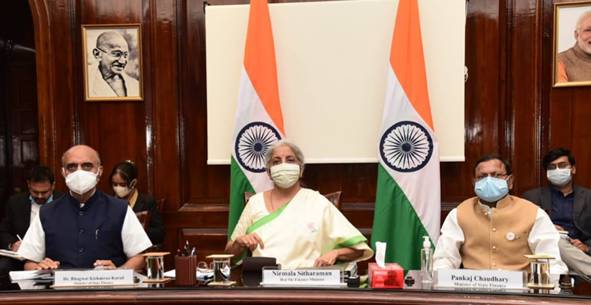
With a view to enhance the investment climate in the country in the wake of strong recovery and the opportunities accorded by a shift in geo-political realities post pandemic, Union Minister for Finance & Corporate Affairs Smt. Nirmala Sitharaman interacted with Chief Ministers and Finance Ministers of all States/ Lt Governors of UTs via virtual conference here today.
Image

The meeting was attended by Chief Ministers of Assam, Chhattisgarh, Goa, Haryana, Himachal Pradesh, Karnataka, Madhya Pradesh, Manipur, Meghalaya, Mizoram, Nagaland, Puducherry, Sikkim, Tripura, and Uttar Pradesh. Lt Governors of Jammu and Kashmir; Deputy Chief Ministers of Arunachal Pradesh, Bihar, and Delhi.  State Ministers of Andhra Pradesh, Gujarat, Kerala, Odisha, Punjab, Rajasthan, Tamil Nadu, Telangana, Uttarakhand, and West Bengal; State Government Officials of Ladakh, Maharashtra, Jharkhand, Andaman & Nicobar, Chandigarh, Dadra and Nagar Haveli & Daman and Diu, Lakshadweep along withSecretaries of GoI Line Ministries, Chief Secretaries and Finance Secretaries Secretary (Economic Affairs), Joint Secretaries (Economic Affairs) and other officials of Centre and State.

In her opening remarks, Finance Minister emphasized that the economy has been growing significantly post the second wave of pandemic and indicators such as imports, exports, PMI manufacturing, digital payments, etc. have already reached pre-pandemic levels. Smt. Sitharaman highlighted that with favourable international perception of India’s growth and in light of the structural, sectoral & financial, reforms undertaken by Government of India, global and domestic investors are upbeat about the investment attractiveness of the country.  States should leverage this opportunity to scale up investments and growth.

The Finance Minister also said that the Government of India has taken concrete steps to increase capital spending and drive an infrastructure and investment-led growth.  Benefits of higher investment in Infrastructure manifest in form of increased employment opportunities, access to market and materials, improved quality of life and empowerment of vulnerable sections. Union Budget FY 2021-22 has allocated Rs 5.54 lakh crore capital outlay, an increase of 34.5% over last year.  Additionally, around Rs 2 lakh crore allocation is for states and autonomous bodies for their capital expenditure.  Over and above this, a new incentive scheme was launched by GoI for states that could achieve at least 15 % of the target set for FY21-22 by the end of 1st quarter, 45% by end of 2nd quarter, 70 % by the end of 3rd quarter. States that achieve their targets become eligible for incremental borrowing. After the end of 1st quarter, 11 states got permission to mobilise an additional total amount of Rs 15,271 crore.

Smt. Sitharaman further said that the recently launched National Monetization Pipeline includes only Central government assets and State assets have been out of its purview as of now. Smt. Sitharaman suggested that there is a significant potentially monetizable asset base in states which could be leveraged to enhance the capital available for new infrastructure creation and other social sector pressing priorities. 

Smt. Sitharaman urged states to help India become the fastest growing economy in coming years, through facilitating investment attractiveness and expediting ease of doing business measures and undertake power reforms with regards to reduction in AT&C and ACS-RRR. Smt. Sitharaman further emphasized that since in many cases land is one of the major bottlenecks for project on-grounding, states must contrive to smoothen land acquisition procedures and create land banks to be tapped at the time of investment.

The Finance Minister urged the States to strengthen their urban local bodies (ULBs) in light of the fact that there has been decidedly a larger allocation to ULBs than earlier and are increasingly been encouraged to pursue resource mobilization.

Since infrastructure projects require technical assistance in addition to financial resources, Smt. Sitharaman said that GoI Line Ministries and DEA would extend all possible cooperation for technical or advisory assistance to states.  Moreover, the Viability Gap Funding provision will help finance socially relevant but financially unviable projects especially across social sectors.

The Finance Minister said that she is looking forward to listening from states and understand their ideas and plans in the direction of investment enhancement.  In the open interaction, States thanked GoI for organizing this consultative interaction. Each of the states enumerated the list of reforms and pro-active policies they are pursuing to establish good governance and to facilitate investments.

Following are the key ideas and requests shared by states to facilitate investment promotion:

  • Affidavit-based clearance system – ABCS by Karnataka and a similar system in UP to provideall clearances in a time-bound manner including plan approval, identification of land, conversion of land, environmental approvals and electricity supply for new enterprises. Affidavit based clearance is given upfront once basic infrastructure is in place and then the investor has 2 years to procure all approvals post-facto.
  • Transparent Mechanism for Investment Facilitation that involves sharing with states, leads of prospective investors who are in touch with GoI. More emphasis on adoption of technology and increase of digital infrastructure
  • Need for a clear-cut policy and SOPs on environment and forest clearances by Government of India, on the lines of ‘Eco-Economics’ and more powers to States under Forest/Environmental matters
  • Need to reassess the District Mineral Fund policy for fund utilization for leveraging across the entire state instead of confining it to a district. 
  • Fast-track clearance and approvals for externally-aided projects by GoI. Reimbursement requested in advance mode.
  • Similar approach to coastal zone regulations framework and application across all coastal states
  • Need for a legal reassessment and intervention on the legality of conversion of several different types of lands into industrial parks
  • Need for strengthening of the dispute resolution mechanism, post-award contract enforcement and of model concession agreements to strengthen infrastructure PPP ecosystem
  • Special emphasis on enhancing road connectivity in North Eastern states even as a lot of work has been done in this regard. These states are rich in resources such as bamboo, which can potentially be utilized in industry but cannot be sent as of now due to connectivity gaps in road and highways.
  • Instill greater increase in banking penetration as well as credit-deposit ratio in states vis-à-vis their dependent population. Moreover, even if in absence of new banking infrastructure, strengthening of existing banks in terms of manpower and systems should be able to address a critical gap.
  • GoI should engage with NE states to develop a State-specific International trade policy in North East depending on location (Look East, Look West, Look South etc)
  • Development of agri-specific infrastructure (GI labs, cold storage, farmer’s market) throughout the country, but especially in North East since a majority of population is dependent on agriculture.
  • Emphasis on increased air connectivity for Himalayan states to support tourism prospects.
  • Need for policy for offshore wind energy
  • Continuation of Centre’s Scheme of loan for capital expenditure beyond the current financial year

The meeting ended with vote of thanks to the chair.

FY 2021-22: Rising Industrial growth, Restrained Inflation and Strong Services Revival (MoF Press Release dated 15th Nov 2021)

The release of quick estimates of Index of Industrial Production (IIP) for the month of September, 2021 shows a sustained increase in industrial production. The IIP, in FY 2021-22, has grown from an average of 121.3 in Q1 to 130.2 in Q2. The IIP in Q2 would have been still higher but for heavy monsoons disrupting mining activity, especially coal and consequently electricity generation, that repressed the growth of overall production index.

The manufacturing index in IIP has held steady and is likely to rise in subsequent months mirroring the eight-month high in Purchasing Manager’s Index (PMI) for manufacturing reaching 55.9 in October, 2021.

A sharp increase in capital goods index from an average of 74.0 in Q1 of FY 2021-22 to 91.7 in Q2 underscores a significant recovery in investment.

There are clear signs of investment being induced by rise in consumption in FY 2021-22 as consumer durables index increases from 91.7 in Q1 to 121.2 in Q2 while consumer non-durables index also moves up from 139.1 to 146.9 across the two quarters.

The release of Consumer Price Index (CPI) numbers for the month of October 2021 shows that the decline in annual consumer price inflation has now gradually set in FY 2021-22. The annual CPI inflation has declined from 5.6 per cent in Q1 to 5.1 per cent in Q2 and it is lower still at 4.5 per cent in October of FY 2021-22.

Similarly, Consumer Food Price Inflation (CFPI) has declined from 4.0 per cent in Q1 of FY 2021-22 to 2.6 per cent in Q2 and further to 0.8 per cent in October showing that supply side disruptions to food distribution have considerably eased.

Activity levels have been steadily increasing in FY 2021-22 as reflected in the latest levels of several High Frequency Indicators including E-way bills, power consumption and GST collections. GST collections have soared in FY 2021-22 to reach its second highest monthly collections ever of Rs.1.3 lakh crore in October, 2021, reflecting robustness of growth revival. Tractor sales hit a record high of 1,15,615 units in October 2021, 25 % higher than September, 2021 volumes, indicative of sustained growth in the agricultural sector.

PMI services has accelerated to a decadal high of 58.4 in October, 2021, suggesting a strong revival in contact-based services sector with the weakening of the pandemic. Average Hotel Occupancy rate in leisure destinations rising from about 55 per cent in Q1 of FY 2021-22 to over 60 per cent in Q2 underscores the service sector growing optimism.

Exports are visibly emerging as the engine of growth for India’s economy having crossed $30 billion for the seventh successive month in October of FY 2021-22. On a cumulative basis, India’s merchandise exports in April-October stood at $232.58 billion, up 54.5% over the same period in 2019.

Outstanding credit of the scheduled commercial banks has been steadily rising in FY 2021-22. Retail credit in particular has been noticeably increasing suggestive of strengthening consumption in the economy. According to CIBIL, inquiry volumes have increased by 54 per cent between February and October of 2021 as economic activity has gained momentum.

FDI in India growing rapidly over last few years. India will witness one of the fastest growth rates across the world.

Ministry of Commerce & Industry, Press Release dated 12 Nov 2021

Shri Piyush Goyal says FDI in India growing rapidly over last few years


Commerce Minister invites South Korea to invest in Defence and Retail

“Plan to manufacture 5 billion vaccines next year”: Shri Piyush Goyal

India will witness one of the fastest growth rates across the world – Shri Goyal

The Minister for Commerce & Industry, Textiles, Consumer Affairs and Food & Public Distribution, Shri Piyush Goyal today said FDI in India has been growing rapidly over the last few years.

“We have today become an attractive and preferred destination for investments,” said Shri Piyush Goyal, while addressing the 4th edition of the India-Korea Business Partnership Forum organised by CII-KITA.

Shri Goyal invited South Korean entrepreneurs to invest in new sectors like Defence and Retail. “We need to complement our complementary strengths in Automobiles, Textiles, Food processing, Leather Products, Metals, Mining, Chemicals and also through some of our traditional sectors like Steel and look at new emerging opportunities in Defence, e-Commerce and Retail.”

Shri Goyal said the Prime Minister Shri Narendra Modi’s ‘Make in India’ initiative is complemented by Her Excellency President Moon’s ‘New Southern Policy’. “Many Korean companies have leveraged the opportunities that India has to offer to ‘Make in India’ for the world using the competitive and comparative advantages of skilled manpower, low cost manufacturing and the Government support that is provided for businesses in India.”

Shri Goyal said during the Covid19 pandemic India has demonstrated our resilience, our capacity to serve the world, our capabilities in terms of being a trusted partner for businesses around the world. “We are widely recognised today as the pharmacy of the world providing medicines and vaccines across continents,” Shri Goyal said. “We plan to manufacture 5 billion vaccines next year and ensure the safety and security of people across the world post-vaccination,” he added.

Shri Goyal said our economy is bouncing back and will possibly see one of the fastest growth rates across the world. “Our Exports are at an all-time high,… Both on the Manufacturing side and on Services our PMI is at all-time highs. We are leveraging our strengths to realise the goal of AatmaNirbhar Bharat, a self-confident and self-reliant India…”

Shri Goyal said the Government has taken several policy measures to support Industry and Services. “We have a very vibrant Production Linked Incentive programme in which many Korean companies have also participated. We have a National Single Window launched recently, a National Infrastructure Pipeline with projects worth over a trillion dollars providing opportunities for Infrastructure companies. We have reduced Corporation taxes to amongst the lowest in the world giving additional incentives to new investments, liberalized our Foreign Investment regime and many other measures to support the growth of the Indian economy,” he said, adding, “In the last four or five years India is home to about 70 Unicorns, nearly half of them only in the last year of the Covid pandemic.”

Global Supply chains should not only be based only on cost but also on trust

Ministry of Commerce & Industry, Press Release dated 12 Nov 2021

Global Supply chains should not only be based only on cost but also on trust – Shri Piyush Goyal


Trade must grow in a mutually beneficial and collaborative way- Shri Goyal

Ensuring transparent, trustworthy and resilient supply chains is at the core of trade revival- Shri Goyal

India has proved its capability and emerged as a resilient and trusted partner to world nations during the pandemic

Shri Goyal delivers the “Keynote Address at Bank of America’s flagship Virtual Conference on the topic “Shifting supply chains globally: Could Make in India see success?”

The Minister for Commerce and Industry, Consumer Affairs, Food and Public Distribution and Textiles, Shri Piyush Goyal today said that COVID-19 highlighted that supply chains should not only be based on cost but also on trust. He opined that ensuring transparent, trustworthy and resilient supply chains is at the core of trade revival and added that India emerged as a source of resilience and a trusted partner during COVID-19. 

He was delivering the “Keynote Address at Bank of America’s flagship Virtual Conference on the topic “Shifting supply chains globally: Could Make in India see success?”, from New Delhi today.

The Minister said that supply and demand disruption brought on by the COVID-19 pandemic have forced manufacturers everywhere to reassess their supply chains. He added that India demonstrated its capacity and capability to the entire world by not only meeting all our international service commitments but also by becoming self-sufficient in production of critical medical supplies (PPEs, testing, masks).

Referring to India’s Pharmaceutical industry, Shri Piyush Goyal said that we are widely recognised as the “Pharmacy of the world” for providing medicines and vaccines to most countries in the world. Speaking of India’s success in implementing the largest vaccination drive in the world, the Minister said that with a plan to manufacture 5 billion doses of vaccine next year, India was aspiring to serve and secure all of the humanity.

Pointing towards the rising economic indicators, Shri Goyal said that India is back in action and the decade is shaping up to be a growth decade, with our exports surging and FDI in-flows and investments following a high growth trajectory. He said that trade must grow in a mutually beneficial and collaborative way.

It may be noted that our Merchandise exports in Apr-Oct 2021 was $ 232 bn (+54% over Apr-Oct 20 & +25% over Apr-Oct 19) and total FDI during the first 4 months of FY 21-22 is 62% more than that of the same period in FY 20-21. India now has 71 unicorns of which 67 were added since 2015.

Shri Goyal said that the Naukri Jobspeak Index for Oct’ 2021 reports a 43%

growth in employment over the same month last year and manufacturing PMI rose to 55.9 in October and service PMI reached a decade high of 58.4 in October. He opined that India has gained trust of global investors, with its investor friendly policies, removal of redundant laws and approvals through single window.

Underscoring India’s strengths as a supply chain alternative, the Minister said that India has a diverse business landscape, skilled workforce and relatively low labour cost. He spoke of India’s ambitious National Infrastructure Pipeline project and said that the new PM GatiShakti Master Plan would lend new life to India’s infrastructure planning and eventually help in reducing logistics cost to 5%.

He stressed that global sentiments are changing from ‘Why India’ to ‘Why not India’ to now “Make in India for the world’ and serving the world from India. “India’s time has come”, he added. He invited the world to ‘Come to India, Invest in India and Make in India, for the world’, and be a part of a large ecosystem of resilient supply chains. 

India poised to achieve Services Export target of $1 Trillion by 2030

Ministry of Commerce & Industry Press Release dated 09th Nov 2021

India poised to achieve Services Export target of $1 Trillion by 2030- Shri Piyush Goyal


India has the potential to become the top services exporter in the world- Shri Piyush Goyal

$89 bn Services Trade surplus in FY 2020-21

Rs. 56,027 crore released under various Export Promotion schemes

“Services” boosting India’s transition from an Assembly economy to a Knowledge based economy- Shri Piyush Goyal

India has transformed from being the ‘Back office’ to the ‘Brain office’ of the world- Shri Goyal

The Minister of Commerce and Industry, Consumer Affairs, Food and Public Distribution and Textiles, Shri Goyal today said that India is poised to achieve services export target of $1 trn by 2030.

He was addressing the gathering at the ‘Services Export Promotion Council- Global Services Conclave 2021” in New Delhi today.

The Minister said that Services are a key driver of India’s economic growth.

He added that services sector provides employment to nearly 2.6 crore people and contributes approximately 40% to India’s total global exports. He added that Services trade surplus was $89 bn in FY 2020-21 and it has been the largest FDI recipient (53% of FDI inflows 2000-2021).

The theme of the Global Services Conclave 2021 was ‘India Serves: Exploring Potential Growth Sectors Beyond IT/ITes’.

Emphasizing that Service sector is our competitive advantage, powered by Skills, Startups and IT Solutions, the Minister said that today, Indian services have the twin power of universal acceptance & universal attraction.

Lauding India’s commitment to enable ‘work from Home’ during the pandemic, Shri Goyal said that, while services trade remained depressed in other countries, India’s services sector showed immense resilience.

“Sectors like tourism, hospitality, etc. which suffered due to COVID-19 is showing revival signs” he added.

Appreciating the spirit that led to rise through the tough times faced by the sector, Shri Goyal said that tough times don’t last, but tough people do. He expressed his admiration for the selfless service of all frontline workers during the COVID 19 pandemic.

The Minister said that in 2020, India became the 7th largest services exporter in the world, moving up the ladder by two positions. Services PMI rose to a decade high of 58.4 in Oct’21, he said.

Emphasizing that India had the potential to become the top services exporter in the world, Shri Goyal said that Services is boosting India’s transition from an assembly economy to a knowledge based economy.

Global sentiments are changing from ‘why India’ to ‘why not India’, he said.

Observing that India has transformed from being the ‘Back office’ to the ‘Brain office’ of the world, Shri Goyal said that today, India’s Services export largely comprise of IT/ITes and stressed that we need to focus on other potential growth sectors.

The Minister listed certain crucial sectors which can catapult India’s services sector on a high growth trajectory such as higher Education. He observed that students from US, Canada etc. prefer India for heritage, art and culture studies.

The Minister assured that the Government was actively pursuing market access opportunities (FTAs) and working on a scheme alternative to SEIS.

He said that the Government supported service sector through Aatmanirbhar Bharat Package, collateral-free Automatic Loans for Businesses, including MSMEs. Rs. 56,027 Crore was released under various Export Promotion schemes.

He spoke of India’s initiatives in Skill development, especially in emerging areas like AI, Big Data, Robotics, etc.

The Minister also highlighted the need for assisting States in formulating a comprehensive export strategy with districts as Export Hubs.

Shri Piyush Goyal said that the Government as a facilitator and enabler, helped Indian Services to grow & touch lives across the globe. He emphasized that Zero Government interference has enabled IT sector to excel. He appreciated the sector for not pursuing incentives but standing on its competitive strength.

Charting the way forward, the Minister said that we must introduce more standards & improve quality. We must move up the value chain in services and pick areas where our strength lies and expand on that, he said. He also said there is a need to expand markets for Legal/Accounting professionals.

Quoting Shri Atal Bihari Vajpayee, Shri Goyal said that “Our aim may be as high as the endless sky, but we should have a resolve in our minds to walk ahead, hand-in-hand for victory will be ours”.

Time to reduce logistics cost by 5% (Ministry of Commerce & Industry Press Release dated 08/11/2021)

Time to reduce logistics cost by 5% – Shri Piyush Goyal


LEADS report to push healthy competition for improvement in logistics development among States – Shri Piyush Goyal

Gujarat, Haryana and Punjab emerge as top performers in LEADS 2021

Inputs of the report to act as significant stimulants to PM GatiShakti National Master Plan- Shri Piyush Goyal

Efficient Logistics is pivotal to bring ease and empowerment to businesses as well as citizens- Shri Piyush Goyal

Ministry of Commerce and Industry releases report on Logistics Ease Across Different States (LEADS) 2021

Jammu and Kashmir bags the top rank among North Eastern States and the Himalayan Region

The Minister of Commerce and Industry, Consumer Affairs, Food and Public Distribution and Textiles, Shri Piyush Goyal today said that the inputs given by Logistics Ease Across Different States Report 2021 can lead the way to bring down logistics cost by 5% over the next 5 years.

He was addressing the gathering after the release of the LEADS Report in New Delhi today.

Shri Piyush Goyal said that India is committed to build modern infrastructure for the 21st century, at a pace never seen before.

Referring to the recently launched PM GatiShakti Master Plan ,he said that it would revolutionise the next generation of multimodal infrastructure development in the country.

Lauding Prime Minister Shri Narendra Modi’s consistent focus on infrastructure, the Minister said that the initiatives taken by him in Gujarat for 13 years had laid the foundation for Gujarat to consistently stay at the top of the chart in LEADS report

He said that the speed of highway construction has increased three fold from ~12 km/day in 2013-14 to 37 km/day in 2020-21 and that there was a four fold increase in Railways Capex from Rs. 54,000 Crore in 2013-14 to Rs. 2.15 Lakh Crore in 2021-22.

He observed that in the 5 years before 2014, only 60 panchayats could be connected with optical fibre and that in last 7 years, more than 1.5 lakh gram panchayats connected with optical fibre.

Shri Goyal emphasized that efficient logistics was pivotal to bring ease and empowerment to businesses as well as citizens. He observed that logistics contributed immensely in our fight against COVID-19 by taking essential supplies including liquid Medical Oxygen throughout the country during the 2nd wave

Observing that logistics is an enabler of multiple visions- From Make in India for the World to Last Mile Delivery, the Minister said that to achieve ambitious targets we cannot afford to walk but we need expressways of Land, Air & Water.

He named Infrastructure, Quality Services & Conducive Regulatory Framework as the three pillars of Resilient logistics. He added that with Competitive & Cooperative federalism, LEADS is creating an Ecosystem for Excellence by bringing in a healthy competitive spirit where everyone is persuaded to improve.

“Rather than just absolute improvement in one State, improvement of logistics across all States, will be a force multiplier for the entire logistics ecosystem”, he said.

He lauded Gujarat, Haryana & Punjab for having acquired the top 3 positions respectively.

He applauded the actions taken by Gujarat Govt against LEADS 2019 recommendations such as the widening of roads, implementation of faceless services in license renewals, expansion of warehousing etc.

He also congratulated the State of Uttar Pradesh for leapfrogging 7 ranks since 2019, highest among all states, driven by policy initiatives, higher infra

spending in logistics.

Shri Goyal said that since its inception in 2018, each year LEADS report has

followed a progressive methodology to provide a granular insight on the logistics performance at State/UTs level. “LEADS 2021 has gone 2-step ahead in analysis of domestic and EXIM logistics ecosystem of the state” he added.

The Minister said that states have Indispensable role in improving the logistics ecosystem of India. He outlined a number of suggestions for States including framing of State Logistics policy & Logistics Master Plan, use single-window clearance system for logistics establishment of grievance redressal mechanism and enabling if skilling in logistics through State skilling infrastructure

He opined that LEADS report would be a handy & practical guide to identify strengths, opportunities & improve the logistics performance of States.

The report ranks the states on the basis of their logistics ecosystem, highlights the key logistics related challenges faced by the stakeholders and includes suggestive recommendations.

The Ministry of Commerce and Industry (MoCI) had launched a study, “Logistics Ease Across Different States (LEADS)” in 2018 with the main objective of ranking States and UTs on the efficiency of their logistics ecosystem.

The first version of the report, LEADS 2018, focused on export-import trade and assessed the efficiency of the logistics ecosystem in each State and UT.

The second edition of the study – LEADS 2019, covered both international and domestic trade.

The LEADS 2021 exercise has gone one-step ahead in analysing domestic and EXIM logistics ecosystem of the state. Specifically, two improvements have been done in the overall assessment framework. Firstly, objective parameters have been used along with the perception-based indicators for index formulation.

The objective parameters in the LEADS 2021 Index have been introduced by way of an objective survey instrument administered to the States/UTs and by the inclusion of secondary datasets on logistics across the State/UT level. Secondly, the statistical methodologies to build the index has been updated to get more robust results, given change in the overall framework.

Alternatively, a total of 21 perception and objective variables have been statistically analysed to prepare a composite index basis upon which the states have been ranked.

The perception survey was administered to the four different categories of logistics stakeholders, viz. traders/ shippers, transport service providers, terminal operators, and logistics service providers.

The States’ objective survey collected binary responses in the context of the areas related to policy, institutional framework, current enforcement mechanism, warehousing approvals and processes, smart enforcement, city logistics, drivers’ empowerment, etc. to understand the initiatives taken by the different state governments towards improving the logistics environment in their respective States.

The secondary dataset was compiled with the assistance of the central government ministries, department and associated agencies.

The LEADS survey 2021 was conducted over the period from May to August 2021 in a challenging environment when the COVID crisis was being fought across multiple fronts.

The whole exercise garnered 3771 responses from 1,405 respondents across the country. For representation purposes, states have been ranked in three separate classes including ‘North Eastern States & Himalayan UTs’ and ‘Other UTs’ group.

Gujarat, Haryana and Punjab have emerged as the top performers in the LEADS 2021 index respectively.

Proactive policies, well-developed infrastructure and services driven by a responsive Government have helped Gujarat to maintain its rank. Haryana has secured the second position, followed by Punjab.

Within the North Eastern States and Himalayan Region, Jammu and Kashmir is the top ranker followed by Sikkim and Meghalaya. Delhi stands at the top rank among Other UTs. Uttar Pradesh, Uttarakhand and Jharkhand have witnessed a remarkable improvement in their ranks compared to 2019 LEADS ranking and have emerged as the top improvers.

The report consists of specific section on States and UTs giving detailed analysis of their performance in the LEADS, including issues and challenges being faced by stakeholders as well as suggestions to mitigate the issues.

States/UTs are encouraged to examine and evaluate the findings of the report and to formulate a suitable strategy and a prioritized action plan for improving logistics performance.

LEADS is a continuous exercise, and the MoCI is enthused to provide a pivotal role in initiating, creating, and connecting all the stakeholders to bring in the required improvements in the logistics space collaboratively.

With the efforts in the right direction, it is hoped that the vision of logistics cost will be reduced by 5% in the next five years. This will ensure that the Logistics sector serves as an engine of growth and a key driver for transforming India into a five trillion-dollar economy.

Department of Commerce through LEADS will continuously engage with all States and UTs to support, facilitate and promote improvements in the overall logistics ecosystem. Synergies flowing from such a coordinated approach will reduce logistics costs and which, in turn, will act as significant stimulants to PM Gati Shakti National Master plan.

Access Weblink- https://commerce.gov.in/whats-new/

Model Tender Documents (MTDs) for Procurement of Goods and non-Consultancy Services (वस्‍तुओं और गैर-परामर्श सेवाओं की खरीद के लिए मॉडल निविदा दस्तावेज (एमटीडी) (MoF Press Release dated 29th Oct 2021)

Finance Secretary Dr T.V. Somanathan releases Model Tender Documents (MTDs) for Procurement of Goods and non-Consultancy Services


MTDs specifically cater to needs of e-procurement, easing digitization process of Public Procurement & help in achieving goal of Digital IndiaPosted Date

वित्त सचिव डॉ. टी वी सोमनाथन ने वस्‍तुओं और गैर-परामर्श सेवाओं की खरीद के लिए मॉडल निविदा दस्तावेज (एमटीडी) जारी किए


एमटीडी से विशेषकर ई-खरीद की जरूरतें पूरी होती हैं,  सार्वजनिक खरीद की डिजिटलीकरण प्रक्रिया आसान हो जाती है और डिजिटल इंडिया के लक्ष्य को प्राप्त करने में मदद मिलती है

Finance Secretary & Secretary Expenditure, Dr T.V. Somanathan here today released Model Tender Documents (MTDs) for Procurement of Goods and non-Consultancy Services as part of continuous process of review of existing rules & procedures as emphasised by the Hon’ble Prime Minister in his Independence Day speech this year.

MTDs specifically cater to needs relating to e-procurement thereby easing the process for adoption of e-procurement and furthering the ambition of convenient and efficient e-governance of the Government. Such initiatives shall help in achieving the goal of Digital India by easing and standardising the digitization process of Public Procurement.

Tender documents are the critical touch point for the Government with industry and are, therefore, a critical vehicle for implementing policy initiatives on the ground. Uniform sets of tender documents permit Government to express its policies effectively, consistently and uniformly. Uniformity in interpretation and application of public procurement policies and initiatives reflect clarity of application, thereby, increasing compliance and enhancing public confidence in procurement process. Further, apart from sharing best procurement practices, uniform tender documents amplify the positive impact of policy initiatives, bringing economies of scale and increasing competition. They create more efficient market conditions for realising value for tax payers money. Bidders also get broader market access for their products.

Accordingly, Model Tender Documents (MTDs) have now been developed for the procurement of Goods and non-Consultancy Services. These MTDs rationalise and simplify the structure of tender documents. Besides aligning provisions with various procurement policies of the Government, like policies related to Micro and Small Enterprises, preference to Make in India and benefits to Start-ups, MTDs incorporate national and international best practices. The MTDs have been developed after a two stage, extensive consultation with Ministries/ Departments/ Central Public Sector Undertakings, other organisations and individual experts.

MTDs issued by the Department of Expenditure , Ministry of Finance  will be guiding templates . In keeping with the Government’s Digital India thrust, the MTDs are being issued in soft template for enabling easy customisation by user departments. Ministries/ Departments shall be competent to suitably customise this document to suit their local/ specialised needs. A separate detailed Guidance Note, as a guide to use of each MTD has also been prepared to help the procuring officials in utilising each MTD. Model Tender Documents, issued by Department of Expenditure (DoE), Ministry of Finance, will be guiding templates.

Government organisations procure various goods and non-consulting services in order to comply with their duties and responsibilities. To improve good governance, transparency, fairness, competition, and value for money in public procurement, the Government of India has taken a number of significant policy initiatives in public procurement in the recent past. The General Financial Rules were issued after comprehensive review in March, 2017. Additionally three procurement Manuals, the Manual for Procurement of Goods, 2017, Manual for Procurement of Consultancy and Other Services, 2017 and Manual for Procurement of Works, 2019, have also been developed.

The formulation and release of these Model Tender Documents are a part of continuous process of review of existing rules and procedures and being monitored by Cabinet Secretary as a special campaign during 2nd October, 2021 to 31st October, 2021.

Documents Links:

https://doe.gov.in/sites/default/files/Model%20Tender%20Document%20for%20Procurement%20of%20Goods_0.pdf

https://doe.gov.in/sites/default/files/Model%20Tender%20Document%20for%20Procurement%20of%20Non%20Consultancy%20Services.pdf

Guidelines for reforms in Public Procurement and Project Management (Ministry of Finance Press Release dated 29th Oct 2021)

Finance Secretary Dr T.V. Somanathan releases guidelines for reforms in Public Procurement and Project Management


Guidelines attempt to incorporate into the realm of Public Procurement, innovative rules for faster, efficient and transparent execution of projectsPosted Date:- Oct 29, 2021

Finance Secretary & Secretary Expenditure, Dr T.V. Somanathan released guidelines to usher in reforms in Public Procurement and Project Management here today. The formulation and release of these guidelines is a part of continuous process of review of existing rules and procedures as emphasised by the Hon’ble Prime Minister during his Independence Day address this year. This is being monitored by Cabinet Secretary as a special campaign during 2nd October, 2021 to 31st October, 2021.

The draft of the guidelines was prepared under the aegis of the Central Vigilance Commission (CVC) after a detailed consultative process involving experts from various fields of public procurement and project management. The Department of Expenditure (DoE), Ministry of Finance, was nominated to issue the guidelines after soliciting and detailed consideration of the comments of Ministries/ Departments.

These guidelines attempt to incorporate into the realm of Public Procurement in India, innovative rules for faster, efficient and transparent execution of projects and to empower executing agencies to take quicker and more efficient decision in public interest. Some of the improvements include prescribing strict timelines for payments when due. Timely release of ad hoc payments (70% or more of bills raised) is expected to improve liquidity with the contractors especially Micro, Small and Medium Enterprises (MSMEs).

As part of Government’s Digital thrust, Electronic Measurement Books have been prescribed as a means of recording progress of works. This system, along with other IT based solutions, proposed in the guidelines, will help in realising the dream of efficient Digital India, facilitate faster payments to contractors and reduce disputes.

Alternative methods for selection of contractors have been permitted, which can improve speed and efficiency in execution of projects. In appropriate cases, quality parameters can be given weightage during evaluation of the proposal in a transparent and fair manner, through a Quality cum Cost Based Selection (QCBS), as an alternative to traditional L1 system.

Executing public projects on time, within the approved cost and with good quality has always been a challenge. As the pace of economic development steps up careful examination of procedures and rules is essential to ensure unwarranted roadblocks are removed and new innovations utilized for increasing value for money of the taxpayer.

The Central Vigilance Commission (CVC), the Comptroller & Auditor General (CAG) and the National Institution for Transforming India (NITI) Aayog had carried out detailed analysis of the procedures and rules for public procurement and project management and had suggested changes in strategies to meet challenges of present and future public procurement.

Order Link:

https://doe.gov.in/sites/default/files/General%20Instructions%20on%20Procurement%20and%20Project%20Management.pdf  

****

RM/KMN

Open Network for Digital Commerce (Scaled up and deployed rapidly) Ministry of Commerce & Industry Press Release dated 26 Oct 2021

Ministry of Commerce & Industry

Shri Piyush Goyal reviews Open Network for Digital Commerce


A non-profit entity to be established by private sector participation

ONDC to be scaled up and deployed rapidly
Posted Date:- Oct 26, 2021

The Union Minister of Commerce & Industry, Consumer Affairs & Food & Public Distribution and Textiles, Shri Piyush Goyal reviewed the progress on Open Network for Digital Commerce (ONDC) initiative of DPIIT. The meeting was attended by Shri Anurag Jain, Secretary, DPIIT and members of Advisory Council of ONDC including Shri R.S. Sharma, CEO, NHA, Shri AdilZainulbhai, Chairman, QCI, Shri DilipAsbe, MD&CEO, NPCI, Shri Suresh Sethi, MD&CEO, NSDL-e Gov Shri Kumar Rajagopalan, CEO, RAI, Shri Arvind Gupta, Founder, MyGov and MsAnjali Bansal ofAvaana Capital.

The Minister was apprised about the significant progress made for the project. QCI has established a team of experts for execution of the project in a mission mode. A number of small and medium enterprises have been on-boarded as volunteers to complement ONDC team. An ONDC gateway has also been established. About 20 entities covering all network components are at various stages of on-boarding. DPIIT has approved a budget of approximately Rs 10 crores for initial work on the project.

It has been suggested to establish a private sector led non-profit company. The entity is expected to provide a start-up mindset for a population scale implementation, enabled by a management with a futuristic vision, leadership with a deep understanding of commerce, comfort with cutting edge technology, and missionary outlook to drive change. A non-profit company structure removes any incentive for owners to drive for profit maximization, keep focus on ethical and responsible behaviour while providing for trust, rigorous norms of governance, accountabilityand transparency.

The role of the entity would be to develop the network by adopting and building enabling technology and encouraging wide-scale voluntary participation by eco-system players. It would ensure network discipline by establishing a code of conduct and rules of network based on principles of consumer protection, fair trade and regulatory conformity. The entity will also provide foundational services for managing the network like digital infrastructure for the network, common registry, certification of participants and certifying agencies, grievance redressal, etc. The entity will develop and operate reference applications for buyers, sellers and gateway for market activation and priming the network along with partner entities. It will also support SMEs in their digital transformation by developing readymade tools to help existing software applications quickly adapt to the network.

The meeting was also attended by a number of prospective promoters including senior representatives from State Bank of India, Punjab National Bank, Bank of Baroda, NABARD, SIDBI, National Payments Corporation of India, NSDL, CDSL, NSE and BSE.

Shri Goyal expressed satisfaction with the progress made and desired to compress timelines for making this network a reality soon. He directed that wide participation from ecosystem should be ensured and the institutional structure should be created in such a manner so as to ensure that the entity conducts itself in an ethical, cooperative, democratic and responsible manner.He directed that special efforts must be made to build trust in the ONDC network and elaborate mechanisms must be put in place for dispute resolution.

How to improve Law Firm (Lawyers) Profitability?

Dear Sir,

Please find below YouTube video link on How to improve Law Firm (Lawyers) Profitability?

1. What is Law firm?

2. Generally used business structure of Law Firm in India

3. Financial indicators

4. Lawyers compensation, Profitability

5. How do law firms make a profit?

6. Revenue vs. profitability

7. What can a law firm do to stay profitable?

8. Tips to improve Law Firm’s profitability

Regards,
Bipul Kumar