FM chairs post-Budget meeting with heads of Banks, NBFCs and Financial Institutions (Press release 22 Feb 2022)

Finance Minister Nirmala Sitharaman chairs post-Budget meeting with heads of Banks, NBFCs and Financial Institutions


Finance Minister exhorts all banks to sign up to Account Aggregator Framework, says it will improve credit flow and promote digital lending

Meeting emphasizes that Benefits of digital banking should reach every nook and corner of the country in a consumer-friendly manner

Union Minister for Finance and Corporate Affairs Smt. Nirmala Sitharaman chaired a post-budget meeting with heads of Banks, Non-Banking Financial Institutions (NBFCs) and Financial Institutions in Mumbai today.

The meeting was attended by Union Minister of State for Finance Dr. Bhagwat Kishanrao Karad; Shri Sanjay Malhotra, Secretary, Department of Financial Services; Shri Ajay Seth, Secretary, Department of Economic Affairs and Dr. V. Anantha Nageswaran, Chief Economic Adviser. The heads of all Public Sector banks, select Private Sector Banks, NBFCs and Financial Institutions were also present in the meeting.

Underscoring the importance of information sharing and collaboration, the Finance Minister exhorted all the banks to sign up to the Account Aggregator model which would facilitate seamless flow of credit for small borrowers and promote digital lending. The Minister directed that pilots for Account Aggregator model and cashflow-based lending may be replicated in different regions around the country including in the North Eastern Region, on the lines of the initiative by two banks in Varanasi district.

The meeting deliberated on the various budget announcements in the context of PM GatiShakti, Defence, Telecom, Manufacturing & exports, Emergency Credit Line Guarantee Scheme (ECLGS) and tax concessions to new manufacturing units and start-ups, which offer new opportunities to the financial sector. The meeting discussed various schemes/programmes such as subordinated debt to MSMEs, KCC, Aatma Nirbhar Bharat Schemes and credit outreach programme which provided immediate relief to the borrowers and the banks, from the impact of the COVID-19 pandemic.  ECLGS, which has been enhanced to Rs. 5 lakh crore and extended up to 31.3.2023, was also discussed.

It was emphasised that digital banking, digital payments and fintech innovations are an opportunity for banks to find new ways to reduce the cost of intermediation and provide cost-effective services and that the benefits of digital banking should reach every nook and corner of the country in a consumer-friendly manner.  

 It was further stressed that banking industry should target to open accounts of unbanked adults under Jan Dhan Yojana and ensure Insurance/Pension coverage to all eligible adults.

It was highlighted in the meeting that with a record profit of Rs. 1.22 lakh crore in FY 20-21 and Rs. 0.79 lakh crore in HY 21-22, declining Gross NPA figures to 6.90% (as on Sep’21) from all-time high of 11.20% (as on Mar ’18) and sufficient buffers with all time high CRAR of 16.5% (as on Sep ’21) against the regulatory mandate of 11.5%, banks are in a strong position to support future growth, enabling the country’s economy for a take-off.

The way forward for stepping-up the lending activity and building a conducive credit environment for businesses and individuals was also stressed upon in the meeting.
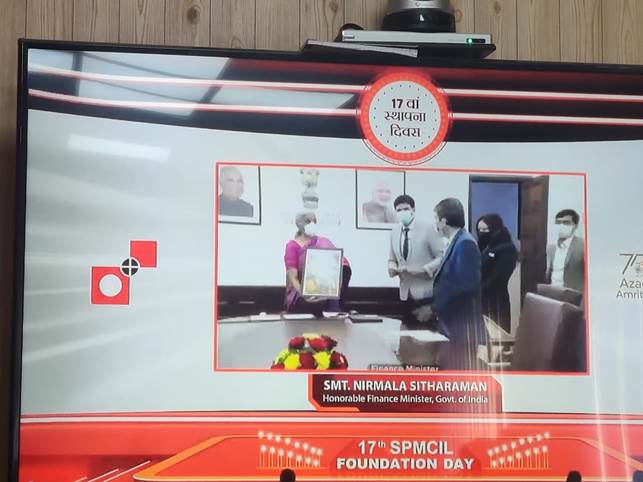

Union Finance Minister Smt. Nirmala Sitharaman launches first colour souvenir coin on “Panchtantra”

Security Printing and Minting Corporation of India Limited (SPMCIL) celebrated its 17th Foundation Day programme today (11th Feb 2022) through the digital mode.

Union Finance Minister, Smt. Nirmala Sitharaman chaired the programme via virtual mode in the presence of Secretary, Department of Economic Affairs (DEA), Ministry of Finance (MoF), Senior Economic Advisor, DEA, MoF and other senior officials from Ministry and Director (HR) & Director (Finance) of SPMCIL. 

Union Finance Minister Smt. Nirmala also launched the first colour souvenir coin on “Panchtantra” during the occasion.

Ms. Tripti Patra Ghosh, CMD, SPMCIL, in her welcome address highlighted the achievements and the innovative initiatives of the Company.

During the occasion, the Chief General Managers of the respective 09 Units awarded the meritorious employees for their outstanding achievements.

The Finance Minister in her address laid stress on upskilling and acquiring new skills, and upgradation to meet the technology driven economy. Further she emphasized on ramping up of quality of products and to brand SPMCIL as lead producers of currency and other sovereign products.

BUDGET 2022 (Download all budget documents) -01st Feb 2022)

Key to Budget Document, 2022

https://www.indiabudget.gov.in/doc/Key_to_Budget_Document_2021.pdf

Budget Highlights (Key Features)

https://www.indiabudget.gov.in/doc/bh1.pdf

Annual Financial Statement
+

https://www.indiabudget.gov.in/#collapse2

Memorandum Explaining the Provisions in the Financial Bill

https://www.indiabudget.gov.in/doc/memo.pdf

Finance Bill

https://www.indiabudget.gov.in/doc/Finance_Bill.pdf

Statements of Fiscal Policy under the FRBM Act, 2003

https://www.indiabudget.gov.in/doc/frbm1.pdf

Output Outcome Framework for Schemes 2022-2023

https://www.indiabudget.gov.in/doc/OutcomeBudgetE2021_2022.pdf

Customs Notifications
+

https://www.indiabudget.gov.in/#custom

Implementation of Budget Announcements 2021-2022

https://www.indiabudget.gov.in/doc/impbud2020-21.pdf

Budget at a Glance
+

https://www.indiabudget.gov.in/#budget

Expenditure Profile
+

https://www.indiabudget.gov.in/#expen

Expenditure Budget

https://www.indiabudget.gov.in/#expenb

Ministry wise Summary of Budget Provisions

https://www.indiabudget.gov.in/doc/eb/sumsbe.pdf

All Statements of Budget Estimates

https://www.indiabudget.gov.in/doc/eb/allsbe.pdf

Finance Minister’s Speech

https://www.indiabudget.gov.in/#collapse1

Consumer Awareness – Cyber Threats and Frauds (RBI Press Release dated 28th Jan 2022)

It has come to the notice of Reserve Bank of India that unscrupulous elements are defrauding and misleading members of public by using innovative modus operandi including social media techniques, mobile phone calls, etc. In view of this, the Reserve Bank cautions members of public to be aware of fraudulent messages, spurious calls, unknown links, false notifications, unauthorized QR Codes, etc. promising help in securing concessions / expediting response from banks and financial service providers in any manner.

Fraudsters attempt to get confidential details like user id, login / transaction password, OTP (one time password), debit / credit card details such as PIN, CVV, expiry date and other personal information. Some of the typical modus operandi being used by fraudsters are –

  • Vishing – phone calls pretending to be from bank / non-bank e-wallet providers / telecom service providers in order to lure customers into sharing confidential details in the pretext of KYC-updation, unblocking of account / SIM-card, crediting debited amount, etc.
  • Phishing – spoofed emails and / or SMSs designed to dupe customers into thinking that the communication has originated from their bank / e-wallet provider and contain links to extract confidential details.
  • Remote Access – by luring customer to download an application on their mobile phone / computer which is able to access all the customers’ data on that customer device.
  • Misuse the ‘collect request’ feature of UPI by sending fake payment requests with messages like ‘Enter your UPI PIN’ to receive money.
  • Fake numbers of banks / e-wallet providers on webpages / social media and displayed by search engines, etc.

RBI urges the members of public to practice safe digital banking by taking all due precautions, while carrying out any digital (online / mobile) banking / payment transactions. These will help in preventing financial and / or other loss to them.

(Yogesh Dayal)     
Chief General Manager

Press Release: 2021-2022/1630

Guidance note on Schedule III of companies Act, 2013 (Revised in January 2022 )-ICAI

Guidance note on Schedule III of companies Act, 2013 (Revised in January 2022 )-ICAI

The Government of India has always been taking many initiatives to promote the Corporate Governance framework in India. It is a well-known fact that transparency is considered as one of the most important underlying factors to improve corporate governance. In this direction, the Ministry of Corporate Affairs (MCA) has revised the Schedule III to the Companies Act, 2013 vide notification dated 24th March 2021 by introducing additional disclosure requirements in the financial statements to improve governance.

These amendments have significant disclosure requirements in the financial statements of the Company. Along with this, it also has a major impact on the accounting professionals as well as on the stakeholders of the Company and are directed at enabling the higher level of corporate governance for the companies.

Considering the need to provide guidance in view of the significant amendments made in Schedule III to the Companies Act, 2013, Corporate Laws & Corporate Governance Committee (CLCGC) of ICAI has undertaken the task of revising the Guidance Note on Division I, II, III

Download Guidance Note from given link :

Guidance Note on Division I – Non Ind AS Schedule III to the Companies Act 2013 issued by CL&CGC ICAI – (24-01-2022)

https://resource.cdn.icai.org/68981clcgc55147-gnd1.pdf

Guidance Note on Division II – Ind AS Schedule III to the Companies Act 2013 issued by CL&CGC ICAI – (24-01-2022)

https://resource.cdn.icai.org/68982clcgc55147-gnd2.pdf

Guidance Note on Division III to Schedule III to the Companies Act 2013 for NBFC that is required to comply with Ind AS issued by CL&CGC ICAI – (24-01-2022)

https://resource.cdn.icai.org/68983clcgc55147-gnd3.pdf

Sovereign Gold Bond Scheme 2021-22 (Series IX) – Issue Price (Press release dated 07th Jan 2022)

In terms of Government of India Notification No.4(5)-B(W&M)/2021 dated October 21, 2021, Sovereign Gold Bonds 2021-22 (Series IX) will be opened for subscription during the period January 10-14, 2022 with Settlement date January 18, 2022. The issue price of the Bond during the subscription period shall be Rs 4,786 (Rupees Four thousand Seven hundred eighty six only) – per gram, as also published by RBI in their Press Release dated January 07, 2022. 

The Government of India in consultation with the Reserve Bank of India has decided to allow discount of Rs 50 (Rupees Fifty only) per gram from the issue price to those investors who apply online and the payment is made through digital mode. For such investors the issue price of Gold Bond will be Rs 4,736 (Rupees Four thousand seven hundred thirty six only) per gram of gold.

88% growth in volume of digital transactions during last 3 years since 2018-19 (Press release dated 21st Dec 2021)

88% growth in volume of digital transactions during last 3 years since 2018-19

With over 22 billion transactions in FY 2020-21, UPI emerges as favourite digital payment choice

As a result of the initiatives taken by the Government, there has been a paradigm shift in digital transactions in India. This was stated by Union Minister of State for Finance Dr Bhagwat Kisanrao Karad in a written reply to a question in Rajya Sabha.

The Minster stated that the paradigm shift is reflected in terms of the increase in the volume of digital transactions over the last three financial years as illustrated below:

Financial Year

Volume (in lakhs)

2018-19

2,32,602

2019-20

3,40,025

2020-21

4,37,445

Source: RBI

As observed from the above table, there has been a growth of 88% in volume of digital transactions during the last 3 years since 2018-19, the Minister stated.

The digital transaction platform is a pan India platform with a facility of ‘’anytime anywhere’’ banking. Accordingly, the data is captured only at the National level, the Minister added.

The Minister further stated that as per the data sourced from National Payments Corporation of India (NPCI), India’s own payment platform, UPI has emerged as the country’s favourite digital payment choice, with over 22 billion transactions registered during FY 2020-21, showing 4 times growth over the last 3 years. Also, AePS inter-bank transactions during FY 2020-21 registered a 9-fold growth, over the past 4 years.

To promote digital transaction in the country, the Minister stated that RuPay debit cards are issued to Jan-Dhan account holders under Pradhan Mantri Jan-Dhan Yojana (PMJDY). As on 08.12.2021, 31.17 crore RuPay debit cards have been issued to PMJDY account holders. As digital payment is one of the priorities of the Government to facilitate hassle free and seamless banking transactions in the country, several other initiatives have been taken by Government of India through its various programs/agencies, Reserve Bank of India (RBI) and banks, to promote and create awareness about digital payments in rural areas.

While answering a question on preventing frauds in digital transactions, the Minister state that the Unique Identification Authority of India (UIDAI) issues the Aadhaar numbers to the residents of the country and provides authentication services for establishing identity of the individual. UIDAI already provides for various modes of authentication namely biometric (which includes fingerprint, iris), One Time Pin-based (OTP) and demographic authentication. These can be used in a single factor or multi-factor mode. Any user agency/ department can opt for one or a combination of these modes depending upon their security/ risk assessment of their respective systems, the Minister stated.

The Minster further apprised that NPCI, RuPay Debit and Credit cards are used at both domestic and international payment gateways. These international and domestic transactions are facilitated by NPCI’s International network partners and domestic tie-ups. In addition, acquiring banks also have their own payment gateways that work with RuPay cards.

Measures taken by Government to keep inflation under control (Press release dated 07th Dec 2021)

The Government has taken various measures to keep inflation under control. This was stated by Union Minister of State for Finance Shri Pankaj Chaudhary in a written reply to a question in Rajya Sabha today.

Giving more details, the Minister said that some of them include the following:

  • Crude Oil/Petroleum Products: To check the petrol and diesel prices, Central Government has reduced Central Excise Duty on Petrol & Diesel by Rs. 5 and Rs. 10 respectively with effect from 04.11.2021. In response many states governments have also reduced Value Added Tax on petrol and diesel. Retail prices of petrol and diesel have sobered down across the country.
  • Essential Commodities: Price situation of major essential commodities is being monitored by the Government on a regular basis and corrective action taken from time to time.
  • Pulses: (i) A buffer stock target of 23 lakh metric tonne (LMT) has been approved for 2021-22. Stocks are subsequently utilised for cooling down prices through supply to states and disposal through Open Market sales (ii) Imposition of stock limits on some pulses under the Essential Commodities Act, 1955 in July 2021 to prevent hoarding. (iii) Changes in the import policy by keeping Tur and Urad under ‘free’ category till 31st December, 2021. (iv) Basic import duty and Agriculture Infrastructure and Development Cess on Masur have been brought down to zero and 10% respectively. (v) 5-year memorandum of understanding (MoUs) have been signed with Myanmar for annual import of 2.5 LMT of Urad and 1 LMT of Tur, and with Malawi for annual import of 0.50 LMT of Tur and MoU with Mozambique for annual import of 2 LMT Tur has been extended for another 5 years.
  • Edible Oils: To soften the prices of edible oils, the import duty on edible oils have been rationalised and stock limits imposed to avoid hoarding upto a period of March 31, 2022. National Mission on Edible Oils- Oil Palm has been approved with a financial outlay of Rs.11,040 crore to encourage domestic production and availability of oil palm.

Giving details on the various initiatives taken to safeguard the interests of the vulnerable population, both in rural and urban areas, the Minister stated that in the wake of COVlD-19 pandemic crisis in the country, the Pradhan Mantri Garib Kalyan Anna Yojana (PMGKAY) was started in April 2020 to provide additional free food grains to about 80 crore National Food Security Act (NFSA) beneficiaries in the country initially for a period of 3 months from April to June 2020 which was later extended for a further period of 5 months from July to November 2020.

The Minister further stated that in 2021, the PMGKAY scheme was resumed for a period of another 7 months from May to November 202l and has been further extended upto March 2022. Further, under the Atma Nirbhar Bharat Scheme (ANBS) food grains were allocated to all states/UTs for free distribution to migrants/stranded migrants and all those not having NFSA or any state PDS ration cards, for a period of 2 months of May and June 2020. Additionally, One Nation One Ration Card (ONORC) enabled ration card portability for NFSA beneficiary to lift the entitled food grains for self or on behalf of the complete household from any Fair Price Shop (FPS) in the country by using their same/existing ration card with biometric authentication on an electronic Point of Sale (ePoS) device. So far, the ONORC plan is enabled in34 States/UTs covering about 75 crore beneficiaries (94.3% NFSA population) in the country, the Minister stated.

****

RM/KMNRelease Id :-1778933

Digital payments increased over last 3 financial years (Press release 06 Dec 2021)

As apprised by Ministry of Electronics and Information Technology (MeitY), Digital India Programme has made a significant and positive impact in the lives of common citizen in the country. This was stated by Union Minister of State for Finance Dr Bhagwat Kisanrao Karad in written reply to a question in Lok Sabha today.

As a result of the initiative taken, the Minister stated, the number of digital payments in volume terms have increased over the last 3 financial years (FY) as illustrated below:

Financial Year

Volume (in lakhs)

2018-19

2,32,602

2019-20

3,40,025

2020-21

4,37,445

2021-22 (till Oct’21)

3,68,284

Source: RBI

The Minister stated that the brief details of major Digital India initiatives, inter-alia, are at  ANNEXURE.

Giving more details, the Minister stated that as apprised by Reserve Bank of India (RBI), in terms of extant instructions, with effect from September 7, 1999, Scheduled Commercial Banks have however been given the freedom to fix service charges for various types of services rendered by them. While fixing service charges, banks have, however, been advised to ensure that the charges are reasonable and not out of line with the average cost of providing these services. They have been further advised to identify basic services and the principles to be adopted /followed by them for ensuring reasonableness in fixing such charges and to take steps to ensure that customers are made aware of the service charges upfront and changes in the service charges are implemented only with the prior notice to the customers.

The Minister further stated that the above instructions are consolidated in paragraph 6 of Master Circular on ‘Customer Service in Banks’ issued vide DBR. No.Leg.BC.21/09.07.006/2015-16 dated July 1, 2015, which is available on RBI website www.rbi.org.in . Also, RBI vide circular DPSS.CO.PD No. 1633 / 02.14.003 / 2017-18 dated December 06, 2017, banks have, inter- alia, been advised to ensure that merchants on-boarded by them do not pass on MDR charges to customers while accepting payments through debit cards.

Further, vide Circular 32 of 2019 dated 30.12.2019 of Department of Revenue, any charge, including the Merchant Discount Rate (MDR), shall not be applicable on or after 01.01.2020 on payment made through prescribed electronic modes i.e. RuPay Debit card, BHIM-UPI and BHIM-UPI QR Code, the Minister stated.

Union Budget 21-22 provided capital outlay of Rs. 5.54 lakh crore, an increase of 34.5% over Budget Estimate of FY 2020-21, to boast economy after COVID-19 pandemic (Press release 06 Dec 2021)

To initiate infrastructure development to boost the economy after COVID-19 pandemic, Union Budget 2021-22 has provided a capital outlay of Rs. 5.54 lakh crore, an increase of 34.5% over Budget Estimate of FY 2020-21. This was stated by Union Minister of State for Finance Shri Pankaj Chaudhary in a written reply to a question in Lok Sabha today.

The Minister stated that the Government has also made provision of more than Rs. 2 lakh crore for States & Autonomous Bodies towards their Capital Expenditure. National Monetization Pipeline was also prepared to unlock the value of investments in public sector assets by tapping private capital and efficiencies for delivering infrastructure services. These proceeds are envisaged to augment existing/ create Greenfield infrastructure. Additionally, Central Ministries/Departments have been suggested to expedite infrastructure investment by front-loading capital expenditure.

Giving more details, the Minister said that the CCEA in its meetings held on 21.10.2021 approved the proposal for development of ‘PM GatiShakti National Master Plan (NMP)’ for providing multimodal connectivity infrastructure to various Economic Zones. It aims to depict various economic zones and the infrastructure linkages to holistically integrate all the multimodal connectivity projects, remove missing gaps for seamless movement of people, goods & services, minimize disruptions, improve logistics efficiency. The sectors intended to be included in PM GatiShakti NMP are Transport & Logistics – Roads, Rail, DFC, Airports, Inland Waterways, Ports, Logistics infrastructure, Bulk material transportation, Urban Public Transport; Energy – Electricity Transmission with specific reference to evacuation of renewable energy projects, National Gas Grid; Communication – OFC network, Telecommunication Towers; Commercial infrastructure – Common infrastructure for industrial parks with industrial activities like, Food parks/Textile parks, SEZs, Electronics Manufacturing Clusters, Fishing Clusters/Harbours, Defence Corridors/Industrial Corridors, Pharma & Medical Device Clusters.

In response to the source of funding for the aforesaid project, the Minister stated that there is no financial implication for multimodal connectivity infrastructure to the economic zones under the PM GatiShakti NMP as the concerned line Ministries/Departments will seek funding of their respective infrastructure projects serving the economic zones as per procedures laid under their respective schemes/programmes.

Giving more details, the Minister stated that the National Infrastructure Pipeline (NIP) was launched with projected infrastructure investment of around Rs. 111 lakh crore during FY 2020-2025 to provide world-class infrastructure across the country, and improve the quality of life for all citizens. NIP was launched with 6,835 projects, which has expanded to over 9,000 projects covering 34 sub- sectors. NIP is a first-of-its-kind, whole-of-government exercise and covers all infrastructure sub- sectors, including MSMEs working in infrastructure sector, as mentioned in Harmonized Master List of Infrastructure Sub-sectors notified by Department of Economic Affairs (DEA).