Sovereign Gold Bond Scheme 2021-22 (Series V) – Issue Price

In terms of Government of India Notification No.4(5)-B (W&M)/2021 dated May 12, 2021, Sovereign Gold Bonds 2021-22 (Series V) will be opened for the period August 9-13, 2021 with Settlement date August 17, 2021. The issue price of the Bond during the subscription period shall be Rs 4,790 (Rupees Four thousand Seven hundred ninety only) – per gram, as also published by RBI in their Press Release dated August 06, 2021.

The Government of India in consultation with the Reserve Bank of India has decided to allow discount of Rs 50 (Rupees Fifty only) per gram from the issue price to those investors who apply online and the payment is made through digital mode. For such investors the issue price of Gold Bond will be Rs 4,740 (Rupees Four thousand seven hundred forty only) per gram of gold. 

Ministry of Finance Press Release dated 06 Aug 2021

Know all about e-RUPI, the new digital payment instrument (Ministry of Finance Press Release dated 06 Aug 2021)

(Prime Minister Shri Narendra Modi  on August 2nd launched digital payment solution e-RUPI, a cashless and contactless instrument for digital payment. Prime Minister said that the eRUPI voucher is going to play a huge role in making Direct Benefit Transfer (DBT) more effective in digital transactions in the country and will give a new dimension to digital governance.   He said e-RUPI is a symbol of how India is progressing by connecting people’s lives with technology.)
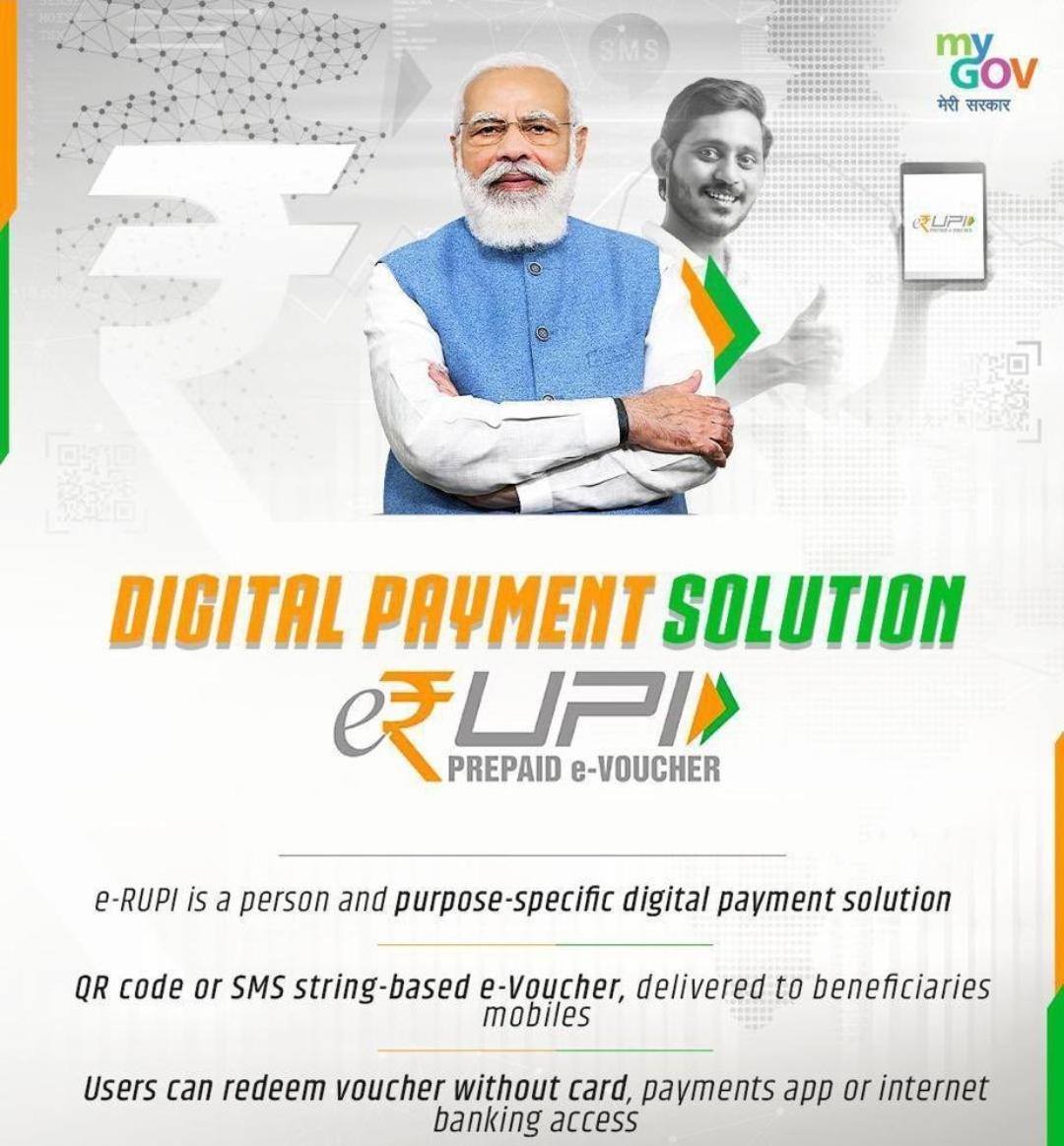
What is e-RUPI and how it works ?

e-RUPI is basically a digital voucher which a beneficiary gets on his phone in the form of an SMS or QR code.  It is a pre-paid voucher, which he/she can go and redeem it at any centre that accepts its.

For example, if the Government wants to cover a particular treatment of an employee in a specified hospital, it can issue an e-RUPI voucher for the determined amount through a partner bank.  The employee will receive an SMS or a QR Code on his feature phone / smart phone.  He/she can go to the specified hospital, avail of the services and pay through the e-RUPI voucher received on his phone.

Thus e-RUPI is a one time contactless, cashless voucher-based mode of payment that helps users redeem the voucher without a card, digital payments app, or internet banking access.
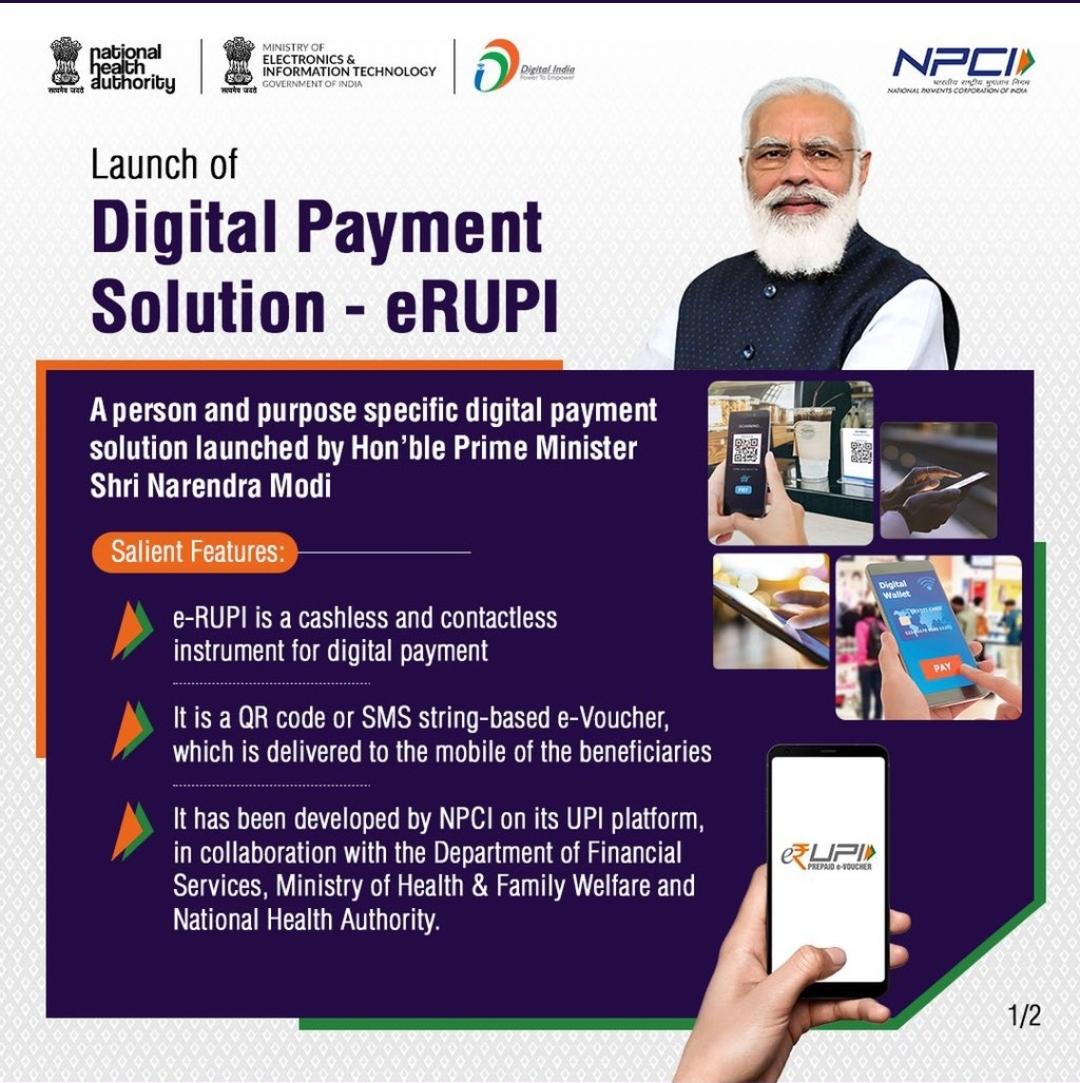
e-RUPI should not be confused with

Digital Currency which the Reserve Bank of India is contemplating.  Instead e-RUPI is a person specific, even purpose specific digital voucher.

How is e-RUPI advantageous to the Consumer ?

e-RUPI does not require the beneficiary to have a bank account, a major distinguishing feature as compared to other digital payment forms.   It ensures an easy, contactless two-step redemption process that does not require sharing of personal details either.

Another advantage is that  e-RUPI is operable on basic phones also, and hence it can be used by persons who do not own smart-phones or in places that lack internet connection.

What are the benefits of e-RUPI for the sponsors.

e-RUPI is expected to play a major role in strengthening Direct-Benefit Transfer and making it more transparent.  Since, there is no need for physical issuance of vouchers, it will also lead to some cost savings as well.

What benefits accrue to the Service Providers.

Being a prepaid voucher, e-RUPI would assure real time payments to the service provider.
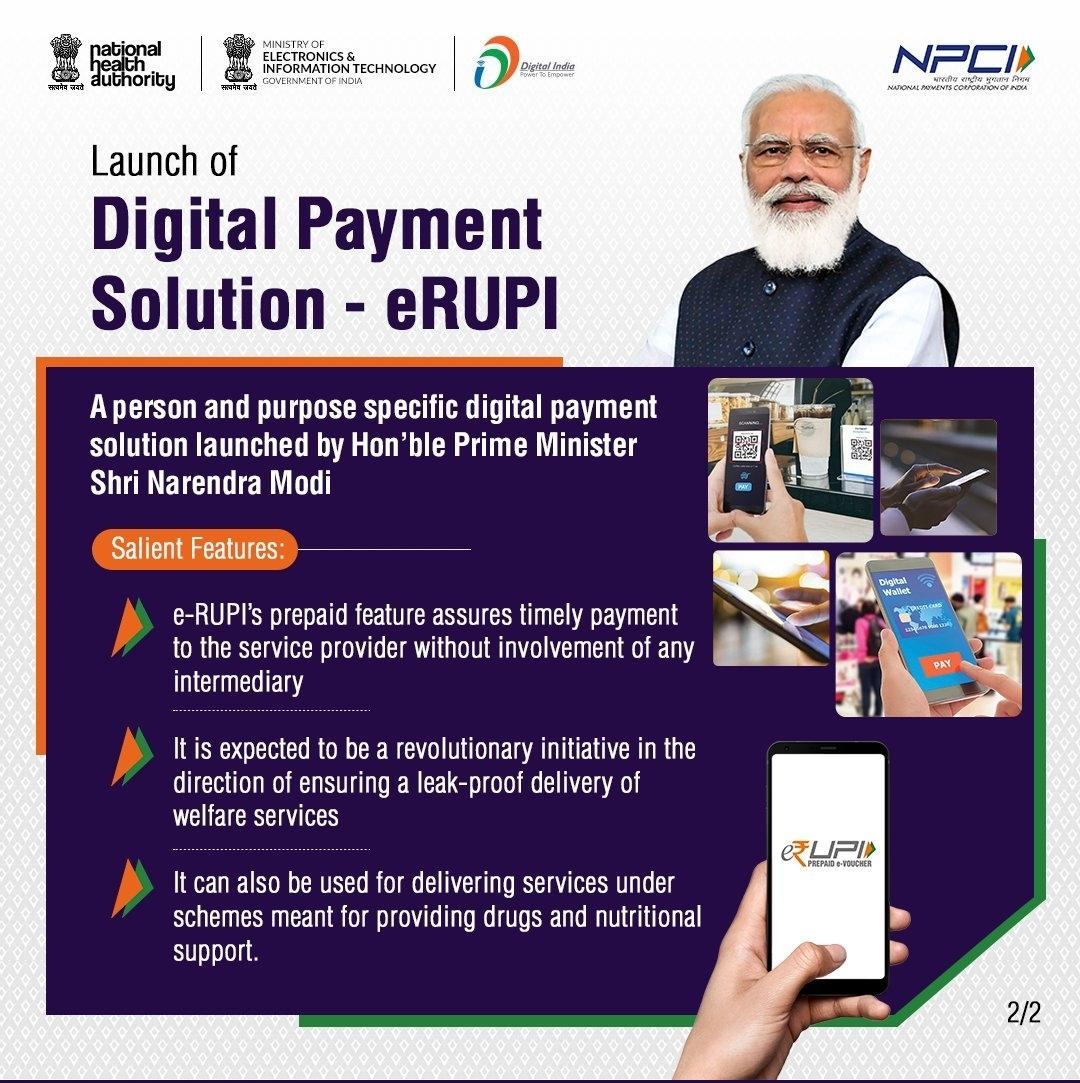
Who has developed the e-RUPI ?

The National Payments Corporation of India (NPCI), which oversees the digital payments ecosystem in India, has launched e-RUPI, a voucher-based payments system to promote cashless transactions.

It has been developed in collaboration with the Department of Financial Services, Ministry of Health & Family Welfare and National Health Authority.

Which Banks issue e-RUPI ?

NPCI has partnered with 11 banks for e-RUPI transactions.  They are Axis Bank, Bank of Baroda, Canara Bank, HDFC Bank, ICICI Bank, Indian Bank, IndusInd Bank, Kotak Mahindra Bank, Punjab National Bank, State Bank of India and Union Bank of India.

The acquiring Apps are Bharat Pe, BHIM Baroda Merchant Pay, Pine Labs, PNB Merchant Pay and YoNo SBI Merchant Pay.

More banks and acquiring Apps are expected to join the e-RUPI initiative soon.

Where can e-RUPI be used now ?

To begin with NPCI has tied up with more than 1,600 hospitals where e-RUPI can be redeemed.

Experts say, in the days to come the user base of e-RUPI is expected to widen, with even private sector using it to deliver employee benefits and MSMEs adopting it for Business To Business (B2B) transactions.
Auction for Sale (Re-issue) of (i) ‘4.26% GS 2023’,(ii) ‘6.10% GS 2031’ and (iii) ‘6.76% GS 2061’

The Government of India (GoI) has announced the Sale (re-issue) of (i) ‘4.26% Government Security, 2023’ for a notified amount of Rs 3,000 crore (nominal) through price based auction using uniform price method (ii) ‘6.10% Government Security, 2031’ for a notified amount of Rs 14,000 crore (nominal) through price based auction using uniform price method; and (iii) ‘6.76% Government Security 2061’ for a notified amount of Rs 9,000 crore (nominal) through price based auction using multiple price method. GoI will have the option to retain additional subscription up to Rs 6,000 crore against above security/securities. The auctions will be conducted by the Reserve Bank of India, Mumbai Office, Fort, Mumbai on Friday i.e. August  06, 2021.

Up to 5% of the notified amount of the sale of the Securitieswill be allotted to eligible individuals and Institutions as per the Scheme for Non-Competitive Bidding Facility in the Auction of Government Securities.

Both competitive and non-competitive bids for the auction should be submitted in electronic format on the Reserve Bank of India Core Banking Solution (E-Kuber) system on August 06, 2021. The non-competitive bids should be submitted between 12.30 p.m. and 01.00 p.m. and the competitive bids should be submitted between 12.30 p.m. and 01.30 p.m.

The result of the auctions will be announced on August 06, 2021 (Friday) and payment by successful bidders will be on August 09, 2021 (Monday).

The Securities will be eligible for “When Issued” trading in accordance with the guidelines on ‘When Issued transactions in Central Government Securities’ issued by the Reserve Bank of India vide circular No. RBI/2018-19/25 dated July 24, 2018 as amended from time to time.

Ministry of Finance Press Release dated 02 Aug 2021

Invitation for public comments on proposed International Financial Services Centres Authority (Capital Market Intermediaries) Regulations, 2021

International Financial Services Centres Authority (IFSCA) has been established as a unified regulator to develop and regulate financial products, financial services and financial institutions in the International Financial Services Centres (IFSCs) in India.

The intermediaries play an important role by providing the intermediation facilities between their clients and the various regulated financial products and financial services in the IFSC. The intermediaries are also essential for building the ecosystem of capital markets in the IFSC.

IFSCA proposes to enact a regulatory framework for the intermediaries in the capital markets operating in IFSC, focusing on ease of doing business and consistent with the fundamental principles laid down by International Organization of Securities Commissions.

The proposed IFSCA (Capital Market Intermediaries) Regulations, 2021 (Intermediaries Regulations) inter alia provide for regulatory requirements in respect of registration, obligations and responsibilities, inspection and enforcement of various types of capital market intermediaries such as broker dealers, clearing members, depository participants, investment bankers, portfolio managers, investment advisers, custodians, credit rating agencies, debenture trustees and account aggregators.

Further, the proposed Intermediaries Regulations envisage registered capital market intermediaries to undertake cross-border business in capital markets in India and foreign jurisdictions, subject to certain conditions such as ring fencing of operations, appropriate risk management and internal controls, maintenance of records etc.

The consultation paper is available on the website of IFSCA at the weblink – https://ifsca.gov.in/PublicConsultation.

Comments and suggestions from public are invited on the proposed Intermediaries Regulations by August 18, 2021.

Ministry of Finance Press Release dated 28 July 2021

India’s forex reserves position comfortable for import cover of more than 18 months & provide cushion against unforeseen external shocks

India’s foreign exchange reserves position is comfortable in terms of import cover of more than 18 months and provides cushion against unforeseen external shocks.  This was stated by Union Minister of State for Finance Shri Pankaj Chaudhary in a written reply to a question in Rajya Sabha today.

Weather the reserve funds are adequate to meet the international payment obligations, the Minister said that the ratio of forex reserves to total external debt stood at 101.2 per cent and short-term external debt to forex reserves stood at 17.5 per cent as at end-March 2021. The ratio of volatile capital flows (including cumulative portfolio inflows and outstanding short-term debt) to reserves was 67.0 per cent at end-December 2020. India is comfortable in most of the external sector vulnerability indicators.

Giving details of India’s foreign exchange reserves in last five years, the Minister tabled the following data:

India’s Foreign Exchange Reserves

Year

Foreign Exchange Reserves

(US$ Billion)

2016-17

370.0

2017-18

424.5

2018-19

412.9

2019-20

477.8

2020-21

577.0

9th July 2021

611.9

Source: RBI

Speaking on the international currencies in our forex reserve, the Minister said the foreign currency assets, constituting more than 90 per cent of India’s forex reserves, are maintained as a multi-currency portfolio comprising major currencies, such as, US dollar, Euro, Pound sterling, Japanese yen, etc.

Ministry of Finance Press Release dated 27 July 2021

Comprehensive measures taken to curb incidence of frauds in Banks

As per the information received from RBI, the number of cases of frauds of Rs 500 crore and above reported by Public Sector Banks/ Indian Banks (Except Foreign Banks) / Select Financial Institutions are 79 cases in 2019-20, 73 cases in 2020-21 and 13 cases in 2021-22 (up to 30th June 2021). This was stated by Union Minister of State for Finance Dr Bhagwat Kisnrao Karad in a written reply to a question in Rajya Sabha today.

The Minister further stated that the RBI Master Circular on Frauds, 2015, observes that frauds are committed by unscrupulous borrowers by various methods including, inter alia, fraudulent discount of instruments, fraudulent disposal of pledged /hypothecated stocks, fund diversion, criminal neglect and mala fide managerial failure on the part of borrowers. The Master Circular also refers to certain other methods, which include forged instruments, manipulated account books, fictitious accounts, unauthorized credit facilities, fraudulent foreign exchange transactions, exploitation of “multiple banking arrangement”, and deficiency on the part of third parties with role in credit sanction/disbursement.

Giving details of the steps the Government has taken comprehensive measures to curb the incidence of frauds in banks, the Minister said, they include, inter-alia, the following:

  1. Government has issued “Framework for timely detection, reporting, investigation etc. relating to large value bank frauds” to Public Sector Banks (PSBs), for systemic and comprehensive checking of legacy stock of their non-performing assets (NPAs), which provides, inter-alia, that-
  1. all accounts exceeding Rs. 50 crore, if classified as NPAs, be examined by banks from the angle of possible fraud, and a report placed before the bank’s Committee for Review of NPAs on the findings of this investigation;
  2. examination be initiated for wilful default immediately upon reporting fraud to RBI; and
  3. report on the borrower be sought from the Central Economic Intelligence Bureau in case an account turns NPA.
  4. Fugitive Economic Offenders Act, 2018 has been enacted to deter economic offenders from evading the process of Indian law by remaining outside the jurisdiction of Indian courts. The act provides for attachment of property of a fugitive economic offender, confiscation of such offender’s property and disentitlement of the offender from defending any civil claim.
  5. PSBs have been advised to obtain certified copy of the passport of the promoters/directors and other authorised signatories of companies availing loan facilities of more than Rs. 50 crore and, decide on publishing photographs of wilful defaulters, in terms of Reserve Bank of India (RBI)’s instructions and as per their Board- approved policy and to strictly ensure rotational transfer of officials/employees. The heads of PSBs have also been empowered to issue requests for issue of Look Out Circulars.
  6. For enforcement of auditing standards and ensuring the quality of audits, Government has established the National Financial Reporting Authority as an independent regulator.
  7. Instructions/advisories have been issued by Government to PSBs to decide on publishing photographs of wilful defaulters, in terms of RBI’s instructions and as per their Board-approved policy, and to obtain certified copy of the passport of the promoters/directors and other authorised signatories of companies availing loan facilities of more than Rs. 50 crore.

****

Auction for Sale (Re-Issue) of (i) ‘5.63% GS 2026’, (ii) ‘GoI Floating Rate Bond 2033’, (iii) ‘6.64% GS 2035’, and (iv) ‘6.67% GS 2050’

The Government of India (GoI) has announced the Sale (Re-issue) of (i) ‘5.63% Government Security, 2026’ for a notified amount of Rs 11,000 crore (nominal) through price based auction using uniform price method (ii) ‘GoI Floating Rate Bonds, 2033’ for a notified amount of Rs 4,000 crore (nominal) through price based auction using uniform price  method (iii) ‘6.64% Government Security, 2035’ for a notified amount of Rs 10,000 crore (nominal) through price based auction using uniform price method, and (iv) ‘6.67% Government Security, 2050’ for a notified amount of Rs 7,000 crore (nominal) through price based auction using multiple price method. GoI will have the option to retain additional subscription up to Rs 8,000 crore against the above Security/Securities. The auctions will be conducted by the Reserve Bank of India, Mumbai Office, Fort, Mumbai on Friday i.e. July 30, 2021.

Up to 5% of the notified amount of the sale of the Securities will be allotted to eligible individuals and Institutions as per the Scheme for Non-Competitive Bidding Facility in the Auction of Government Securities.

Both competitive and non-competitive bids for the auction should be submitted in electronic format on the Reserve Bank of India Core Banking Solution (E-Kuber) system on July 30, 2021. The non-competitive bids should be submitted between 10.30 a.m. and 11.00 a.m. and the competitive bids should be submitted between 10.30 a.m. and 11.30 a.m.

The result of the auctions will be announced on July 30, 2021 (Friday) and payment by successful bidders will be on August 02, 2021 (Monday).

The Securities will be eligible for “When Issued” trading in accordance with the guidelines on ‘When Issued transactions in Central Government Securities’ issued by the Reserve Bank of India vide circular No. RBI/2018-19/25 dated July 24, 2018 as amended from time to time.

Ministry of Finance Press Release dated 26 July 2021

Significant improvement in India’s score in United Nation’s Global Survey on Digital and Sustainable Trade Facilitation

India has scored 90.32% in United Nation’s Economic and Social Commission for Asia Pacific’s (UNESCAP) latest Global Survey on Digital and Sustainable Trade Facilitation. The Survey hails this as a remarkable jump from 78.49% in 2019. The survey result can be accessed at(https://www.untfsurvey.org/economy?id=IND).

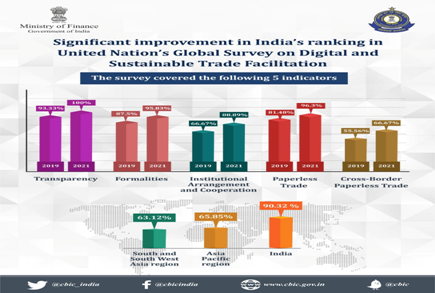
After evaluation of 143 economies, the 2021 Survey has highlighted India’s significant improvement in the scores on all 5 key indicators, as follows:

  1. Transparency:100% in 2021 (from 93.33% in 2019)
  2. Formalities: 95.83% in 2021 (from 87.5% in 2019)
  3. Institutional Arrangement and Cooperation: 88.89% in 2021 (from 66.67% in 2019)
  4. Paperless Trade: 96.3% in 2021 (from 81.48% in 2019)
  5. Cross-Border Paperless Trade: 66.67% in 2021 (from 55.56% in 2019)

The Survey notes that India is the best performing country when compared to South and South West Asia region (63.12%) and Asia Pacific region (65.85%). The overall score of India has also been found to be greater than many OECD countries including France, UK, Canada, Norway, Finland etc. and the overall score is greater than the average score of EU. India has achieved a 100% score for the Transparency index and 66% in the “Women in trade” component.

CBIC, has been at forefront of path breaking reforms under the umbrella of ‘Turant’ Customs to usher in a Faceless, Paperless and Contactless Customs by way of a series of reforms. This has had a direct impact in terms of the improvement in the UNESCAP rankingson digital and sustainable trade facilitation.

Further, during the Covid19 pandemic, Customs formations have made all efforts to expedite Covid related imports such as Oxygen related equipments, life-saving medicines, vaccines etc.A dedicated single window COVID-19 24*7 helpdesk for EXIM trade was created on the CBIC website to facilitate quick resolution of issue(s) faced by importers. 
About the Survey:

The Global Survey on Digital and Sustainable Trade Facilitation is conducted every two years by UNESCAP. The 2021 Survey includes an assessment of 58 trade facilitation measures covered by the WTO’s Trade Facilitation Agreement. The Survey is keenly awaited globally as it evidences whether or not the trade facilitation measures being taken have the desired impact and helps draw comparison amongst countries. A higher score for a country also helps businesses in their investment decisions.

Ministry of Finance Press release dated Press Release Press Release dated 23 July 2021

Stand Up India Scheme extended up to the year 2025

Key Highlights:

  • Stand Up India Scheme was launched by the Prime Minister on 05th April, 2016 and extended up to the year 2025.
  • Stand Up India Scheme facilitates loans to Scheduled Caste, Scheduled Tribe and women borrowers. 
  • A total of 1,16,266 loans amounting to Rs. 26204.49 crore extended under the Scheme since inception.
  • Margin Money requirements for Scheme loans reduced in the Budget Speech for FY 2021-22
  • Activities allied to agriculture included in the Scheme in the Budget Speech for FY 2021-22.

As informed by the Department of Financial Services, Ministry of Finance, the Stand Up India Scheme was launched by the Prime Minister on 05th April, 2016 and has been extended up to the year 2025. The objective of the Stand Up India Scheme is to facilitate loans from Scheduled Commercial Banks (SCBs) of value between Rs. 10 lakh and Rs.1 Crore to at least one Scheduled Caste (SC) or Scheduled Tribe (ST) borrower and one woman borrower per bank branch for setting up a green field enterprise in manufacturing, services or trading sector. As on 28.06.2021, a total of 1,16,266 loans amounting to Rs. 26204.49 crore have been extended under the Scheme since inception.

Pursuant to an announcement made by the Finance Minister in the Budget Speech for F.Y.2021-22, the margin money requirement for loans under the Scheme has been reduced from ‘upto 25%’ to `upto 15%’ and activities allied to agriculture have been included in the Scheme. Apart from this, no other change is contemplated in the scheme.

Government does not allocate funds for loans under the Stand Up India Scheme. Loans under the Scheme are extended by SCBs as per commercial parameters, Board approved policies of respective banks and extant RBI guidelines. An amount of Rs. 500 crore each was however released by Government in FY 2016-17 and FY 2017-18 and Rs 100 crore in FY 2020-21 towards the corpus of Credit Guarantee Fund for Stand Up India (CGFSI).

The Government has taken various steps towards effective implementation of the Scheme, these, inter alia, include provision for submission for online applications by potential borrowers through http://www.standupmitra.in portal, hand-holding support, intensive publicity campaign, simplified loan application form, Credit Guarantee Scheme, convergence with State and Central government Schemes wherever feasible, reduction in margin money and inclusion of activities allied to agriculture etc.

This information was given by Minister of State for Social Justice and Empowerment Sushri Pratima Bhoumik in a written reply in Lok Sabha today.                                                                                                          

Ministry of Social Justice & Empowerment Press release dated 20 July 2021