Latest Landmark Judicial Updates (Supreme Court) -14th Oct 2021

Will cannot be doubted merely for Exclusion of brother or sister: SC

V. Prabhakara Vs Basavaraj K. (Dead) By Lr. & Anr. (Supreme Court of India) dated 07th Oct 2021

××××××××××××××××××××

In a contempt jurisdiction, Court cannot travel beyond original judgment: SC

V. Senthur And Another Vs M. Vijayakumar (Supreme Court of India) dated 01/10/2021

×××××××××××××××××××

SC allows CBI to continue investigation against ITO & her Husband now Minister in AP Govt

( Central Bureau of Investigation (CB) And Anr. Vs Thommandru Hannah Vijayalakshmi (Supreme Court of India) dated 08/10/2021

×××××××××××××××××××××

Mere Revenue Record is not A Document of Title & not create any right : SC

( Prabhagiya Van Adhikari Awadh Van Prabhag Vs Arun Kumar Bhardwaj (Dead) Thr. Lrs (Supreme Court of India) dated 05th Oct 2021

××××××××××××××××××××××

Onus to Prove Deficiency in Service is on Complainant: SC SGS India Ltd. Vs Dolphin International Ltd. (Supreme Court) dated 06/10/2021

××××××××××××××××××

Mere Truthful Declaration of Criminal Cases cannot compel an Employer to Appoint a Candidate: SC

 (Union of India And Others Vs Methu Meda (Supreme Court of India) dated 06/10/2021

××××××××××××××××××××

Stamp Duty refund cannot be denied for delay in Application due to Judicial Proceedings
Rajeev Nohwar Vs Chief Controlling Revenue Authority Maharashtra State, Pune and Others (Supreme Court of India)
Dated 24 Sept 2021

×××××××××××××××××

Beneficial scheme cannot run contrary to express terms of provisions

Union of India Vs Abhiram Verma (Supreme Court of India) dated 30 Sept 2021

Regards,
Bipul Kumar

Notification issued on incentives and disincentives pertaining to Vehicle Scrapping Policy

In the Vehicle Scrapping Policy, it is proposed to have a system of incentives and disincentives to nudge vehicle owners to discard old and polluting vehicles, which have higher maintenance and fuel consumption costs.         

          In this regard, the Ministry of Road Transport and Highways has issued a GSR Notification, 714(E) dated 04.10.2021 in the Gazette of India, which shall come into force from the 1st day of April, 2022.  Details are as below:

  1. As an incentive, there will be waiver of the fee for issue of certificate of registration for a new vehicle, purchased against the authority of the Certificate of Deposit (CoD) issued by a Registered Vehicle Scrapping Facility for a vehicle being scrapped. 
  2. As regards disincentives, there will be:
  1. Increase in the fee for conducting fitness test and renewal of fitness certificate for motor vehicles more than 15 years old,
  2. Increase in the fitness certification fee for transport vehicles more than 15 years old, and
  3. Increase in the renewal of registration fee for personal vehicles (non transport vehicles) more than 15 years old.

Click here to open the Gazette notification    

Ministry of Road Transport & Highways

Press Release dated 05 Oct 2021

More than 22000 compliances reduced in Government (Ministry of Commerce & Industry Press Release dated 28th Sept 2021)

More than 22000 compliances reduced in Government.


103 offences decriminalized and 327 redundant provisions/laws removed by the Centre

Exercise being carried out by Centre to simplify, decriminalize & remove redundant laws – Piyush Goyal

Reduction of compliance burden is the best way to strengthen & boost confidence of business owners- Shri Piyush Goyal

Our focus has been to simplify & streamline procedures to run or start a business – Shri Goyal

A big exercise is being carried out by Central Ministries & States/UTs to reduce compliance burden and the aim of this exercise is to simplify, decriminalize & remove redundant laws, said Shri Piyush Goyal, Minister of Commerce & Industry, Consumer Affairs, Food & Public Distribution, Textiles, while speaking at the workshop on National Workshop on Reducing Compliance Burden organised by DPIIT here today.

Shri Goyal said that India, under PM Modi, has come a long way from red-tapism to laying the red carpet for businesses.

The mindset has evolved from “Not able to understand complexities” to “It’s so simple to start a business”.

He said that  numerous regulatory compliances only confused the new prospects & built hesitation in investors but today we are creating a most conducive environment for entrepreneurs.

The Minister said that  the soft launch  of the National Single Window System is an outstanding example of Government’s commitment to simply and rationalise things.

The NSWS portal hosts approvals across 18 Central Departments & 9 States and another 14 Central depts & 5 states will be added by Dec’21.

Shri Goyal said that through a participative & consultative approach with all stakeholders we are identifying & eliminating hurdles in a timebound manner.

Speaking on the occasion Secretary DPIIT said that more than 22,000 compliances have been reduced by Union Ministries, States & UTs so far under the initiative and about 13,000 compliances simplified while more than 1,200 processes have been digitized. It may be noted that during last fee years 103 offences have been decriminalized and 327 redundant provisions/laws removed.

Shri Goyal said that the National Workshop on Reducing Compliance Burden will showcase the progress, achievements and notable initiatives under the exercise of Reducing Compliance Burden to ensure Ease of Living and Ease of Doing Business.

During the workshop Ministries and States showcased iconic reforms, shared Best Practices and highlighted impact created in continuous endeavour to reduce compliance burden and improve quality of living for citizens.

On the occasion Shri Piyush Goyal also released the Stakeholders Booklet on Reduction of Compliances.

The Workshop is going to promote peer learning among Ministries and States/UTs to facilitate swift adoption of Best Practices for improved Service Delivery to citizens and businesses.

With the intent to ensure “Minimum Government, Maximum Governance” the Government of India embarked on an ambitious journey to reduce burdensome compliances.

Department for Promotion of Industry and Internal Trade (DPIIT) pioneered this initiative and closely engaged with the States/UTs and Ministries for more than two years to improve the regulatory and governance model across the country.

Under the aegis of ‘Azadi Ka Amrit Mahotsav’, an initiative of the Government of India to celebrate and commemorate 75 years of progressive India and its achievements, DPIIT held this National Workshop on Reducing Compliance Burden.

The workshop was chaired by Shri Piyush Goyal, and also addressed by Ministers of State for Commerce and Industry Shri Som Parkash and Smt. Anupriya Patel.

Some of the iconic reforms implemented by the Centre to ease compliance burden on citizens and businesses are-

1) Removal of distinction between Domestic and International OSP (other service provider) which will provide thrust to voice-based BPO and ITeS organizations in India,

2) liberalized access to geospatial data,

3) Introduction of ‘Mera Ration’ mobile app,

4) Introduction of single step online Aadhaar validation process for 18 services associated with Driving License and Registration Certificate.

5) 46 penal provisions of the Companies Act, 2013 and 12 offences under the Limited Liability Partnership (LLP) Act, 2008 decriminalized.

6) Through business process re-engineering, States/UTs have reduced time for granting approvals/licenses, eliminated physical touch-points and brought transparency in inspections.

7) Single window clearances for new investors have reduced the time to start operations across businesses.

It was noted that many State Governments have also maintained the momentum of continued reforms by implementing licensing reforms, computerized central random inspection system, labour reforms, initiatives to support Medium, Small and Micro Enterprises (MSMEs) and promote industrial development in the true spirit of cooperative federalism.

In July 2020, Cabinet Secretary had written to all Ministries to set up a dedicated team to examine the Acts and Regulations under their purview and reduce the compliance burden for citizens and business activities. DPIIT has been directed to act as a Nodal Department to coordinate this exercise of reducing compliance burden on citizens and business activities.

The objective for this comprehensive exercise is to improve ease of living and ease of doing business by simplifying, rationalizing, digitizing and decriminalizing government to business and citizen interfaces across all Ministries and States/Union Territories. Following are the focus areas of this exercise:-

1) Eliminate compliance burden across all procedures, rules, notifications, circulars, office memorandums, etc. which merely add to time and cost without achieving any tangible improvement in governance.

2) Repeal/amend/subsume redundant laws.

3) Decriminalize laws pertaining to technical and minor non-compliance issues to eliminate constant fear of being prosecuted for trivial defaults, while retaining strict criminal enforcement for serious fraudulent offences that jeopardize and prejudice public interest.

In July-August 2020, DPIIT shared the template of Action Plan to reduce compliance burden with all Ministries and States/UTs. Each Department and State/UT appointed a nodal officer for coordinating the exercise for reduction of compliance burden.

So far, through a simple, transparent, and time-bound exercise various government agencies have reduced more than 22,000 compliances across Ministries and States/UTs.

As part of the exercise on reducing compliance burden, Ministries and States/ UTs implemented various initiatives that impact specific segments of citizens and businesses. Some of the iconic Initiatives of different departments are –

1) Department of Telecommunications:

– Distinction between Domestic and International OSP (other service provider) removed, allowing Indian Telecom Service Providers serving foreign counterparts to register as an OSP. Allowed sharing of EPABX and PSTN lines by domestic and international centers. This provides massive growth thrust to BPO, BPM and ITeS organizations providing voice-based services in India

2) Department of Science and Technology:

– Private, public entities and research institutes now allowed to collect, process, store, publish and share geospatial data and services including maps enabling an Indian firm offer world class geo spatial service such as Google maps. Liberalized access to geospatial data helps stakeholders plan better for infrastructure projects, protection from natural calamities and enables environment protection. Reduced reliance on foreign resources and technology for geo spatial mapping

3) Department of Food and Public Distribution:

– Migrant beneficiaries empowered to get their entitled quota of food grains from any electronic point of sale (e-PoS) enabled fair price shops across the country. ‘Mera Ration’ mobile app introduced to help users identify nearest fair price shop, check entitlement details and recent transactions. Ration cards made portable minimizing compliance pain of migrant beneficiaries in availing their food grain quota. Facility covers more than 75 Crore beneficiaries under National Food Security Act (NFSA) covering almost 94.3% of NFSA population

4) Ministry of Road Transport and Highways:

– Single step online Aadhaar validation process introduced for 18 services associated with Driving License (DL), Registration Certificate (RC), Transfer of Ownership, International Driving Permit, Hire-Purchase, etc., eliminating the need for citizens to visit the Road Transport Offices (RTO) leading to hassle free services at the doorstep of citizens

– Registration Certificate now issued at dealer location itself. Vehicle registration can be done anywhere in the state (Maharashtra, Delhi, Uttar Pradesh, Haryana, Chhattisgarh, West Bengal)  vis-a-vis earlier process wherein it could be done only at respective RTO

5) Ministry of Education-

– Digital Infrastructure for Knowledge Sharing (DIKSHA) user interface developed to enable learners and teachers across the country to access curricula of NCERT, CBSE and SCERTs online. 1.85 lakh pieces of e-content on-boarded and high traffic on portal (~2,400 crore hits since lockdown) showcases its increased usage. Training of teachers has been enabled online on DIKSHA with about 25 lakh teachers benefitting from it.

6) Ministry of Micro, Small and Medium Enterprises:

– Samadhaan portal launched empowering MSMEs across the country to register and track grievances related to delayed payment and settlement of disputes. CHAMPIONS portal launched by the Prime Minister for speedy redressal of grievances of MSMEs. Over 37,000 grievances redressed (by Aug’21) with a reply rate of more than 99%.

– Sampark portal launched to help connect jobseekers (passed out trainees/ students of MSME Technology Centers) to recruiters. 4.73+ lakh jobseekers and more than 6,200 recruiters are registered on the portal till date

8) Department of Consumer Affairs:

– BIS Care app launched empowering consumers to check authenticity of ISI marked and hallmarked products. Citizens can also lodge complaints against fraudulent products using the App.

***

DJNRelease Id :-1758949
सड़क सुरक्षा की इलेक्ट्रॉनिक निगरानी और यातायात कानून-पालन के लिये अधिसूचना

Ministry of Road Transport & Highways Please release dated 19 Aug 2021

सड़क सुरक्षा की इलेक्ट्रॉनिक निगरानी और यातायात कानून-पालन के लिये सड़क यातायात और राजमार्ग मंत्रालय ने एक अधिसूचना जीएसआर 575(ई), 11 अगस्त, 2021-नियम 167ए जारी कर दी है। नियमों के तहत यातायात कानूनों का पालन कराने के लिये इलेक्ट्रॉनिक उपकरणों का विस्तार से प्रावधान किया गया है। प्रावधानों में गति पकड़ने वाला कैमरा, सीसीटीवी कैमरा, स्पीड गन, शरीर पर धारण करने वाला कैमरा, मोटर के डैशबोर्ड पर लगाने वाला कैमरा, ऑटोमैटिक नंबर प्लेट की पहचान सम्बंधी उपकरण (एएनपीआर), वजन बताने वाली मशीन और अन्य प्रौद्योगिकियां शामिल की गई हैं। 

राज्य सरकारें यह सुनिश्चित करेंगी कि यातायात कानूनों का पालन कराने वाले सभी इलेक्ट्रॉनिक उपकरणों को राष्ट्रीय राजमार्गों और राज्य राजमार्गों के अति जोखिम तथा अति व्यस्त रास्तों पर लगाया जाये। इसके अलावा कम से कम उन सभी प्रमुख शहर के महत्त्वपूर्ण चौराहों-गोल चक्करों पर इन उपकरणों को लगाया जाये, जिन शहरों की आबादी दस लाख से अधिक हो। इसमें 132 शहरों का विवरण शामिल है, जिनका ब्योरा नियमों की तालिका में देखा जा सकता है।

कानून लागू कराने वाले इलेक्ट्रॉनिक उपकरणों को इस तरीके से लगाया जायेगा, जिसके कारण न तो कोई बाधा पैदा होगी, न देखने में दिक्कत होगी और न यातायात में कोई व्यवधान पड़ेगा। निम्नलिखित नियम-उल्लंघन के लिये इन इलेक्ट्रॉनिक उपकरणों का इस्तेमाल किया जा सकता है, जिनकी फुटेज में स्थान, तिथि और समय दर्ज हो। इनका उपयोग चालान जारी करने में किया जायेगाः-

1. निर्धारित गति-सीमा के दायरे में वाहन नहीं चलाना (धारा 112 और 183);

2. अनधिकृत स्थान पर वाहन रोकना या पार्क करना (धारा 122) ;

3. वाहन चालक और पीछे बैठी सवारी के लिये सुरक्षा का ध्यान न रखना (धारा 128) ;

4. हेलमेट न पहनना (धारा 129);

5.            लाल-बत्ती पार करना, रुकने के संकेत का पालन न करना, वाहन चलाते समय मोबाइल फोन का इस्तेमाल करना, कानून का पालन न करते हुये अन्य वाहनों से आगे निकलना या उन्हें ओवरटेक करना, यातायात की विपरीत दिशा में वाहन चलाना, वाहन को इस तरह चलाना, जिसकी अपेक्षा एक सावधान और होशियार चालक से नहीं की जा सकती और उस होशियार चालक को यह भान हो कि ऐसा करना खतरनाक हो सकता है (धारा 184);

6.            निर्धारित वजन से अधिक भार लेकर गाड़ी चलाना (धारा 194 की उपधारा-1);

7.            बिना सेफ्टी-बेल्ट के गाड़ी चलाना (धारा 194बी);

8.            मोटर वाहन (चालक) नियम, 2017 (धारा 177ए) के नियम 6 (अपनी लेन में गाड़ी चलाना) की अवहेलना;

9.            माल ढोने वाले वाहनों में सवारी बैठाना (धारा 66);

10.          मोटर वाहन (चालक) नियम, 2017 (धारा 117ए) के नियम 36 (गाड़ी की नंबर प्लेट के विषय में) की अवहेलना; ऐसे वाहन को चलाना, जिसमें माल इस तरह भरा गया हो कि वह दोनों तरफ या आगे या पीछे या ऊपर की तरफ निकला हो तथा जो निर्धारित सीमा से अधिक हो (धारा 194 की उपधारा-1ए);

12.          आपातकालीन वाहनों को निकलने का रास्ता देने में कोताही करना (धारा 194ई)।

नियम 167 के तहत जारी होने वाले सभी चालान इलेक्ट्रॉनिक स्वरूप में होंगे और यातायात नियमों का उल्लंघन होते ही वे इलेक्ट्रॉनिक निगरानी तथा कानून-पालन प्रणाली के जरिये अपने-आप तैयार हो जायेंगे। उनमें निम्नलिखित सूचना दर्ज रहेगीः

i.              यातायात नियम का उल्लंघन करने का ब्योरा और वाहन की नंबर प्लेट की फोटो सबूत के तौर पर दर्ज होगी।

ii.             कानून लागू कराने वाले इलेक्ट्रॉनिक उपकरण से पैमाइश।

iii.            नियम-उल्लंघन की तिथि, समय और स्थान।

iv.           अधिनियम के जिस प्रावधान का उल्लंघन किया गया है, नोटिस में उसका हवाला।

v.            भारतीय साक्ष्य अधिनियम 1872 (1872 का 1) की धारा 65बी की उपधारा (4) के अनुपालन में लिखित साक्ष्य, जिसमें-

a.            इलेक्ट्रॉनिक रिकॉर्ड की पहचान दर्ज होगी उसे तथा प्रस्तुत करने के तरीके का विवरण होगा,

b.            उस इलेक्ट्रॉनिक रिकॉर्ड में उल्लंघन पकड़ने वाले उपकरण का विवरण होगा, जिससे पता चलेगा कि वह इलेक्ट्रॉनिक रिकॉर्ड कंप्यूटर से स्वमेव तैयार हुआ है।

c.             राज्य सरकार की तरफ से अधिकृत अधिकारी का हस्ताक्षर रहेगा।

सड़क सुरक्षा की इलेक्ट्रॉनिक निगरानी और कानून-पालन का विवरण देखने के लिये यहां क्लिक करें।

New Consumer Protection Law – An Overview (Consumer Protection Act 2019) II उपभोक्ता संरक्षण अधिनियम 2019- मुख्य बातें II

Dear Sir,

Please find below YouTube video link on II New Consumer Protection Law – An Overview (Consumer Protection Act 2019) II उपभोक्ता संरक्षण अधिनियम 2019- मुख्य बातें II

CPA 1986 Vs CPA 2019 (w.e.f. 20 July 2021)

Central Consumer Protection Authority (CCPA)

e-commerce entity –Information, Complain redressal

Product liability

Simplifying the consumer dispute adjudication

Alternate Dispute Resolution mechanism of Mediation

No fee for filing cases upto Rs. 5 lakh.

Electronically filing of complaints

Punishment by a competent court for manufacture or sale of adulterant/spurious goods.

Regards,
Bipul Kumar

Government notifies the Plastic Waste Management Amendment Rules, 2021, prohibiting identified single use plastic items by 2022.

Government notifies the Plastic Waste Management Amendment Rules, 2021, prohibiting identified single use plastic items by 2022.


Thickness of plastic carry bags increased from 50 to 75 microns from 30th September, 2021 and to 120 microns with effect from the 31st December, 2022.

Guidelines for Extended Producer Responsibility given legal force.

Ministry of Environment, Forest and Climate Change Press release 13th Aug 2021

In line with the clarion call given by Prime Minister Shri Narendra Modi to phase out single use plastic by 2022, keeping in view the adverse impacts of littered plastic on both terrestrial and aquatic ecosystems, the Ministry of Environment, Forest and Climate Change, Government of India, has notified the Plastic Waste Management Amendment Rules, 2021, which prohibits identified single use plastic items which have low utility and high littering potential by 2022.  

Pollution due to single use plastic items has become an important environmental challenge confronting all countries. India is committed to take action for mitigation of pollution caused by littered Single Use Plastics. In the 4th United Nations Environment Assembly held in 2019, India had piloted a resolution on addressing single-use plastic products pollution, recognizing the urgent need for the global community to focus on this very important issue. The adoption of this resolution at UNEA 4 was a significant step.

The manufacture, import, stocking, distribution, sale and use of following single-use plastic, including polystyrene and expanded polystyrene, commodities shall be prohibited with effect from the 1st July, 2022:-

  1. ear buds with plastic sticks, plastic sticks for balloons, plastic flags, candy sticks, ice-cream sticks, polystyrene [Thermocol] for decoration;
  1. plates, cups, glasses, cutlery such as forks, spoons, knives, straw, trays, wrapping or packing films around sweet boxes, invitation cards,  and cigarette packets, plastic or PVC banners less than 100 micron, stirrers.

In order to stop littering due to light weight plastic carry bags, with effect from 30th September, 2021, the thickness of plastic carry bags has been increased from fifty microns to seventy five microns and to one hundred and twenty microns with effect from the 31st December, 2022. This will also allow reuse of plastic carry due to increase in thickness.

The plastic packaging waste, which is not covered under the phase out of identified single use plastic items, shall be collected and managed in an environmentally sustainable way through the Extended Producer Responsibility of the Producer, importer and Brand owner (PIBO), as per Plastic Waste Management Rules, 2016. For effective implementation of Extended Producer Responsibility the Guidelines for Extended Producer Responsibility being brought out have been given legal force through Plastic Waste Management Amendment Rules, 2021.

The waste management infrastructure in the States/UTs is being strengthened through the Swachh Bharat Mission. The following steps have also been taken to strengthen implementation of Plastic Waste Management Rules, 2016 and also to reduce the use of identified single use plastic items:(i) the States/UTs have been requested to constitute a Special Task Force for elimination of single use plastics and effective implementation of Plastic Waste Management Rules, 2016. A National Level Taskforce has also been constituted by the Ministry for taking coordinated efforts to eliminate identified single use plastic items and effective implementation of Plastic Waste Management Rules, 2016.

The State /UT Governments and concerned Central Ministries/Departments have also been requested to develop a comprehensive action plan for elimination of single use plastics and effective implementation of Plastic Waste Management Rules, 2016, and its implementation in a time bound manner. Directions under Section 5 of Environment (Protection) Act, 1986, have been issued to all States/Union Territories inter alia for setting up for institutional mechanism for strengthening enforcement of Plastic Waste Management (PWM) Rules, 2016.

The Government has also been taking measures for awareness generation towards elimination of single use plastics and effective implementation of Plastic Waste Management Rules, 2016.  A two month long Awareness Campaign of Single Use Plastic 2021 has been organized. The Ministry has also organized pan India essay writing competition on the theme for spreading awareness amongst school students in the country.

To encourage innovation in development of alternatives to identified single use plastic items and digital solutions to plastic waste management, the India Plastic Challenge – Hackathon 2021, has been organized for students of Higher Educational Institutions and startups recognized under Startup India Initiative. 

Gazette Notification

India has a sound legal framework backed by strong institutional mechanism to deal with corruption: Law Minister

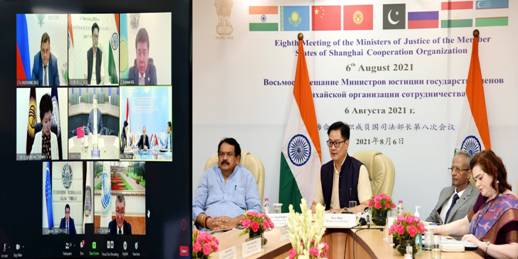
Zero Tolerance to Corruption and Black Money, says Shri Kiren Rijiju at the 8th Justice Ministers Meet of the Shanghai Cooperation Organization


India has a sound legal framework backed by strong institutional mechanism to deal with corruption: Law Minister

Minister for Law and Justice, Shri Kiren Rijiju today said that the approach of the Indian Government under Prime Minister Shri Narendra Modi is of Zero Tolerance to Corruption and Black Money and the country has a sound legal framework backed by strong institutional mechanism to deal with corruption.

At the 8th Shanghai Cooperation Organisation- Justice Minister’s meet held today, Union Law Minister @KirenRijiju said that the approach of the Indian Government under PM @narendramodi is of Zero Tolerance to Corruption and Black Money.

📽️: @DDNewslive pic.twitter.com/X4Ge9XkWqA— PIB India (@PIB_India) August 6, 2021

Addressing the 8th Justice Ministers Meet of the Shanghai Cooperation Organization (SCO), Shri Rijiju highlighted the initiatives taken by the Indian Government for providing affordable and easy access to justice for all.

The Minister apprised the gathering the slew of legislative and executive measures taken by India to be largely UNCAC (UN Convention against Corruption) compliant and underscored the high priority, the Government has given to resolving disputes through alternate dispute resolution; framing business facilitating laws and rules, including Commercial Courts Act and Arbitration Laws with a view to make India a preferred destination for investment and business.

Shri Rijiju mentioned the role of actions taken by India under Disaster Management Act for effective management and containing the spread of COVID-19 and to lay down substantive guideline to ensure appropriate COVID protocol and medical facilities.

The Law Minister also highlighted various facets of provisioning of free legal aid to marginalized sections of the society. In this regard, he also informed launching of E-Lok Adalat, an effective tool to settle disputes, combining technology and Alternative Dispute Resolution (ADR) mechanism which offer a faster, transparent and accessible option to the citizens of the country.

As part of activities of Justice Ministers’ Forum, Shri Rijiju urged the SCO Member States to promote exchange of ideas, best practices and experiences in identified areas through this prestigious podium. He also stressed on widening the horizon of activities being undertaken in the SCO Forum.

Earlier, on 4th and 5th of August, 2021 the Experts Working Group of SCO Member States discussed the importance of providing free legal aid to the citizens as also cooperation in all spheres including legal initiatives, given the spread of the coronavirus pandemic. Shri Anoop Kumar Mendiratta, Secretary, Department of Legal Affairs, Ministry of Law & Justice, was part of the consultations from the Indian side.

The Ministers of (Law and) Justice and senior officials / experts from the Ministries of Law & Justice of India, Kazakhstan, China, Kyrgyz Republic, Pakistan, Russian Federation, Tajikistan and Uzbekistan participated in the three days’ deliberations which concluded today. The next meeting shall be hosted by Islamic Republic of Pakistan. A Joint Statement following the Results of the Eighth Session of the Ministers of Justice of the SCO Member States was also adopted.

Ministry of Law and Justice Press release dated 06 Aug 2021