Companies (Appointment and Qualification of Directors) Amendment Rules, 2022 (MCA Notification dated 01st June 2022)

Short title and commencement.-

(1) These rules may be called the Companies (Appointment and Qualification of Directors) Amendment Rules, 2022.

(2) They shall come into force on the date of their publication in the Official Gazette. 2. In the Companies (Appointment and Qualification of Directors) Rules, 2014, ―

(i) in rule 8, after the proviso, the following proviso shall be inserted, namely:-

“Provided further that in case the person seeking appointment is a national of a country which shares land border with India, necessary security clearance from the Ministry of Home Affairs, Government of India shall also be attached alongwith the consent.”;

(ii) in rule 10, in sub-rule (1), the following proviso shall be inserted, namely: –

“Provided that no application number shall be generated in case of the person applying for Director Identification Number is a national of a country which shares land border with India, unless necessary security clearance from the Ministry of Home Affairs, Government of India has been attached alongwith application for Director Identification Number.”.

iii) in the Annexure, –

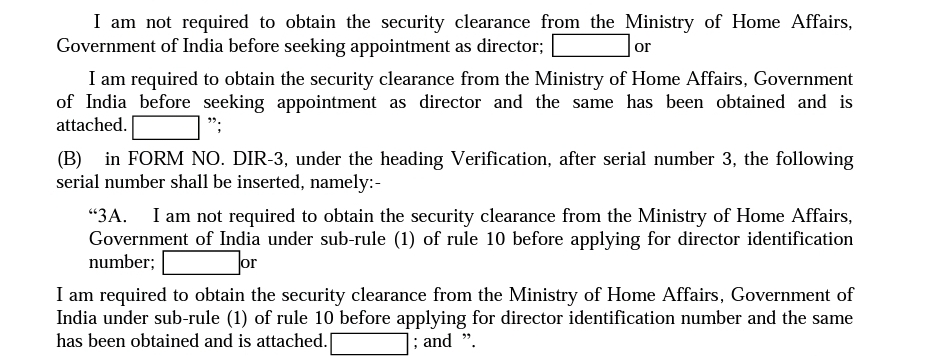
(A) in Form DIR-2, under the heading Declaration, the existing paragraph, shall be numbered as paragraph

(i) thereof and after the paragraph (i) as so numbered, the following shall be inserted, namely:-

“(ii) I further declare that –

Refer YouTube Video – Click

INCOME TAX : Rajasthan High Court grants refund of recovered tax in excess of 20% against disputed demand

Case reference:

Ram Gopal Sharma Vs ITO (Rajasthan High Court) dated 23/05/2022

1. Learned counsel for the petitioner has submitted that the petitioner is a senior citizen and has been filing regular income tax return. In the instant case, return of income tax was filed on 23.07.2017 for the assessment year 2017-18. The same came in scrutiny and high pitched additions were made vide assessment order dated 28.11.2019. It is submitted that income assessed by Assessing Officer was Rs. 24,04,440/-, which is more than two times the returned income, and a demand of Rs. 12,62,649/- was created. Against the said order, appeal before the Commissioner Of Income Tax (Appeal-1) was preferred on 18.12.2019, within a period of 30 days. After filing appeal, the petitioner suo moto deposited a sum of Rs. 2,52,530/- on 18.12.2019, which was equivalent to 20% of demand created, in terms of Office Memorandum dated 29.02.2016 and 31.07.2017, issued by respondent No. 2. As a matter of precaution, stay application dated 26.12.2019 was also filed by the petitioner, requesting for keeping the demand in abeyance till the disposal of the appeal. 

2. It is further submitted that the Assessing Officer i.e. respondent No. 1, against all canons of law, without disposing the stay application filed by the petitioner, without considering the fact that the petitioner has himself deposited Rs. 2,52,530/- and bypassing the Office Memorandum dated 29.02.2016 and 31.07.2017, initiated coercive recovery on 28.01.2020 and recovered entire amount of Rs. 12,62,650/- from the bank account of the petitioner in a exparte manner. 

3. In this background, present writ petition was filed against the adversarial and illegal approach of the respondents contrary to their own circulars and provisions of law and against orders passed by Hon’ble Supreme Court and Hon’ble Jurisdictional High Court and other Hon’ble High Court’s. 

4. Per contra, learned Standing Counsel, Mr. Anuroop Singhi, submitted that the amount of Rs 2,52,530, equivalent to 20% of additional demand, which was deposited by the petitioner on 18.12.2019 was already refunded to him vide rectification order (u/s 154 r.w.s 144 of the I.T. Act, 1961) dated 01.06.2020, after the recovery of entire amount of Rs. 12,62,650 from the petitioner, which was done on 28.01.2020. On the date of hearing, however, learned counsel for the respondent fairly conceded that recovery of over 20% of demand, before disposal of appeal is not appropriate. He was further unable to refute the narration and positions submitted by counsel for the petitioner. He fairly conceded that petitioner is entitled to refund of amount in excess of 20% of the total demand which was recovered from him. 

5. In this background, relying upon the Office Memorandum dated 29.02.2016 & 31.07.2017, considering Section 220(6) of theT. Act, 1961, considering the fair admission on part of Standing Counsel, and considering the fact that the amount of Rs 2,52,531, equivalent to 20% of the demand, was already refunded by department on 01.06.2020, this court deems it appropriate to direct the respondent to refund the excess amount of Rs 10,10,119, being 80% of the demand that is already recovered from the petitioner. The respondents are entitled to keep 20% of the demand, i.e. Rs 2,52,530 in terms of Office Memorandum dated 29.02.2016 and 31.07.2017, until the appeal of petitioner pending before Commissioner Of Income Tax (Appeal-1) is decided. The refund of Rs. 10,10,119 be made to the petitioner within a period of 30 days from the pronouncement of this judgment, failing which respondent will be liable to pay interest as applicable. Upon delay of the payment, interest as applicable will be recovered from the erring officer/respondent. 

6. In light of the above, the writ petition is disposed off. 

All pending applications also stand disposed off.
Department of Legal Affairs introduces opportunity for internship for law students, under it’s offices in Delhi Mumbai, Bengaluru, Kolkata and Chennai

Shri Kiren Rijiju recommends young talent to apply for Internship Programme introduced for Law students


Department of Legal Affairs introduces opportunity for internship for law students, under it’s offices in Delhi Mumbai, Bengaluru, Kolkata and Chennai

Internship programme aims to acquaint young law students with workings of the Department of Legal Affairs by training them in various related fields

Selected interns to be given a token remuneration

On the 1st of June, 2022, the Department of Legal Affairs has opened its forms for the Internship Programme for Law students at the behest of the Minister of Law & Justice, Shri Kiren Rijiju, under the capable guidance of the Minister of State, Prof. S.P. Singh Baghel, the Law Secretary, Dr. Niten Chandra and, the Additional Secretary in the Department of Legal Affairs, Dr. Anju Rathi Rana. The intended purpose of the said Internship Programme is to acquaint young law students with the workings of the Department of Legal Affairs by training them in research and referencing work, tendering legal advice in various specialized fields of law such as constitutional and administrative law, finance law, infrastructure law, economic law, labour law, conveyancing, arbitration and contract law, etc.

Shri Kiren Rijiju, Minister of Law & Justice, has recommended the young talent of the country to apply for this internship programme.

Shri Kiren Rijiju tweeted:

“A great opportunity to work at the Department of Legal Affairs, as it introduces #internships for law students for offices in Delhi, Mumbai, Bengaluru, Kolkata and Chennai.

I recommend young talent to apply for this internship at https://legalaffairs.gov.in/internship ”

A great opportunity to work at the Department of Legal Affairs, as it introduces #internships for law students for offices in Delhi, Mumbai, Bengaluru, Kolkata and Chennai.
I recommend young talent to apply for this internship at https://t.co/Gy4AQBUOwm pic.twitter.com/PuUOFpK8iK— Kiren Rijiju (@KirenRijiju) June 1, 2022

The eligibility criteria for this Internship Programme includes that the applicants must be Indian students who are pursuing their studies in the 2nd and 3rd year of the three-year degree course, and in their 3rd to 5th year of the five-year degree course, or students who have completed their LLB course from any recognized college/law school/university. The duration of this internship will ordinarily remain for a period of one month, which shall commence from the first working day of every month unless specified otherwise. The monthly internships shall tentatively start from June, 2022 until May, 2023.

In a given month, the maximum number of interns to be allowed will be 10-30. The students willing to undergo the Internship Programme under the Department of Legal Affairs may fill their application along with the relevant documents/ an NOC from their respective college/law school/university. The application form can be accessed on the website https://legalaffairs.gov.in/internship. All applicants are advised to fill the form online and upload all the documents prior to the last date, as mentioned on the website.

The selection of the interns for the Programme will be made on a first come, first served basis, subject to the availability of slots and approval of the competent authority. All further intimations regarding the same will be sent to the applicants via SMS and emails. The selected interns will be attached with an officer of appropriate level in the Department of Legal Affairs in the cities of New Delhi, Mumbai, Chennai, Bengaluru and Kolkata.

At the end of the Internship Programme, all interns will be required to submit a report on the work undertaken by them in the Department of Legal Affairs and upon a satisfactory completion of the internship, a Certificate of Internship shall be awarded, along with an honorarium of Rs. 5000/-. For a satisfactory completion of the internship, inter-alia 90% attendance is mandatory. The said Internship is a full-time internship, to be attended physically, where the interns are expected not to pursue any other course/work during the tenure of the internship.

All further information and clarifications can be attained by contacting the Section Officer, Admin.I (LA) admn1-la@nic.in (011-23387914)     

Press Release dated 01st June 2022

International Taxation : No TDS deductible on business profit of non-resident in absence of Permanent Establishment in India

Case Reference :

Apurva Goswami Vs DDIT (International Taxation) (ITAT Delhi) dated 24/05/2022

Facts in brief :

From 15CA/CB certificates filed by the assessee, the Ld. AO noted that the assessee has remitted amounts to various parties outside India without deducting tax at source. It was pointed out that the Global Business Affiliates (GBA), as per the terms and conditions of the agreement were entitled to fixed compensation and further additional commission on orders procured for the assessee. It was further stated that the nature of services as rendered by non resident agent who is carrying out business activities in other contracting state falls squarely within the scope of Article 7 of DTAA. As per Article 7 the profits of an enterprise of other State would be taxable in India if there was a PE of such enterprise in India. The explanation of the assessee was not acceptable to the ld. AO. According to him the impugned payments were made to the consultant which are covered under section 9(1)(vii) and not to the agent as claimed. The assesee was liable to deduct tax at source from fee paid for consultancy services.

Conclusion of the case :

Held that the payments made to the GBAs/ BDAs are not FTS but business profits not taxable in the hands of GBAs/BDAs in India in the absence of PE by virtue of the Article 7 of the DTAA, no tax is required to be deducted at source on such payments. In the case of GE India Technology Centre Pvt. Ltd. vs. CIT (2010-TMI-77380-SC) the Hon’ble Supreme Court held that obligation under section 195(1) to withhold tax arrives only if the payment is chargeable to tax in the hands of non-resident recipient. Therefore, merely because a person has not deducted tax at source from a remittance abroad, it cannot be inferred that the person making a remittance has committed a failure in discharging his tax withholding obligations because such obligations come into existence only when recipient has a tax liability in India. Thus, the payments made to the GBAs/ BDAs are not subject to any withholding tax, such payments being not chargeable to tax in India.

Company Law : Order passed by Adjudicating Authority without application of resolution professional’s for initiation of proceedings u/s 43 of IBC is unsustainable

Order passed by Adjudicating Authority without application of resolution professional’s for initiation of proceedings u/s 43 of IBC is unsustainable

Case Reference :

Sahara India Vs Nandkishor Vishnupant Despande (Delhi- NCLAT) dated 09 May 2022

Conclusion of the case:

When a statutory functionary makes an order based on certain grounds, its validity must be judged by the reasons so mentioned and cannot be supplemented by fresh reasons in the shape of affidavit or otherwise. Otherwise, an order bad in the beginning may, by the time it comes to court on account of a challenge, get validated by additional grounds later brought out…”

It reflects that the Resolution Professional, a statutory functionary, has not filed an application for initiation of proceedings under Section 43 of the Code in respect of preferential transactions and the Adjudicating Authority has passed the order, then it is supplementing it by fresh reason in through affidavit or otherwise. This is also not acceptable in the case of the Code.

Facts in brief:

The Appellant has remitted the principal amount of Rs. 39,95,00,000/- in various tranches commencing from April, 2018 to February, 2019 in accordance with the ‘Memorandum of Understanding’ (MOU) dated 07th March, 2017 with the Corporate Debtor (CD)/Respondent (in CIRP) for supply of future goods in the form of gold coins/Gold ornaments. The golds were supposed to be supplied by the CD any time after January, 2019. As per MoU vide para 1 reflects clearly that all such advance payments will not attract any interest. It is also stated at para 3 of the MOU that both the parties have agreed to fix the price of Gold coin/Gold ornaments at the prevailing market rate of the day when Gold coin/Gold Ornaments demanded is physically delivered to the Buyer as per the location(s) specified by the Buyer. The Seller also agrees to give 2% discount on the prevailing market price of Gold and will not charge making charges and delivery charges on the future demand by the Buyer (after January, 2019) and at the time of delivery of quantity. The Buyer has a right to assign its obligations and rights as per this MOU to its nominee(s) without taking prior consent of the Seller and the Seller shall not cause any hindrance are raise any objection in the same. The Seller gives at least 30 days’ notice showing its unwillingness to continue the understanding as reached between the parties and the buyer is ready to give a mutually agreed compensation as well as refund the excess amount, if any. The Ld. Counsel for the Appellant has submitted that they have informed the CD vide its letter dated 04th February, 2019 to supply of 10 kg Gold coins (100 points of 100 gram each) as obligation in accordance with the MOU. Even after long wait CD didn’t supplied, accordingly, the Appellant vide its letter dated 05th March, 2019 asked the CD to refund the amount as there is too much delay. The CD informed the Appellant vide its letter dated 11th March, 2019 to convert the advance amount of the Appellant into unsecured loan with 10% p.a. rate of interest on outstanding amount till full and final payment of the same are made to them. However, the Appellant accepted the offer after communicating the notice of default to the CD in between there are other correspondence also. ‘Corporate Insolvency Resolution Process’ was initiated against CD on 13th November 2019. Accordingly, the appellant submitted its claim in Form C. Resolution Professional considered the claims of the appellant, not in the category of ‘Financial Debt’ and as a result the appellant challenged the decision.

Company Law: SC explains applicability of Duomatic Principle in Company Law In India

Case Reference

Mahima Datla Vs Dr. Renuka Datla (Supreme Court of India) dated 06/04/2022


The *Duomatic Principle* can be briefly stated as ‘anything the members of a company can do by formal resolution in a general meeting, they can also do informally, if all of them assent to it.’

It is noted that application of Duomatic Principle is only applicable in those cases wherein bona fide transactions are involved. Fraud is a clear exception to application of these principles, be it Duomatic Principle or Doctrine of Indoor Management.

CCI : Mere common business linkages between bidders not sufficient to prove bid rigging

Case Reference:

Virendra Kumar Singh Vs Nandal Finance & Leasing Private Limited (Competition Commission of India) dated 18/05/2022

_It may not be entirely uncommon, where a common Promoter/Director acts as a link between two entities, to facilitate anti-competitive behaviour. However, there is no presumption that it has to be that way at all times; instead it will depend upon the attendant factual matrix. Thus, the Commission is of the view that merely having common business linkages between the bidders as projected by the Informant, in itself, cannot be the sole basis to suggest meeting of minds or assentio mentium between the bidders in the bidding process.”_

Delhi ROC Penalty order for non appointment of whole time Company Secretary in the matter of Pitchers Internet Private Limited dated 25 May 2022

Delhi ROC Penalty order for non appointment of whole time Company Secretary in the matter of Pitchers Internet Private Limited dated 25 May 2022

Total Penalty imposed :

On Company: Rs.5 Lakhs
On officer in defaults: 13.23 Lakhs

Bar of voting as per Section 188 of the Companies Act, 2013 on related parties operated only at the time of entering into a contract or arrangement  (SEBI Vs R.T. Agro Private Limited (Supreme Court) dated 25 April 2022)

APPELLANT: SEBI

RESPONDENTS: R.T. AGRO PRIVATE LIMITED & ORS.

Legal provisions:
188. Related party transactions   (1) Except with the consent of the Board of Directors given by a resolution at a meeting of the Board and subject to such conditions as may be prescribed, no company shall enter into any contract or arrangement with a related party with respect to— (a) sale, purchase or supply of any goods or materials; (b) selling or otherwise disposing of, or buying, property of any kind; (c) leasing of property of any kind; ——————————————————— [Provided that no contract or arrangement, in the case of a company having a paid-up share capital of not less than such amount, or transactions exceeding such sums, as may be prescribed, shall be entered into except with the prior approval of the company by a Special resolution ( Resolution substituted by Companies (Amendment) Act, 2015 and is effective from 29th May, 2015.):   [Provided further that no member of the company shall vote on such [resolution], to approve any contract or arrangement which may be entered into by the company, if such member is a related party:]]

Having heard learned counsel for the appellant-Securities and Exchange Board of India (‘SEBI’) and having perused the material placed on record, we find absolutely no reason to entertain this appeal.

The company R. T. Exports Limited proposed to enter into a transaction with one Neelkanth Realtors Private Limited for purchase of 40,000 sq. ft. of residential space. This proposal was treated as a related party transaction and was required to be approved by the shareholders of the Company. Accordingly, a special resolution was approved by R. T. Exports Limited on 15.07.2014. In terms of Section 188 of the Companies Act, 2013, the related parties abstained from voting on this special resolution. Thereafter, an Extra-Ordinary General Meeting was convened on 16.12.2016 for rescinding the resolution dated 15.07.2014 in which, the related parties also voted.

However, the appellant-SEBI took up the matter on a complaint and issued notice alleging violation of Regulation 23 of the Securities and Exchange Board of India (Listing Obligations and Disclosure Requirements) Regulations, 2015. The Adjudicating Officer, ultimately, proceeded to penalise the present respondents 1 with a cumulative sum of Rs. 35 lakhs for the alleged violation of the said Regulation 23.

The Securities Appellate Tribunal has not approved this order passed by the Adjudicating Officer and has allowed the appeal filed by the present respondents while, inter alia, holding that the bar of voting as per Section 188 of the Companies Act, 2013 on related parties operated only at the time of entering into a contract or arrangement, i.e., when the resolution dated 15.07.2014 was passed; and therein the said related parties indeed abstained from voting. The Appellate Tribunal found no fault in the said parties voting in the recalling/rescinding of the said resolution.

The view, as taken by the Appellate Tribunal, in the given set of facts and circumstances of the present case, appears to be a plausible view of the matter. In fact, nothing of ill-intent on the part of the respondents has been established in the present case. The hyper-technical stance of the appellant could have only been, and has rightly been, disapproved on the given set of facts and circumstances.

The appeal fails and is, therefore, dismissed.

All pending applications stand disposed of.

Kolkata ROC adjudication order for violation of Section 134 of the Companies Act, 2013 in the matter of M/s Kejriwal Castings Limited

https://youtu.be/MbeijEw1UjM

Kolkata ROC adjudication order for violation of Section 134 of the Companies Act, 2013 in the matter of M/s Kejriwal Castings Limited

Facts

Suo motu application filed by Co. & MD for adjudication of offence for contravention of Section 134 of CA 2013 for Board Report not prepared on due time

Penalty imposed

On Company : Rs. 6 Lakhs
On MD : Rs. 1 Lakh

Refer Rulings: