Disposal of pending cases in courts is within the domain of the judiciary. No time frame has been prescribed for disposal of various kinds of cases by the respective courts. Government has no role in disposal of cases in courts. Timely disposal of cases in courts depends on several factors which, inter-alia, include availability of adequate number of judges and judicial officers, supporting court staff and physical infrastructure, complexity of facts involved, nature of evidence, co-operation of stake holders viz. bar, investigation agencies, witnesses and litigants and proper application of rules and procedures. There are several factors which may lead to delay in disposal of cases. These, inter-alia, include vacancies of judges, frequent adjournments and lack of adequate arrangement to monitor, track and bunch cases for hearing. The Central Government is fully committed to speedy disposal of cases in accordance with Article 21 of the Constitution and reducing pendency. The Government has taken several initiatives to provide an ecosystem for faster disposal of cases by the judiciary.
National Mission for Justice Delivery and Legal Reforms was set up in August, 2011 with the twin objectives of increasing access by reducing delays and arrears in the system and enhancing accountability through structural changes and by setting performance standards and capacities. The Mission has been pursuing a co-ordinated approach for phased liquidation of arrears and pendency in judicial administration, which, inter-alia, involves better infrastructure for courts including computerization, increase in strength of subordinate judiciary, policy and legislative measures in the areas prone to excessive litigation, re-engineering of court procedure for quick disposal of cases and emphasis on human resource development.
Facilities for virtual hearing are available in the Supreme Court as well as in High Courts of the country. Since Covid lockdown started, the District courts heard 1,11,40,223 cases while the High Court heard 60,21,688 cases (totalling 1.71 crore) till 31.01.2022 using video conferencing. The Supreme Court held 2,18,891 hearings till 14.03.2022 since the beginning of lockdown period. To bring about uniformity and standardization in the conduct of Video Conferencing (VC), an overarching order was passed by the Hon’ble Supreme Court of India on 6th April 2020 which gave legal sanctity and validity to the court hearings done through VC. Further, VC rules were framed by a 5-judge committee which was circulated to all the High Courts for adoption after local contextualization. A total of 23 High Courts have implemented Video Conferencing rules. One video conference equipment each has been provided to all Court Complexes including taluk level courts and additionally funds have been sanctioned for additional VC equipment for 14,443 court rooms. Funds for setting up 2506 VC Cabins have been made available. Additional 1500 VC Licenses have been acquired. VC facilities are already enabled between 3240 court complexes and corresponding 1272 jails. A sum of Rs. 7.60 crore has been released for procurement of 1732 Document Visualizers.
Virtual hearing of the cases by the High Courts and the Supreme Court has helped the litigants including the under privileged litigants as it helps litigants to appear before the court from any location of their choice thus leading to considerable saving of time and money. It also helped the entire legal ecosystem including vulnerable litigants to have recourse to justice delivery system particularly during the Covid pandemic when congregational mode of court hearing could not be held due to lockdown and social distancing protocols. However, whether open physical courts will operate alongwith virtual hearing is an administrative matter which falls within the purview and domain of judiciary for taking a decision.
This information was given by the Union Minister of Law and Justice, Shri Kiren Rijiju in a written reply in Rajya Sabha, today.
Category: Legal awareness
Cuttack ROC penalty order for violation of Section 92 & 137 of CA 2013 in the matter of KKDIL Nidhi Limited (Order dated 23rd March 2022)
Cuttack ROC penalty order for violation of Section 92 & 137 of CA 2013 in the matter of KKDIL Nidhi Limited (Order dated 23rd March 2022)
✒️ On the basis of Supplementary Inspcction Report under Section 206(5) of the CA, 2013 the Directorate directed ROC to take action under Section 92(5) and 137(3) of the Act for violation of Section 92(4) and 137(1) of the Act. Accordingly, ROC initiated Adjudication proceedings.
✒️ ROC order -. The offence is of serious nature since non-filing of Annual Accounts by the Company put itself out of reach of stakeholders/regulatory authorities and other concerned. The object of filing of Annual Return of company with the Public Domain is in the public interest, to enable the investors, public and whosoever interested in the company can access the fundamental information about the company and its management. Non-filing of this statutory return will result in denial of information to public about the company
✒️ The object of filing Financial Statements of a company with MCA Portal is to enable the interested public/investors/statutory agencies to access and know about the company’s state of affairs. The financial statements of a company so filed shall give a be and fair view of the state of affairs of the company. The said statements will become documents of public domain and the interested public can access the said statcments through MCA website to know the financial state of affairs of the company as on that date.
✒️ Total Penalty imposed: Rs. 32,42,600/-
Regards,
Bipul Kumar
Illegal Dumping of E-Waste
The import and export of hazardous and other wastes is regulated under the Hazardous and Other Wastes (Management and Transboundary Movement) Rules, 2016 notified by the Ministry. Government had banned import of e-waste in the country by listing e-waste in the Schedule VI (Basel No. A1180) of the said rules.
As per the information provided by the Central Board of Indirect Taxes & Customs (CBIC), Department of Revenue, Ministry of Finance, there were a total 29 cases of illegal import of e-waste detected across the country in the last 3 years including current years. The details are at Annexure-I. CBIC, further informed that all field formations and Directorate of Revenue Intelligence (DRI) under CBIC keep constant vigil to check illegal import of e-waste into India and take action in accordance with law whenever such contraventions are noticed.
The management of e-waste in the Country is regulated under the E-Waste (Management) Rules, 2016. Under the said Rules, the responsibility of disposal of e-waste in a scientific and environmentally sound manner has been assigned to Producers of notified Electrical & Electronic Equipment (EEE) as listed in Schedule – I of the said rules under the principle of Extended Producer Responsibility (EPR). Under EPR regime producers of EEE, have given annual e-waste collection and recycling targets based on the generation from the previously sold EEE or based on sales of EEE as the case may be.
The compliance monitoring is done through Action Plan developed by Central Pollution Control Board (CPCB) for enforcement of E-Waste (Management) Rules, 2016 in the Country. The major action points include identification of Non-EPR Authorization producers, State/UT wise inventorization of e-waste, verification of system provided by producers for e-waste channelization, verification of facilities of dismantlers/ recyclers, drives for checking informal activities, formulation of State Level Committee for monitoring implementation of rules and mass awareness activities etc. Under the action plan, monitoring and compliance of producers are ensured through Sate Pollution Control Boards and Pollution Control Committees. Further, under the existing rules, provisions are in place for action against the companies who are violating the said rules.
This information was given by Shri Ashwini Kumar Choubey, Minister of State, Ministry of Environment, Forest & Climate Change in Lok Sabha today.
Annexure – I
Table: State-wise cases of Illegal Shipment and dumping of e-waste
https://pib.gov.in/PressReleaseIframePage.aspx?PRID=1810575&RegID=3&LID=1
NCLT- The Road Ahead (Press release 26th March 2022)
NCLT organised Colloquium on “NCLT- The Road Ahead”
Chief Justice (Retd.) Ramalingam Sudhakar exhorts use of Artificial Intelligence for speedier dispensing of justice and resolution under IBC
MCA Secretary commends NCLT for disposing off about 62,000 cases out of about 83,000 cases filed before it
IBBI Chairperson calls for standardization to fast track resolution of cases
The National Company Law Tribunal (NCLT) organized a national level Colloquium on the subject “NCLT- The Road Ahead” here today.
Chief Justice (R) Ramalingam Sudhakar, President, NCLT; Shri Rajesh Verma, Secretary, Ministry of Corporate Affairs; and Shri Ravi Mital, Chairman, Indian Bankruptcy Board of India (IBBI) inaugurated the colloquium. Members of the Tribunal, both Judicial and Technical, representing 15 Benches across India also participated in the colloquium.
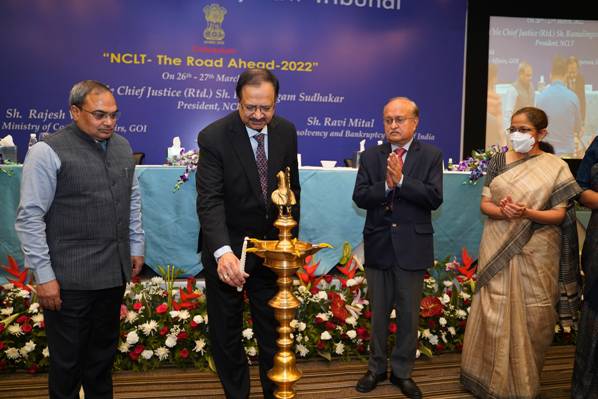
In his address as the chief guest, Chief Justice (Retd.) Ramalingam Sudhakar said that India is envisioning a multi-trillion dollar economy. Industry and commerce, crucial in the nation’s economy, are governed by Company Law besides other laws. Chief Justice (Retd.) Ramalingam Sudhakar stated that the Government has come out with [Insolvency & Bankruptcy Code (IBC)] code to resolve corporate issues to enable corporates of India to compete with the world. NCLT is the guardian of the corporate law and each of the Members has a role to play in the economic growth of the country. Today’s Colloquium will address effective and judicatious process and resolution, he stated.
While talking about Artificial Intelligence (AI), Chief Justice(R) Sudhakar concluded his address while stating that one aspect for early resolution is the development of Artificial Intelligence technology for speedier dispensing of justice. AI can be used in case resolution, especially in admission of cases, he suggested.
In is address, Shri Rajesh Verma, Secretary, MCA, stated that NCLT is an institution of pride and it has led to faster resolution of corporate disputes under the Company Act and the IBC. Praising NCLT’s performance during COVID-19, Shri Verma said that NCLT disposed of about 62,000 cases out of about 83,000 cases filed before it.
Enumerating the various achievements of NCLT, Shri Verma said that these include rescue of creditors, providing an orderly exit for companies under distress, helping creditors realize the value of their assets and behavioral change in both Creditors and Debtors. The IBC has been key in releasing entrepreneurship from honest business failures, which is important as we have the 3rd largest startup ecosystem in the world, he said.
Shri Verma emphasized that the IBC Code has seen a roller coaster ride with six amendments have been made in the main legislation so far. Shri Verma further stated that many provisions of IBC have come out unscathed when challenged (in the higher courts) and the Supreme Court of India had settled the jurisprudence on various aspects of this new law at an unprecedented pace and passion.
Shri Verma suggested that to enhance the effectiveness of IBC, introduction of a cross border insolvency framework in the IBC is being considered. Leveraging technology and filling up posts are two key factors in increasing the speed, he said.
In his address to the gathering, Shri Mital, Chairman, IBBI, stated that there are two corner stones of the IBC viz timelines in process and the control being given to creditors as against Debtors. He stated that with more standardization, the speed of resolution of cases can be increased. Shri Mital said that IBBI is always ready to collaborate with NCLT in simplification of the process of resolution.
Inaugural session was followed by the technical session, where Shri Sudhakar Shukla, Whole Time Member, IBBI and Prof. Charan Singh, CEO, EGROW Foundation, also participated. Members of the Tribunal covered other areas such as Aadmission of Petitions u/s 7 and 9 IBC, Oppression & Mismanagement, Avoidance Transactions, Insolvency & Voluntary Liquidation- Section 10 and Section 59, IBC, and Resolution Plan Approval etc.
About National Company Law Tribunal (NCLT)
The Central Government constituted the National Company Law Tribunal (NCLT) under section 408 of the Companies Act, 2013 w.e.f. 01st June 2016. In the first phase the Ministry of Corporate Affairs set up 11 Benches, one Principal Bench at New Delhi and ten Benches in various locations in India. As on today, there are 15 benches spread across India which are manned by 48 Members who hear cases related to the Companies Act and the Insolvency and Bankrupcy Code 2016.
NCLT is a quasi-judicial authority incorporated for dealing with corporate disputes under the Companies Act. It is the adjudicating authority for insolvency resolution process of companies and limited liability partnerships under the Insolvency and Bankruptcy Code, 2016.
Out of a total of 83838 cases filed before National Company Law Tribunal since its inception, 62506 (75%) cases have been disposed off by the Tribunal as on Feb 2022. The cases disposed off comprises of 39446 cases under Companies Act and 23060 cases under Insolvency Bankruptcy Code, 2016. Even during Covid-19, NCLT kept its doors open and decided large number of cases.
The NCLT has been instrumental in effective implementation and success of the IBC for orderly growth of the corporate sector.
Speedy Disposal of the Cases
Ministry of Law and Justice Press releases dated 25 March 2022
Disposal of pending cases in courts is within the domain of the judiciary. No time frame has been prescribed for disposal of various kinds of cases by the respective courts. Government has no role in disposal of cases in courts. Timely disposal of cases in courts depends on several factors which, inter-alia, include availability of adequate number of judges and judicial officers, supporting court staff and physical infrastructure, complexity of facts involved, nature of evidence, co-operation of stake holders viz. bar, investigation agencies, witnesses and litigants and proper application of rules and procedures. There are several factors which may lead to delay in disposal of cases. These, inter-alia, include vacancies of judges, frequent adjournments and lack of adequate arrangement to monitor, track and bunch cases for hearing. The Central Government is fully committed to speedy disposal of cases in accordance with Article 21 of the Constitution and reducing pendency. The Government has taken several initiatives to provide an ecosystem for faster disposal of cases by the judiciary.
After announcement of nation-wide lockdown from 25th March, 2020, directions have been issued from time to time by the respective High Courts to the Subordinate Courts under their administrative jurisdiction for hearing of urgent civil and criminal matters in virtual or physical mode depending on local conditions. Most High Courts have further advised district and subordinate courts that where there is no shut down/lockdown, they may, as far as possible, resume normal functioning by virtual/physical mode and take up all kind of cases, including those pertaining to under-trial prisoners, trial of civil cases, matrimonial disputes, child custody matters, recording of evidence and other old matters. Wherever physical hearing was permitted in district and subordinate courts, they were advised to strictly adhere to Covid protocols and social distancing norms and take all precautions including consent of the parties. A new Software Patch and Court User Manual has been developed for COVID- 19 Management. This tool has been developed to help in smart scheduling all cases to effectively manage overcrowding in courts. As regards the Supreme Court, an overarching order has been issued by the Supreme Court on 06.04.2020 giving legal sanctity and validity to video conference hearing.
National Mission for Justice Delivery and Legal Reforms was set up in August, 2011 with the twin objectives of increasing access by reducing delays and arrears in the system and enhancing accountability through structural changes and by setting performance standards and capacities. The Mission has been pursuing a co-ordinated approach for phased liquidation of arrears and pendency in judicial administration, which, inter-alia, involves better infrastructure for courts including computerization, increase in strength of subordinate judiciary, policy and legislative measures in the areas prone to excessive litigation, re-engineering of court procedure for quick disposal of cases and emphasis on human resource development.
The major steps taken during the last seven years under various initiatives are as follows:
- Improving infrastructure for Judicial Officers of District and Subordinate Courts: As on date, Rs. 8,758.71 crores have been released since the inception of the Centrally Sponsored Scheme (CSS) for Development of Infrastructure Facilities for Judiciary in 1993-94. The number of court halls has increased from 15,818 as on 30.06.2014 to 20,812 as on 17.03.2022 and number of residential units has increased from 10,211 as on 30.06.2014 to 18,338 as on 17.03.2022 under this scheme. In addition, 2,767 court halls and 1,651 residential units are under construction. The Centrally Sponsored Scheme for the Development of Infrastructure Facilities for Judiciary has been extended till 2025-26 at a total cost of Rs. 9000 crores, out of which Central share will be Rs. 5307 crores. Besides, construction of Court Halls and Residential Units, it would also cover construction of Lawyer’s Halls, Toilet Complexes and Digital Computer Rooms.
- Leveraging Information and Communication Technology (ICT) for improved justice delivery: Government has been implementing the e-Courts Mission Mode Project throughout the country for Information and Communication Technology enablement of district and subordinate courts. Number of computerized District & Subordinate courts has increased to 18,735 so far. WAN connectivity has been provided to 98.9% of court complexes. New and user-friendly version of Case Information Software has been developed and deployed at all the computerized District and Subordinate Courts. All stakeholders including Judicial Officers can access information relating to judicial proceedings/decisions of computerized District & Subordinate Courts and High Courts on the National Judicial Data Grid (NJDG). As on 02.03.2022, litigants can access case status of over 19.92 crore cases and 16.81 crore order/judgments pertaining to these courts. eCourts services such as details of case registration, cause list, case status, daily orders & final judgments are available to litigants and advocates through eCourts web portal, Judicial Service Centres (JSC) in all computerized courts, eCourts Mobile App, email service, SMS push & pull services. Video Conferencing facility has been enabled between 3240 court complexes and 1272 corresponding jails. With a view to handle the COVID- 19 challenges better and to make the transition to virtual hearings smoother, 475 e-Sewa Kendras have been set up at court complexes to facilitate lawyers and litigants needing assistance ranging from case status, getting judgments/orders, court/case related information and efiling facilities. Rs. 5.01 crores has been allocated for providing equipment in Video Conferencing cabins in various court complexes to facilitate virtual hearings. Rs. 12.12 crores has been allocated for 1732 Help desk counters for efiling in various court complexes.
Seventeen Virtual Courts have been set up in 13 States/UTs viz. Delhi (2), Haryana, Tamil Nadu, Karnataka, Kerala (2), Maharashtra (2), Assam, Chhattisgarh, Jammu & Kashmir (2), Uttar Pradesh, Odisha, Meghalaya and Himachal Pradesh to try traffic offences. As on 03.03.2022, these courts have handled more than 1.32 crore cases and realized more than Rs. 229.22 crore in fines.
Video conferencing emerged as the mainstay of the Courts during the Covid lockdown period as physical hearings and normal court proceedings in the congregational mode were not possible. Since Covid lockdown started, the District courts heard 1,11,40,223 cases while the High Court heard 60,21,688 cases (totalling to 1.71 crore) till 30.01.2022 using video conferencing. The Supreme Court had 2,18,891 hearings since the lockdown period upto 14.03.2022.
3. Filling up of vacant positions in Supreme Court, High Courts and District and Subordinate Courts: From 01.05.2014 to 17.03.2022, 44 Judges were appointed in Supreme Court. 710 new Judges were appointed and 588 Additional Judges were made permanent in the High Courts. Sanctioned strength of Judges of High Courts has been increased from 906 in May, 2014 to 1104 currently. Sanctioned and working strength of Judicial Officers in District and Subordinate Courts has increased as follows:
As on
Sanctioned Strength
Working Strength
31.12.2013
19,518
15,115
21.03.2022
24,521
19,341
However, filling up of vacancies in Subordinate judiciary falls within the domain of the State Governments and High Courts concerned.
4. Reduction in Pendency through / follow up by Arrears Committees: In pursuance of Resolution passed in Chief Justices’ Conference held in April, 2015, Arrears Committees have been set up in High Courts to clear cases pending for more than five years. Arrears Committees have been set up under District Judges too. Arrears Committee has been constituted in the Supreme Court to formulate steps to reduce pendency of cases in High Courts and District Courts. In the past, Minister of Law & Justice has taken up the matter with Chief Justices of High Courts and Chief Ministers in the past drawing their attention to cases pending for more than five years and to take up pendency reduction campaign. The Department has developed an online portal for reporting by all High Courts on the compliance of Arrears Eradication Scheme guidelines of the Malimath Committee Report.
5. Emphasis on Alternate Dispute Resolution (ADR): Commercial Courts Act, 2015 (as amended on 20th August, 2018) stipulates mandatory pre-institution mediation and settlement of commercial disputes. Amendment to the Arbitration and Conciliation Act, 1996 has been made by the Arbitration and Conciliation (Amendment) Act 2015 for expediting the speedy resolution of disputes by prescribing timelines.
6. Initiatives to Fast Track Special Type of Cases: The Fourteenth Finance Commission endorsed the proposal of the Government to strengthen the judicial system in States which included, inter-alia, establishing Fast Track Courts for cases of heinous crimes; cases involving senior citizens, women, children etc., and urged the State Governments to use the additional fiscal space provided in the form of enhanced tax devolution form 32% to 42% to meet such requirements. As on 31.01.2022, 915 Fast Track Courts are functional for heinous crimes, crimes against women and children etc. To fast track criminal cases involving elected MPs / MLAs, ten (10) Special Courts are functional in nine (9) States/UTs (1 each in Madhya Pradesh, Maharashtra, Tamil Nadu, Karnataka, Andhra Pradesh, Telangana, Uttar Pradesh, West Bengal and 2 in NCT of Delhi). Further, Government has approved a scheme for setting up 1023 Fast Track Special Courts (FTSCs) across the country for expeditious disposal of pending cases of Rape under IPC and crimes under POCSO Act. As on date, 28 States/UTs have joined the scheme for setting up of 842 FTSCs including 363 ‘exclusive POCSO Courts’. Rs.140 crore was released in the financial year 2019-20 and Rs. 160.00 crore has been released during the financial year 2020-21 and Rs. 62.23 crore has been released during the FY 2021-22 upto 15.03.2022 for the scheme. 712 FTSCs are presently functional including 399 exclusive POCSO Courts, which disposed 81462 cases as on 28.02.2022. The continuation of the Scheme of FTSC has been approved for another two years (2021-23) at a total outlay of Rs. 1572.86 crore, including Rs. 971.70 crore as Central share.
7. In addition, to reduce pendency and unclogging of the courts, the Government has recently amended various laws like the Negotiable Instruments (Amendment) Act, 2018, the Commercial Courts (Amendment) Act, 2018, the Specific Relief (Amendment) Act, 2018, the Arbitration and Conciliation (Amendment) Act, 2019 and the Criminal Laws (Amendment) Act, 2018.
This information was given by Shri Kiren Rijiju, Union Minister of Law and Justice, in Lok Sabha today.
Online Dispute Resolution
Ministry of Law and Justice Press release dated 25 March 2022
The concept of Online Dispute Resolution(ODR) in India is at a nascent stage. In order to create an effective implementation framework for Online Dispute Resolution (ODR) in India, the NITI Aayog had constituted a high level committee in June 2020under the chairmanship ofJustice A K Sikri, Retired Judge, Supreme Court of India. The Committee was required to develop an action plan that can aid in mainstreaming ODR and thus promote access to justice through ODR.
The report of the committee titled “Designing the future of dispute Resolution: the ODR Policy Plan for India” was released on 29.11.2021. The report recommends measures at three levels to tackle challenges in adopting ODR framework in India.
- At the structural level, it suggests actions to increase digital literacy, improve access to digital infrastructure and train professionals as neutrals to deliver ODR services.
- At the behavioural level, the report recommends adoption of ODR to address disputes involving Government departments and ministries.
- At the regulatory level, the report recommends a soft-touch approach to regulate ODR platforms and services. This involves laying down design and ethical principles to guide ODR service providers to self-regulate while fostering growth and innovations in the ecosystem.
The report also stresses on strengthening the existing legislative framework for ODR by introducing necessary amendments to statutes. The report offers a phased implementation framework for ODR in India.
The Government of India has already initiatedthe steps to strengthen ODR mechanisms in the country. Acknowledging the importance of online dispute resolution, it has been proposed to provide for online mediation under the Mediation Bill, 2021 which was introduced in the Rajya Sabha on 20.12.2021. The online mediation is to be conducted in accordance with the process specified by the Mediation Council of India. The Bill ispresently under examination of the Department-related Parliamentary Standing Committee on Personnel, Public Grievances, Law and Justice.
This information was given by Shri Kiren Rijiju, Union Minister of Law and Justice, in Lok Sabha today.
Live Streaming of Court Proceedings
Ministry of Law and Justice dated 25 March 2022
A Writ Petition was filed in the Hon’ble Supreme Court, seeking declaration for permitting live streaming of Supreme Court case proceedings of constitutional and national importance having an impact on the public at large and a direction to make available the necessary infrastructure for live streaming and to frame guidelines for the determination of such cases which are of constitutional and national importance. The Hon’ble Supreme Court vide its Judgment dated 26th September, 2018 in
Writ Petition (Civil) No. 66 of 2018 – Indira Jai Singh versus Secretary General of Supreme Court & Others has, inter-alia, observed that : (i) it is important to re-emphasise the significance of live-streaming as an extension of the principle of open justice and open courts; (ii)The process of live-streaming should be subjected to carefully structured guidelines, (iii) Initially, a pilot project may be conducted for about three months by live-streaming only cases of national and constitutional importance which can be expanded in due course with availability of infrastructure.
The eCommittee of the Supreme Court has set up a Committee to draw up Standard Operating Procedure (SOP) for Live Streaming. Additionally, under the guidance of eCommittee, Supreme Court of India, a sub-committee was constituted for framing Model Rules for Live Streaming. The said rules have been forwarded to Computer Committee of High Courts for the feedback and suggestions.
Live Streaming of video conferencing of proceedings has been started in High Courts of Gujarat, Orissa, Karnataka, Jharkhand, Patna and Madhya Pradesh thus allowing media and other interested persons to join the proceedings.
This information was given by Shri Kiren Rijiju, Union Minister of Law and Justice, in Lok Sabha today.
Nari Adalat
The National Commission for Women (NCW) used to provide financial assistance to Non-Governmental Organisations (NGOs) for organising Parivarik Mahila Lok Adalats (PMLAs) till the year 2014-2015. Thereafter, the scheme has been discontinued by the NCW.
The matters redressed through these Lok Adalats related to family affairs, matrimonial disputes, bigamy, succession, and motor vehicle accident disputes related to labour. The NGOs in association with District Legal Aid and Advisory Boards, activists, advocates and other stakeholders, used to organize PMLAs. Till discontinuation of the scheme in 2014-15, a total of 298 such Adalats were held.
The Government has now approved ‘Mission Shakti’, an integrated women empowerment programme. The program is carefully designed to touch upon and address all concerns and issues of women, responsively, in a comprehensive manner, and during their entire lifecycle continuum. One of the components included in Mission Shakti is ‘Nari Adalat’. Initially, it is being started on a pilot basis, for providing women with an alternate Grievance Redressal Mechanism for resolving cases of petty nature (harassment, subversion, curtailment of rights or entitlements) faced by them at local level.
This information was given by the Minister of Women and Child Development, Smt. Smriti Zubin Irani, in a written reply in Lok Sabha today.
Ministry of Women and Child Development Press release dated 25 March 2022
National Domestic Violence Helpline
The Government implements the Universalisation of Women Helpline (WHL) Scheme since 1st April, 2015 with the aim to provide 24×7 emergency and non-emergency responses, including assistance to women facing any kind of violence and distress, through a toll-free telecom service with short code 181 across the country by referral service. Women helpline is operational in 34 States/ UTs and it has handled more than 68.70 lakh calls since its operationalization.
The Government also implements Emergency Response Support System (ERSS) under Nirbhaya Fund, which is a pan-India, single, internationally recognized number, i.e. 112 based system for various emergencies such as police, fire and ambulance services, with computer aided dispatch of field resources to the location of distress. It has been operationalized in 35 States/ UTs.
Further to protect women from any kind of violence including domestic violence, the National Commission for Women (NCW) has launched Helpline number(s) for reporting of domestic violence incidence during the year 2020-21. One of such helpline number is 7827170170 to provide 24×7 online support to women in distress through referral by linking them with Police, Hospitals, District Legal Services Authority, psychological counsellors etc. The portal is driven by Interactive Voice Response (IVR) mechanism through Digital India in collaboration with Ministry of Electronics and Information Technology.
Further, to assist the women facing domestic violence during the pandemic when the survivors were confined at homes with their abusers, a WhatsApp number 7217735372 was also launched as emergency response during lockdown. In matters which require urgent intervention, the State Police authorities were also approached through telephone calls/ email for providing immediate assistance to these women. A total of 1430 complaints were reported during the period of its functioning (10th April, 2020 to 16th September, 2020).
This information was given by the Minister of Women and Child Development, Smt. Smriti Zubin Irani, in a written reply in Lok Sabha today.
Ministry of Women and Child Development Press Release 25 March 2022
84.61% of total defrauded funds attached/seized under PMLA and Fugitive Economic Offenders Act & Consortium of banks realizes Rs. 7,975.27 crore by sale of assets (MoF Press Release 24 March 2022)
Prevention of Money Laundering Act, 2002 (PMLA) and Fugitive Economic Offenders Act, 2018 (FEOA) provide that the Special Court trying the offence may restore any property/assets involved in money laundering to a third party claimant with legitimate interest, including banks. This was stated by Union Minister of State for Finance Shri Pankaj Chaudhary in a written reply to a question in Rajya Sabha today.
The Minister stated that in the cases pertaining to Vijay Mallya, Nirav Modi and Mehul Choksi who have defrauded Public Sector banks by siphoning off the funds through their companies which resulted in total loss of Rs. 22,585.83 crore to the public sector banks.
Giving more details, the Minister stated that as on 15.03.2022, assets worth Rs. 19,111.20 crore have been attached under the provisions of PMLA. Out of which, assets worth Rs. 15,113.91 crores has been restituted to the Public Sector Banks. In addition, assets worth Rs 335.06 crore have been confiscated to Government of India.
The Minister further stated that as on 15.03.2022, 84.61% of the total defrauded funds in these cases have been attached/seized and 66.91% of total loss to the banks has been handed over to Banks/Confiscated to Government of India. It is pertinent to mention here that as on 15.03.2022, the consortium of banks led by SBI has realized Rs. 7,975.27 crore by sale of assets handed over to them by the Directorate of Enforcement, the Minister added.
 Business So Simple