GST Updates (05 Nov 2016)


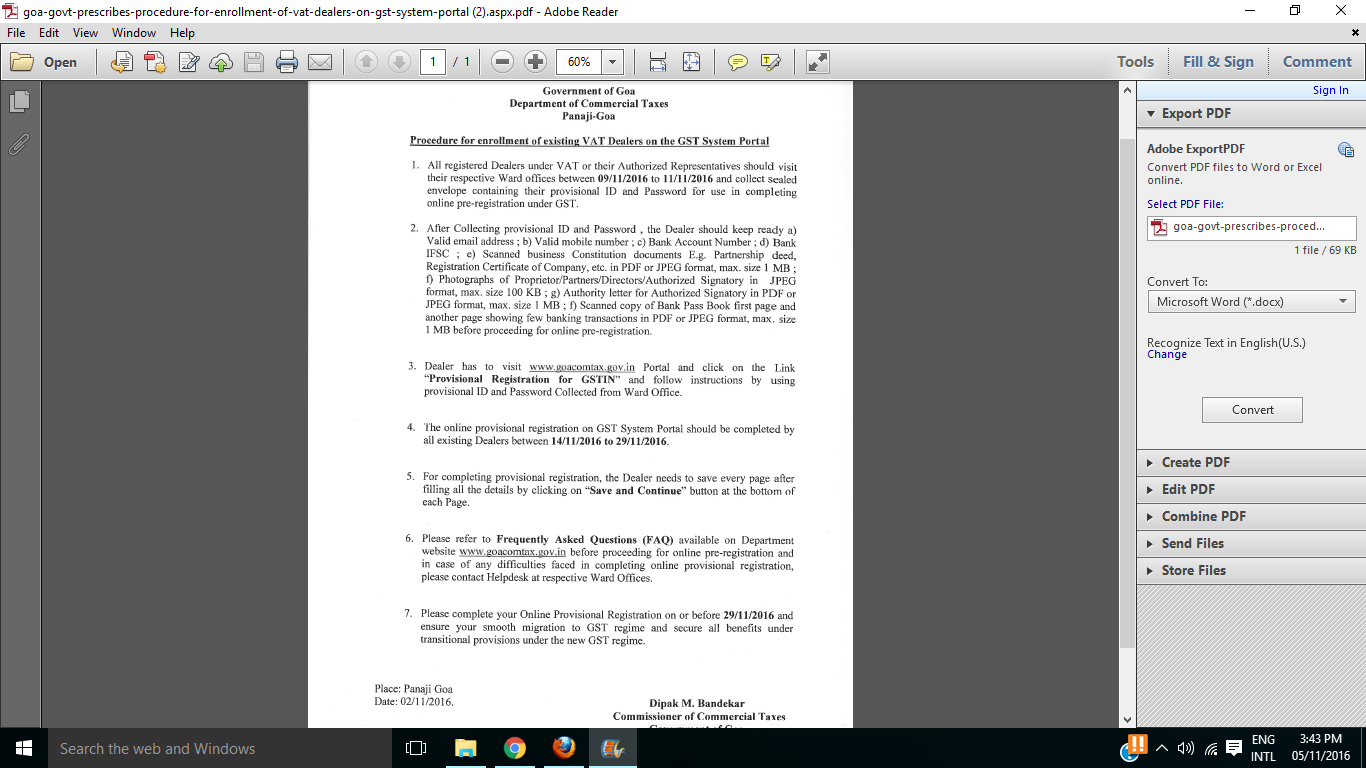
1.Goa Govt. prescribes procedure for enrollment of VAT dealers on GST system portal.


2.Concern over securities transaction under GST

November 5, 2016

The proposed model of goods and services tax (GST), which has included ‘securities’ in the definition of goods, has raised serious concerns on whether transactions in securities would attract GST or would be subject to an additional tax. According to tax experts, the government needs to improve the proposed definition and exclude securities from the definition of ‘goods’. Currently, share transaction attracts securities transaction tax (STT) and Krishi Kalyan cess and Swachh Bharat cess, apart from exchange transaction charges, stamp duty, clearing member charges and Securities and Exchange Board of India turnover charges. While the current model gives no clarity that securities would come under the ambit of the GST, the government’s intent might not be to introduce yet another tax over and above STT of 0.1 per cent on delivery-based trades. “Technically, the government cannot tax transaction in securities as it falls under direct tax but if it does happen, the whole stock market will crash down. Meanwhile, if you see the range of proposed tax rate which is up to 28 per cent — it’s impossible to implement it on securities,” said Sumit Lunker, executive director (tax and regulatory services) at PwC. He added that in the indirect tax legislation scenario, securities being considered as activity of sale and purchase and has never been subjected to any service tax and value added tax. So, one cannot treat securities at par with normal goods and services used in the normal course. Another controversy that might rise is on central and state governments’ revenue. “Let us assume certain securities traded at the stock exchange in Mumbai. But, sellers and buyers are in different states while the servers are at various locations. Under such circumstance, which state will get revenue is an issue that needs to be addressed,” he added. Other section of experts, though, agree with the current interpretation of law. “From state governments’ perspective, they would want direct access to taxpayers’ data as opposed to waiting for the Centre to perform assessments and verifications and trust the Centre to allocate funds to the state. If securities are taxed as goods, it allows the government to track its trading more efficiently under GST. Else, they would have to build a complex place of supply rules for capturing all the various activities around trade in securities,” said Amit Kumar Sarkar, partner, Grant Thornton India. – http://www.business-standard.com[05-11-2016]

3.  Govt’s Next Task on GST: Training 18L Tax Officials

November 5, 2016

After finalising the goods and services tax (GST) rates with the consensus of all the states, the central government has taken on another equally challenging task: to train nearly two million officers to handle the new tax mechanism.

The Centre has roped in senior tax experts from the industry and from the government mechanism to train about 1.8 million tax officers across the country in four phases in line with their ranks, and training sessions are being carried out in various cities since September, a senior tax official said.

Besides familiarising tax officials -who until now were only familiar with several indirect taxes -with the new framework, the government has to train them on the nitty-gritty of implementing GST.This, industry insiders said, could pose some problems.

“GST is not just a tax, it’s a new framework where everything would change,“ said the tax official quoted earlier. “Officers, especially the junior ones, are used to dealing with current system. They have to be not just trained but also handheld for some time initially.“

Industry insiders said it is essential that tax officers, who would be responsible to not just understand but also implement GST, understand how the complex web of GST works.

“The new rules around GST would mean that tax officers have to not and taxpayer-friendly approach but also unlearn what they were practicing thus far to effectively implement GST and the adopt the concept of e-enabled tax administration,“ said Sachin Menon, head of indirect tax at KPMG.

“Also in some way GST would reorganise the structure of the tax department so that GST is implemented smoothly and the efforts of state and central GST officers are not duplicated in assessment, audit and adjudication proceedings,“ said Menon, a former IAS officer with the revenue department.

There are fears that there could be a turf war between the Centre and states over collection of GST although the government has alre ady said they are trying to iron out such problems. “More clarity is al so required as to which part of the GST would be handled by the tax officials in the state and what wo uld be looked after by the Centre,“ a tax officer said.
Another area where tax officials will need training is technology.“Not just the data would be collected online, tax officers would have to learn absolutely new concepts,“ said an industry expert.

India will start the new tax regime with four GST slabs -5%, 12%, 18% and 28%. While this multi-layered system drew flak from some tax experts, it was mainly done to overcome the fear of inflation. Experts said that wherever GST has been implemented, inflation has jumped for the first two to three years along with boost in growth.  – http://www.economics-times.com[05-11-2016]

4.  Edible oil tax slab may be revenue-neutral

November 5, 2016

The tax slab for the edible oil sector under the coming national goods and services tax (GST) is likely to be revenue-neutral. Besides checking tax evasion, this is likely to improve the overall efficiency in the sector, experts said. Edible oil is in the essential commodity category, which attracts the lowest GST rate of five per cent; the overall rate would be nearly 5.5 per cent. “Inflation on edible oil is not only managed by tax. The government has import duty as another tool, with a large part (of supply) imported. GST would improve efficiency in the supply chain,” said Siraj Chaudhry, chairman, Cargill India. India produces 7-7.5 million tonnes of edible oil annually, a third of its consumption. The rest is met through imports, primarily from Indonesia, Malaysia and Argentina. This year’s import is likely to be a record 15.5 mt. Operating at a one to two per cent, some small and medium size entities opt for tax evasion to avoid loss. GST is expected to help check this. “Keeping edible oil in the lowest slab category would encourage genuine business in the system,” said B V Mehta, executive director, Solvent Extractors’ Association of India. “We are analysing the impact; a lot of clarity is required on the GST structure announced recently. Including edible oil in the lowest category of taxation under GST will help enlarge the food security net,” said Dinesh Shahra, managing director, Ruchi Soya Industries. – http://www.business-standard.com[05-11-2016]


5. Insurance may fall under 12% tax slab in new tax regime

November 5, 2016

Insurance might come under the 12 per cent tax slab in the goods and services tax (GST) regime to be implemented from April 1, 2017, sources said. The sector had sought a slab of five per cent less. Sachin Menon, partner and head of indirect tax at KPMG, said while there was no clarity on the rates, there wouldn’t be any additional cess applicable on these services. Here, he said insurance will be classified as a service. At present, apart from the 14 per cent service tax, Krishi Kalyan cess and Swachh Bharat cess are also applicable, taking the total service tax applicable on insurance products to 15 per cent. The service tax rate for other products such as annuity in case of single premium policies is 1.5 per cent approximately. Insurers, however, do not have any clarity on how the new GST tax structure will be implemented. “Different products attract different rates of service tax. If there is one rate proposed for insurance, the question is whether the lower tax structures for products like annuity will continue,” said the chief executive officer of aprivate life insurance company. Another area of concern is whether the same rates of service tax will be applicable for government-sponsored programmes such as the Pradhan Mantri Jan Suraksha insurance scheme. “If it is a one-nation, onerate system, all insurance products including those with focus on financial inclusion will have to be clubbed under one tax slab. We do not know how this will be done,” said the appointed actuary at a mid-size private life insurer. In 2014, service tax was made applicable on insurance premiums. Later, in 2015, Finance Minister Arun Jaitley raised the rate of service tax from 12.36 per cent to 14 per cent. Insurance premiums had come under the service tax ambit from 2014 when the government had made changes to the Finance Bill. After this, the service tax impositions were passed on to customers in the form of increased premiums. This will provide relief to policyholders who pay almost 15 per cent for insurance policies as premium. So, if tax is reduced to 12 per cent, it will mean insurance premiums will also go down. Earlier, major players such as the Life Insurance Corporation of India had expressed reservations about service tax being imposed on insurance premiums. They wanted insurance premiums to be excluded from the purview of service tax. However, their demands were not considered. – http://www.business-standard.com[05-11-2016]


6. Draft law for states’ compensation to be ready by November 15

November 5, 2016

The Centre is set to draft the goods and services tax (GST) compensation law by November 15 for discussion in the next meeting of the GST Council, slated for November 24-25. States had demanded such a law to fully compensate them for a period of five years for the likely revenue loss they might incur. The law is likely to be approved in the next Council meeting. “The Compensation Bill will include a range of clauses clearly defining each term, leaving no scope for ambiguity. That a separate account will be created for income for cess solely for compensating states will also be a part of the law,” said an official. The GST Council is chaired by Finance Minister Arun Jaitley with state finance ministers or their representatives as members. The base year for calculating the revenue of a state has been decided to be 2015-16. Besides, a secular growth rate of 14 per cent would be taken for calculating the likely revenue of each state in the first five years of implementation of GST. States getting lower revenue than this would be compensated by the Centre. A cess on demerit goods at 28 per cent GST rate will also be a part of the proposed Compensation Act. The additional cess will be imposed on luxury cars, pan masala, tobacco and aerated drinks. According to the finalised proposal, the incidence of tax on these items will remain at the current levels even under GST. The Centre is expecting Rs 50,000 crore revenue from cess, including Rs 26,000 crore by way of clean environment cess to compensate states. – http://www.business-standard.com[05-11-2016]

7. Centre, states divided on who will control GST

November 5, 2016

A day after reaching a consensus on tax rates, the GST Council on Friday failed to arrive at an agreement over the crucial issue of administrative control over assessees under the new indirect tax regime. “No decision was taken,” Finance Minister Arun Jaitley told reporters after the meeting. He said clear guidelines on complex and contentious issue will be required. Therefore, further discussion is required on the matter. The finance ministers will have an informal meeting on November 20 to discuss it and have a political solution on the matter. The November 20 meeting will not be of the GST Council and will be held without officials. Jaitley said, “We can’t have two competing assessing authorities for the same assessees.” He said two models were discussed to divide the administrative control between the Union and state governments. One of these was horizontal model, whereby states will have sole control over entities earning up to Rs 1.5 crore a year and dual control of the Centre and states over this level. The other was vertical model whereby both the Centre and states will have control over assessees right from the beginning. This model is called “cross empowerment” too. The assessees for scrutiny and audit will be divided in a pre-decided ratio between the Centre and states, be it a 50:50 or some other ratio, 75:25. The earlier agreement reached between the Centre and states over horizontal model had fallen apart after states expressed keenness to have control over service tax assessees in certain areas such as entertainment tax. According to an earlier proposal, states were to assess businesses with an annual turnover Rs 1.5 crore, while both the Centre and states were to do so for businesses with higher turnover. The Centre and states had earlier agreed that the Centre will have exclusive power over assessees in the services sector, till the state officials were trained to do so. But some states raised objection to this. The GST Council meetings, which were supposed to happen on November 9 and 10, have been put off till November 24 and 25. Those meetings will discuss model GST Bills. When asked whether the government will be able to meet the April one, 2017 target to roll out GST under this scenario, Jaitley said,”We hope so. We will try and approve the GST drafts on November 25.” He said efforts are on to pass IGST, CGST Bills in the winter session of the parliament.The draft GST legislation and the compensation Bill will be decided by November 15 and states could consider it, he said. – http://www.business-standard.com [05-11-2016]


  

Happy Chhatha Pooja (Pray for the well-being, success and progress of whole world)

CHHATH POOJA


About Chhath Festival
Chhath Festival  is dedicated to the God of energy
People offer thanks to the Lord Surya for blessing the life on the earth as ever
Sun worship is related to the cure of a range of diseases such as leprosy, etc.

Chhath is a Hindu festival celebrated each year by the people very eagerly. This is very antique festival of the Hindu religion dedicated to the God of energy, also known as Dala Chhath or Surya Shashti. People celebrate this festival to offer thanks to the Lord Surya for blessing the life on the earth as ever. People worship the God Sun very enthusiastically and pray for the well-being, success and progress of their family members, friends, and elders. According to the Hinduism, Sun worship is related to the cure of a range of diseases such as leprosy, etc.
The rituals at this day is to wake up early in the morning, take a holy bath in the Gange and keep fast for whole day, even people do not drink water and they keep themselves standing in the water for a long time. They offer prasad and aragh to the rising sun. It is celebrated in the various states of India like Bihar, UP, Jharkhand and Nepal. According to the Hindu calendar, it is celebrated at 6th day of the month of Kartika(month of October or November).
At some places, Chaiti Chhath is also celebrated in the month of Chaitra (March or April) few days after Holi. It is named as chhath because it is celebrated at the 6th day of the month of Kartika. Chhat puja is very famous in the Dehri-On-Sone, Patna, Dev and Gaya. Now, it is celebrated all over the country.
Chhath Puja 2016 Dates
§  Friday, 4th of November 2016 is the day of bath and eat.
§  Saturday, 5th of November 2016 is the day of fast which ends after sunset after the 36 hour long fast.
§  Sunday, 6th of November 2016 is the day of Sandhya Argh known as the evening offerings.
§  Monday, 7th of November 2016 is the day of Suryodaya Argh and the Paran or breaking of the fast.
History and Origin of Chhath Puja
Chhath puja has a great significant in the Hindu religion and it is assumed that the oldest Purohits were requested by the kings to come and perform the traditional puja of the Lord Sun. They chant the ancient Rigveda texts and a variety of hymns for worshiping the Sun. In the ancient, Chhath puja were celebrated by Draupadi and Pandavas of Hastinapur (New Delhi) for solving their instant problem and regaining their lost kingdom.
It is also assumed that the Chhath puja was first started by the Surya Putra Karna. He was a great warrior and had ruled over the Anga Desh (Munger district of Bihar) during the Mahabharata period.
Worship of Chhathi Maiya (consort of the Lord Surya) is held at Chhath puja, Chhathi Maiya is also known as Usha in the Vedas. Usha means dawn (the first light of the day). People pray to Chhathi Maiya to overcome their troubles as well as to get the Moksha or liberation.   T
The Goddess who is worshipped during the famous Chhath Puja is known as Chhathi Maiya. Chhathi Maiya is known as Usha in the Vedas. She is believed to be the beloved younger wife of Surya, the sun god. Usha and Pratyusha are wives of Surya and Aditi is his mother.

Usha is the term used to refer to dawn– The first light of day. But in the Rig Veda she has more symbolic meaning. Symbolically Usha is the dawn of divine consciousness in the individual aspirant. It is said – Usha and Pratyusha, wives of Sun are the main source of Sun. Both Usha and Pratyusha are worshiped along with Sun in chhath parva. Usha(literally-the first morning sun-ray) is worshipped on the last day and Pratyusha(the last sun-ray of day) is worshipped in the evening by offering water or milk to the rising and setting sun respectively. This is the only parva which signifies rising sun as well as setting sun both
Another history behind celebrating the Chhath puja is the story of Lord Rama. It is considered that Lord Rama and Mata Sita had kept fast and offer puja to the Lord Sun in the month of Kartik in Shukla Paksh during their coronation after returning to the Ayodhya after 14 years of exile. From that time, chhath puja became the significant and traditional festival in the Hindu religion and started celebrating every year at the same date.
Chhath Puja Katha
A long year ago, there was a king named, Priyavrat and his wife Malini. They were living very happily but there was a big unhappiness in their life as they have no child. They decided to make a big Yagya by the help of Maharishi Kashyap in order to be blessed with a child. His wife became pregnant because of the effect of Yagya. But she had given birth to a dead child after nine months. King was very sad and decided to suicide. Suddenly, there came a Goddess in front of him while suicide. Goddess said that, I am a Goddess Khashti, if someone would offer puja to me with pure mind and soul, he would definitely get a child. The king, Priyavrat did the same and blessed with a very beautiful and cute child. Since then, people started celebrating the chhath puja.
Rituals and Traditions of Chhath Puja
It is believed that worshipers of the Chhath take holy bath and follows a period of abstinence and become separate for 4 days from the main family. Throughout the period he is believed as the pure spirit and sleep on the floor having single blanket. There is a normal belief that once a family begins Chhatt Puja, he has to perform it yearly as well as pass it to his next generations and it can only be skipped when there is a death of any person in the family that year.
Devotees offer prasad to Sun at the Chhath such as sweets, Kheer, Thekua and fruits included in a small bamboo tokari. The prasad should be cooked without salt, onions or garlic with maintained purity. It is a four days festival which includes:
§  On the first day, devotees take bathe early in the morning in the holy water of Gange and bring some water to their home to prepare the offerings. The home and its surroundings should be cleaned at this day. They take only one meal a day known as kaddu-bhat cooked only by using the bronze or soil utensils and mango woods over the soil stove.
§  On the second day (the day before Chhath), Panchami, devotees keeps fast for whole day and break their fast in the evening after sunset after the worship of Sun. They offer Rasiao-kheer, puris, fruits in the puja. After taking meal in the evening, they go on a fast without water for the next 36 hours.
§  On the third day (day of Chhath) they offer the Sanjhiya Arghya at the ghat of riverbank. After Arghya, they wear the single saree of turmeric color. Other family members are waiting for getting the blessings from worshiper. At the night of Chhath a vibrant event of Kosi is celebrated by lighting the lamps of clay diyas under the covering of five sugarcane sticks. The five sugarcane sticks indicate the Panchatattva (earth, water, fire, air and space) that human body made of Panchatattva.
§  On the early morning of the fourth day (Paarun), devotees along with their family and friends offer Bihaniya Aragh at the ghat of riverbank of Gange. Devotees end their festival through breaking the fast by having the Chhath prashad.
Stages of Chhath Puja
There are six great stages of the Chhath puja which are:
§  The belief of fast and cleanliness of body on the festival identify the detoxification of the body and mind in order to set up the body and mind to accept the cosmic solar energy.
§  Standing in water with half of the body inside the water diminishes the escape of energy as well as facilitates the prana to elevate to the sushumna.
§  Then the entrance of cosmic solar energy takes place in the pineal, pituitary and hypothalamus glands (known as the Triveni complex) by the retina and optic nerves.
§  In the 4th stage Triveni complex gets activated.
§  After activation of the Triveni complex, spine gets polarized and body of devotee gets transformed into a cosmic powerhouse and gets the Kundalini Shakti.
§  At this stage the devotee is fully able to conduct, recycle and pass on the energy into entire universe.
Benefits of the Processes of Chhath puja
§  It is the way of detoxifying the body and mind which lead to the biochemical changes.
§  Through detoxification it becomes possible to control the flow of prana as well as getting more energetic. It improves the look of skin, develops better eyesight and the ageing process gets slow down.
Benefits of Chhath Puja
§  Devotee of the Chhath puja can improve the immunity of body.
§  A variety of skin infections can be cured through the safe radiations of sunlight.
§  It increases the fighting power of blood by improving the performance of WBC.
§  Solar energy provides the power to control the secretion(emission,discharge) of hormones.
Daily sun meditation relaxes the body and mind. Pranayam, yoga, meditation are also the way to improve the control on body and mind. Pilgrims comes at Varanasi for a peaceful yoga and meditation at the bank of river Ganga.
Significance of Chhath Puja
Chhath puja has a special significance during the Sunrise and Sunset periods. The Sunrise and sunset are the most important periods of the day during which a human body can safely get the solar energy without any harm. That’s why there is a myth of offering the Sanjhiya Arghya and Bihaniya Arghya to the Sun at the Chhath festival. During this period the solar energy has low level of ultraviolet radiations so it is safe for the human body. People perform the Chhath puja in order to thank the Lord Sun for continuing the life on the earth as well as to get blessings.

The ritual of Chhath puja provides mental calmness (by detoxifying the body and mind), enhances the energy level and immunity, reduces the frequency of anger, jealous as well as lot of negative emotions. It is also believed that following the Chhath processes helps in slowing down the ageing process. Such beliefs and rituals of the Chhath make it the most significant festival in the Hinduism.


GST Updates (04 Nov 2016)


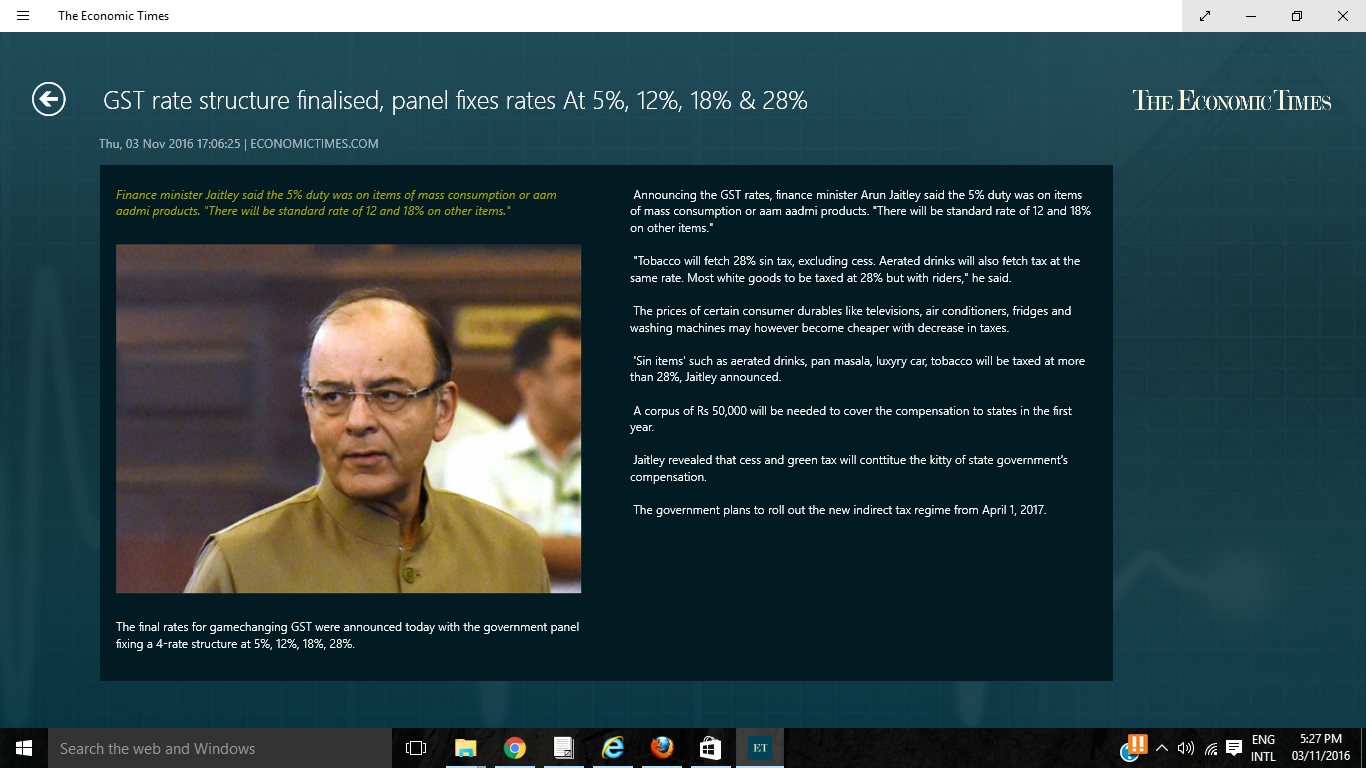
GST Council decides four-tier rate structure of 5%, 12%, 18% and 28%

November 4, 2016

GST Council decides four-tier rate structure of 5%, 12%, 18% and 28%
The GST Council in its fourth meeting held on November 03, 2016, has finalised the GST rates. The finalised rates are 5, 12, 18 and 28 percent. The lower rate is for essential items and highest rate is for luxury goods. The GST rate on Gold has not been decided yet but the rate of service tax will go up from 15 percent to 18 percent.

In the last meeting held in October, Centre proposed four tier rates which are 6, 12, 18 and 26 percent. The rates have been approved by the GST council after some tinkering with the earlier proposed slabs.

The Hon’ble Finance Minister, Arun Jaitley, said that the Sin items such as tobacco, aerated drinks, pan masala, luxury car, etc., will be taxed at more than 28 percent as additional cess will be levied on these. Items constituting half of the consumer price index (CPI) basket including food grain, will be exempt. He also pointed out that the Corpus of Rs.50, 000 Crore would be needed to fund compensation to the States in the first year.

It would give a little more relief to the poor and a little more grief to the rich in the goods and services tax. The additional cess and a clean energy cess will create a revenue pool which will be used to compensate States for any loss of revenue during the first five years of the implementation of GST. The cess, Jaitley said, will not be an additional burden on the taxpayers because higher rate of 28% and cess will not exceed the total of the existing levies.


India Inc Welcomes Four-tier Tax Rates

November 4, 2016

India Inc, which will possibly benefit the most from the introduction of Goods and Services Tax, welcomed the rapid progress on this key reform even as it pointed out certain shortcomings that it hoped would be addressed over a period of time. Industry has called for a centralised registration system under GST, while flagging concerns around the burden of complexity that could arise due to multiple registrations for supply of goods and services in each state.

“Businesses in the services sector such as telecom, banking, insurance, airlines, ecommerce undertake pan-India operations. Meeting requirements of each state through different registrations, audits and compliances would be a massive task,“ said Confederation of Indian Industry President Naushad Forbes. On the four-tier rate structure that was unveiled on Thursday, the CII suggested that over time the government converge those into one or two rates.

Hemant Kanoria, chairman of SREI Infrastructure Finance, said GST as a concept would do good to the infrastructure industry, but “the process of its implementation should not be cumbersome“.

Industry stands to gain with lower incidence of tax, better input tax credit and lower logistics costs once the GST is rolled out nationally, creating a single national market for delivery of goods and services. This should boost the profitability of companies.
The Confederation of All India Traders (CAIT), however, said the final impact of the new structure would emerge only when the classification of goods under different tax rates was done.

The traders’ body called for one single return and single authority to control the taxation system, irrespective of rates. Only that will widen the tax net and increase revenue, said BC Bhartia, the president of CAIT.

“The rate structure will achieve the twin objective of protecting the revenues of the central and the state governments and further containing the inflationary pressures that may arise consequent upon the change of the taxation system,“ said Ficci President Harshavardhan Neotia. – http://www.economictimes.indiatimes.com [04-11-2016]


Nasscom concerned over GST implementation

November 4, 2016

Software lobby group National Association of Software and Services Companies (Nasscom) said it was yet to get clarity on the rates for IT products but cautioned that the bigger challenge for the sector would be the implementation of the goods and services tax. “The industry is looking at a rate of 12-16 per cent. So, it entirely depends on how it gets. But, the bigger concern is how the GST is applied,” said R Chandrashekhar, president of Nasscom. Finance Minister Arun Jaitley on Thursday announced the four slabs – 5 per cent, 12 per cent, 18 per cent and 28 per cent – for GST rates. The software industry was also concerned about the need to register in multiple jurisdictions. “Many state governments have not dealt with services as it was so far a central subject. How will they assess place of supply and also valuation of the inventory when it is supplied from another office?” said Chandrashekhar. “The tax rates are less of a concern. GST should also not make ease of business more complex with the whole process.” He also was concerned about credit for taxes as the industry was predominantly focused on exporting software. Stating that software is ‘intangible’, which can be used and transferred between offices, Chandrashekhar asked how would authorities count the place of supply, if it originates from another office. – http://www.business-standard.com[04-11-2016]

GST Site to Open soon so Filing won’t Tax You

November 4, 2016

Much before the April deadline of the roll-out of the Goods and Services Tax (GST), the online filing portal is ready to throw itself open to the public from next week, enabling tax payers to warm up to the new system before it finally launches in April of next year. On Thursday, the GST Council finalised a four-tier tax structure of 5, 12, 18 and 28% for the new tax regime, with lower rates for essential items and the highest for luxury and de-merits goods.

According to a government official, the GST portal will be hosted at the domain http:www.gst.gov.in, which will be launched on November 8, even as the mobile app is currently being developed. “The proposal was discussed in the GST panel meeting today (Thursday) and the date has been finalised. There was no adverse reaction to it,“ said the official who requested anonymity.

The portal will allow tax payers whose PAN numbers have been verified by the tax department to register themselves in advance and fill in their details and legacy data. “The idea is to avoid everyone trying to log-in at the same time before the roll-out in April,“ said the official adding that the government is looking at getting the tax payers to enter all the data about themselves in their system for it to work smoothly at the time of the launch without any “challenges“.

ET had reported earlier that India’s second-largest software company Infosys has been mandated to develop and run the Goods and Services Tax Network (GSTN) -the entity tasked with providing the information technology infrastructure for it -in a project worth Rs. 1,380 crore. The portal itself will be a one-stop destination for filing and processing of all taxes for almost 65 to 70 lakh tax payers in the country and is being designed by a specialised design unit of Infosys.

The GST portal will be a front for the tax payer where registration, return and payments will be filed. It will also provide help-desk support. The technology at the backend will have the power to analyse data for trends on sales, tax filings etc. The portal will allow businesses to register using their PAN and mobile number or Aadhaar number. All businesses will be given a GST identification number, which will be a 15-digit code, consisting of their state code and ten-digit PAN.GSTN has already validated the PAN of 58 lakh businesses from the tax department over the past two years.

The official added that GSTN has already generated the GST identification numbers for around 20 lakh tax payers in eight states and has sent the data to the states for further disbursal. The rest of the tax payers will be covered in batches over the coming weeks, said the official. “We are doing it right now for VAT which covers excise as well, since those paying excise are also registered for VAT. Registration for people paying service tax will begin in January,“ said the official.

The entity is also in the process of developing a mobile app through which tax payers can also register themselves and at the same time allow them to file taxes or upload returns.
“We are making the process really simple by allowing people to just take pictures from their phone cameras and then upload them,“ said the official, adding that the app is also expected to be ready over the next five to seven days. – http://www.economictimes.indiatimes.com [04-11-2016]
  

GST Updates (03 Nov 2016)


Assocham, KPMG Warn against Sharp Anomalies in GST Rates

November 3, 2016

Ahead of the crucial Goods and Services Tax Council meeting on Thursday and Friday, industry body Assocham and consultancy KPMG have called for avoiding sharp anomalies in taxation structure across different industries such as telecom, tobacco and textiles under the new tax regime.

“While GST is a path-breaking reform, its implementation should be calibrated in a manner to cause least disturbance to the existing taxation structure,“ Assocham secretary general DS Rawat said on Wednesday after the association and KPMG jointly submitted a paper to the GST Council on the proposed tax framework.

Taxation structure for sin goods like tobacco should not be based on emotive issues, but on rational parameters like the need to check illicit trade, the submission said, opposing the idea of taxing tobacco and tobacco products at a higher than standard rate. It said the focus should be on bringing exempted items under GST net and eliminate rampant illicit trade. The GST Council at its meeting will seek to decide on the GST rates and the division of tax administration. The Centre has proposed four slabs and a fifth rate for precious metals besides a cess on ultra-luxury and tobacco products, which has not been accepted by states.

Chandrajit Banerjee, director general at industry body Confederation of Indian Industry (CII), said the government should ultimately reduce the number of GST rates to one or two. “The GST should begin with an absolute limit of four rates as suggested by the government, and over time, the government should commit to converging these four rates to one or two rates,“ he said. The Assocham-KPMG paper cautioned that for the telecom sector GST may negatively impact the working capital cost since initial landed price of purchases, including imports, may increase due to higher tax rates. The paper said the cost of procurement of services may increase to more than 18% from the current 15%, which will be a challenge for the industry, especially if CENVAT credit on passive infrastructure and fuel consumption is continued to be denied to the industry.

It also pointed out that for the tourism sector different abatement schemes addressing different situations are currently available under service tax, such as 30% in case of composite package and 60% for dining at a standalone restaurant.

The paper said differential rates are leading to ambiguity and complexity in determining the value on which service tax is payable, and pitched for a uniform tax treatment to overcome such a situation.

It said the food processing industry is taxed at a concessional rate or zero rate. GST is likely to be based on minimal exemptions regime, leading to increase in the tax cost for the food processing industry and inflation. – http://www.economictimes.indiatimes.com [03-11-2016]

GST Council meet starts today: Trust deficit between Centre, states widen; is April deadline a tall order

November 3, 2016
With barely a fortnight left for Parliament’s Winter Session, the GST Council will begin its crucial two-day meeting on Thursday to decide on tax rate, including the levy of cess and sort out the vexed issue of jurisdiction over assessees.

The meeting is to be chaired by Finance Minister Arun Jaitley.

Here are the key facts you need to know about the meeting:

The agenda: At the meeting, the Central government is likely to press its proposal for 4-tier tax structure of 8, 12, 18 and 26 percent.
Under the proposed 4-slab structure, the items which are currently taxed between 3-9 per cent will fall in the 6 percent bracket; those in 9-15 percent range will come under 12 percent rate. Those products which are currently taxed between 15-21 percent will attract 18 percent levy while those above 21 percent will be taxed at the peak rate of 26 percent.
The Centre has also proposed to levy additional cess on demerit goods like tobacco, aerated drinks and polluting items to create a Rs 50,000 crore fund to compensate the states for revenue loss. The proposal, which was discussed at the last meeting, could not be adopted by the Council because of opposition by some states.
The cess is also likely to be taken up in the meeting.
Another important issue to be discussed at the meeting is the dual control of service tax assessees.

Centre-states mistrust: On almost all the issues to be taken up at the meeting the central government and the states are headed for a collision course. The Centre is expected to have a tough task of building consensus with states.
On tax rate, some of the state governments, such as Kerala, are opposed to the cap at 26 percent, according to a media reports.
“The logic of reducing the tax incidence on consumer durables and demerit goods to 26% makes the GST severely regressive… The upper rate has been pegged at a lower rate so that the central government has the option to impose the cess as and when necessary,” Kerala finance minister Thomas Isaac has been quoted as saying in a reportin The Financ ial Express.
The second contentious issue is the cess. Many state finance ministers have questioned the very rational of imposing a cess under the GST regime. Issac had earlier said such a move will defeat the purpose of bringing in the tax reform as such. States are opposed to cess as it is an item that is not shared with them.
As far as service tax is concerned, the Centre-state differences are wider.
At the last meeting, differences arose between the Centre and states on dual control, with states demanding control over 11 lakh service tax assessees and the Centre proposing to do away states having exclusive control over all dealers up to an annual revenue threshold of Rs 1.5 crore.
West Bengal Finance Minister Amit Mitra has said that the Centre has withheld information relating to the number of service tax assessees. He said while the Centre has disclosed 11 lakh tax payer, the actual number of service tax assessees is estimated at 30.5 lakh.
There is difference on even the priority of the issues to be taken up. Media reports say while the Centre wants to take up the rate structure first, the state governments want the service tax issue to be resolved first.
Most importantly, trust deficit seems to be widening between the states and the Centre.
“The centre has been trying to dictate its own terms. There is a feeling among states that the centre is not sharing information promptly with the states and neither is it trying to see the states’ viewpoint,” a report in the Mint quoted a source as saying.

What to expect: The Centre, nonetheless, exudes confidence that there will be a consensus and the deadline of 1 April 2017 is workable. Minister of State for Finance Arjun Ram Meghwal has termed differences over cess as “minor”.
“Our effort is to decide on all matters through consensus. We want everyone to come around on all issues… There may be times when Tamil Nadu or Kerala or West Bengal or Uttar Pradesh have said something different but we will get them around. We are confident that the GST will be rollout from April
1, 2017…all issues would be sorted out before that,” he has been quoted as saying in the report.
The meeting beginning today is crucial as it will have to sort out the issues concerning tax rate to enable Parliament to approve the Central GST (CGST) and Integrated GST (IGST) legislations in the winter session beginning November 16. This is important to meet the 1 April 2017 roll-out deadline.
But given the major trust deficit between the states and the Centre, the meeting the deadline is likely to be a tough call. Source – http://www.firstpost.com [03-11-2016]

Industry bodies call for eventual streamlining of multiple GST rates

November 3, 2016

Industry bodies have raised concerns over the government’s proposed multiple rate structure for the Goods and Services Tax regime, saying that the four proposed rates should eventually be collapsed into fewer rates.
They also called for a clear roadmap for the withdrawal of the cesses the government proposes to levy on luxury goods and tobacco products over and above the 26 per cent GST rate.
“The GST should begin with an absolute limit of four rates as suggested by the Government, and over time, the Government should commit to converging these four rates to one or two rates,” Chandrajit Banerjee, Director General, CII said on Wednesday, a day before the fourth meeting of the GST Council.
He added that industry was cognisant of the fact that a single GST rate could not apply in a country like India and so a beginning must be made with multiple rates.
“It is suggested that the higher rate of 26 per cent should apply only to ‘demerit goods’ and the term “luxury” goods should not be used to define this category,” Mr Banerjee said, adding that the bulk of goods and services should fall within the standard rate of 18 per cent and only a few exceptions should be taxed at the higher rate of 26 per cent.
“The government should also roll out a clear roadmap for the early withdrawal of cess once the buoyancy in tax collection becomes adequate to compensate the states for any shortfall that they might have,” Mr Banerjee said.
The industry bodies also voiced some sector-specific demands in the run up to the fourth meeting of the GST Council.
“The (textiles) industry players expect a tax efficient GST regime in the form of various incentives such as continuation of zero rating of exports along with a streamlined and efficient refund mechanism; liberalisation of credit regime allowing full credit to eliminate inverted duty structure and cascading effect; uniform tax structure to eliminate tax differentiation and tax arbitrage amongst various states; and higher rate of duty drawback to encourage increase in production of textile and apparel products for export,” according to a report by Assocham and KPMG.
The report also mentions the need to revisit several complications in the taxation structure of the telecom sector, saying that there were several issues here such as the proposed shift from the levy of circle-wise tax to a levy of state-wise tax, the classification of services and goods, and the taxability of SIM cards and recharge coupons, to name a few.
“Petroleum products and alcohol are the main drivers and ingredient to the tourism industry,” the report added. “The Government under the proposed GST structure has proposed to keep both the products outside the purview of GST. Therefore, either a special abatement should be provided to balance the incremental costs or the same should be covered in the proposed structure of GST. Source – http://www.thehindu.com [03-11-2016]

Financial services industry deserve a better GST

November 3, 2016

The financial services industry must be spared a compliance nightmare when the goods and services tax (GST) is rolled out. The industry is happy to pay whatever tax is due but would like the Centre and the states to sort out how to share the proceeds amongst themselves without making service providers jump through hoops to facilitate that division. Most financial services span multiple states and extensively use computer networks and servers, whose location at a particular site has no real bearing on where, and from where, a service using those networks is rendered. The sensible thing to do would be to treat all financial services as inter-state transactions to be taxed under Integrated GST, with all vendors to financial services also being taxed under IGST, so as to avoid accumulation of input tax credits that cannot be availed of.

Absurdly, the model law treats securities as goods. Taxing securities transactions on the value of securities would kill trading in securities and cripple the role of the capital markets in allocating capital to different alternative uses and hedging risk. A bond or a share is a unit of capital with particular characteristics including risk and return associated with it. It is an input to value addition, not value addition in itself. No value-added tax should apply to capital, per se. The process of matching suppliers of capital with those looking for it is indeed a service that should be and is taxed. The government must amend the model law to remove the anomaly of treating financial services as goods. Source – http://blogs.economictimes.indiatimes.com [03-11-2016]

GSTN to borrow 800 cr to meet infra building cost

November 2, 2016

GSTN, the company that is building the world’s biggest and most complex tax system, will borrow Rs. 800 crore from banks to fund infrastructure costs to support Goods and Services Tax rollout from April 1 next year.

The Goods and Services Tax Network (GSTN), a not-for-profit, non-government, private limited company promoted by the Central and State governments, is borrowing Rs. 250 crore for working capital needs and another Rs. 550 crore as long-term loan from domestic lenders, its chairman Navin Kumar told PTI here.

The Centre has 24.5 per cent stake in GSTN and the state governments an equal share. The remaining 51 per cent is with private financial institutions.

“The total authorised and paid-up capital is Rs. 10 crore. So, Rs. 4.90 crore has come from Central and State governments and Rs. 5.10 crore from private institutions,” he said.
Kumar said the cost of infrastructure to support the GST will be Rs. 1,380 crore.
“We will be borrowing Rs. 550 crore for infrastructure. We have also sought some working capital limit, that we will see if there is any default in payment,” he said.

Since its incorporation on March 28, 2013, the GSTN had used Rs. 64 crore towards payments to its vendors and employees out of the central government’s sanctioned grant of Rs. 315 crore for the first three years.

“The government has released Rs. 120 crore from the grant, and we have used Rs. 64 crore, rest of the money we have to refund to the government,” he said, adding this year the entire expenses would be met through borrowing.

Kumar said after receiving Letter of Guarantee from the government, the GSTN will raise a five-year term loan of Rs. 550 crore from various Indian banks.

“We have also requested for a Rs. 250-crore working capital loan. So, if there is any delay by any government in making payment, then we will borrow money. We have selected the banks,” he said.

Explaining how the working capital and term loans would work, he said the working capital loan works like a credit and at the end of the year the borrower has to square up the loans.
But the payment of term loan has to be made every month.

GSTN is a non-government, private limited company promoted by the central and state governments with the specific mandate to build the IT infrastructure and the services required for implementing Goods and Services Tax (GST).  Source – http://www.thehindubusinessline.com [02-11-2016]

As GST Council begins meeting, Centre affirms rollout of the tax regime by April 2017

November 3, 2016
The Goods and Services Tax Council will begin a two-day meeting on Thursday to decide on outstanding issues such as a tax rate and the levy of cesses, PTI reported. Union Minister of State for Finance AR Meghwal expressed confidence that the new tax regime would be rolled out by April 1, 2017, the deadline the central government has set for itself.

The Centre is likely to press for the introduction of a four-tier tax rate structure of 8%, 12%, 18% and 26%, at the meeting that will be chaired by Union Finance Minister Arun Jaitley. Meghwal said the central government would make all efforts to reach a consensus on the outstanding issues. “We want everyone to come around on all issues,” he said.

The Centre will also seek to levy an additional cess on goods such as tobacco and aerated drinks for the purpose of creating a Rs 50,000 crore fund. The fund will be used to compensate states for revenue losses during the transition to the new regime.

At its last meeting in October, the Centre and states failed to reach a consensus on the rate bands for the new regime. The states also reportedly failed to come to an agreement on the Centre’s proposal to impose a cess over the GST on luxury items. Revenue Secretary Hasmukh Adhia said the states were of the opinion that it was not possible to segregate goods and services. Meanwhile, Jaitley said the final tax slabs would depend on the source of funds that the Centre intends to use to compensate states for revenue losses incurred after the shift to the GST regime.

However, states have hardened their opposition to the method of implementation of the tax. On Wednesday, West Bengal Finance Minister Amit Mitra accused the Centre of not revealing information on the service taxpayer base from states, which he said influenced negotiations between the two sides on the sharing of administrative powers between them. In a letter to Jaitley, Mitra said new data placed the taxpayer base to be at 3.05 million, a sharp rise from the figure of 1.1 million given to states previously, Mint reported.

Similarly, Kerala Finance Minister Thomas Isaac has also expressed concerns regarding the rate of tax. At the previous Council meeting, he reportedly demanded that the highest rate be fixed at 30% so that commonly-used items would be kept out of the GST’s ambit or levied with a lower cess.

The GST Bill got President Pranab Mukherjee’s approval on September 8, after being ratified by 16 states. It was passed by the Rajya Sabha on August 3. Source – http://scroll.in [03-11-2016]

‘Raise’ tobacco tax under GST

November 2, 2016
Health activists today said the proposed 2 6 per cent sin rate on tobacco will negatively impact revenue and public health and the tax rate on tobacco products should not be below 4 0 per cent.

India has the second largest number of tobacco users (2 7 5 million or 3 5 pc of all adults in India) in the world. Of these at least a million die annually from tobacco-related diseases and tobacco-use imposes enormous health and economic costs on the country .

In a statement today , several health activists said: ” There is an over arching consensus that harmful goods be categorised as sin goods and taxed at the highest rate under GST as recommended in the Chief Economic Adviser report which seeks a 4 0% GST sin rate on all tobacco products, including cigarettes, ‘bidis’ and chewing tobacco. The GST council meeting that concluded on October 20 proposed a much lower 2 6 % GST sin rate, which would have significant impact on the revenue as well as the health of our nation , both of which require serious consideration .”

Among those supporting higher tax on tobacco are Rijo John , assistant professor at IIT Jodhpur , Pankaj Chaturvedi, on cologist at Tata Memorial Hospital, Mumbai, Bhavn a Mukhopadhyay of the Voluntary Health Association of India , Ashim Sanyal, COO of Consumer VOICE, an anti-tobacco campaigning NGO, among others.  Source – http://www.tribuneindia.com [02-11-2016]

Assocham opposes cess in GST

November 2, 2016
Health activists today said the proposed 2 6 per cent sin rate on tobacco will negatively impact revenue and public health and the tax rate on tobacco products should not be below 4 0 per cent.

India has the second largest number of tobacco users (2 7 5 million or 3 5 pc of all adults in India) in the world. Of these at least a million die annually from tobacco-related diseases and tobacco-use imposes enormous health and economic costs on the country .

In a statement today , several health activists said: ” There is an over arching consensus that harmful goods be categorised as sin goods and taxed at the highest rate under GST as recommended in the Chief Economic Adviser report which seeks a 4 0% GST sin rate on all tobacco products, including cigarettes, ‘bidis’ and chewing tobacco. The GST council meeting that concluded on October 20 proposed a much lower 2 6 % GST sin rate, which would have significant impact on the revenue as well as the health of our nation , both of which require serious consideration .”

Among those supporting higher tax on tobacco are Rijo John , assistant professor at IIT Jodhpur , Pankaj Chaturvedi, on cologist at Tata Memorial Hospital, Mumbai, Bhavn a Mukhopadhyay of the Voluntary Health Association of India , Ashim Sanyal, COO of Consumer VOICE, an anti-tobacco campaigning NGO, among others.  Source – http://www.tribuneindia.com [02-11-2016] 

GST Updates (02 Nov 2016)


Assocham suggests GST rate hike by 1-2% to compensate states for revenue losses

November 2, 2016

Arguing against the levy of cess, Assocham has written to Finance Minister Arun Jaitley to hike the proposed Goods and Services Tax by 1-2 per cent to compensate states for revenue loss under the GSTsystem.

“The idea of levying cess to make a corpus for compensation to states does not seem to be feasible. The additional revenue required for such compensation can be collected by increasing the tax rates (by 1-2 percent) instead of levying the cess,” Assocham Secretary General DS Rawat said in a letter written last week to Jaitley.

The next meeting of the GST Council, chaired by Jaitley, is slated for November 3-4.

On the crucial issue of the tax rate structure, which three earlier meetings of the GST Council failed to decide, Jaitley has said that a four-slab structure of 6, 12, 18 and 26 per cent is under consideration, with lower rates for essential commodities and higher ones for luxury goods.

It has been proposed that items constituting nearly 50 per cent of the weightage in the Consumer Price Index basket, mostly food items, be exempted from the levy.

Besides, a cess is also likely to be levied on demerit or sin goods and polluting items.

The industry body Assocham suggested that essential commodities of mass consumption like fruit, vegetables and grains should not be taxed, while processed food products like dairy products, rice, edible oil and biscuits should attract six per cent duty.

It said mobile phones, computers, fruit juices, pet foods should be taxed at 12 per cent and other items at 18 per cent.

Luxury cars, tobacco and pan masala should be taxed at 26 per cent, Assocham added.
Jaitley suggested last week that in order to compensate states for loss of revenue in the GST regime, a cess on tobacco and luxury goods is an option preferable over additional tax, which will be exorbitantly high.

“Assuming that the compensation is Rs 50,000 crore for the first year, the total tax impact of funding the compensation through a tax would be abnormally high. A Rs 1.72 lakh crore of tax will have to be imposed for the central government to get Rs 50,000 crore in order to fund the compensation,” Jaitley wrote in a Facebook post.

“Fifty per cent of the tax collected will go to the states as their GST share and of the balance 50 per cent in the hands of the Centre, 42 per cent more will go to the states as devolution.”
“So, out of every 100 rupees collected under the GST system, only 29 per cent remains with the Centre. The tax impact of this levy will be exorbitantly high and almost unbearable,” he said.

“Different items used by different segments of society have to be taxed differently. Otherwise, the GST will be regressive. Air conditioners and hawai chappals (flip-flops) cannot be taxed at the same rate. Total tax eventually collected has to be revenue neutral. The government should not lose money necessary for expenditure nor make a windfall gain,” he added.

Jaitley proposed, instead, imposing cess, which would be subsumed in the taxes after five years.

“This will include cess on clean energy, luxury items and tobacco products, which in any case presently also pay levy higher than 26 per cent. This will ensure no additional burden on the taxpayer and yet be able to compensate the losing states,” he said.

The Finance Minister said if cess is levied, the states which benefit from the GST will not have to compensate the losing states.  Source – http://www.business-standard.com [02-11-2016]

Centre moves to overcome hurdle on dual control of GST

November 2, 2016

The sticky issue of administration or control over assessees under the goods and services tax (GST) regime is close to a breakthrough. The Centre is likely to propose that the power of audit and scrutiny should be with the Union as well as state governments without any threshold. The two-day meeting between the Centre and state finance ministers to discuss GST norms begins on Thursday. The Centre, however, is likely to audit and scrutinise fewer assessees than states. The issue of administrative control is one of the key matters to be taken up by the GST Council on Thursday and Friday, after an earlier agreement between the Centre and states fell through in the last month meeting. According to an earlier proposal, states were to assess businesses with an annual turnover Rs 1.5 crore, while both the Centre and states were to do so for businesses having higher turnover. The Centre and states had earlier agreed that the Centre will have exclusive power over assessees in the service sector, till the state officials were trained to do so. But some states raised objection to this. “Threshold is a bad idea as turnover of a company keeps changing. Besides, it is difficult to have a clear distinction between what classifies as a good or service. So instead, we can have clear distinction to carry out audit and scrutiny. We are willing to carry out a lot less intervention than states. If states want the comfort of numbers, they will get that,” said a government official who did not wish to be identified. There will be “cross-empowerment” right from the beginning to ensure that a taxpayer will have to deal with one authority for all taxes to protect them from harassment. Under the framework, both the Centre and states will have administrative control over assessment, scrutiny and audit for the central GST and state GST. Whoever strikes first will carry out the assessment for CGST, SGST and IGST. “There will be a demarcation on who will carry out what audits. We want to supervise so that taxes grow and more people comply,” said the official. In case of scrutiny, if the states want to do it for 5-10 per cent cases, the Centre will do for just 1-2 per cent, as per the proposal. This will ensure that both Centre and states will share equal powers on all tax matters. Which assessee would be assessed by which administration would be decided on the basis of risk assessment. The list will be shared with one another, based on which each authority will get its share of assessees for auditing and checking for a possible evasion. Only about 5 per cent entities will be audited under the GST regime. – http://www.business-standard.com[02-11-2016]

Raise GST rate by 1-2%, no cess: Assocham to FM

November 2, 2016

Assocham has made a pitch to finance minister Arun Jaitley not to levy cess, but raise GST (goods and services tax) rate one-two per cent to garner additional resources to compensate states for any revenue loss on rollout of the new regime from April next year. It said additional cess should not be made applicable as this would lead to distortion and cascading of taxes. – http://www.business-standard.com[02-11-2016]

Happy Bhai Dooj


Bhai Dooj(भाई दूज) / Bhau-Beej / Bhai Tika / Bhai Phonta(ভাইফোঁটা) is a festival celebrated by Hindus of India and Nepal on the second lunar day of Shukla Paksha (bright fortnight) in the Vikram Samvat Hindu calendar month of Kartika.[3] It is the last day of the five-day-long Diwali or Tihar festival.
The celebrations of this day are similar to the festival of Raksha Bandhan. On this day, brothers get gifts from sisters.
In souther part of the country, the day is celebrated as Yama Dwitiya.

Regional names

The festival is known as:
  • Bhai Dooj (Hindi:भाई दूज) in entire Northern part of India, observed on the last day of the five-day Diwali festival. This is also the second day of the Vikrami Samvat New Year, the calendar followed in Northern India (including Kashmir), which starts from the lunar month of Kārtika. The first day of this New Year is observed as Govardhan Pūja.
  • Bhai Tika (Nepali:भाई टीका) in Nepal, where it is the most important festival after Dashain (Vijaya Dashmi / Dussehra). Observed on the third day from Tyohar festival, it is widely celebrated by NewariMaithaliTharuBahun and Chhetri people. Also known as Bhai Dooj in Nepal, too.
  • Bhai Phonta (Bengali:ভাই ফোঁটা) in Bengal and it takes place every year on the first or the second day of the Kali Puja festival.
  • Bhai BijBhau Beej, or Bhav Bij (Marathi : भाऊबीज) amongst the GujaratiMarathi and Konkani-speaking communities in the states of GujaratMaharashtraGoa and Karnataka.
  • Another name for the day is Yamadwitheya or Yamadvitiya, after a legendary meeting between Yama the god of Death and his sister Yamuna (the famous river) on Dwitheya (the second day after new moon).
  • Other names include Bhatru Dviteeya, or Bhatri Ditya.
According to a popular legend in Hindu mythology, after slaying the evil demon Narkasur, Lord Krishna visited his sister Subhadra who gave him a warm welcome with sweets and flowers. She also affectionately applied tilak on Krishna’s forehead. Some believe this to be the origin of the festival.


The ceremony


On the day of the festival, sisters invite their brothers for a sumptuous meal often including their favorite dishes/sweets. The procedure may be different in bihar and central india. The whole ceremony signifies the duty of a brother to protect his sister, as well as a sister’s blessings for her brother.
Carrying forward the ceremony in traditional style, sisters perform aarti for their brother and apply a red tika on the brother’s forehead. This tika ceremony on the occasion of Bhai Bij signifies the sister’s sincerest prayers for the long and happy life of her brother and treat them with gifts. In return brothers bless their sisters and may treat them also with gifts or cash.
As it is customary in HaryanaMaharashtra to celebrate the auspicious occasion of Bhau-beej, women who do not have a brother worship the moon god instead. They apply mehendi on girls as their tradition.
The sister whose brother lives far away from her and can not go to her house, sends her sincerest prayers for the long and happy life of her brother through the moon god. She performs aarti for the moon. This is the reason why children of Hindu parents affectionately call the moon Chandamama (Chanda means moon and mama means mother’s brother).

The celebration


Bhai Phonta in West Bengal is celebrated with much splendor. The ceremony is marked with many rituals along with a grand feast arranged for the brothers.
The festival of Bhai Bij is popular in HaryanaGujaratMaharashtra and Goa and is celebrated with great fervour and gaiety. Brothers and sisters look forward to the occasion with immense enthusiasm. To add charm to the occasion, Bhai Bij gifts are exchanged between brothers and sisters as a token of love and appreciation.
Bhav Bij is a time for family reunions as all brothers and sisters in the family get together. Close relatives and friends are also invited to celebrate the Bhav Bij in many families.
Special dishes for the festival include the Maharashtra sweet called basundi poori or kheerni poori.On this occasion sisters give gifts to their brothers.

Bhaitika in Nepal

Bhaitika in Nepal is also known as Bhaitihar meaning tihar of brothers. On this day, sisters pray to Yamraj for her brother’s long life and prosperity.[4] Sisters put seven colored long tika on forehead of their brothers.

GST Updates (01 Nov 2016)


GST rates: Amit Mitra blames Centre for concealing service tax payer data

Tue, Nov 01 2016.
In a letter to Arun Jaitley, West Bengal finance minister Amit Mitra blames the Centre for concealing the existing service tax payer base from the states
The sharing of administrative powers between the Centre and the states for controlling traders and service tax payers in a GST regime has been a point of contention between both for a long time.
New Delhi: In another signal of the growing trust deficit between the states and the Centre, West Bengal finance minister Amit Mitra has blamed the Centre for concealing the existing service tax payer base from the states.
The sharing of administrative powers between the Centre and the states for controlling traders and service tax payers in a goods and services tax (GST) regime has been a point of contention between both for a long time. Many methods of sharing these powers have been proposed and discarded over the last few weeks in the meetings of the GST council.
In a letter to Union finance minister Arun Jaitley ahead of the crucial GST council meet on 3-4 November, Mitra wrote that he was surprised about the data provided about tax payer base in services provided by the GST council secretariat.
“The minutes of the 1st and the 2nd GST council meeting clearly records a tax base of around 11 lakh for service tax payers. When we referred to the report on dual control of the empowered committee of 2014, the service tax base mentioned was around 9 lakh. Suddenly, we find that the service tax payers number has escalated to 30.5 lakh out of which 26.41 lakh are shown as active tax payers,” Mitra wrote in letter dated 28 October.
“This implies that the service tax base has grown 3 times over 2 years. What is even more surprising is that even a month ago this fact was not told to the states,” he wrote, adding that the figures seem an afterthought surfacing only after the issue of dual control was discussed in the last GST council meeting held on 18-19 October.
Mint has reviewed a copy of the letter. Emails to Mitra and revenue secretary Hasmukh Adhia have not elicited a response yet.
Initially, it was agreed that the Centre will control all the existing 11 lakh service tax dealers. For goods traders, states were given administrative control over those with an annual revenue threshold of less than Rs.1.5 crore with a sharing mechanism between the Centre and the states to be worked out for traders above this threshold.
However, states later opposed the Centre’s exclusive control over service tax payers. They sought control over the big service tax payers while some also pointed out that some of these service tax payers already are under the VAT (value-added tax) net—for example restaurants.
In his letter, Mitra also pointed out that the disaggregated data of VAT, excise and service tax base based on thresholds of Rs.1.5 crore and 20 lakh has not been shared with the states so far. He also added that the states are likely to get the updated data only by 1 November which leaves them only a day to deliberate before the GST council meeting.
Mitra’s letter comes close on the heels of Kerala finance minister Thomas Isaac expressing concerns over the rate structure and the tax rates under GST as proposed by the Centre.
With states hardening their stand on these remaining important issues, the Centre is racing against time to meet the 1 April 2017 deadline for the implementation of GST. The Centre is hoping to resolve all these issues by the third week of November so that the central GST law and the integrated GST law can receive Parliament’s nod in the upcoming winter session(http://www.livemint.com/)

GST Updates (31st Oct 2016)


Here’s the list: What is cheaper and what is dearer after GST

October 29, 2016
Here’s the list: What is cheaper and what is dearer after GST

Salt, bread, fresh fruit and vegetables, eggs, milk, curd, blood (yes blood, the human kind), prasad (the sacred kind), the national flag, kumkum, bindi-sindoor, glass bangles, even contraceptives — all these will continue to enjoy a taxfree run under the proposed goods and services tax (GST) regime.

A few essential services will also escape the levy under the new regime that the government wants to roll out from April next year. All the same, the list of exempted items that will be thrashed out by state and central government officials shortly after the rate structure is finalised will be getting shorter.

“The exemption list is to be pruned,” said a government official outlining the broad principle that will be followed in deciding what doesn’t get taxed under GST. But “those items that are exempted under value added tax will likely remain out of the tax net.”

This includes the items listed above. The exemptions are aimed at making sure that the common man isn’t subjected to tax shock. Shortening the list will ensure that the tax base is broadened.

“The list of exempted items cannot be very long but those that are considered of common essential use would be kept out,” the official said, adding that some of the services of this nature would also be included.

Exempted items won’t however be eligible for input tax credit. Many sectors, therefore, want to be included in the GST net but zero-rated, which means they’ll be eligible for input tax credit but untaxed.

After the rates are endorsed by the GST Council headed by Finance Minister Arun Jaitley, it will decide on exemptions and what items go into which tax bracket. The Centre has proposed five alternatives to a four-rate slab including a separate levy of 4% for precious metals. The rates proposed are 5-7% at the threshold level and 10-19% at the standard rate level.

The Centre’s preference is for 6%, 12%, 18% and 26% but the council will take a call on the framework at its next meeting on November 3-4. The minister said on Wednesday that a consensus is close on the matter.

Jaitley has already made it clear that the effort will be to keep the exercise tax neutral and fit items into tax brackets that are similar to the levies on them now.

There could still be differences depending on the bracket but even if these are on the higher side that should be more than offset by seamless input tax credit.

GST seeks to replace multiple central and state taxes on goods and services such as excise duty, service tax, value added tax, entry tax, purchase tax with one levy and create a seamless national market. Source – http://economictimes.indiatimes.com[26-10-2016]

GSTN inks MoU with DGFT for sharing of forex realisation data

October 28, 2016
GSTN inks MoU with DGFT for sharing of forex realisation data
The Goods and Services Network (GSTN) today signed a memorandum of understanding with the commerce ministry for sharing of foreign exchange realisation and import-export code data.

The move is expected to strengthen processing of export transactions of taxpayers under GST, increase transparency and reduce human interface, an official said.

GSTN is a not-for-profit, non-government, private limited company promoted by the central and state governments with the specific mandate to build the IT infrastructure and the services required for implementing GST.

The MoU was signed by Director General of Foreign Trade Ajay K Bhalla and GSTN CEO Prakash Kumar.

An electronic bank realisation certificate captures transaction level details of foreign exchange realised in India.

The eBRC project implemented by DGFT created an integrated platform for receipt, processing and subsequent use of all bank realisation related information by exporters, banks, central and state government departments.

The e-BRC project enabled banks to upload foreign exchange realisation information related to exports on to the DGFT server under a secured protocol.

The official said that so far 100 banks operating in India, including foreign banks and cooperative banks have uploaded more than 1.9 crore e-BRCs on to the DGFT server. Source – http://economictimes.indiatimes.com [28-10-2016]

Monthly returns to be mandatory under GST

October 29, 2016
Moving at a fast pace, the tax department on Tuesday came up with two more draft rules and their formats on GST returns and refunds requiring assessees to file monthly returns and specifying procedure for claiming refunds of taxes, interest and fees.

The stakeholders have been given time till Wednesday to give their comments on the two draft rules which, along with other rules, will be finalised at the second meeting of the Goods andServices Tax (GST) Council on September 30.

The Central Board of Excise and Customs (CBEC) on Monday unveiled three draft rules and their formats relating to registration, invoice and payments for public comments.

The government aims to implement the new indirect tax regime GST from April 1, 2017.
As per the rules for refund, every registered taxable person will be required to furnish a monthly return in specified form (GSTR-3).

There is also a provision for electronic furnishing of annual return by every registered taxable person and composition supplier.

The rules further said that every taxable person whose aggregate turnover during a financial year exceed Rs 1 crore will be required to submit annually a duly certified audited statement.

The draft rules, according to Rajat Mohan, Director- Indirect Taxation, Nangia & Co, “have prescribed the form and manner of submission of quarterly returns by composition supplier, returns by non-resident taxable person, input service distributor, persons required to deduct tax at source and the form and manner of submitting statement of supplies effected through e-commerce.”

The rules, he added, also provide for matching of input tax credit claim on inward supplies and procedure for output tax liability reduction claim.

As regards the refunds, the rules specified the procedure for claiming refund of any tax, interest, penalty, fees or any other amount under GST.

“Where application relates to refund of input tax credit, electronic credit ledger shall be debited by the applicant by an amount equal to the refund so claimed…refund in case of export of taxable goods or services without payment of tax under bond or letter of undertaking, shall be granted on the basis of a prescribed formula,” said Mohan.

He further said that as per the rules no refund of input tax credit would be allowed if supplier of goods or services avails drawback or claims rebate of tax paid.

The rules also provide for grant of provisional 80 per cent refund to notified exporters and refund to certain persons.

It further specified that in respect of supplies made to an SEZ unit/developer, or supplies regarded as deemed exports, application will have to be filed by said SEZ unit/developer or recipient of deemed export supplies Source –http://timesofindia.indiatimes.com [29-10-2016]

How The Promise Of GST Is Shaking Up India’s ‘Zero Mile’ City Nagpur

October 28, 2016
When Indian retailer Future Group opened a warehouse on the outskirts of Nagpur three years ago to supply its supermarkets, the building was surrounded by dry, barren fields. Now it is only one in an expanse of distribution centres, storage depots and factories.

A dusty provincial city of 2.5 million, Nagpur is at the geographical heart – India’s “zero mile” marker, the centre of the country, has been located here since the British colonial era.

It is also at the heart of the action now as the government prepares to roll out the biggest fiscal overhaul since independence: GST, a national value-added tax that will replace a proliferation of local levies.

The Goods and Services Tax itself, due to be introduced in April next, could well see delays.

But Nagpur is already benefiting from a change that will allow companies to move goods across state borders without being hamstrung by local levies. Property prices have surged as companies from Amazon to tractor maker John Deere have set up central facilities in the city to cut down on transport costs.

“The advantage of Nagpur is simple. All metros (big cities) in the country are all about 900 km from there,” said Rakesh Biyani, Future Group’s joint managing director.

Consultancy Alvarez & Marsal, which specialises in turnarounds and performance improvement, estimates firms can cut logistics costs by 25 per cent if they consolidate their warehouses in Nagpur.

Future Group is quadrupling the land it owns at the edge of the city, with plans to turn Nagpur into its biggest warehousing facility supplying more than 250 of its Big Bazaar supermarkets.

Mahindra Logistics, part-owned by cars-to-IT conglomerate Mahindra Group, has accelerated plans to buy more land in Nagpur since the new tax was approved in August. E-commerce giant Flipkart and even guru-turned-businessman Baba Ramdev are setting up facilities in Nagpur or planning to.

Land prices are up by as much as a fifth since April, real estate agents say, as developers snap up farmland.

Viren Thakkar, managing director of warehouse manager Logistics Park India, said he was getting three enquiries a week about Nagpur, up from one a month a year ago. “I have started aggregating land parcels in the city, anticipating demand,” he said.

Nagpur has seen ambitious plans before. Almost a decade ago, India was promoting plans to build an international metropolis here – then the global financial crisis hit and plans for export-oriented special economic zones were put on ice.

But since then, India’s consumer goods market has blossomed, and so too has the pressure for better logistics hubs: the e-commerce industry, for example, has grown five-fold between 2013 and 2015, from $2.9 billion to $16 billion (around 19,300 crore to around 1.06 lakh crore), Deloitte estimates.

Nagpur is also in a rosy political spot. The city is home to the Rashtriya Swayamsevak Sangh or RSS, the ruling BJP’s ideological mentor and the local MP is India’s powerful transport and shipping minister, Nitin Gadkari.

Mr Gadkari has said the government has sanctioned R 25,000 crore ($3.7 billion) worth of projects linked to the city since Prime Minister Narendra Modi came to power in 2014, including starting work on a new ring-road and acquiring land for a dry port with rail and road connections to Mumbai, India’s biggest city and largest port 825 km to the west.

“Nagpur is the zero mile, where you can manufacture and distribute in the country and the logistics cost is less. There are huge opportunities,” Mr Gadkari said in an interview at his office.

Mr Gadkari said he wants to accelerate construction of a long-delayed international cargo hub and expanded airport, spread over an area the size of 4,000 football fields, so that it provides 50,000 jobs by 2019, compared to 9,600 staff today.

What is not clear is how quickly these ambitious projects will be completed. While a new expressway to Mumbai has been approved, critics say construction will mean acquiring land from reluctant farmers – a slow process.

Mr Gadkari’s international cargo hub has been partly constructed and some tenants have arrived. But the airport expansion has stalled, although a tender for the project is likely to be launched this year.

There is little question India needs an efficient hub. It is hampered by creaking infrastructure, with many roads and rail links dating to the colonial era. It has few cold storage networks, and cross country transport is at glacial speeds.

Fractured tax systems among India’s 29 states and seven other territories have hardly helped. Goods trucks wait days at checkposts at state borders for clearance and payment of local taxes before they can proceed. That has blocked movement of goods and encouraged firms to operate multiple warehouses across the country.

Mahesh Y Reddy, director general of the Infrastructure Industry and Logistics Federation of India, said it was sometimes cheaper to send goods from Mumbai’s port to Dubai than to Nagpur, less than half the distance away, because of delays in shifting goods onto trucks and then the slow haul through the interior of the country.

“Ultimately, it’s because of these inefficiencies that the likes of Nagpur do not become industrial hubs,” Mr Reddy said. “They remain as they are.  Source – http://www.ndtv.com [28-10-2016]

Petroleum products to enter under GST regime to fuel big gains

October 28, 2016
Petroleum products to enter under GST regime to fuel big gains

Petroleum products, including crude and some intermediate products, could be taxed under the proposed goods and services tax (GST), a move that will reduce the imperfections in the new levy and also narrow the inflationary impact of the tax.

A proposal favouring imposition of a modest tax on these products is being examined and is expected to be taken up by the newly constituted GST Council where the government will try a convince states of its merit.

The idea is to have some minimal tax of about 2-3 per cent so that seamless flow of credit is n broken and cascading is removed.

These products are at present proposed to be covered within the GST but zero rated till the time the council decides to impose a tax. States will continue to have freedom to levy local sales tax on it.

States have been opposed to a change in tax regime for petroleum goods, an easy way of quickly mopping up revenues if needed. But now thinking has veered around to having some minimal tax from the beginning as it could help in bringing down the overall tax rate and allow the industry to get credit.

The Arvind Subramanian committee has recommended a standard GST rate of around 18 per cent. There are concerns GST could stoke inflation. ET had reported some policymakers are in favour of rate as low as 16 per cent.

Tax at marginal rate would not hurt consumers much but will benefit industry in a big way.
“If the petroleum products are taxed at a GST rate which is equivalent to the input GST cost, the cascading of taxes would be mitigated and the final price of the products may reduce,” said Bipin Sapra, partner, EY.

Credits to power, airlines sectors

Sapra said this will allow some credits to the sectors such as power, airlines, transport of goods and passengers, which will help in reducing the cost of these services. “There have been discussions on having some tax on petroleum products…,” said a government official, adding that the final decision would rest with the GST Council.

This would be in addition to local state sales tax on these products. “This would reduce cascading to some extent and allow for some flow of credit,” the official added. The committee headed by Chief Economic Adviser Arvind Subramanian, which had suggested revenue neutral rate in the 15-15.5per cent range with a lower rate of 12per cent anda standard rate of 18 per cent, had said its inclusion could make the industry more competitive.

“Bringing electricity and petroleum within the scope of the GST could make Indian manufacturing more competitive,” the report had said.

The government has put implementation of GST, which seeks to replace plethora of central taxes including excise duty, service tax, cesses and state taxes such as value-added tax, octroi, entry tax with a single levy, on fast track and the newly set up GST Council will meet later this month to take a call on crucial issues.

Prime Minister Narendra Modi will also attend a presentation on the GST framework and issues connected with it on Wednesday.  Source – http://economictimes.indiatimes.com

GST Updates (28th Oct 2016)

India’s tax reforms running a ground


October 27, 2016
Is the tax reform agenda running aground? That is the impression one gathers from the Centre’s proposals on the goods and services tax (GST) presented at the mid-October meeting of the GST Council. These proposals would have undermined the logic of the GST reform. Fortunately, they were not endorsed. The Centre proposed a four-rate structure — six, 12, 18 and 26 per cent. But it added a rider about a higher rate for some demerit goods and a four per cent rate for gold (against which bullion and jewellery trades are already lobbying). Add the zero rate which will apply to many basic goods and services and, in effect, we have a seven-rate structure proposal. In addition, there is some back-tracking on cesses which were supposed to be absorbed. It appears that a couple of them will continue. There is also a peculiar proposal for cesses on demerit goods to raise their rate well above the top 26-per cent rate and help raise the amount the Centre needs to compensate the states for any shortfall. One defence given is that the principle of a uniform rate for each item across the country has been preserved. But if that had not been done we would not have a General Sales Tax! The important goal of rate structure simplification has been sacrificed. There are clear signs of a takeover by the tax bureaucrats who probably designed a structure which would allow each taxable item to be placed in a bracket that would mean minimal change relative to the present applicable rate. This is also implicit in NITI Aayog Vice-Chairman Arvind Panagariya’s defence that the multiple rates would make the revenue collection and inflation impact more predictable. One can guess the tenor of the internal arguments. To drop the simpler 12-18-40 per cent proposal, someone would have pointed out that an 18-per cent rate on durables would lower the tax incidence too much and a 40-per cent rate would raise it too high. Other “anomalies” would have been identified. Such an attitude must rest on the belief that the present rate structure is right. But if that is the case why have the GST? Does not the key goal of simplification imply that the rates on some items will rise and on some will fall? Trying to preserve tax incidence on each item is a very clumsy way of implementing the revenue-neutrality requirement. Revenue neutrality has to apply to the total collection, not to how much is realised from each taxable item. The potential differential impact of this on states is mitigated by the commitment to protect this level for five years. One reason for the GST reform was to reduce the lobbying for changing the rates applicable on individual items. The structure proposed by the Union finance ministry and the stated theology of categorising items as essential, standard low, standard high, durables or luxury/demerit is an open invitation to producers’ and traders’ associations to put forward suitable arguments to be shifted to a lower rate category. The theology should be that there is a default standard rate and a limited number of departures from this in both directions. A simple GST structure will reduce the demands on the tax bureaucracy, contain corruption and competitive policy leveraging and allow savings in tax administration. The predictability concerns leading to the multiplerates proposal apply to the taxes on goods. The service tax is already a uniform and is meant to remain so in the new GST structure. But can this distinction between the G and S part of the new structure be maintained? Will we get lobbying for lower rate categories for services which can advance suitable theological arguments for this? The GST reform was to be a game-changer. What we got from the finance ministry was just a name-changer, with the old rates left more or less unchanged but given a different name. Implementing the GST by April 1, 2017 looks like a very big ask. The first year or so of GST implementation will generate a backlash as the hitches in the system surface and the in-built pressures for compliance drag former tax avoiders into the net. The key benefit of setoffs for taxes paid will kick in only after old input stocks are used up. Competition is expected to lead traders to pass on the set-offs but that too may take time to take effect. If implementation gets pushed forward to 2018 then electoral compulsions may dictate a postponement of implementation to 2019 after the election. Mr Jaitley, time is running out. With regard to direct taxes, the reform agenda seems to have gone into some sort of limbo. The Direct Tax Code has been put in cold storage and the finance ministers Budget speech focussed on a phased change in corporation tax with the removal of exemptions and a corresponding reduction in the corporation tax rate to 25 per cent over four years. But unlike the GST debate, there is no process of consultation or discussion to identify a road map which investors can use for their decisions. There is no indication of any rationalisation of personal taxation and the impression one gathers from the Budget speech is that the plethora of concessions will continue. The case for simplification is as great for direct taxes and is easier to pursue as it is within the central government’s competence. We need a public discussion on the need for additions and deletions to the armoury of direct taxes, applicability, and rate structure — a new Kaldor Report in effect. Let me here throw in one suggestion applicable to the GST and to direct taxes. The overall tax incidence sometimes has to be adjusted up or down for macroeconomic management. Once a rational rate structure is set up it is irrational to fiddle around with rates to secure a macroeconomic effect. Instead, tax reformers could consider the feasibility of Level Regulators for the GST and direct taxes that would adjust rates proportionately up or down by the amount required to secure the desired macroeconomic stimulus or restraint while preserving the structure. A similar inflation regulator could also be used to adjust direct tax slabs for inflation. If this could be done, the second part of the budget speech dealing with tax proposals could be reduced to one paragraph! – http://www.business-standard.com[27-10-2016]