Various steps taken by Government since 2014 helped keep economy and people afloat in difficult times

Various steps taken by Government since 2014 helped keep economy and people afloat in difficult times: Smt. Nirmala Sitharaman


Government’s targeted approach during Pandemic helped to deliver assistance to citizens: FM

FM inaugurates Department of Economic Affairs Iconic Day celebrations today; launches ‘NETRA Portal and Mobile Application:

Finance Minister launches DEA’s three short films on Externally Aided Projects, financial literacy and lines of credit to other countries by the Government

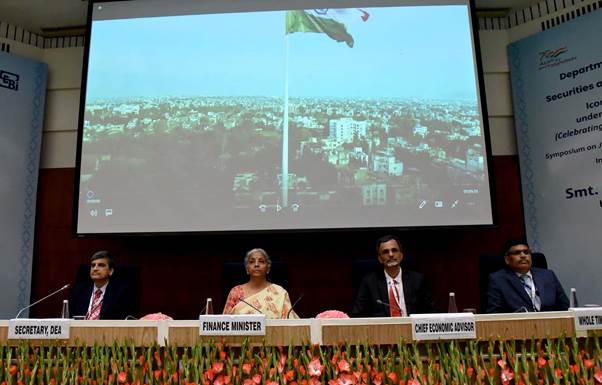
Union Minister for Finance and Corporate Affairs Smt. Nirmala Sitharaman launched the Iconic Day celebrations of the Department of Economic Affairs with Securities and Exchange Board of India (SEBI) under the Azadi Ka Amrit Mahotsav (AKAM) here today. Along with the Union Finance Minister, Shri Ajay Seth, Secretary, D/o Economic Affairs; Dr. Anantha V. Nageswaran, Chief Economic Advisor, Ministry of Finance and Shri S.K. Mohanty, Whole Time Member, SEBI also participated.  The occasion also saw participation from key dignitariesand prominent leaders from the world of finance.
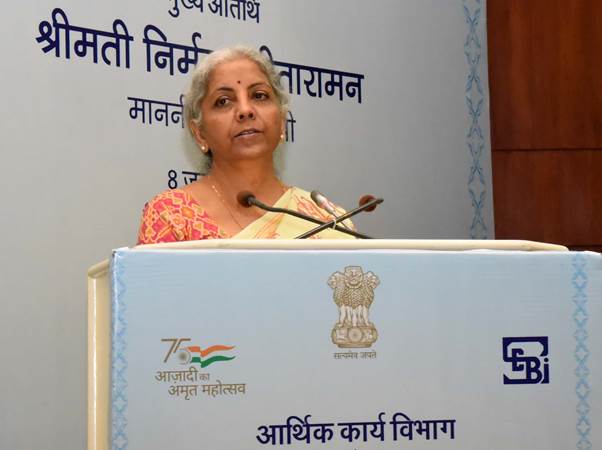
In her address, the Finance Minister said that India’s fundamentals are once again sound because of the many steps taken by the Government since 2014. Major steps taken by the Government, before the COVID-9 pandemic hit us, which include reducing the corporate tax, ensuring that the economy is greatly digitised, bringing in the GST and IBC – all of this heavylifting prepared us for the unprecedented situation of the Pandemic, she said.

Smt. Sitharaman emphasised that when Government looks at targeted approach of providing assistance and takes the input from the ground and does so quickly, in time and in an open fashion, the impact is for all to see. In this context she cited a study on Pradhan Mantri Garib Kalyan Yojana (PMGKY) which brought out that the probability of people cutting down consumption utilities has come down by 75% across the country. The study has also shown that the PMGKY reduced the probability of borrowing money by 67% of all respondents.
Citing another study on the Emergency Credit Liquidity Guarantee Scheme (ECLGS), the Finance Minister stated that as of March 2022 loans sanctioned under this scheme have crossed Rs 3.19 lakh crore and the scope of ECLGS has now been extended till 2023. The study says that this handholding has kept many people afloat during the Pandemic.

The third study highlighted by the Finance Minister was on the Ayushman Bharat scheme wherein the implementation of this scheme has been associated with a 21% decline in out of pocket health expenditure and 8% reduction in the tendency to borrow for emergency health purposes.

The Finance Minister underlined that the Department of Economic Affairs has channelised external aid towards every region of the country, with the support of multiple multilateral institutions. India very smartly raised funds and distributed them not only for infrastructure building but also for livelihood prospects in each region. Smt. Sitharaman also appreciated the DEA’s efforts through the IDEAS project that spans across so many countries and making a difference to livelihood environment, especially for most of Africa and also for the Island countries.

In his address during the AKAM celebrations, Chief Economic Advisor Dr Anantha V. Nageswaran said that the structural reforms of this Government, such as the Goods and Services Tax (GST) and the Insolvency & Bankruptcy Code (IBC) will manifest their advantages and potential in the coming decade, once the current clouds of global political developments and macro monetary policy challenges dissipate. The CEA underlined that for these reasons India is forecasted by the International Monetary Fund (IMF) to cross $5 trillion by 2026-27 and if GDP of the country doubles every 7 years, we will be $20 trillion GDP by 2040 with the per capita income close to $15,000.

Dr Nageswaran stated that India is better-positioned than many other countries in facing the current challenges. He indicated that we face challenges of managing a sustainably high growth rate, moderate inflation, keeping the fiscal under balance and also ensuring that the external value of the rupee remains stable. The CEA stated that the Government is prepared to meet the challenges of balancing these core important considerations.

Smt. Sitharaman launched ‘NETRA (New e-Tracking and Remote Administration)’ Portal and Mobile Application for Indian Development and Economic Assistance Scheme (IDEAS).

NSDL’s outreach initiative ‘Market Ka Eklavya – Express’, a programme specially designed to introduce students to the basics of investing and financial markets was screened during the event.

Market Ka Eklavya – Express’:

Market Ka Eklavya – Express’ lays the foundation of the twin pillars of Financial Independence, namely, Financial Awareness and Financial Discipline in a simple language using relatable examples from everyday life to explain complex concepts. As a part of the AKAM celebrations, NSDL has recently launched the programme in 8 languages to reach 75 cities to commemorate 75 years of independence.

The Finance Minister also released a short film ‘Sahyog se Samriddhi’ on Externally Aided Projects during the Iconic Week celebrations of Azadi Ka Amrit Mahotsav. The film showcased the role of Externally Aided Projects in India’s development trajectory since 1947, with a special emphasis on India’s engagement with multilateral and bilateral agencies in last 8 years.

‘Sahyog se Samriddhi’:

Smt. Sitharaman also inaugurated a film on the lines of credit called “IDEAS – India Partnering in Global Growth”. This film showcased India’s recognition as a trusted development partner for the developing economies. The Indian Development and Economic Assistance Scheme (IDEAS) has played a key role in the socio-economic development in the partner countries. The film features key marquee projects financed by Exim Bank of India under the GoI Lines of Credit  in Africa, Asia, Latin America, Oceania, and the CIS region.

“IDEAS – India Partnering in Global Growth”:

During the morning session, engaging discussions on ‘Emergence of women investors in securities market’ and ‘Growth of Indian retail investors’ during the symposium on ‘Jaagruk Niveshak: Samridha Bharat ki Neev’ organised by SEBI in collaboration with Department of Economic Affairs took place. The idea of an enlightened investor empowered to make informed financial choices was central to the discussions. The symposium also explore the exciting possibilities presented by the encouraging trend of increasing participation of women in financial markets.

Watch live streaming:

Ministry of Finance Press Release Id :-1832085, 08th March 2022

RBI hikes Repo Rate by 50 basis points (Press release 08th June 2022)

RBI hikes Repo Rate by 50 basis points


Retains GDP growth forecast at 7.2%, Inflation projected at 6.7% during FY 2022-23

Credit Cards, beginning with RuPay card can be linked with UPI

e-Mandate transaction limit increased to Rs 15,000

Upper limit on housing loans by Cooperative banks hiked by more than 100%

Key Policy Rates

  • The Monetary Policy Committee of Reserve Bank of India, which met from 6-8 June 2022, has unanimously decided to hike the Repo Rate by 50 basis points to 4.90 %
  • Consequently, Standing Deposit Facility Rate stands adjusted to 4.65% and Marginal Standing Facility rate and Bank Rate to 5.15%
  • The MPC also decided to remain focused on withdrawal of accommodation to ensure that inflation remains within the target going forward, while supporting growth.
  • Inflation

Assuming normal monsoon in 2022 and average crude oil price of $105 per barrel in Indian basket, inflation is projected at 6.7% in 2022-23

Q1 – 7.5%

Q2 – 7.4%

Q3 – 6.2%

Q4 – 5.8%

  • Growth forecast

The MPC has observed that the global economy continues to grapple with multi-decadal high inflation and slowing growth, persisting geopolitical tensions and sanctions, elevated prices of crude oil and other commodities and lingering COVID-19 related supply chain bottlenecks.

  • Economic indicators for April –May indicate a broadening of the recovery in economic activity in India. Urban demand is recovering and rural demand is gradually improving. Merchandise exports posted robust double-digit growth for the fifteenth month in a row during May while non-oil non-gold imports continued to expand at a healthy pace, pointing to recovery of domestic demand.
  • Real GDP growth for 2022-23 is estimated at 7.2%

Q1 – 16.2%

Q2 – 6.2%

Q3 – 4.1%

Q4 – 4.0%

  • According to NSO provisional estimates released on May 31, India’s GDP growth in 2021-22 is estimated at 8.7%, higher than pre-pandemic level.

Measures to benefit Cooperative Banks

  1. Taking into account the increase in housing prices since the limits were last revised and considering the customer needs, it has been decided to increase the existing limits on individual housing loans by cooperative banks. Accordingly, the limits for Tier I /Tier II UCBs shall stand revised from ₹30 lakh/ ₹70 lakh to ₹60 lakh/ ₹140 lakh, respectively. As regards RCBs, the limits shall increase from ₹20 lakh to ₹50 lakh for RCBs with assessed
  2. net worth less than ₹100 crore; and from ₹30 lakh to ₹75 lakh for other RCBs.
  3. Urban cooperative banks can now extend doorstep banking services to customers Will enable these banks to better meet the needs of their customers, especially senior citizens and differently abled persons-
  • Rural cooperative banks can now extend finance to commercial real estate (loans to residential housing projects) within existing aggregate housing finance limit of 5% of total assets
  • Enhancement of limit on e-mandate transactions

To further augment customer convenience  and facilitate recurring payments like subscriptions, insurance premia and education fees of larger value, limit per transcation for e-mandate based recurring payments increased from ₹5,000 to ₹ 15,000

  • Enhancing scope of UPI payment system. 

Now, credit cards too can be linked with UPI platform, beginning with RuPay cards.  This will provide additional convenience to users and enhance scope of digital payments.  UPI has become the most inclusive mode of payment in India. Currently, over 26 crore unique users and 5 crore merchants are onboarded on the UPI platform.

  • The Monetary Policy Committee, besides the Governor Shri Shaktikanta Das comprised Dr. Shashanka Bhide, Dr. Ashima Goyal, Prof. Jayanth R. Varma, Dr. Rajiv Ranjan and  Dr. Michael Debabrata Patra

The next meeting of the MPC is scheduled during August 2-4, 2022

RBI Governor’s Detailed statement can be seen here

The next meeting of the MPC is scheduled during August 2-4, 2022

RBI Governor’s Detailed statement can be seen here

***

PIB Mum 001/CY

Follow us on social media: @PIBMumbai  Image result for facebook icon /PIBMumbai    /pibmumbai  pibmumbai@gmail.com


***

PIB Mum 001/CY

Follow us on social media:

@PIBMumbai
Image result for facebook icon
/PIBMumbai

/pibmumbai

pibmumbai@gmail.com

CCI issues cease and desist order against Amateur Baseball Federation of India for abusing its dominant position (CCI Press Release 03rd June 2022)

The Competition Commission of India (CCI) passed an order dated 03.06.2022 under the provisions of Section 27 of the Competition Act, 2002 (‘Act’) against Amateur Baseball Federation of India (ABFI), finding it to be in violation of the provisions of Section 4 of the Act, which proscribe abuse of dominance.

The case was initiated on the basis of Information filed by the Confederation of Professional Baseball Softball Clubs (CPBSC) under Section 19(1)(a) of the Act, against ABFI alleging inter alia contravention of the provisions of Section 4 of the Act. As per information, ABFI by way of communications dated 07.01.2021 sent to its affiliated State Baseball Associations requested them not to entertain unrecognized bodies and not allow state level players to participate in any of the tournaments organised by them.

Based on evidence on record, the Commission found ABFI to be in a dominant position in the relevant market of organization of baseball leagues/events/ tournaments in India and further ABFI by issuing communication dated 07.01.2021 to its affiliated State Baseball Associations, was found to have contravened the provisions of Sections (4)(2)(a)(i), 4(2)(b)(i), and 4(2)(c) of the Act. In this backdrop, the Commission issued a cease and desist order against ABFI, however, the Commission refrained from imposing any monetary penalty considering ABFI has already withdrawn the impugned letter, and to that extent. The necessary market correction has already taken place.

The order was passed in Case No. 03 of 2021 and a copy of the order is available on the CCI website at http://www.cci.gov.in

Clarification regarding Form No 10AC issued till the date of this Circular (CBDT Circular dated 03rd June 2022)

1. Finance Act, 2022 has inserted sub-section (4) in section 12AB of the Income-tax Act, 1961 (the Act) allowing the Principal Commissioner or Commissioner of Income-tax to examine if there is any “specified violation” by the trust or institution registered or provisionally registered under the relevant clauses of sub-section (1) of section 12AB or subsection (1) of section 12AA. Subsequent to examination by the Principal Commissioner or Commissioner of Income-tax, an order is required to be passed for either cancellation of the registration or refusal to cancel the registration. Similar provisions have also been introduced in clause (23C) of section 10 of the Act by substituting the fifteenth proviso of the said clause with respect to fund or institution trust or institution or any university or other educational institution or any hospital or other medical institution referred under sub-clauses (iv), (v), (vi), (via) of this clause and which have been approved or provisionally approved under the second proviso to the said clause. These amendments are effective from 1st April, 2022. In addition to the specified violations referred above, the power of cancellation has also been granted under sub-rule (5) of rule 17A and sub-rule (5) of rule 2C of the Income-tax Rules, 1962 ( the Rules) to the Principal Commissioner or Commissioner authorised by the Board. This Circular only relates to cancellation of registration/approval or provisional registration/approval in the case of “specified violation”.

2. The definition of “specified violation” for the purposes of fifteenth proviso to clause (23C) of section 10 and section 12AB of the Act has been provided in the respective clause and section. The said definition, inter-alia, includes instances where any activity of the fund or trust or institution is not being carried out in accordance with all or any of the conditions subject to which it was approved/ provisionally approved or registered/provisionally registered.

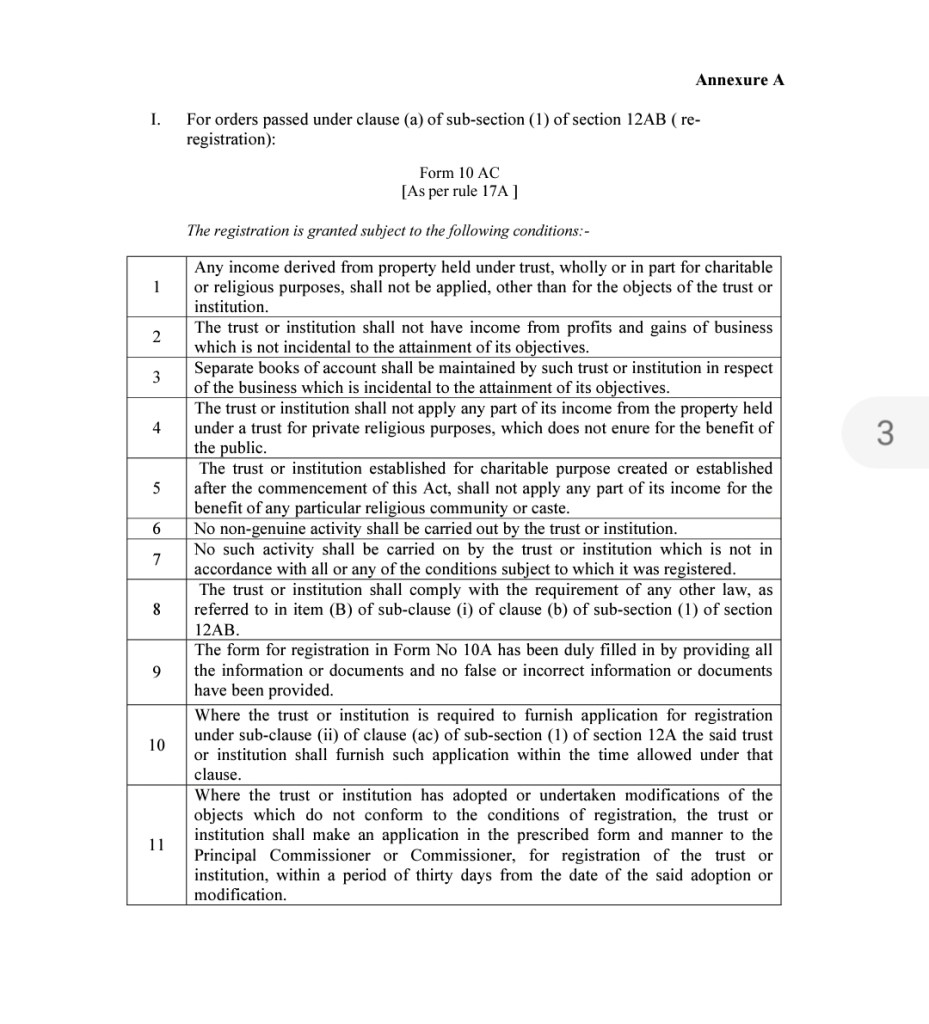
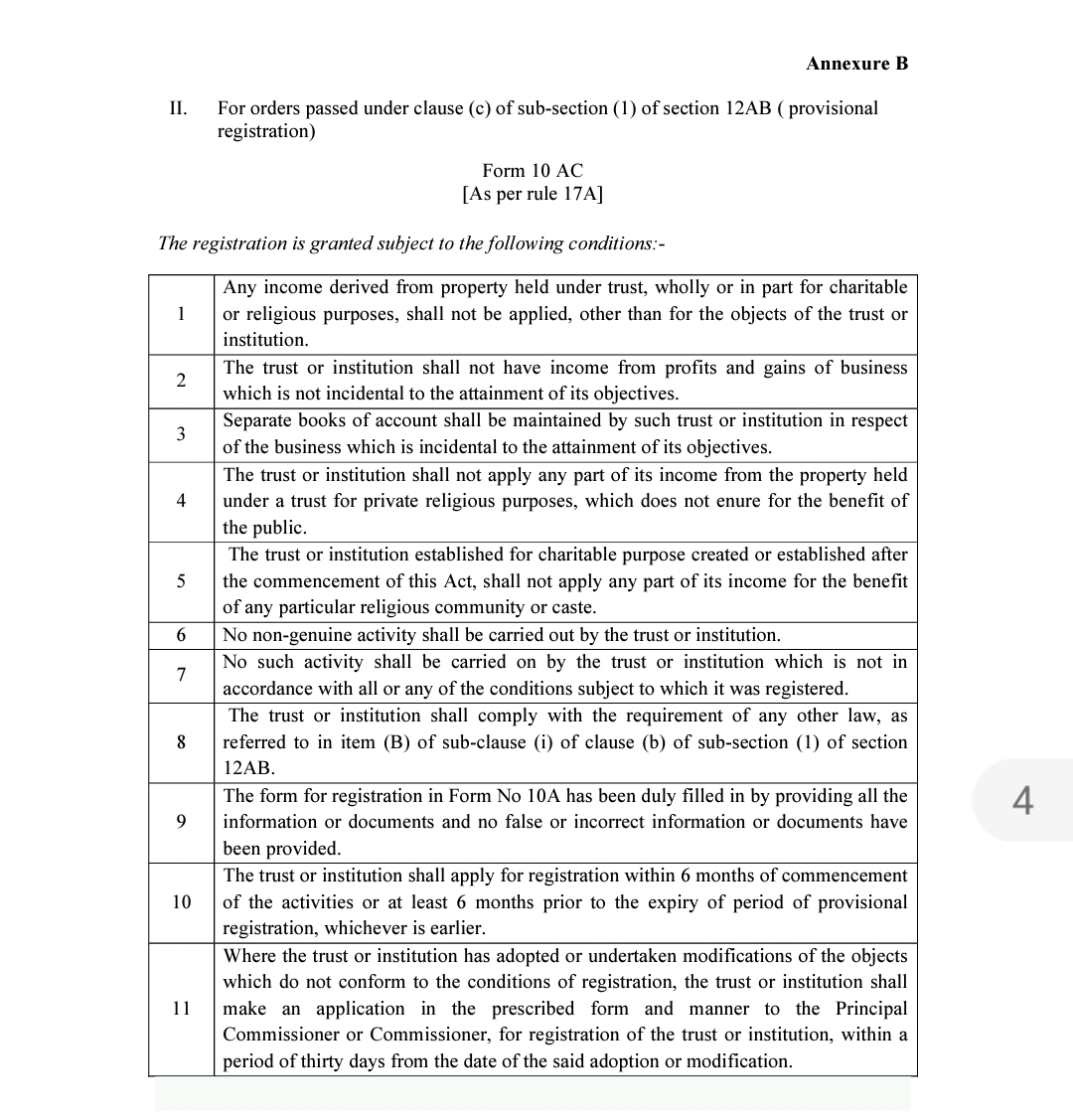
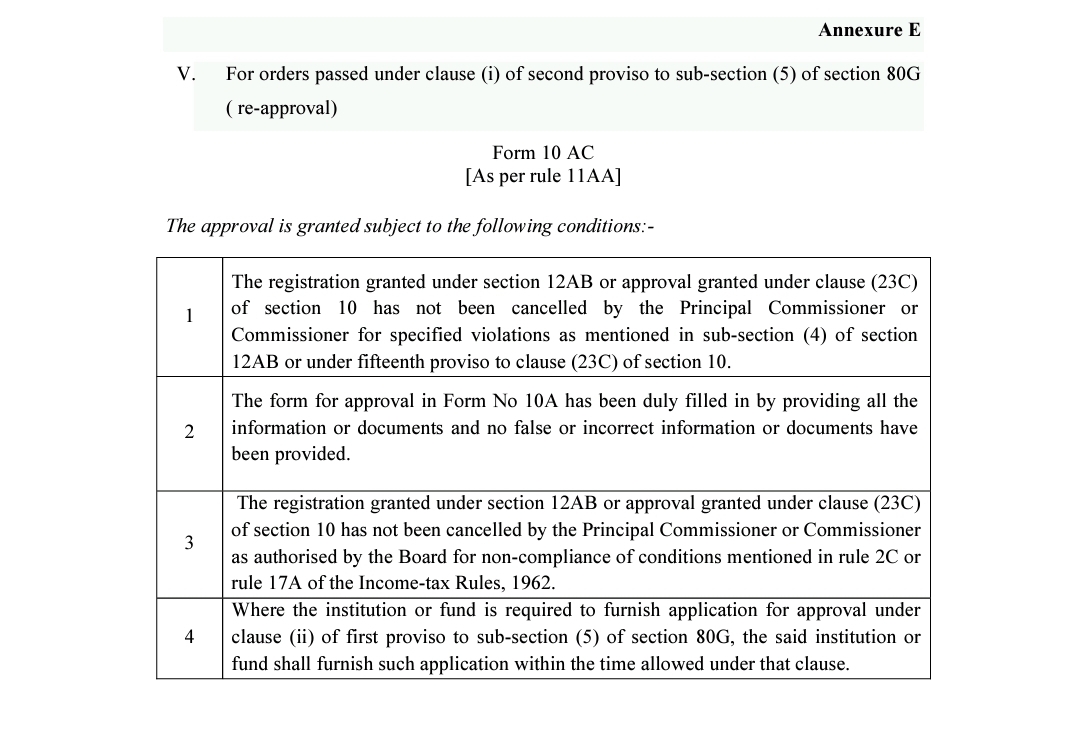
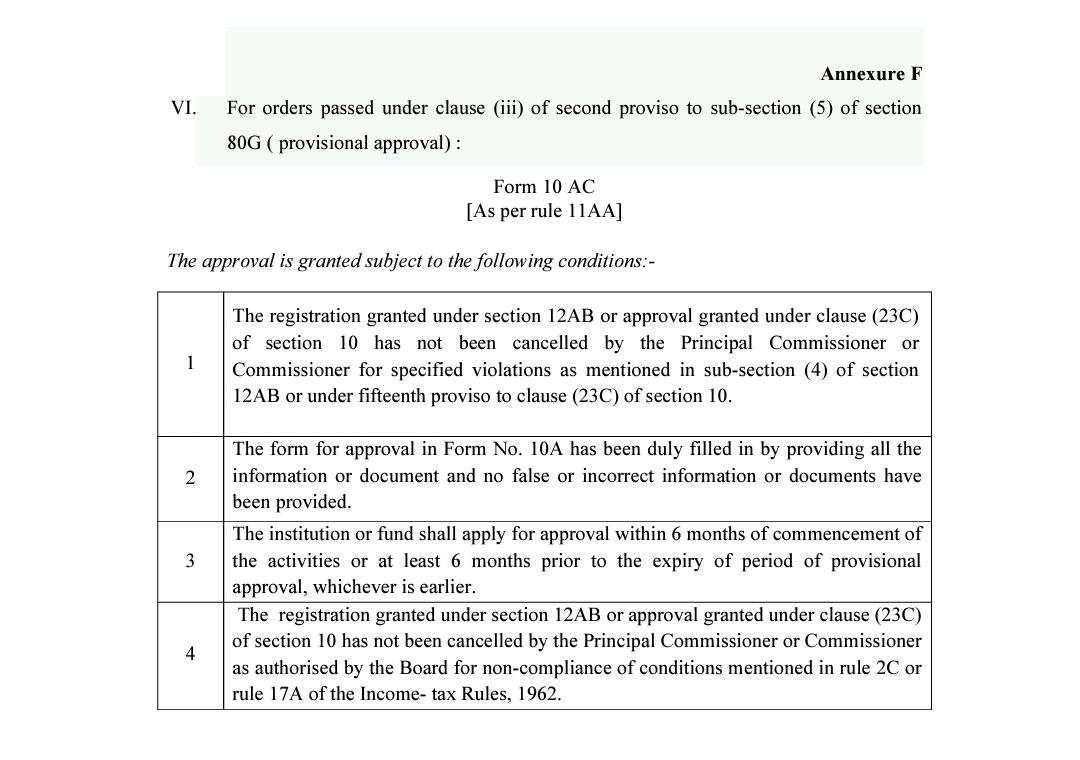
3. It may be noted that as per the new procedure for approval/registration of charitable entities, which was notified vide Notification No 19/2021 dated 26.03.2021, the entities seeking re-registration/ approval or provisional registration/ approval (fresh) are required to file an application in Form 10A. Further, the order granting registration or provisional registration or approval or provisional approval is made in Form 10AC subject to the fulfilment of certain conditions.

4. In view of the amendments made vide Finance Act, 2022, the conditions subject to which the registration/approval or provisional registration/ provisional approval was granted to trusts and institutions need to be revised to align the same with the amendments made by Finance Act, 2022.

5.In view of the above, it is hereby clarified that,-

(i) the conditions contained in Form No. 10AC, issued between 01.04.2021 till the date of issuance of this Circular, shall be read as if the said conditions had been substituted with the conditions as provided in the Table 1 with effect from 1st April, 2022;

(ii) where due to technical glitches, Form No. 10AC has been issued during FY 20212022 with the heading “Order for provisional registration” or “ Order for provisional approval” instead of “Order for registration” or “ Order for approval”, then all such Form No. 10AC shall be considered as an “Order for registration or approval” and, in such cases where Form No. 10AC has been issued, –

(a) under section code 01 (applications seeking re-registration),-

(i) in the heading and in rows 6, 7, 9 and 10 the words ,“ provisional registration” shall be read as “registration”;

(ii) in row 8 the word “ provisionally registered” shall be read as “registered”;

(b) under section codes 03, 04, 05, 06 or 11 (applications seeking re-approval),-

(i) in the heading and in rows 6, 7, 9 and 10 the words ,“ provisional approval” shall be read as “approval”;

(ii) in row 8 the word “ provisionally approved” shall be read as “approved”;

(iii) row no 5 of Form No. 10AC ( issued for all section codes) shall be read as “Unique Registration Number” instead of “Provisional Approval/ Approval Number” or “ Provisional Registration/ Registration Number”, as the case maybe.

PMLA : ED news 01st June 2022

ED has provisionally attached bank accounts of Popular Front of India and Rehab India Foundation having collective balance of Rs. 68,62,081 under PMLA, 2002.
01 Jun ,2022

ED has conducted searches under PMLA, 2002 at the residential and official premises of Subhra Jyoti Bharali, the then Managing Director of Industrial Co-operative Bank Limited (ICBL), under PMLA, 2002 in connection with misappropriation of bank funds of Rs. 9.5 Crore.
01 Jun ,2022

ED has provisionally attached assets worth Rs.1.91 Crore of Sanjeev Kumar, Puja Shrivastav and others under PMLA, 2002 in a fake degree certificate case of “Techno Global University, Shillong, 01 June 2022

Aadhaar Authentication for RBI (Notification dated 02 June 2022)

Ministry of Finance Notification dated 02nd June 2022

S.O. 2543(E).—In exercise of the powers conferred by sub-section (1) of section 11A of the Prevention of Money-laundering Act, 2002 (15 of 2003)[hereinafter referred to as the Money-laundering Act], the Central Government on being satisfied that the reporting entities mentioned in the Table below comply with the standards of privacy and security under the Aadhaar (Targeted Delivery of Financial and Other Subsidies, Benefits and Services) Act, 2016 (18 of 2016)[hereinafter referred to as the Aadhaar Act], and it is necessary and expedient to do so, and after consultation with the Unique Identification Authority of India established under sub-section (1) of section 11 of the Aadhaar Act and the appropriate regulator namely, the Reserve Bank of India, hereby permits the said reporting entities to perform authentication under the Aadhaar Act for the purposes of section 11A of the Money-laundering Act, namely:-

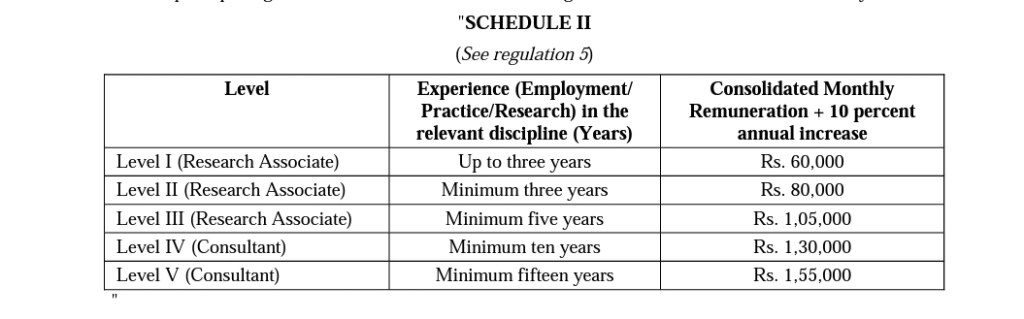
Insolvency and Bankruptcy Board of India (Engagement of Research Associates and Consultants) (Amendment) Regulations, 2022 (Notification dated 01st June 2022)

No. IBBI/2022-23/GN/REG083.- In exercise of the powers conferred by section 240 read with section 194 of the Insolvency and Bankruptcy Code, 2016 (No. 31 of 2016), the Insolvency and Bankruptcy Board of India hereby makes the following regulations to amend the Insolvency and Bankruptcy Board of India (Engagement of Research Associates and Consultants) Regulations, 2017, namely:-

1. (1) These regulations may be called the Insolvency and Bankruptcy Board of India (Engagement of Research Associates and Consultants) (Amendment) Regulations, 2022.

(2) They shall come into force on the date of their publication in the Official Gazette.

2. In the Insolvency and Bankruptcy Board of India (Engagement of Research Associates and Consultants) Regulations, 2017, (hereinafter referred to as „the principal regulations‟) in regulation 5, after subregulation (3), the following proviso shall be inserted, namely:-

“Provided that the Chairperson may amend the consolidated remuneration given in Schedule II for reasons to be recorded in writing.”

3. In the principal regulations, in regulation 8, for sub-regulation (1), the following sub-regulation shall be substituted, namely:- “(1) A selected candidate shall ordinarily be engaged as a Research Associate or Consultant, as the case may be, on contractual basis for a period not less than one year and up to three years: Provided that the Chairperson may extend the term of such engagement, one year at a time, up to a maximum of total five years.”

4. In the principal regulations, for Schedule II, the following Schedule shall be substituted, namely:

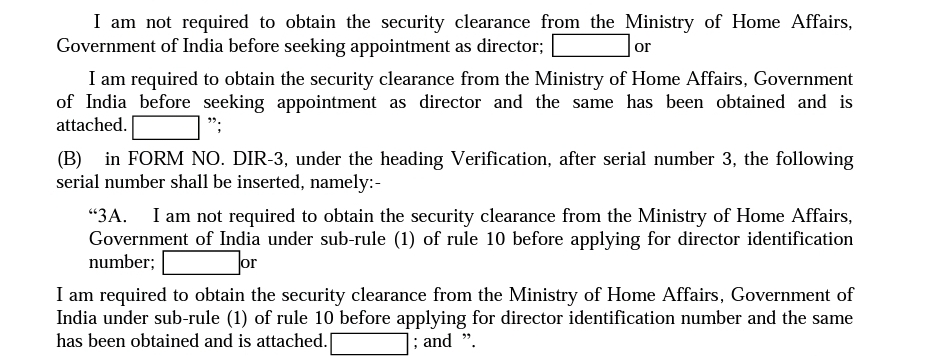
Companies (Appointment and Qualification of Directors) Amendment Rules, 2022 (MCA Notification dated 01st June 2022)

Short title and commencement.-

(1) These rules may be called the Companies (Appointment and Qualification of Directors) Amendment Rules, 2022.

(2) They shall come into force on the date of their publication in the Official Gazette. 2. In the Companies (Appointment and Qualification of Directors) Rules, 2014, ―

(i) in rule 8, after the proviso, the following proviso shall be inserted, namely:-

“Provided further that in case the person seeking appointment is a national of a country which shares land border with India, necessary security clearance from the Ministry of Home Affairs, Government of India shall also be attached alongwith the consent.”;

(ii) in rule 10, in sub-rule (1), the following proviso shall be inserted, namely: –

“Provided that no application number shall be generated in case of the person applying for Director Identification Number is a national of a country which shares land border with India, unless necessary security clearance from the Ministry of Home Affairs, Government of India has been attached alongwith application for Director Identification Number.”.

iii) in the Annexure, –

(A) in Form DIR-2, under the heading Declaration, the existing paragraph, shall be numbered as paragraph

(i) thereof and after the paragraph (i) as so numbered, the following shall be inserted, namely:-

“(ii) I further declare that –

Refer YouTube Video – Click

INCOME TAX : Rajasthan High Court grants refund of recovered tax in excess of 20% against disputed demand

Case reference:

Ram Gopal Sharma Vs ITO (Rajasthan High Court) dated 23/05/2022

1. Learned counsel for the petitioner has submitted that the petitioner is a senior citizen and has been filing regular income tax return. In the instant case, return of income tax was filed on 23.07.2017 for the assessment year 2017-18. The same came in scrutiny and high pitched additions were made vide assessment order dated 28.11.2019. It is submitted that income assessed by Assessing Officer was Rs. 24,04,440/-, which is more than two times the returned income, and a demand of Rs. 12,62,649/- was created. Against the said order, appeal before the Commissioner Of Income Tax (Appeal-1) was preferred on 18.12.2019, within a period of 30 days. After filing appeal, the petitioner suo moto deposited a sum of Rs. 2,52,530/- on 18.12.2019, which was equivalent to 20% of demand created, in terms of Office Memorandum dated 29.02.2016 and 31.07.2017, issued by respondent No. 2. As a matter of precaution, stay application dated 26.12.2019 was also filed by the petitioner, requesting for keeping the demand in abeyance till the disposal of the appeal. 

2. It is further submitted that the Assessing Officer i.e. respondent No. 1, against all canons of law, without disposing the stay application filed by the petitioner, without considering the fact that the petitioner has himself deposited Rs. 2,52,530/- and bypassing the Office Memorandum dated 29.02.2016 and 31.07.2017, initiated coercive recovery on 28.01.2020 and recovered entire amount of Rs. 12,62,650/- from the bank account of the petitioner in a exparte manner. 

3. In this background, present writ petition was filed against the adversarial and illegal approach of the respondents contrary to their own circulars and provisions of law and against orders passed by Hon’ble Supreme Court and Hon’ble Jurisdictional High Court and other Hon’ble High Court’s. 

4. Per contra, learned Standing Counsel, Mr. Anuroop Singhi, submitted that the amount of Rs 2,52,530, equivalent to 20% of additional demand, which was deposited by the petitioner on 18.12.2019 was already refunded to him vide rectification order (u/s 154 r.w.s 144 of the I.T. Act, 1961) dated 01.06.2020, after the recovery of entire amount of Rs. 12,62,650 from the petitioner, which was done on 28.01.2020. On the date of hearing, however, learned counsel for the respondent fairly conceded that recovery of over 20% of demand, before disposal of appeal is not appropriate. He was further unable to refute the narration and positions submitted by counsel for the petitioner. He fairly conceded that petitioner is entitled to refund of amount in excess of 20% of the total demand which was recovered from him. 

5. In this background, relying upon the Office Memorandum dated 29.02.2016 & 31.07.2017, considering Section 220(6) of theT. Act, 1961, considering the fair admission on part of Standing Counsel, and considering the fact that the amount of Rs 2,52,531, equivalent to 20% of the demand, was already refunded by department on 01.06.2020, this court deems it appropriate to direct the respondent to refund the excess amount of Rs 10,10,119, being 80% of the demand that is already recovered from the petitioner. The respondents are entitled to keep 20% of the demand, i.e. Rs 2,52,530 in terms of Office Memorandum dated 29.02.2016 and 31.07.2017, until the appeal of petitioner pending before Commissioner Of Income Tax (Appeal-1) is decided. The refund of Rs. 10,10,119 be made to the petitioner within a period of 30 days from the pronouncement of this judgment, failing which respondent will be liable to pay interest as applicable. Upon delay of the payment, interest as applicable will be recovered from the erring officer/respondent. 

6. In light of the above, the writ petition is disposed off. 

All pending applications also stand disposed off.