Rs 1,38,394 crore Gross GST Revenue collected for January 2022
GST collection crossed Rs 1.30 lakh crore mark for the 4th time
Revenues for the month of January 2022 15% higher than GST revenues in the same month last year and 25% higher than the GST revenues in January 2020Posted
Press Release date:- Jan 31, 2022
The gross GST revenue collected in the month of January 2022 till 3PM on 31.01.2022 is Rs 1,38,394 crore of which CGST is Rs 24,674 crore, SGST is Rs 32,016 crore, IGST is Rs 72,030 crore (including Rs 35,181 crore collected on import of goods) and cess is Rs 9,674 crore (including Rs 517 crore collected on import of goods). The highest monthly GST collection has been Rs 1,39,708 crore in the month of April 2021. Total number of GSTR-3B returns filed upto 30th January 2022 is 1.05 crore that includes 36 lakh quarterly returns.
The government has settled Rs 29,726 crore to CGST and Rs 24,180 crore to SGST from IGST as regular settlement. In addition, Centre has also settled Rs. 35,000 crore of IGST on ad-hoc basis in the ratio of 50:50 between Centre and States/UTs in this month. The total revenue of Centre and the States in the month of January 2022 after regular and ad-hoc settlements is Rs 71,900 crore for CGST and Rs 73,696 crore for the SGST. Centre also released GST compensation Rs 18,000 crore in January’2022 to States/UTs.
The revenues for the month of January2022 are 15%higher than the GST revenues in the same month last year and 25% higher than the GST revenues in January 2020. During the month, revenues from import of goods was 26% higher and the revenues from domestic transaction (including import of services) are 12% higher than the revenues from these sources during the same month last year.
This is for the fourth time GST collection has crossed Rs 1.30 lakh crore mark. 6.7 crore e-way bills were generated in the month of December 2021 which is 14% higher than 5.8 crore e-way bills generated in the month of November 2021. Coupled with economic recovery, anti-evasion activities, especially action against fake billers have been contributing to the enhanced GST. The improvement in revenue has also been due to various rate rationalization measures undertaken by the Council to correct inverted duty structure. It is expected that the positive trend in the revenues will continue in the coming months as well.
Retail Direct scheme is a one-stop solution to facilitate investment in Government Securities by Individual Investors. Under this scheme Individual Retail investors can open Gilt Securities Account – “Retail Direct Gilt (RDG)” Account with the RBI.
Who can open Retail Direct Gilt Account?
Retail investors would mean all individuals (natural persons)
Retail investors, as defined under the RBI Retail Direct scheme, can register under the Scheme and maintain a RDG Account, if they have the following:
Rupee savings bank account maintained in India;
Permanent Account Number (PAN) issued by the Income Tax Department;
Any OVD for KYC purpose;
Valid email id; and
Registered mobile number.
Non-Resident retail investors eligible to invest in Government Securities under Foreign Exchange Management Act, 1999 are eligible under the scheme.
The RDG account can be opened singly or jointly with another retail investor who meets the eligibility criteria.
What are the benefits of the Scheme?
Retail investors (individuals) will have the facility to open and maintain the ‘Retail Direct Gilt Account’ (RDG Account) with RBI.
The investor can place non competitive bids in Primary issuance of all Central Government securities (including Treasury Bills and Sovereign Gold bonds) as well as securities issued by various State Governments.
Under this scheme, the individual can also access Secondary market through “NDS OM” – RBI’s trading system.
The investor will automatically receive any interest paid/maturity proceeds into his linked bank account on due dates.
What are the facilities available on the RBI Retail Direct Portal?
The RBI Retail Direct Online Portal will facilitate the following:
On-boarding of Retail Direct Investors,
Opening and management of RDG Accounts,
Facilitate participation in Non Competitive Bidding in Primary G-sec Auctions through the Clearing Corporation of India (CCIL)
Facilitate Investing in Sovereign Gold Bonds (SGBs) through CCIL
Facilitate NDS OM access to Retail Direct Investors for secondary market trading and settlement of such trades through CCIL.
Provide Investor Services such as:
Account Statement
Nomination Facility
Pledge/Lien
Gift Transactions
Facilitate Corporate Actions such as:
Coupon Payments
Coupon Payments
What are the documents requiredfor opening a Retail Direct Gilt Account?
The individual can login to RBI Retail Direct to open a Retail Direct Gilt Account. The account can be opened online with just PAN, Rupee Savings Account, email id and mobile number of the Individual. With these details, the individual needs to complete seamless online KYC procedure to do registration under this scheme. Investors will have to follow the RBI KYC Guidelines while opening the RDG Account.
What is the procedure for opening a Retail Direct Gilt Account?
Eligible Investors will be allowed to register online on the Retail Direct Portal;
The eligible retail clients can open RDG Account either singly or jointly;
To open an account, the investor will have to furnish details like Full Name, PAN, Mobile Number, Email Address, Residential Address, Bank Account number etc. The mobile number and email address will be authenticated using OTP as all further customer request and services will be OTP based;
The user will be provided with a tracking number to track application status;
Such Investors will be subject to Know your Customer Guidelines. CCIL will adhere to the RBI KYC Direction 2018 while onboarding the Investor;
In case of Joint Accounts, the KYC verification is proposed to be done for both the holders. In case of KYC failures, the individual can make new application or resubmit application after making necessary changes;
The Bank Account of the Customer will also be validated
Once the KYC is successful, a Retail Direct Gilt (RDG) Account will be opened in the name of the Investor(s);
Information related to account number, login id & password to access the Online Portal for participating in primary auctions and accessing other services will be made available to the Customer over mail.
It will be mandatory for the Investor to fill in the nomination details at the time of opening of the account. The nomination details will be displayed online to the Investor and the Investor will have to accept the same by uploading and attaching a scanned image of signature.
The RDG Account will be available for primary market participation and well as secondary market transactions on NDS-OM
What is permitted under Primary Issuances?
RDG Account holders have been allowed to participate in the primary issuance of CG/SG/T-bill/SGB. CCIL will act as the Aggregator for receiving bids for Primary Auctions from such Retail Direct (RD) Investors;
CCIL will also act as the Receiving Office for receiving bids for Sovereign Gold Bonds (SGB) from such RD Investors;
How will the bidding happen using the RBI Retail Direct Portal?
The participation of RDG Account holder, in CG/SG/T-bill Primary Auctions will be on non-competitive basis;
CCIL will submit a single aggregate bid (consisting of all RDG Account holders non-competitive bid in a particular security) to RBI on auction date;
In case of SGB, the individual bids of each RDG Account holder is proposed to be sent to RBI;
The RDG Account holders will be allowed to place bids and withdraw bids during the bidding interval or the period of subscription (for SGBs);
Only one active bid will be allowed per retail client in the non-competitive portion for respective Security. In case of CG/SG/T-bill, the bidding will be in minimum & multiple of FV 10,000, in case of SGB, FV unit of 1 gram;
The maximum limit per bid specified by RBI (presently Rs 2 crore for CG/T Bill and 1 percent for SG) will be validated;
How will the payment be made for the bids placed on the RBI Retail Direct Portal?
For the Primary Auction market, a Bid is required to be backed by funding based on indicative price and accrued interest alongwith a Markup (as non-competitive allotment price shall be known only after auction cut off) for protection against any adverse price movement till Auction Settlement Date. The Markup will be refunded to the Investor post allocation based on the Cut Off Price for the Auction;
In case of SGBs, the funding will be based on Issue Price declared for the particular Issue;
For making payment for the bids, the retail clients can use services like UPI (Transfer or Block) and Net Banking to transfer funds to a designated current account using Payment Gateways linked to the Online Portal;
The funding of the bids can be done either at the time of bidding or at a later time, but, before the closure of bidding/subscription window. Bids which are not funded as on the date of submission of bids to RBI will be cancelled.
When will the allotment be made and credited to the RDG Account?
Based on the allotment advice received as a part of the auction result, the allotments will be made to the Individual Investors;
In case of full allotment, each bidder will be allocated in full FV for which he/she had submitted the bid. In case of partial allotment, a pro-rata allotment will be made to the bidder based on the partial allocation percentage determined during the result declaration process;
Once the allotment is completed, the revised consideration for allotted bids shall be recomputed based on Weighted Average Price (WAP) declared by RBI in respective Security Auction;
On settlement date of Auction, post settlement at RBI, the RDG account shall be credited with the security to the extent of Face Value allotment;
In case of SGBs, post allotment of SGB units at RBI, the RDG account shall be credited with the SGB unit to the extent of allotment;
RDG account holders shall be provided with requisite queries to view the allotment on the portal. RDG account holders shall also be notified through a SMS message on their registered mobile and registered email;
When will the excess mark up collected at the time of bidding be refunded?
After the weighted average price is announced by RBI, the excess markup,will be refunded to the Retail Direct Investor on the settlement date.
Such refunds will be processed by the online portal and will be remitted to the retail client’s respective bank accounts;
The retail client can view such details on the portal. Email and SMS will also be sent to the client about such updates;
How can the NDS OM Secondary Market Portal be accessed?
The NDS OM Secondary Market Portal can be accessed through the RBI Retail Direct Portal. Each registered RD Investor opting for secondary market trading on NDS OM will be provided a CCIL ID. RDG will be permitted to access NDS-OM Order Matching Segment and Request for Quote (RFQ) Segment.
What is the procedure for carrying out secondary market trades on NDS OM?
RDG Account holders can trade in CG/SG/T-bill/SGB, in the Odd Lot segment. RDG available balances would be transferred to NDS OM at the beginning of the day;
RDG can place sell orders only to the extent of balances available. Other transfers would be permitted in the RDG Account only after end of trading day;
RDG can place buy orders only after remittance of funds using service like UPI(Transfer/Block) and Net Baking through Payment Gateways linked to the NDS OM Retail Portal. Funds remitted by RDG shall be received in the designated current account with the Bank providing Payment Gateway;
How does the secondary market settlement happen?
Trades executed by Retail Direct Investors will flow to CCIL for settlement. Settlement would happen on T+1 day;
Securities credit to RDG in respect of their purchases shall be made post completion of settlement on settlement date;
Fund credit to RDG in respect of their sale shall be made after completion of settlement on settlement date to their registered Bank Accounts;
In case the funds remitted by the Retail Direct Investor using the Payment Gateway is not received by CCIL, the securities purchased by the Retail Direct Investor may not be credited to the RDG Account, till the time the funds are received by CCIL from the Payment Gateway.
In case of a failure by a seller from whom the Retail Direct Investor has purchased a security, to deliver the concerned security, the funds remitted by the Retail Direct Investor will be refunded to the Retail Direct Investor on the settlement day.
When will the excess money transferred for secondary market purchase be refunded?
The excess funds received from Retail Direct Investor after adjusted the trade consideration shall be refunded back to Retail Direct Investor on the date of receipt/settlement date;
How will the corporate actions (coupon and redemption) on the RDG holdings serviced?
On receipt of coupon/ redemption proceeds from RBI, the exact entitlement of each RDG account holder will be computed based on their holdings;
The exact amount to be paid will be computed and remitted to the respective bank account of each RDG Account holder holding concerned security on the day of receipt from RBI;
The RDG account holders can view such Corporate Action details on the online portal;
How can the Holding Statement of RDG Accounts be viewed?
The RDG Account holder will have access to information about his/her holding balances on a daily basis. Such information can be viewed on the portal by the RDG Account holder. Period Account Statements will also be mailed to the RDG Account Holder;
What are the other services available under the Retail Direct scheme?
The following additional services are proposed to be made available to the Retail Direct Investor on the RBI Retail Direct Portal:
Nomination
Gifting
Pledge/Lein/Transfer
What are the charges/fees payable?
No fee will be charged for opening and maintaining ‘Retail Direct Gilt account’ with RBI. No fee will be charged by the aggregator for submitting bids in the primary auctions. Fee for payment gateway etc., as applicable, will be borne by the registered investor.
What is the Role of Clearing Corporation of India Ltd (CCIL)?
CCIL is authorized by the Reserve Bank of India to act as an aggregator for Primary Issuances and as Receiving Office for Sovereign Gold Bondsfor the Retail Direct Investors. CCIL is also authorized by RBI to operate the NDS OM platform.
Liability of ensuring that keyword is not an infringement of trademark lies on Google
DRS Logistics (P) Ltd. Vs Google India Pvt Ltd & Ors. (Delhi High Court) dated 30/10/2021
Criminal liability on officers arises only when offence is committed by company
Dayle De’souza Vs Government of India (Supreme Court of India) dated 29/10/2021
Forwarding of documents immediately by ED to AA after order of freezing passed under PML Rules
Since none of the other relevant material, which was the basis of the seizure under Section 17(1A) and the complaint under Section 17(4) of the PMLA were supplied to assessee, as the same were not even supplied by the ED to the AA. Thus, ED should forward a copy of the documents to the Adjudicating Authority immediately after a freezing order under PML Rule.
J K Tyre And Industries Ltd Vs Directorate of Enforcement (Delhi High Court) dated 27/10/2021
Bombay HC grants injunction in favor of Zee Entertainment in dispute with Invesco
Zee Entertainment Enterprises Ltd. Vs Invesco Developing Markets Fund (Bombay High Court) dated 26/10/2021
Rental income from sub-lease shall be considered as Business Income since same was business of assessee
Shanthilal Movji Bhai Thakker Vs ITO (ITAT Chennai) dated 03/11/2021
Change in service conditions vis-à-vis non-issuance of notice of change under section 9A makes transfer order illegal
Caparo Engineering India Ltd. Vs Ummed Singh Lodhi And Anr (Supreme Court of India) dated 26/10/2021
Amount lying in stale draft account cannot be treated as income
DCIT Vs The Karur Vysya Bank Ltd. (ITAT Chennai) dated 03/11/2021
GST collection for October 2021 registered the second highest since implementation of GST
₹ 1,30,127 crore gross GST revenue collected in October
Revenues for the month of October 2021 are 24% higher than the GST revenues in the same month last year and 36% over 2019-20
Refer link for Press Release
GST collection for October 2021 registered the second highest since implementation of GST₹ 1,30,127 crore gross GST revenue collected in October Revenues for th
Aadhaar authentication of registration to be made mandatory for being eligible for filing refund claim and application for revocation of cancellation of registration.
Late fee for delayed filing of FORM GSTR-1 to be auto-populated and collected in next open return in FORM GSTR-3B.
Refund to be disbursed in the bank account, which is linked with same PAN on which registration has been obtained under GST.
Rule 59(6) of the CGST Rules to be amended with effect from 01.01.2022 to provide that a registered person shall not be allowed to furnish FORM GSTR-1, if he has not furnished the return in FORM GSTR-3B for the preceding month.
Rule 36(4) of CGST Rules, 2017 to be amended, once the proposed clause (aa) of section 16(2) of CGST Act, 2017 is notified, to restrict availment of ITC in respect of invoices/ debit notes, to the extent the details of such invoices/ debit notes are furnished by the supplier in FORMGSTR-1/ IFF and are communicated to the registered person in FORM GSTR-2B.
Secretary MSME underlines need for hand-holding support to MSMEs through capacity building trainings, exchange of best practices and technologies
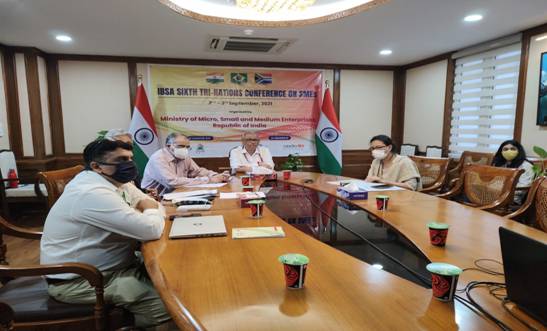
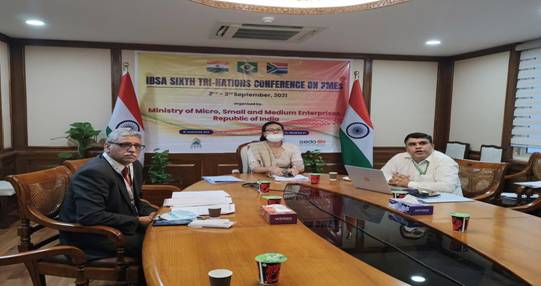
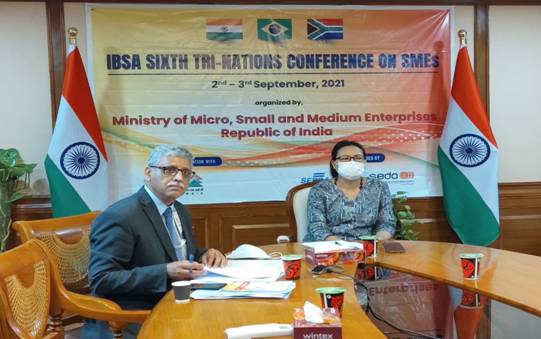
IBSA Conference calls for collective efforts towards better collaborations amongst the three nationsPosted Date:- Sep 08, 2021
Secretary (MSME) Shri BB Swain has said that the IBSA forum plays an important role in creating awareness about the strengths, opportunities and challenges of MSMEs and help in creating markets for finished products and provide hand-holding support to MSMEs through capacity building trainings, exchange of best practices and technologies. Inaugurating the IBSA 6th Tri-nation Virtual Conference on Small and Medium sized Enterprises (SME), Shri Swain stated that these meetings are being held with the objective to promote trade, understand trade barriers, facilitate investments through collective efforts towards better collaborations amongst the three nations.
IBSA is a unique Forum which brings together India, Brazil and South Africa, three large democracies and major economies from three different continents, facing similar challenges.
The Conference was hosted by the Ministry of MSME last week in association with the National Small Industries Corporation Ltd (NSIC), Brazilian Micro and Small Business Support Service (SEBRAE), Department of Small Business Development (DSBD) and Small Enterprise Development Agency (SEDA), South Africa.
Mr. Vijayendra, CMD, NSIC during his address informed that the main theme of the 6th IBSA Conference was “Democracy for Demography and Development”. He briefed about the various topics of technical sessions to bediscussed.He emphasized that there is much to share and learn from each other’s experiences and best practices in terms of regulatory environment, technology support, access to finance and initiatives taken amid Covid-19 pandemic by IBSA members.
Mr. Eduardo Diogo- Director of Administration and Finance of (Brazilian Micro and Small Business Support Service) SEBRAE, Brazil said that despite the challenges faced due to Covid 19 pandemic, SMEs are still reinventing and generating employment and IBSA needs to work towards their sustainable development.
Mr. LindokuhleMkhumane, Director General,(Department of Small BusinessDevelopment)DSBD, South Africa emphasized that issues like poverty, inequality and unemployment can be addressed by promoting MSMEs. He said that youth and women should also be skilled to promote inclusivity.
Ms. Mercy Epao, Joint Secretary (SME), Ministry of MSME, talked about the contribution of MSME sector in India’s socio-economic development and various policy intervention of the Govt. of India to help the growth of MSMEs in India. She also spoke about the impact of Covid19 pandemic on the MSMEs.
The IBSA 6th Tri-Nations Virtual Conference had four Technical sessions divided into two days in which experts and senior officials from Ministry of MSME, Govt. of India; Brazilian Micro and Small Business Support Service (SEBRAE), Brazil; Department of Small Business Development (DSBD) & Small Enterprise Development Agency (SEDA), South Africa deliberated on various topics like- Enabling MSMEs in National Entrepreneurial Ecosystem, Innovation & Inclusivity, Integration into Global Value Chains, Sustainable Development: Preparedness of IBSA to deal with COVID-19 like crisis in future.
The conference is an important initiative to enhance cooperation amongst the IBSA members in MSME sector synergizing the competencies and inherent strengths of each country. A roadmap will be drawn based on the deliberations held during the sessions to strengthen MSMEs networking, to help overcome the challenges and make the MSMEs competitive on the global platform.
*****
Ministry of Micro,Small & Medium Enterprises Press Release dated 08th Sept 2021
Ministry of Finance Press Release dated 01 Sept 2021
The gross GST revenue collected in the month of August 2021 is ₹ 1,12,020 crore of which CGST is ₹ 20,522 crore, SGST is ₹ 26,605 crore, IGST is ₹ 56,247 crore (including ₹ 26,884 crore collected on import of goods) and Cess is ₹ 8,646 crore (including ₹ 646 crore collected on import of goods).
The government has settled ₹ 23,043 crore to CGST and ₹ 19,139 crore to SGST from IGST as regular settlement. In addition, Centre has also settled ₹ 24,000 crore as IGST ad-hoc settlement in the ratio of 50:50 between Centre and States/UTs. The total revenue of Centre and the States after regular and ad-hoc settlements in the month of August’ 2021 is ₹ 55,565 crore for CGST and ₹ 57,744 crore for the SGST.
The revenues for the month of August 2021 are 30% higher than the GST revenues in the same month last year. During the month, the revenues from domestic transaction (including import of services) are 27% higher than the revenues from these sources during the same month last year. Even as compared to the August revenues in 2019-20 of ₹ 98,202 crore, this is a growth of 14%.
GST collection, after posting above Rs. 1 lakh crore mark for nine months in a row, dropped below Rs. 1 lakh crore in June 2021 due to the second wave of covid. With the easing out of COVID restrictions, GST collection for July and August 2021 have again crossed ₹1 lakh crore, which clearly indicates that the economy is recovering at a fast pace. Coupled with economic growth, anti-evasion activities, especially action against fake billers have also been contributing to the enhanced GST collections. The robust GST revenues are likely to continue in the coming months too.
Ministry of Consumer Affairs, Food & Public Distribution
Hallmarking scheme becoming a grand success .
More than ONE CRORE pieces of jewellery Hallmarked
More than 90000 Jewellers registered already
Nearly 4 lac pieces of Jewellery getting hallmarked each day now
HUID-based hallmarking a win-win situation for everyone, as it brings about transparency in the functioning of the industry, ensures consumers’ right to get right stuff for their money and obviates the chances of Inspector Raj
Any one can get existing Jewellery Hallmarked and get true Valuation of Gold and their savings
Implementation of Hallmarking is a work in progress And Government is in a constant dialogue with Jewellers and the benefits of scheme are being appreciated by most of the Jewellers
Government was fully committed to address the genuine demandsPosted Date:- Aug 21, 2021
“Hallmarking scheme is turning out to be grand success with more than 1 crore pieces of Jewellery hallmarked in a quick time” – said Director General BIS while addressing a Press Conference on the subject of progress being made in the Hallmarking in India . He said that more than 90000 Jewellers have also registered in same time period.
He said that the scheme had ben a grand success because of their support and cooperation, which is reflected in the fact that the number of registered jewellers has increased to 91,603 and that of the jewellery pieces received for hallmarking and hallmarked since 1st July, 2021 to 20th August to One crore Seventeen lakhs and One crore Two lakhs respectively. The number of jewellers, who sent their jewellery for hallmarking increased from 5145 during 1st July to 15th July increased to 14,349 during 1st August to 15th August, 2021; and 861 AHCs started hallmarking as per the HUID-based system.
Dwelling upon the issue of the pace of hallmarking, DG, BIS said that there has been gradual and satisfactory increase in the pace of hallmarking. During the fortnight 1st July to 15th July, 2021, 14.28 lakh pieces were hallmarked, but this number increased to 41.81 lakh during 1st August to 15th August. In a single day, on 20th August, 2021, 3 lakh 90 thousand jewellery pieces were hallmarked. He added that there should not be any problem in hallmarking 10 crore pieces of jewellery in a year, which is the estimated number of jewellery pieces to be hallmarked if the hallmarking became mandatory across the country.
DG, BIS also refuted the claim by some that the existing capacity of AHCs in 256 districts was not enough to meet the demand. He shared the data that out of 853 AHCs which received jewellery during the fortnight 1st August to 15th August, 2021, only 161 got more than 500 pieces per day, and more than 300 AHCs received less than 100 pieces per day. Hence, there was a lot of underutilised capacity in the country. He said that the functioning of the AHCs was being reviewed regularly and they have been instructed to follow the FIFO principle. Proposal has also been submitted to DoCA for enhancing the reach of AHCs.
He said that government had been accessible and sensitive to the demands of the jewellery industry and shown an exemplary sense of appreciation and accommodation of their genuine demands. Hon’ble Minister, Consumer Affairs constituted a High-level Expert Committee before the scheme of mandatory hallmarking was launched, and the committee had three meetings. After the launch of mandatory hallmarking, an Advisory Committee was constituted to recommended measures for smooth implementation of the mandatory hallmarking. This Committee had six meetings and submitted its report to the government a few days back. The last meeting with the stakeholders was held on 19th August, 2021 in which representatives of manufacturers, wholesalers, retailers, consumer groups, AHCs, all of them participated. He said that the call for strike by certain sections of the jewellery industry, therefore, was highly uncalled for. He added that in the stakeholders meeting on 19th August, 2021, representatives of several organisations had condemned the idea of strike by some.and extended full support to the HUID-based hallmarking scheme.
Sharing details of the steps taken by the government to accommodate the genuine demands of the jewellery industry, DG, BIS underlined following facts:
i. Hallmarking made mandatory only in 256 districts having an AHC..
ii. HUID was limited to AHC level, to start with, and to be implemented at the jewellers and consumers level after the new system settles down fully.
iii. Registration process was made simpler and registration fee waived.
iv. 20, 23 and 24 carats of gold jewellery allowed for hallmarking.
v. Indian standard amended to allow hallmarking of small mixed lots of same purity.
vi. Software improved to allow handing over of jewellery at the AHC level too. vii. Help Desk created at the Headquarters and Branch Offices and 300 Awareness Camps held so far.
viii. Advisory Committee had n in-depth review of the issues concerning hallmarking and submitted its report to DoCA.
Replying to queries, DG, BIS clarified, that it was a complete misinformation that BIS was tracking the B-t-B movement of jewellery and jewellers were required to upload the details of sales on BIS portal. There is NO SUCH requirement in on behalf of Jewellers.
He emphasised that the scheme had been a grand success and after having hallmarked more than one crore pieces of jewellery, it made no sense to be talking about the postponement or withdrawal of the scheme. He reiterated that HUID-based hallmarking was a win-win situation for everyone, as it brings about transparency in the functioning of the industry, ensures consumers’ right to get right stuff for their money and obviates the chances of Inspector Raj.
He appealed to the members of industry to extend their full cooperation in the implementation of the scheme and desist from strike and such activities, as Government was fully committed to address their genuine demands.

 Business So Simple