Category: News Desk
Updates on Income tax, GST, Company Law, SEBI, FEMA, FCRA
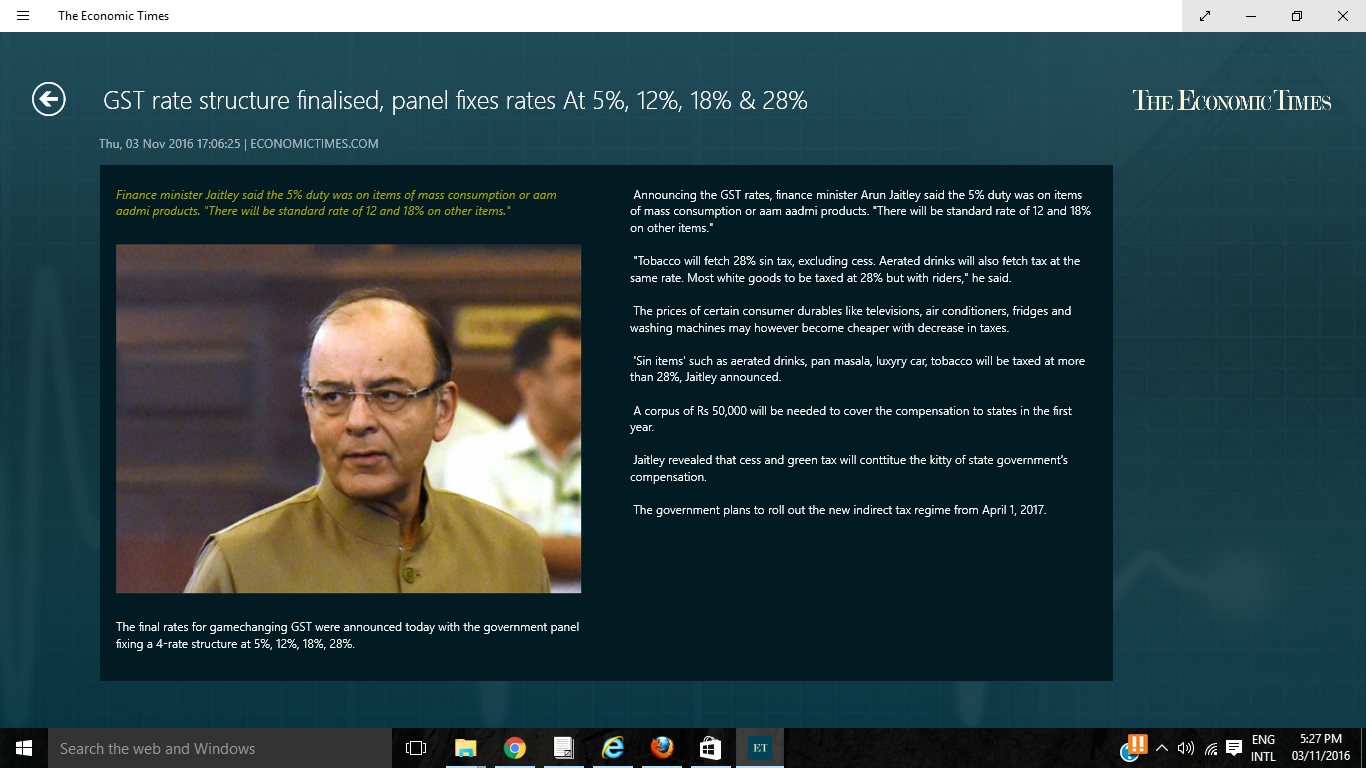
GST rate structure finalised, panel fixes rates at 5%, 12%,18% & 28%
GST Updates (03 Nov 2016)
Assocham, KPMG Warn against Sharp Anomalies in GST Rates
GST Council meet starts today: Trust deficit between Centre, states widen; is April deadline a tall order
November 3, 2016
With barely a fortnight left for Parliament’s Winter Session, the GST Council will begin its crucial two-day meeting on Thursday to decide on tax rate, including the levy of cess and sort out the vexed issue of jurisdiction over assessees.
The meeting is to be chaired by Finance Minister Arun Jaitley.
Here are the key facts you need to know about the meeting:
The agenda: At the meeting, the Central government is likely to press its proposal for 4-tier tax structure of 8, 12, 18 and 26 percent.
Under the proposed 4-slab structure, the items which are currently taxed between 3-9 per cent will fall in the 6 percent bracket; those in 9-15 percent range will come under 12 percent rate. Those products which are currently taxed between 15-21 percent will attract 18 percent levy while those above 21 percent will be taxed at the peak rate of 26 percent.
The Centre has also proposed to levy additional cess on demerit goods like tobacco, aerated drinks and polluting items to create a Rs 50,000 crore fund to compensate the states for revenue loss. The proposal, which was discussed at the last meeting, could not be adopted by the Council because of opposition by some states.
The cess is also likely to be taken up in the meeting.
Another important issue to be discussed at the meeting is the dual control of service tax assessees.
Centre-states mistrust: On almost all the issues to be taken up at the meeting the central government and the states are headed for a collision course. The Centre is expected to have a tough task of building consensus with states.
On tax rate, some of the state governments, such as Kerala, are opposed to the cap at 26 percent, according to a media reports.
“The logic of reducing the tax incidence on consumer durables and demerit goods to 26% makes the GST severely regressive… The upper rate has been pegged at a lower rate so that the central government has the option to impose the cess as and when necessary,” Kerala finance minister Thomas Isaac has been quoted as saying in a reportin The Financ ial Express.
The second contentious issue is the cess. Many state finance ministers have questioned the very rational of imposing a cess under the GST regime. Issac had earlier said such a move will defeat the purpose of bringing in the tax reform as such. States are opposed to cess as it is an item that is not shared with them.
As far as service tax is concerned, the Centre-state differences are wider.
At the last meeting, differences arose between the Centre and states on dual control, with states demanding control over 11 lakh service tax assessees and the Centre proposing to do away states having exclusive control over all dealers up to an annual revenue threshold of Rs 1.5 crore.
West Bengal Finance Minister Amit Mitra has said that the Centre has withheld information relating to the number of service tax assessees. He said while the Centre has disclosed 11 lakh tax payer, the actual number of service tax assessees is estimated at 30.5 lakh.
There is difference on even the priority of the issues to be taken up. Media reports say while the Centre wants to take up the rate structure first, the state governments want the service tax issue to be resolved first.
Most importantly, trust deficit seems to be widening between the states and the Centre.
“The centre has been trying to dictate its own terms. There is a feeling among states that the centre is not sharing information promptly with the states and neither is it trying to see the states’ viewpoint,” a report in the Mint quoted a source as saying.
What to expect: The Centre, nonetheless, exudes confidence that there will be a consensus and the deadline of 1 April 2017 is workable. Minister of State for Finance Arjun Ram Meghwal has termed differences over cess as “minor”.
“Our effort is to decide on all matters through consensus. We want everyone to come around on all issues… There may be times when Tamil Nadu or Kerala or West Bengal or Uttar Pradesh have said something different but we will get them around. We are confident that the GST will be rollout from April
1, 2017…all issues would be sorted out before that,” he has been quoted as saying in the report.
The meeting beginning today is crucial as it will have to sort out the issues concerning tax rate to enable Parliament to approve the Central GST (CGST) and Integrated GST (IGST) legislations in the winter session beginning November 16. This is important to meet the 1 April 2017 roll-out deadline.
But given the major trust deficit between the states and the Centre, the meeting the deadline is likely to be a tough call. Source – http://www.firstpost.com [03-11-2016]
Industry bodies call for eventual streamlining of multiple GST rates
November 3, 2016
Industry bodies have raised concerns over the government’s proposed multiple rate structure for the Goods and Services Tax regime, saying that the four proposed rates should eventually be collapsed into fewer rates.
They also called for a clear roadmap for the withdrawal of the cesses the government proposes to levy on luxury goods and tobacco products over and above the 26 per cent GST rate.
“The GST should begin with an absolute limit of four rates as suggested by the Government, and over time, the Government should commit to converging these four rates to one or two rates,” Chandrajit Banerjee, Director General, CII said on Wednesday, a day before the fourth meeting of the GST Council.
He added that industry was cognisant of the fact that a single GST rate could not apply in a country like India and so a beginning must be made with multiple rates.
“It is suggested that the higher rate of 26 per cent should apply only to ‘demerit goods’ and the term “luxury” goods should not be used to define this category,” Mr Banerjee said, adding that the bulk of goods and services should fall within the standard rate of 18 per cent and only a few exceptions should be taxed at the higher rate of 26 per cent.
“The government should also roll out a clear roadmap for the early withdrawal of cess once the buoyancy in tax collection becomes adequate to compensate the states for any shortfall that they might have,” Mr Banerjee said.
The industry bodies also voiced some sector-specific demands in the run up to the fourth meeting of the GST Council.
“The (textiles) industry players expect a tax efficient GST regime in the form of various incentives such as continuation of zero rating of exports along with a streamlined and efficient refund mechanism; liberalisation of credit regime allowing full credit to eliminate inverted duty structure and cascading effect; uniform tax structure to eliminate tax differentiation and tax arbitrage amongst various states; and higher rate of duty drawback to encourage increase in production of textile and apparel products for export,” according to a report by Assocham and KPMG.
The report also mentions the need to revisit several complications in the taxation structure of the telecom sector, saying that there were several issues here such as the proposed shift from the levy of circle-wise tax to a levy of state-wise tax, the classification of services and goods, and the taxability of SIM cards and recharge coupons, to name a few.
“Petroleum products and alcohol are the main drivers and ingredient to the tourism industry,” the report added. “The Government under the proposed GST structure has proposed to keep both the products outside the purview of GST. Therefore, either a special abatement should be provided to balance the incremental costs or the same should be covered in the proposed structure of GST. Source – http://www.thehindu.com [03-11-2016]
Financial services industry deserve a better GST
November 3, 2016
The financial services industry must be spared a compliance nightmare when the goods and services tax (GST) is rolled out. The industry is happy to pay whatever tax is due but would like the Centre and the states to sort out how to share the proceeds amongst themselves without making service providers jump through hoops to facilitate that division. Most financial services span multiple states and extensively use computer networks and servers, whose location at a particular site has no real bearing on where, and from where, a service using those networks is rendered. The sensible thing to do would be to treat all financial services as inter-state transactions to be taxed under Integrated GST, with all vendors to financial services also being taxed under IGST, so as to avoid accumulation of input tax credits that cannot be availed of.
Absurdly, the model law treats securities as goods. Taxing securities transactions on the value of securities would kill trading in securities and cripple the role of the capital markets in allocating capital to different alternative uses and hedging risk. A bond or a share is a unit of capital with particular characteristics including risk and return associated with it. It is an input to value addition, not value addition in itself. No value-added tax should apply to capital, per se. The process of matching suppliers of capital with those looking for it is indeed a service that should be and is taxed. The government must amend the model law to remove the anomaly of treating financial services as goods. Source – http://blogs.economictimes.indiatimes.com [03-11-2016]
GSTN to borrow 800 cr to meet infra building cost
November 2, 2016
GSTN, the company that is building the world’s biggest and most complex tax system, will borrow Rs. 800 crore from banks to fund infrastructure costs to support Goods and Services Tax rollout from April 1 next year.
The Goods and Services Tax Network (GSTN), a not-for-profit, non-government, private limited company promoted by the Central and State governments, is borrowing Rs. 250 crore for working capital needs and another Rs. 550 crore as long-term loan from domestic lenders, its chairman Navin Kumar told PTI here.
The Centre has 24.5 per cent stake in GSTN and the state governments an equal share. The remaining 51 per cent is with private financial institutions.
“The total authorised and paid-up capital is Rs. 10 crore. So, Rs. 4.90 crore has come from Central and State governments and Rs. 5.10 crore from private institutions,” he said.
Kumar said the cost of infrastructure to support the GST will be Rs. 1,380 crore.
“We will be borrowing Rs. 550 crore for infrastructure. We have also sought some working capital limit, that we will see if there is any default in payment,” he said.
Since its incorporation on March 28, 2013, the GSTN had used Rs. 64 crore towards payments to its vendors and employees out of the central government’s sanctioned grant of Rs. 315 crore for the first three years.
“The government has released Rs. 120 crore from the grant, and we have used Rs. 64 crore, rest of the money we have to refund to the government,” he said, adding this year the entire expenses would be met through borrowing.
Kumar said after receiving Letter of Guarantee from the government, the GSTN will raise a five-year term loan of Rs. 550 crore from various Indian banks.
“We have also requested for a Rs. 250-crore working capital loan. So, if there is any delay by any government in making payment, then we will borrow money. We have selected the banks,” he said.
Explaining how the working capital and term loans would work, he said the working capital loan works like a credit and at the end of the year the borrower has to square up the loans.
But the payment of term loan has to be made every month.
GSTN is a non-government, private limited company promoted by the central and state governments with the specific mandate to build the IT infrastructure and the services required for implementing Goods and Services Tax (GST). Source – http://www.thehindubusinessline.com [02-11-2016]
As GST Council begins meeting, Centre affirms rollout of the tax regime by April 2017
November 3, 2016
The Goods and Services Tax Council will begin a two-day meeting on Thursday to decide on outstanding issues such as a tax rate and the levy of cesses, PTI reported. Union Minister of State for Finance AR Meghwal expressed confidence that the new tax regime would be rolled out by April 1, 2017, the deadline the central government has set for itself.
The Centre is likely to press for the introduction of a four-tier tax rate structure of 8%, 12%, 18% and 26%, at the meeting that will be chaired by Union Finance Minister Arun Jaitley. Meghwal said the central government would make all efforts to reach a consensus on the outstanding issues. “We want everyone to come around on all issues,” he said.
The Centre will also seek to levy an additional cess on goods such as tobacco and aerated drinks for the purpose of creating a Rs 50,000 crore fund. The fund will be used to compensate states for revenue losses during the transition to the new regime.
At its last meeting in October, the Centre and states failed to reach a consensus on the rate bands for the new regime. The states also reportedly failed to come to an agreement on the Centre’s proposal to impose a cess over the GST on luxury items. Revenue Secretary Hasmukh Adhia said the states were of the opinion that it was not possible to segregate goods and services. Meanwhile, Jaitley said the final tax slabs would depend on the source of funds that the Centre intends to use to compensate states for revenue losses incurred after the shift to the GST regime.
However, states have hardened their opposition to the method of implementation of the tax. On Wednesday, West Bengal Finance Minister Amit Mitra accused the Centre of not revealing information on the service taxpayer base from states, which he said influenced negotiations between the two sides on the sharing of administrative powers between them. In a letter to Jaitley, Mitra said new data placed the taxpayer base to be at 3.05 million, a sharp rise from the figure of 1.1 million given to states previously, Mint reported.
Similarly, Kerala Finance Minister Thomas Isaac has also expressed concerns regarding the rate of tax. At the previous Council meeting, he reportedly demanded that the highest rate be fixed at 30% so that commonly-used items would be kept out of the GST’s ambit or levied with a lower cess.
The GST Bill got President Pranab Mukherjee’s approval on September 8, after being ratified by 16 states. It was passed by the Rajya Sabha on August 3. Source – http://scroll.in [03-11-2016]
‘Raise’ tobacco tax under GST
November 2, 2016
Health activists today said the proposed 2 6 per cent sin rate on tobacco will negatively impact revenue and public health and the tax rate on tobacco products should not be below 4 0 per cent.
India has the second largest number of tobacco users (2 7 5 million or 3 5 pc of all adults in India) in the world. Of these at least a million die annually from tobacco-related diseases and tobacco-use imposes enormous health and economic costs on the country .
In a statement today , several health activists said: ” There is an over arching consensus that harmful goods be categorised as sin goods and taxed at the highest rate under GST as recommended in the Chief Economic Adviser report which seeks a 4 0% GST sin rate on all tobacco products, including cigarettes, ‘bidis’ and chewing tobacco. The GST council meeting that concluded on October 20 proposed a much lower 2 6 % GST sin rate, which would have significant impact on the revenue as well as the health of our nation , both of which require serious consideration .”
Among those supporting higher tax on tobacco are Rijo John , assistant professor at IIT Jodhpur , Pankaj Chaturvedi, on cologist at Tata Memorial Hospital, Mumbai, Bhavn a Mukhopadhyay of the Voluntary Health Association of India , Ashim Sanyal, COO of Consumer VOICE, an anti-tobacco campaigning NGO, among others. Source – http://www.tribuneindia.com [02-11-2016]
Assocham opposes cess in GST
November 2, 2016
Health activists today said the proposed 2 6 per cent sin rate on tobacco will negatively impact revenue and public health and the tax rate on tobacco products should not be below 4 0 per cent.
India has the second largest number of tobacco users (2 7 5 million or 3 5 pc of all adults in India) in the world. Of these at least a million die annually from tobacco-related diseases and tobacco-use imposes enormous health and economic costs on the country .
In a statement today , several health activists said: ” There is an over arching consensus that harmful goods be categorised as sin goods and taxed at the highest rate under GST as recommended in the Chief Economic Adviser report which seeks a 4 0% GST sin rate on all tobacco products, including cigarettes, ‘bidis’ and chewing tobacco. The GST council meeting that concluded on October 20 proposed a much lower 2 6 % GST sin rate, which would have significant impact on the revenue as well as the health of our nation , both of which require serious consideration .”
Among those supporting higher tax on tobacco are Rijo John , assistant professor at IIT Jodhpur , Pankaj Chaturvedi, on cologist at Tata Memorial Hospital, Mumbai, Bhavn a Mukhopadhyay of the Voluntary Health Association of India , Ashim Sanyal, COO of Consumer VOICE, an anti-tobacco campaigning NGO, among others. Source – http://www.tribuneindia.com [02-11-2016]
GST Updates (02 Nov 2016)
Assocham suggests GST rate hike by 1-2% to compensate states for revenue losses
Centre moves to overcome hurdle on dual control of GST
Raise GST rate by 1-2%, no cess: Assocham to FM
Happy Bhai Dooj
Regional names
- Bhai Dooj (Hindi:भाई दूज) in entire Northern part of India, observed on the last day of the five-day Diwali festival. This is also the second day of the Vikrami Samvat New Year, the calendar followed in Northern India (including Kashmir), which starts from the lunar month of Kārtika. The first day of this New Year is observed as Govardhan Pūja.
- Bhai Tika (Nepali:भाई टीका) in Nepal, where it is the most important festival after Dashain (Vijaya Dashmi / Dussehra). Observed on the third day from Tyohar festival, it is widely celebrated by Newari, Maithali, Tharu, Bahun and Chhetri people. Also known as Bhai Dooj in Nepal, too.
- Bhai Phonta (Bengali:ভাই ফোঁটা) in Bengal and it takes place every year on the first or the second day of the Kali Puja festival.
- Bhai Bij, Bhau Beej, or Bhav Bij (Marathi : भाऊबीज) amongst the Gujarati, Marathi and Konkani-speaking communities in the states of Gujarat, Maharashtra, Goa and Karnataka.
- Another name for the day is Yamadwitheya or Yamadvitiya, after a legendary meeting between Yama the god of Death and his sister Yamuna (the famous river) on Dwitheya (the second day after new moon).
- Other names include Bhatru Dviteeya, or Bhatri Ditya.
The ceremony
The celebration
Bhaitika in Nepal
GST Updates (01 Nov 2016)
GST rates: Amit Mitra blames Centre for concealing service tax payer data
GST Updates (31st Oct 2016)
Here’s the list: What is cheaper and what is dearer after GST
GSTN inks MoU with DGFT for sharing of forex realisation data
Monthly returns to be mandatory under GST
How The Promise Of GST Is Shaking Up India’s ‘Zero Mile’ City Nagpur
Petroleum products to enter under GST regime to fuel big gains
GST Updates (28th Oct 2016)
India’s tax reforms running a ground
GST Updates (27th Oct 2016)
GST rate speculation slows luxury car sales
The rationale for multiple rates in GST
Panagariya defends 4 GST rates and cess
Time for Tamil Nadu government to pore over proposed GST rates
India’s tax reforms running a ground
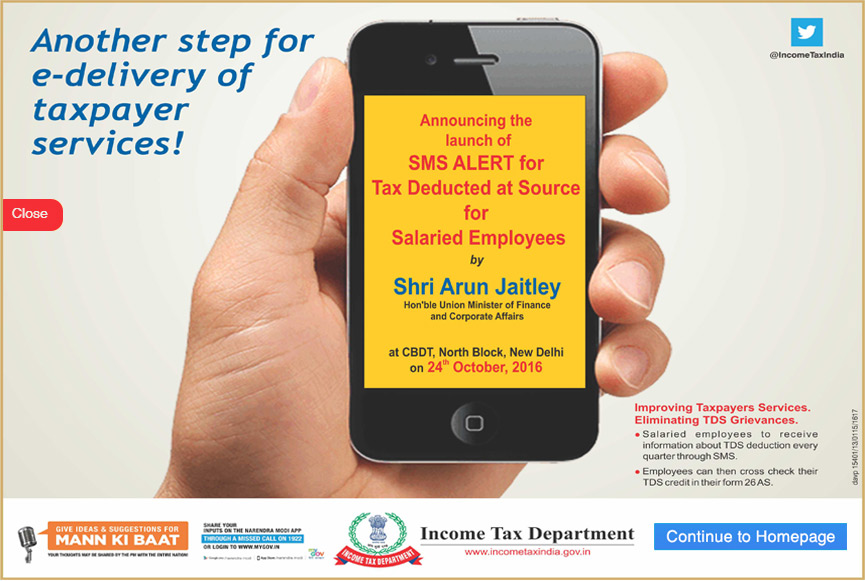
Certificates of Appreciation to tax payers & SMS alert to salaried persons for TDS deductions
1. CBDT issues second round of Certificates of Appreciation to tax payers for their contribution towards Nation building
Government of India
Ministry of Finance
Department of Revenue
Central Board of Direct Taxes
25th October, 2016
Press Release
(Meenakshi Goswami)
Commissioner of Income Tax
(Media & Technical Policy)
Official Spokesperson, CBDT.
2. Quarterly SMS Service for salaried persons about their TDS deductions
Dear Taxpayer,
Our Government is happy to launch Quartely SMS service for salaried persons about their TDS deductions.
Arun Jaitley
Finance Minister