Consequences of late filing of Income tax return(Amended by Finance Act 2016)

Here, we are discussing Consequences of late filing of Income tax return(Amended by Finance Act 2016)

  • If the taxpayer files the return of income after the specified due date, interest under section 234A will be levied. Interest is levied at 1% per month or part of a month
  • You will not be allowed to carry forward certain losses if you are filing your income tax return after the deadline.
  • You may lose interest on refund u/s 244A as delay in filing is attributable to you for the period by which you have filed late return.
  • You may be charged a penalty of Rs 5,000 if you file your income tax return after the expiry of one year of the financial year for which you are filing your income tax return.
  • Late returns are not allowed to be revised  up to Assessment year 2016-17. From Assessment year  2017-18, belated return submitted u/s 139(4) can be revised.


Please find below provisions in detail for interest  on delay filing  of Income Tax Return: 
Basic provisions

Interest under section 234A is levied for delay in filing the return of income. In other words, if the taxpayer files the return of income after the due date specified in this regard, interest under section 234A will be levied. 
Illustration

Mr. Kapoor is a doctor. His tax liability for the financial year 2015-16 amounted to Rs. 8,400. The due date of filing the return of income in his case is 31st July, 2016. On 5th August, 2016 he paid tax of Rs. 8,400 and filed his return of income. Will he be liable to pay interest under section 234A?

Interest under section 234A is levied for delay in filing the return of income. The due date for filing the return of income in the case of Mr. Kapoor is 31st July, 2016 and he has paid the tax and filed the return on 5th August 2016. Hence, he will be liable to pay interest under section 234A on the outstanding tax liability


Rate of interest
Interest under section 234A is levied for delay in filing the return of income. Interest is levied at 1% per month or part of a month. The nature of interest is simple interest. In other words, the taxpayer is liable to pay simple interest at 1% per month or part of a month for delay in filing the return of income.


Period of levy of interest under section 234A
Interest under section 234A is levied from the period commencing on the date immediately following the due date of filing the return of income and ending on the date of furnishing the return of income, or in case where no return has been furnished, on the date of completion of the assessment under section 144.
It should be noted that while computing the period of levy of interest, part i.e. fraction of a month is considered as full month.

Illustration

Mr. Sunil is an engineer. The due date of filing the return of income in his case is 31st July, 2016. He filed his return of income on 9th January, 2017. His tax liability for the financial year 2015-16 is Rs. 8,400 (which is paid on 9th January, 2017). Will he be liable to pay interest under section 234A, if yes then what will be the period of levy of interest?
**
The due date of filing the return of income is 31st July, 2016, and return of income is filed on 9th January, 2017 i.e. after the due date and hence, Mr. Sunil will be liable to pay interest under section 234A.

While computing interest, part of the month will be taken as full month. In this case, there is a delay of 5 months and 9 days. Part of the month i.e. 9 days will be considered as full month and hence, interest will be levied for 6 months.

Amount liable to interest under section 234A

Interest under section 234A is levied on the amount of tax as determined under section 143(1) and where regular assessment is made, the tax on total income as determined under such regular assessment as reduced by advance tax, tax deducted/collected at source, relief claimed under various sections like sections 90/90A/91 and tax credit claimed under section 115JAA/115JD.


Illustration

Mr. Kumar is running a medical store. The due date for filing the return of income in his case is 31st July. He filed his return of income on 3rd December. Tax liability of Mr. Kumar for the year is Rs. 28,400 (which is paid on 3rd December). Advance tax paid by him is Rs. 15,000 and he has TDS credit of Rs. 5,000. Will he be liable to pay interest under section 234A, if yes then how much?


Mr. Kumar has filed his return of income after the due date i.e. after 31st July and hence, he will be liable to pay interest under section 234A. Interest will be levied at 1% per month or part of the month.

The due date of filing the return of income is 31st July and the return of income is filed on 3rd December and hence, there is a delay of 4 months and 3 days. Part of the month i.e. 3 days will be considered as full month and hence, interest will be charged for a period of 5 months. Interest will be levied at 1% per month on Rs. 8,400 (*) for 5 months. Thus, interest under section 234A will come to Rs. 420.

(*) Advance tax of Rs. 15,000 and TDS of Rs. 5,000 are to be deducted from the tax liability of Rs. 28,400, hence, net liability after deducting advance tax and TDS will come to Rs. 8,400. Thus, interest will be levied on Rs. 8,400.

GST updates 15 Oct 2016

CAIT backs penalty waiver in first 3 years of GST rollout

October 15, 2016
Traders body CAIT on Friday proposed that the government should waive penalties on compliance errors during the first three years of rollout of the goods and services tax (GST) regime. Observing that it would be difficult for anyone to evade taxes under the new framework, CAIT said even the instances of under-invoicing will gradually wane as the tax department will have PAN-based registration and sale-purchase data of traders.

“GST will be a complex structure of taxes and we have asked the tax department to exempt traders from penalties in the transition period of first three years,” CAIT Secretary General Praveen Khandelwal said.

To educate traders about the new indirect tax set-up, the Confederation of All India Traders (CAIT) has entered into an MoU with Tally Solutions to train them on GST compliance and adoption.

The government plans to roll out GST from April 1 next year. The GST will subsume excise, service tax and other local levies.

Khandelwal said the next meeting of the GST Council, to be chaired by Finance Minister Arun Jaitley, later this month will decide on tax rates, products and compliance and after that, CAIT will prepare the working module for traders. A standard GST rate of 18% would be “justified”, and at that rate, the investment cost of traders will be less, he told reporters here.

Asked about the fate of traders who do not give bills at present, Khandelwal said the GST design does not have this option. “We have to give sales details to the tax department and hence, there will be no scope of under-invoicing as over a period of time, all data will go to the tax department,” he said.

CAIT National President B C Bhartia said that since GST registration is PAN based, so the government will get to know how many traders have not registered from its own database. “The purchase ledger of traders is with the government. So by under-reporting of sales, if stocks start piling up, the tax department will ask why are you purchasing? With so much data, it will become difficult to evade taxes,” Bhartia reasoned. He said last-mile disposal by an importer will come under the tax lens through Integrated GST and hence, under-billing will become difficult. Source – http://www.dnaindia.com [15-10-2016]

GST may trigger consolidation in warehousing space

October 15, 2016
GST may trigger consolidation in warehousing space

The goods and services tax (GST) regime could usher in consolidation in the Indian warehousing space, property consultants and analysts said.

With the government pushing for an April 2017 rollout of the single tax structure, many manufacturers who had built or leased warehouses in nearly every state to avoid duplication of taxes don’t see the need to extend their lease arrangements, and can instead own or lease large warehouses in a few strategic locations.

Warehouses across the country mostly facilitate operations of ecommerce firms, automotive companies, and manufacturers of consumer electronics, pharmaceuticals and fast-moving consumer goods. These manufacturers are now looking at having fewer but larger warehouses at locations such as Mumbai, Delhi, Ahmedabad, Chennai, Bengaluru and Hyderabad.

“Instead of having warehouses in all the cities, we will look at a cluster of states where it will be easier to send goods across the country without having to make the customer wait,” said Pravin Shah, chief executive (automotive) of Mahindra & Mahindra. However, he said that his company was waiting for the GST rates to be finalised to chalk out a strategy on consolidating warehousing.

Experts said that warehouses in tier-I markets may find business, but it will be difficult for those in smaller cities to sustain in the medium to longer term. While some see opportunity to set up new larger warehouses in emerging manufacturing hubs and strategic locations, others are looking at options to convert idle warehouses in smaller cities into residential and commercial assets.

Amazon and Flipkart didn’t respond to ET’s queries, while ShopClues refused to comment.
Meanwhile, the looming shift in strategy is catching the attention of developers. Indospace, a joint venture between private equity firm Everstone Capital Advisors and Realterm Global, is planning to develop big projects at manufacturing clusters with an investment of over $1billion over the next fourfive years to more than double the project pipeline to about 50 million square feet from the current 20 million sq feet.

“There will be a consolidation in this market with the passage of GST, as there will be more focus on setting up warehouses in the manufacturing hubs. This will lead to cost efficiency with reduced cost on transportation, labour and real estate,” said Indospace’s partner Brian Oravec.

“Ecommerce companies in our network are already in the consolidation process with Amazon and Flipkart, and are moving into lar ge warehouses of around 350,000 sq ft from their earlier spaces measuring 50,000 sq ft on an average,” said Mumbai-based Prakhhyat Infraprojects’ proprietor Sumit Bhalotia.

“The warehouses that will become redundant will be bought out by smaller players or will make way for office or residential complexes, as it would not be viable to run with low demand and high rentals,” says Samantak Das, chief economist at Knight Frank.

The government is setting up inter-state industrial corridors such as the Delhi-Mumbai industrial corridor and freight corridors such as the western and eastern dedicated freight corridors. Analysts said that more manufacturing activities will be taken up along these routes, which in turn will increase warehousing demand.

Further, with direct sale, companies’ inventory of goods will also reduce by nearly a third, as goods will move from manufacturing hubs to the dis tributors directly, instead of it being stocked. This will lead to efficiency in the supply chain and cost, said Balbirsingh Khalsa, national director (industrial services and landlord representation), Knight Frank.

The total warehousing space requirement in the top seven markets is expected to grow at a compounded annual growth rate (CAGR) of 8% -from 621 million sq ft in 2016 to 839 million sq ft by 2020 -estimated the Indian Warehousing Market Report 2016 by property consultant Knight Frank.  Source – http://www.economictimes.indiatimes.com [15-10-2016]


GST Updates 14th Oct 2016


Parliament’s winter session to begin on November 16 to expedite GST rollout

October 14, 2016
Winter session of Parliament will start on November 16. It will be a month-long session that will end on December 16, the cabinet committee on parliamentary affairs decided on Thursday.

The winter session usually starts in the third or fourth week of November, but was advanced to achieve the government’s ambitious target of rolling out the goods and services tax — a uniform indirect tax regime that will subsume all central and local levies such as excise, octroi and value added tax — from April 1 next year.

It’s also in keeping with the government’s plan to advance the presentation of the general budget by about a month. The budget is usually presented on the last working day of February, but the government has decided to advance it to start the process of revenue mobilisation and capital expenditures from April 1, the first day of the financial year.

Parliament passed the Constitution (122nd) Amendment Bill for GST in August, but it has to clear the Central GST and Integrated GST bills before its rollout from April 1, 2017, as envisaged by the NDA government.

These two enabling laws, while empowering the Centre to levy the GST on goods and services and collect it on inter-state trade and commerce, are expected to specify the range of GST rates, exempted items and compensation, among others. These issues are being deliberated upon by the GST Council headed by finance minister Arun Jaitley.

The government is likely to give a renewed push to its labour reforms agenda in the winter session of Parliament as well. High on the priority list is the Labour Code on Wages that seeks to empower the Centre to fix minimum wages across all sectors. The code amalgamates four existing laws relating to wages.

The labour ministry also hopes to build political consensus to get parliamentary approval to the Code on Industrial Relations, which aims to make retrenchment easier for firms employing up to 300 workers.

The last monsoon session was relatively smooth and productive — compared to previous sessions that were marred by government-opposition face-offs — but the winter session could witness a fractious debate on India’s September 29 surgical strikes across the de facto border in Pakistan-occupied Kashmir. Opposition parties have accused the BJP of politicising and “profiteering” from the military action, while the ruling party has accused them of “belittling” the sacrifice of the armed forces.

Ahead of elections in Uttar Pradesh, Punjab and three other states in February-March next year, these allegations and counter-allegations could cast a shadow on the legislative agenda of the government in the coming session of Parliament. Source –http://www.hindustantimes.com [14-10-2016]

Centre warns against criticism of GST network

October 14, 2016
The Centre has warned its employees that they could invite penal action if it is found that they are indulging in criticism of its policies and actions. T his presage came from the Union Finance Ministry amid a sustained campaign by the Indian Revenue Service (Customs and Central Excise) and All India Association of Central Excise Gazetted Executive for changes in the Goods and Services Tax Network (GSTN)-a private company tasked with the creation of Information Technology (IT ) infrastructure and composition of a GST council secretariat for the new tax regime.

“Of late, it has been noticed that some associations or federations have commented adversely about the government and its policies. It may be brought to the notice of all associations or federations that if anyone indulges in criticism of the government and its policies, appropriate action (including disciplinary action) shall be taken,” a memo issued by recently by the Finance Ministry said.

It cited the service rules tinkered in June, covering the social media as well, that bar a government servant from making any adverse criticism of any policy or action of the government.

The Ministry said the primary objective of the service associations is to promote common service interest of its members. T he service rules were amended in June making it clear that disapproval of government policies on social media also amounted to violation of conduct rules. And the threat of disciplinary action extends to caricatures that are uncharitable to the government.

Earlier rule book spoke about criticism made in a radio broadcast, public media (such as television) or documents. It will be applicable to anonymous and pseudonymous posts by officials too.

The recent memo of the Finance Ministry capped weeks of unrest among officers and cadre of the Excise and Revenue Department officials over a number of issues related to roll out of the General Sales Tax regime.

The central government holds 24.5 per cent stake in GSTN while state governments together hold another 24.5 per cent. T he balance 51 per cent equity is with non-government financial institutions, like HDFC Bank, ICICI Bank and LIC Housing Finance.

“Management of GSTN be entrusted to Directorate General, Systems of Central Board of Excise and Customs, as GSTN is a newly created Special Purpose Vehicle, which does not have any experience in implementing any IT project or domain knowledge in Indirect T ax laws,” the IRS association had said in a statement.

The Cabinet Committee on Economic Affairs, chaired by the Prime Minister, Narendra Modi, had recently approved ‘Project Saksham’ — a new indirect tax network (systems integration) of the Central Board of Excise and Customs (CBEC). T he total project cost involved is Rs 2,256 crore which will be incurred over a period of seven years.

Three days later in a letter to the Union Finance Minister Arun Jaitley Steering Committee of Associations in the Central Board of Excise and Customs representing the IRS and seven other bodies wrote on the subject of GST .

It said their main concern was that `unity of purpose’ is being compromised at the expense of the growth of tax base and revenue. T he Committee said a resolution on the GST at their meeting believes that service Tax (services above threshold level falling within GST ) Administration should be in the exclusive domain of Centre and dual Control of the Centre and the States (for Goods) across the spectrum.

“Sir, we feel that the benefits of pan-India foot prints of the central indirect taxes would be lost if the tax payer base is handed over to the states without proper evaluation, and we expect that our understanding would get due recognition and initiate a positive response”, it said. Source – http://www.thehindu.com [14-10-2016]


GST Impact on E-commerce sector

October 14, 2016[2016] 74 taxmann.com 3 (Article)
Introduction
1. E-commerce, an unheard of term a few years back has now become people’s “gharkidukaan”and the most desired shopping platform where articles from a sewing needle to one’s dream home are available for sale. On one side it is one-click shopping platform for consumers and on the other side its business model as well as tax structure are very complex. E-commerce operators (hereinafter referred as e-com’s) which are ordinarily newspaper headlines as regards levy of entry tax have also gathered attraction in GST.
Business models in E-Commerce sector & its impact on GST
2. There are two models of e-commerce, transactions i.e., aggregator model and e-commerce operator model.
A summarised understanding of these models and its GST impact have been drafted below:-
(1)   Under aggregator model three persons are involved, i.e., aggregator (Brand owner- Uber), service provider (cab driver) and end user (say Anil). Here aggregator is neither the service provider nor a service receiver, but only an intermediary entity, whose mobile application (app) is used by Anil, the end user to get connected to cab driver.
  In present taxation regime, aggregator is responsible to get itself registered under Service tax department for payment of service tax under reverse charge.
  In GST the definition of aggregator has been kept same as in Service tax. But in GST, as per supply definition, the supply of branded service by the cab driver shall be deemed to be supply of service by the aggregator, i.e., Uber. Therefore, the aggregator is liable to register and pay GST as a ‘supplier of service’ as against payment under reverse charge under pre-GST regime, irrespective of the threshold limit of Rs. 9 Lakhs in Model GST Law.
(2)   Under e-commerce operator’s model also three persons are involved, i.e., Marketplace (like amazon, flipkart), logistic company and the ultimate consumer. This model has further three sub-models, i.e., Drop-shipping, fulfilment centre and inventory-led model.
Following is the brief understanding and its impact on GST of these sub-models:-
(i)   Drop-shipping a.k.a marketplace model is a model where e-com’s provide an electronic platform to different vendors all over the country to sell their products. Here the responsibility of warehousing and delivering the goods lies on the vendor. E-com’s only provide the order details to the vendor. Hence, such e-com’s define themselves not as retailers but as a provider of IT services (Information Technology services).
  In current scenario such e-com’s require central registration with service tax department for providing IT services and other associated services and pay service tax on the commission they charge from the vendors.
  But in GST as per para 5(ix) of Schedule III of Model GST Law, e-com’s are compulsorily required to be registered irrespective of threshold limit of Rs. 9 lakhs. As e-com’s operate its business on an electronic platform, it would be interesting to know that in which State such e-commerce operators would require to register. Since nowhere, no else provisions or information is provided in Model GST Law in regard to their registration, for determining the State where registration is required in GST shall be based on type of ‘person’. If such e-com’s are registered as company, partnership firm under the respective Acts, then GST registration shall be taken in the State where it is registered under various Acts (Partnership Act, Companies Act). If it is not registered under such acts (Companies Act, Partnership Act) and want to conduct business as an individual (sole proprietor), then GST registration shall be taken in the State where he opens a bank account for transaction purpose .
(ii)   Fulfilment Centre model is a model where the e-com’s in addition to facilitating electronic portal to the vendor also provides the services of storing and delivery of goods to vendors. Here, the e-com’s fulfil the orders of buyers by making delivery to them from the stock of goods of various vendors stored by them in their warehouses or godowns. This model is more customer- focused and is followed so as to save logistics cost and to provide timely delivery to the buyers.
  In current scenario, the e-com’s are paying Service tax on the commission charges, storage and delivery services and are not paying VAT because they are not in any way covered in the definition of ‘dealer’. This matter of coverage in the definition of ‘dealer’ is under litigation in the Karnataka HC. In this case department took the view that since the e-com’s store the goods procured from various suppliers in their facilitation centre (warehouse) before dispatching it to the customers, hence these companies appear to be involved in supplying and distributing goods, therefore, e-com’s would be covered under the definition of ‘dealers’ of in the Karnataka Value Added Tax Act and are liable to discharge VAT.
  Now in GST this VAT dispute has been resolved by specifically covering warehouses or godowns under the definition of ‘place of business’, therefore these companies are required to take registration in all the States where their warehouses orgodowns are situated.
(iii)   Inventory-led model is a model where the e-commerce companies buy goods from different vendors and stock it and then sell to the ultimate customer. Since the e-com’s are buying and selling goods, they define themselves as ‘dealers’ and are liable to get themselves registered under VAT. This model is less in existence now-a -days, because of huge capital involvement. In GST also such type of companies shall have to take registration in the State in which they are operating.
Now, in GST the reframing of business models could be done based on various relevant business factors instead of tax structure.
Entry tax subsumed in GST
3. Many State governments (Uttarakhand, Bihar, Assam, Odisha, Gujarat, Jharkhand and Himachal Pradesh) have already levied entry tax on the goods entering the States through e-commerce portals for safeguarding the interest of local dealers. Many representations have been made by the traders challenging validity of entry tax on such inter-State e-commerce transactions, contending that entry tax is levied on the goods acquired in the course of businessand not on the goods purchased for personal use.
Since GST involves free flow of goods, services and Input tax credit, all the taxable persons become nation-wide players for supplying their goods and services all over India without any barriers. Therefore, the very intent (to safeguard local dealer’s interest) behind levying entry tax by various States has no more relevance in GST. From State government’s revenue viewpoint, since GST is a destination based consumption tax where the consuming State would get the tax revenue, the State governments which have levied entry tax on these e-commerce transactions would promote such inter-State supplies, so as to enhance their State’s revenue.
Tax rate impact on GST
4. In GST, such e-com’s have to pay higher rate of tax, i.e., 18% (proposed) as against 15% (Service Tax or VAT), but an uninterrupted credit-flow would be helpful in paying such extra output liability.
GST Dealer: a nation-wide player
5. GST will open new markets for online commerce, because in pre-GST regime the customers in some States cannot order everything from online shopping destinations due to entry tax and other process complexities.
Introduction of TCS concept for E-Commerce sector in GST
6. Inspite of various positive aspects of GST for e-commerce companies, the introduction of TCS for e-commerce operators only has put unnecessary compliance burden on them. As per section 43C of the Model GST Law, the e-commerce operator shall collect an amount (….%) at the time of credit of any amount in vendor’s account or payment in cash, whichever is earlier.
Such companies have thousands of vendors listed with them. Now they have to maintain the data of all such vendor’s account and payment in detail so as to collect tax. The amount collected shall have to be deposited by 10th of next month to the credit of appropriate government.
While GST undeniably comes as a relief to the e-commerce sector, it is also expected to pose challenges in respect of TCS, which the industry is hopeful would not be finally introduced.
(Article: N.K. Gupta Executive Director, S.S. Kothari Mehta & Co.)


GST updates 13 Oct 2016

Big changes for small units under GST

October 13, 2016
Under-reporting transactions will result in blocked credits and fragmentation will not pay

Traditionally, indirect tax policymakers have accorded the small and medium industry favourable tax treatment. This favourable treatment was provided on the premise that small-scale units use less amounts of capital per unit of output and also provide more employment per unit of output.

There is, however, not much evidence to establish that small-scale excise exemptions in the past have really helped in the growth of the small-scale sector.

Notwithstanding all this, the new Goods and Services Tax law does protect the small-scale duty benefits. The GST Council, which is the joint policy formulating group consisting of both the Centre and the States, has accepted an annual threshold limit of Rs. 20 lakh turnover up to which GST will not be payable.

Beyond Rs. 20 lakh, for another additional Rs. 30 lakh annual turnover, the GST rates would be a flat 1-2 per cent based on self-certification of the turnover, or on the basis of the turnover declared in the financial accounts of the company.

Hardly an incentive

While the very small units are provided duty benefits or duty concessions, the GST does bring the small and medium units under a tight regulatory regime which would be IT-driven. Every unit paying GST must have a GSTN number after registration. Smaller units that are under the compounding scheme with a turnover between Rs. 20 lakh and Rs. 50 lakh would require to be registered with a GSTN number. There is now growing evidence that the small-scale exemptions in the past did not really incentivise the small-scale units to grow. On the other hand, they encouraged fragmentation in order to remain below the threshold level of exemption.
The big difference in GST is that the entire value chain, from raw material to retail, has become integrated for the purpose of taxation. The Constitutional Amendment Bill empowers the Centre to tax trading, and the States to tax services. The Constitutional Amendment really ushers in the dual VAT.
In the GST scenario, the decision to remain small would become counter-productive as units underreporting transactions would suffer from blocked credits. Today, with the integration of the value chain for taxation, units would be eligible for credit for input goods, input services and imported capital goods. Many of them carry Central duties, which the State VAT-paying traders hitherto could not utilise.
We can, therefore, see in the GST scenario, more and more units in the informal sector pretending to be small, forced to enter the formal duty-paying segment. This would have significant revenue consequences, as it would also result in smaller units having to report higher incomes to the Direct Tax department in view of the synergy between Direct Tax and the Indirect Tax department established by the common PAN registration number.
It is also important to make a distinction between the small and medium industries in the goods sector and their counterparts in the services sector. The exemption threshold in the service sector was only Rs. 10 lakh compared to a turnover threshold of Rs. 1.5 crore on the goods side. Therefore, there has been less incentive to fragment and remain small in the services sector compared with the goods sector.

Compliance and after

The GST scheme announced by the Government spells out a clear design of the dual control regime. This really covers the whole area of compliance verification.

Compliance verification has broadly three prongs, namely return scrutiny, audit and anti-evasion. It is now agreed that small units manufacturing goods beyond Rs. 1.50 crore annual turnover will have to deal locally with the State government. Small service providers, on the other hand, will have to deal with the Centre, whom hitherto they have been dealing with. The small and medium units have, therefore, been protected from the vagaries of dealing with both the Central and the State Indirect Tax departments. This is undoubtedly a big relief.

Finally, where does all this leave the small and medium industry in the GST era?

The self-policing mechanism provided by the design of GST and the tracking of every transaction by the GSTN system will ensure a more level playing field for all units, whether big or small. The GST philosophy represents a shift in tax thinking, which is that tax incentives must be relied upon less and less to encourage particular segments of the industry. The tax rates must be low with fewer exemptions covering a larger tax base.

Recent studies by the International Monetary Fund and the World Bank have shown that tax incentives do not confer any real benefit but merely distort the resource allocation. Small and medium units would be better off if there is greater ease of doing business which would require easing of the regulatory mechanisms, loosening of the labour laws, and greater access to bank credits. Expenditure switching from tax incentives to infrastructure spending could benefit small and medium units more than tax incentives. Perhaps this new thinking in the GST may end up helping the small and medium units even more. Source –http://www.thehindubusinessline.com [13-10-2016]


GST Network to launch registration portal


October 13, 2016
Goods and Services Tax Network (GSTN), the company tasked with setting up the information technology backbone for the ambitious indirect tax reform, will open a website for the registration of taxpayers such as traders, manufactures and service providers in November.

Taxpayers will be able to access the website and submit the necessary information for registering with the tax network to ensure seamless tax payment, returns and refunds under GST.

“Beginning November, we will be opening a portal for existing taxpayers. Login IDs and passwords will be given to the taxpayers. They can log in and fill in details like their place of business and other such information,” said Navin Kumar, chairman of GSTN. “Even new taxpayers will be able to enrol at a later date through this portal.”

With the GST council finalizing the threshold levels for GST’s applicability as well as the contours of the compounding scheme, taxpayers now have more clarity on the operational aspects of this tax reform, which is expected to be implemented from 1 April 2017.

“Industry needs time to prepare its information technology systems for a transition to GST. The faster the draft laws and rules are finalized, the easier it will be for the industry to make the transition to GST smoothly,” said Vipul Jhaveri, managing partner, tax and regulatory, at Deloitte Haskins and Sells Llp.

Last month, the GST council finalized the revenue threshold levels below which traders will be exempted from levy of GST.

It was decided that all assessees with annual revenue below Rs20 lakh will be exempted from GST. The threshold is Rs10 lakh for 11 special category states—the north-eastern and the hill states.

Further, the council also finalized the revenue levels for a taxpayer to opt for the compounding scheme. Small traders with revenues of Rs20-50 lakh can pay a flat tax and do away with unnecessary paperwork.

GST is expected to remove barriers across states and integrate the country into a common market. It will subsume most of the indirect taxes levied by the centre and the states, including excise duty, service tax, value added tax, entertainment tax and luxury tax. It will put the entire tax process online—right from registration, tax payment and tax return filing to refunds, audits and assessments.

GSTN has already launched a developer portal for IT firms that want to develop GST-based applications for various kinds services like preparing taxpayers for tax payment and filing of returns. Source – http://www.livemint.com [13-10-2016]

Union Budget will be announced on Feb 1, Economic Survey to be out on Jan 31

October 13, 2016
The time table for the Union Budget has been advanced by one month and is being scheduled for February 01, 2017. Arvind Subramanian, the Chief Economic Adviser, said the Economic Survey will be out on Jan31.
“The time-table is fixed. It is going to be the day before the budget and since the budget is going to be on 1st of February, we have to table it on the last day of January. So, it has been advanced by exactly one month. It means that we have to compress our work schedule and we have started working on that and we are going to hopefully meet the deadline but we have some very exciting ideas to explore,” Subramanian told ET.
Speaking on the Goods and Services Tax (GST), Subramanian said the GST rate should be below 20%.
“The GST is really a game changing reform but I do not think one should ascribe anything to one reform measure. But GST is of such a magnitude that it seems to have impressed foreign investors. We had actually suggested a range between 17 and 19%. Taking into account the Indian situation, the margin should err on the side of lower rates rather than higher rates,” he told ET.
Meanwhile, Subramanian said Non-Performing Assets (NPAs) are one of the biggest challenges Indian economy has to face, adding the government has introduced a slew of measures to grapple with it.
“It is one of the major challenges for the economy in the short run because credit to industry is relatively weak and corporate balance sheets is also not very strong. So we have to work our way through this problem before we can see private investment and growth pick up further,” said Subramanian. Source – http://www.businessinsider.in [13-10-2016]


Handicraft export council draws strategy to address GST issues

October 13, 2016
Apex exporters body, Export Promotion Council for Handicrafts (EPCH) has said that Goods and Services Tax (GST) is one of the biggest taxation reforms in India and is a comprehensive tax levy on manufacture, sale and consumption of goods and services at a National level. GST is all set to integrate the state economies and boost overall Growth.

EPCH has organized a stakeholders consultation meet in EPCH House, New Delhi recently, wherein representatives of Industry Associations and exporters gathered to discuss the implications of Goods and Services Tax (GST) on handicrafts sector.

EPCH has engaged the services leading Tax Consultant of national repute having expertise on GST matters to prepare a petition on behalf of handicrafts exporters to be submitted the GST Council, Ministry of Finance, Govt. of India. A similar petition is also being forwarded through various state Govts to the Ministry of Finance, Govt. of India so that the interests of handicrafts sector can be safeguarded. A meeting with Hon’ble Union Finance Minister and other senior Govt. officials is likely to be held shortly wherein the petition will be submitted.

Members of EPCH have also decided to approach the finance minister of their respective state governments as they are members of the GST council. It would be an additional help to highlight the issues concerning GST with respect Handicrafts sector.

Major issues of handicrafts sector which the exporter apprehend will have adverse impact on their business are as under:-

  •  Handicrafts sector to be exempt from the purview of GST
  •  Blocking of Working capital to be addressed, in case handicrafts sector not exempted, will result in high cost of capital
  •  Merchant exporter to be allowed procure goods without paying taxes
  •  Job workers procedure to be clarified
  •  Refund procedure to be simplified
  •  Utilization of duty credit scrip not to be restricted only to payment of customs duty
  •  Duty Drawback rate to factor increased tax cost on procurements of input material

The exports of handicrafts during the first six months of 2016-17 are Rs. 13005.35 crores registering a growth of 18.28% over the same period last year. The Handicrafts exports during the year 2015-16 were Rs. 21457.91 crores with overall 6.85% increase in comparison to last year Source – http://www.smetimes.in [13-10-2016]


GST Updates 12th October 2016


SIAM calls for standard GST rates on small cars


The SIAM has issued a statement on GST rates and has called for a standard rate on small cars. It has said that anything other than a small car should be charged at eight per cent qabove the standard rate. They have also called for the implementation of standard rates on MUVs, two wheelers, three wheelers and CVs.
They have also said that a GST rate of less than eight per cent below the standard should be levied on electric vehicles, hybrid electric vehicles and other alternative fuel vehicles. They have also stressed for the inclusion of road tax and registration tax to be brought under the ambit of the GST.
We could expect a possible implementation in the next year or so. The landmark tax reform bill was passed 1.5 months ago after unanimous approval and many years of struggle. The initial statement is a bit ambiguous as it is still unclear if the current vehicle definitions will be retained once GST is implemented.
It is also good that they have properly included electric and hybrid vehicles in their statement as this is the way forward and has the potential to further transform and boost manufacturing in the sub-continent.   Source – http://www.msn.com [12-10-2016]

GST loopholes highlighted by Central excise officials


The senior officials of the central excise department have prepared a report on some major loopholes in the Goods and Services Tax (GST) as sought by the Union government to fine tune and improve the law. The report would be submitted to the concerned ministry in a week.
“We have raised some key points and specific areas of concerns which need to be looked into,” said a senior tax official of the central excise department.
In its draft report, tax officials have expressed apprehension on the definition of ‘supply’ which is believed to be extremely wide and intends to cover almost all kind of transactions. “In the current draft, there is no clarity on such transactions and about its administration which could lead to a dispute and lot of litigations,” said the official cited above.
He further explained that Section 3 of model GST Law (model law) specifies the meaning and scope of term ‘supply’ which includes all forms of supply of goods/services such as sale, transfer, barter, exchange, license, rental, lease etc. This means anything an assessee changes whether it’s ownership, custody of any kind of goods and services would attract GST.
Another troubling provision relates to ‘valuation’ of taxablesupply ofgoods and services, which may again create room for confusion and disputes, said another tax official. Under the GST regime, specificadditions have been made to the price charged. Such additions include value of goods/services supplied free or at concessional rates by the recipient to the supplier. For instance, if a doctor or a lawyer offers services free of cost or a company offers a ‘buy one-get one free’ kind schemes would be under the tax net.
If the values of these supplies are to be included in the taxable supplies by the service provider, an amount that is already taxed would once again attract taxation, added official.
The report also highlighted the lacuna on the part of ‘input tax credit’, another important area which needs to be revisited, noted the official. The GST law provides for credit of GST paid on all the inputs, except on some items. The exceptions or ineligible credit criteria is quite subjective in nature. For example, services in relation to food/drink, outdoor catering and membership of clubs are restricted when used mainly for personal use of employees. The officials fears that if the loophole remains it could lead to massive tax evasion.
According to tax experts, the administration of GST has to be sorted out, and if it is not resolved, it may significantly dent the ease of doing business. “It is giving dual responsibility to both central and state as far as adjudication and assessment are concerned. The GST Council was unable to reach a consensus on who would administer and who would assess the transactions as it is going to be dual control. Now if each of the authorities comes up with its own assessment then it is going to be lots of harassment on the assessee,” said Prajakta Menezes, principal associate (indirect tax), Khaitan & Co  Source –http://www.business-standard.com [12-10-2016]

CBEC warns of small traders exploiting loophole


The debate on administrative control over small traders in the goods and services tax (GST) regime is far from over.
States last month announced that the centre has agreed to their demand that only they will have administrative control over small traders whose annual revenue is less than Rs.1.5 crore, but the indirect tax arm of the Union government fears this could lead to massive tax evasion.
With a majority of the traders expected to go out of the central government’s supervision if there is no dual control over traders generating revenue less than Rs.1.5 crore, the central board of excise and customs (CBEC) fears that traders may deliberately form smaller enterprises to stay out of the centre’s radar.
Besides, unlike the centre, the states may not be able to check the creation of multiple enterprises specifically designed for tax evasion.
It is also worried that states may not be equipped to deal with service tax since they have no expertise in that area.
“What if a trader sets up three units showing different proprietorships to ensure they remain below the Rs.1.5 crore threshold and out of centre’s supervision? The states will also not have access to data across other states like what will be available with the centre. They also have no expertise in administering service tax,” said a senior official of CBEC, who did not want to be identified.
“Even if we identify tax evasion by some small trader through technology, we won’t have any power to do anything about it,” the official added.
India is implementing a dual GST model wherein both the states and the centre will levy GST separately in the form of state GST (SGST) and central GST (CGST), unlike some other countries wherein only centre levies GST and then proceeds to divide it among states.
States, arguing that small traders will have to face the hassle of dealing with officials from both the centre and the states, had demanded that for those traders whose annual revenue is less than Rs.1.5 crore, the states should collect both central GST and state GST.
This will effectively take these traders completely outside the centre’s purview.
“On the issue of dual control, it has been agreed by the centre that up to Rs.1.5 crore, states will administer the taxes and after that threshold, a seamless process will have to be worked out,” West Bengal finance minister Amit Mitra said in Kolkata last month after a meeting of the empowered committee of state finance ministers.
To be sure, the upcoming meeting of the state finance ministers in New Delhi on Tuesday will try to sort out the sticking points.
“If it is a clean transaction, taxmen and taxpayer will never meet since the entire registration, payment and return process is online on the GST network. Only when there is an alleged infraction, there will be an interaction between the tax payer and the taxmen. So, small traders will not be inconvenienced,” said Sumit Dutt Majumder, former chairman of CBEC.
He pointed out that the centre, having administered service tax since 1994, is much more experienced to collect this tax. “States have no idea of dealing with service tax, which is an intangible thing. States have only dealt with goods,” Majumder said.
He also dismissed the notion that the centre doesn’t deal with small taxpayers.
He pointed out that though excise duty exemption limit is Rs.1.5 crore, it is only Rs.10 lakh for service tax.
“The question is whether the centre will feel comfortable in outsourcing its revenue collection function to states,” Majumder said.  Source – http://www.livemint.com [12-10-2016]

Units availing tax holiday get jittery about GST


The industrialists who had set up units here from 2003 to 2010 are wary about the implementation of GST. Under the industrial package, the units that came up in Himachal during the period were exempted from Central Excise for 10 years. Many units that started production in 201 0 were exempt from Central Excise Tax till 2020. However, now with the GST coming into force from April 2017 , the industrialists are fearing that their package is being cut short.

Sarwal, who had set up a pharma unit in Golthai, said the government should continue the package till 2020. They had set up units following package given by the government. Under a new legislation, the government could not withdraw the benefit given to them by the previous government.

Rajneesh Vohra, a CA in Una district, said the Centre had proposed that industrialists would initially have to deposit the GST and it be reimbursed to them later. Since the time of reimbursement was not clear, the industrialists are wary. The industrial associations were planning to meet Finance Minister Arun Jaitley , he said.

Sources said many industrialists were contemplating to move court against the decision to bring them under the am bit of GST that would make them liable to pay waived taxes.

The package to Himachal was given by the NDA government led by Atal Behari Vajpayee. The package was given for 10 years ranging from 2003 to 2013. However, owing to pressure from neighbouring Punjab and Haryana, the package was curtailed by the previous UPA government in 2010. However, the industrial units that started production till March 2010 were entitled to tax benefits for 10 y ears.

Since GST was being imposed after the merger of all taxes such as Central Excise, sales tax, entry taxes of states, it would be hard for the units to escape it, sources said. Source – http://www.tribuneindia.com [11-10-2016]

Draft GST Rules and Forms: Key takeaways

06/10/2016
Draft GST Rules and Forms: Key takeaways 
CBEC released draft rules and forms under GST on Registration, Invoice and Payment on 26th September 2016.. GST council has also approved of draft rules in its meeting on 30th September, 2016.
Key takeaways of draft rules and forms are given hereunder:

Registration
1.
The application for GST registration will be made online either directly on the GSTN Portal or through Facilitation Centres.
2.
The proper officer will examine registration application and grant registration within 3 common working days.
3.
If the application is found deficient, then applicant will be intimated within 3 common working days. Thereafter, applicant has to furnish information or documents sought within 7 working days electronically. If the proper officer is satisfied with such details, then he will grant registration within 7 common working days from date of receipt of such details.
4.
The person obtaining registration as casual dealer is required to make advance deposit for estimated tax liability for the period for which registration is sought.
5.
The registration certificate must be displayed at principal place of business and at every additional place of business. GSTIN (i.e. registration number) must be displayed in the name board at the entry point of business premises.
Invoice
1.
Supplier needs to mention following details in invoice if recipient is unregistered and taxable value of supply is Rs 50,000 or more:
Name and address of recipient;
Delivery address along with the name of State.
2.
Every invoice should contain place of supply if supply is in course of inter-State trade or commerce.
3.
Three copies of invoice should be prepared in case of goods and only two copies of invoice are needed in case of services.
4.
In case of taxable supply of services, the invoice shall be issued within 30 days from date of supply of services. However, no time-period is specified for issuance of invoice in case of supply of goods.
Returns
1.
The registered taxable person is required to file details of outward supplies in Form GSTR-1 electronically. The recipient will receive GSTR 2A on the basis of details furnished by supplier in GSTR 1.
2.
The recipient will file details of inward supplies in GSTR 2 electronically on basis of details contained in GSTR 2A. The recipient shall specify the details of inward supplies for which he is not eligible for input tax credit and quantum of such ineligible input credit.
3.
The registered taxable person (other than composition dealer) shall file monthly return in GSTR-3. Part of this return will be electronically generated from GSTR 1, GSTR 2, electronic credit ledger, electronic cash ledger and electronic liability register.
4.
A notice in Form GSTR 3A will be sent electronically to a registered taxable person who fails to file returns.
Payments
1.
The electronic tax liability register, electronic credit ledger and electronic cash ledger will be maintained on the common portal for every registered person.
2.
The electronic tax liability register shall be debited with amount of tax, interest, late fee, mismatch in credits, etc. It shall be credited with amount paid through electronic cash register or electronic credit register.
3.
The electronic credit ledger of taxpayer will show the details of invoice and amount of credit. It will also show details of credit matching or mismatching.
4.
The electronic cash ledger shall be credited with the amount deposited and debiting with the payment therefrom towards tax interest, penalty, fee or any other amount.
5.
The final acceptance of input credit will be made available to registered taxable person through Form GST ITC 1 electronically.
Refund
1.
The refund claimed in Part B of GSTR-3 shall be deemed to be an application filed for refund.
2.
The provisional refund, i.e., 80% of refund claimed shall be granted on satisfaction of following conditions:-
Person claiming refund has not been prosecuted for any offence under GST during any 5 preceding years. If he has been prosecuted under an earlier law, the amount of tax evaded should not exceed Rs.2,50,000.
GST compliance rating of the applicant is not less than 5 on a scale of 10.
No proceeding for any appeal, review or revision is pending on issues which form the basis of the refund and if pending, the same has not been stayed by the appropriate authority or court.
3.
Refund shall be granted after adjusting any outstanding demand payable by the applicant.
4.
If Proper Officer is satisfied that refund is not payable then he shall issue a notice requiring applicant to furnish a reply within 15 days.
5.
Any amount rejected as refund shall be re-credited to the electronic credit ledger.
6.
Person claiming refund of tax paid on inward supplies shall apply for refund in FORM GST RFD-10 once in every quarter.

CBEC releases draft GST Rules and Forms


With the enactment of 101st Constitution Amendment Act, the road to GST is clear. The Govt. had already unveiled draft model law on GST.

On 26th September, CBEC released draft rules and forms under GST on Registration, Invoice and Payment.


Draft Registration Rules (Registration – 17 Rules)
http://www.cbec.gov.in/resources//htdocs-cbec/gst/draft-registration-rules.pdf

Draft Registration Formats (Forms GST REG 1 to 26 – 26 Forms)


Draft Payment Formats (Forms GST PMT 1 to 6 (includes 2A) – 7 Forms)
http://www.cbec.gov.in/resources//htdocs-cbec/gst/draft-formats-under-payment-rules.pdf

Draft Invoice Rules (Tax Invoice, Credit & Debit Notes – 5 Rules)
http://www.cbec.gov.in/resources//htdocs-cbec/gst/draft-invoice-rules.pdf


Corresponding changes in Model Law is being carried out separately

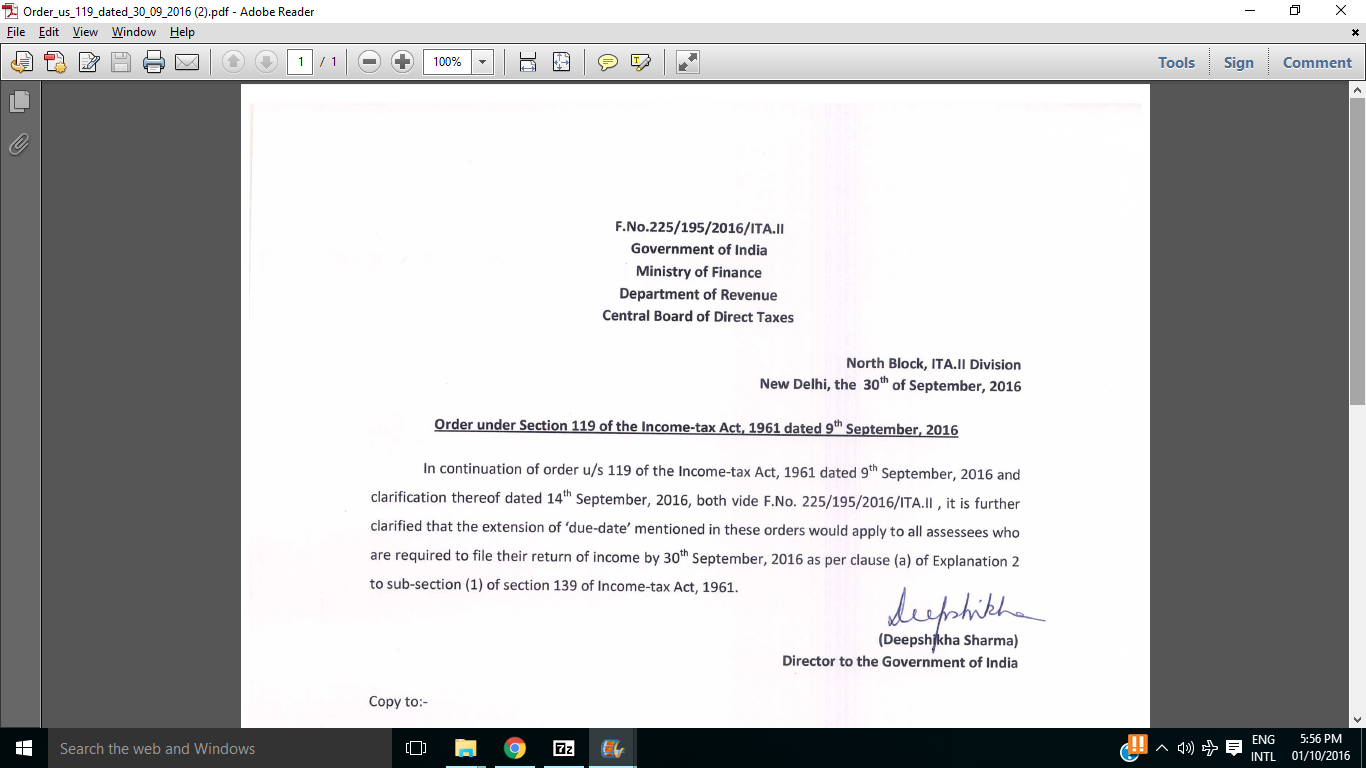
Clarification:Extension of due date of filing of ITR (From 30th Sept 2016 to 17th Oct 2016)


F. No. 225/195/2016-ITA II
Government of India
Ministry of Finance
Department of Revenue
Central Board of Direct Taxes
North Block, New Delhi
Dated the 14th of September, 2016
Clarification req. u/s 119 of the Income-tax Act, 1961 dated 09th September 2016
Central Board of Direct Taxes, vide order u/s 119 of the Income-tax Act, 1961 (Act) dated 9th September, 2016, has extended the ‘due date’ for filing of income tax returns by the taxpayers whose accounts are audited u/s 44AB and who are required to furnish the returns of income for Assessment Year 2016-17 by 30th September, 2016 as per provisions of section 139(1) of the Act from 30th September, 2016 to 17th October, 2016. Clarifications are now being sought whether the said extension of ‘due date’ would also apply for getting the accounts audited in accordance with the provision of section 44AB.
Section 44AB of the Act, stipulates that the accounts are to be got audited by an accountant and furnished in the prescribed manner before the ‘specified date’. The ‘specified date’ under Explanation (ii) to that section has been defined to be the ‘due date’ for furnishing the return of income under sub­section (1) of section 139. Therefore, the extended ‘due date’ as per CBDT order dated 9th September, 2016 would also apply for the purpose of section 44AB of the Act.

(Deepshikha Sharma)
Director to the Government of India

Extension of due date of return (From 30th Sept 2016 to 17th Oct 2016) whose accounts are required to be audited under the Income Tax Act


F.No.225/195/2016-ITA-H

Government of India

Ministry of Finance

Department of Revenue

Central Board of Direct Taxes

North Block, ITA.II Division New Delhi, the 9th September, 2016

Order under Section 119 of the Income-tax Act, 1961
The last date for making declarations under the Income Declaration Scheme 2016 is 30th September, 2016 which coincides with the last date of filing Income-tax returns by the tax payers whose accounts are audited and who are required to furnish the returns of income for Assessment Year 2016-17 by 30th September, 2016 as per provisions of section 139 (1) of Income tax Act, 1961.
In order to remove inconvenience and to facilitate ease of compliance, the Central Board of Direct Taxes, in exercise of powers conferred under section 119 of the Income-tax Act, 1961, hereby extends the ‘due-date’ for furnishing such returns of Income from 30th September, 2016 to 17th October, 2016, in case of tax payers throughout India, who are liable to furnish their Income-tax return by the said ‘due-date’.
(Deepshikha Sharma)
Director to the Government of India
———————————————
Government of India

Ministry of Finance

Department of Revenue
Central Board of Direct Taxes

New Delhi, 9th September, 2016
Press Release
Sub :- CBDT Extends due date for filing of Income Tax Returns – reg
The due date for filing of Income tax returns by tax payers whose accounts are required to be audited under the Income Tax Act is the 30th September of the following year. The tax payers whose business receipts exceed Rupees One Crore or professional receipts exceed Rupees twenty-five Lakh during the previous year 2015-16 are required to file an Income Tax return accompanied by an audit report by the above mentioned due date.
However, taking into consideration that the last date for making declarations under the Income Declaration Scheme 2016 is also 30th September, 2016, the Central Board of Direct Taxes has decided to extend the last date for such returns which were due on 30th September, 2016 to 17th October, 2016 in order to remove inconvenience and to facilitate ease of compliance.
(Meenakshi J Goswami)
Commissioner of Income Tax
(Media and Technical Policy)
Official Spokesperson, CBDT.