Measures taken by Government to keep inflation under control (Press release dated 07th Dec 2021)

The Government has taken various measures to keep inflation under control. This was stated by Union Minister of State for Finance Shri Pankaj Chaudhary in a written reply to a question in Rajya Sabha today.

Giving more details, the Minister said that some of them include the following:

  • Crude Oil/Petroleum Products: To check the petrol and diesel prices, Central Government has reduced Central Excise Duty on Petrol & Diesel by Rs. 5 and Rs. 10 respectively with effect from 04.11.2021. In response many states governments have also reduced Value Added Tax on petrol and diesel. Retail prices of petrol and diesel have sobered down across the country.
  • Essential Commodities: Price situation of major essential commodities is being monitored by the Government on a regular basis and corrective action taken from time to time.
  • Pulses: (i) A buffer stock target of 23 lakh metric tonne (LMT) has been approved for 2021-22. Stocks are subsequently utilised for cooling down prices through supply to states and disposal through Open Market sales (ii) Imposition of stock limits on some pulses under the Essential Commodities Act, 1955 in July 2021 to prevent hoarding. (iii) Changes in the import policy by keeping Tur and Urad under ‘free’ category till 31st December, 2021. (iv) Basic import duty and Agriculture Infrastructure and Development Cess on Masur have been brought down to zero and 10% respectively. (v) 5-year memorandum of understanding (MoUs) have been signed with Myanmar for annual import of 2.5 LMT of Urad and 1 LMT of Tur, and with Malawi for annual import of 0.50 LMT of Tur and MoU with Mozambique for annual import of 2 LMT Tur has been extended for another 5 years.
  • Edible Oils: To soften the prices of edible oils, the import duty on edible oils have been rationalised and stock limits imposed to avoid hoarding upto a period of March 31, 2022. National Mission on Edible Oils- Oil Palm has been approved with a financial outlay of Rs.11,040 crore to encourage domestic production and availability of oil palm.

Giving details on the various initiatives taken to safeguard the interests of the vulnerable population, both in rural and urban areas, the Minister stated that in the wake of COVlD-19 pandemic crisis in the country, the Pradhan Mantri Garib Kalyan Anna Yojana (PMGKAY) was started in April 2020 to provide additional free food grains to about 80 crore National Food Security Act (NFSA) beneficiaries in the country initially for a period of 3 months from April to June 2020 which was later extended for a further period of 5 months from July to November 2020.

The Minister further stated that in 2021, the PMGKAY scheme was resumed for a period of another 7 months from May to November 202l and has been further extended upto March 2022. Further, under the Atma Nirbhar Bharat Scheme (ANBS) food grains were allocated to all states/UTs for free distribution to migrants/stranded migrants and all those not having NFSA or any state PDS ration cards, for a period of 2 months of May and June 2020. Additionally, One Nation One Ration Card (ONORC) enabled ration card portability for NFSA beneficiary to lift the entitled food grains for self or on behalf of the complete household from any Fair Price Shop (FPS) in the country by using their same/existing ration card with biometric authentication on an electronic Point of Sale (ePoS) device. So far, the ONORC plan is enabled in34 States/UTs covering about 75 crore beneficiaries (94.3% NFSA population) in the country, the Minister stated.

****

RM/KMNRelease Id :-1778933

Steps Taken by Governement against Excess Charges Being Levied by Private Hospitals( Ministry of Health and Family Welfare Press Release dated 03 Dec 2021)

Health being a State subject, it is the responsibility of the respective State/Union Territory (UT) Government to take cognizance of complaints against private hospitals including for charging excess fees for the same procedures from the patients paying in cash as compared to those who pay through cashless health insurance schemes and to take suitable action to prevent and control such practices. Therefore, complaints, if any, are forwarded to State/UT Governments for taking appropriate action.

Government of India has enacted the Clinical Establishments (Registration and Regulation) Act, 2010 (CE Act, 2010) and notified Clinical Establishments (Central Government) Rules, 2012, as amended in 2018 and 2020thereunder, which prescribe conditions for registration and regulation of clinical establishments (both Government and Private) in the country. As per the Act, among other conditions the clinical establishments in the States/UTs which have adopted the Act, are required to display the rates charged for each type of service provided and facilities available in the local as well as in English languageat a conspicuous placefor the benefit of the patients. Further, as per the Act, the clinical establishment shall charge the rates for each type of procedure and service within the range of rates determined and issued by the Central Government in consultation with the State Government from time to time.

Towards this the Central Government has shared a standard list of medical procedures and standard template for costing with the States/UTs where the Act is applicable, for necessary action by them. The Act further provides for a registering authority in each district, which is empowered to conduct inquiry in case of violation of the provisions of the Act and take necessary action including imposing penalties and cancellation of registration, if applicable.

Further as per the Act, the Central/State Government issues Standard Treatment Guidelines (STG) from time to time which also facilitate rationalisation of cost of treatment. So, far STG for 227 medical conditions belonging to 21 clinical specialties/super specialties in allopathy and 18 medical conditions in Ayurveda have been issued by Ministry of Health and Family Welfare, Government of India.

The implementation and monitoring of the CE Act is within the remit of the respective State Government/UT Administration. As on date the CE Act has been adopted by 11 States and 6 UTs. Another 17 States and 1 UT have their own Act.

The Union Minister of State for Health and Family Welfare, Dr Bharati Pravin Pawar stated this in a written reply in the Lok Sabha.

****

MV/AL

HFW/PQ/ Steps by Govt against excess charges levied by Pvt Hospitals/3rd Dec2021/4

What is National Single Window System ? / All CG/SG approvals under one mouse click / Complete Business set up guidelines

Dear Sir,

Please find below YouTube video link on What is National Single Window System ? II All CG/SG approvals under one mouse click II Complete Business set up guidelines


https://youtu.be/lpV_U3bBmZE

Regards,
Bipul Kumar

India will be the next investment global hotspot (Ministry of Commerce & Industry Press Release dated 16 Nov 2021)

Shri Piyush Goyal says India will be the next investment global hotspot


Under Prime Minister Modi, India attracted a record FDI during last seven years, each year breaking the previous record for 7 years in a row – Shri Piyush Goyal

“‘Why India?’ to ‘Why Not India!’, and today ‘We must be in India!’, – Global sentiment has changed”

“More success stories here than anywhere in the world today; come, be a part of the unfolding India story” – Minister’s message to the CII National Conference on MNCs

The Minister for Commerce and Industry, Consumer Affairs, Food and Public Distribution and Textiles, Shri Piyush Goyal has said, as per a recent CII-Ernst & Young report, India will be the next investment global hotspot.

“We have the potential to attract an annual FDI in the range of $120- $160 billion by 2025. Last seven years we’ve seen a record FDI, each year breaking the previous record for 7 years in a row. And I do hope to see that continue looking at the major structural reforms, the fact that we have a proactive leader in Prime Minister Modi, willing to listen and willing to change with the changing times,” he said, addressing the 2nd edition of the CII National Conference on MNCs, 2021, through video conference today.

Shri Goyal said global sentiments have changed from ‘Why India?’ to ‘Why Not India!’, and today ‘We must be in India!’ “There are more success stories here than anywhere in the world today, 71 unicorns. Naukri Jobspeak Index for Oct’ 2021 reports a 43% growth in employment over the same month last year. Our Manufacturing PMI (is high) and Service PMI reached a decade high,” he said.

Shri Goyal said Government has introduced several key policy and business reforms for improving the investment climate. “The closest and most recent decision like the privatization of Air India which was successfully bid by the Tata group, the removal of that very, very unfortunate Retrospective Tax which has, I believe, cost us dear in terms of investment climate for many years, the kind of reforms in Mining, in the Coal sector, ones that we are hoping to do in Power, the huge Renewable Energy growth story in India, all of these things, I think, encourage us to look for a brighter future,” he said.

Shri Goyal said the National Single Window System (NSWS) has been launched to serve as a one-stop-shop for approvals and clearance needed by investors. “The portal hosts approvals across 18 Central departments and 9 States. Another 14 Central departments and 5 States will be added by December.”

Shri Goyal said India has all the right ingredients for the Multi-National Corporations (MNCs) and can help MNCs become more competitive at global level. “Diverse business landscape, rule of law & transparent systems, skilled workforce & low labour cost, no forced technology transfers.”

Encouraging the Indian MNCs to take ‘Brand India’ to the world and be ambassadors of India’s culture, quality and values, Shri Goyal said MNCs have been an integral part of India’s growth story and their contribution is immense.

“Whether it’s in terms of building highly skilled managerial talent, whether it’s building good business practices or good manufacturing practices in India, whether it’s the good Corporate Social Responsibility and such social initiatives that are taken up by many of our MNCs. Whether it’s skill development, I think, a huge contribution by the MNCs when it comes to skill development in India, and all of these have had a multiplier effect on the economy,” he said.

Shri Goyal stressed on promoting partnership between the Government and Industry. “This partnership is important more because in today’s time because it gives us ideas, it gives us thoughts, it gives us an opportunity to understand where you come from, what needs to be done and, I think, this partnership needs to be strengthened further as we go along.”

Quoting Prime Minister Modi, “Good and smart governance is needed to bring reforms. The world is a witness to how India is writing a new chapter of governance”, Shri Goyal invited entrepreneurs to be a part of the unfolding India story.

Key ideas and requests shared by states to facilitate investment promotion (MoF Press Release dated 15th Nov 2021)

  • Affidavit-based clearance system – ABCS by Karnataka and a similar system in UP to provideall clearances in a time-bound manner including plan approval, identification of land, conversion of land, environmental approvals and electricity supply for new enterprises. Affidavit based clearance is given upfront once basic infrastructure is in place and then the investor has 2 years to procure all approvals post-facto.
  • Transparent Mechanism for Investment Facilitation that involves sharing with states, leads of prospective investors who are in touch with GoI. More emphasis on adoption of technology and increase of digital infrastructure
  • Need for a clear-cut policy and SOPs on environment and forest clearances by Government of India, on the lines of ‘Eco-Economics’ and more powers to States under Forest/Environmental matters
  • Need to reassess the District Mineral Fund policy for fund utilization for leveraging across the entire state instead of confining it to a district. 
  • Fast-track clearance and approvals for externally-aided projects by GoI. Reimbursement requested in advance mode.
  • Similar approach to coastal zone regulations framework and application across all coastal states
  • Need for a legal reassessment and intervention on the legality of conversion of several different types of lands into industrial parks
  • Need for strengthening of the dispute resolution mechanism, post-award contract enforcement and of model concession agreements to strengthen infrastructure PPP ecosystem
  • Special emphasis on enhancing road connectivity in North Eastern states even as a lot of work has been done in this regard. These states are rich in resources such as bamboo, which can potentially be utilized in industry but cannot be sent as of now due to connectivity gaps in road and highways.
  • Instill greater increase in banking penetration as well as credit-deposit ratio in states vis-à-vis their dependent population. Moreover, even if in absence of new banking infrastructure, strengthening of existing banks in terms of manpower and systems should be able to address a critical gap.
  • GoI should engage with NE states to develop a State-specific International trade policy in North East depending on location (Look East, Look West, Look South etc)
  • Development of agri-specific infrastructure (GI labs, cold storage, farmer’s market) throughout the country, but especially in North East since a majority of population is dependent on agriculture.
  • Emphasis on increased air connectivity for Himalayan states to support tourism prospects.
  • Need for policy for offshore wind energy
  • Continuation of Centre’s Scheme of loan for capital expenditure beyond the current financial year

With a view to enhance the investment climate in the country in the wake of strong recovery and the opportunities accorded by a shift in geo-political realities post pandemic, Union Minister for Finance & Corporate Affairs Smt. Nirmala Sitharaman interacted with Chief Ministers and Finance Ministers of all States/ Lt Governors of UTs via virtual conference here today.
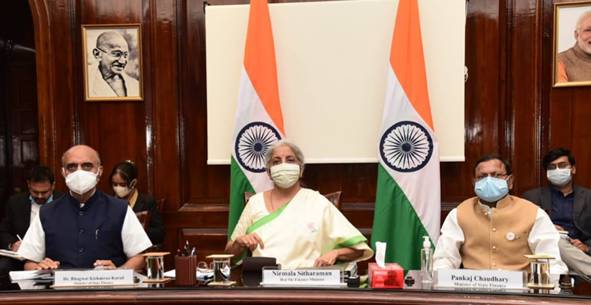
Image

The meeting was attended by Chief Ministers of Assam, Chhattisgarh, Goa, Haryana, Himachal Pradesh, Karnataka, Madhya Pradesh, Manipur, Meghalaya, Mizoram, Nagaland, Puducherry, Sikkim, Tripura, and Uttar Pradesh. Lt Governors of Jammu and Kashmir; Deputy Chief Ministers of Arunachal Pradesh, Bihar, and Delhi.  State Ministers of Andhra Pradesh, Gujarat, Kerala, Odisha, Punjab, Rajasthan, Tamil Nadu, Telangana, Uttarakhand, and West Bengal; State Government Officials of Ladakh, Maharashtra, Jharkhand, Andaman & Nicobar, Chandigarh, Dadra and Nagar Haveli & Daman and Diu, Lakshadweep along withSecretaries of GoI Line Ministries, Chief Secretaries and Finance Secretaries Secretary (Economic Affairs), Joint Secretaries (Economic Affairs) and other officials of Centre and State.

In her opening remarks, Finance Minister emphasized that the economy has been growing significantly post the second wave of pandemic and indicators such as imports, exports, PMI manufacturing, digital payments, etc. have already reached pre-pandemic levels. Smt. Sitharaman highlighted that with favourable international perception of India’s growth and in light of the structural, sectoral & financial, reforms undertaken by Government of India, global and domestic investors are upbeat about the investment attractiveness of the country.  States should leverage this opportunity to scale up investments and growth.

The Finance Minister also said that the Government of India has taken concrete steps to increase capital spending and drive an infrastructure and investment-led growth.  Benefits of higher investment in Infrastructure manifest in form of increased employment opportunities, access to market and materials, improved quality of life and empowerment of vulnerable sections. Union Budget FY 2021-22 has allocated Rs 5.54 lakh crore capital outlay, an increase of 34.5% over last year.  Additionally, around Rs 2 lakh crore allocation is for states and autonomous bodies for their capital expenditure.  Over and above this, a new incentive scheme was launched by GoI for states that could achieve at least 15 % of the target set for FY21-22 by the end of 1st quarter, 45% by end of 2nd quarter, 70 % by the end of 3rd quarter. States that achieve their targets become eligible for incremental borrowing. After the end of 1st quarter, 11 states got permission to mobilise an additional total amount of Rs 15,271 crore.

Smt. Sitharaman further said that the recently launched National Monetization Pipeline includes only Central government assets and State assets have been out of its purview as of now. Smt. Sitharaman suggested that there is a significant potentially monetizable asset base in states which could be leveraged to enhance the capital available for new infrastructure creation and other social sector pressing priorities. 

Smt. Sitharaman urged states to help India become the fastest growing economy in coming years, through facilitating investment attractiveness and expediting ease of doing business measures and undertake power reforms with regards to reduction in AT&C and ACS-RRR. Smt. Sitharaman further emphasized that since in many cases land is one of the major bottlenecks for project on-grounding, states must contrive to smoothen land acquisition procedures and create land banks to be tapped at the time of investment.

The Finance Minister urged the States to strengthen their urban local bodies (ULBs) in light of the fact that there has been decidedly a larger allocation to ULBs than earlier and are increasingly been encouraged to pursue resource mobilization.

Since infrastructure projects require technical assistance in addition to financial resources, Smt. Sitharaman said that GoI Line Ministries and DEA would extend all possible cooperation for technical or advisory assistance to states.  Moreover, the Viability Gap Funding provision will help finance socially relevant but financially unviable projects especially across social sectors.

The Finance Minister said that she is looking forward to listening from states and understand their ideas and plans in the direction of investment enhancement.  In the open interaction, States thanked GoI for organizing this consultative interaction. Each of the states enumerated the list of reforms and pro-active policies they are pursuing to establish good governance and to facilitate investments.

Following are the key ideas and requests shared by states to facilitate investment promotion:

  • Affidavit-based clearance system – ABCS by Karnataka and a similar system in UP to provideall clearances in a time-bound manner including plan approval, identification of land, conversion of land, environmental approvals and electricity supply for new enterprises. Affidavit based clearance is given upfront once basic infrastructure is in place and then the investor has 2 years to procure all approvals post-facto.
  • Transparent Mechanism for Investment Facilitation that involves sharing with states, leads of prospective investors who are in touch with GoI. More emphasis on adoption of technology and increase of digital infrastructure
  • Need for a clear-cut policy and SOPs on environment and forest clearances by Government of India, on the lines of ‘Eco-Economics’ and more powers to States under Forest/Environmental matters
  • Need to reassess the District Mineral Fund policy for fund utilization for leveraging across the entire state instead of confining it to a district. 
  • Fast-track clearance and approvals for externally-aided projects by GoI. Reimbursement requested in advance mode.
  • Similar approach to coastal zone regulations framework and application across all coastal states
  • Need for a legal reassessment and intervention on the legality of conversion of several different types of lands into industrial parks
  • Need for strengthening of the dispute resolution mechanism, post-award contract enforcement and of model concession agreements to strengthen infrastructure PPP ecosystem
  • Special emphasis on enhancing road connectivity in North Eastern states even as a lot of work has been done in this regard. These states are rich in resources such as bamboo, which can potentially be utilized in industry but cannot be sent as of now due to connectivity gaps in road and highways.
  • Instill greater increase in banking penetration as well as credit-deposit ratio in states vis-à-vis their dependent population. Moreover, even if in absence of new banking infrastructure, strengthening of existing banks in terms of manpower and systems should be able to address a critical gap.
  • GoI should engage with NE states to develop a State-specific International trade policy in North East depending on location (Look East, Look West, Look South etc)
  • Development of agri-specific infrastructure (GI labs, cold storage, farmer’s market) throughout the country, but especially in North East since a majority of population is dependent on agriculture.
  • Emphasis on increased air connectivity for Himalayan states to support tourism prospects.
  • Need for policy for offshore wind energy
  • Continuation of Centre’s Scheme of loan for capital expenditure beyond the current financial year

The meeting ended with vote of thanks to the chair.

खनन क्षेत्र की डिजिटल फोटो को जमा करने को लेकर पट्टेदार और आशयपत्र धारकों के लिए नियम बनाए गए (खनिज संरक्षण और विकास (संशोधन) नियम, 2021, Ministry of Mines Press Release dated 10 Nov 2021)

खनिज संरक्षण और विकास (संशोधन) नियम, 2021 अधिसूचित


खनन क्षेत्र की डिजिटल फोटो को जमा करने को लेकर पट्टेदार और आशयपत्र धारकों के लिए नियम बनाए गए

गलत सूचना दिए जाने के खिलाफ कार्रवाई करने का अधिकार भारतीय खान ब्यूरो (आईबीएम) को दिया गया

खान मंत्रालय ने 3 नवंबर, 2021 को खनिज संरक्षण और विकास (संशोधन) नियम- 2021 को खनिज संरक्षण और विकास नियम, 2017 [एमसीडीआर] में संशोधन करने के लिए अधिसूचित किया है।

खनिजों के संरक्षण, व्यवस्थित व वैज्ञानिक खनन, देश में खनिज के विकास और पर्यावरण की सुरक्षा के संबंध में नियम उपलब्ध कराने के लिए एमसीडीआर को खान और खनिज (विकास और विनियमन) अधिनियम, 1957 [एमएमडीआर अधिनियम] की धारा 18 के तहत बनाया गया है।

राज्य सरकारों, उद्योग संघों, खनिकों, अन्य हितधारकों और आम जनता के साथ व्यापक परामर्श के बाद संशोधित नियम बनाए गए हैं। इन नियमों में संशोधन के प्रमुख बिंदु निम्नलिखित हैं:

(i) ये नियम निर्धारित करते हैं कि भारतीय खान ब्यूरो (आईबीएम) के विशिष्ट निर्देश के अनुरूप खान से संबंधित सभी योजना और खंडों को डिजिटल वैश्विक स्थिति निर्धारण प्रणाली (डीजीपीएस) या कुल स्टेशन या ड्रोन सर्वेक्षण के संयोजन का उपयोग कर कुछ या सभी पट्टों के संबंध में तैयार किए जाएंगे।

(ii) पट्टेदार और आशयपत्र धारकों के खनन क्षेत्र की डिजिटल फोटो जमा करने का प्रावधान करने के लिए नए नियम को जोड़ा गया है। 1 मिलियन टन या उससे अधिक की वार्षिक खनन योजना वाले पट्टेदारों या 50 हेक्टेयर या उससे अधिक के पट्टे वाले क्षेत्र केपट्टेदारों को हर साल पट्टा क्षेत्र और पट्टे की सीमा से 100 मीटर बाहर तक की ड्रोन सर्वेक्षण फोटो जमा करने की जरूरत है। अन्य पट्टेदारों को हाई रेजोल्यूनश सैटेलाइट फोटो जमा करने होंगे। इस कदम से न केवल खान नियोजन अभ्यासों, खानों की सुरक्षा में सुधार होगा, बल्कि खनन कार्यों का बेहतर पर्यवेक्षण भी सुनिश्चित होगा।

(iii) नियम 34ए के अनुसार हाई रिजोल्यूशन जियोरिफ्रेन्सड अर्थो-रेक्टिफाइड मल्टीस्पेक्ट्रल सैटेलाइट फोटो जमा करने और ड्रोन सर्वेक्षण के उपयोग के लिए कार्टोसैट-2 उपग्रह लाआईएसएस-IV सेंसर से प्राप्त सैटेलाइट फोटो को भू-संपत्ति मानचित्र के पैमाने पर जमा करने की जरूरत को प्रावधान की प्रविष्टि के मद्देनजर हटा दिया गया है।

(iv) अनुपालन के बोझ को कम करने के लिए दैनिक रिटर्न के प्रावधान को हटा दिया गया है। वहीं, मासिक या वार्षिक रिटर्न में अधूरी या गलत या फर्जी जानकारी के खिलाफ कार्रवाई करने की शक्ति राज्य सरकार के अतिरिक्त आईबीएम को भी दी गई है।

(v) 25 हेक्टेयर से कम के पट्टे वाले क्षेत्र ‘ए’ श्रेणी की खदानों के लिए एक अंशकालिक (पार्ट टाइम) खनन इंजीनियर या एक अंशकालिक भू-वैज्ञानिक की नियुक्ति की अनुमति दी गई है। इससे छोटे खनिकों पर अनुपालन बोझ कम होगा।

(vi) रोजगार के अवसर बढ़ाने के लिए, खान सुरक्षा महानिदेशक द्वारा जारी पात्रता के एक द्वितीय श्रेणी प्रमाण पत्र के साथ विधिवत मान्यता प्राप्त संस्थान की ओर से दिया गया खनन और खान सर्वेक्षण में डिप्लोमा को पूर्णकालिक खनन इंजीनियर के लिए तय पात्रता में जोड़ा गया है। इसके अलावा अंशकालिक खनन इंजीनियर के लिए भी पात्रता जोड़ी गई है।

(vii) नियमों में दंड संबंधी प्रावधानों को युक्तिसंगत बनाया गया है। पहले नियम उल्लंघन की गंभीरता के बावजूद हर नियम के उल्लंघन के लिए 2 साल तक के कारावास या 5 लाख रुपये तक के जुर्माने या दोनों, के प्रावधान थे। नियमों में संशोधन निम्नलिखित प्रमुख शीर्षकों के तहत नियमों के उल्लंघन को वर्गीकृत करता है:

क. बड़े उल्लंघन: कारावास की सजा, जुर्माना या दोनों।

ख. मामूली उल्लंघन: जुर्माने को कम किया गया, ऐसे उल्लंघनों के लिए केवल जुर्माने का दंड निर्धारित किया गया है।

ग. अन्य नियमों के उल्लंघन को अपराध की श्रेणी से हटा दिया गया है। इन नियमों मेंरियायत पाने वाले या किसी अन्य व्यक्ति पर कोई विशिष्ट बाध्यता को आरोपित नहीं किया। इस तरह, 24 नियमों के उल्लंघन को अपराध मुक्त कर दिया गया है।

(viii) निर्धारित अवधि के भीतर अंतिम खदान बंद करने की योजना प्रस्तुत न करने की स्थिति में पट्टाधारक के वित्तीय बीमा या परफॉरमेंस सिक्योरिटी को जब्त करने के प्रावधान को जोड़ा गया है।

(ix) श्रेणी ‘ए’ और श्रेणी ‘बी’ की खदानों के लिए वित्तीय बीमा की राशि को मौजूदा तीन और दो लाख रुपये से बढ़ाकर क्रमशः पांच लाख रुपये और तीन लाख रुपये कर दिया गया है।

संशोधन नियम की अधिसूचना खान मंत्रालय की वेबसाइट  (www.mines.gov.in) पर उपलब्ध है।

FDI in India growing rapidly over last few years. India will witness one of the fastest growth rates across the world.

Ministry of Commerce & Industry, Press Release dated 12 Nov 2021

Shri Piyush Goyal says FDI in India growing rapidly over last few years


Commerce Minister invites South Korea to invest in Defence and Retail

“Plan to manufacture 5 billion vaccines next year”: Shri Piyush Goyal

India will witness one of the fastest growth rates across the world – Shri Goyal

The Minister for Commerce & Industry, Textiles, Consumer Affairs and Food & Public Distribution, Shri Piyush Goyal today said FDI in India has been growing rapidly over the last few years.

“We have today become an attractive and preferred destination for investments,” said Shri Piyush Goyal, while addressing the 4th edition of the India-Korea Business Partnership Forum organised by CII-KITA.

Shri Goyal invited South Korean entrepreneurs to invest in new sectors like Defence and Retail. “We need to complement our complementary strengths in Automobiles, Textiles, Food processing, Leather Products, Metals, Mining, Chemicals and also through some of our traditional sectors like Steel and look at new emerging opportunities in Defence, e-Commerce and Retail.”

Shri Goyal said the Prime Minister Shri Narendra Modi’s ‘Make in India’ initiative is complemented by Her Excellency President Moon’s ‘New Southern Policy’. “Many Korean companies have leveraged the opportunities that India has to offer to ‘Make in India’ for the world using the competitive and comparative advantages of skilled manpower, low cost manufacturing and the Government support that is provided for businesses in India.”

Shri Goyal said during the Covid19 pandemic India has demonstrated our resilience, our capacity to serve the world, our capabilities in terms of being a trusted partner for businesses around the world. “We are widely recognised today as the pharmacy of the world providing medicines and vaccines across continents,” Shri Goyal said. “We plan to manufacture 5 billion vaccines next year and ensure the safety and security of people across the world post-vaccination,” he added.

Shri Goyal said our economy is bouncing back and will possibly see one of the fastest growth rates across the world. “Our Exports are at an all-time high,… Both on the Manufacturing side and on Services our PMI is at all-time highs. We are leveraging our strengths to realise the goal of AatmaNirbhar Bharat, a self-confident and self-reliant India…”

Shri Goyal said the Government has taken several policy measures to support Industry and Services. “We have a very vibrant Production Linked Incentive programme in which many Korean companies have also participated. We have a National Single Window launched recently, a National Infrastructure Pipeline with projects worth over a trillion dollars providing opportunities for Infrastructure companies. We have reduced Corporation taxes to amongst the lowest in the world giving additional incentives to new investments, liberalized our Foreign Investment regime and many other measures to support the growth of the Indian economy,” he said, adding, “In the last four or five years India is home to about 70 Unicorns, nearly half of them only in the last year of the Covid pandemic.”

Global Supply chains should not only be based only on cost but also on trust

Ministry of Commerce & Industry, Press Release dated 12 Nov 2021

Global Supply chains should not only be based only on cost but also on trust – Shri Piyush Goyal


Trade must grow in a mutually beneficial and collaborative way- Shri Goyal

Ensuring transparent, trustworthy and resilient supply chains is at the core of trade revival- Shri Goyal

India has proved its capability and emerged as a resilient and trusted partner to world nations during the pandemic

Shri Goyal delivers the “Keynote Address at Bank of America’s flagship Virtual Conference on the topic “Shifting supply chains globally: Could Make in India see success?”

The Minister for Commerce and Industry, Consumer Affairs, Food and Public Distribution and Textiles, Shri Piyush Goyal today said that COVID-19 highlighted that supply chains should not only be based on cost but also on trust. He opined that ensuring transparent, trustworthy and resilient supply chains is at the core of trade revival and added that India emerged as a source of resilience and a trusted partner during COVID-19. 

He was delivering the “Keynote Address at Bank of America’s flagship Virtual Conference on the topic “Shifting supply chains globally: Could Make in India see success?”, from New Delhi today.

The Minister said that supply and demand disruption brought on by the COVID-19 pandemic have forced manufacturers everywhere to reassess their supply chains. He added that India demonstrated its capacity and capability to the entire world by not only meeting all our international service commitments but also by becoming self-sufficient in production of critical medical supplies (PPEs, testing, masks).

Referring to India’s Pharmaceutical industry, Shri Piyush Goyal said that we are widely recognised as the “Pharmacy of the world” for providing medicines and vaccines to most countries in the world. Speaking of India’s success in implementing the largest vaccination drive in the world, the Minister said that with a plan to manufacture 5 billion doses of vaccine next year, India was aspiring to serve and secure all of the humanity.

Pointing towards the rising economic indicators, Shri Goyal said that India is back in action and the decade is shaping up to be a growth decade, with our exports surging and FDI in-flows and investments following a high growth trajectory. He said that trade must grow in a mutually beneficial and collaborative way.

It may be noted that our Merchandise exports in Apr-Oct 2021 was $ 232 bn (+54% over Apr-Oct 20 & +25% over Apr-Oct 19) and total FDI during the first 4 months of FY 21-22 is 62% more than that of the same period in FY 20-21. India now has 71 unicorns of which 67 were added since 2015.

Shri Goyal said that the Naukri Jobspeak Index for Oct’ 2021 reports a 43%

growth in employment over the same month last year and manufacturing PMI rose to 55.9 in October and service PMI reached a decade high of 58.4 in October. He opined that India has gained trust of global investors, with its investor friendly policies, removal of redundant laws and approvals through single window.

Underscoring India’s strengths as a supply chain alternative, the Minister said that India has a diverse business landscape, skilled workforce and relatively low labour cost. He spoke of India’s ambitious National Infrastructure Pipeline project and said that the new PM GatiShakti Master Plan would lend new life to India’s infrastructure planning and eventually help in reducing logistics cost to 5%.

He stressed that global sentiments are changing from ‘Why India’ to ‘Why not India’ to now “Make in India for the world’ and serving the world from India. “India’s time has come”, he added. He invited the world to ‘Come to India, Invest in India and Make in India, for the world’, and be a part of a large ecosystem of resilient supply chains. 

25 States/UTs have so far undertaken reduction of VAT on Petrol and diesel ( Ministry of Petroleum & Natural Gas Press Release dated 12 Nov 2021)

25 States/UTs have so far undertaken commensurate reduction of  VAT on Petrol and diesel to give relief to the consumers.  This follows the decision of the Government of India on 3rd November, 2021 to significantly reduce Central Excise Duty on Petrol and Diesel by Rs. 5 & Rs. 10 respectively. While doing so, the States were also urged to commensurately reduce VAT on Petrol and diesel to give relief to consumers.

The States/UTs which have not undertaken any reduction in VAT in Petrol and Diesel are: Maharashtra, NCT of Delhi, West Bengal, Tamil Nadu, Telangana, Andhra Pradesh, Kerala, Jharkhand, Chattisgarhand Rajasthan.In Lakshdweep, UT Government procures Kerala paid VAT Petrol and Diesel. Currently, there is Nil tax on Petrol and Diesel in the UT.

Following the cut in VAT, the price of Petrol has come down most in Punjab by Rs 16.02 per litre, followed by Rs 13.43 in UT of Ladakh and Rs 13.35 in Karnataka. Petrol is cheapest in Andaman & Nicobar at Rs 82.96 per litre, while it is Rs 92.02 per litre in Itanagar, Arunachal Pradesh. Petrol is priced at Rs 117.45 per litre in Jaipur, Rajasthan, while it is Rs 115.85 in Mumbai, Maharashtra.

In case of Diesel, the price has come down most in UT of Ladakh by Rs 19.61 per litre, followed by Rs 19.49 in Karnataka and Rs 19.08 in Puducherry. Diesel is cheapest in Andaman & Nicobar at Rs 77.13 per litre, while it is Rs 79.55 per litre in Aizwal, Mizoram. Diesel is priced at Rs 108.39 per litre in Jaipur, Rajasthan, while it is Rs 107.48 in Vizag, Andhra Pradesh.