‘eSanjeevani’, Govt. of India’s free Telemedicine service completes 70 Lakh consultations

‘eSanjeevani’, Govt. of India’s free Telemedicine service completes 70 Lakh consultations


Prime Minister commended eSanjeevani on 6th Anniversary of Digital India Initiatives

Around 1.25 million patients benefitted from the National Telemedicine Service in last 30 days with over 50K daily consultations in last 2 weeks

Union Health Ministry’s National Telemedicine Service – eSanjeevani has crossed another milestone by completing 7 million (70 lakh) consultations. Patients consult with doctors and specialists on a daily basis using this innovative digital medium to seek Health services. In another significant milestone, in June it served around 12.5 lakh patients, which is the highest since the services were launched last year in March.

Currently, the National Telemedicine Service is operational in 31 States/Union Territories.

eSanjeevaniAB-HWC – the doctor-to-doctor telemedicine platform has been implemented at around 21,000 Health and Wellness Centres as spokes and over 1900 hubs, which are located in District Hospitals and Medical Colleges in around 30 States. The doctor-to-doctor telemedicine platform has served over 32 lakh patients. The Ministry of Defence too has hosted a National OPD on eSanjeevaniOPD, where over 100 veteran doctors and specialists – roped in by the Ministry of Defence, serve patients across the country.

In April last year, soon after the first National lockdown, the Union Ministry of Health and Family Welfare launched eSanjeevaniOPD, owing to the ranging pandemic. eSanjeevaniOPD is a patient-to-doctor telemedicine platform and provisions health services to the public in the confines of their homes. 420 OnlineOPDs are hosted on eSanjeevaniOPD and the platform hosts speciality and super-speciality OPDs, as well many of these speciality and super-specialty OPDs are being managed by premium hospitals like AIIMS in 5 States (Himachal Pradesh, Punjab, Telangana, West Bengal, Uttarakhand), King George Medical University in Lucknow etc. From past 2 weeks over 50,000 patients have been utilising eSanjeevani services and around 2000 doctors practice telemedicine on daily basis.

The Union Ministry of Health and Family Welfare is consistently working towards increasing the reach of this state-of-the-art National Telemedicine Service. Last month, the Union Ministry of Health and Family Welfare with the Ministry of Electronics & IT and C-DAC in Mohali had enabled the provision of accessing eSanjeevani services through 3.75 Common Service Centres across the country free of cost, for those on the other side of the digital health divide. On the 1st of July 2021, the eSanjeevani was commended by the Prime Minister during the 6th Anniversary of Digital India initiatives. The Prime Minister had virtually interacted with a beneficiary from East Champaran in Bihar who has been seeking eSanjeevani’s speciality services through its geriatrics and mental health onlineOPD run by KGMC, Lucknow, for her ailing grandmother.

People in many states have been quick to recognise the benefits of eSanjeevani and this has led to an encouraging trend of widespread rapid adoption of this digital modality of seeking Health services. It has led to massive improvement in access to specialised health services, particularly in rural areas. Further, this Service has come in handy for the patients in urban areas as well, especially during the second wave of the ongoing pandemic that has burdened the Healthcare services delivery system in the country.

In a short span of time, Govt. of India’s National Telemedicine Service has started aiding the Indian healthcare delivery system by plugging the digital health divide that exists in urban and rural India. It is also addressing the shortage of doctors and specialists at ground level while reducing the burden on secondary and tertiary level hospitals. In line with the National Digital Health Mission, eSanjeevani is also boosting the digital health ecosystem in the country.

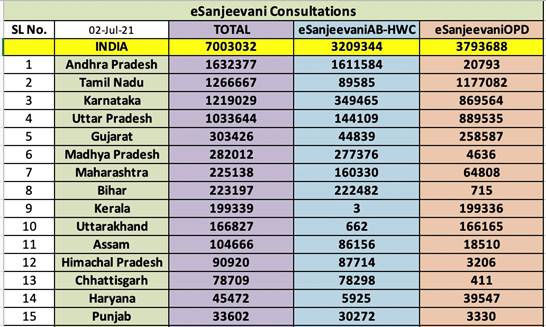
Leading 10 States in terms of adoption (number of consultations) of eSanjeevani are Andhra Pradesh (16,32,377), Tamil Nadu (12,66,667), Karnataka (12,19,029), Uttar Pradesh (10,33,644), Gujarat (3,03,426), Madhya Pradesh (2,82,012), Maharashtra (2,25,138), Bihar (2,23,197), Kerala (1,99,339) and Uttarakhand (1,66,827).

eSanjeevani is also available on Android apart from https://esanjeevaniopd.in/

*****

Ministry of Health and Family Welfare Press release dated 03 July 2021

MV

Stock Limits and Movement Restrictions on Specified Foodstuffs (Amendment) Order, 2021 has been issued with immediate effect from today i.e. 2nd July 2021.

In a consistent effort to crackdown on prices of essential commodities like pulses, Govt. of India has issued a landmark order imposing stock limits on Pulses applicable to wholesales, retailers, millers and importers


Stock Limits and Movement Restrictions on Specified Foodstuffs (Amendment) Order, 2021 has been issued with immediate effect from today i.e. 2nd July 2021.

Under the visionary leadership of Hon’ble PM Narendra Modi, Govt. of India has formulated a multi-pronged strategy to ensure that the prices of the pulses remain controlled

As a result of above series of consistent actions by Government of India, declining trend in the prices of pulses and oilseeds is being witnessed

Highest ever total production of major pulses amounting to 255.8 LMT in 2020-21 with Gram (126.1 LMT) and Moong Dal (26.4 LMT) particularly breaking all of their past records of production

Targeted size of pulses buffer to be maintained in FY 2021-22 under the Price Stabilisation Fund (PSF) has been raised to 23 LMT

To enable real-time monitoring of price of pulses, a web portal has been developed to keep a check on the undesirable practice of hoarding

To soften the prices of edible oils, a mechanism has been institutionalized to monitor the speedy clearance of food commodities at ports

Changes have been made in import policy by shifting Tur, Urad and Moong from restricted category to free category

Average dwell time for clearances of consignments has come down to 6.9 days from 10 to 11 days in case of pulses and 3.4 days in case of edible oils

In a consistent effort to crackdown on prices of essential commodities like pulses, Government of India has issued a landmark order where it has imposed stock limits on pulses applicable to wholesales, retailers, millers and importers. The Removal of Licensing Requirements, Stock Limits and Movement Restrictions on Specified Foodstuffs (Amendment) Order, 2021 has been issued with immediate effect from today i.e. 2nd July 2021

Under this order, stock limits have been prescribed for all pulses except Moong until 31st October 2021 for all States/UTs. Stock limit will be 200 MT (provided there should not be more than 100 MT of one variety) for wholesalers, 5 MT for retailers and it will be the last 3 months of production or 25% of annual installed capacity, whichever is higher, for the millers. Lastly, for importers, the stock limit will be the same as that of wholesaler for stocks held/imported prior to 15th May 2021 and for stocks imported after 15th May 2021, stock limit applicable on wholesalers will apply after 45 days from date of customs clearance. It has also been stated that if the stocks of entities exceed the prescribed limits, they have to be declared on the online portal (fcainfoweb.nic.in) of Department of Consumer Affairs and have to be brought within the prescribed limit within 30 days of the notification of this order.

As a result of a series of consistent actions taken by the Government of India, a declining trend in the prices of pulses and edible oils is being witnessed. Additionally, in the past 6 years, the highest ever total production of major pulses amounting to 255.8 LMT took place in 2020-21 with Gram (126.1 LMT) and Moong Dal (26.4 LMT) particularly breaking all of their past records of production. Since the entire country has been reeling under the impact of the pandemic, the Government has been committed to adopting timely measures and has substantially alleviated the concerns and anguish of the common man. This development has been received with widespread relief by all the sections of the society.

Taking its vision for an ‘Aatmanirbhar Bharat’ forward, the Government of India has formulated a multi-pronged strategy to ensure that the prices of essential commodities like pulses remain controlled. As a part of the Price Monitoring Scheme under which the central government assists the state/UT governments in setting up price monitoring centres, there has been a 50% increase (57 centres in 2014 to 114 centres in 2020) in the number of such price monitoring centres. Incidentally, within the first three months of 2021 itself, 22 more centres have been added. This step will ensure that the reporting of data on prices from all across the country becomes more representative.

As a part of a large-scale digitisation effort, with a commitment to improve the quality of price data, a mobile app was launched by the government on 1st January 2021 to report on prices on a daily basis from the price monitoring centres while showing an actual market location and a dashboard has been developed to generate analysis of price trends and projections. Also, the services of a marketing agency are being utilised to assess the ground level situation.

A mechanism for retail intervention was introduced in 2020-21 to enhance the immediate impact of released pulses from the buffer to cool down retail prices. Moong, Urad and Tur Dal were offered to the States/UTs for supply through retail outlets such as FPS, Consumer Cooperative Society outlets etc. Costs related to milling/processing, transportation, packaging & service charge of NAFED were borne by the Department itself. Additionally, during October, 2020 and January, 2021, 2 LMT of Tur Dal was disposed of through Open Market Sales to control the prices. Furthermore, pulses have also been supplied for welfare and nutrition programmes at MSP for Tur and at 5% discount on MSP in case of Chana.

More recently, guided by the principle that buffer should be built through increased procurement from farmers during bumper production and released to cool down during periods of volatility, effective interventions in the form of increased procurement and increased buffer stock targets were made for price stabilisation. Targeted size of pulses buffer to be maintained in FY 2021-22 under the Price Stabilisation Fund (PSF) has been raised to 23 LMT and chana buffer has been increased to 10 LMT. Also, under the PSF, procurement of 1 LMT of summer moong at MSP is being undertaken in Madhya Pradesh as the quantity offered by the state for procurement under Price Support Scheme (PSS) exceeded the quantity approved for it. This move will increase the income of the farmers as they will receive remunerative prices for their produce and ensure that they do not reduce their area of cultivation for that crop during next season.

In March-April, there was a sustained increase in the price of pulses. The need for an urgent policy decision was felt to send the right signal to the market. For the first time ever, a mechanism has been adopted to declare the real time stock of pulses all over the country, for keeping a check on the undesirable practice of hoarding, which leads in turn to artificial scarcity and price escalation. In order to enable real-time monitoring of the prices of the pulses and ensure transparency, a web portal has been developed by the government to declare the stocks held by different stockholders. States/UTs were requested by the government on 14th May 2021 to register and declare the pulses stocks of Millers, importers, dealers and stockists under the EC Act, 1955. This step has received a positive response as so far there have been 7001 registrations and stocks worth 28.31 lakh MT have been declared.

Parallely, to enhance the domestic availability and smoothen the inflow of pulses import, changes have been made in import policy by shifting Tur, Urad and Moong from restricted category to free category for the period from 15th May 2021 to 31st October 2021. Additionally, 5-year MoUs have been signed with Myanmar for annual import of 2.5 LMT of Urad and 1 LMT of Tur, with Malawi for annual import of 1 LMT of Tur, and MoU with Mozambique for annual import of 2 LMT Tur has been extended by another 5 years. These MoUs will ensure predictability in the quantity of pulses being produced abroad and exported to India, thus benefiting both India and the pulse exporting country.

Moreover, to soften the prices of edible oils, a mechanism has been institutionalized involving nodal offices of the Customs department, FSSAI, Plant Quarantine division to monitor the speedy clearance of food commodities like Crude Palm Oil (CPO) at shipping ports. Also, to protect the interest of consumers, the duty of CPO has been cut by 5% from 30th June 2021 until 30th September 2021. Pertinently, this reduction is only valid until September as the government is committed to protecting the interest of its farmers as well. This reduction will bring down the effective tax rate on CPO to 30.25% from the earlier 35.75% and will, in turn, bring down the retail prices of edible Oils. Further, the duty on Refined palm oil/Palmolein has been reduced to 37.5% from 45%.

A revised import policy for Refined Bleached Deodorized (RBD) Palm Oil and RBD Palmolein has been put in place from 30th June 2021 under which they have been removed from restricted to free category. To further support streamlined and smooth processes at the ports, particularly to speed up clearances delayed due to COVID-19, Standard Operating Procedure for faster clearance of consignments of imports of pulses and edible oils have been prepared. The average dwell time for clearances of consignments has come down to 6.9 days from 10 to 11 days in case of pulses and 3.4 days in case of edible oils.

Despite the disruption of the supply chain and other economic consequences due to the pandemic, the government has proactively taken all possible steps to ensure easy access and uninterrupted supply of essential commodities to all of its citizens across the nation. It will continue to work in mission-mode to cater to the needs of its people and take its vision of ‘Self-reliant India’ forward by not only focusing on building its domestic capability but by aligning its policies like the National Oilseeds Mission with foreign trade.

Ministry of Consumer Affairs, Food & Public Distribution Press release dated 02 July 2021
In order to reduce the edible oil prices, Center reduces the duty on Crude Palm Oil (CPO) by 5%

Ministry of Consumer Affairs, Food & Public Distribution Press Release dated 30 June 2021

In order to reduce the edible oil prices, Center reduces the duty on Crude Palm Oil (CPO) by 5%


Further, to cool down the prices of RBD Palmolein (Refined Palm oil), DFPD recommends removal of the restriction on import of RBD Palmolein and put it in the open general category of imports

 Move to support its availability at lower prices for the domestic consumer

In order to bring relief to the consumers and reduce the edible oil prices, Center has reduced the duty on   Crude Palm Oil (CPO) by 5%.

Further, to cool down the prices of RBD Palmolein (Refined Palm oil), Department of Food & Public Distribution has recommended removal of the restriction on import of RBD Palmolein and to put it in the open general category of imports.

These Moves are expected to lower prices of edible oils for the domestic consumers.

The major edible oils consumed in the country are mustard, soyabean, groundnut, sunflower sesame oil, niger seed, safflower seed, castor and linseed (primary source) and coconut, palm oil, cottonseed, rice bran, solvent extracted oil, tree & forest origin oil. The total domestic demand of edible oils in the country is approximately 250 LMT per year. Around 60% of the edible oils consumed in the country is met through imports. Palm oils (Crude + Refined) import constitutes around 60% of the total edible oil imported, out of which 54% is imported from Indonesia and Malaysia. As the country has to depend heavily on imports to meet the gap between demand and supply, the International prices have an impact on domestic prices of edible oils.

Food inflation including high prices of edible oils has been a cause of concern and therefore the government has been monitoring their prices and taking steps by way of removing bottlenecks to soften prices. A mechanism was institutionalized involving nodal offices of the Customs department, FSSAI, Plant Quarantine division to monitor the speedy clearance of food commodities like pulses and Crude Palm Oil (CPO) at shipping ports.  The international prices of crude edible oil and refined palm oil were showing declining trend in prices over the past one month. Still, the prices of domestic refined palm oil and crude edible oil remained high.

The Government, keeping in view the consumer interest due to rising prices of Edible oil, has reduced the duty on CPO duty by 5%. Further, to cool down the prices of RBD Palmolein (refined Palm oil) , DFPD recommended removal of the restriction on import of RBD Palmolein and put it in the open general category of imports to support its availability at lower prices for the domestic consumer.

Ministry of Finance vide Notification No. 34/2021-Customs dated 29th June, 2021 has cut duty on CPO to 10% from 15% w.e.f. 30th June, 2021 and this will remain in force upto and inclusive of the 30th September, 2021.  The reduction will bring down the effective tax rate on CPO to 30.25% from the earlier 35.75% inclusive of additional agri-cess of 17.5% and 10% social welfare cess. This reduction, in turn, will bring down the retail prices of Edible Oils.

Further, Department of Commerce vide Notification No. 10/2015-2020 dated 30th June, 2021 has issued revised import policy for Refined Bleached Deodorized (RBD) Palm Oil and RBD Palmolein by removing both from restricted to free category. This would be effective with immediate effect and for a period upto 31.12.2021.

Government has reduced duty only till September 2021 to clearly signal to farmers that their interest shall not be compromised. Making India “AtmaNirbhar” in edible oils is our cherished goal and National Oilseeds mission is committed to achieving it by aligning policies including foreign trade.The government will be monitoring the prices on a daily basis expects the industry to pass on full benefits to the consumers.

**** 

Cabinet approves Revamped Distribution Sector Scheme: A Reforms based and Results linked Scheme”

The Union Cabinet, chaired by the Prime Minister, Shri Narendra Modi has approved a Reforms-based and Results-linked, Revamped Distribution Sector Scheme.  The Scheme seeks to improve the operational efficiencies and financial sustainability of all DISCOMs/ Power Departments excluding Private Sector DISCOMs by providing conditional financial assistance to DISCOMs for strengthening of supply infrastructure. The assistance will be  based on meeting pre-qualifying criteria as well as upon achievement of basic minimum benchmarks by the DISCOM evaluated on the basis of agreed evaluation framework tied to financial improvements. Implementation of the Scheme would be based on the action plan worked out for each state rather than a “one-size-fits-all” approach.

The Scheme will have an outlay of Rs.3,03,758 crore with an estimated GBS from Central Government of Rs.97,631 crore. It is proposed that the currently ongoing approved projects under the Schemes of IPDS, DDUGJY along with PMDP-2015 for the Union Territories of Jammu & Kashmir (J&K) and Ladakh would be subsumed in this Scheme, and the savings of their GBS (approx. Rs. 17000 crore) would be part of the total outlay of the Revamped Distribution Sector Scheme under the existing terms and conditions till their sunset on 31″ March, 2022. The funds under these Schemes would be available for the identified projects under IPDS and for the approved ongoing projects under Prime Minister’s Development Program (PMDP) for the Union Territories of J&K and Ladakh under IPDS and DDUGJY till 31 March, 2023.

The Revamped Distribution Sector Scheme aims to improve operational efficiencies and financial sustainability, by providing result-linked financial assistance to DISCOMs for strengthening of supply infrastructure based on meeting pre-qualifying criteria and achieving basic minimum benchmarks. The Scheme would be available till the year 2025-26. REC and PFC have been nominated as nodal agencies for facilitating implementation of the Scheme.

Scheme Objectives

  1. Reduction of AT&C losses to pan-India levels of 12-15% by 2024-25.
  2. Reduction of ACS-ARR gap to zero by 2024-25.
  3. Developing Institutional Capabilities for Modern DISCOMs
  4. Improvement in the quality, reliability, and affordability of power supply to consumers through a financially sustainable and operationally efficient Distribution Sector.

Details

The Scheme provides for annual appraisal of the DISCOM performance against predefined and agreed upon performance trajectories including AT&C losses, ACS-ARR gaps, infrastructure upgrade performance, consumer services, hours of supply, corporate governance, etc. DISCOMs have to score a minimum of 60% of marks and clear a minimum bar in respect to certain parameters to be able to be eligible for funding against the Scheme in that year.

The Scheme has a major focus on improving electricity supply for the farmers and for providing daytime electricity to them through solarization of agricultural feeders. Under the scheme, works of separation of 10,000 agriculture feeders would be taken up through an outlay of almost Rs 20,000 crore, which would be highly beneficial to the farmers who would get access to dedicated agriculture feeders providing them reliable and quality power. This Scheme converges with the Pradhan Mantri Kisan Urja Suraksha Evem Utthan Mahabhiyan (PM-KUSUM) Scheme, which aims to solarize all feeders, and provide avenues for additional income to farmers.

A key feature of the Scheme is to enable consumer empowerment by way of prepaid Smart metering to be implemented in Public-Private-Partnership (PPP) mode. Smart meters would allow consumers to monitor their electricity consumption on a routine basis instead of monthly basis, which can help them in usage of electricity as per their own needs and in terms of the resources available. While in all 25 crore Smart meters are planned to be installed during the Scheme period, priority would be given to install prepaid Smart Meters in a mission mode in the first phase in (i) all Electricity Divisions of 500 AMRUT cities, with AT&C Losses > 15% (ii) all Union Territories (iii) MSMEs and all other Industrial and Commercial consumers (iv) all Government offices at Block level and above (v) other areas with high losses. It is proposed to install approximately 10 crore prepaid Smart Meters by December, 2023 in the first phaseThe progress of installation of prepaid Smart meters would be monitored closely, especially those in Government Offices, to enable their installation in a time-bound manner.

Looking into the scattered nature of agricultural connections and their remoteness from the habitations, agricultural connections would be covered only through Feeder Meters.

Along with the time-bound implementation of prepaid Smart metering for consumers, it is also proposed to take up System metering at Feeder and Distribution Transformer (DT) level with communicating feature simultaneously in PPP mode.

Artificial Intelligence would be leveraged to analyze data generated through IT/OT devices including System Meters, prepaid Smart meters to prepare system generated energy accounting reports every month to enable DISCOMs to take informed decisions on loss reduction, demand forecasting, Time of Day (ToD) tariff, Renewable Energy (RE) Integration and for other predictive analysis. This would contribute a great deal towards enhancing operational efficiency and financial sustainability of the DISCOMs. Funds under the scheme would also be used for development of applications related to the use of Artificial Intelligence in the Distribution sector. This would promote the development of Startups in the Distribution Sector across the country.

Major components:

  1. Consumer Meters and System Meters
    1. Prepaid Smart Meters for all consumers except Agricultural consumers
    2. ~25 crore consumers to be covered under prepaid Smart metering
    3. Prioritizing the urban areas, UTs, AMRUT cities and High Loss areas for prepaid Smart metering i.e. ~10 crore prepaid Smart meter installation by 2023, the balance to be taken up in phases
    4. Communicable AMI meters proposed for all Feeders and Distribution Transformers to enable energy accounting, leading to better planning for loss reduction by DISCOMs
    5. Installing prepaid Smart Meters should help DISCOMs in improving of their operational efficiencies and strengthen DISCOMs to provide better service to consumers
  1. Feeder Segregation
    1. Scheme also focuses on funding for feeder segregation for unsegregated feeders, which would enable solarization under KUSUM
    2. Solarization of feeders will lead to cheap/ free day time power for irrigation and additional income for the farmers.
  1. Modernization of Distribution system in urban areas
    1. Supervisory Control and Data Acquisition (SCADA) in all urban areas
    2. DMS in 100 urban centers
  1. Rural and Urban area System strengthening

Provision for Special Category States:

All Special Category States including North-Eastern States of Sikkim and States/Union Territories of Jammu & Kashmir, Ladakh, Himachal Pradesh, Uttarakhand, Andaman & Nicobar Islands, and Lakshadweep will be treated as Special Category States.

For Prepaid Smart metering, grant of Rs 900 or 15% of the cost per consumer meter worked out for the whole project, whichever is lower, shall be available for “Other than Special Category” States. For “Special Category” States, the corresponding grant would be Rs 1350 or 22.5% of the cost per consumer, whichever is lower.

In addition, the DISCOMs can also avail of an additional special incentive of 50% of the aforementioned grants if they install the targeted number of Smart meters by December, 2023.

For works other than Smart metering, maximum financial assistance given to DISCOMs of “Other than Special Category” States will be 60% of the approved cost, while for the DISCOMs in Special Category States, the maximum financial assistance will be 90% of the approved cost.

Cabinet Committee on Economic Affairs (CCEA) Press release dated 30 June 2021 *******

Mass Emission Standards for E 12 and E 15 Fuels notified

Ministry of Road Transport & Highways Press release dated 29th June 2021

The Ministry of Road Transport and Highways has issued a draft notification dated 28th June 2021,    notifying mass emission standards for E 12( blend of 12% ethanol in gasoline) & E 15 fuels , thereby facilitating their use as automotive fuels.

Comments have been solicited from all concerned stakeholders within a period of thirty days.

MJPS