India poised to achieve Services Export target of $1 Trillion by 2030

Ministry of Commerce & Industry Press Release dated 09th Nov 2021

India poised to achieve Services Export target of $1 Trillion by 2030- Shri Piyush Goyal


India has the potential to become the top services exporter in the world- Shri Piyush Goyal

$89 bn Services Trade surplus in FY 2020-21

Rs. 56,027 crore released under various Export Promotion schemes

“Services” boosting India’s transition from an Assembly economy to a Knowledge based economy- Shri Piyush Goyal

India has transformed from being the ‘Back office’ to the ‘Brain office’ of the world- Shri Goyal

The Minister of Commerce and Industry, Consumer Affairs, Food and Public Distribution and Textiles, Shri Goyal today said that India is poised to achieve services export target of $1 trn by 2030.

He was addressing the gathering at the ‘Services Export Promotion Council- Global Services Conclave 2021” in New Delhi today.

The Minister said that Services are a key driver of India’s economic growth.

He added that services sector provides employment to nearly 2.6 crore people and contributes approximately 40% to India’s total global exports. He added that Services trade surplus was $89 bn in FY 2020-21 and it has been the largest FDI recipient (53% of FDI inflows 2000-2021).

The theme of the Global Services Conclave 2021 was ‘India Serves: Exploring Potential Growth Sectors Beyond IT/ITes’.

Emphasizing that Service sector is our competitive advantage, powered by Skills, Startups and IT Solutions, the Minister said that today, Indian services have the twin power of universal acceptance & universal attraction.

Lauding India’s commitment to enable ‘work from Home’ during the pandemic, Shri Goyal said that, while services trade remained depressed in other countries, India’s services sector showed immense resilience.

“Sectors like tourism, hospitality, etc. which suffered due to COVID-19 is showing revival signs” he added.

Appreciating the spirit that led to rise through the tough times faced by the sector, Shri Goyal said that tough times don’t last, but tough people do. He expressed his admiration for the selfless service of all frontline workers during the COVID 19 pandemic.

The Minister said that in 2020, India became the 7th largest services exporter in the world, moving up the ladder by two positions. Services PMI rose to a decade high of 58.4 in Oct’21, he said.

Emphasizing that India had the potential to become the top services exporter in the world, Shri Goyal said that Services is boosting India’s transition from an assembly economy to a knowledge based economy.

Global sentiments are changing from ‘why India’ to ‘why not India’, he said.

Observing that India has transformed from being the ‘Back office’ to the ‘Brain office’ of the world, Shri Goyal said that today, India’s Services export largely comprise of IT/ITes and stressed that we need to focus on other potential growth sectors.

The Minister listed certain crucial sectors which can catapult India’s services sector on a high growth trajectory such as higher Education. He observed that students from US, Canada etc. prefer India for heritage, art and culture studies.

The Minister assured that the Government was actively pursuing market access opportunities (FTAs) and working on a scheme alternative to SEIS.

He said that the Government supported service sector through Aatmanirbhar Bharat Package, collateral-free Automatic Loans for Businesses, including MSMEs. Rs. 56,027 Crore was released under various Export Promotion schemes.

He spoke of India’s initiatives in Skill development, especially in emerging areas like AI, Big Data, Robotics, etc.

The Minister also highlighted the need for assisting States in formulating a comprehensive export strategy with districts as Export Hubs.

Shri Piyush Goyal said that the Government as a facilitator and enabler, helped Indian Services to grow & touch lives across the globe. He emphasized that Zero Government interference has enabled IT sector to excel. He appreciated the sector for not pursuing incentives but standing on its competitive strength.

Charting the way forward, the Minister said that we must introduce more standards & improve quality. We must move up the value chain in services and pick areas where our strength lies and expand on that, he said. He also said there is a need to expand markets for Legal/Accounting professionals.

Quoting Shri Atal Bihari Vajpayee, Shri Goyal said that “Our aim may be as high as the endless sky, but we should have a resolve in our minds to walk ahead, hand-in-hand for victory will be ours”.
Model Tender Documents (MTDs) for Procurement of Goods and non-Consultancy Services (वस्‍तुओं और गैर-परामर्श सेवाओं की खरीद के लिए मॉडल निविदा दस्तावेज (एमटीडी) (MoF Press Release dated 29th Oct 2021)

Finance Secretary Dr T.V. Somanathan releases Model Tender Documents (MTDs) for Procurement of Goods and non-Consultancy Services


MTDs specifically cater to needs of e-procurement, easing digitization process of Public Procurement & help in achieving goal of Digital IndiaPosted Date

वित्त सचिव डॉ. टी वी सोमनाथन ने वस्‍तुओं और गैर-परामर्श सेवाओं की खरीद के लिए मॉडल निविदा दस्तावेज (एमटीडी) जारी किए


एमटीडी से विशेषकर ई-खरीद की जरूरतें पूरी होती हैं,  सार्वजनिक खरीद की डिजिटलीकरण प्रक्रिया आसान हो जाती है और डिजिटल इंडिया के लक्ष्य को प्राप्त करने में मदद मिलती है

Finance Secretary & Secretary Expenditure, Dr T.V. Somanathan here today released Model Tender Documents (MTDs) for Procurement of Goods and non-Consultancy Services as part of continuous process of review of existing rules & procedures as emphasised by the Hon’ble Prime Minister in his Independence Day speech this year.

MTDs specifically cater to needs relating to e-procurement thereby easing the process for adoption of e-procurement and furthering the ambition of convenient and efficient e-governance of the Government. Such initiatives shall help in achieving the goal of Digital India by easing and standardising the digitization process of Public Procurement.

Tender documents are the critical touch point for the Government with industry and are, therefore, a critical vehicle for implementing policy initiatives on the ground. Uniform sets of tender documents permit Government to express its policies effectively, consistently and uniformly. Uniformity in interpretation and application of public procurement policies and initiatives reflect clarity of application, thereby, increasing compliance and enhancing public confidence in procurement process. Further, apart from sharing best procurement practices, uniform tender documents amplify the positive impact of policy initiatives, bringing economies of scale and increasing competition. They create more efficient market conditions for realising value for tax payers money. Bidders also get broader market access for their products.

Accordingly, Model Tender Documents (MTDs) have now been developed for the procurement of Goods and non-Consultancy Services. These MTDs rationalise and simplify the structure of tender documents. Besides aligning provisions with various procurement policies of the Government, like policies related to Micro and Small Enterprises, preference to Make in India and benefits to Start-ups, MTDs incorporate national and international best practices. The MTDs have been developed after a two stage, extensive consultation with Ministries/ Departments/ Central Public Sector Undertakings, other organisations and individual experts.

MTDs issued by the Department of Expenditure , Ministry of Finance  will be guiding templates . In keeping with the Government’s Digital India thrust, the MTDs are being issued in soft template for enabling easy customisation by user departments. Ministries/ Departments shall be competent to suitably customise this document to suit their local/ specialised needs. A separate detailed Guidance Note, as a guide to use of each MTD has also been prepared to help the procuring officials in utilising each MTD. Model Tender Documents, issued by Department of Expenditure (DoE), Ministry of Finance, will be guiding templates.

Government organisations procure various goods and non-consulting services in order to comply with their duties and responsibilities. To improve good governance, transparency, fairness, competition, and value for money in public procurement, the Government of India has taken a number of significant policy initiatives in public procurement in the recent past. The General Financial Rules were issued after comprehensive review in March, 2017. Additionally three procurement Manuals, the Manual for Procurement of Goods, 2017, Manual for Procurement of Consultancy and Other Services, 2017 and Manual for Procurement of Works, 2019, have also been developed.

The formulation and release of these Model Tender Documents are a part of continuous process of review of existing rules and procedures and being monitored by Cabinet Secretary as a special campaign during 2nd October, 2021 to 31st October, 2021.

Documents Links:

https://doe.gov.in/sites/default/files/Model%20Tender%20Document%20for%20Procurement%20of%20Goods_0.pdf

https://doe.gov.in/sites/default/files/Model%20Tender%20Document%20for%20Procurement%20of%20Non%20Consultancy%20Services.pdf

Guidelines for reforms in Public Procurement and Project Management (Ministry of Finance Press Release dated 29th Oct 2021)

Finance Secretary Dr T.V. Somanathan releases guidelines for reforms in Public Procurement and Project Management


Guidelines attempt to incorporate into the realm of Public Procurement, innovative rules for faster, efficient and transparent execution of projectsPosted Date:- Oct 29, 2021

Finance Secretary & Secretary Expenditure, Dr T.V. Somanathan released guidelines to usher in reforms in Public Procurement and Project Management here today. The formulation and release of these guidelines is a part of continuous process of review of existing rules and procedures as emphasised by the Hon’ble Prime Minister during his Independence Day address this year. This is being monitored by Cabinet Secretary as a special campaign during 2nd October, 2021 to 31st October, 2021.

The draft of the guidelines was prepared under the aegis of the Central Vigilance Commission (CVC) after a detailed consultative process involving experts from various fields of public procurement and project management. The Department of Expenditure (DoE), Ministry of Finance, was nominated to issue the guidelines after soliciting and detailed consideration of the comments of Ministries/ Departments.

These guidelines attempt to incorporate into the realm of Public Procurement in India, innovative rules for faster, efficient and transparent execution of projects and to empower executing agencies to take quicker and more efficient decision in public interest. Some of the improvements include prescribing strict timelines for payments when due. Timely release of ad hoc payments (70% or more of bills raised) is expected to improve liquidity with the contractors especially Micro, Small and Medium Enterprises (MSMEs).

As part of Government’s Digital thrust, Electronic Measurement Books have been prescribed as a means of recording progress of works. This system, along with other IT based solutions, proposed in the guidelines, will help in realising the dream of efficient Digital India, facilitate faster payments to contractors and reduce disputes.

Alternative methods for selection of contractors have been permitted, which can improve speed and efficiency in execution of projects. In appropriate cases, quality parameters can be given weightage during evaluation of the proposal in a transparent and fair manner, through a Quality cum Cost Based Selection (QCBS), as an alternative to traditional L1 system.

Executing public projects on time, within the approved cost and with good quality has always been a challenge. As the pace of economic development steps up careful examination of procedures and rules is essential to ensure unwarranted roadblocks are removed and new innovations utilized for increasing value for money of the taxpayer.

The Central Vigilance Commission (CVC), the Comptroller & Auditor General (CAG) and the National Institution for Transforming India (NITI) Aayog had carried out detailed analysis of the procedures and rules for public procurement and project management and had suggested changes in strategies to meet challenges of present and future public procurement.

Order Link:

https://doe.gov.in/sites/default/files/General%20Instructions%20on%20Procurement%20and%20Project%20Management.pdf  

****

RM/KMN

Automotive Industry : Notification of Mass Emission Standards for E12 AND E15 fuels

Ministry of Road Transport & Highways

Notification of Mass Emission Standards for E12 AND E15 fuels

Posted Date:- Oct 13, 2021

Ministry of Road Transport and Highways vide GSR 728 (E) dated 11th October 2021 has notified mass emission standards for E 12 (12% Ethanol with Gasoline) and E15 (15% Ethanol 12 with gasoline) fuels. This will enable the Automotive Industry to manufacture E 12 and E 15 compliant motor vehicles.

*****

Click here to see Notification

MJPSRelease Id :-1763584

Supporting Startups in Infrastructure: Workshop organised by DEA and Invest India

A virtual workshop on ‘Supporting Startups in Infrastructure’ was organised by the Department of Economic Affairs (DEA), Ministry of Finance, and Invest India today. This workshop was an effort towards mainstream participation of startups in infrastructure, for sustainably and efficiently scaling up public infrastructure delivery. The workshop was chaired by Secretary DEA, Shri Ajay Seth, and with opening remarks from Additional Secretary, DEA, Shri K. Rajaraman. Special addressees included Additional Secretary, DPIIT, Shri Anil Agrawal and MD & CEO, Invest India, Shri Deepak Bagla.

The workshop addressed experiences and success stories of sourcing or having sourced solutions from startups, as well as benefits and challenges of onboarding startups. In this regard, presentations were made by Shri Kunal Kumar, Joint Secretary, Ministry of Housing and Urban Affairs (MoHUA) and Mission Director, Smart Cities Mission, Shri Roshan Popli, Chief Information Officer, Airports Authority of India, and Dr Neeru Bhooshan, CEO, Pusa Krishi.

Key infrastructure players from the private sector, including startups, also shared experiences of working with innovative solutions in public infrastructure delivery, including within the government. Startup India also presented a framework for enabling ministries and departments to launch their own startup challenges. The workshop was attended by more than 150+ officials from all infrastructure ministries, key PSUs, and senior representatives of private startups.

Shri Seth, Secretary, DEA, in his address emphasised the importance of not to build more but to build smart with smart design to improve ease of access. He said that mainstreaming technology and leveraging analytics in core infrastructure activities such as construction, asset management and mobility, etc., are some of the critical areas where startups and governments can begin to collaborate.

The workshop also saw the launch of a report ‘Driving Innovations in Infrastructure: The Startup Way’, which aims to highlight the importance of accelerating growth in the infrastructure sector by leveraging home grown technologies and solutions. The report is available for public circulation on the Invest India and India Investment Grid websites.

The workshop concluded with an address by Joint Secretary, DEA, Shri. Baldeo Purushartha, reiterating the importance of Infratech and urging ministries and departments to leverage innovations and startups for efficient infrastructure and smart service delivery.

This workshop, organised as part of the Azadi ka Amrit Mahotsav (AKAM) under DEA, was a precursor for an actionable way forward, wherein ministries and departments will work towards launching their own startup challenges in partnership with DEA and Invest India.

MOF Press Release dated 02 Sept 2021

Indian startup ecosystem has the potential & promise to make India the Innovation & Invention hub of the world

Indian startup ecosystem has the potential & promise to make India the Innovation & Invention hub of the world: Shri Piyush Goyal


In 75 weeks of “Azadi ka Amrit Mahotsav, NSAC should facilitate 75 startups to become unicorns by the 75th Independence Day: Shri Goyal

Tier II & Tier III cities to be the backbone of Start up revolution and catalyze employment generation with strengthen forward & backward linkages.- Shri Goyal

21 unicorns in last 6 months inspire all to Dream Big & Achieve Bigger – Shri Goyal

Union Minister of Commerce & Industry Shri Piyush Goyal chairs a meeting of “National Startup Advisory Council

Government is committed to cut red tape, improve “Ease of Doing Business” , provide financial assistance through Startup seed fund, supporting incubators, enhancing skills- Shri Goyal

Ministry of Commerce & Industry Press Release dated 16 Aug 2021

Union Minister of Commerce & Industry, Consumer Affairs, Food & Public Distribution and Textiles, Shri Piyush Goyal chaired the virtual meeting of  “National Startup Advisory Council here today. While addressing the meeting, the Minister said that implementation of ideas of Financing, Mentorship, Taxation etc. will enable us to strengthen our startup ecosystem further. He said our startup ecosystem is a reflection of our youth’s Energy, Enthusiasm and Agility and Startup India movement has brought a ‘change in mindset’ from ‘can do’ to ‘will do’. 

In his address, he said that our startup ecosystem has the potential & promise to make India the Innovation & Invention   hub of the world and National Startup Advisory Council on AC has been working tirelessly to pave the way  forward for budding Startup Entrepreneurs in India. Shri Goyal said that NSAC will nurture Startups to aim for higher Competitiveness & make India the Startup Capital.  He urged that in the 75 weeks of Azadi ke Amrit Mahotsav, NSAC should facilitate 75 startups to become unicorns by the 75th Independence Day. He further added that the Prime Minister’s mantra of ‘Sabka Saath, Sabka Vikas, Sabka Vishwas aur Sabka Prayas’ finds resonance with our startups. He said our aim is to make ‘Startup India’ a symbol of National Participation & National Consciousness. 

In this age of COVID-19, when everyone is overcoming severe stress, he said that he was happy to see the resilience & ‘never say die’ spirit of our startup ecosystem. The Minister said the 21st century is the ‘Century of Startups’ & with our   Startups it is the ‘Century of India’. He said 21 unicorns in last 6 months inspire all to Dream Big &  Achieve Bigger. With nearly 60 unicorns, India has one of the largest startup stable in the entire world.  

The Minister urges to start a STARTUP revolution, he said with NEP 2020, schools will now sow the seeds of      startup ideas at a young age. He said youth are job creators of tomorrow and drivers of innovation & leaders of 4th Industrial Revolution. Shri Goyal said that he wanted to see new startups emerge across India especially in Tier II & Tier III cities. He said, this will catalyze employment generation & strengthen forward & backward linkages.

Shri Goyal asked DPIIT to now act as a ‘Facilitator’ with Open doors, Open Arms & Open Mind. He said that Government is committed to cut red tape, improve Ease of Doing Business  provide financial assistance through Startup seed  fund, supporting incubators, enhancing skills and this holistic approach has intended to resolve the issues relating to capital mobilization, support innovation with tinkering labs, & meet the capacity &  capability requirements of startups. 

He said today, our vision expands beyond the traditional models of growth, our aim is to create a New India i.e. an Aatmanirbhar Bharat and Startups are the key to building an Aatmanirbhar Bharat with Courage, Collaboration & Commitment and to achieve such an ambitious target we need a participative approach from all stakeholders. He said Industry must help create Startup Superstars by identifying innovators & investing in talent. 

 Our aim must be to make our startups grow beyond our   geographical boundaries & create global impact .

The meeting was attended by top stake holders, officials  and existing  start ups in the country. Some of them include Shri M.R. Kumar, Chairman, LIC; Shri R.S. Sharma, CEO, National Health Authority; Shri Rajan Anandan, Managing Director, Sequoia Capital; Shri Ritesh Agarwal, Founder, OYO Rooms; Shri Manoj Kohli, Country Head, Softbank India; Shri Abhiraj Bhal, Co-founder, UrbanCompany; Shri Kunal Bahl, Co-founder, Snapdeal; Shri Vineet Aggarwal, President, ASSOCHAM; Shri Sanjeev Bhikchandani, Co-founder, InfoEdge; Shri Mohandas Pai, Co-founder & Chairman, Aarin Capital; Shri Prashant Prakash, Partner, Accel Partners; Smt. Anjali Bansal, Founder, Avaana Capital; Shri Sharad Sharma, Founder, iSpirt; Smt. Debjani Ghosh, President, NASSCOM

*****

Open Network for Digital Commerce (ONDC)

Shri Piyush Goyal chaired Open Network for Digital Commerce (ONDC)


Move to democratise digital commerce & move it from platform-centric model to an open-network model

Success story of platform independent protocols like UPI to be replicated to provide alternatives to propriety e-commerce sites and create mechanisms to connect buyers and sellers

Merchants will be able to save their data under ONDC to build credit history and reach consumers

Go ahead for rapid development and deployment of ONDC

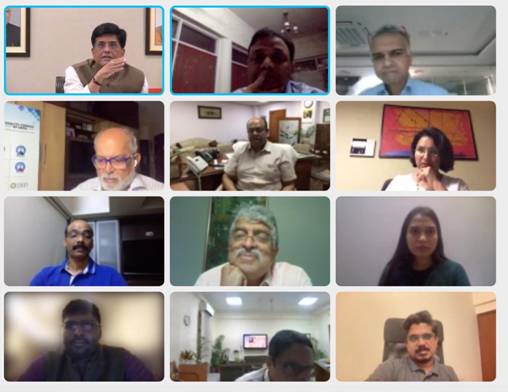
The Union Minister of Commerce & Industry Shri Piyush Goyal today chaired a meeting for the review of the Open Network for Digital Commerce (ONDC) initiative of DPIIT. Shri Goyal deliberated with the members of the advisory council& experts on how the initiative will democratise digital commerce & move it from platform-centric model to an open-network model.The advisory council includes Shri R.S. Sharma, CEO, National Health Authority, Shri Nandan M. Nilekani, non-executive Chairman of Infosys, Shri Adil Zainulbhai, Chairman, QCI and Capacity Building Commission, Ms Anjali Bansal, Founder & Chairperson, Avaana Capital, Shri Arvind Gupta, Co-founder & Head, Digital India Foundation, Shri DilipAsbe, MD & CEO, NPCI, Shri Suresh Sethi, MD & CEO, NSDL, Shri Praveen Khandelwal, Secretary-General, Confederation of All India Traders and Shri Kumar Rajagopalan, CEO, Retailer Association of India.

While reviewing the progress, the Minister said that ONDC will work for everything and not just limited to products but also services. Shri Goyal suggested that some guidelines or basic infrastructure, size, ethics and principles should be there. Shri Goyal further added that security and data privacy and confidentiality must be ensured. He said that this willcreate new opportunities and remove monopolistic environments.

It may be noted, Open Network for Digital Commerce christened ONDC is globally first-of-its-kind initiative that aims to democratise Digital Commerce, moving it from a platform-centric model to an open-network. As UPI is to the digital payment domain, ONDC is to  e-commerce in India. ONDC will enable, buyers and sellers to be digitally visible and transact through an open network. no matter what platform/application they use. ONDC will empower merchants and consumers by breaking silos to form a single network to drive innovation and scale, transforming all businesses from retail goods, food to mobility

Advisory Council was constituted on July 5 and its first meeting was convened on July 16, 2021.The Advisory Council adopted its role to guide and mentor design, implementation and national rollout of ONDC in addition to the scope of the erstwhile Steering Committee. The Advisory Council discussed the key design elements national rollout. Its recommendations have been incorporated in the implementation plan developed.

ONDC shall take all measures to ensure confidentiality & privacy of data in the network

            – ONDC shall not mandate sharing of any transaction-level data by participants  with ONDC.

– ONDC will work with its participants to publish anonymised aggregate metrics on network performance without compromising on confidentiality and privacy

            – ONDC will be compliant with the Information Technology Act, 2000 and designed for compliance with the emerging Personal Data Protection Bill.

In addition to establishing ONDC to manage the Open Network the Government may consider establishing an Independent Regulatory Authority for eCommerce (such as SEBI for Capital Market).

ONDC shall initially give special attention help onboard small and medium players. ONDC to plan for a well developed Information, Education & Communication campaign to educate, encourage and to address any apprehensions of various network participants. ONDC should evolve over time as a self-sustaining entity generating income for its operations and surplus for continuous investment in technology, processes and network development. This is very workable option considering the significant benefits it will extend to the ecosystem players

Chaired a meeting of the Open Network for Digital Commerce (ONDC).

Deliberated with the members of the board & experts on how the initiative will democratise digital commerce & move it from platform-centric model to an open-network model. pic.twitter.com/RQLQFaGUjm— Piyush Goyal (@PiyushGoyal) August 13, 2021

Ministry of Commerce & Industry Press Release dated 13 Aug 2021

APEDA organizes orientation programme for start-ups for boosting agricultural products exports from Rajasthan

In a bid to give fillip to the start-up ecosystem for promotion of agricultural products exports, APEDA in association with Agriculture University, Jodhpur, Rajasthan organized a programme where more than 430 farmers, students, traders and other stakeholders had participated.

The orientation programme for start-ups in agri-export, was aimed at creating awareness among farmers and agriculture students in the western region of Rajasthan on agri-exports. The focus of the programme was to urge the Rajasthan government to adopt ‘agriculture export’ as a business opportunity for boosting livelihood and farmers’ income.

The aim of programme organized on 28th July, 2021 through virtual mode was to support the farmers, agriculture students and other stakeholders in the export oriented supply chain which generate rural employment. 

During the programme, APEDA officials explained issues around agricultural exports and challenges in the export oriented agri supply chain.  

APEDA officials also explained various Government initiatives on agriculture exports such as Financial Assistance Schemes, Risk Management in agriculture export, RBI Guidelines, Pesticides issues, Digital Traceability in agri supply chain, etc. 

The Agriculture department of Rajasthan, Agricultural University, Jodhpur and other state government officials discussed the agriculture export potential from the west zone of Rajasthan especially in the crops such as barley, caster, legums, mustard, pomegranate, dates, etc.  The programme also discussed the export potential of commercial crops including Capparis decidua, (referred locally as karira or kerda), Acacia Senegal (Kummat), Prosopis cenararia (Sangari).

Besides the export potential of cumin, isabgol, pomegranate, anise seeds, caster, guargam, hina etc were discussed.   The programme emphasized the need for automation, mechanization in agriculture for achieving quality production which would enhance competitiveness in the international market.  The officials from Rajasthan Agricultural Marketing Board (RSAMB) have participated in the meet.

APEDA has been focusing on collaborative approach to bring synergy with number of organizations and institutions having inherent professional and specialized expertise in different areas for capacity building of various stakeholders and providing solutions for addressing some of the identified interventions for the development of Agriculture and its export enhancement in consonance with the objectives set under Agri Export Policy (AEP) announced by Government of India in 2018.

APEDA has been engaged with State Governments for the implementation of AEP. The States of Maharashtra, U.P., Kerala, Nagaland, Tamil Nadu, Assam, Punjab, Karnataka, Gujarat, Rajasthan, Andhra Pradesh, Telangana, Manipur, Sikkim, Uttarakhand and M.P. have finalized the State specific Action Plan for exports while the action plans of other States are at different stages of finalization.

Ministry of Commerce & Industry Press Release dated 30 July 2021

52,391 entities recognized as startups.

Ministry of Commerce & Industry Press Release dated 28 July 2021

52,391 entities recognized as startups.


More than 5.7 lakh jobs have been reported by such start ups.

As per Industry estimates, there are 53 unicorns currently in India, with a tentative valuation of Rs. 1.4 lakh crore.

Indian startup ecosystem is widely recognized as the 3rd largeststartup ecosystem. As of 14th , July 2021 total 52,391 entities are recognized as startups by Department for Promotion of Industry and Internal Trade (DPIIT) and as of 14th July 2021, more than 5.7 lakh jobs have been reported by more than 50,000 startups.

As per Industry estimates, there are 53 unicorns currently in India, with a tentative valuation of Rs. 1.4 lakh crore. Valuation of a company is a market driven exercise and the data of individual companies is not maintained by DPIIT.

The Startup India initiative is a flagship initiative of Government of India which aims to build a strong ecosystem for nurturing innovation and Startups in the country. A 19-point Startup India Action Plan was launched in January 2016 which paved the way for the introduction of a number of policy initiatives to build a strong, conducive, growth-oriented environment for Indian startups. Hon’ble Prime Minister unveiled Startup India: The Way Ahead at 5 years celebration of Startup India on 16th January 2021 which includes actionable plans for promotion of ease of doing business for startups, greater role of technology in executing various reforms, building capacities of stakeholders and enabling a digital Aatmanirbhar Bharat.

This information was given by the Minister of State in the Ministry of Commerce and Industry, Shri SomParkash, in a written reply in the Lok Sabha today.