The Goods and Services Tax Network (GSTN) has introduced a Simplified GST Registration Scheme by inserting Rule 14A in the CGST Rules, 2017. This scheme is effective from 1 November 2025 and is designed specifically to reduce procedural complexity and compliance costs for small taxpayers with limited tax exposure.
2. Objective of Rule 14A
Rule 14A has been introduced with the following objectives:
To promote voluntary GST compliance among small businesses and service providers
To provide a fast-track, automated registration mechanism
To reduce manual scrutiny and documentation
To ensure quick market entry for low-risk taxpayers with minimal tax liability
3. Eligibility Criteria
A taxpayer can opt for GST registration under Rule 14A only if all the following conditions are satisfied:
Monthly output tax liability on supplies made to registered persons does not exceed ₹2.5 lakh
The applicant does not hold more than one GST registration in the same State or Union Territory under the same PAN
⚠️ Non-fulfilment of any condition disqualifies the applicant from this simplified route.
4. Key Features of the Simplified Registration Scheme
Registration is granted within 3 days from submission of FORM GST REG-01
b. Mandatory Aadhaar Authentication Aadhaar verification is compulsory for:
The Primary Authorised Signatory
At least one Promoter or Partner (in case of firms, LLPs, companies, etc.)
c. Single Registration Restriction
Only one GST registration per State/UT per PAN is permitted under Rule 14A
d. Application Declaration
While filing FORM GST REG-01, the applicant must explicitly select “Yes” for opting registration under Rule 14A
5. Procedure for Withdrawal of Registration under Rule 14A
Taxpayers who wish to withdraw their GST registration obtained under Rule 14A must comply with the following:
a. Mandatory Return Filing
All GST returns from the date of registration till withdrawal must be duly filed
b. Minimum Return Filing Requirement
Withdrawal before 1 April 2026 → Minimum 3 months’ returns must be filed
Withdrawal on or after 1 April 2026 → Minimum 1 tax period’s return must be filed
c. Restriction on Withdrawal Withdrawal will not be permitted if any of the following are pending:
Application for amendment of registration
Application for cancellation of registration
Departmental cancellation proceedings initiated
6. Conclusion
Rule 14A marks a progressive reform in GST administration, especially for small taxpayers. By offering:
Quick, automated registration
Minimal documentation
Simplified exit mechanism
the scheme significantly enhances ease of doing business and encourages voluntary GST participation, while maintaining adequate safeguards for revenue protection.
The case is M/s Sahil Enterprises vs. Union of India (Tripura High Court, January 2026).
The purchaser (Sahil Enterprises) bought goods and paid GST to the supplier between July 2017 and Jan 2019.
The supplier reflected sales in GSTR-1 but filed ‘Nil’ GSTR-3B returns, thus not depositing the tax collected with the government.
Tax authorities denied Input Tax Credit (ITC) to the purchaser, blocked its credit ledger, and issued demands for tax, interest, and penalty.
Core Legal Issue
Whether a bona fide purchaser (one acting in good faith and without fraud/collusion) can be denied ITC solely because the supplier failed to remit the GST collected to the government under Section 16(2)(c) of the CGST Act, 2017.
Court’s Key Findings
Unrealistic Burden: The court observed that a purchaser has no control or statutory method to verify whether the supplier actually deposited the tax. Imposing such a burden would be impossible and unfair.
Reading Down Section 16(2)(c): The court applied the legal principle of “reading down” to interpret Section 16(2)(c) in a way that protects bona fide transactions. This means the provision should not be used to deny ITC to honest buyers, but only to situations involving fraud, collusion, or non-genuine transactions.
Precedent Support: The decision relied on prior judicial interpretations, particularly a Delhi High Court ruling in On Quest Merchandising India Pvt. Ltd., which was implicitly approved by the Supreme Court, as authority for protecting bona fide purchasers.
No Constitutional Invalidity Held: The court did not strike down Section 16(2)(c) as unconstitutional per se, but clarified its limited application so as not to penalize honest taxpayers.
Outcome
The Tripura High Court set aside the demand and denial of ITC against the petitioner.
It directed authorities to allow the claimed ITC that had previously been denied.
Practical Impact
This judgment ensures that:
A genuine purchaser who paid GST cannot be penalized for a supplier’s subsequent non-deposit of tax — provided there is no fraud or collusion.
Section 16(2)(c) must be interpreted in a manner that doesn’t place an impossible compliance burden on honest businesses.
Question 1: How can a recipient avail ITC of wrongly rejected Invoices/ Debit notes/ECO-Documents in IMS as corresponding GSTR-3B of same tax period was also filed by recipient?
Answer: In such cases recipient can request to the corresponding supplier to report the same record (without any change) in same return period’s GSTR-1A or respective amendment table of subsequent GSTR-1/IFF. Thus, recipient can avail the ITC basis on amended record by accepting such record on IMS and recomputing GSTR-2B on IMS. Here the recipient will get ITC of complete amended value as original record was rejected by the recipient.
However, recipient will be able to take ITC for the again furnished document by the supplier, as stated above, only in the GSTR-2B of the concerned tax-period.
Question 2: If any original record is rejected by the recipient and supplier furnishes the same record in GSTR-1A of same tax period or in the amendment table of GSTR-1/IFF of subsequent period, till the specified time limit, then what impact it will have on supplier’s liability?
Answer: In case supplier had furnished an original record in GSTR-1/IFF but the same record was rejected wrongly by the recipient in IMS. In such cases supplier on noticing the same in the supplier’s view of IMS dashboard or on request of recipient, may furnish the same record again (without any change) in GSTR-1A of same tax period or in the amendment table of GSTR-1/IFF in any subsequent period, till the specified time limit, then the liability of supplier will not increase. As amendment table take delta value only. Thus, in present case of same values, differential liability increase will be zero.
Question 3: As a recipient taxpayer, how to reverse ITC of wrongly rejected Credit note in IMS as the corresponding GSTR-3B has already been filed?
Answer: In such cases recipient can request the concerned supplier to furnish the same Credit note (CN) without any change in the same return period’s GSTR-1A or in amendment table of subsequent period’s GSTR-1/IFF. Now recipient can reverse the availed ITC based on the amended CN by accepting the CN on IMS. Hence, the recipient’s ITC will get reduced with complete amended value, as soon as the recipient recomputes GSTR-2B on IMS. The reduced value is same as that of the value of original CN as in this case the complete original CN was rejected by the recipient.
Question 4: If any original Credit note was rejected by the recipient and supplier furnishes the same credit note in GSTR-1A of same tax period or in the amendment table of GSTR-1/IFF of any future tax-period, till the specified time limit, then what impact it will have on supplier’s liability?
Answer: At first instant the supplier’s liability will be added back in the open GSTR-3B return, because of original credit note rejection by the recipient. However, as the supplier furnishes the same credit note in GSTR-1A of same tax period or in amendment table of GSTR-1/IFF in any subsequent period, supplier’s liability for this amendment will get reduced again corresponding to the value of amended CN (which in this case is same as original). Thus, net effect on liability of supplier will be only once.
GST Council recommends waiving interest and penalties for demand notices issued under Section 73 of the CGST Act (i.e. the cases not involving fraud, suppression or wilful misstatement, etc.) for the fiscal years 2017-18, 2018-19 and 2019-20, if the full tax demanded is paid upto 31.03.2025.
GST Council recommends the time limit to avail input tax credit w.r.t. any invoice or debit note under Section 16(4) of CGST Act, through any GSTR 3B return filed upto 30.11.2021 for FY 2017-18, 2018-19, 2019-20 and 2020-21, may be deemed to be 30.11.2021
Council has recommends monetary limit of Rs. 20 lakh for GST Appellate Tribunal, Rs. 1 crore for High Court and Rs. 2 crore for Supreme Court, for filing of appeals by the Department, to reduce litigation
GST Council recommends reduction of the quantum of pre-deposit required to be paid for filing of appeals under GST
GST Council recommends amending provisions of CGST Act to provide that the three-month period for filing appeals in GST Appellate Tribunal will start from a date to be notified by the Government
To ease the interest burden of the taxpayers, GST Council recommends to not levy interest u/s 50 of CGST Act in case of delayed filing of return, on the amount which is available in Electronic Cash Ledger (ECL) on the due date of filing of the said return
GST Council recommends sunset clause from April 1st, 2025 for receipt of any new application for Anti-profiteering
GST Council recommends exemption from Compensation Cess leviable on the imports in SEZ by SEZ Unit/developer for authorised operations from 1st July, 2017
GST Council recommends 12% GST on milk cans (steel, iron, aluminum) irrespective of use; Carton, Boxes And Cases of both corrugated and non-corrugated paper or paper-board; Solar cookers whether single or dual energy source; and sprinklers including fire water sprinklers.
GST Council recommends exemption of certain services provided by Indian Railways to common man and also intra railway supplies
GST Council recommends certain exemptions related to accommodation services, providing relief to students and working professionals
GST Council recommends to roll-out the biometric-based Aadhaar authentication of registration applicants on pan-India basis in a phased manner
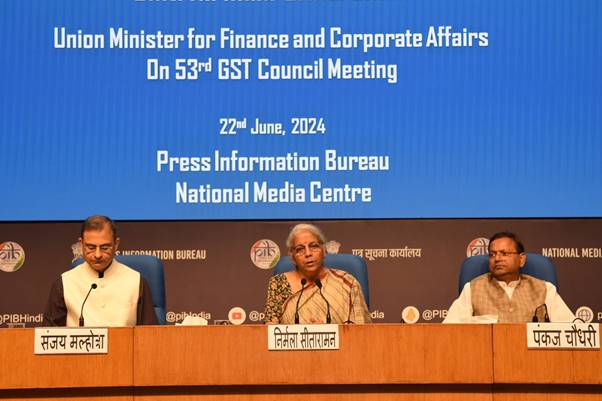
The 53rd GST Council met under the Chairpersonship of Union Minister for Finance & Corporate Affairs Smt. Nirmala Sitharaman in New Delhi today. The meeting was also attended by Union Minister of State for Finance Shri Pankaj Chaudhary, Chief Ministers of Goa and Meghalaya; Deputy Chief Ministers of Bihar, Haryana, Madhya Pradesh, and Odisha; besides Finance Ministers of States & UTs (with legislature) and senior officers of the Ministry of Finance & States/ UTs.
The GST Council inter alia made the following recommendations relating to changes in GST tax rates, measures for facilitation of trade and measures for streamlining compliances in GST.
Changes in GST Tax Rates:
I. Recommendations relating to GST rates on Goods
A. Changes in GST rates of goods
A uniform rate of 5% IGST will apply to imports of ‘Parts, components, testing equipment, tools and tool-kits of aircrafts, irrespective of their HS classification to provide a fillip to MRO activities subject to specified conditions.
All milk cans (of steel, iron and aluminium) irrespective of their use will attract 12% GST.
GST rate on ‘carton, boxes and cases of both corrugated and non-corrugated paper or paper-board’ (HS 4819 10; 4819 20) to be reduced from 18% to 12%.
All solar cookers whether single or dual energy source, will attract 12% GST.
To amend existing entry covering Poultry keeping Machinery attracting 12% GST to specifically incorporate “parts of Poultry keeping Machinery” and to regularise past practice on ‘as is where is’ basis in view of genuine interpretational issues.
To clarify that all types of sprinklers including fire water sprinklers will attract 12% GST and to regularise the past practice on ‘as is where is’ basis in view of genuine interpretational issues.
To extend IGST exemption on imports of specified items for defence forces for a further period of five years till 30th June, 2029.
To extend IGST exemption on imports of research equipment/buoys imported under the Research Moored Array for African-Asian-Australian Monsoon Analysis and Prediction (RAMA) programme subject to specified conditions.
To exempt Compensation Cess on the imports in SEZ by SEZ Unit/developers for authorised operations w.e.f. 01.07.2017.
Other Miscellaneous Changes
To exempt Compensation cess on supply of aerated beverages and energy drinks to authorised customers by Unit Run Canteens under Ministry of Defence.
To provide Adhoc IGST exemption on imports of technical documentation for AK-203 rifle kits imported for Indian Defence forces.
II. Recommendations relating to GST rates on services
To exempt the services provided by Indian Railways to general public, namely, sale of platform tickets, facility of retiring rooms/waiting rooms, cloak room services and battery-operated car services and to also exempt the Intra-Railway transactions. The issue for the past period will be regularized from 20.10.2023 to the date of issue of exemption notification in this regard.
To exempt GST on the services provided by Special Purpose Vehicles (SPV) to Indian Railway by way of allowing Indian Railway to use infrastructure built & owned by SPV during the concession period and maintenance services supplied by Indian Railways to SPV. The issue for the past will be regularized on ‘as is where is’ basis for the period from 01.07.2017 till the date of issue of exemption notification in this regard.
To create a separate entry in notification No. 12/2017- CTR 28.06.2017 under heading 9963 to exempt accommodation services having value of supply of accommodation up to Rs. 20,000/- per month per person subject to the condition that the accommodation service is supplied for a minimum continuous period of 90 days. To extend similar benefit for past cases.
Other changes relating to Services
Co-insurance premium apportioned by lead insurer to the co-insurer for the supply of insurance service by lead and co-insurer to the insured in coinsurance agreements, may be declared as no supply under Schedule III of the CGST Act, 2017 and past cases may be regularized on ‘as is where is’ basis.
Transaction of ceding commission/re-insurance commission between insurer and re-insurer may be declared as no supply under Schedule III of CGST Act, 2017 and past cases may be regularized on ‘as is where is’ basis.
GST liability on reinsurance services of specified insurance schemes covered by Sr. Nos. 35 & 36 of notification No. 12/2017-CT (Rate) dated 28.06.2017 may be regularized on ‘as is where is’ basis for the period from 01.07.2017 to 24.01.2018.
GST liability on reinsurance services of the insurance schemes for which total premium is paid by the Government that are covered under Sr. No. 40 of notification No. 12/2017-CTR dated 28.06.2017 may be regularized on ‘as is where is’ basis for the period from 01.07.2017 to 26.07.2018.
To issue clarification that retrocession is ‘re-insurance of re-insurance’ and therefore, eligible for the exemption under Sl. No. 36A of the notification No. 12/2017-CTR dated 28.06.2017.
To issue clarification that statutory collections made by Real Estate Regulatory Authority (RERA) are exempt from GST as they fall within the scope of entry 4 of No.12/2017-CTR dated 28.06.2017.
To issue clarification that further sharing of the incentive by acquiring bank with other stakeholders, where the sharing of such incentive is clearly defined under Incentive scheme for promotion of RuPay Debit Cards and low value BHIM-UPI transactions and is decided in the proportion and manner by NPCI in consultation with the participating banks is not taxable.
B. Measures for facilitation of trade:
Insertion of Section 128A in CGST Act, to provide for conditional waiver of interest or penalty or both, relating to demands raised under Section 73, for FY 2017-18 to FY 2019-20 : Considering the difficulties faced by the taxpayers, during the initial years of implementation of GST, the GST Council recommended, waiving interest and penalties for demand notices issued under Section 73 of the CGST Act for the fiscal years 2017-18, 2018-19 and 2019-20, in cases where the taxpayer pays the full amount of tax demanded in the notice upto 31.03.2025. The waiver does not cover demand of erroneous refunds. To implement this, the GST Council has recommended insertion of Section 128A in CGST Act, 2017.
2.Reduction of Government Litigation by Fixing monetary limits for filing appeals under GST: The Council recommended to prescribe monetary limits, subject to certain exclusions, for filing of appeals in GST by the department before GST Appellate Tribunal, High Court, and Supreme Court, to reduce government litigation. The following monetary limits have been recommended by the Council:
GSTAT: Rs. 20 lakhs
High Court: Rs. 1 crore
Supreme Court: Rs. 2 crores
3.Amendment in Section 107 and Section 112 of CGST Act for reducing the amount of pre-deposit required to be paid for filing of appeals under GST: The GST Council recommended reducing the amount of pre-deposit for filing of appeals under GST to ease cash flow and working capital blockage for the taxpayers. The maximum amount for filing appeal with the appellate authority has been reduced from Rs. 25 crores CGST and Rs. 25 crores SGST to Rs. 20 crores CGST and Rs. 20 crores SGST. Further, the amount of pre-deposit for filing appeal with the Appellate Tribunal has been reduced from 20% with a maximum amount of Rs. 50 crores CGST and Rs. 50 crores SGST to 10 % with a maximum of Rs. 20 crores CGST and Rs. 20 crores SGST.
4.Applicability of Goods and Services Tax on Extra Neutral Alcohol (ENA) Taxation of ENA under GST: The GST Council, in its 52nd meeting, had recommended to amend GST Law to explicitly exclude rectified spirit/Extra Neutral Alcohol (ENA) from the scope of GST when supplied for manufacturing alcoholic liquors for human consumption. The GST Council now recommended amendment in sub-section (1) of Section 9 of the CGST Act, 2017 for not levying GST on Extra Neutral Alcohol used for manufacture of alcoholic liquor for human consumption.
5.Reduction in rate of TCS to be collected by the ECOs for supplies being made through them: Electronic Commerce Operators (ECOs) are required to collect Tax Collected at Source (TCS) on net taxable supplies under Section 52(1) of the CGST Act. The GST Council has recommended to reduce the TCS rate from present 1% (0.5% CGST + 0.5% SGST/ UTGST, or 1% IGST) to 0.5 % (0.25% CGST + 0.25% SGST/UTGST, or 0.5% IGST), to ease the financial burden on the suppliers making supplies through such ECOs.
6. Time for filing appeals in GST Appellate Tribunal: The GST Council recommended amending Section 112 of the CGST Act, 2017 to allow the three-month period for filing appeals before the Appellate Tribunal to start from a date to be notified by the Government in respect of appeal/ revision orders passed before the date of said notification. This will give sufficient time to the taxpayers to file appeal before the Appellate Tribunal in the pending cases.
7.Relaxation in condition of section 16(4) of the CGST Act:
a) In respect of initial years of implementation of GST, i.e., financial years 2017-18, 2018-19, 2019-20 and 2020-21:
The GST Councilrecommended that the time limit to avail input tax credit in respect of any invoice or debit note under Section 16(4) of CGST Act, through any return in FORM GSTR 3B filed upto 30.11.2021 for the financial years 2017-18, 2018-19, 2019-20 and 2020-21, may be deemed to be 30.11.2021. For the same, requisite amendment in section 16(4) of CGST Act, retrospectively, w.e.f. 01.07.2017, has been recommended by the Council.
b) with respect to cases where returns have been filed after revocation:
The GST Councilrecommended retrospective amendment in Section 16(4) of CGST Act, to be made effective from July 1st, 2017, to conditionally relax the provisions of section 16(4) of CGST Act in cases where returns for the period from the date of cancellation of registration/ effective date of cancellation of registration till the date of revocation of cancellation of the registration, are filed by the registered person within thirty days of the order of revocation.
8.Change in due date for filing of return in FORM GSTR-4 for composition taxpayers from 30th April to 30th June: The GST Council recommended an amendment in clause (ii) of sub-rule (1) of Rule 62 of CGST Rules, 2017 and FORM GSTR-4 to extend the due date for filing of return in FORM GSTR-4 for composition taxpayers from 30th April to 30th June following the end of the financial year. This will apply for returns for the financial year 2024-25 onwards. The same would give more time to the taxpayers who opt to pay tax under composition levy to furnish the said return.
9.Amendment of Rule 88B of CGST Rules, 2017 in respect of interest under Section 50 of CGST Act on delayed filing of returns, in cases where the credit is available in Electronic Cash Ledger (ECL) on the due date of filing the said return: The GST Council recommended amendment in rule 88B of CGST Rules to provide that an amount, which is available in the Electronic Cash Ledger on the due date of filing of return in FORM GSTR-3B, and is debited while filing the said return, shall not be included while calculating interest under section 50 of the CGST Act in respect of delayed filing of the said return.
10.Insertion of Section 11A in CGST Act for granting power not to recover duties not levied or short-levied as a result of general practice under GST Acts: The GST Council recommended inserting a new Section 11A in CGST Act to give powers to the Government, on the recommendations of the Council, to allow regularization of non-levy or short levy of GST, where tax was being short paid or not paid due to common trade practices.
11. Refund of additional Integrated Tax (IGST) paid on account of upward revision in price of the goods subsequent to export: The GST Council recommended to prescribe a mechanism for claiming refund of additional IGST paid on account of upward revision in price of the goods subsequent to their export. This will facilitate a large number of taxpayers, who are required to pay additional IGST on account of upward revision in price of the goods subsequent to export, in claiming refund of such additional IGST.
Clarification regarding valuation of supply of import of services by a related person where recipient is eligible to full input tax credit: The Council recommended to clarify that in cases where the foreign affiliate is providing certain services to the related domestic entity, for which full input tax credit is available to the said related domestic entity, the value of such supply of services declared in the invoice by the said related domestic entity may be deemed as open market value in terms of second proviso to rule 28(1) of CGST Rules. Further, in cases where full input tax credit is available to the recipient, if the invoice is not issued by the related domestic entity with respect to any service provided by the foreign affiliate to it, the value of such services may be deemed to be declared as Nil, and may be deemed as open market value in terms of second proviso to rule 28(1) of CGST Rules.
Clarification regarding availability of Input Tax Credit (ITC) on ducts and manholes used in the network of Optical Fiber Cables (OFCs): The Council recommended to clarify that input tax credit is not restricted in respect of ducts and manhole used in network of optical fiber cables (OFCs), under clause (c) or under clause (d) of sub-section (5) of section 17 of CGST Act.
Clarification on the place of supply applicable for custodial services provided by banks: The Council recommended to clarify that place of supply of Custodial services supplied by Indian Banks to Foreign Portfolio Investors is determinable as per Section 13(2) of the IGST Act, 2017.
Clarification on valuation of corporate guarantee provided between related persons after insertion of Rule 28(2) of CGST Rules, 2017: GST Council recommended amendment of rule 28(2) of CGST Rules retrospectively with effect from 26.10.2023 and issuance of a circular to clarify various issues regarding valuation of services of providing corporate guarantees between related parties. It is inter alia being clarified that valuation under rule 28(2) of CGST Rules would not be applicable in case of export of such services and also where the recipient is eligible for full input tax credit.
Clarification regarding applicability of provisions of Section 16 (4) of CGST Act, 2017, in respect of invoices issued by the recipient under Reverse Charge Mechanism (RCM): The Council recommended to clarify that in cases of supplies received from unregistered suppliers, where tax has to be paid by the recipient under reverse charge mechanism (RCM) and invoice is to be issued by the recipient only, the relevant financial year for calculation of time limit for availment of input tax credit under the provisions of section 16(4) of CGST Act is the financial year in which the invoice has been issued by the recipient.
17.Clarification on following issues to provide clarity to trade and tax officers and to reduce litigation:
Clarification on taxability of re-imbursement of securities/shares as ESOP/ESPP/RSU provided by a company to its employees
Clarification on requirement of reversal of input tax credit in respect of amount of premium in Life Insurance services, which is not included in the taxable value as per Rule 32(4) of CGST Rules.
Clarification on taxability of wreck and salvage values in motor insurance claims
Clarification in respect of Warranty/ Extended Warranty provided by Manufacturers to the end customers
Clarification regarding availability of input tax credit on repair expenses incurred by the insurance companies in case of reimbursement mode of settlement of motor vehicle insurance claims.
Clarification on taxability of loans granted between related person or between group companies.
Clarification on time of supply on Annuity Payments under HAM Projects.
Clarification regarding time of supply in respect of allotment of Spectrum to Telecom companies in cases where payment of licence fee and Spectrum usage charges is to be made in instalments.
Clarification relating to place of supply of goods supplied to unregistered persons, where delivery address is different from the billing address
Clarification on mechanism for providing evidence by the suppliers for compliance of the conditions of Section 15(3)(b)(ii) of CGST Act, 2017 in respect of post-sale discounts, to the effect that input tax credit has been reversed by the recipient on the said amount.
Clarifications on various issues pertaining to special procedure for the manufacturers of the specified commodities, like pan masala, tobacco etc.
18. The Council recommended amendment in section 140(7) of CGST Act retrospectively w.e.f. 01.07.2017 to provide for transitional credit in respect of invoices pertaining to services provided before appointed date, and where invoices were received by Input Service Distributor (ISD) before the appointed date.
19. The Council recommended providing a new optional facility by way of FORM GSTR-1A to facilitate the taxpayers to amend the details in FORM GSTR-1 for a tax period and/ or to declare additional details, if any, before filing of return in FORM GSTR-3B for the said tax period. This will facilitate taxpayer to add any particulars of supply of the current tax period missed out in reporting in FORM GSTR-1 of the said tax period or to amend any particulars already declared in FORM GSTR-1 of the current tax period (including those declared in IFF, for the first and second months of a quarter, if any, for quarterly taxpayers), to ensure that correct liability is auto-populated in FORM GSTR-3B.
20. The Council recommended that filing of annual return in FORM GSTR-9/9A for the FY 2023-24 may be exempted for taxpayers having aggregate annual turnover upto two crore rupees.
21. Amendment was recommended to be made in section 122(1B) of CGST Act retrospectively w.e.f. 01.10.2023, so as to clarify that the said penal provision is applicable only for those e-commerce operators, who are required to collect tax under section 52 of CGST Act, and not for other e-commerce operators.
22. The Council recommended amendment in rule 142 of CGST Rules and issuance of a circular to prescribe a mechanism for adjustment of an amount paid in respect of a demand through FORM GST DRC-03 against the amount to be paid as pre-deposit for filing appeal.
Other measures pertaining to Law and Procedures
23.Rolling out of bio-metric based Aadhaar authentication on All-India basis: The GST Council recommended to roll-out the biometric-based Aadhaar authentication of registration applicants on pan-India basis in a phased manner. This will strengthen the registration process in GST and will help in combating fraudulent input tax credit (ITC) claims made through fake invoices.
24.Amendments in Section 73 and Section 74 of CGST Act, 2017 and insertion of a new Section 74A in CGST Act, to provide for common time limit for issuance of demand notices and orders irrespective of whether case involves fraud, suppression, willful misstatement etc., or not: Presently, there is a different time limit for issuing demand notices and demand orders, in cases where charges of fraud, suppression, willful misstatement etc., are not involved, and in cases where those charges are involved. In order to simplify the implementation of those provisions, the GST Council recommended to provide for a common time limit for issuance of demand notices and orders in respect of demands for FY 2024-25 onwards, in cases involving charges of fraud or willful misstatement and not involving the charges of fraud or willful misstatement etc. Also, the time limit for the taxpayers to avail the benefit of reduced penalty, by paying the tax demanded along with interest, has been recommended to be increased from 30 days to 60 days.
25. The Council recommended amendment in section 171 and section 109 of CGST Act, 2017 to provide asunset clause for anti-profiteering under GST and to provide for handling of anti-profiteering cases by Principal bench of GST Appellate Tribunal (GSTAT). Council has also recommended the sun-set date of 01.04.2025 for receipt of any new application regarding anti-profiteering.
26.Amendment in Section 16 of IGST Act and section 54 of CGST Act to curtail refund of IGST in cases where export duty is payable: The Council recommended amendments in section 16 of IGST Act and section 54 of CGST Act to provide that the refund in respect of goods, which are subjected to export duty, is restricted, irrespective of whether the said goods are exported without payment of taxes or with payment of taxes, and such restrictions should also be applicable, if such goods are supplied to a SEZ developer or a SEZ unit for authorized operations.
27. The threshold for reporting of B2C inter-State supplies invoice-wise in Table 5 of FORM GSTR-1 was recommended to be reduced from Rs 2.5 Lakh to Rs 1 Lakh.
28. The Council recommended that return in FORM GSTR-7, to be filed by the registered persons who are required to deduct tax at source under section 51 of CGST Act, is to be filed every month irrespective of whether any tax has been deducted during the said month or not. It has also been recommended that no late fee may be payable for delayed filing of Nil FORM GSTR-7 return. Further, it has been recommended that invoice-wise details may be required to be furnished in the said FORM GSTR-7 return.
Note: The recommendations of the GST Council have been presented in this release containing major item of decisions in simple language for information of the stakeholders. The same would be given effect through the relevant circulars/ notifications/ law amendments which alone shall have the force of law.
The Government, vide Notification No. 19/2021- Central Tax, dated 01.06.2021, had provided relief to the taxpayers by reducing / waiving late fee for non-furnishing FORM GSTR-3B for the tax periods from July, 2017 to April, 2021, if the returns for these tax periods are furnished between 01.06.2021 to 31.08.2021. The last date to avail benefit of the late fee amnesty scheme, has now been extended from existing 31.08.2021 to 30.11.2021.[Refer Notification No. 33/2021- Central Tax, dated 29.08.2021].
Based on the multiple representations received, Government has also extended the timelines for filing of application for revocation of cancellation of registration to 30.09.2021, where the due date of filing of application for revocation of cancellation of registration falls between 01.03.2020 to 31.08.2021. The extension would be applicable only in those cases where registrations have been cancelled under clause (b) or clause (c) of sub-section (2) of section 29 of the CGST Act. [Refer Notification No. 34/2021- Central Tax, dated 29.08.2021].
The filing of FORM GSTR-3B and FORM GSTR-1/ IFF by companies using electronic verification code (EVC), instead of Digital Signature certificate (DSC) has already been enabled for the period from 27.04.2021 to 31.08.2021. This has been further extended to 31st October, 2021. [Refer Notification No. 32/2021- Central Tax, dated 29.08.2021].
The extension of the closing date of late fee amnesty scheme and extension of time limit for filing of application for revocation of cancellation of registration will benefit a large number of taxpayers, specially small taxpayers, who could not file their returns in time due to various reasons, mainly because of difficulties caused by COVID-19 pandemic, and whose registrations were cancelled due to the same. Taxpayers are requested to avail the benefit of these extensions at the earliest to avoid last minute rush.
How to add bank account in GST registration details.
A functionality to check status of bank account details update for the taxpayers who have taken new registration at GST Portal but have not yet furnished the same, has been introduced, in view of Rule 10A of the CGST Rules 2017. Such taxpayers are required to update their Bank Account Details within 45 days of the first login henceforth.
The taxpayers may login and update Bank Account details through Non-core amendment in the manner as specified in the below table. In case the taxpayers who had not updated bank account after registration and are also failed to update within 45 days of their first login henceforth, the system will prompt and force them to comply with the requirements.
Login to the taxpayer portal
Go to ‘Services’
Click on ‘Registration’
Click on the tab ‘Amendment of Registration Non-Core Fields’
Select tab ‘Bank Accounts’
Add details of Bank Account (Account No., IFSC, Address, Bank Account type)
Click on the verification tab, select authorized signatory, enter a place
Sign application using DSC, E-sign or EVC
Note: After completion of Bank Account update, a success message will appear on the screen, and the acknowledgment will be sent at the registered email and mobile phone.
Ministry of Finance Press release dated 13th July 2021
Misuse of the beneficial provision of Input Tax Credit (ITC) under GST regime is the most common modus of evasion under the GST Law. The field formations of the Central Board of Indirect taxes and Customs (CBIC) have beenregularly detecting such cases from very beginning of the GST regime. During the financial year 2020-21 the CGST zones and the Directorate General of GST Intelligence (DGGI)have booked about 8000 cases involving fake ITC of over Rs. 35000 crore. During the financial year 426 persons including 14 professionals such as CAs, Lawyers and masterminds, beneficiaries, directors etc were arrested. Considering the high proportion of fake ITC availment and utilisation a nation-wide special drive against the fake GST invoice was launched w.e.f. 9th November 2020 which is still continuing.
However due to the serious Covid pandemic spread during the past two three months and related safety concerns, the drive slowed down but with gradual lifting of lockdown and improved Covid-19 situation in different parts of the country, the department has resumed the drive in coordinated action at national level. The crack-down byDirectorate General of GST Intelligence and all the Central GST formations against the fraudsters responsible for causing loss to the government exchequerhas gained momentum during this month. In this nationwide drive against unscrupulous entities, Directorate General of GST Intelligence and CGST Zones under CBIC have during the current financial year detected more than 500 cases involving 1200 entities and arresting 24 persons. The number of arrests made by officers of CBIC is one of the highest in recent times.
CBIC officers are using latest IT tools, digital evidence and also collecting information from other government departments to catch the fraudsters. Along with legislative and procedural changes in the law, the nationwide drive has contributed to better compliance and revenue collection. During the drive, cases of fake ITC availment against some well-known companies were also booked.
Some of the notable cases booked recently include a case by DGGI Nagpur Zonal Unit against three firms involved in passing on fraudulent Input Tax Credit (ITC) to the tune of Rs. 214 crore and claiming refund of accumulated ITC in fraudulent manner. These firms had submitted fake rental agreements and fake electricity bills and they existed only on paper without any business activities having taken place from their registered place of business. These firms were showing exports of a common product i.e. smoking mixtures for pipes and cigarettes attracting GST @ 28 % and Compensation Cess @ 290 %.
In another instance, DGGI Chandigarh Zonal Unit booked and apprehended a mastermind, who was operating fake firms for passing on illegal ITC to the tune of 115 crore. On information that fictitious/bogus firms were used to pass inadmissible ITC to various iron and steel units based in Himachal Pradesh, Punjab and Haryana, searches were conducted at multiple premises in Himachal Pradesh (Baddi) and Punjab where incriminating evidences in the form of laptop containing incriminating e-mails, pen drives, mobile phones evidencing fraudulent transactions were resumed. Similarly a case of fraudulent ITC was also booked by DGGI SuratZonal Unit in which non – existent firms were found to be engaged in supply of invoices and passing on illegal ITC to the tune of Rs. 300 crore.
CGST Jaipur Zone, detected a case involving multiple fake firms for availment/passing on fraudulent ITC of Rs. more than 100 crore in which three persons were arrested. In another case of ITC fraud, CGST Delhi Zone busted a network of 23 entities involved in creation of fake invoices worth Rs. 551 crore and passing on fraudulent ITC worth Rs. 91 crore. These fake entities were issuing invoices of bituminous mixtures, base metals, furniture and doors. Three key persons involved in this fake invoice racket have been arrested. In another instance, CGST Ahmedabad Zone booked a case of ITC fraud of Rs. 38 crore against thirteen fake entities which were created to pass on fraudulent ITC by way of issuing bogus invoices of iron and steel.
The enforcement drive against the fake invoice fraudsters and other GST evaders is likely to intensify with an objective to catch and book unscrupulous elements engaged in illegal activities to defraud the government exchequer.
Apart from cases of fake ITC the DGGI and other CGST formations have also detected GST evasion involving misclassification, undervaluation and clandestine supplies of goods and services.
Minister for Road Transport & Highways and MSME Shri Nitin Gadkari has said that GST will help achieve the vision of five trillion dollar Indian economy by 2025. Addressing a webinar on the “GST Day” on the theme “THE JOURNEY OF GST AND WAY FORWARD – AATMANIRBHAR BHARAT” organised by the Institute of Cost Accountants of India he said said GST is founded on the notion of “One Nation, One Market, One Tax” which has helped and will be helping the trade and industry a lot despite the prevailing pandemic situation. Shri Gadkari said Goods and Services Tax was implemented from 1st July 2017 and now it has completed four years of its implementation, during these four years a remarkable change is seen in the way the business is being carried out.
The minister said digitalisation and information technology have an important role to play. He said for transparent and time bound decision making process Performance Audit alongwith Financial Audit is very important. Talking about the problems faced by MSMEs he said delayed payments are the main cause of concern which has to be resolved.
The minister said though GST has completed four years there is still room for improvement . Shri Gadkari said cooperation, coordination, communication and rectification is needed from all stakeholders.
Shri Gadkari complimented The Institute of Cost Accountants of India for conducting regular webinars, seminars, various courses for different stake-holders throughout the Country to unlearn and relearn new subjects which are need of the hour to survive in the New Normal.
On the eve of completion of 4 years of the GST, CBIC to honour the tax payers contributing to the GST success story
CBIC to issue certificates of appreciation to honour contributions of tax payers
Government reaffirms its commitment to continuous improvement in taxpayer services
GST is a historic tax reform introduced on the 1st of July 2017. Over the years there has been a reduction in the tax rates, simplification of procedures and a growing economy has also led to an exponential increase in the tax base. GST revenues have steadily grown and have been above the 1 lakh crore mark for eight consecutive months in a row. On the eve of completion of 4 years of the GST, it has been decided to honour the tax payers who have been a part of the GST success story.
A data analytics exercise was hence undertaken by the Central Board of Indirect Taxes and Customs to identify taxpayers who have made substantial contribution in payment of GST in cash along with timely filing of returns. As a result, 54,439 (Fifty-Four Thousand Four Hundred and Thirty-Nine) taxpayers have been identified. More than 88% of these taxpayers are from Micro (36%), Small (41%) and Medium enterprises (11%) representing a wide spectrum sectors involved in the supply of goods & services spread acrossall States/UTs, as given below:
State/UT
Count of GSTIN
Maharashtra
15131
Karnataka
7254
Tamil Nadu
5589
Haryana
3459
West Bengal
2977
Telangana
2863
Rajasthan
2527
Uttar Pradesh
2179
Gujarat
2162
Punjab
1709
Madhya Pradesh
1694
Kerala
1385
Delhi
1163
Uttarakhand
895
Assam
583
Bihar
551
Andhra Pradesh
516
Goa
436
Chandigarh
361
Chattisgarh
192
Dadra and Nagar Haveli
181
Odisha
128
Tripura
104
Jharkhand
96
Meghalaya
88
Himachal Pradesh
60
Pondicherry
47
Sikkim
44
Jammu and Kashmir
32
Mizoram
24
Arunachal Pradesh
2
Nagaland
2
Andaman and Nicobar Islands
2
Manipur
1
Lakshadweep Islands
1
Ladakh
1
Total
54,439
While it is widely acknowledged that the Nation meets its obligations towards spending in various social sectors and welfare schemes and infrastructure development out of revenues mobilized through tax payments by millions of honest tax payers, this step marks the first effort by the Government to directly communicate to the GST taxpayers for their contribution. As an acknowledgment, the Central Board of Indirect Taxes and Customs will be issuing certificates of appreciation to these taxpayers. Goods and Services Tax Network (GSTN) will be sending out the certificates of appreciation to individual tax payers by e-mail. The taxpayers will be able to print and display these certificates.
The Government is committed to continuous improvement of taxpayer services and seeks the cooperation of all taxpayers for their voluntary compliance and contributing to national development for a strong and resilient India.
*****
Ministry of Finance Press release dated 30 June 2021
The tax rate on ventilators, medical grade oxygen, COVID-19 testing kits, oxygen concentrators and BiPAP machine have been brought down to 5 percent from 12 percent at present.
The GST on anti-coagulants like Heparin, high flow nasal canula (HFNC) device and pulse oximeters has been reduced to 5 percent from 12 percent at present.
The GST on hand sanitisers and temperature check equipment has been reduced to five percent from 18 percent at present.
5% GST on vaccines will stay.
“GST rates have been decided for 4 categories of products- medicines, oxygen, oxygen-generation equipment, testing kits and other machines and other COVID19 related relief material.
GST Council approved all recommendations of GoM on rate rationalisation.GST on ambulances reduced to 12 percent.
The Centre will buy the 75 per cent vaccine as announced and will pay its GST too. But 70 per cent of income from GST will be shared with States.

 Business So Simple