All High Court websites now have captchas accessible to physically disabled people
The e-Committee, Supreme court of India’s special initiative to make Indian Judicial System more Accessible to the Disabled
Creation of Standard Operating Procedure (SOP) for generating accessible court documents is under process
Judgment Search Portal accessible to persons with disabilities created
The task of making the digital infrastructure of the Indian judicial system more accessible to persons with disabilities has been a core component of the work of the e-Committee, Supreme Court of India, in the last few months. A significant milestone that the e-Committee’s efforts towards this objective have yielded has been to ensure that all High Court websites now have captchas which are accessible to Persons with Disabilities (PwDs).
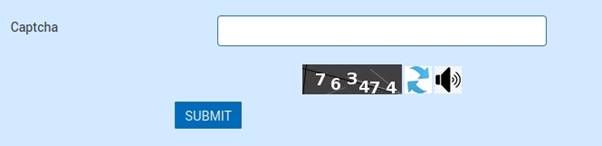
These captchas serve as entry points to access several essential facets of a court website, such as judgments/orders, cause-lists and checking the status of cases. Many High Court websites were hitherto exclusively using visual captchas inaccessible to the visually challenged, making it impossible for them to access such content independently. In coordination with all High Courts, the e-Committee has now ensured that visual captchas are accompanied by text/ audio captchas making the website content accessible to the visually challenged.
In a letter dated 16th December 2020, the Chairperson of the e-Committee, Dr Justice D.Y. Chandrachud, exhorted all High Courts to make their digital infrastructure accessible to persons with disabilities in conformity with the constitutional and statutory entitlements of the disabled. The letter contained a series of structural interventions for all High Courts to undertake in this regard.
Pursuant to this letter, the e-Committee formulated an action plan to ensure the accessibility of the digital interface of all High Courts’ websites in Phase 1 of this project. Six parameters were devised to determine if the website of a given High Court was accessible. These were: Access to judgments; Access to cause-lists; Access to case status; Contrast/ colour theme; text size [A+AA]; and screen reader access.
The e-Committee conducted a series of sessions for the Central Project Coordinators of all High Courts and their technical teams to create awareness and impart training on ensuring accessibility of the digital interface of all High Courts’ websites and generating accessible PDFs. The websites of the High Courts now comply with the above parameters except for a few websites which are in the process of providing screen reader access. The status of the compliance of the High Courts with these parameters- Annexure A.
The e-Committee is also in the process of creating a Standard Operating Procedure (SOP) for generating accessible court documents and will serve as a user guide to its stakeholders. This will also address the issues of watermarks, entering content by hand, improper placement of stamps and inaccessible pagination of files. In this regard, the Chairperson of the e-Committee, Dr Justice D Y Chandrachud, has addressed a letter dated 25.06.2021 to the Chief Justices of all the High Courts for their input and suggestions on creating the said SOP.
Another significant initiative undertaken by the e-Committee in collaboration with NIC is creating a judgment search portal ( https://judgments.ecourts.gov.in ) accessible to persons with disabilities. The portal contains judgements and final orders passed by all High Courts. The portal uses a free text search engine. In addition, the portal provides the facility of using an audio captcha, along with a text captcha. It also uses accessible combo boxes, making it easier for the visually disabled to navigate the website.
The website of the e-Committee (https://ecommitteesci.gov.in/) and the e-Courts website (https://ecourts.gov.in/ecourts_home/) are also accessible to persons with disabilities. The eCommittee webpage is created on the S3WAAS platform, which complies with the standards for making websites accessible for the disabled.
The e-Committee’s training programmes for Lawyers also sensitise Advocates to adopt accessible filing practices.
These measures, cumulatively viewed, have significantly furthered access to justice for the disabled and served as a powerful affirmation of their dignity allowing them to participate in our justice system on equal terms. For legal professionals with disabilities, these measures have been a significant step in enabling them to participate in the profession on the same footing as their able-bodied counterparts. These initiatives of the e-Committee have helped transform our courts from sites of exclusion to bastions of inclusion for the disabled, and it is a way forward in creating an accessible and inclusive legal system.
Annexure A
*****
Ministry of Law & Justice Press Release dated 27 June 2021
 Business So Simple