Boost to private investment in medical infrastructure
Focus on strengthening healthcare facilities for the children
Multiple initiatives for farmers, small entrepreneurs and self-employed persons
The measures will help to stimulate economic activities, boost production & exports and generate employment: PM
Measures demonstrate our Government’s continuing commitment to reforms: PM
The Prime Minister , Shri Narendra Modi has said that the measures announced by the Finance Minister today will help to stimulate economic activities, boost production & exports and generate employment. He also underlined the measures taken for healthcare, healthcare facilities for children, farmers, small entrepreneurs and self-employed persons.
In a series of tweets the Prime Minister said.
“Measures announced by FM @nsitharamantoday will enhance public health facilities, especially in under-served areas, boost private investment in medical infrastructure and augment critical human resources. Special focus is on strengthening healthcare facilities for our children.
Importance has been given to helping our farmers. Multiple initiatives have been announced which reduce their costs, increase their incomes & support greater resilience and sustainability of agricultural activities.
Further support has been announced for our small entrepreneurs & self-employed persons,to enable them to sustain their business activities but & expand them further. Several initiatives, including financial assistance are being taken to help those linked with tourism.
The measures will help to stimulate economic activities, boost production & exports and generate employment. Result linked Power Distribution Scheme and streamlined processes for PPP projects and Asset Monetisation demonstrates our Government’s continuing commitment to reforms.”
Measures announced by FM @nsitharaman today will enhance public health facilities, especially in under-served areas, boost private investment in medical infrastructure and augment critical human resources. Special focus is on strengthening healthcare facilities for our children.— Narendra Modi (@narendramodi) June 28, 2021
Finance Ministry release on the package can be seen here.
Presentation of stimulus package of Rs 6,28,993 crore announced by Union Minister for Finance & Corporate Affairs Smt. Nirmala Sitharaman to support Indian economy in fight against COVID-19 pandemic
Ministry of Finance Press release dated Jun 28, 2021
Scientists have developed electrically configured nanochannels that can eliminate unwanted energy waste and promise wave-based computing. This can revolutionize on-chip data communication and processing in future.
Conventional electronics is composed of logic circuits having a large number of transistors interconnected by metallic wires. The data carried by electric charges suffer undesirable heating limiting its integration density.
Spintronics, also known as spin electronics, or the study of the intrinsic spin of the electron and its associated magnetic moment, in addition to its fundamental electronic charge, in solid-state devices offer to harness electron spins. Their collective precession can carry information encoded in its amplitude, phase, wavelength, and frequency without any physical motion of particles, eliminating unwanted energy waste and promising wave-based computing.
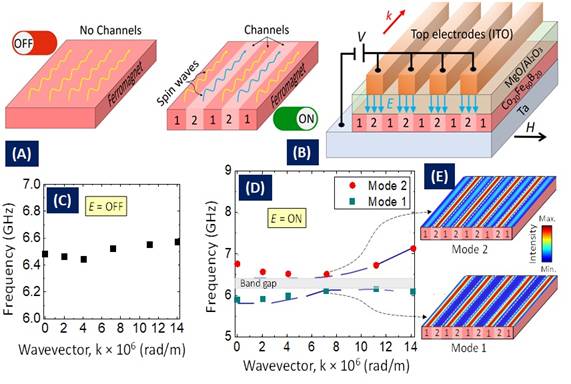
To this end, Professor Anjan Barman and coworkers from the S. N. Bose National Centre for Basic Sciences, an autonomous institute under the Department of Science and Technology (DST), Government of India, have developed electrically reconfigured parallel nanochannels that tune the behaviour of spin waves in nano-structure elements. They have done this by periodically tailoring the property that confers a preferred direction on the spin of a system, also called anisotropy using the electric field — technically called the principles of voltage-controlled magnetic anisotropy. This work has been published in the journal ‘Science Advances’.
In the recent research, spin-waves were efficiently transferred through these nanochannels, and this could be switched ‘ON’ and ‘OFF’ and its magnitude altered by a meagre voltage of few volts. The team believes that in future, these nanochannels can be engineered further to transfer specific bands of frequencies through designed parallel channels towards development of on-chip multiplexing devices.
Figure: A. Schematic illustration shows the concept of spin-wave nanochannels. B. Schematic illustration shows the device structure and formation of nanochannels. Spin-wave frequencies versus wavevector when electric field, E is OFF (C) and ON (D). E. Heatmap plots show the spatial distribution of spin-wave intensity for spin-wave mode 2 and mode 1 at wavevector k = 7.1 × 10⁶ rad/m.
Publication link:
DOI: 10.1126/sciadv.aba5457
For more details, Anjan Barman, Senior Professor (abarman@bose.res.in), can be contacted.
****
Ministry of Science & Technology dated 28 June 2021
Scientists have fabricated a simple, cost-effective, bio-compatible, transparent nanogenerator that can generate electricity from vibrations all around for use in optoelectronics, self-powered devices, and other biomedical applications.
Searching for renewable energy resources with reduced carbon emissions is one of the most urgent challenges due to the increasing threat of global warming and energy crisis. Some of the unconventional methods to generate electricity include piezoelectric, thermoelectric, and electrostatic techniques used in devices like touch screens, electronic displays, and so forth.
The triboelectric nanogenerators (TENG) make use of mechanical energy in the form of vibrations present everywhere in different forms to generate electricity. The energy harvesting TENG works on the principle of creation of electrostatic charges via instantaneous physical contact of two dissimilar materials followed by generation of potential difference when a mismatch is introduced between the two contacted surfaces through a mechanical force. This mechanism drives the electrons to move back and forth between the conducting films coated on the back of the tribo layers. The method employed till date to design TENG use expensive fabrication methods like photolithography or reactive ion etching, and additional process like electrode preparation and so on.
Dr. Shankar Rao and his team from the Centre for Nano and Soft Matter Sciences, Bengaluru, an autonomous institute under the Department of Science & Technology, Government of India, have designed a transparent TENG, using thermoplastic polyurethanes (TPU) either in the form of electrospun nanofibers or as a flat film using the simpler Doctor’s blade technique, along with Polyethylene terephthalate (PET) as tribo layers. TPU nanofibers are obtained from the electrospinning (ES) technique. The Doctor’s blade technique, a routine procedure adapted in a variety of situations, squeezes the material through a blade and the substrate yielding a uniform thin layer. The easy availability of the active material and the simplicity of the fabrication process make it cost-effective over currently available fabrication techniques. The resulting device is also highly efficient, robust, and gives reproducible output over long hours of operation. The results were published in ‘Journal of Nanoscience and Nanotechnology’.
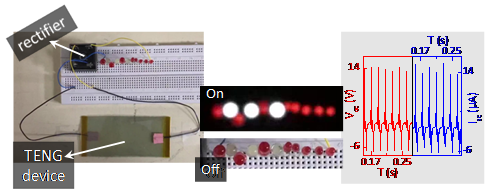
The fabricated device could light up eleven LEDs by gentle hand tapping and could be a potential candidate for use in optoelectronics, self-powered devices, and other biomedical applications.
Image of the flexible and transparent TENG device with PET as one and thermoplastic polyurethane (TPU) as the complementing tribolayer. With the application of a small force of 0.33N, the device provided 21.4 V and 23 µA as open-circuit voltage and short-circuit current, respectively, indicating the high efficiency of the device. In addition, the gentle hand tapping on the TENG device can power up to 11 light-emitting diodes (LEDs).
Union Minister Shri Narendra Singh Tomar addressed the CII Northern Region Food Processing Summit 2021
Government has taken several initiatives to harness the food and horticulture potential of the country: Shri Narendra Singh Tomar
The government is committed to the development of the food processing sector, says Shri Tomar
Union Minister for Agriculture & Farmers Welfare, Food Processing Industries, Rural Development and Panchayati Raj Shri Narendra Singh Tomar addressed the 3rd edition of the Northern Zone Food Processing Summit organized by the Confederation of Indian Industry (CII) through video conference.
Speaking on the occasion, Shri Tomar said that the Government of India has taken several initiatives to harness the food and horticulture potential of the country to encourage investment and development in the agriculture sector as well as to provide a better environment to the existing enterprises. He added that the Government is also committed to the development of the food processing sector. “A new production linked incentive scheme for the food processing industry was launched by Prime Minister Shri Narendra Modi, as a part of the self-reliant India campaign. About Rs. 11 thousand crores will be spent on the scheme”, the Minister said.https://www.youtube.com/embed/0vJap9nJYJs
Shri Tomar said that the Ministry of Food Processing Industries has launched the Prime Minister formalization of Micro Food Processing Enterprises (PMFME) scheme under Atmanirbhar Bharat Abhiyan with an aim to enhance the competitiveness of existing individual micro-enterprises in the unorganized sector. The scheme focuses on supporting groups engaged in agri-food processing such as Farmer Producer Organizations (FPOs), Self Help Groups (SHGs) and producer cooperatives across their value chain.
Shri Tomar said that CII is a premier industry organization, which is helping to lead the country on the path of development. Calling for cooperation to take the benefits of the government initiatives to all the farmers, he said that the Ministry of Food Processing Industries is working on these initiatives in a planned manner. He urged CII to conduct a comparative study on the available food grains and horticulture resources in the country with their processing so that the Government of India could devise a strategy to fill the gaps.
Speaking on the occasion, Shri Manoj Joshi, Additional Secretary, Ministry of Food Processing Industries, Government of India emphasized the need for joint efforts by the government and industry in the area of fortification of processed food and meeting the changing consumer preferences.
*****
*Ministry of food processing Industries press release dated 24 June 2021
International Financial Services Centres Authority (IFSCA) has constituted a committee to examine global best practices in ship financing and leasing, identify opportunities and devise a roadmap to enable such activities from GIFT IFSC. This committee will be chaired by Ms. Vandana Aggarwal, former Senior Economic Advisor, Government of India. The committee includes representatives from the Government of India, Gujarat Maritime Board and industry experts possessing domain knowledge.
India is strategically located on the world’s shipping routes and has a large coastline of approximately 7,500 km. India also has 12 major and over 200 minor ports. Data from the Ministry of Shipping suggests that 95% of India’s trading by volume and 70% by value is done via maritime transport. Inspite of significant exposure to Shipping, India is yet to develop as an international shipping hub. IFSCA aims to provide an enabling regulatory framework and facilitative environment so that GIFT IFSC can become an international hub for Ship Financing & Leasing activities thereby benefitting shipowners, lessors, carriers, ship operators, ship management companies and other stakeholders in the maritime ecosystem.
The committee is mandated to examine the existing legal, regulatory, tax and other applicable frameworks, identify the bottlenecks pertaining to ship financing & leasing and recommend specific measures required which shall enable ship financing & leasing from IFSC at par with best international practices. The committee would submit its recommendations to IFSCA in three months.
A new non-precious metal-based bi-functional electrocatalyst (capable of catalyzing two different types of reactions) can decrease cost and increase the efficiency of metal air batteries.
With the rise in demand for different energy sources, worldwide efforts are being made to develop different kinds of energy devices, such as lithium-ion batteries, lead-acid batteries, redox flow batteries, lithium-air batteries, zinc-air batteries, etc. sodium-ion batteries, fuel cells, and super capacitors.
Among them, Zn-air batteries have drawn significant attention due to their low cost and high energy density. They are compact power sources for portable electronics and electric vehicles and energy storage devices to manage energy flow among renewable energy generators, such as wind turbines, photovoltaic panels, electric grids, and end-users. However, a major challenge for such batteries is catalyst development. A bi-functional catalyst works for oxygen reduction while discharging the battery and the same catalyst helps in oxygen evolution reaction during the charging cycle. Most of the conventional catalysts available consist of noble metals in their composition, making the batteries costly.
International Advanced Research Centre for Powder Metallurgy and New Materials (ARCI), an autonomous R&D Centre of Department of Science and Technology (DST), Govt. of India, has developed the cost-effective electrocatalyst by anchoring transition metal ions into the sulfur-doped carbon framework via carbonization of a polymer called sPEEK (sulphonated polyether ether ketone). This catalyst synthesis method can also be used to recycle used ionomers (polymer composed of both neutral repeating units and ionized units).
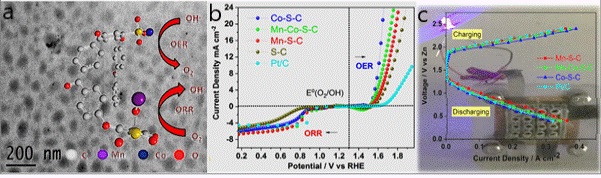
The scientists have used an ion-exchange strategy that positions the metal ions in the carbon framework homogeneously, limits the particle size and offers control on composition and size at a very low loading of transition metal. Cost-effectiveness is thus achieved by low loading of transition metal, high activity, and high cycling stability compared to many of the catalysts earlier reported in the literature.
The catalyst also leads to reduced voltage polarization, enabling higher energy efficiency and a stable charge-discharge characteristic. The results obtained were comparable to that of conventionally used noble metal-based catalysts with metal loading of 20% or higher. The research has been published in ACS Applied Energy Materials.
Fig. a) TEM image of Mn-S-C catalyst b) electrochemical property and c) charge-discharge characteristics of the developed catalysts.
Publication link: DOI:10.1021/acsaem.9b01217
For more details, Dr. K. Ramya (ramya@arci.res.in) can be contacted.
Ministry of Science & Technology press release dated 24 June 2021
Ministry of Communication issued Press release today (23 June 2021):
1. Guidelines for Other Service Providers (OSP) further liberalized: announces Telecom Minister Shri Ravi Shankar Prasad
2. No distinction between Domestic and International OSPs to bring in better synergies among businesses
3. Work from Home and Work from Anywhere made easier
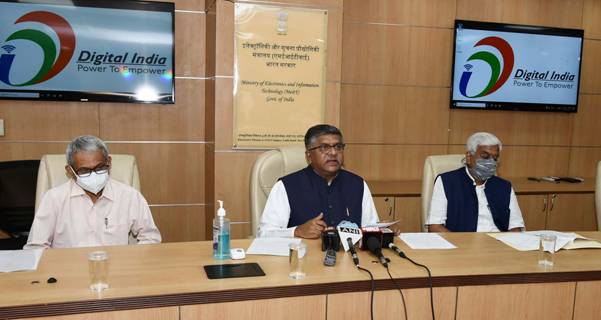
Shri Ravi Shankar Prasad, Union Minister for Electronics & Information Technology, Communications and Law & Justice, announced in a press interaction today that Department of Telecommunication has further liberalized the guidelines for Other Service Providers (OSPs). These entities are business process outsourcing (BPO) organisations giving Voice based services, in India and abroad. The Guidelines issued today further liberalized the special dispensation given to OSPs in addition to the major measures already announced and implemented in November, 2020.
Shri Prasad informed that India’s BPO industry is one of the largest in the world. Today India’s IT-BPM industry stands at US$ 37.6 billion (2019-20) i.e. Rs. 2.8 lakh crores approx. giving job opportunities to lakhs of youths in the country. Further it has a potential for double digit growth reaching upto US$ 55.5 billion i.e. Rs. 3.9 lakh crores by 2025.
AatmaNirbhar Bharat is the key initiative of Govt. led by PM Shri Narendra Modi and steps like Electronics Manufacturing Productivity Linked Incentive scheme,starting dedicated scheme of Electronic Manufacturing Cluster and dedicated PLI scheme for Telecom Equipment are few steps in this direction.
Similarly Ease of Doing Business is another fulcrum based on which series of reforms has been initiated in IT & Telecom vertical by present Govt. Start of one touch VNO licenses, Spectrum Sharing & Trading, Delicensing of certain frequency bands and now Next Gen OSP liberalisation is another step in this direction.
In November 2020, OSP guidelineswere liberalized as following:-
Data related OSPs were totally taken out of ambit of any regulation
No Bank Guarantees
No requirement of static IP
No requirement of reporting to the DoT
No requirement of publication of Network Diagram
No penalties
Made Work from Anywhere a reality
The BPM industry revenues grew from USD 37.6 billion in 2019-20 to USD 38.5 billion in 2020-21, despite the pandemic. This was largely possible due to the industry’s ability to work remotely and majorly enabled by the Government of India’s relaxations of WFH requirements under the OSP regime, first temporarily, in March 2020 and then complete reforms under the new guidelines in November 2020.
The Highlight of the Global Business is given below
Current BPM market – USD 198 BN
Outsourcing Market – USD 91 BN (46%)
Current BPM outsourcing revenue, India – USD 38.5 BN (Rs 2.8 lakh crore)
The main features of the liberalised guidelines announced today are :-
Distinction between Domestic and International OSPs has been removed. A BPO centre with common Telecom resources will now be able to serve customers located worldwide including in India.
EPABX (Electronic Private Automatic Branch Exchange) of the OSP can be located anywhere in the world. OSPs apart from utilising EPABX services of the Telecom Service Providers can also locate their EPABX at third Party Data Centres in India.
With the removal of the distinction between Domestic and International OSP centres, the interconnectivity between all types of OSP centres is now permitted.
Remote Agents of OSP can now connect directly with the Centralised EPABX/ EPABX of the OSP/ EPABX of the customer using any technology including Broadband over wireline/ wireless.
No restriction for data interconnectivity between any OSP centres of same company or group company or any unrelated company.
It may be recalled that DoT has already exempted Data Based Services from the OSP regulations. In addition, the regulations exempted OSPs from requirement of any registration. Also, no Bank Guarantees were to be furnished. Work from Home and Work from Anywhere was also permitted.
Penalties for violations were removed altogether reaffirming the trust Government has in business.
Further liberalization of Guidelines today will provide a big fillip for growth of OSP industry in India. This will create immense opportunities, income and employment in India.
OSP reforms impact survey conducted by NASSCOM in April 2021, enumerated following important findings :
Over 72% of the respondents mentioned that they are highly satisfied with the OSP reforms
95% of the respondent mentioned has helped in reducing the compliance burden and cost of doing business in India
95% of the respondent also stated that this will help in making IT services more competitive globally
Another 77% of the respondent mentioned that OSP reforms has helped in increasing the productivity
92% of respondent stating that reforms also helped in reducing the financial burden on the companies
62% of the respondent mentioned that they will consider expanding their operation or will make fresh investments basis the OSP reforms
55% also mentioned that this will help in generating new employment opportunities and will enhance access to talent
Today’s reform will further help the BPM industry to reduce their establishment cost and creating synergies among different companies. Through these reforms more and more MNCs will get attracted towards India as a favorable destination and hence will lead to more FDIs.
It is also to be highlighted that FDI during present govt. and previous UPA govt stands at :
Ministry of Commerce & Industry issued Press release today 22 June 2021.
Union Minister of Commerce & Industry, Railways and Consumer Affairs, Food & Public Distribution, Shri Piyush Goyal today said that we will soon have the soft launch of the first phase of the National Single window system. The digital platform will allow investors to identify and apply for various pre-operations approvals required for commencing a business in India. There will be 17 Ministries/Departments and 14 states onboard in the first phase which is likely to be launched soon, the Minister said during the review meeting of Single window system held today.MoS, Commerce and Industry, Shri Som Prakash also attended the meeting.
Shri Goyal expressed the hope that it will be a seamless interface where all the facilities from land purchasing to all the information needed to businesses and industrialists will be available. He said that the “Single window” would be a genuine one, acting as a one-stop solution to all the problems or requirements of the investors. This would provide end-to-end facilitation, support, including pre-investment advisory, information related to land banks and facilitating clearances at Central and State levels, he added. It will facilitate the investors to know the approvals required to establish a particular business and let them apply for those approvals to commence business, see the status of those approvals as well as provide/seek clarifications regarding the same- all in one platform.
Shri Goyal also emphasized on the security and the authentication of the critical data used in this platform. He said all security measures should be in place to safeguard the critical data. He also suggested for third party auditing of the platform before its launch.
The Minister appreciated all the Ministries/Departments and states for showing enthusiasm, interest and open-mindedness in speedily working on developing the project, despite Covid-19 hurdles.“It is because of your exemplary contribution, cooperation and hard work that such a huge exercise has reached at an advance stage now”, he said.
Shri Goyal said that learning from the past experiences we should go on improving it in the future. He hoped that its success will be a real tribute to Dr Guruprasad Mahapatra,Secretary DPIIT who recently left for his heavenly abode.
The participants in the meeting gave status report on their preparedness on being on board of the portal. They were told to register in the portal, try out various use cases and identify areas for improvement.
Ministry of Consumer Affairs, Food & Public Distribution issued Press release today 21st June 2021, says that
Proposed Amendments to the Consumer Protection (E-commerce) Rules, 2020
Government has received several complaints against widespread cheating and unfair trade practices being observed in e-commerce ecosystem
Conventional e-commerce flash sales are not banned. Only specific flash sales or back-to-back sales which limit customer choice, increase prices and prevents a level playing field are not allowed
To protect the interests of consumers and encourage free and fair competition in the market, Government is sharing a draft of the proposed amendments to the Consumer Protection (E-commerce) Rules, 2020
Proposed amendments aim to bring transparency in e-commerce platforms and further strengthen the regulatory regime
Views comments suggestions sought on the amendments to Consumer Protection (E-commerce) Rules, 2020 within 15 days (by 6th July, 2021)
For the purposes of preventing unfair trade practices in e-commerce, the Central Government had notified the Consumer Protection (E-Commerce) Rules, 2020 with effect from 23 July 2020. However, since the notification of these rules, the Government has received several representations from aggrieved consumers, traders and associations complaining against widespread cheating and unfair trade practices being observed in the e-commerce ecosystem.
Prevalence of such unfortunate incidents has negatively impacted the consumer and business sentiment in the market, causing immense distress and anguish to many. It was observed that there was an evident lack of regulatory oversight in e-commerce which required some urgent action. Moreover, the rapid growth of e-commerce platforms has also brought into the purview the unfair trade practices of the marketplace e-commerce entities engaging in manipulating search result to promote certain sellers, preferential treatment to some sellers, indirectly operating the sellers on their platform, impinging the free choice of consumers, selling goods close to expiration etc.
Additionally, conventional flash sales by third party sellers are not banned on e-commerce platform. But, certain e-commerce entities are engaging in limiting consumer choice by indulging in “back to back” or “flash” sales wherein one seller selling on platform does not carry any inventory or order fulfilment capability but merely places a “flash or back to back” order with another seller controlled by platform. This prevents a level playing field and ultimately limits customer choice and increases prices.
To protect the interests of consumers, prevent their exploitation and encourage free and fair competition in the market, the Government of India is sharing a draft of the proposed amendments to the Consumer Protection (E-commerce) Rules, 2020. The proposed amendments aim to bring transparency in the e-commerce platforms and further strengthen the regulatory regime to curb the prevalent unfair trade practices. The proposed amendments are as follows
To ensure compliance of the Consumer Protection Act, 2019 and Rules, appointment of Chief Compliance Officer, a nodal contact person for 24×7 coordination with law enforcement agencies, officers to ensure compliance to their orders and Resident Grievance Officer for redressing of the grievances of the consumers on the e-commerce platform, has been proposed. This would ensure effective compliance with the provisions of the Act and Rules and also strengthen the grievance redressal mechanism on e-commerce entities.
Putting in place a framework for registration of every e-commerce entity with the Department for Promotion of Industry and Internal Trade (DPIIT) for allotment of registration number which shall be displayed prominently on website as well as invoice of every order placed the e-commerce entity. Registration of e-commerce entities would help create a database of genuine e-commerce entities and ensure that the consumers are able to verify the genuineness of an e-commerce entity before transacting through their platform.
To protect the interests of consumers, mis-selling has been prohibited i.e selling goods and services entities selling goods or services by deliberate misrepresentation of information by such entities about such goods or services. To ensure that consumers are aware about the expiry date of the products they are buying on the e-commerce platform all sellers on marketplace e-commerce entities and all inventory e-commerce entities to provide best before or use before date to enable consumers to make an informed purchase decision.
To ensure that the domestic manufacturers and suppliers get a fair and equal treatment on the e-commerce platform it has been provided that where an e-commerce entity offers imported goods or services, it shall incorporate a filter mechanism to identify goods based on country of origin and suggest alternatives to ensure fair opportunity to domestic goods.
To ensure that consumers are not adversely affected in the event where a seller fails to deliver the goods or services due to negligent conduct by such seller in fulfilling the duties and liabilities in the manner as prescribed by the marketplace e-commerce entity, provisions of Fall-back liability for every marketplace e-commerce entity have been provided.

 Business So Simple