DGGI Gurugram arrests one person for fraudulently availing ITC of more than 160 crore through a network of 10 fake firms (Press release 18 May 2022)

The Directorate General of GST Intelligence (DGGI) Gurugram Zonal Unit (GZU), Haryana has detected a case wherein total ITC of more than Rs 160 crore has been utilized and passed on by network of nonexistent & fake firms in tandem with various existing entities / merchants / wholesalers.

Based on intelligence which was analyzed & acted upon by the Gurugram Zonal Unit, it emerged that a merchant, who is an importer and wholesale trader of dry fruits has availed IGST Input Tax Credit on imports, but has further issued duty paid invoices to various non-existent firms, whereas the goods (dry fruits) were sold in the open market to various retailers. Quiet a few of the firms, to whom invoices were issued were found to be non-existent / fake (registered on GST portal under different HSN), who further issued goodless invoices to fraudulently pass on ITC without supply of any goods.  The merchant has rendered itself to liable under Section 122 (i) (ii) of the CGST Act, 2017, etc., as a Consequence of which the merchant has deposited Rs. 5 crore till date, additional recovery in this matter is expected.

In all, 10 such fake firms busted so far in the investigation, have fraudulently availed & passed on Input Tax Credit (ITC) in excess of Rs. 160 crore, bases on inwards from the merchant, and from other fake/cancelled sources, which is under further investigation. Controller of one such firm to whom duty paid invoices were issued without supply of actual goods by the merchant, prima facie passed on fraudulent ITC of Rs. 26.3 crore, was identified as Sh. Pawan Kumar Sharma. It emerged through investigation that Sh. Pawan Kumar Sharma is also proprietor of another firm M/s Pawan Traders also involved in passing on fraudulent Input Tax Credit (ITC). 

Accordingly, Shri Pawan Kumar Sharma was arrested on 13.05.2022 under the provisions of Section 69 of CGST Act, 2017 read with clause (b) (c) of subsection (1) of section 132 of CGST Act, 2017 and produced before CMM, Patiala House Court on 13.05.2022, who ordered judicial custody for 14 days.

Further investigations in the matter is under progress.
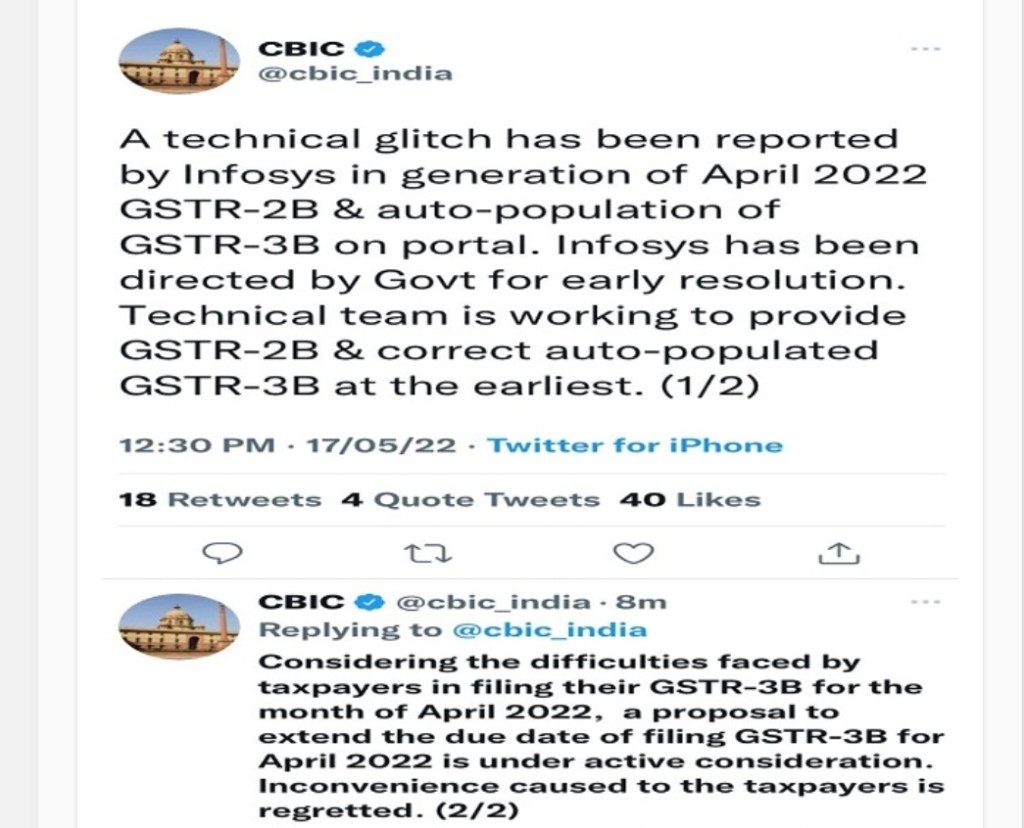
Due date of filing GSTR-3B for April 2022 may be extended

A technical glitch has been reported by Infosys in generation of April 2022 GSTR-2B & auto-population of GSTR-3B on portal. Infosys has been directed by Govt for early resolution. Technical team is working to provide GSTR-2B & correct auto-populated GSTR-3B at the earliest.

Considering the difficulties faced by taxpayers in filing their GSTR-3B for the month of April 2022, a proposal to extend the due date of filing GSTR-3B for April 2022 is under active consideration. Inconvenience caused to the taxpayers is regretted.

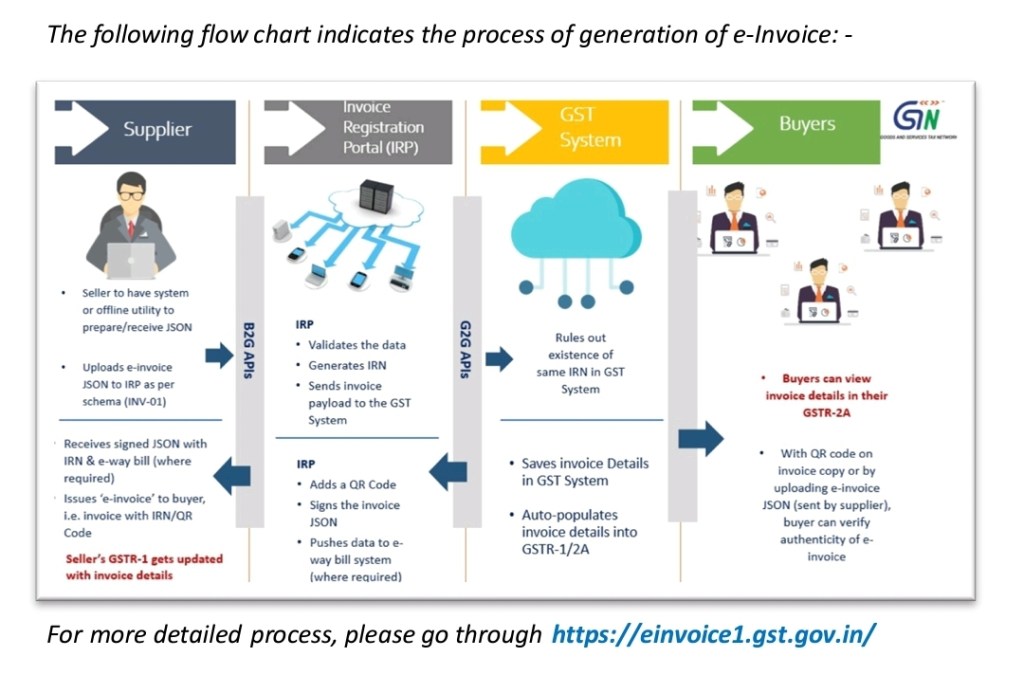
Process for generation of e-Invoice under GST

Flowchart :

What is ‘e-invoicing’?

As per Rule 48(4) of CGST Rules, notified class of registered persons shall prepare an invoice by incorporating the Invoice Reference Number (IRN) and the QR-Code generated by uploading specified particulars in FORM: GST INV-01 on Invoice Registration Portal (IRP).

Such invoice containing, inter alia, the QR Code embedded with IRN (mentioning IRN separately, is optional), issued by the notified supplier to buyer is commonly referred to as ‘e-invoice’ in GST.

Please note that ‘e-invoice’ doesn’t mean generation of invoice on a Government portal or issue of invoice in pdf form.

How is ‘e -invoicing’ different from present system (normal invoice)?

There is no much difference between the e-invoice and a normal invoice. In the e-invoice system, the notified registered persons will continue to create their GST invoices on their own Accounting/Billing/ERP Systems, but it shall bear the QR Code embedded with IRN (mentioning IRN separately, is optional), pre-generated on IRP. In other words, the specified contents of the invoices will have to be first posted in FORM: GST INV-01 on IRP, to generate the said unique IRN with a QR Code. e-Invoice is nothing but an invoice issued to the receiver of goods/services by the supplier along with the QR Code .

A GST invoice issued by the notified supplier will be valid only with a valid IRN/QR-code.

For which businesses, e-invoicing is mandatory?

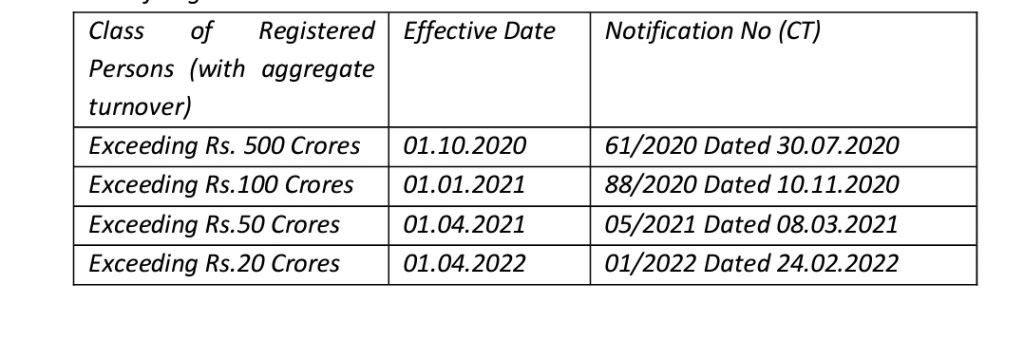
e-invoicing is mandatory for the class of Registered Persons whose aggregate turnover (based on PAN) is more than the prescribed limit (as per relevant notification) in any preceding financial year from 2017-18 onwards. of The effective date from which the e-Invoice was notified as mandatory for different class of Registered Persons is indicated hereunder:

What are the advantages of e-invoice for businesses?

e-invoice has many advantages for businesses such as:

Ø Smooth ITC reconciliation by Auto-reporting of invoices into GST return;

Ø Simultaneous generation of EWB

Ø Utmost reliability (no need to doubt the genuineness- eliminates fake invoices);

Ø Reconciliation problems are eliminated;

Ø Standardisation & eliminates data entry errors;

Ø Documents become tax compliant on real time basis;

Ø Reduction of processing costs; Ø improve payment cycles;

Ø thereby greatly improving overall business efficiency and ensure Ease of doing business.

Reporting 6% rate in GSTR-1 (GST portal updates 10 May 2022)

A new tax rate of 6% IGST or 3% CGST+ 3% SGST has been introduced on certain goods vide Notification No. 02/2022 dated 31st March 2022. Changes are being made on the GST portal to include this rate in GSTR-1. As a temporary measure, taxpayers who have to report goods at this rate may do so by reporting the entries in the 5% heading and then manually increasing the system computed tax amount to 6%. This can be done by entering the value in the ‘Taxable value’ column next to 5% tax-rate and then increasing the system computed tax-amount to 6% IGST or 3% CGST + 3% SGST in the ‘Amount of Tax’ column under the relevant Table, namely B2B, B2C or Export, as applicable. This will ensure that correct tax amount is reported in GSTR-1.

Meanwhile, this rate will be made available on the GST portal shortly.

GST Revenue collection for April 2022 highest ever at Rs 1.68 lakh crore

GST Revenue collection for April 2022 highest ever at Rs 1.68 lakh crore


Gross GST collection in April 2022 is all time high, Rs 25,000 crore more than the next highest collection of Rs. 1,42,095 crore, just last month


Press Release dated May 01, 2022

The gross GST revenue collected in the month of April, 2022 is Rs 1,67,540 crore of which CGST is Rs  33,159 crore, SGST is Rs  41,793 crore, IGST is Rs  81,939 crore (including Rs 36,705 crore collected on import of goods) and cess is Rs  10,649 crore (including Rs  857 crore collected on import of goods).

The gross GST collection in April 2022 is all time high, Rs 25,000 crore more than the next highest collection of Rs. 1,42,095 crore, just last month.

The government has settled Rs33,423 crore to CGST and Rs 26962 crore to SGST from IGST. The total revenue of Centre and the States in the month of April 2022 after regular settlement is Rs66,582 crore for CGST and Rs68,755 crore for the SGST.

The revenues for the month of April 2022 are 20% higher than the GST revenues in the same month last year. During the month, revenues from import of goods was 30% higher and the revenues from domestic transaction (including import of services) are 17% higher than the revenues from these sources during the same month last year.

For the first time gross GST collection has crossed Rs1.5 lakh crore mark. Total number of e-way bills generated in the month of March 2022 was 7.7 crore, which is 13% higher than 6.8 crore e-way bills generated in the month of February 2022, which reflects recovery of business activity at faster pace.

Month of April 2022 saw the highest ever tax collection in a single day on 20th April 2022 and highest collection during an hour, during 4 PM to 5PM on that day. On 20th April 2022, Rs 57,847 crore was paid through 9.58 lakh transactions and during 4-5 PM, almost Rs 8,000 crore was paid through 88,000 transactions. The highest single day payment last year (on the same date) was Rs 48,000 crore through 7.22 lakh transactions and highest one hour collection (2-3PM on the same date last year) was Rs 6,400 crore through 65,000 transactions.

During April 2022, 1.06 crore GST returns in GSTR-3B were filed, of which 97 lakh pertained to the month of March 2022, as compared to total 92 lakh returns filed during April 2021. Similarly, during April 2022, 1.05 crore statements of invoices issued in GSTR-1 were filed. Till end of the month, the filing percentage for GSTR-3B in April 2022 was 84.7% as compared to 78.3% in April 2021 and the filing percentage for GSTR-1 in April 2022 was 83.11% as compared to 73.9% in April 2021.

This shows clear improvement in the compliance behaviour, which has been a result of various measures taken by the tax administration to nudge taxpayers to file returns timely, to making compliance easier and smoother and strict enforcement action taken against errant taxpayers identified based on data analytics and artificial intelligence.

The chart below shows trends in monthly gross GST revenues during the current year. The table shows the state-wise figures of GST collected in each State during the month of April 2022 as compared to April 2021.

Advisory to composition taxpayers (GST Portal updates 30 April 2022)

Background: Since FY 2019-20, composition taxpayers has to pay the liability through Form GST CMP-08 on quarterly basis while return in Form GSTR-4 is required to be filed on annual basis after end of a financial year.

Reason of Negative Liability in GSTR-4: The liability of the complete year is required to be declared in GSTR-4 under applicable tax rates. Taxpayers should fill up table 6 of GSTR-4 mandatorily. In case, there is no liability, the said table may be filled up with ‘0’ value. If no liability is declared in table 6, it is presumed that no liability is required to be paid, even though, taxpayer may have paid the liability through Form GST CMP-08. In such cases, liability paid through GST CMP-08 becomes excess tax paid and moves to Negative Liability Statement for utilization of same for subsequent tax period’s liability.

What the taxpayer did wrongly: Liability paid through Form GST CMP-08 is auto-populated in table 5 of the GSTR-4 for convenience of the taxpayers. Taxpayers who do not fill up table 6 of GSTR-4 i.e. no liability is declared, even though, taxpayer may have paid the liability through Form GST CMP-08; since the ‘Tax payable’ in GSTR-4 is computed after reducing the liability declared in GST CMP-08 which is auto-populated in table 5. Thus, if nothing is declared in table 6, then the negative liability entry appears in GSTR-4.

Debit of the negative liability – In the past, lot of tickets were received on the Helpdesk for reducing the negative liability from the Negative Liability Statement and the same was being done. For convenience of the taxpayers, the amount available in negative liability statement have been debited for all taxpayers. It has been noticed that some taxpayers had utilised the amount available in negative liability statement for paying the liability to file statement in Form GST CMP-08 or GSTR-4 of subsequent financial year. In such cases, the amount utilised out of negative liability statement has been debited in the cash ledger. Though, such liability should have been paid by depositing the amount through challan but in some cases the amount had not been deposited by the taxpayers. The taxpayer who have deposited the amount in cash ledger, the debited amount has been adjusted whereas in case the amount of liability has not been deposited through challan, the balance in cash ledger becomes negative. In such cases, the taxpayers are advised to deposit the past liability through challan of equal amount urgently.

The details of the debit so made have been communicated to all such taxpayers through emails available on the portal. In case, the liability had been paid through adding in the next years’ liability, the same can be claimed as refund through application in Form GST RFD-01.

Thanking you,
Team GSTN

Annual Aggregate Turnover (AATO) computation for FY 2021-22 (GST Portal updates 02 May 2022)

02/05/2022

The functionality of AATO for the FY 2021-22 has now been made live on taxpayers’ dashboards with the following features:

  • The taxpayers can view the exact Annual Aggregate Turnover (AATO) for the previous Financial Year (FY).
  • The taxpayers can also view the Aggregate Turnover of the current FY based on the returns filed till date.
  • The taxpayers have also been provided with the facility of turnover updation in case taxpayers feel that the system calculated turnover displayed on their dashboard varies from the turnover as per their records.
  • This facility of turnover update shall be provided to all the GSTINs registered on a common PAN. All the changes by any of the GSTINs in their turnover shall be summed up for computation of Annual Aggregate Turnover for each of the GSTINs.
  • The taxpayer can amend the turnover twice within the month of May, 2022. Thereafter, the figures will be sent for review of the Jurisdictional Tax Officer who can amend the values furnished by the taxpayer wherever required.

Note: For more details, the taxpayers may check out the ‘Advisory’ section of the aforementioned functionality on their respective dashboards.

Thanking you,
Team GSTN

Status Note on GST compensation released to States/UTs (Press release 27 April 2022)

Status Note on GST compensation released to States/UTs


₹ 2.78 lakh crore of compensation released to States for the year 2020-21 itself ; nothing is pending for the year

Centre released ₹ 7.35 lakh crore and compensation of ₹78,704 crore pending only for the year 2021-22

At the time of introduction of GST, the Constitution amendment provided that the Parliament, by law shall provide compensation to States for a period of five years for loss of revenue due to introduction of GST. Accordingly, the GST Compensation to States Act was legislated which provides for release of compensation against 14% year-on-year growth over revenues in 2015-16 from taxes subsumed in GST. This compensation cess is credited to the compensation fund and as per the Act, all compensation is paid out of the fund. Presently, cess is levied on items like pan masala, tobacco, coal and cars.

Compensation of about ₹ 49,000 crore has been released for 2017-18 from the fund, which increased to ₹ 83,000 crore for 2018-19 and further to ₹ 1.65 lakh crore in 2019-20. For these three years, almost ₹ 3 lakh crore compensation was released to States. However, the compensation requirement increased substantially during 2020-21 due to impact of covid on revenues. To ensure that States have adequate and timely resources to combat covid and related issues, Centre borrowed ₹ 1.1 lakh crore in 2020-21 and ₹ 1.59 lakh crore in 2021-22 and passed it on to States on a back-to-back basis. During 2021-22, Centre ensured that release of this amount of ₹ 1.59 lakh crore was front loaded to ensure that States have adequate resources in the earlier part of the year.

Taking into account this loan, ₹ 2.78 lakh crore of compensation has been released to States for the year 2020-21 itself and nothing is pending for the year. Including the assistance released on back-to-back basis, ₹ 7.35 lakh crore has been released to States till now and, currently, only for the year 2021-22, compensation of ₹78,704 crore is pending due to inadequate balance in the fund, which is equivalent to compensation of four months.

Normally, compensation for ten months of April-January of any financial year is released during that year and the compensation of February-March is released only in the next financial year. As explained earlier, compensation of eight out of ten months of 2021-22 has already been released to States. The pending amount will also be released as and when amount from cess accrues in the compensation fund.

Status Note on GST compensation released to States/UTs (Press release 27 April 2022)

Status Note on GST compensation released to States/UTs


₹ 2.78 lakh crore of compensation released to States for the year 2020-21 itself ; nothing is pending for the year

Centre released ₹ 7.35 lakh crore and compensation of ₹78,704 crore pending only for the year 2021-22

At the time of introduction of GST, the Constitution amendment provided that the Parliament, by law shall provide compensation to States for a period of five years for loss of revenue due to introduction of GST. Accordingly, the GST Compensation to States Act was legislated which provides for release of compensation against 14% year-on-year growth over revenues in 2015-16 from taxes subsumed in GST. This compensation cess is credited to the compensation fund and as per the Act, all compensation is paid out of the fund. Presently, cess is levied on items like pan masala, tobacco, coal and cars.

Compensation of about ₹ 49,000 crore has been released for 2017-18 from the fund, which increased to ₹ 83,000 crore for 2018-19 and further to ₹ 1.65 lakh crore in 2019-20. For these three years, almost ₹ 3 lakh crore compensation was released to States. However, the compensation requirement increased substantially during 2020-21 due to impact of covid on revenues. To ensure that States have adequate and timely resources to combat covid and related issues, Centre borrowed ₹ 1.1 lakh crore in 2020-21 and ₹ 1.59 lakh crore in 2021-22 and passed it on to States on a back-to-back basis. During 2021-22, Centre ensured that release of this amount of ₹ 1.59 lakh crore was front loaded to ensure that States have adequate resources in the earlier part of the year.

Taking into account this loan, ₹ 2.78 lakh crore of compensation has been released to States for the year 2020-21 itself and nothing is pending for the year. Including the assistance released on back-to-back basis, ₹ 7.35 lakh crore has been released to States till now and, currently, only for the year 2021-22, compensation of ₹78,704 crore is pending due to inadequate balance in the fund, which is equivalent to compensation of four months.

Normally, compensation for ten months of April-January of any financial year is released during that year and the compensation of February-March is released only in the next financial year. As explained earlier, compensation of eight out of ten months of 2021-22 has already been released to States. The pending amount will also be released as and when amount from cess accrues in the compensation fund.

GSTR-1/IFF enhancements deployed on GST Portal (27 April 2022)

GSTR-1 enhancements & improvements :

The statement of outward supplies in FORM GSTR-1 is to be furnished by all normal taxpayers on a monthly or quarterly basis, as applicable. Quarterly GSTR-1 filers have also been provided with an optional Invoice Furnishing Facility (IFF) for reporting their outward supplies to registered persons (B2B supplies) in the first two months of the quarter. Continuous enhancements & technology improvements in GSTR-1/IFF have been made from time to time to enhance the performance & user-experience of GSTR-1/IFF, which has led to improvements in Summary Generation process, quicker response time, and enhanced user-experience for the taxpayers.

The previous phase of GSTR-1/IFF enhancement was deployed on the GST Portal in November 2021. In that phase, new features like the revamped dashboard, enhanced B2B tables, and information regarding table/tile documents count were provided. In continuation to the same, the next Phase of the GSTR-1/IFF improvements is now available on the Portal.

GSTR-1/IFF can be viewed as usual by navigating in the following manner :
Return Dashboard > Selection of Period > Details of outward supplies of goods or services GSTR-1 > Prepare Online
The following changes are being done in this phase of the GSTR-1/IFF enhancements :


Removal of ‘Submit’ button before filing : The present two-step filing of GSTR-1/IFF involving ‘Submit’ and ‘File’ buttons will be replaced with a simpler single-step filing process . The upcoming ‘File Statement’ button will replace the present two-step filing process and will provide taxpayers with the flexibility to add or modify records till the filing is completed by pressing the ‘File Statement’ button.
Consolidated Summary : Taxpayers will now be shown a table-wise consolidated summary before actual filing of GSTR-1/IFF. This consolidated summary will have a detailed & table-wise summary of the records added by the taxpayers. This will provide a complete overview of the records added in GSTR-1/IFF before actual filing.
Recipient wise summary : The consolidated summary page will also provide recipient-wise summary, containing the total value of the supplies & the total tax involved in such supplies for each recipient. The recipient-wise summary will be made available with respect to the following tables of GSTR-1/IFF, which have counter-party recipients :-    Table 4A : B2B supplies-    Table 4B : Supplies attracting reverse charge-    Table 6B : SEZ supplies-    Table 6C : Deemed exports-    Table 9B : Credit/Debit notes

It was previously intimated that this enhancement would be made available on the Portal shortly. It is to inform that these changes have now been implemented, and are available on the Portal. For detailed advisory & sample screenshots of the GSTR-1/IFF improvements & enhancements, please click here

https://acrobat.adobe.com/link/review?uri=urn:aaid:scds:US:0efdd15a-eb1f-306e-a2e0-e8bd5e866807


Thanking you,
Team GSTN