Agro Tec start-ups : Office of PSA’s KisanMitr & KVKs partner to make agritech accessible for farmers through vernacular sessions

The 28th edition of the series of agricultural presentations had a guest. Balraj, a farmer from Punjab spoke about the impact that deploying a sensor to detect moisture in the atmosphere has made in their irrigation practices. His village doesn’t have electricity and they use diesel-run pumps. Deploying this sensor saved both diesel, and water (which he quantified as 15-20 hours of running the pump). The sensor was able to detect moisture in the lower layers of the soil. He observed an improvement in crop yield and soil health. This sensor is a product of an agritech startup.

One of the biggest challenges,for agriculture technology start-ups,is reaching out to the farmers, FPOs,and Krishi Vigyan Kendras(KVKs) – their end-users. Kisanmitr was conceptualized and has been successful in linking the Supply with the Demand side. The start-ups can support the farmers through the KVKs and the farmers can find solutions to some of their challenges.

The series of agricultural presentations by technology developers across the Indian research Institutes and their incubated start-ups have helped showcasearound 150 agricultural technologies across different themes, farm management, post-harvest management, allied agriculture, etc.These have been garnered under the Office of the Principal Scientific Adviser, Government of India. The presentations are made primarily for the demand members (Industry and Incubators) to evaluate the technologies and to stitch the supply side and Demand side of agriculture through technology.

Speaking at the 28th edition on 3rd July 2021, Dr. A. K. Singh, Deputy Director-General, (Agricultural Extension) ICAR pointed out thatKisanMitr is helping meet the PM’s vision of developing technology solutions for farmers’ problems. He congratulated the Office of PSA, ICST, NSRCEL for facilitating the process of making technology and innovations that are developed in research laboratories across the country reach farmers across the country. Applauding the organization of vernacular sessions of these webinars, he also hoped that the upcoming webinars will bring together more farmers to talk about their problems, and what technology solutions they need. He opined that “one farmer will help train many more farmers. So, if we train one with technology,they will help transfer knowledge too.” Dr. Singh called out to the KVKs to be flag bearers and help reach these solutions to reach the farmer by organizing a viewing session in KVK offices for farmers for demonstration of technologies. Seventy-five KVKs have, till now, partnered for this outreach.

Watch the 28th edition here:https://www.youtube.com/watch?v=8SyC2G2DRT0

Among thevoluntary organizationsthat are facilitating the organization of these vernacular language sessions for farmers are VIT School of Agricultural Innovations and Advanced Learning, VAIAL (Tamil), and Grameena Incubation Center (Telugu). The teams are in talks with others for sessions in Gujarati, Marathi, and Rajasthani.The upcoming sessions in Tamil and Telugu are planned to be held on 10th July and 17th July respectively. Coming months, the plan is to telecast these sessions in other regional languages as more KVK partners join the initiative.

About KisanMitr:

KisanMitr or ‘Friends of the Farmers’, is an initiative of the Office of the Principal Scientific Adviser, Government of India. This project aims to make Indian farmers more self-reliant by giving them insights and recommendations based on information from various data sources from different departments of the Government. The website is at: https://kisanmitr.gov.in/

About Office of Principal Scientific Adviser, Government of India:

In November 1999, Cabinet Secretariat established the Office of the Principal Scientific Adviser to the Government of India. The PSA’s office aims to provide pragmatic and objective advice to the Prime Minister and Cabinet on matters related to science, technology, and innovation with a focus on the application of science and technology in critical infrastructure, economic and social sectors in partnership with Government departments, institutions, and industry.

About KVK:

The Krishi Vigyan Kendras (KVKs) work towards the mandate of “Technology Assessment and Demonstration for its Application and Capacity Development.” These kendras (centres) are a part of the National Agricultural Research System (NARS), which aims at assessment of location-specific technology modules in agriculture and allied enterprises, through technology assessment, refinement, and demonstrations. KVKs have been functioning as Knowledge and Resource Centre of agricultural technology supporting initiatives of public, private, and voluntary sectors for improving the agricultural economy of the district and are linking the NARS with extension system and farmers.

About Indian CST:

The Office of PSA engaged the services of the Indian Centre for Social Transformation (Indian CST) (www.indiancst.in), a Registered Public Trust who developed and are maintaining https://epashuhaat.gov.in for the Ministry of Animal Husbandry Dairying and Fisheries for the (then) Ministry of Agriculture and Farmers Welfare since 26.11.2016. Indian CST has contributed its GPMS Transportal for building the KISANMITR portal on the lines of e-pashuhaat.

About NSRCEL:

With programs specifically catering to entrepreneurs with profit ventures and social ventures, also student and women entrepreneurs, IIMB’s NSRCEL offers its support to various players of the startup ecosystem. NSRCEL brings together startups, industry mentors, eminent academicians from its parent institution Indian Institute of Management Bangalore, and researchers who thrive on continuous interaction of theory and practice.

Office of Principal Scientific Advisor to GoI Press release dated 07th July 2021
Wealth from Waste: Spent catalyst from industry can be an efficient catalyst for batteries

Posted Date:- Jul 06, 2021

We are perhaps looking at a future in which industrial waste will form the base for energy storage in batteries. Scientists have shown that the spent catalysts from the energy industry or the raw material for recycling operation that deliver fresh catalysts and valuable metals work as an efficient bifunctional oxygen electrocatalyst and can catalyze the core reactions that facilitate the operation of metal-air batteries.

It can help develop new strategies for effectively using industrial waste for energy storage in batteries paving the way to realize the dream of achieving ‘today’s waste is tomorrow’s energy’.

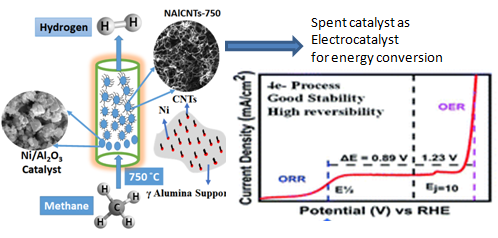
Hydrogen energy offers a promising power generation route for the industry and transport sectors due to high energy density and clean output. One of the ways to produce hydrogen is by catalytic decomposition of methane using nickel catalyst embedded on alumina or zeolite. After several runs, the catalysts get spent due to carbon choking and lose their activity. The spent catalysts are typically subjected to energy-intensive processes such as high-temperature combustion for recycling, releasing a large amount of COx into the atmosphere during the process or chemical treatment for the reclamation of metal constituents. These protocols are neither economically viable nor environmentally friendly, thus demanding alternative avenues to efficiently use the spent catalyst.

One of the best possible routes is to use the retrieved spent catalyst for energy generation/storage applications. The composition of the given spent catalyst, Carbon nanotubes with Ni nanoparticles and porous alumina, may be ideal for direct use as electrocatalyst in electrochemical energy applications and thus, opens up a viable strategy for converting waste to wealth.

Dr C. Sathiskumar, Dr Neena S. John and Dr H.S.S. Ramakrishna Matte from the Centre for Nano and Soft Matter Sciences (CeNS), an autonomous institute under the Department of Science & Technology, Government of India, in collaboration with Hindustan Petroleum Corporation Ltd (HPCL) R&D Green Centre, Bengaluru, have demonstrated that the above-spent catalyst works as an efficient bifunctional oxygen electrocatalyst. It can catalyze both electrochemical oxygen evolution (OER) and oxygen reduction reactions (ORR), the core reactions that facilitate the operation of metal-air batteries.This research was recently published in the journal ‘Sustainable Energy Fuels’.

The spent catalyst shows stable current density for 20 hrs and 8 hrs towards OER and ORR. The potential difference for overall oxygen electrocatalyst (ΔE) reveals a superior bifunctional activity of the spent catalyst. Furthermore, the spent catalyst employed in Zn-air batteries displayed commendable charge-discharge performance up to 45 hrs with high reversibility.

The work supported by the Centre for High Technology (CHT)-Oil and Industry Development Board (OIDB), Hydrogen Corpus Fund help in effectively utilizing industrial waste for energy storage applications, thus producing green energy in a sustainable manner.

Publication links:

DOI: 10.1039/d1se00007a.

For more details Dr Neena S. John and Dr H.S.S. Ramakrishna Matte jsneena@cens.res.in, matte@cens.res.in can be contacted.

Ministry of Science & Technology Press release dated 06th July 2021

SS/RKP

Setting up of Advisory Council for Open Network for Digital Commerce (ONDC)

Department for Promotion of Industry and Internal Trade (DPIIT), Ministry of Commerce and Industry has initiated a project on Open Network for Digital Commerce (ONDC). The task has been assigned to Quality Council of India (QCI). ONDC aims at promoting open networks developed on open sourced methodology, using open specifications and open network protocols independent of any specific platform. ONDC is expected to digitize the entire value chain, standardize operations, promote inclusion of suppliers, derive efficiencies in logistics and enhance value for consumers.

An advisory council has been constituted to advise the Government on measures needed to design and accelerate adoption of ONDC. The members of the Advisory council will be:

  1. Shri R.S. Sharma, CEO, National Health Authority
  2. Shri Nandan M. Nilekani, non-executive Chairman of Infosys
  3. Shri Adil Zainulbhai, Chairman, QCI and Capacity Building Commission
  4. Ms Anjali Bansal, Founder & Chairperson, Avaana Capital
  5. Shri Arvind Gupta, Co-founder & Head, Digital India Foundation
  6. Shri Dilip Asbe, MD & CEO, NPCI
  7. Shri Suresh Sethi, MD & CEO, NSDL
  8. Shri Praveen Khandelwal, Secretary-General, CAIT
  9. Shri Kumar Rajagopalan, CEO, RAI

Additional Secretary (ITeC),DPIIT shall be the cove nor of the Advisory Council.

Ministry of Commerce & Industry Press release dated 05 July 2021

Role of women in leading scientific research increasing

The involvement of women as science leaders seems to be increasing. The percentage of women leading research projects has increased by 4 percent over two years, said a recent government report.

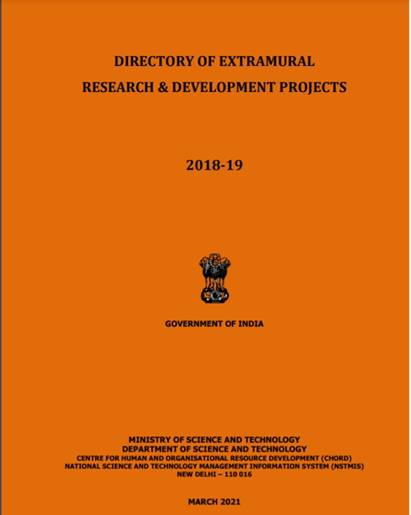
Women Principal Investigators (PIs) participation in research that received Extramural Research (EMR) support (support through peer-reviewed competitive grant mechanism) was 28% during 2018-19, as compared to 24% during 2016-17, according to the Directory of Extramural Research & Development (R&D) Project 2018-19 report released by the government recently.

The report also showed that extramural R&D support or R&D support through peer-reviewed competitive grant mechanisms by the central government was Rs. 2091.04 Crore in 2018-19 as compared to Rs. 2036.32 Crore in 2017-18 — an increase of Rs. 54.72 Crore over the previous year. The number of projects supported has increased, as has the number of PIs. A total of 3839 PIs undertook 4616 projects in comparison to 3491 PIs undertaking 4137 projects during 2017-18.

Of this support, 64% of the projects were received by 8 states, including Tamil Nadu, Delhi, Karnataka, Kerala, Maharashtra, Telangana, Uttar Pradesh, and West Bengal, accounting for 71 % of the share of funding.

The 22 Indian Institute of Technologies (IITs) combined received 822 projects – the maximum number, with highest financial support of Rs. 449.25 Crore, followed by 26 National Institute of Technology (NITs) combined, which received 191 projects with financial support of Rs. 55.83 Crore. The maximum financial support went to Engineering and Technology, while the maximum number of projects went to Biological Sciences. 

The Department of Science and Technology (DST) accounted for the maximum Extramural Research (EMR) support of Rs. 1392.21 Crore (67%), followed by the Department of Biotechnology (DBT) with Rs. 341.37 Crore (16%). The two Departments together contributed to 83% of the total extramural R&D funding in India.

The Scientific and Technological (S&T) activities play a vital role in the economic, social, and physical development of a country. Scientific and technological research needs huge investments and calls for judicious utilization of scarce resources like finance, trained manpower, raw materials, and so on. Data collection and analysis pertaining to resources devoted to S&T, therefore, assumes significant importance. The growth of S&T, its performance, and its impact on society and economy are indicators to assess the effectiveness of planning and policy formulation.

Extramural Research and Development (R&D) projects support is a peer-reviewed competitive grant mechanism of the Central Government to promote, catalyze and advance R&D and innovation in the country and provides special encouragement to scientists to pursue a research career. Centre for Human and Organisational Resource Development (CHORD) division, formerly known as the National Science and Technology Management Information System (NSTMIS) division of DST, has been collating, analyzing, and disseminating information on Extramural Research and Development projects funded by various scientific agencies. CHORD has been entrusted with the task of building the information base on a continuous basis on resources devoted to scientific and technological activities for policy planning in the country.

Directory of Extramural R&D projects approved for funding by selected Central Government Departments/Agencies is being published by DST annually since 1990-91. The present directory, twenty-ninth in the series, is an outcome of the efforts made for the projects funded during the year 2018-19 by various scientific agencies of the Government. This directory contains information on 4616 R&D projects approved for funding by 16 scientific agencies/departments during 2018-19.

Detailed Report: https://dst.gov.in/sites/default/files/EM_Directory_2018_19_0.pdf

                           https://dst.gov.in/sites/default/files/EM_Directory_2017-18_0.pdf

*

Ministry of Science & Technology Press release dated 02 July 2021

Highest ever merchandise exports in a quarter (Q1 2021-22, USD 95 billion) in the history of India

Highest ever merchandise exports in a quarter (Q1 2021-22, USD 95 billion) in the history of India


India sets a target of USD 400 billion merchandise exports in 2021-22

Despite COVID-19, labour-intensive sectors (engineering goods, rice, marine products, etc.) saw a rapid export growth

Highest ever FDI inflow of USD 81.72 billion in 2020-21

Number of startups recognised by DPIIT goes up to 50,000, spread across 623 districts

Shri Piyush Goyal said, “the world sees India as the trusted and reliable partner”

Ministry of Commerce & Industry Press release dated 02 July 2021

The Minister of Commerce & Industry, Railways and Consumer Affairs, Food & Public Distribution, Shri Piyush Goyal held a press conference today to showcase the achievements of the Ministry of Commerce and Industry in Q1 (April – June) of 2021-22. He mentioned how an ambitious target of USD 400 billion exports has been set for 2021-22.

Shri Piyush Goyal said that sector specific interventions, involvement of all the stakeholders and functioning of the Government as a whole helped in achieving the growth. Simplification of procedures, extension of timelines and licences, all of that has resulted in the record performance of exports, he added. He specially thanked the Hon’ble Prime Minister Shri Narendra Modi ji for leading from the front, and holding discussions with various stakeholders through webinars after the Union budget, and encouraging everyone to put in their best.

Shri Piyush Goyal further said that the performance of the services sector has also been excellent, and despite the pandemic, almost 97% of 2019-20 service export levels were achieved in the last FY. He said that after deliberations with the stakeholders, he is confident that USD 350 billion service exports can be achieved by 2025, and may even go up to USD 500 billion very soon.

The press conference was also attended by Ministers of State for Commerce & Industry, Shri Som Parkash and Shri Hardeep Singh Puri. The Secretaries of the Department of Commerce and DPIIT then briefed the media about the achievements of their respective departments.

Highest Ever Merchandise Exports in the history of India

Highest ever merchandise exports of USD 95 billion in Q1 of 2021-22 has been achieved in the history of India. This is 85% higher than exports of Q1 of 2020-21 and 18% higher than the exports of Q1 of 2019-20. It is also 16% more than the previous highest Q1 exports of 2018-19 (USD 82 billion) and is higher than the earlier peak of exports in Q4 of 2020-21 (USD 90 billion).

Labour intensive sectors seeing rapid export growth

Several Labour-Intensive sectors have seen a rapid export growth. The exports in the engineering goods sector has increased by USD 5.2 billion over Q1 of 2019-20. Likewise, Rice exports growth has remained positive since May 2020 and rose by 37% in Q1 of 2021-22 compared to Q1 of 2019-20

India’s Exports Performance Vis-a-vis Major Economies in April 2021

India showcased robust export performance in April 2020 compared to major economies of the world. As compared to April 2019, India’s exports growth during April 2021 was higher than other major advanced economies like European Union, Japan, USA, Republic of Korea & United Kingdom

Record FDI Inflows

India received the highest ever FDI inflow in 2020-21 of USD 81.72 billion. This is higher by 10% compared to USD 74.39 billion achieved in 2019-20. The positive momentum continues with FDI inflow of USD 6.24 billion during April 2021, which is 38% higher than April 2020.

Startup India

Number of startups recognised by DPIIT has crossed 50,000 and is spread across 623 districts in India. With these startups nearly 1.8 lakh formal jobs have been created by 16,000+ recognised startups in 2020-21. Several times more have benefited from the Startup ecosystem.

Reducing Compliance Burden

To improve the ease of doing business and reduce the compliance burden 6,426 compliances have been reduced in Phase-I. 3,177 compliances are being been reduced in Phase II. The timeline for Phase I was 31st March 2021 & Phase II is 15th August 2021.

Investment Clearance Cell

The National Single Window System is a one-stop digital platform to obtain clearances & approvals. In the phase-1 of integration,  43 Depts/Ministries & 14 States Single Window Systems are being on-boarded. The pre-launch version is undergoing extensive testing and we are gearing up for a soft launch.

The Hon’ble Minister concluded by saying that the world sees India as the trusted and reliable partner, and has more confidence in India’s capability to provide quality products and services on time. With the goods and services gaining momentum, a large number of employment opportunities will be generated, the economy will strengthen, revenues will increase, and the government will be able to help the disadvantaged sections in a more substantive manner.

***

YB/SS

Six technology innovation platforms launched for development of technologies for globally competitive manufacturing in India.

Six technology innovation platforms launched for development of technologies for globally competitive manufacturing in India.


Innovation in high-end technology creates wealth for the country, we must innovate for our needs and lead India towards an ‘AatmaNirbhar Bharat’: Shri Prakash Javadekar

Minister of Heavy Industries and Public Enterprises Shri Prakash Javadekar today inaugurated (through virtual mode) six Technology Innovation Platforms which will focus on development of technologies for the globally competitive manufacturing in India.

Launched 6 technology innovation platforms that will help derive India-specific solutions in the capital goods sector.
Innovation in high-end technology creates wealth for the Country. PM @narendramodi Ji has a vision and mission for enhanced investment in research & innovation. pic.twitter.com/pM9eAHwgtJ— Prakash Javadekar (@PrakashJavdekar) July 2, 2021

Shri Javadekar said that these platforms are the gift to the nation during the celebration of AzadikaAmrutMahotsav-Celebration of 75 Years of Independence’ and will help in bringing all India’s technical resources and the concerned Industry on to one platform to kick start and facilitate identification of technology problems faced by Indian Industry and crowd source solutions for the same.

The Minister further stated that this will facilitate the development of the key ‘mother’ manufacturing technologies’ indigenously through ‘Grand Challenges’ on the Platforms to help achieve the vision of an Aatmanirbhar Bharat and a globally competitive manufacturing sector in India.

A nation that innovates progresses and prospers. The technology innovation platforms launched today will further boost an #AatmaNirbharBharat in technology solutions and will drive India to emerge as a Technology and Innovation Hub of the World. pic.twitter.com/WpVExaHXG9— Prakash Javadekar (@PrakashJavdekar) July 2, 2021

The Six Technology Platforms have been developed by IIT Madras,Central Manufacturing Technology Institute (CMTI), International Centre for Automotive Technology(iCAT), Automotive Research Association of India(ARAI),BHEL and HMT in association with IIScBanglore. These platforms will focus on development of technologies for the globally competitive manufacturing in India.

These platforms will facilitate industry (including OEMs, Tier 1 Tier 2 & Tier 3 companies & Raw Material Manufacturers), start-ups, domain experts/professionals, R&D institutions and academia (colleges & universities), to provide technology solutions, suggestions, expert opinions etc. on issues involving manufacturing technologies. Further, it will facilitate exchange of knowledge with respect to research & development and other technological aspects. Over 39000 Students, Experts, Institutes, Industries and labs have already registered on these platforms.

Following are the links to register on the six Technology Platforms:

  1. https://aspire.icat.in
  2. https://sanrachna.bhel.in/
  3. https://technovuus.araiindia.com/
  4. https://techport.hmtmachinetools.com
  5. https://kite.iitm.ac.in/
  6. https://drishti.cmti.res.in/

Ministry of Heavy Industries & Public Enterprises Press Release dated 02 July 2021

GK

Arun Jaitley National Institute of Financial Management (AJNIFM) partners with Microsoft to build an AI and Emerging Technologies Centre of Excellence

Arun Jaitley National Institute of Financial Management (AJNIFM) partners with Microsoft to build an AI and Emerging Technologies Centre of Excellence


Joint development of Centre of Excellence to drive cloud and AI led innovation in fintech

Partnership will focus on capacity building of government officials, skilling them in emerging technologies, like AI and machine learning

The Arun Jaitley National Institute of Financial Management (AJNIFM) and Microsoft signed a Memorandum of Understanding (MoU) for a strategic partnership to build an AI and emerging technologies Centre of Excellence at AJNIFM. The collaboration seeks to explore the role of cloud, AI and emerging technologies for transforming and shaping the future of public finance management in India.

The Centre of Excellence will serve as a central body for research, AI scenario envisioning and tech led innovation. AJNIFM and Microsoft will jointly explore use cases of emerging technologies in finance and related areas, across central and state ministries and public sector enterprises. Microsoft will partner closely with AJNIFM to define the future of public finance management in India, providing the technology, tools and resources to build a strong ecosystem of partners, upskill government officials and build thought leadership. 

Both organizations will also work closely on a capacity building program for senior government officials in associated ministries, departments and financial institutions. As part of this skilling effort, public sector officials will be trained on the application of emerging technologies in finance management to address potential risks like money laundering, use of machine learning models for decision making, role of responsible tech in finance, etc. Microsoft will also work closely with its partners, MSMEs and ISVs to build customized solutions that address the challenges of the sector.

As part of the strategic partnership, Microsoft and AJNIFM will focus on:

  • Building an innovation centre: Joint development of a Centre of Excellence at AJNIFM to drive AI envisioning in finance management across key associated ministries of AJNIFM.
  • Industry thought leadership: Microsoft and AJNIFM will jointly develop research papers and organize strategic knowledge sharing workshops with industry experts to discuss the role of cloud, data and AI for re-imagining public finance management in India.
  • Reskilling and capacity building: Developers at AJNIFM and senior government officials from associated ministries will be skilled in data engineering, data sciences, AI and machine learning etc.
  • Creating a strong ecosystem of partners: Engaging ecosystem partners, academia and MSMEs to drive innovation in financial management based on priority scenarios.

Speaking about the partnership, Shri Prabhat Ranjan Acharya, Director, AJNIFMsaid, “The Steering Committee on fintech related issues under the chairmanship of Secretary, Economic Affairs, had recommended setting up centres of excellence on fintech in key premier national institutions like AJNIFM. The ambit of research studies will seek to address key challenges in public financial management, particularly expenditure management, revenue leakages, use of emerging technologies in preventing money laundering, studying existing DBT system and potential of application of emerging technologies including machine learning models in decision making etc. With continuous technological support from Microsoft, AJNIFM will be the only institution in the country equipped with high pedigree of financial analytical tools in the financial sector research domain.”

Commenting on this, Shri Navtez Bal, Executive Director, Public Sector, Microsoft Indiasaid,“AJNIFM has a long history of driving research and innovation, preparing the next generation of leaders to transform India’s finance management system. This collaboration brings together AJNIFM’s rich experience in the public sector with Microsoft’s cloud and AI capabilities, paving the way for data and AI led governance and fintech transformation.  We are excited to work together to accelerate research, enable skilling in emerging tech and invest in building a strong industry ecosystem for public finance management in the country. “

About AJNIFM: 

The Arun Jaitley National Institute of Financial Management (AJNIFM) is a Centre of Excellence specialising in capacity building of professionals in the fields of Public Policy, Financial Management and other governance issues for promoting highest standards of professional competence and practice. AJNIFM was set up in 1993 as a registered society under Ministry of Finance, Government of India. AJNIFM plays a pivotal role in governance and administrative reforms by providing a platform for interaction and exchange of ideas and experiences among officers from different organized services, different state governments and between personnel of civil and defense establishments. AJNIFM has become a premier resource center to meet the training needs of Central Government for senior and middle level management.

About Microsoft India

Microsoft enables digital transformation for the era of an intelligent cloud and an intelligent edge. Its mission is to empower every person and every organization on the planet to achieve more. Microsoft set up its India operations in 1990. Today, Microsoft entities in India have over 13,000 employees, engaged in sales and marketing, research, development and customer services and support, across 11 Indian cities – Ahmedabad, Bengaluru, Chennai, New Delhi, Gurugram, Noida, Hyderabad, Kochi, Kolkata, Mumbai, and Pune. Microsoft offers its global cloud services from local data centers to accelerate digital transformation across Indian startups, businesses, and government organization.

Ministry of Finance Press release dated 01st July 2021

RM/MV/KMN

Atal Innovation Mission concludes first fintech cohort of ‘AIM-iLEAP’(Innovative leadership for entrepreneurial agility and profitability)as major step to accelerate Tech Start-ups across India

In a move to give a major push to tech startups across the country, Atal Innovation Mission, NITI Aayog Wednesday concluded its first fintech cohort of AIM-iLEAP- an initiative to back tech start-ups with much-needed access to industry, markets and investors.

The fintech cohort was done through a series of thematic virtual demo days organised AIM in partnership with Startup Réseau and Visa as part of AIM-iLEAP (Innovative leadership for entrepreneurial agility and profitability) initiative.

The program had kickstarted with the inaugural four-day bootcamp for “FinTech” start-ups (the chosen few from among the several AIM supported Fintech start-ups) from 14th to 17th June, 2021.

The Fin-Tech cohort consisted of start-ups from a wide range of areas such as- payments, international money transfers, personal finance, consumer banking, insurance, neo bank etc. In the bootcamp they got an opportunity to fine-tune their pitches, work on their GTM strategy, understand more about the fintech ecosystem, ask questions to sectoral experts and so on.

After going through rigorous polishing, the start-ups showcased their solutions to various enterprises for market access and investors for funding via the inaugural virtual Demo Day on 30th June 2021. The Demo Day saw participation from a large number of corporates and investors. Fintech giants such as Visa, Paytm etc as well as big investors attended the program.

As per the AIM’s mission, AIM-iLEAP bootcamp and demo day is the first among the many more to come initiatives to push startups in the country. Future cohorts shall be focussed on different sectors such as Agri-tech, Defence Tech, Smart Mobility, AI and so on.

While speaking on the virtual event today, Mission Director AIM, NITI Aayog Dr Chintan Vaishnav said that the main mandate of AIM is to catalyse India’s start-up and innovation ecosystem and the AIM-iLEAP program is a step in that direction.

 “It gives a structured yet lite-weight approach to bring together the start-ups, enterprises, investors and financers to come together and create partnerships that would help these start-ups to take a leap forward in achieving more scalable and sustainable solutions,” he asserted.

He further said that this will help to build trust and confidence among all the stakeholders which are the vital ingredients of a vibrant start-up and innovation ecosystem. Fintech community is at the forefront of building an ecosystem where everyone wins; such platforms catalyze movement towards reaching such a goal. It is AIM’s main objective to culminate into reality the vision of an Indian innovation ecosystem that runs sustainably on an auto-pilot mode.

Partnered with AIM, Startup Réseau aims to attract participation from 80 – 100 corporates for a series of 12 thematic bootcamps and Virtual Demo Days, over the course of the program.

 It has developed a structured, result-driven model, for providing an environment to the corporations to set up new rules, enabling a possibility to proactively spot new ideas on the edge, as well as at the core of its business, and a place where such disruptive ideas can be protected from the organization while also being supported by it.

Founder & CEO, Startup Réseau Ajay Ramasubramaniam while speaking during the virtual event said “We firmly believe that successful models of incubation and acceleration of start-ups require broader participation of the industry at large. Atal Innovation Mission is a fantastic enabler of incubators and the infrastructure supporting innovation and entrepreneurship.”

He added that Startup Réseau brings a strong global network of mentors, enterprise connections and investors that can be leveraged by these start-ups supported under Atal Incubation Centres. Through AIM iLEAP, the AIM is to enable next-gen start-ups in India, through a series of bootcamps and demo days that will open up access points.

AIM has also onboarded an industry partner Visa-a corporation known globally for backing entrepreneurship. The digital payments company will be extending their API’s and services to the start-ups. They will also provide the B2B and B2C start-ups their platform for digitized payments.

Commenting on the partnership, Arvind Ronta, Head – Products, India and South Asia, Visa said, “Visa has always been a reliable partner for fintech’s across the world and in India, whether by opening our APIs to them or through programs like Visa Everywhere Initiative. Now, we are excited to collaborate with the AIM for the AIM iLEAP program and work with tech start-ups across India. Through this partnership, we hope to enable opportunities for India’s innovative start-up ecosystem to take secure, scalable solutions to market faster.” 

Meanwhile, the Demo Day started off with a keynote address on maximising customer experiences for the fintech players by a seasoned fintech expert, Jitendra Gupta, founder of neo-banking start-up Jupiter and Citrus Pay.

This was followed by a panel discussion on ‘Facilitating innovation for corporates and start-ups in Fin-tech sector’.

It was a riveting and insightful discussion presided by prominent and distinguished personalities from some of the national and international fin-tech giants, Including Pramod Mulani, head digital of India and South Asia at Visa, Lincy Therattil, Head – Open Innovation at Barclays, Dr Chintan Vaishnav, Mission director of Atal Innovation mission and Ajay Ramasubramaniam, founder and CEO of Startup Réseau.

A closed-door pitching session by the eight AIM supported fintech start-ups to the investors and enterprises from was also held today. The demo day was concluded with the closed room networking session between the start-ups and investor/enterprises. The Demo Day saw participation from some marquess names in the fin-tech enterprise and investor ecosystem including fintech giants such as Visa, Paytm amongst others.

The start-ups that were showcased includes FinOS, VillPay, Kutumba, Mudracircle,  Earnhance (Mkix Pvt Ltd) , Yottol , Strafox Consulting India Pvt Ltd, and Finaara Technologies Pvt Ltd.

The objective of the AIM-iLEAP program is to invite technology start-ups across a broad range of functions and have them present their solutions to the corporate leadership and innovation team for enabling market access and industry partnerships. On the other hand, individual and institutional investors participating in this program shall consider investing in the curated set of AIM supported start-ups.

Working as an apex body for innovation and entrepreneurship in the country, AIM has access to over 2000+ tech start-ups pan-India through its member base of 65+ business incubators, 24 ACICs, 15 ARISE-ANIC and over 7200+ATLs.

Niti Aayog Press release dated 30 June 2021

DS /AKJ

MOU BETWEEN INDIAN NAVY AND M/s BEL FOR TECHNOLOGY INCUBATION FORUM (TIF)

Ministry of Defence Press release dated 29th June 2021

A Memorandum of Understanding (MoU) was signed between the Indian Navy and M/s Bharat Electronics Limited, Bangalore on 29 June 21at Integrated Headquarters, Ministry of Defence (Navy), New Delhi forcreation of a joint Technology Incubation Forum (TIF).

The Technology Incubation Forum reflects the joint vision of Indian Navy and Bharat Electronics Limited towards innovative and creativethinking and fostering development of Emerging Technologies. The broadcharter of the TIF includes technology development in the domain of Weapons & Sensors, Information Technology and Emerging Technologiessuch as Artificial Intelligence & Machine Learning, Quantum Computing,Autonomous Platforms/ Robotics, Image Processing and Cognitive Radio.The TIF will spearhead mission mode development of deployable productsunder the Government’s ‘Atmanirbhar Bharat’ initiative with involvement of Industry, Academia and Start-Ups.

ABBB/VM