Dear Friends,
Please find below YouTube video link on Pitch Presentation (Story behind Facebook, flipkart, case study) (Startup Financing-Part 3)
Regards,
Bipul Kumar
Simplifying your business ideas, structures, functionalities, relations & operations
Dear Friends,
Please find below YouTube video link on Pitch Presentation (Story behind Facebook, flipkart, case study) (Startup Financing-Part 3)
Regards,
Bipul Kumar
Dear Friends,
Please find below YouTube video link on 9 Innovative ways to Finance a Startup (Startup Financing-Part 2) https://youtu.be/qnUknq7TGsw
Regards,
Bipul Kumar
Related video :
2. Tax benefits for Startup
https://youtu.be/1DDJ1_LlhfA
3. Virtual CFO suitable for Startup business
https://youtu.be/UGuqgP29X98
4. Fund raising options for Private Limited Company
https://youtu.be/YcpfF_WXB2w
Virtual CFO (or vCFO for short) stands for virtual Chief Financial Officer. A virtual CFO is an outsourced service provider offering high skill assistance in financial requirements of an organization, just like a chief financial officer does for large organizations.A virtual CFO may be a single person or an entity.
You may refer, YouTube video link on Virtual CFO(vCFO) II CFOs on Rise Post Covid II CA/CS/CFA/MBA most preferable vCFO II
Regards,
Bipul Kumar
Posted Date:- Jul 06, 2021
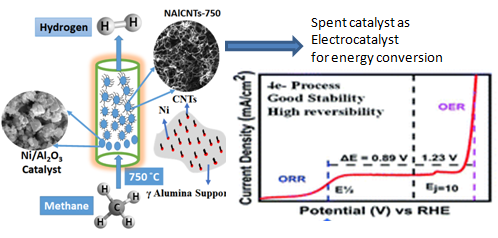
We are perhaps looking at a future in which industrial waste will form the base for energy storage in batteries. Scientists have shown that the spent catalysts from the energy industry or the raw material for recycling operation that deliver fresh catalysts and valuable metals work as an efficient bifunctional oxygen electrocatalyst and can catalyze the core reactions that facilitate the operation of metal-air batteries.
It can help develop new strategies for effectively using industrial waste for energy storage in batteries paving the way to realize the dream of achieving ‘today’s waste is tomorrow’s energy’.
Hydrogen energy offers a promising power generation route for the industry and transport sectors due to high energy density and clean output. One of the ways to produce hydrogen is by catalytic decomposition of methane using nickel catalyst embedded on alumina or zeolite. After several runs, the catalysts get spent due to carbon choking and lose their activity. The spent catalysts are typically subjected to energy-intensive processes such as high-temperature combustion for recycling, releasing a large amount of COx into the atmosphere during the process or chemical treatment for the reclamation of metal constituents. These protocols are neither economically viable nor environmentally friendly, thus demanding alternative avenues to efficiently use the spent catalyst.
One of the best possible routes is to use the retrieved spent catalyst for energy generation/storage applications. The composition of the given spent catalyst, Carbon nanotubes with Ni nanoparticles and porous alumina, may be ideal for direct use as electrocatalyst in electrochemical energy applications and thus, opens up a viable strategy for converting waste to wealth.
Dr C. Sathiskumar, Dr Neena S. John and Dr H.S.S. Ramakrishna Matte from the Centre for Nano and Soft Matter Sciences (CeNS), an autonomous institute under the Department of Science & Technology, Government of India, in collaboration with Hindustan Petroleum Corporation Ltd (HPCL) R&D Green Centre, Bengaluru, have demonstrated that the above-spent catalyst works as an efficient bifunctional oxygen electrocatalyst. It can catalyze both electrochemical oxygen evolution (OER) and oxygen reduction reactions (ORR), the core reactions that facilitate the operation of metal-air batteries.This research was recently published in the journal ‘Sustainable Energy Fuels’.
The spent catalyst shows stable current density for 20 hrs and 8 hrs towards OER and ORR. The potential difference for overall oxygen electrocatalyst (ΔE) reveals a superior bifunctional activity of the spent catalyst. Furthermore, the spent catalyst employed in Zn-air batteries displayed commendable charge-discharge performance up to 45 hrs with high reversibility.
The work supported by the Centre for High Technology (CHT)-Oil and Industry Development Board (OIDB), Hydrogen Corpus Fund help in effectively utilizing industrial waste for energy storage applications, thus producing green energy in a sustainable manner.
Publication links:
DOI: 10.1039/d1se00007a.
For more details Dr Neena S. John and Dr H.S.S. Ramakrishna Matte jsneena@cens.res.in, matte@cens.res.in can be contacted.
Ministry of Science & Technology Press release dated 06th July 2021
SS/RKP
The involvement of women as science leaders seems to be increasing. The percentage of women leading research projects has increased by 4 percent over two years, said a recent government report.
Women Principal Investigators (PIs) participation in research that received Extramural Research (EMR) support (support through peer-reviewed competitive grant mechanism) was 28% during 2018-19, as compared to 24% during 2016-17, according to the Directory of Extramural Research & Development (R&D) Project 2018-19 report released by the government recently.
The report also showed that extramural R&D support or R&D support through peer-reviewed competitive grant mechanisms by the central government was Rs. 2091.04 Crore in 2018-19 as compared to Rs. 2036.32 Crore in 2017-18 — an increase of Rs. 54.72 Crore over the previous year. The number of projects supported has increased, as has the number of PIs. A total of 3839 PIs undertook 4616 projects in comparison to 3491 PIs undertaking 4137 projects during 2017-18.
Of this support, 64% of the projects were received by 8 states, including Tamil Nadu, Delhi, Karnataka, Kerala, Maharashtra, Telangana, Uttar Pradesh, and West Bengal, accounting for 71 % of the share of funding.
The 22 Indian Institute of Technologies (IITs) combined received 822 projects – the maximum number, with highest financial support of Rs. 449.25 Crore, followed by 26 National Institute of Technology (NITs) combined, which received 191 projects with financial support of Rs. 55.83 Crore. The maximum financial support went to Engineering and Technology, while the maximum number of projects went to Biological Sciences.
The Department of Science and Technology (DST) accounted for the maximum Extramural Research (EMR) support of Rs. 1392.21 Crore (67%), followed by the Department of Biotechnology (DBT) with Rs. 341.37 Crore (16%). The two Departments together contributed to 83% of the total extramural R&D funding in India.
The Scientific and Technological (S&T) activities play a vital role in the economic, social, and physical development of a country. Scientific and technological research needs huge investments and calls for judicious utilization of scarce resources like finance, trained manpower, raw materials, and so on. Data collection and analysis pertaining to resources devoted to S&T, therefore, assumes significant importance. The growth of S&T, its performance, and its impact on society and economy are indicators to assess the effectiveness of planning and policy formulation.
Extramural Research and Development (R&D) projects support is a peer-reviewed competitive grant mechanism of the Central Government to promote, catalyze and advance R&D and innovation in the country and provides special encouragement to scientists to pursue a research career. Centre for Human and Organisational Resource Development (CHORD) division, formerly known as the National Science and Technology Management Information System (NSTMIS) division of DST, has been collating, analyzing, and disseminating information on Extramural Research and Development projects funded by various scientific agencies. CHORD has been entrusted with the task of building the information base on a continuous basis on resources devoted to scientific and technological activities for policy planning in the country.
Directory of Extramural R&D projects approved for funding by selected Central Government Departments/Agencies is being published by DST annually since 1990-91. The present directory, twenty-ninth in the series, is an outcome of the efforts made for the projects funded during the year 2018-19 by various scientific agencies of the Government. This directory contains information on 4616 R&D projects approved for funding by 16 scientific agencies/departments during 2018-19.
Detailed Report: https://dst.gov.in/sites/default/files/EM_Directory_2018_19_0.pdf
https://dst.gov.in/sites/default/files/EM_Directory_2017-18_0.pdf
*
Ministry of Science & Technology Press release dated 02 July 2021
Highest ever merchandise exports in a quarter (Q1 2021-22, USD 95 billion) in the history of India
India sets a target of USD 400 billion merchandise exports in 2021-22
Despite COVID-19, labour-intensive sectors (engineering goods, rice, marine products, etc.) saw a rapid export growth
Highest ever FDI inflow of USD 81.72 billion in 2020-21
Number of startups recognised by DPIIT goes up to 50,000, spread across 623 districts
Shri Piyush Goyal said, “the world sees India as the trusted and reliable partner”
Ministry of Commerce & Industry Press release dated 02 July 2021
The Minister of Commerce & Industry, Railways and Consumer Affairs, Food & Public Distribution, Shri Piyush Goyal held a press conference today to showcase the achievements of the Ministry of Commerce and Industry in Q1 (April – June) of 2021-22. He mentioned how an ambitious target of USD 400 billion exports has been set for 2021-22.
Shri Piyush Goyal said that sector specific interventions, involvement of all the stakeholders and functioning of the Government as a whole helped in achieving the growth. Simplification of procedures, extension of timelines and licences, all of that has resulted in the record performance of exports, he added. He specially thanked the Hon’ble Prime Minister Shri Narendra Modi ji for leading from the front, and holding discussions with various stakeholders through webinars after the Union budget, and encouraging everyone to put in their best.
Shri Piyush Goyal further said that the performance of the services sector has also been excellent, and despite the pandemic, almost 97% of 2019-20 service export levels were achieved in the last FY. He said that after deliberations with the stakeholders, he is confident that USD 350 billion service exports can be achieved by 2025, and may even go up to USD 500 billion very soon.
The press conference was also attended by Ministers of State for Commerce & Industry, Shri Som Parkash and Shri Hardeep Singh Puri. The Secretaries of the Department of Commerce and DPIIT then briefed the media about the achievements of their respective departments.
Highest Ever Merchandise Exports in the history of India
Highest ever merchandise exports of USD 95 billion in Q1 of 2021-22 has been achieved in the history of India. This is 85% higher than exports of Q1 of 2020-21 and 18% higher than the exports of Q1 of 2019-20. It is also 16% more than the previous highest Q1 exports of 2018-19 (USD 82 billion) and is higher than the earlier peak of exports in Q4 of 2020-21 (USD 90 billion).
Labour intensive sectors seeing rapid export growth
Several Labour-Intensive sectors have seen a rapid export growth. The exports in the engineering goods sector has increased by USD 5.2 billion over Q1 of 2019-20. Likewise, Rice exports growth has remained positive since May 2020 and rose by 37% in Q1 of 2021-22 compared to Q1 of 2019-20
India’s Exports Performance Vis-a-vis Major Economies in April 2021
India showcased robust export performance in April 2020 compared to major economies of the world. As compared to April 2019, India’s exports growth during April 2021 was higher than other major advanced economies like European Union, Japan, USA, Republic of Korea & United Kingdom
Record FDI Inflows
India received the highest ever FDI inflow in 2020-21 of USD 81.72 billion. This is higher by 10% compared to USD 74.39 billion achieved in 2019-20. The positive momentum continues with FDI inflow of USD 6.24 billion during April 2021, which is 38% higher than April 2020.
Startup India
Number of startups recognised by DPIIT has crossed 50,000 and is spread across 623 districts in India. With these startups nearly 1.8 lakh formal jobs have been created by 16,000+ recognised startups in 2020-21. Several times more have benefited from the Startup ecosystem.
Reducing Compliance Burden
To improve the ease of doing business and reduce the compliance burden 6,426 compliances have been reduced in Phase-I. 3,177 compliances are being been reduced in Phase II. The timeline for Phase I was 31st March 2021 & Phase II is 15th August 2021.
Investment Clearance Cell
The National Single Window System is a one-stop digital platform to obtain clearances & approvals. In the phase-1 of integration, 43 Depts/Ministries & 14 States Single Window Systems are being on-boarded. The pre-launch version is undergoing extensive testing and we are gearing up for a soft launch.
The Hon’ble Minister concluded by saying that the world sees India as the trusted and reliable partner, and has more confidence in India’s capability to provide quality products and services on time. With the goods and services gaining momentum, a large number of employment opportunities will be generated, the economy will strengthen, revenues will increase, and the government will be able to help the disadvantaged sections in a more substantive manner.
***
YB/SS
In a move to give a major push to tech startups across the country, Atal Innovation Mission, NITI Aayog Wednesday concluded its first fintech cohort of AIM-iLEAP- an initiative to back tech start-ups with much-needed access to industry, markets and investors.
The fintech cohort was done through a series of thematic virtual demo days organised AIM in partnership with Startup Réseau and Visa as part of AIM-iLEAP (Innovative leadership for entrepreneurial agility and profitability) initiative.
The program had kickstarted with the inaugural four-day bootcamp for “FinTech” start-ups (the chosen few from among the several AIM supported Fintech start-ups) from 14th to 17th June, 2021.
The Fin-Tech cohort consisted of start-ups from a wide range of areas such as- payments, international money transfers, personal finance, consumer banking, insurance, neo bank etc. In the bootcamp they got an opportunity to fine-tune their pitches, work on their GTM strategy, understand more about the fintech ecosystem, ask questions to sectoral experts and so on.
After going through rigorous polishing, the start-ups showcased their solutions to various enterprises for market access and investors for funding via the inaugural virtual Demo Day on 30th June 2021. The Demo Day saw participation from a large number of corporates and investors. Fintech giants such as Visa, Paytm etc as well as big investors attended the program.
As per the AIM’s mission, AIM-iLEAP bootcamp and demo day is the first among the many more to come initiatives to push startups in the country. Future cohorts shall be focussed on different sectors such as Agri-tech, Defence Tech, Smart Mobility, AI and so on.
While speaking on the virtual event today, Mission Director AIM, NITI Aayog Dr Chintan Vaishnav said that the main mandate of AIM is to catalyse India’s start-up and innovation ecosystem and the AIM-iLEAP program is a step in that direction.
“It gives a structured yet lite-weight approach to bring together the start-ups, enterprises, investors and financers to come together and create partnerships that would help these start-ups to take a leap forward in achieving more scalable and sustainable solutions,” he asserted.
He further said that this will help to build trust and confidence among all the stakeholders which are the vital ingredients of a vibrant start-up and innovation ecosystem. Fintech community is at the forefront of building an ecosystem where everyone wins; such platforms catalyze movement towards reaching such a goal. It is AIM’s main objective to culminate into reality the vision of an Indian innovation ecosystem that runs sustainably on an auto-pilot mode.
Partnered with AIM, Startup Réseau aims to attract participation from 80 – 100 corporates for a series of 12 thematic bootcamps and Virtual Demo Days, over the course of the program.
It has developed a structured, result-driven model, for providing an environment to the corporations to set up new rules, enabling a possibility to proactively spot new ideas on the edge, as well as at the core of its business, and a place where such disruptive ideas can be protected from the organization while also being supported by it.
Founder & CEO, Startup Réseau Ajay Ramasubramaniam while speaking during the virtual event said “We firmly believe that successful models of incubation and acceleration of start-ups require broader participation of the industry at large. Atal Innovation Mission is a fantastic enabler of incubators and the infrastructure supporting innovation and entrepreneurship.”
He added that Startup Réseau brings a strong global network of mentors, enterprise connections and investors that can be leveraged by these start-ups supported under Atal Incubation Centres. Through AIM iLEAP, the AIM is to enable next-gen start-ups in India, through a series of bootcamps and demo days that will open up access points.
AIM has also onboarded an industry partner Visa-a corporation known globally for backing entrepreneurship. The digital payments company will be extending their API’s and services to the start-ups. They will also provide the B2B and B2C start-ups their platform for digitized payments.
Commenting on the partnership, Arvind Ronta, Head – Products, India and South Asia, Visa said, “Visa has always been a reliable partner for fintech’s across the world and in India, whether by opening our APIs to them or through programs like Visa Everywhere Initiative. Now, we are excited to collaborate with the AIM for the AIM iLEAP program and work with tech start-ups across India. Through this partnership, we hope to enable opportunities for India’s innovative start-up ecosystem to take secure, scalable solutions to market faster.”
Meanwhile, the Demo Day started off with a keynote address on maximising customer experiences for the fintech players by a seasoned fintech expert, Jitendra Gupta, founder of neo-banking start-up Jupiter and Citrus Pay.
This was followed by a panel discussion on ‘Facilitating innovation for corporates and start-ups in Fin-tech sector’.
It was a riveting and insightful discussion presided by prominent and distinguished personalities from some of the national and international fin-tech giants, Including Pramod Mulani, head digital of India and South Asia at Visa, Lincy Therattil, Head – Open Innovation at Barclays, Dr Chintan Vaishnav, Mission director of Atal Innovation mission and Ajay Ramasubramaniam, founder and CEO of Startup Réseau.
A closed-door pitching session by the eight AIM supported fintech start-ups to the investors and enterprises from was also held today. The demo day was concluded with the closed room networking session between the start-ups and investor/enterprises. The Demo Day saw participation from some marquess names in the fin-tech enterprise and investor ecosystem including fintech giants such as Visa, Paytm amongst others.
The start-ups that were showcased includes FinOS, VillPay, Kutumba, Mudracircle, Earnhance (Mkix Pvt Ltd) , Yottol , Strafox Consulting India Pvt Ltd, and Finaara Technologies Pvt Ltd.
The objective of the AIM-iLEAP program is to invite technology start-ups across a broad range of functions and have them present their solutions to the corporate leadership and innovation team for enabling market access and industry partnerships. On the other hand, individual and institutional investors participating in this program shall consider investing in the curated set of AIM supported start-ups.
Working as an apex body for innovation and entrepreneurship in the country, AIM has access to over 2000+ tech start-ups pan-India through its member base of 65+ business incubators, 24 ACICs, 15 ARISE-ANIC and over 7200+ATLs.
Niti Aayog Press release dated 30 June 2021
DS /AKJ
Scientists have developed electrically configured nanochannels that can eliminate unwanted energy waste and promise wave-based computing. This can revolutionize on-chip data communication and processing in future.
Conventional electronics is composed of logic circuits having a large number of transistors interconnected by metallic wires. The data carried by electric charges suffer undesirable heating limiting its integration density.
Spintronics, also known as spin electronics, or the study of the intrinsic spin of the electron and its associated magnetic moment, in addition to its fundamental electronic charge, in solid-state devices offer to harness electron spins. Their collective precession can carry information encoded in its amplitude, phase, wavelength, and frequency without any physical motion of particles, eliminating unwanted energy waste and promising wave-based computing.
To this end, Professor Anjan Barman and coworkers from the S. N. Bose National Centre for Basic Sciences, an autonomous institute under the Department of Science and Technology (DST), Government of India, have developed electrically reconfigured parallel nanochannels that tune the behaviour of spin waves in nano-structure elements. They have done this by periodically tailoring the property that confers a preferred direction on the spin of a system, also called anisotropy using the electric field — technically called the principles of voltage-controlled magnetic anisotropy. This work has been published in the journal ‘Science Advances’.
In the recent research, spin-waves were efficiently transferred through these nanochannels, and this could be switched ‘ON’ and ‘OFF’ and its magnitude altered by a meagre voltage of few volts. The team believes that in future, these nanochannels can be engineered further to transfer specific bands of frequencies through designed parallel channels towards development of on-chip multiplexing devices.
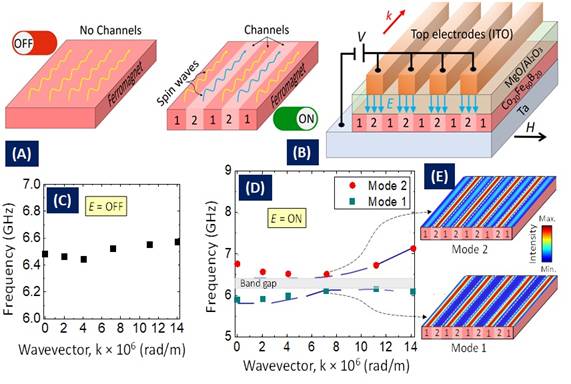
Figure: A. Schematic illustration shows the concept of spin-wave nanochannels. B. Schematic illustration shows the device structure and formation of nanochannels. Spin-wave frequencies versus wavevector when electric field, E is OFF (C) and ON (D). E. Heatmap plots show the spatial distribution of spin-wave intensity for spin-wave mode 2 and mode 1 at wavevector k = 7.1 × 10⁶ rad/m.
Publication link:
DOI: 10.1126/sciadv.aba5457
For more details, Anjan Barman, Senior Professor (abarman@bose.res.in), can be contacted.
****
Ministry of Science & Technology dated 28 June 2021
SS/RP
Scientists have fabricated a simple, cost-effective, bio-compatible, transparent nanogenerator that can generate electricity from vibrations all around for use in optoelectronics, self-powered devices, and other biomedical applications.
Searching for renewable energy resources with reduced carbon emissions is one of the most urgent challenges due to the increasing threat of global warming and energy crisis. Some of the unconventional methods to generate electricity include piezoelectric, thermoelectric, and electrostatic techniques used in devices like touch screens, electronic displays, and so forth.
The triboelectric nanogenerators (TENG) make use of mechanical energy in the form of vibrations present everywhere in different forms to generate electricity. The energy harvesting TENG works on the principle of creation of electrostatic charges via instantaneous physical contact of two dissimilar materials followed by generation of potential difference when a mismatch is introduced between the two contacted surfaces through a mechanical force. This mechanism drives the electrons to move back and forth between the conducting films coated on the back of the tribo layers. The method employed till date to design TENG use expensive fabrication methods like photolithography or reactive ion etching, and additional process like electrode preparation and so on.
Dr. Shankar Rao and his team from the Centre for Nano and Soft Matter Sciences, Bengaluru, an autonomous institute under the Department of Science & Technology, Government of India, have designed a transparent TENG, using thermoplastic polyurethanes (TPU) either in the form of electrospun nanofibers or as a flat film using the simpler Doctor’s blade technique, along with Polyethylene terephthalate (PET) as tribo layers. TPU nanofibers are obtained from the electrospinning (ES) technique. The Doctor’s blade technique, a routine procedure adapted in a variety of situations, squeezes the material through a blade and the substrate yielding a uniform thin layer. The easy availability of the active material and the simplicity of the fabrication process make it cost-effective over currently available fabrication techniques. The resulting device is also highly efficient, robust, and gives reproducible output over long hours of operation. The results were published in ‘Journal of Nanoscience and Nanotechnology’.
The fabricated device could light up eleven LEDs by gentle hand tapping and could be a potential candidate for use in optoelectronics, self-powered devices, and other biomedical applications.
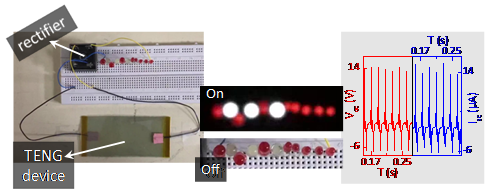
Image of the flexible and transparent TENG device with PET as one and thermoplastic polyurethane (TPU) as the complementing tribolayer. With the application of a small force of 0.33N, the device provided 21.4 V and 23 µA as open-circuit voltage and short-circuit current, respectively, indicating the high efficiency of the device. In addition, the gentle hand tapping on the TENG device can power up to 11 light-emitting diodes (LEDs).
Publication link: https://doi.org/10.1166/jnn.2021.19143
****
Ministry of Science & Technology Press release dated 26 June 2021
Union Minister Shri Narendra Singh Tomar addressed the CII Northern Region Food Processing Summit 2021
Government has taken several initiatives to harness the food and horticulture potential of the country: Shri Narendra Singh Tomar
The government is committed to the development of the food processing sector, says Shri Tomar
Union Minister for Agriculture & Farmers Welfare, Food Processing Industries, Rural Development and Panchayati Raj Shri Narendra Singh Tomar addressed the 3rd edition of the Northern Zone Food Processing Summit organized by the Confederation of Indian Industry (CII) through video conference.
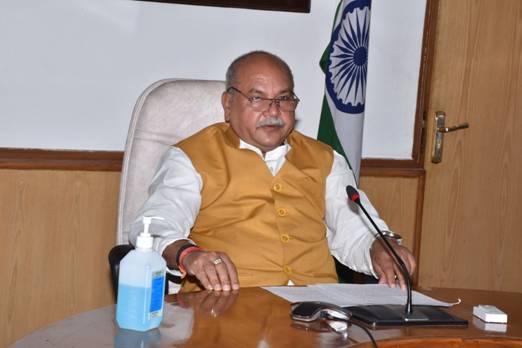
Speaking on the occasion, Shri Tomar said that the Government of India has taken several initiatives to harness the food and horticulture potential of the country to encourage investment and development in the agriculture sector as well as to provide a better environment to the existing enterprises. He added that the Government is also committed to the development of the food processing sector. “A new production linked incentive scheme for the food processing industry was launched by Prime Minister Shri Narendra Modi, as a part of the self-reliant India campaign. About Rs. 11 thousand crores will be spent on the scheme”, the Minister said.https://www.youtube.com/embed/0vJap9nJYJs
Shri Tomar said that the Ministry of Food Processing Industries has launched the Prime Minister formalization of Micro Food Processing Enterprises (PMFME) scheme under Atmanirbhar Bharat Abhiyan with an aim to enhance the competitiveness of existing individual micro-enterprises in the unorganized sector. The scheme focuses on supporting groups engaged in agri-food processing such as Farmer Producer Organizations (FPOs), Self Help Groups (SHGs) and producer cooperatives across their value chain.
Shri Tomar said that CII is a premier industry organization, which is helping to lead the country on the path of development. Calling for cooperation to take the benefits of the government initiatives to all the farmers, he said that the Ministry of Food Processing Industries is working on these initiatives in a planned manner. He urged CII to conduct a comparative study on the available food grains and horticulture resources in the country with their processing so that the Government of India could devise a strategy to fill the gaps.
Speaking on the occasion, Shri Manoj Joshi, Additional Secretary, Ministry of Food Processing Industries, Government of India emphasized the need for joint efforts by the government and industry in the area of fortification of processed food and meeting the changing consumer preferences.
*****
*Ministry of food processing Industries press release dated 24 June 2021
APS/JK
 Business So Simple