Updates-07th March 2022

🖋️ Court room

SC Allows Insolvency Application Withdrawal as Majority Homebuyers accepted Builder’s Settlement during CIRP

Amit Katyal Vs Meera Ahuja (Supreme Court of India) dated 03/03/2022

Sale deed registration operate from the time from which it would have commenced to operate if no registration was required or made

Chitranshi Goyal Vs Indian Oil Corporation Ltd. (Rajasthan High Court) dated 22/02/2022

Parties by agreement cannot give jurisdiction to a Court which lacks jurisdiction

Aanchal Mittal Vs Ankur Shukla (Delhi High Court) dated 25/02/2022

Summons for appearance & authorization for arrest under GST is not a Criminal Proceedings

Saurabh Mittal Vs Union of India (Delhi High Court) dated 11/02/2022

Compounding Benefit under Income Tax cannot be denied for non-acquittal from Criminal Charges

Jai Singh Goel Vs Chief Commissioner of Income Tax (Central) & Anr. (Delhi High Court) dated 25/02/2022

✒️ Laws-Act, Rule, Regulation,Notification, Circular etc.

LLP (2nd Amendment) Rules, 2022 dated 04th March 2022 (Clausewise analysis)

Auto-population of e-invoice details into GSTR-1 (GST Portal updates-03 March 2022)

✒️ Articles, News etc.

“Net Profit” calculation for CSR & Managerial remuneration II Net Profit as per Section 198 of CA 2013

ROC Adjudication order dated 03rd March 2022 for violation of 2nd proviso of Section 149(1) of CA 2013 (Non appointment of women director)

Exporter arrested for GST fraud case (Fraudulent ITC claim of Rs. 15.26 Cr.)-GST Updates -04-03-2022

ROC Adjudication order dated 03rd March 2022 for violation of 2nd proviso of Section 149(1) of CA 2013 (Non appointment of women director)

ROC Adjudication order dated 03rd March 2022 for violation of 2nd proviso of Section 149(1) of CA 2013 (Non appointment of women director)

Section reference As per Section 149 : Company to have Board of Directors.—(1) Every company shall have a Board of Directors consisting of individuals as directors and shall have— (a) a minimum number of three directors in the case of a public company, two directors in the case of a private company, and one director in the case of a One Person Company; and (b) a maximum of fifteen directors:

Provided that a company may appoint more than fifteen directors after passing a special resolution:

Provided further that such class or classes of companies as may be prescribed, shall have at least one woman director.

172. Penalty.— If a company is in default in complying with any of the provisions of this Chapter and for which no specific penalty or punishment is provided therein, the company and every officer of the company who is in default shall be liable to a penalty of fifty thousand rupees, and in case of continuing failure, with a further penalty of five hundred rupees for each day during which such failure continues, subject to a maximum of three lakh rupees in case of a company and one lakh rupees in case of an officer who is in default.]

Exporter arrested for GST fraud case (Fraudulent ITC claim of Rs. 15.26 Cr.)-GST Updates -04-03-2022

Exporter arrested for GST fraud case (Fraudulent ITC claim of Rs. 15.26 Cr.)-GST Updates -04-03-2022

The officers of Anti Evasion wing of Thane CGST Commissionerate of Mumbai zone have arrested an exporter who is Director of a Private Limited Company, for fraudulently claiming GST Input Tax Credit (ITC) of Rs. 15.26 Crore. This ITC was claimed on the basis of bogus invoices of  Rs. 85 Crore issued by the fake entities.

Based on inputs received from Delhi Customs and further developed by Officers of Thane Commissionerate, an investigation was initiated against M/s. Corvette Tradelink Pvt. Ltd, Borivali. Investigation revealed that this firm was engaged in export of footwear and had availed GST Input Tax Credit fraudulently on the basis of bogus invoices issued by non-existent fake entities from  Delhi The Company had used this fake ITC for payment of IGST for exports through ICD Tughlakabad, Delhi and had subsequently claimed IGST refund from Indian Customs on the fake ITC so used.

One Director of the said Private Limited Company  was arrested on 03.03.2022, under Section 69 of CGST Act 2017 for contravention of Section 132(b) and 132(c) of CGST Act 2017 and produced before Chief Metropolitan Magistrate, Mumbai. The accused  was sent to judicial custody for 14 days by the magistrate.  If proved guilty, he shall face imprisonment up to 5 years and fine.

This case is a part of Anti-Evasion drive launched by CGST, Mumbai Zone against the tax evaders and fraudsters. CGST Thane Commissionerate has detected tax evasion of Rs. 1238 , recovered  Rs. 20 crore and arrested 7 persons during last six months.

The CGST department is using data-mining, data analysis and network analysis tools to identify potential tax evaders and fraudsters. The department is focusing on all sectors of economy including service sector, exports, imports and digital economy to identify tax evaders who has been causing unfair competition for honest and compliant tax payers. The department is going to intensify this anti-evasion drive in the coming days and months.

***

S.Thakur/P.Kor


Follow us on social media: 

@PIBMumbai  

 /PIBMumbai   

 /pibmumbai  

pibmumbai@gmail.com

Release Id :-1803047

CCI organises 7th Edition of National Conference on Economics of Competition Law

Key discussion :

Emergence of technology giants and the challenges and novel questions it poses for regulation and regulators.

Key technological and economic factors such as, network effects, scale economies, synergies between intangible assets within technology ecosystems etc. that give rise to concentration of market power in digital markets.

Importance of investments in intangible assets such as brands, software, patents etc., financing aspects such as the predominance of venture capital funds and private equity funding.

Outlined the role of economics in unravelling the intricacies of markets, in understanding the state of competition and what aids, abets or hinders it.

The architecture of the Competition Act, 2002 is such that adjudication entails appreciation of the economics of markets and the impugned conduct.

Refer extract of Press release dated 04th March 2022

The Competition Commission of India (CCI) today organized the Seventh National Conference on Economics of Competition Law in virtual mode. Mr Neelkanth Mishra Member, Economic Advisory Council to the Prime Minister, was the Keynote Speaker at the Conference. Mr Ashok Kumar Gupta, Chairperson, CCI, delivered the Special Address at the Inaugural Session and Dr Sangeeta Verma, Member, CCI opened the Conference with her opening remarks. 

The Keynote Address by Mr Neelkanth Mishra focused on the emergence of technology giants and the challenges and novel questions it poses for regulation and regulators. Mr Mishra, in his address, discussed the key technological and economic factors such as, network effects, scale economies, synergies between intangible assets within technology ecosystems etc. that give rise to concentration of market power in digital markets. Elucidating the features and metrics that are relevant in digital markets distinguishing them from traditional markets, he referred to the importance of investments in intangible assets such as brands, software, patents etc., financing aspects such as the predominance of venture capital funds and private equity funding. While technology sectors, owing to their innate features may be susceptible to winner-take-all market structures, they also hold enormous potential to drive innovation, facilitate new business models and help remove inefficiencies in the value chain, he pointed out. The question that merits attention in this context is whether concentration of capital and market power, size and scale of the technology giants, by themselves, be seen as a threat to competition, he said. He concluded by presenting a set of questions for regulators to ponder over so that the regulatory approach remains informed of the complexities of digital markets, entailing deep-rooted assessment, global collaboration and cautious reaction. 

In his Special Address, Mr Ashok Kumar Gupta outlined the role of economics in unravelling the intricacies of markets, in understanding the state of competition and what aids, abets or hinders it. The architecture of the Competition Act, 2002 is such that adjudication entails appreciation of the economics of markets and the impugned conduct, he said. Referring to the growing emphasis placed by the Commission on market studies, Mr Gupta mentioned that the application of this complex economic legislation could only be effective when it appropriately accounted for market specificities. Given the inherently dynamic nature of markets especially the new age markets, the Commission engages proactively with stakeholders through its Market Studies and Stakeholder consultations.  The learnings from these market studies allow the Commission to appreciate various strategic market interactions in oligopolistic markets and going forward the Commission proposes to undertake several market studies for the purpose of enforcement and advocacy, he added.

In her opening remarks, Dr Sangeeta Verma talked about the feedback loop between antitrust research and enforcement. She stressed on the need for the evolving academic discourse and the shifts in economic understanding to reflect in antitrust enforcement. On the other hand, a growing body of antitrust case law with rigorous economic analyses could stimulate follow-on research, she mentioned. For accurate yet speedy investigation and disposal of cases, she said, it was important that parties, both in antitrust and combination matters, made their submissions and arguments giving due regard to the economic framework that applies to the industry concerned.

The Conference Plenary was on ‘Reforms and Deepening of Markets’. Mr Amitabh Kant, Chief Executive Officer, NITI Aayog, Mr Tuhin Kanta Pandey, Secretary, Department of Investment and Public Asset Management, Ministry of Finance, Government of India, Dr M. S. Sahoo, Distinguished Professor, National Law University, Delhi and Dr Nachiket Mor, Visiting Scientist, The Banyan Academy of Leadership in Mental Health and Senior Research Fellow, IIIT Bangalore were the distinguished panellists at the Plenary. The Plenary was moderated by Ms Latha Venkatesh, Executive Editor, CNBC TV18.

The Conference also included two technical sessions on Competition and Regulation: Empirical Inquiries; and Competition Law and Policy: Issues and Approaches, where researchers presented papers on economics of competition law. The technical sessions were chaired by Dr Pami Dua, Director, Delhi School of Economics and Dr Aditya Bhattacharjea, Senior Professor, Delhi School of Economics.
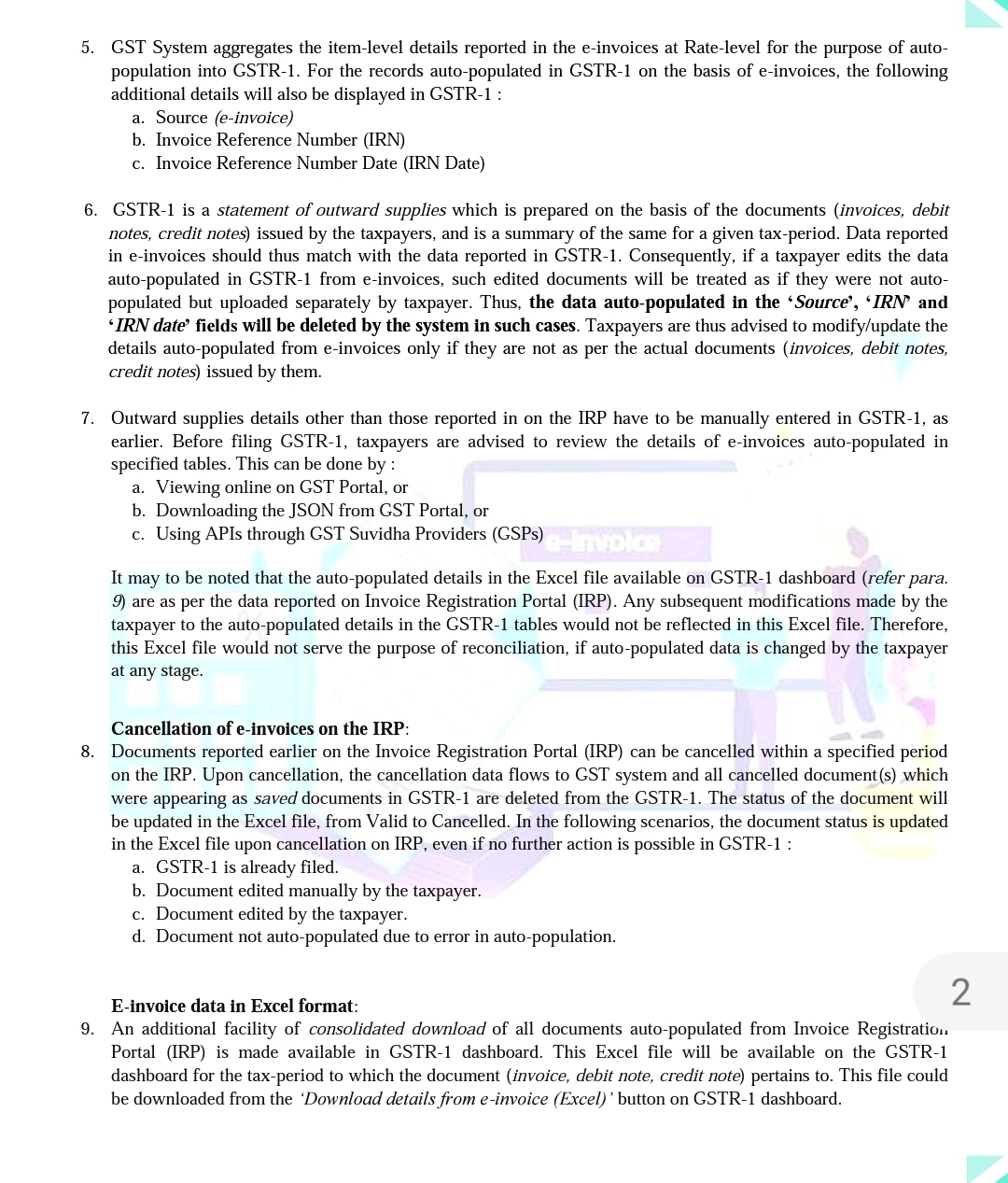
Auto-population of e-invoice details into GSTR-1 (GST Portal updates-03 March 2022)

  1. Generation of e-invoice is mandatory for certain class of taxpayers, as notified by the Government. These taxpayers are required to prepare & issue their e-invoices by reporting their invoice data in the prescribed format (e-invoice schema in FORM GST INV-01) and reporting the same on the Invoice Registration Portal (IRP). Invoices reported successfully on the IRP are given a unique Invoice Reference Number (IRN). The documents (invoices, debit notes, credit notes) reported on the IRP are then transmitted electronically to the GST system and are auto-populated in the respective tables of GSTR-1.
  2. For a detailed advisory regarding auto-population of e-invoice data into GSTR-1 tables, please refer below:

Auto population of e-invoice details into GSTR-1

ED has filed a Prosecution Complaint against Pushpesh Kumar Baid & Ors under PMLA, 2002 in a Rs. 182.78 Crore Bank Loan cheating case. Court has taken cognizance in the matter.

For your quick reference

Section 13 in The Prevention of Money-Laundering Act, 2002

13. Powers of Director to impose fine.—

(1) The Director may, either of his own motion or on an application made by any authority, officer or person, call for records referred to in sub-section (1) of section 12 and may make such inquiry or cause such inquiry to be made, as he thinks fit.

(2) If the Director, in the course of any inquiry, finds that a banking company, financial institution or an intermediary or any of its officers has failed to comply with the provisions contained in section 12, then, without prejudice to any other action that may be taken under any other provisions of this Act, he may, by an order, levy a fine on such banking company or financial institution or intermediary which shall not be less than ten thousand rupees but may extend to one lakh rupees for each failure.

Income Tax raid on major Telecom Group (Press release 03rd March 2022)

The Income Tax Department conducted search & seizure operations on a multinational group, engaged in distribution of telecom products and providing captive software development services, on 15.02.2022. The ultimate shareholding of the group lies with a foreign entity of a neighbouring country. The searches, which were spread across Delhi, Gurugram and Bengaluru covered the main business premises and also the residential premises of the key office bearers.  

The search action has revealed that the group has made inflated payments against receipt of technical services from its related parties outside India. The assessee company could not justify the genuineness of obtaining of such alleged technical services in lieu of which payment has been made as also the basis of determination of consideration for the same. The expenses debited by the assessee company towards receipt of such services are to the tune of Rs. 129 crore over a period of five years.

During the search, it was found that, the assessee group has debited more than Rs.350 crore in its books of account in recent financial years towards royalty to its related party. Such expenses have been incurred for the use of brand and technical know-how related intangibles. During the search, the group has failed to substantiate receipt of any such services/technical know-how, or the basis of quantification of royalty rate for such claim. Consequently, the rendering of services and such royalty payments become highly questionable and prima facie, disallowable as business expenses as per extant Income Tax law.

Evidences gathered and statements recorded during the search also reveal that one of the group entities engaged in providing software development services, has been disclosing lower net margins from the related parties, by claiming its operation to be of low-end nature. However, the evidences collected during the investigation indicated that this entity has been rendering significant services/ operations of high-end nature. On this aspect, suppression of income of Rs. 400 crore has been detected.

The search action has further revealed that the group has manipulated its books of account to reduce its taxable income in India through creation of various provisions for expenses, such as provisions for obsolescence, provisions for warranty, doubtful debts/ loans & advances etc., which have little or no scientific/financial rationale. During the investigation, the group has failed to provide any substantial and appropriate justification for such claims.

Further investigations are in progress.