KEY HIGHLIGHTS OF THE ECONOMIC SURVEY 2021-22 (Press release dated 31 Jan 2022)

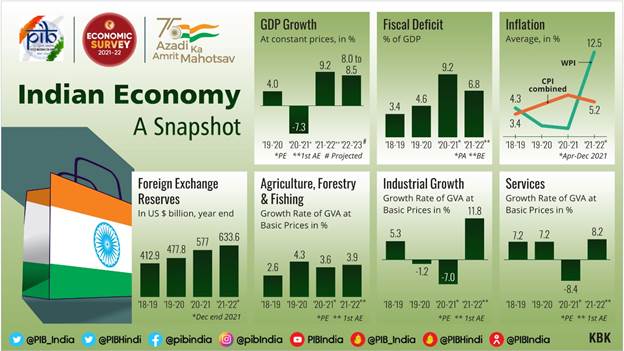
9.2 PERCENT GROWTH EXPECTED IN REAL TERMS IN 2021-22

GDP PROJECTED TO GROW 8.0-8.5 PERCENT IN 2022-23

PANDEMIC: GOVERNMENT’s SUPPLY SIDE REFORMS PREPARING ECONOMY FOR SUSTAINED LONGTERM EXPANSION 

CAPEX GROWS BY 13.5 PERCENT (YoY) DURING APRIL-NOVEMBER, 2021

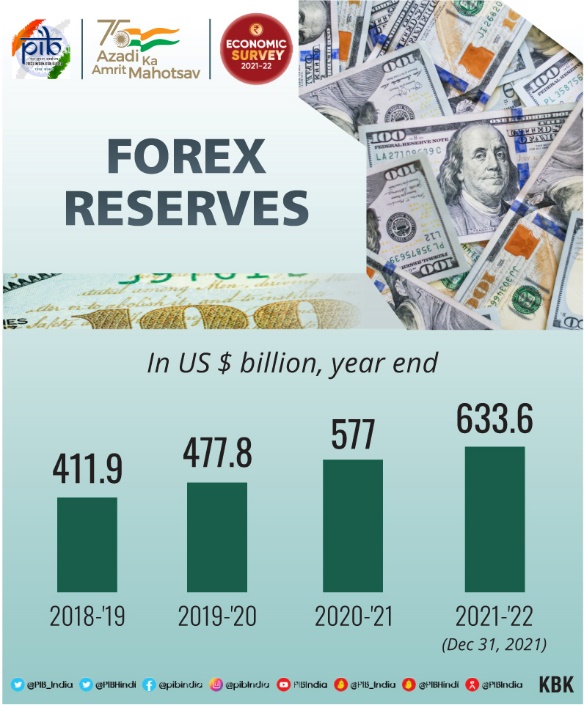
FOREIGN EXCHANGE RESERVES TOUCH  US$ 633.6 BILLION ON 31st DECEMBER, 2021 

MACROECONOMIC STABILITY INDICATORS SUGGEST ECONOMY WELL PLACED TO TAKE ON CHALLENGES OF 2022-23
MASSIVE GROWTH IN REVENUE RECEIPTS

SOCIAL SECTOR: EXPENDITURE ON SOCIAL SERVICES AS PROPORTION OF GDP INCREASES TO 8.6 PERCENT IN 2021-22 (BE) AS COMPARED TO 6.2 PERCENT IN 2014-15 

WITH REVIVAL OF ECONOMY, EMPLOYMENT INDICATORS BOUNCED BACK TO PRE-PANDEMIC LEVELS DURING LAST QUARTER OF 2020-21

MERCHANDISE EXPORTS AND IMPORTS REBOUND STRONGLY AND SURPASS PRECOVID LEVELS 

BANK CREDIT ACCELERATES TO 9.2 PERCENT AS ON 31st DECEMBER, 2021

Rs 89,066 CRORE RAISED VIA 75 IPOs; SIGNIFICANTLY HIGHER THAN IN ANY YEAR IN LAST DECADE

CPI-C INFLATION MODERATES TO 5.2 PERCENT IN 2021-22 (APRIL-DECEMBER)

FOOD INFLATION AVERAGES AT A LOW OF 2.9 PERCENT IN 2021-22 (APRIL-DECEMBER)

EFFECTIVE SUPPLY SIDE MANAGEMENT KEEPS PRICES OF MOST ESSENTIAL COMMODITIES UNDER CONTROL

AGRICULTURE: GVA REGISTERS BUOYANT GROWTH OF 3.9% IN 2021-22

RAILWAYS: CAPITAL EXPENDITURE SEES SUBSTANTIAL INCREASE TO Rs. 155,181 CRORE IN 2020-21; BUDGETED TO FURTHER INCREASE TO Rs. 215,058 CRORE IN 2021-22, A FIVE TIMES INCREASE COMPARED TO 2014 LEVEL 

PER DAY ROAD CONSTRUCTION INCREASES TO 36.5 KMS IN 2020-21 – RISE OF 30.4 PERCENT COMPARED TO THE PREVIOUS YEAR

SDGs: OVERALL SCRORE ON NITI AAYOG DASHBOARD IMPROVES TO 66 IN  2020-21

The Union Minister for Finance & Corporate Affairs, Smt. Nirmala Sitharaman presented the Economic Survey 2021-22 in Parliament today. The highlights of the Economic Survey are as follows:

State of the Economy:

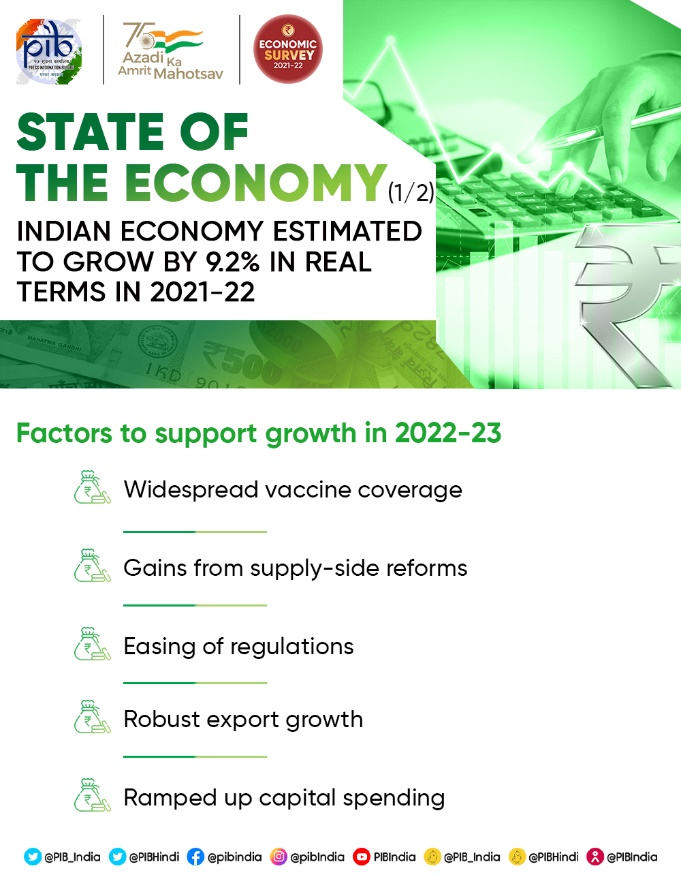
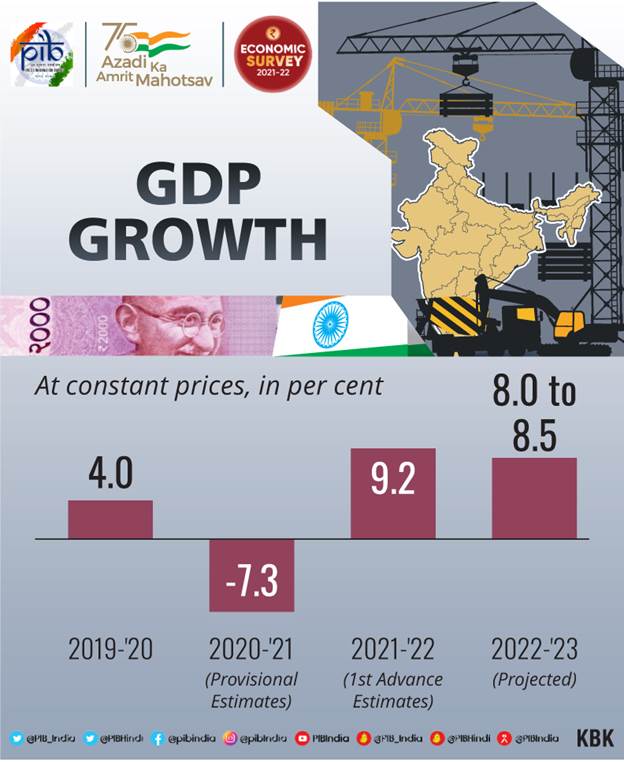
  • Indian economy estimated to grow by 9.2 percent in real terms in 2021-22 (as per first advanced estimates) subsequent to a contraction of 7.3 percent in 2020-21. 
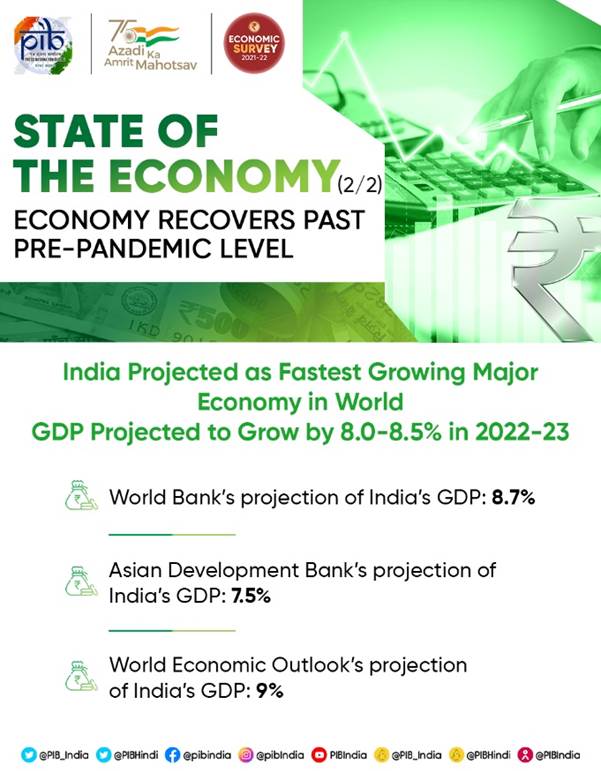
  • GDP projected to grow by 8- 8.5 percent in real terms in 2022-23.  
  • The year ahead poised for a pickup in private sector investment with the financial system in good position to provide support for economy’s revival. 
  • Projection comparable with World Bank and Asian Development Bank’s latest forecasts of real GDP growth of 8.7 percent and 7.5 percent respectively for 2022-23.
  • As per IMF’s latest World Economic Outlook projections, India’s real GDP projected to grow at 9 percent in 2021-22 and 2022-23 and at 7.1 percent in 2023-2024, which would make India the fastest growing major economy in the world for all 3years.
  • Agriculture and allied sectors expected to grow by 3.9 percent; industry by 11.8 percent and services sector by 8.2 percent in 2021-22.
  • On demand side, consumption estimated to grow by 7.0 percent, Gross Fixed Capital Formation (GFCF) by 15 percent, exports by 16.5 percent and imports by 29.4 percent in 2021-22.
  • Macroeconomic stability indicators suggest that the Indian Economy is well placed to take on the challenges of 2022-23.
  • Combination of high foreign exchange reserves, sustained foreign direct investment, and rising export earnings will provide adequate buffer against possible global liquidity tapering in 2022-23.
  • Economic impact of “second wave” was much smaller than that during the full lockdown phase in 2020-21, though health impact was more severe.
  • Government of India’s unique response comprised of safety-nets to cushion the impact on vulnerable sections of society and the business sector, significant increase in capital expenditure to spur growth and supply side reforms for a sustained long-term expansion.
  • Government’s flexible and multi-layered response is partly based on an “Agile” framework that uses feedback-loops, and the use of eighty High Frequency Indicators (HFIs) in an environment of extreme uncertainty.

Fiscal Developments:

  • The revenue receipts from the Central Government (April to November, 2021) have gone up by 67.2 percent (YoY) as against an expected growth of 9.6 percent in the 2021-22 Budget Estimates (over 2020-21 Provisional Actuals).
  • Gross Tax Revenue registers a growth of over 50 percent during April to November, 2021 in YoY terms.  This performance is strong compared to pre-pandemic levels of 2019-2020 also. 
  • During April-November 2021, Capex has grown by 13.5 percent (YoY) with focus on infrastructure-intensive sectors.
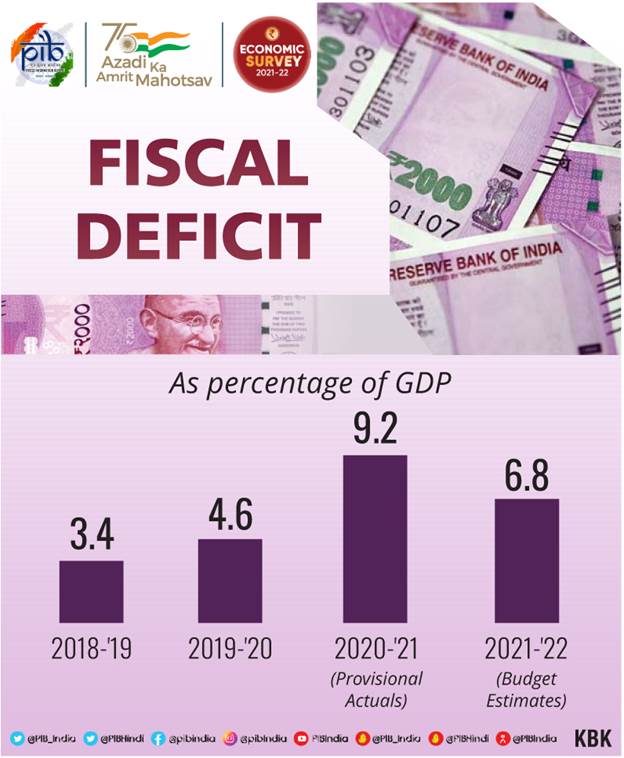
  • Sustained revenue collection and a targeted expenditure policy has contained the fiscal deficit for April to November, 2021 at 46.2 percent of BE.
  • With the enhanced borrowings on account of COVID-19, the Central Government debt has gone up from 49.1 percent of GDP in 2019-20 to 59.3 percent of GDP in 2020-21, but is expected to follow a declining trajectory with the recovery of the economy. 

External Sectors:

  • India’s merchandise exports and imports rebounded strongly and surpassed pre-COVID levels during the current financial year.
  • There was significant pickup in net services with both receipts and payments crossing the pre-pandemic levels, despite weak tourism revenues.
  • Net capital flows were higher at US$ 65.6 billion in the first half of 2021-22, on account of continued inflow of foreign investment, revival in net external commercial borrowings, higher banking capital and additional special drawing rights (SDR) allocation.
  • India’s external debt rose to US $ 593.1 billion at end-September 2021, from US $ 556.8 billion a year earlier, reflecting additional SDR allocation by IMF, coupled with higher commercial borrowings.
  • Foreign Exchange Reserves crossed US$ 600 billion in the first half of 2021-22 and touched US $ 633.6 billion as of December 31, 2021.
  • As of end-November 2021, India was the fourth largest forex reserves holder in the world after China, Japan and Switzerland.

Monetary Management and Financial Intermediation:

  • The liquidity in the system remained in surplus.
    • Repo rate was maintained at 4 per cent in 2021-22.
    • RBI undertook various measures such as G-Sec Acquisition Programme and Special Long-Term Repo Operations to provide further liquidity.
  • The economic shock of the pandemic has been weathered well by the commercial banking system:
    • YoY Bank credit growth accelerated gradually in 2021-22 from 5.3 per cent in April 2021 to 9.2 per cent as on 31st December 2021.
    • The Gross Non-Performing Advances ratio of Scheduled Commercial Banks (SCBs) declined from 11.2 per cent at the end of 2017-18 to 6.9 per cent at the end of September, 2021.
    • Net Non-Performing Advances ratio declined from 6 percent to 2.2 per cent during the same period.
    • Capital to risk-weighted asset ratio of SCBs continued to increase from 13 per cent in 2013-14 to 16.54 per cent at the end of September 2021.
    • The Return on Assets and Return on Equity for Public Sector Banks continued to be positive for the period ending September 2021.
  • Exceptional year for the capital markets:
    • Rs. 89,066 crore was raised via 75 Initial Public Offering (IPO) issues in April-November 2021, which is much higher than in any year in the last decade.
    • Sensex and Nifty scaled up to touch peak at 61,766 and 18,477 on October 18, 2021.
    • Among major emerging market economies, Indian markets outperformed peers in April-December 2021.

Prices and Inflation:

  • The average headline CPI-Combined inflation moderated to 5.2 per cent in 2021-22 (April-December) from 6.6 per cent in the corresponding period of 2020-21.
    • The decline in retail inflation was led by easing of food inflation.
    • Food inflation averaged at a low of 2.9 per cent in 2021-22 (April to December) as against 9.1 per cent in the corresponding period last year.
    • Effective supply-side management kept prices of most essential commodities under control during the year.
    • Proactive measures were taken to contain the price rise in pulses and edible oils.
    • Reduction in central excise and subsequent cuts in Value Added Tax by most States helped ease petrol and diesel prices.
  • Wholesale inflation based on Wholesale Price Index (WPI) rose to 12.5 per cent during 2021-22 (April to December).
    •  This has been attributed to:
      • Low base in the previous year,
      • Pick-up in economic activity,
      • Sharp increase in international prices of crude oil and other imported inputs, and
      • High freight costs.
  • Divergence between CPI-C and WPI Inflation:
    • The divergence peaked to 9.6 percentage points in May 2020.
    • However, this year there was a reversal in divergence with retail inflation falling below wholesale inflation by 8.0 percentage points in December 2021.
    • This divergence can be explained by factors such as:
      • Variations due to base effect,
      • Difference in scope and coverage of the two indices,
      • Price collections,
      • Items covered,
      • Difference in commodity weights, and
      • WPI being more sensitive to cost-push inflation led by imported inputs.
    • With the gradual waning of base effect in WPI, the divergence in CPI-C and WPI is also expected to narrow down.

Sustainable Development and Climate Change:

  • India’s overall score on the NITI Aayog SDG India Index and Dashboard improved to 66 in 2020-21 from 60 in 2019-20 and 57 in 2018-19.
  • Number of Front Runners (scoring 65-99) increased to 22 States and UTs in 2020-21 from 10 in 2019-20.
  • In North East India, 64 districts were Front Runners and 39 districts were Performers in the NITI Aayog North-Eastern Region District SDG Index 2021-22.
  • India has the tenth largest forest area in the world.
  • In 2020, India ranked third globally in increasing its forest area during 2010 to 2020.
  • In 2020, the forests covered 24% of India’s total geographical, accounting for 2% of the world’s total forest area.
  • In August 2021, the Plastic Waste Management Amendment Rules, 2021, was notified which is aimed at phasing out single use plastic by 2022.
  • Draft regulation on Extended Producer Responsibility for plastic packaging was notified.
  • The Compliance status of Grossly Polluting Industries (GPIs) located in the Ganga main stem and its tributaries improved from 39% in 2017 to 81% in 2020.
  • The consequent reduction in effluent discharge has been from 349.13 millions of litres per day (MLD) in 2017 to 280.20 MLD in 2020.
  • The Prime Minister, as a part of the national statement delivered at the 26th Conference of Parties (COP 26) in Glasgow in November 2021, announced ambitious targets to be achieved by 2030 to enable further reduction in emissions.
  • The need to start the one-word movement ‘LIFE’ (Lifestyle for Environment) urging mindful and deliberate utilization instead of mindless and destructive consumption was underlined.

Agriculture and Food Management:

  • The Agriculture sector experienced buoyant growth in past two years, accounting for a sizeable 18.8% (2021-22) in Gross Value Added (GVA) of the country registering a growth of 3.6% in 2020-21 and 3.9% in 2021-22.
  • Minimum Support Price (MSP) policy is being used to promote crop diversification.
  • Net receipts from crop production have increased by 22.6% in the latest Situation Assessment Survey (SAS) compared to SAS Report of 2014.
  • Allied sectors including animal husbandry, dairying and fisheries are steadily emerging to be high growth sectors and major drivers of overall growth in agriculture sector.
  • The Livestock sector has grown at a CAGR of 8.15% over the last five years ending 2019-20. It has been a stable source of income across groups of agricultural households accounting for about 15% of their average monthly income.
  • Government facilitates food processing through various measures of infrastructure development, subsidized transportation and support for formalization of micro food enterprises.
  • India runs one of the largest food management programmes in the world.
  • Government has further extended the coverage of food security network through schemes like PM Gareeb Kalyan Yojana (PMGKY).

Industry and Infrastructure:

  • Index of Industrial Production (IIP) grew at 17.4 percent (YoY) during April-November 2021 as compared to (-)15.3 percent in April-November 2020.

· Capital expenditure for the Indian railways has increased to Rs. 155,181 crores in 2020-21 from an average annual of Rs. 45,980 crores during 2009-14 and it has been budgeted to further increase to Rs. 215,058 crores in 2021-22 – a five times increase in comparison to the 2014 level.

· Extent of road construction per day increased substantially in 2020-21 to 36.5 Kms per day from 28 Kms per day in 2019-20 – a rise of 30.4 percent.

· Net profit to sales ratio of large corporates reached an all-time high of 10.6 percent in in July-September quarter of 2021-22 despite the pandemic (RBI Study).

  • Introduction of Production Linked Incentive (PLI) scheme, major boost provided to infrastructure-both physical as well as digital, along with measures to reduce transaction costs and improve ease of doing business, would support the pace of recovery.

Services:

  • GVA of services crossed pre-pandemic level in July-September quarter of 2021-22; however, GVA of contact intensive sectors like trade, transport, etc. still remain below pre-pandemic level.

· Overall service Sector GVA is expected to grow by 8.2 percent in 2021-22.

· During April-December 2021, rail freight crossed its pre-pandemic level while air freight and port traffic almost reached their pre-pandemic levels, domestic air and rail passenger traffic are increasing gradually – shows impact of second wave was much more muted as compared to during first wave.

· During the first half of 2021-22, service sector received over US$ 16.7 billion FDI – accounting for almost 54 percent of total FDI inflows into India.

· IT-BPM services revenue reached US$ 194 billion in 2020-21, adding 1.38 lakh employees during the same period.

· Major government reforms include, removing telecom regulations in IT-BPO sector and opening up of space sector to private players.

· Services exports surpassed pre-pandemic level in January-March quarter of 2020-21 and grew by 21.6 percent in the first half of 2021-22 – strengthened by global demand for software and IT services exports.

· India has become 3rd largest start-up ecosystem in the world after US and China. Number of new recognized start-ups increased to over 14000 in 2021-22 from 733 in 2016-17.

· 44 Indian start-ups have achieved unicorn status in 2021 taking overall tally of unicorns to 83, most of which are in services sector.

Social Infrastructure and Employment:

  • 157.94 crore doses of COVID-19 vaccines administered as on 16th January 2022; 91.39 crore first dose and  66.05 crore second dose.

· With revival of economy, employment indicators bounced back to pre-pandemic levels during last quarter of 2020-21.

· As per the quarterly Periodic Labour Force Survey (PFLS) data up to March 2021, employment in urban sector affected by pandemic has recovered almost to the pre-pandemic level.

· According to Employees Provident Fund Organisation (EPFO) data, formalization of jobs continued during second COVID wave; adverse impact of COVID on formalization of jobs much lower than during the first COVID wave.

· Expenditure on social services (health, education and others) by Centre and States as a proportion of GDP increased from 6.2 % in 2014-15 to 8.6% in 2021-22 (BE)

· As per the National Family Health Survey-5:

  • Total Fertility Rate (TFR) came down to 2 in 2019-21 from 2.2 in 2015-16
  • Infant Mortality Rate (IMR), under-five mortality rate and institutional births have improved in 2019-21 over year 2015-16

· Under Jal Jeevan Mission (JJM), 83 districts have become ‘Har Ghar Jal’ districts.

  • Increased allotment of funds to Mahatma Gandhi National Rural Employment Guarantee Scheme (MNREGS) to provide buffer for unorganized labour in rural areas during the pandemic.

RM/BY/MV/LP/RC/SSV/AKS/PB
SUMMARY OF THE ECONOMIC SURVEY 2021-22 (Press release 31st Jan 2022)

SUMMARY OF THE ECONOMIC SURVEY 2021-22

AS PER WORLD BANK, ADB AND IMF PROJECTIONS, INDIA TO REMAIN THE FASTEST GROWING MAJOR ECONOMY IN THE WORLD DURING 2021-24

INDIAN ECONOMY TO GROW BY 9.2% IN REAL TERMS IN 2021-22

AGRICULTURE TO GROW BY 3.9 % IN 2021-22 IN COMPARISON TO 3.6% IN THE PREVIOUS YEAR

INDUSTRIAL SECTOR TO WITNESS SHARP REBOUND FROM A CONTRACTION OF 7% IN 2020-21 TO EXPANSION OF 11.8% IN 2021-22

SERVICES TO CLOCK 8.2% GROWTH IN 2021-22 AFTER A CONTRACTION OF 8.4% LAST YEAR

FOREIGN EXCHANGE RESERVES STOOD AT US$ 634 BILLION AS ON 31ST DECEMBER 2021 EQUIVALENT TO OVER 13 MONTHS OF IMPORTS AND HIGHER THAN COUNTRY’S EXTERNAL DEBT

INVESTMENT IS EXPECTED TO SEE A STRONG GROWTH OF 15% IN 2021-22

CONSUMER PRICE INDEX (CPI) COMBINED INFLATION OF 5.6% IN DECEMBER 2021 IS WELL WITHIN TARGETED TOLERANCE BAND

FISCAL DEFICIT FOR APRIL-NOVEMBER 2021 CONTAINED AT 46.2% OF BUDGET ESTIMATES

CAPITAL MARKET BOOMS DESPITE PANDEMIC; OVER RS 89 THOUSAND CRORE RAISED VIA 75 IPO ISSUES IN APRIL-NOVEMBER 2021, MUCH HIGHER THAN IN ANY YEAR IN THE LAST DECADE


MACRO-ECONOMIC STABILITY INDICATORS SUGGEST INDIAN ECONOMY WELL PLPosted Date:- Jan 31, 2022

India to witness GDP growth of 8.0-8.5 per cent in 2022-23, supported by widespread vaccine coverage, gains from supply-side reforms and easing of regulations, robust export growth, and availability of fiscal space to ramp up capital spending.

The Union Minister for Finance & Corporate Affairs Smt Nirmala Sitharaman tabled the Economic Survey 2021-22 in Parliament today, which states that the year ahead is well poised for a pick-up in private sector investment with the financial system in a good position to provide support to the revival of economy. The growth projection for 2022-23 is based on the assumption that there will be no further debilitating pandemic related economic disruption, monsoon will be normal, withdrawal of global liquidity by major central banks will be broadly orderly, oil prices will be in the range of  US$70-$75/bbl, and global supply chain disruptions will steadily ease over the course of the year.

The Survey says, the above projection is comparable with the World Bank’s and Asian Development Bank’s latest forecasts of real GDP growth of 8.7 per cent and 7.5 per cent respectively for 2022-23. As per the IMF’s latest World Economic Outlook (WEO) growth projections released on 25th January, 2022, India’s real GDP is projected to grow at 9 per cent in both 2021-22 and 2022-23 and at 7.1 per cent in 2023-24. This projects India as the fastest growing major economy in the world in all these three years.

Referring to First Advance Estimates, the Survey states that the Indian economy is estimated to grow by 9.2 per cent in real terms in 2021-22, after a contraction of 7.3 per cent in 2020-21. This implies that overall economic activity has recovered past the pre-pandemic levels. Almost all indicators show that the economic impact of the “second wave” in Q1 was much smaller than that experienced during the full lockdown phase in 2020-21, even though the health impact was more severe.

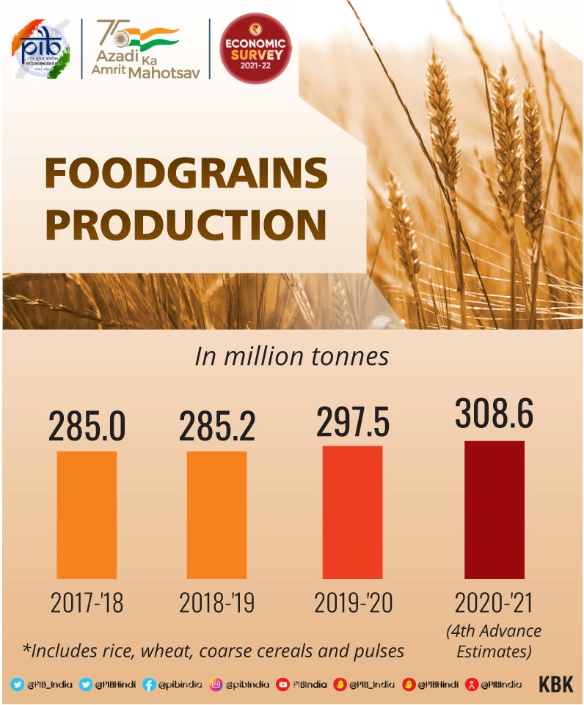
Dwelling on the sectoral aspects, the Survey states that Agriculture and allied sectors have been the least impacted by the pandemic and the sector is expected to grow by 3.9 per cent in 2021-22 after growing by 3.6 per cent in the previous year. The area sown under Kharif and Rabi crops, and the production of wheat and rice has been steadily increasing over the years. In the current year, food grains production for the Kharif season is estimated to post a record level of 150.5 million tonnes. Moreover, procurement of food grains under the central pool accordingly maintained its rising trend in 2021-22 along with minimum support prices, which augur well for national food security and farmers’ incomes. Importantly, the strong performance of the sector was supported by Government policies that ensured timely supplies of seed and fertilizers despite pandemic related disruptions. It was helped by good monsoon rains as reflected in reservoir levels being higher than the 10-year average.

According to Survey, the industrial sector went through a sharp rebound  from a contraction of 7 per cent in 2020-21 to an expansion of  11.8 per cent in this financial year. The manufacturing, construction and mining sub-sectors went through the same swing although the utilities segment experienced a more muted cycle as basic services such as electricity and water supply were maintained even at the height of the national lockdown. The share of industry in GVA is now estimated at 28.2 per cent.

The Survey states that the services sector has been the hardest hit by the pandemic, especially segments that involve human contact.  This sector is estimated to grow by 8.2 per cent this financial year following last year’s 8.4 per cent contraction. It should be noted that there is a wide dispersion of performance by different sub-sectors. Both the finance /Real Estate and the Public Administration segments are now well above pre-COVID levels. However, segments like Travel, Trade and hotels are yet to fully recover. There has been a boom in software and IT-enabled services exports even as earnings from tourism have declined sharply.

The Survey added that total consumption is estimated to have grown by 7.0 per cent in 2021-22 with government consumption remaining the biggest contributor as in the previous year. Government consumption is estimated to grow by a strong 7.6 per cent surpassing pre-pandemic levels. Private consumption is also estimated to have improved significantly to recover 97 per cent of corresponding pre-pandemic output level and it is poised to see stronger recovery with rapid coverage in vaccination and faster normalization of economic activity.

According to the Survey, Investment, as measured by Gross Fixed Capital Formation (GFCF) is expected to see strong growth of 15 per cent in 2021-22 and achieve full recovery of pre-pandemic level. Government’s policy thrust on quickening virtuous cycle of growth via capex and infrastructure spending has increased capital formation in the economy lifting the investment of GDP ratio to about 29.6 per cent in 2021-22, the highest in seven years. While private investment recovery is still at a nascent stage, there are many signals which indicate that India is poised for stronger investment. A sturdy and cleaned-up banking sector stands ready to support private investment adequately.

On the Exports and Imports front, the Survey states that India’s exports of both goods and services have been exceptionally strong so far in 2021-22. Merchandise exports have been above US$30 billion for eight consecutive months in 2021-22, despite many pandemic related global supply constraints. Net services exports have also risen sharply, driven by professional and management consulting services, audio visual and related services, freight transport services, telecommunications, computer and information services. From a demand perspective, India’s total exports are expected to grow by 16.5 per cent in 2021-22 surpassing pre-pandemic levels. Imports also recovered strongly with revival of domestic demand and continuous rise in price of imported crude and metals. Imports are expected to grow by 29.4 per cent in 2021-22 surpassing corresponding pre-pandemic levels. Resultantly, India’s net exports have turned negative in the first half of 2021-22, compared to a surplus in the corresponding period of 2020-21. But current account deficit is expected to remain within manageable limits.

Further, the Survey points out that despite all the disruptions caused by the global pandemic, India’s balance of payments remained in surplus throughout the last two years. This allowed the Reserve Bank of India to keep accumulating foreign exchange reserves, which stand at US$634 billion on 31st December 2021. This is equivalent to 13.2 months of imports and higher than the country’s external debt.

The Survey notes that inflation has reappeared as a global issue in both advanced and emerging economies. The surge in energy prices, non-food commodities, input prices, disruption of global supply chains, and rising freight costs stoked global inflation during the year. In India, Consumer Price Index (CPI) inflation moderated to 5.2 per cent in 2021-22 (April-December) from 6.6 per cent in the corresponding period of 2020-21. It was 5.6 per cent (YoY) in December 2021, which is within the targeted tolerance band. The decline in retail inflation in 2021-22 was led by easing of food inflation. Wholesale Price Inflation (WPI), however, has been running in double-digits.

The Survey says that fiscal support given to the economy as well as the health response caused the fiscal deficit and government debt to rise in 2020-21. However, there has been a strong rebound in government revenues in 2021-22 so far. The revenue receipts of the central government during April-November 2021 have gone up by 67.2 per cent (YOY), as against an expected growth of 9.6 per cent in the 2021-22 Budget Estimates over provisional actuals. The tax collections have been buoyant for both direct and indirect taxes and the gross monthly GST collections have crossed Rs 1 lakh crore consistently since July 2021.

It adds that on the account of a sustained revenue collection and a targeted expenditure policy by the Government of India, the fiscal deficit for April-November 2021 has been contained at 46.2 per cent of Budget Estimates (BE) which is nearly one third of the proportion reached during the same period of the previous two years (135.1% of BE in April-November 2020 and 114.8% of BE in April-November 2019).

The Survey points out that the financial sector is always a possible area of stress during turbulent times. However, India’s capital markets have done exceptionally well and have allowed record mobilization of risk capital of Indian companies. The Sensex and Nifty scaled up to touch its peak at 61,766 and 18,477 on October 18, 2021. Rs 89,066 crore was raised via 75 IPO issues in April- November 2021, much higher than in any year in the last decade. Moreover, the banking system is well capitalized and NPAs seems to have structurally declined. The Gross Non-Performing Advances (GNPA) ratio (i.e. GNPAs as a percentage of Gross Advances) and Net Non-Performing Advances (NNPA) ratio of Scheduled Commercial banks (SCBs) continued to decline since 2018-19. GNPA ratio of SCBs decreased from 7.5 per cent at end-September 2020 to 6.9 per cent at end-September 2021.

The Survey expresses that another distinguishing feature of India’s economic response has been an emphasis on supply-side reforms rather than a total reliance on demand management. These supply-side reforms include deregulation of numerous sectors, simplification of processes, removal of legacy issues like ‘retrospective tax’, privatization, production-linked incentives and so on. Even the sharp increase in capital spending by the Government can be seen as both demand and supply response as it creates infrastructure capacity for future growth.

There are two common themes in India’s supply-side strategy: (i) Reforms that improve flexibility and innovation in order to deal with the long-term unpredictability of the post-Covid world. This includes factor market reforms; deregulation of sectors like space, drones, geospatial mapping, trade finance factoring; process reforms like those in government procurement and in telecommunications sector; removal of legacy issues like retrospective tax; privatization and monetization, creation of physical infrastructure, and so on. (ii) Reforms aimed at improving the resilience o the Indian economy. These range from climate/environment related policies; social infrastructure such as public provision of tap water, toilets, basic housing, insurance for the poor, and so on; support for key industries under Atmanirbhar Bharat; a strong emphasis on reciprocity in foreign trade agreements, and so on.

An important theme that has been discussed through the course of the Economic Survey is that of ‘process reforms’. It is important to distinguish between deregulation and process reforms. The former relates to reducing or removing the role of government from a particular activity. In contrast, the latter broadly relates to simplification and smoothening of the process for activities where the government’s presence as a facilitator or regulator is necessary.

The Survey points out that the last two years have been difficult for the world economy on account of the COVID-19 pandemic. Repeated waves of infection, supply-chain disruptions and more recently, global inflation have created particularly challenging times for policy-making. Faced with these challenges, the Government of India opted for a ‘ Barbell Strategy” that combined a bouquet of safety-nets to cushion the impact on vulnerable sections of society and the business sector. It next pushed through a significant increase in capital expenditure on infrastructure to build back medium-term demand as well as aggressively implemented supply-side measures to prepare the economy for the sustained long-term expansion. This flexible and multi-layered approach is partly based on an “Agile” framework that used feedback-loops, and the monitoring of real-time data.

The Survey underlines that Monetary policy since the outbreak of the pandemic was calibrated to provide a cushion and support growth, but carefully controlled in order to avoid the medium term dislocations of excess liquidity. An important aspect of the safety-net was the use of Government guarantees to provide access to financial support to the economy in general and MSMEs in particular. In the last two years, government leveraged an array of eighty High Frequency Indicators (HFIs) representing industry, services, global trends, macro-stability indicators and several other activities, from both public and private sources to gauge the underlying state of the economy on a real-time basis. These HFIs helped policy makers tailor their response to an evolving situation rather than rely on pre-defined responses of a Waterfall framework, which has been the conventional method for framing policy in India and most of the world.

In conclusion, the Survey is quite optimistic that overall macro-economic stability indicators suggest that the Indian Economy is well placed to take on the challenges of 2022-23 and one of the reasons that the Indian Economy is in good position is its unique response strategy.

***

RM/SNC/SKSRelease Id :-1793826

Read this release in


SUMMARY OF THE ECONOMIC SURVEY 2021-22AS PER WORLD BANK, ADB AND IMF PROJECTIONS, INDIA TO REMAIN THE FASTEST GROWING MAJOR ECONOMY IN THE WORLD DURING 2021-24I

https://pib.gov.in/PressReleaseIframePage.aspx?PRID=1793826&RegID=3&LID=1

The CBDT has extended the last date for updating UDINs for all the IT forms at the e-filing portal to 30th April, 2022.

UDIN Directorate
The Institute of Chartered Accountants of India
31st January 2022

Last Date of updation of UDINs at e-filing Portal

The CBDT has extended the last date for updating UDINs for all the IT forms at the e-filing portal to 30th April, 2022.

For any clarification, please write us at udin@icai.in.

UDIN Directorate

FRN will be compulsory field for UDIN Generation from 12.00 am of 1st February 2022 (ICAI)

This is to state that Firm Registration Number (FRN) will be a compulsory field for generating UDIN from 12.00 am of 1st February 2022. The FRN will be displayed in the dropdown which will be fetched from the SSP database on real-time basis. If the member is not carrying out the assignment on behalf of any firm, then member can mention NA/Not Applicable/Individual Capacity in the place of FRN. The purpose of mandating the FRN is to enable the firms to consolidate the total UDINs generated by its partners on its behalf for its clients, prospectively. Further, the head in charge of the firm, as per the SSP database, can view the list of UDINs generated by the partners on behalf of the firm prospectively. It may be noted that one firm cannot view the UDINs generated for another firm by a common partner. Members may take a note of aforesaid information.

For queries, please write to us at udin@icai.in UDIN Directorate

Procedure for Attestation/Apostille (Documents used abroad)

The Ministry of External Affairs attests original documents//true copies of documents for use abroad. Attestation done by the Ministry of External Affairs is of two types:

1. Apostille

India, since 2005, is a member of the Hague Convention of October 5, 1961 that abolished the requirement of legalization of foreign public documents. Apostille is acceptable in all member-countries of the Convention (For more info please visit the website: http://www.hcch.net). Apostille is done for personal documents like birth/death/marriage certificates, Affidavits, Power of Attorney, etc. and educational documents like degree, diploma, matriculation and secondary level certificates etc. As India is a member of the Hague Apostille Convention, 1961, no further attestation or legalization of a document apostilled by a member country, should be required for using such apostilled document in India. An apostilled document should, therefore, be treated as legalized document for all purposes in India by all concerned, in accordance with the international obligation under the Convention.(Countries under Hague Convention is available at the following link)

.pdf

(No further requirement of attestation of apostilled documents)

.pdf

(Enclosure: Issuing and Accepting Apostilles ) 

.pdf

2. Normal Attestation:

This is done for all the countries which are not a member of Hague Convention and where Apostille is not accepted.

Procedure for Attestation/Apostille

A. E-sanad: A. E-sanad: e-Service for verification & attestation of documents of Indian Citizens. Detatils of e-Sanad can be obtained by following the following Link.

.pdf

B. Attestation/apostille of documents not covered under E-sanad:

Step 1. Authentication of Documents

Applicant Regional Authentication Centres (RACs)
(Details of RACs is available at following link)

.pdf

Step 2. Deposition of Documents with authorized Outsource Service Provider.

Details of Outsource Agency centers is available at following link Appendix G

.pdf

Details of Jurisdiction of Branch Secretariat/RPos is available at following linkAppendix H

.pdf

Step 3. Receipt of apostilled/Attested documents from Outsource agencies.

Important Note:

Legalisation of documents: The Ministry of External Affairs thereafter, legalises the documents on the basis of the signature of the designated signing authorities of the State Government/Union Territory/Chambers of Commerce. Hence it does not take responsibility of the contents of the documents.

Outsourcing of receipt and Delivery of Documents. As a result to outsourcing of receipt and delivery of documents for attestation/Apostille with effect from July 2012, no document is directly accepted from individuals at the Ministry of External Affairs Counter at CPV Division, Patiala House Annexe, New Delhi. The original document/true copy is to be submitted directly to any of the four outsourced service providers along with a photocopy of the document and a photocopy of the Passport of the applicant. It would be pertinent to point out that the Ministry does not legalize photocopies. Applicants are advised not to rely on unauthorised persons/touts for Apostille or Attestation services.

Decentralization of Attestation/ Apostille Services. W.e.f. January 01 2019, Attestation/Apostille services have been decentralized to Branch Secretariats/RPOs in 15 cities Ahemdabad, Bengaluru, Bhopal, Chennai, Chandigarh, Cochin, New Delhi, Guwahati,, Hyderabad, Kolkata, Lucknow, Mumbai, Panaji, Raipur and Thiruvanantapuram. The contact details of these RPOs and the collection centres of the four service providers in these 15 cities are as given above.NORKA ROOTS, a public sector company under the Department of Non-Resident Keralite Affairs, Government of Kerala is authorized to submit documents for Attestation/Apostille by RPO, Thiruvanantapuram .

Applicants are requested to approach their respective Branch Secretariats/RPOs as enumerated above through the four outsourced service providers for obtaining the requisite services of apostille/attestation as required.

Fees for Apostille and Normal Attestation

MEA: A fee of Rs 50 is payable for Apostille of document. (W.e.f 21 December 2016, payment by means of postal orders has been discontinued.) Normal Attestation is done free of cost.

Outsourced agencies: As the Ministry of External Affairs (MEA) is not accepting documents directly from the applicant/individual, all documents for the purpose of Attestation/Apostille by MEA are to be submitted and collected from the four designated outsourced agencies. The fee chargeable by the outsourced agencies per document for its collection and delivery for Apostille/normal attestation by MEA will be Rs. 90/- (Service Fee) and Rs 3 per page (Scanning Fee) .

For more information, suggestions or any grievance please contact:

Attestation Section/Apostille Cell
Ministry of External Affairs
Jawahar Lal Nehru Bhawan, Janapath Marg,
New Delhi-110011.
Telephone : 011-49018403 (Attestation)
49018404 (Apostille)
CPV Division
Ministry of External Affairs
Patiala House Annexe,
Tilak Marg
New Delhi -110001
Fax: 011-23782821
Email: uscpv@mea.gov.in

Fax : 011- 49016638
Email : sooi@mea.gov.in, soatt1@mea.gov.in

(Sources: http://www.mea.gov.in)

Sunday special-30th Jan 2022

👉 If we desire respect for the law, we must first make the law respectable.

👉 Change is the law of life. And those who look only to the past or present are certain to miss the future.

👉 The power of the lawyer is in the uncertainty of the law.

👉 The end of law is not to abolish or restrain, but to preserve and enlarge freedom. For in all the states of created beings capable of law, where there is no law, there is no freedom.

Why is self-awareness so important? We need it for self growth. Otherwise, it’s just self-flagellation. Self-awareness gives us an understanding of the qualities that can truly enrich our lives. Essential moral qualities are Forgiveness, Gratitude and Giving.*

Regards,

🙏🙏🙏🙏💐💐💐💐

Consumer Awareness – Cyber Threats and Frauds (RBI Press Release dated 28th Jan 2022)

It has come to the notice of Reserve Bank of India that unscrupulous elements are defrauding and misleading members of public by using innovative modus operandi including social media techniques, mobile phone calls, etc. In view of this, the Reserve Bank cautions members of public to be aware of fraudulent messages, spurious calls, unknown links, false notifications, unauthorized QR Codes, etc. promising help in securing concessions / expediting response from banks and financial service providers in any manner.

Fraudsters attempt to get confidential details like user id, login / transaction password, OTP (one time password), debit / credit card details such as PIN, CVV, expiry date and other personal information. Some of the typical modus operandi being used by fraudsters are –

  • Vishing – phone calls pretending to be from bank / non-bank e-wallet providers / telecom service providers in order to lure customers into sharing confidential details in the pretext of KYC-updation, unblocking of account / SIM-card, crediting debited amount, etc.
  • Phishing – spoofed emails and / or SMSs designed to dupe customers into thinking that the communication has originated from their bank / e-wallet provider and contain links to extract confidential details.
  • Remote Access – by luring customer to download an application on their mobile phone / computer which is able to access all the customers’ data on that customer device.
  • Misuse the ‘collect request’ feature of UPI by sending fake payment requests with messages like ‘Enter your UPI PIN’ to receive money.
  • Fake numbers of banks / e-wallet providers on webpages / social media and displayed by search engines, etc.

RBI urges the members of public to practice safe digital banking by taking all due precautions, while carrying out any digital (online / mobile) banking / payment transactions. These will help in preventing financial and / or other loss to them.

(Yogesh Dayal)     
Chief General Manager

Press Release: 2021-2022/1630

Judicial updates-29th Jan 2022

Judicial updates-29th Jan 2022

=======================
K. Arumuga Velaiah vs P.R. Ramasamy Supreme Court Judgement dated 27th Jan 2022

👉 Document of partition which provides for effectuating division of properties in future is not compulsorily registrable u/s 17 of the Registration Act


SC not entertain the petitions under Article 32 of the Constitution in the first instance. The petitioners have an alternate and efficacious remedy of moving the concerned High Courts under Article 226 of the Constitution.

Udaipur Chambers of Commerce  Vs Union of India (Supreme Court of India) dated 04/01/2022


Tenancy Transfer not Amounts to Creation of New Tenancy

Bombay HC- Alice Realties Pvt. Ltd. Vs State of Maharashtra dated 03/01/2022


HC should Exercise jurisdiction under Article 226 on sound judicial principles

LNJ Power Ventures Ltd. Vs Rajasthan Electricity Regulatory Commission (Rajasthan High Court) dated 06/01/2022

For regular updates:

DGGI Gurugram officials bust nexus of 93 fake firms issuing fake input tax credit invoices of Rs 491 crore, arrest one (Press release 28th Jan 2022)

The Gurugram Zonal Unit (GZU) of Directorate General of GST Intelligence (DGGI), has arrested one person on 18.01.2022 under the provisions of the GST Act on charges of running multiple fake firms on the strength of fake documents and having passed on fraudulently ITC to the quantum of Rs. 491 crore.

Acting upon on specific inputs from Jaipur Zonal unit of DGGI that a person was providing cloud storage facility to various persons across India, for carrying out their work from remote locations and storing data, Hard Disk recovered from the Cloud service provider was scrutinized. Through scrutiny of data contained in such Hard Disk being provided by the Cloud Storage facility, the identity of the key operative emerged who appeared to be running a nexus of 93 fake firms.

During searches conducted on 18/01/2022, various firms were found non-existent at their given addresses.  The key operative who was actively using the cloud storage service and running the said firms was apprehended from Hansi in Haryana on 18/1/2022.  During investigation, the key operative admitted to have orchestrated the fraud along with other accomplices.  Based on the verifications, evidences and statements recorded, he appeared to be a key person in the functioning of the racket of creation of fake firms, issuing of invoices without actual supply of goods in respect of 93 fake firms which has led to passing on of fraudulent and inadmissible ITC of Rs. 491 crore and thereby, violation of multiple provisions of the CGST Act, 2017.  Accordingly, he was arrested on 18/1/2022 and sent to 14 days Judicial Custody by Duty Magistrate.

Further investigation in the case is underway.