Bhagavad Gita: Yoga-sthah Kuru Karmani (Text 48, Ch2, Contents of Gita Summarized)

Yoga-sthah Kuru Karmani
Sangam tyaktva dhananjaya
Siddy-asiddyoh samo bhutva
Samatvam yoga ucyate (Text 48, Ch2, Contents of Gita Summarized)
                                  
Meaning: Perform your duty equipoised,  O Arjuna, abandoning all attachment to success or failure, such equanimity is called yoga.
(Yoga-sthah : equipoised, Kuru: Perform, Karmani: Your duties,  Sangam: attachment,  tyaktva: Giving up,  dhananjaya : O Arjuna, Siddy-asiddyoh: in success and failure, samoh: equipoised, bhutva: becoming,  Samatvam: equanimity, yogah: Yoga(to concentrate the mind upon the Supreme by controlling the ever –disturbing senses), ucyate: is called.)

आयकर (ज्ञान श्रृंखला-6): क्लब्बिंग अॉफ़ इनकम (Clubbing of Income)

आयकर (ज्ञान श्रृंखला-6): क्लब्बिंग अॉफ़ इनकम (Clubbing of Income) 


  • 1. आय के संयोजन का अर्थ क्या है?

  • ​आम तौर पर, एक व्यक्ति पर कर केवल उसके द्वारा अर्जित आय के संबंध में लगाया जाता है। हालांकि, कुछ विशेष मामलों में अन्य व्यक्ति के आय को भी करदाता के कर योग्य आय में शामिल (अर्थात संयोजित) कर लिया जाता है और ऐसे एक मामले में वह उसकी आय (यदि हो तो) साथ ही साथ अन्य व्यक्ति के आय के संबंध में भी कर का भुगतान करने के लिए उत्तरदायी होगा। स्थिति जिसमें अन्य व्यक्ति की आय करदाता के आय में शामिल किया जाता है आय को जोड़ना कहा जाता है। जैसे, नाबालिग बच्चे की आय उसकी/उसके माता पिता की आय के साथ जोड़ दिया जाता है। धारा 60 से 64​ आय को संयोजन से संबंधित विभिन्न प्रावधान देते हैं।

  • 2. संपत्ति के हस्तांतरण के बिना आय के हस्तांतरण के मामले में कोर्इ भी संयोजन प्रावधान मौजूद हैं?

  • ​धारा 60​ के अनुसार, अगर एक व्यक्ति अपने स्वामित्व के एक परिसंपत्ति के स्थानान्तरण के बिना उस संपत्ति से उत्पन्न आय का हस्तांतरण करता है, तो इस तरह से स्थानांतरित एक परिसंपत्ति से पैदा आय पर अंतरणकर्ता के हाथों में कर लगाया जाता है (अर्थात आय का हस्तांतरण करने वाला व्यक्ति)।
    उदाहरण के लिए, श्री राज ने अपने स्वामित्वाधीन एक बंगले को किराए पर दिया है। बंगले का वार्षिक किराया 84,000 रुपये है। उन्होंने अपने बंगले की पूरी आय अपने दोस्त श्री कुमार को हस्तांतरित कर दी। हालांकि, उन्होंने उस बंगले का हस्तांतरण नहीं किया। इस स्थिति में, 84,000 रुपये के किराये पर कर श्री राज के हाथों में लगाया जाएगा।

  • 3. एक प्रतिसंहरणीय स्थानांतरण के मामले में कोर्इ भी संयोजन प्रावधान मौजूद है?
    प्रतिसंहरणीय स्थानांतरण आम तौर पर एक ऐसा हस्तांतरण है जिसमें अंतरणकर्ता प्रत्यक्ष या परोक्ष रूप से हस्तांतरित संपत्ति या संपत्ति से प्राप्त आय पर अधिकार/नियंत्रण रखता है।
    धारा 61​ के अनुसार, अगर एक प्रतिसंहरणीय हस्तांतरण आयोजित किया जाता है तो संपत्ति से प्राप्त प्रतिसंहरणीय स्थानांतरण के तहत शामिल आय पर अंतरणकर्ता के हाथों में कर लगाया जाता है। ट्रस्ट के जरिये हस्तांतरण के मामले में, जो लाभार्थी के जीवन काल में प्रतिसंहरणीय नहीं है या एक ऐसा हस्तांतरण जो अंतरिती के जीवनकाल में प्रतिसंहरणीय नहीं है ऐसे हस्तांतरण के मामले में धारा 61​ के प्रावधान लागू नहीं होंगे।

  • 4. क्या एक व्यक्ति के पति/पत्नी द्वारा प्राप्त किया गया पारिश्रमिक उसका/उसकी आय के साथ रखा जा सकता है?​
    ​​​
    कुछ परिस्थितियों के तहत जैसा कि धारा 64 (1) (ii​), में दिया गया है एक व्यक्ति के पति/पत्नी द्वारा प्राप्त पारिश्रमिक (यानी, वेतन) एक प्रयोजन से जिसमें व्यक्ति की पर्याप्त रुचि रही है व्यक्ति के आय के साथ रखा जाता है। इस विषय में प्रावधान निम्नलिखित हैं:
      • प्रयोजन (*) में व्यक्ति की काफी रुचि रही है।
      • व्यक्ति के पति /पत्नी उस प्रयोजन में कार्यरत है जिसमें व्यक्ति की पर्याप्त रुचि रही है।
      • व्यक्ति के पति / पत्नी बिना किसी तकनीकी या पेशेवर ज्ञान या अनुभव के कार्यरत है (यानी, पारिश्रमिक न्यायोचित नहीं है)।
    (*) एक व्यक्ति का किसी भी प्रयोजन में, पर्याप्त रुचि है समझा जाएगा अगर ऐसा व्यक्ति अकेले या अपने रिश्तेदारों के साथ मिलकर पिछले वर्ष के दौरान किसी भी समय 20% या इससे अधिक इक्विटी शेयरों (एक कंपनी के मामले में) या लाभ का 20 प्रतिशत का हकदार है (एक कंपनी के अलावा अन्य प्रयोजन के मामले में)।
    इस उद्देश्य के लिए रिश्तेदार में पति, पत्नी, भार्इ या बहन या उस के नजदीकी लग्न या उस व्यक्ति के वंशज शामिल हैं। धारा 2 (41)।
    उदाहरण क
    श्री राजा एसेम खनिज प्रा. लिमिटेड के लाभदायक 21% इक्विटी शेयर धारण करते है। श्रीमती राजा एसेम खनिज प्रा. लिमिटेड में (लेखा विभाग में) 84,000 रुपये के मासिक वेतन पर प्रबंधक के रूप में कार्यरत हैं। श्रीमती राजा के पास लेखा के क्षेत्र में कोर्इ भी ज्ञान, अनुभव या योग्यता नहीं है। क्या श्रीमती राजा द्वारा प्राप्त किया गया पारिश्रमिक (यानी, वेतन) श्री राजा के आय के साथ जोड़ा जा सकता है?
    **
    इस स्थिति में, श्री राजा की एसेम खनिज प्रा. लिमिटेड में काफी रुचि है। और श्रीमती राजा को प्राप्त पारिश्रमिक न्यायोचित नहीं है (यानी, वह किसी भी तकनीकी या पेशेवर ज्ञान या अनुभव के बिना कार्यरत है), और, इसलिए, श्रीमती राजा द्वारा एसेम खनिज प्रा. लिमिटेड से प्राप्त हुआ वेतन श्री राजा की आय के साथ जोड़ दिया जाएगा और श्री राजा के हाथों में कर लगाया जाएगा।
    उदाहरण ख
    श्रीमती कुमार एसएम निर्माण प्राइवेट लिमिटेड के लाभदायक 25% इक्विटी शेयर धारण करते है। श्री कुमार एक वास्तुकार हैं और वह एसएम निर्माण प्राइवेट लिमिटेड में 28,400 रुपये के मासिक वेतन पर एक साइट पर्यवेक्षक के रूप में कार्यरत हैं। श्री कुमार द्वारा प्राप्त हुआ पारिश्रमिक, अपने ज्ञान अनुभव और योग्यता पर न्यायोचित है। क्या श्री कुमार द्वारा प्राप्त किया गया पारिश्रमिक (यानी, वेतन) श्रीमती कुमार की आय के साथ जोड़ा जायेगा? क्योंकि उसका एस एम कंस्ट्रक्शन प्रा. लि. में वस्तुगत हित है
    **
    इस स्थिति में, श्रीमती कुमार की एसएम निर्माण प्राइवेट लिमिटेड में काफी रुचि है। लेकिन श्री कुमार अपने ज्ञान, अनुभव और योग्यता के आधार पर प्रतिनियुक्त है और, इसलिए, श्री कुमार को एसएम निर्माण प्राइवेट लिमिटेड से प्राप्त हुआ वेतन का भुगतान न्यायोचित है। धारा 64 (1)(ii​)​​ का आय को संयोजन का प्रावधान केवल ऐसे मामले में लागू होता है जहाँ नियुक्ति बिना किसी तकनीकी या पेशेवर ज्ञान या अनुभव के किया गया हो। इस मामले में पति या पत्नी का पारिश्रमिक न्यायोचित है, इसलिए, श्री कुमार द्वारा प्राप्त हुआ वेतन श्रीमती कुमार की आय के साथ जोड़ा नहीं जाएगा, लेकिन उसके हाथ में कर लगाया जाएगा।

  • 5. पर्याप्त प्रतिफल के बिना पति या पत्नी को हस्तांतरित संपत्ति से आय को अंतरणकर्ता पति या पत्नी की आय के साथ जोड़ा जा सकता है? ​

  • ​धारा 64 (1)(ii) के अनुसार अगर एक व्यक्ति (प्रत्यक्ष या परोक्ष रूप से) अपनी संपत्ति (गृह संपत्ति के आलावा अन्य) बिना किसी पर्याप्त प्रतिफल के अपने पति या पत्नी को हस्तांतरित करते हैं तो ऐसी संपत्ति से आय को व्यक्ति (अर्थात, अंतरणकर्ता) की आय के साथ जोड़ दिया जायेगा। पर्याप्त प्रतिफल के बिना गृह संपत्ति के हस्तांतरण से होने वाली आय भी संयोजन के प्रावधानों को आकर्षित करेगी, हालांकि, ऐसे किसी मामले में जोड़ना धारा 27​ के अनुसार किया जायेगा धारा 64 (1)(iv) के तहत नहीं। अगर प्राप्त कर्ता पति या पत्नी संपत्ति के स्वरुप को बदल देते हैं, धारा 64 (1)(iv) की संयोजन के प्रावधान तब भी लागू होंगें। कुछ स्थितियां ऐसी भी हैं जिनमें धारा 64 (1)(iv) ​के संयोजन के प्रावधान लागू नहीं होते (इन स्थितियों के लिए अगले पूछे जाने वाले प्रश्न देखें)।
    उदाहरण ग
    श्री सोहम श्यामल खनिज लिमिटेड के 8,400 डिबेंचरों को धारण करते हैं। उन्होंने इन इन डिबेंचरों को अपनी पत्नी को भेंट कर दिया। क्या डिबेंचर से प्राप्त आय श्री सोहम की आय के साथ जोड़ा जाएगा?
    **
    इस स्थिति में, डिबेंचर जीवनसाथी को स्थानांतरित किया जा रहा है। स्थानांतरण उपहार के माध्यम से किया गया है (अर्थात किसी भी प्रतिफल के बिना) और, इसलिए, हस्तांतरित संपत्ति से आय, अर्थात, ऐसे डिबेंचरों पर ब्याज श्री सोहम की आय के साथ जोड़ दिया जाएगा।
    उदाहरण घ
    श्री कपूर ने 8,40,000 रुपये अपनी पत्नी को भेंट किया। उक्त रकम को पत्नी ने एक कंपनी की डिबेंचर में निवेश कर दिया। क्या उपहार के पैसे से श्रीमती कपूर द्वारा खरीदे गए डिबेंचर से आय को श्री कपूर की आय के साथ जोड़ा जायेगा?
    **
    8,40,000 रुपये जीवनसाथी को हस्तांतरित किया गया है। रकम उपहार के माध्यम से स्थानांतरित की गयी है (अर्थात किसी भी प्रतिफल के बिना) और, इसलिए, धारा 64 (1)(iv) के प्रावधान लागू होंगे। संयोजन के प्रावधान तब भी लागू होंगे जब संपत्ति के रूप को अंतरिती-जीवनसाथी ने बदल दिया हो।
    इस मामले में हस्तांतरित परिसंपत्ति पैसा है और, बाद में, परिसंपत्ति के रूप को डिबेंचरों में बदल दिया जाता है, इसलिए, पति द्वारा उपहार में दिये गए पैसे से खरीदे गए डिबेंचर से प्राप्त आय को उसके पति की आय के साथ जोड़ दिया जायेगा। इस प्रकार, श्रीमती कपूर द्वारा डिबेंचर पर प्राप्त ब्याज की आय को श्री कपूर की आय के साथ जोड़ दिया जायेगा।

  • 6. क्या कोर्इ ऐसी स्थिति भी है जिसमें जीवनसाथी को हस्तांतरित संपत्ति से आय के संबंध में जोड़ने के प्रावधान लागू नहीं होते?​
    ​​
    धारा 64 (1)(iv​)​ की संयोजन के प्रावधान निम्न स्थितियों में लागू नहीं होते :
      • अगर संपत्ति का हस्तांतरण पर्याप्त प्रतिफल के साथ किया गया है;
      • अगर संपत्ति का हस्तांतरण अलग रहने के समझौते के संबंध में किया गया है;
      • अगर संपत्ति का हस्तांतरण शादी से पहले किया गया है तो शादी के बाद भी आय को जोड़ा नहीं जायेगा क्योंकि संपत्ति का हस्तांतरण और आय के उपार्जन दोनों के समय पति और पत्नी का रिश्ता मौजूद होना चाहिए;
      • अगर आय के उपार्जन की तिथि पर, अंतरिती अंतरणकर्ता का जीवनसाथी नहीं है (यानी पति और पत्नी का रिश्ता मौजूद नहीं है)।

  • 7. क्या पर्याप्त प्रतिफल के बिना बेटे की पत्नी को हस्तांतरित संपत्ति से आय को अंतरणकर्ता अर्थात, सास/ससुर की आय के साथ जोड़ा जा सकता है?​

  • धारा 64(1)(iv)​ के अनुसार अगर एक व्यक्ति (प्रत्यक्ष या परोक्ष रूप से) अपनी संपत्ति अपने बेटे की पत्नी को पर्याप्त प्रतिफल के बिना हस्तांतरित करता है तो ऐसी परिसंपत्ति से प्राप्त आय को व्यक्ति (यानी, अंतरणकर्ता  सास / ससुर ) की आय के साथ जोड़ दिया जाएगा। संयोजन के प्रावधान तब भी लागू होंगे जब कि अंतरिती-बेटी-दामाद ने परिसंपत्ति के रूप को भले ही बदल दिया हो। अगर संपत्ति, बेटे की शादी से पहले ही स्थानांतरित की जा रही हो तो शादी के बाद भी कोर्इ आय नहीं जोड़ी जायेगी। क्योंकि सास / ससुर और बहू का सम्बन्ध परिसंपत्ति के स्थानांतरण और आय के उपार्जन दोनों समय मौजूद होना चाहिए।
    अगर आय के उपार्जन की तिथि पर, सास / ससुर और बहू का सम्बन्ध मौजूद मौजूद नहीं है, तो फिर आय संयोजन का प्रावधान लागू नहीं हो सकता।
  • 8. क्या जीवनसाथी या बेटे की पत्नी के लाभ के लिए पर्याप्त प्रतिफल के बिना किसी भी व्यक्ति को हस्तांतरित संपत्ति से आय को अंतरणकर्ता की आय के साथ रखा जा सकता है?​

  • ​ धारा 64 (1)(vii), के अनुसार अगर एक व्यक्ति अपनी संपत्ति को पर्याप्त प्रतिफल के बिना एक व्यक्ति को या व्यक्तियों के एक संघ को अपने जीवनसाथी के तत्काल या आस्थगित लाभ के लिए (प्रत्यक्ष या परोक्ष रूप से) हस्तांतरित करता है तो फिर उस संपत्ति से उत्पन्न होने वाली आय अंतरणकर्ता की आय के साथ जोड़ दिया जायेगा।
    धारा 64 (1)(vii​i)​, के अनुसार अगर एक व्यक्ति अपनी संपत्ति को पर्याप्त प्रतिफल के बिना एक व्यक्ति को या व्यक्तियों के एक संघ को अपने बेटे की पत्नी के तत्काल या आस्थगित लाभ के लिए (प्रत्यक्ष या परोक्ष रूप से) हस्तांतरित करता है तो फिर उस संपत्ति से उत्पन्न होने वाली आय अंतरणकर्ता की आय के साथ जोड़ दिया जायेगा।

  • 9. क्या नाबालिग बच्चे की आय माता पिता की आय के साथ जोड़ दी जायेगी?​
    धारा 64 (1क) के अनुसार, नाबालिग बच्चे की आय उसकी/उसके माता पिता (*) की आय के साथ जोड़ दिया जाता है। नाबालिग बच्चे की शारीरिक श्रम के खाते में, या उसकी/उसके कौशल, ज्ञान, प्रतिभा के उपयोग को शामिल करती किसी भी गतिविधि अनुभव, आदि से प्राप्त आय उसकी/उसके माता पिता की आय के साथ नहीं जोड़ी जाएगी। हालांकि, ऐसी आय से संचय को ऐसे नाबालिग के माता पिता की आय के साथ जोड़ दी जायेगी।
    नाबालिग की आय उसके माता पिता की आय में से जिसकी आय (नाबालिग की आय) के बिना अधिक हो उसकी आय के साथ जोड़ दी जायेगी।
    अगर माता-पिता की शादी बरकरार नहीं है तो नाबालिग की आय उसके माता पिता में से उसके साथ जोड़ी जायेगी जो नाबालिग की देखभाल करता होगा।
    नाबालिग बच्चे की आय सहित एक व्यक्ति के आय के मामले में ऐसे व्यक्ति धारा 10 (32) के तहत 1500 रुपये की या नाबालिग की उसकी आय में जोड़ी गयी आय इनमें से जो भी कम है के छूट का दावा कर सकते हैं।
    (*) धारा 80प के तहत निर्दिष्ट किसी विकलांगता से पीड़ित एक नाबालिग बच्चे की आय पर धारा 64 (1क) के प्रावधान लागू नहीं होंगे। दूसरे शब्दों में खंड 80प के तहत निर्दिष्ट विकलांगता से पीड़ित एक नाबालिग की आय उसकी/उसके माता पिता की आय के साथ नहीं जोड़ी जाएगी।
    उदाहरण च
    श्री राजा के दो नाबालिग बच्चे है, अर्थात., मास्टर क और मास्टर ख। मास्टर क एक बाल कलाकार है और मास्टर ख धारा 80प​ के तहत निर्दिष्ट रोगों से पीड़ित है। ए और बी की आय निम्नानुसार हैं:
      • मंच शो से क की आय : 1,00,000 रुपये।
      • बैंक ब्याज से क की आय: 6000 रुपये।
      • बैंक ब्याज से ख की आय: 1,20,000 रुपये।

  • 10. क्या नाबालिग बच्चों की आय उनके माता-पिता की आय के साथ जोड़ी जायेगी (श्रीमती राजा की कोर्इ आय नहीं हो रही है)?​
    धारा 64 (1क) के अनुसार, नाबालिग बच्चों की आय उनके माता पिता में से जिनकी आय (नाबालिग की आय को छोड़कर) अधिक है उसके साथ जोड़ दी जाती है। इस मामले में, श्रीमती राजा को कोर्इ आय नहीं हो रही है और, इसलिए, कोर्इ भी आय यदि जोड़ी जा रही है तो वह श्री राजा की आय के साथ जाड़ी जायेगी।
    शारीरिक श्रम के खाते पर अर्जित नाबालिग बच्चे की आय या नाबालिग बच्चे की कौशल, ज्ञान, प्रतिभा, अनुभव, आदि, से आय उसकी/उसके माता पिता की आय के साथ नहीं जोड़ी जायेगी। इस प्रकार, स्टेज शो से क की आय को श्री राजा की आय के साथ नहीं जोड़ा जायेगा लेकिन बैंक ब्याज से 6000 रुपये की आय को श्री राजा की आय के साथ जोड़ दिया जायेगा।
    धारा 80प के तहत निर्दिष्ट विकलांगता से पीड़ित एक नाबालिग की आय उसकी/उसके माता पिता के आय के साथ नहीं जोड़ी जाएगी। इसलिए, ख की कोर्इ भी आय श्री राजा की आय के साथ नहीं जोड़ी जायेगी।
    करदाता धारा 10 (32) के तहत छूट का दावा कर सकते हैं। इस प्रकार, श्री राजा की आय में जोड़ी गयी ब्याज आय के संबंध में 6000 रुपये की आय पर वह धारा 10 (32)​ के तहत 1500 रुपये की छूट का दावा करने के हकदार होंगे। इसलिए, जोडी गयी शुद्ध आय 4500 रुपए हो जाएगी (यानी 6,000 रुपये – 1500 रुपये)।

  • 11. क्या हिंदू अविभाजित परिवार (एचयूएफ) को इसके सदस्य द्वारा संपत्ति के हस्तांतरण के मामले में कोर्इ भी जोड़ने का प्रावधान लागू होता है? ​
    धारा 64 (2)​ के अनुसार, जब एक व्यक्ति, जो एचयूएफ का सदस्य हो एचयूएफ को पर्याप्त प्रतिफल के बिना अपनी संपत्ति का हस्तांतरण करता है या एचयूएफ से संबंधित संपत्ति में अपनी संपत्ति को रूपांतरित करता है (यह संयुक्त परिवार की संपत्ति के चरित्र के साथ ऐसी संपत्ति को मिलाने या परिवार के सामान्य शेयर में ऐसी संपत्ति डालने से किया जाता है), फिर संपत्ति को संयोजन के प्रावधान निम्नानुसार लागू होगा:
    एचयूएफ के विभाजन से पहले, ऐसी संपत्ति से पूरी आय अंतरणकर्ता की आय के साथ जोड़ दी जायेगी।
    एचयूएफ के विभाजन के बाद, ऐसी संपत्ति परिवार के सदस्यों के बीच वितरित की जाती है। ऐसे एक मामले में अंतरणकर्ता के जीवनसाथी द्वारा ऐसी संपत्ति से प्राप्त आय को व्यक्ति की आय के साथ जोड़ दी जायेगी और उसके हाथ में कर लगाया जाएगा।

Refer link for detailed provisions of Section 60 to 65 (in english & hindi)

https://incometaxindia1.blogspot.in/p/ch-v.html


DELHI
JHARKHAND
BIPUL KUMAR
BUSINESS CONSULTANT
H-9, HAUZ KHAS
NEW DELHI
Tel: 91-11-26533819 
Mob.: 9560084833
businesssosimple@gmail.com
RAJESH SRIVASTAVA
ADVOCATE
NEAR KALI MANDIR,
AWAL MUHALA, CHATRA, JHARKHAND-825401
Email id :rajeshsrivastava902@gmail.com
Mob: 9122050937


Income Tax Department has made it easy for taxpayers to link their PAN with Aadhaar


The Income Tax Department has made it easy for taxpayers to link their PAN with Aadhaar:


The Income Tax Department has made it easy for taxpayers to link their PAN with Aadhaar.

It was reported that taxpayers were finding it difficult as their names did not match in both systems (Eg. Names with initials in one and expanded initials in another). Responding to such grievances,the Dept has come out with a simple solution now.

Just go to www.incometaxindiaefiling.gov.in and click on the link on the left pane -> Link Aadhaar. Provide PAN, Aadhaar no. and ENTER NAME EXACTLY AS GIVEN IN AADHAAR CARD (avoid spelling mistakes) and submit. After verification from UIDAI, the linking will be confirmed.

In case of any minor mismatch in Aadhaar name provided by you when compared to the actual data in Aadhaar, One Time Password (Aadhaar OTP) will be sent to the mobile registered with Aadhaar which has to be provided. Please ensure that the date of birth and gender in PAN and Aadhaar are exactly same. There is no need to login or be registered on E-filing website. This facility can be used by anyone to link their Aadhaar with PAN.

In a rare case where Aadhaar name is completely different from name in PAN, then the linking will fail and taxpayer will be prompted to change the name in either Aadhaar or in PAN database.

To update your PAN details please contact  NSDL 

or To update your Aadhaar card details please contact UIDAI at

This facility is also available after login. Go to Profile settings and choose Aadhaar linking. The details as per PAN are pre-populated. Enter Aadhaar no. and ENTER NAME EXACTLY AS GIVEN IN AADHAAR CARD (avoid spelling mistakes) and submit.

Please use the simplified process to complete the linking of Aadhaar with PAN asap. This will be useful for E-Verification of Income Tax returns using Aadhaar OTP.

Tax Planning Series 2.2 : Capital Gain (Exemption u/s 54F: LTCG invested in residential house)


DEDUCTION IN RESPECT OF LONG TERM CAPITAL GAIN INVESTED IN RESIDENTIAL HOUSE (SECTION 54F)

1.       Provisions of section 54F in brief
If an individual or a HUF having LTCG arising out of sale of capital asset other than a residential house invests in the purchase or construction of a residential house, then, he/it is eligible for a deduction of
             Amount invested
=           ________________    X  LTCG
  
             Net consideration
where net consideration = full value of consideration – cost of transfer.
The time available for investment and the method to be followed for investment after the due date for filing of return of income are the same as mentioned for section 54
In this case, however, cost of the new asset is not changed. But the assessee should not own more than one residential house other than the residential house in which he has invested as on the date of transfer and also, he should not purchase/construct any other residential house for a period of 1/3 years, respectively, from the date of transfer. In case he owns more than one residential house as on the date of transfer he is not eligible for this deduction. In case he purchases/constructs a house within 2/3 years from the date of transfer after getting this deduction, the amount allowed as deduction would be taxed as capital gains in the year of such purchase/construction.
If the new asset is transferred within 3 years of its purchase or construction the deduction given earlier from LTCG would be charged as LTCG in the year of such transfer.
2.       Long term capital gain invested in residential house
For individual and HUF assessees who transfer any long term capital asset this provision viz. section 54F is a boon. Transfer of any long term capital asset and resultant long term capital gain which is chargeable to tax could go out of the tax net if the assessee makes investment of the entire net sale consideration, in acquisition or construction of a residential house.
The scope and application of this section is discussed in this Chapter.
3.       Conditions for deduction
Exemption under section 54F can be claimed where the following conditions are fulfilled :
The assessee is an individual or a HUF.
The asset transferred is a long-term capital asset other than a residential house.
The assessee has, within one year before or two years after the date of transfer purchased, or has within three years after the date of transfer constructed, a residential house. (One residential house in India with effect from 1-4-2015)
On the date of transfer of the original asset, the assessee does not own more than one residential house. In other words, on the date of transfer of the original asset, the assessee may own one house apart from the new house.
The assessee does not purchase any residential house, other than the new house within one year after the date of transfer or construct any residential house, other than the new house within three years after the date of transfer.
The capital gain not utilised in the purchase or construction of the new asset before furnishing the return of income is deposited in an account under the Capital Gains Accounts Scheme before the due date for furnishing the return of income under section 139(1) and proof of such deposit is furnished along with the return of income.
In Nipun Mehrota v. Asstt. CIT [2008] 110 ITD 520 (Bang. – Trib.) the assessee had long term capital gain. He paid the amount for purchase of flat to the builder and claimed exemption under section 54F for the acquisition of building within 2 years after the date of transfer of long term capital asset. The Assessing Officer disallowed the exemption under section 54F on the ground that the assessee had not deposited the unutilized sum in the capital gain account before the due date mentioned in section 139(1). The Tribunal held that the assessee is eligible for exemption under section 54F even though the amount was not deposited in the capital gain account before the due date mentioned in section 139(1) and the sale consideration was applied towards acquisition of residential building to avail exemption under section 54F. Following the judgment in the case of CIT v. Rajesh Kumar Jalan [2006] 157 Taxman 398 (Gau.) it was held that there is no specific condition that the unutilized sale consideration must be deposited before the ‘due date’ prescribed under section 139(1) and the reference in section 54F(4) is on section 139 which includes the date for filing the return under section 139(4) also. The Tribunal while following the judgment of Gauhati High Court did not consider Delhi Tribunal decision in the case of Taranbir Singh Sawhney v. Dy.CIT [2006] 5 SOT 417 (Delhi – Trib.) with a simple observation that the benefit of the decision of the Gauhati High Court was not available to the Delhi Bench while it decided the case.
4.       Amendment of section 54F by Finance (No. 2) Act, 2014, w.e.f. assessment year 2015-16
The Finance (No. 2) Act, 2014 has amended sub-section (1) so as to provide that the exemption is available if the investment is made in purchase or construction of one residential house situated in India. This amendment will take effect from 1st April, 2015 and will, accordingly, apply in relation to assessment year 2015-16 and subsequent years.
  
5.       Net consideration
By ‘net consideration’ is meant the full value of the consideration received or accruing as a result of transfer of the capital asset as reduced by “any expenditure incurred wholly and exclusively in connection with such transfer”. Expenditure in connection with transfer could include broker’s commission, lawyer’s fees, etc.
  
6.       Purchase/construction of second residential house
If the assessee purchases, within the period of 1 year after the date of transfer of the original asset, or constructs, within the period of 3 years after such date, any residential house, the income from which is chargeable under the head ‘Income from house property’, other than the new asset, the amount of capital gains arising from the transfer of the original asset not charged under the head ‘Capital gains’ on the basis of the cost of such new asset under section 54F, will be deemed to be income chargeable under the head ‘Capital gains’ relating to long-term capital assets of the previous year in which the residential house is purchased or constructed.
In other words, if an assessee who has claimed exemption under section 54F on sale of a capital asset and purchased/constructed a residential house with the proceeds, purchases/constructs another residential house within the specified time period, the amount exempted earlier under section 54F will be chargeable to tax as long-term capital gains of the previous year in which the second residential house is purchased/constructed.

The benefit of considering the indexed cost of acquisition and indexed cost of improvement are available in computing such long-term capital gains.

Aravind owned a piece of land with superstructure. The land with superstructure was sold for ` 20 lakhs to ABC Ltd. as per agreement of sale dated 8-12-2007. As per the said agreement ` 25,000 was paid on its execution and ` 75,000 on 30-12-2007. ` 4.50 lakhs was payable by 31-3-2008 and the balance thereafter in 5 monthly instalments of ` 2.50 lakhs each and the last instalment of ` 2 lakhs. Under the agreement, the conveyance deed is to be executed within 36 months from the date of agreement. At what point in time will the capital gain arise? Will section 54F apply if a flat is purchased in October 2008 out of the sale proceeds?
Section 2(47)(v) includes within the definition of “transfer” any transaction involving the allowing the possession of any immovable property to be taken or retained in part performance of a contract of the nature referred to in section 53A of the Transfer of Property Act. In the instant case, therefore, only if possession of the property has been handed over to ABC Ltd. before 31-3-2008 in pursuance of the agreement of sale, the transfer is complete and the capital gains will be liable to tax in the assessment year 2008-09. Where the possession is not given and the vendee as no legal possession over the property till the full payment is made and document is executed, the capital gain would not arise.
If the capital asset sold was not a residential house and the transferor purchased a residential flat within a period of one year before or two years after the date of sale, he would be entitled to claim the relief provided in section 54F.
7.       Date of purchase of new house

The relevant date for the purposes of section 54F is when the assessee paid the full consideration amount on the flat becoming ready for occupation and obtained possession of the flat, and not the date of registration of the agreement to purchase. [CIT v. Smt. Beena K. Jain [1994] 75 Taxman 145 (Bom.)].
8.       Sale of second vacant land and investment in second dwelling unit

In Abdul Gaffar v. ITO [2006] 285 ITR 203(Kar.) the assessee sold a second vacant site and claimed exemption by making investment of the sale proceeds in a second dwelling house. The court held if the assessee had applied the proceeds from the sale of second vacant site in the development of first residential house, the claim could be allowed. But putting up a second dwelling house from the second site would disentitle the assessee from claiming relief under section 54F of the Act. As regards the constitutional validity of the statutory provision being vague and discriminative, was dismissed by the court.
9.       Exemption for minor

In Asstt. CIT v. Madan Lal Bassi [2004] 88 ITD 557 (Chd. – Trib.), it was held that a minor transferring a long term capital asset could claim the benefit of section 54F even though the parent with whose income the minor’s income is clubbed may have more than one residential house. It was held that whenever the income of wife or of a minor child was added in the hands of the assessee separate computation of income was directed to be made by different High Courts. In other words, classification made for the purpose of computation of income is to be kept in mind and before the income is added it is to be computed by taking into account the various exemptions. The Tribunal held that the minor child must be treated as an assessee under section 2(7) of the Act for the purpose of allowing exemption under section 54F. In respect of minor’s income exemptions under sections 54 to 54H have to be allowed separately and only the resultant income is liable for clubbing 
10.   No deduction for extension of house

In CIT v. V. Pradeep Kumar [2006] 153 Taxman 138 (Mad.) it was held that the exemption under section 54F is not allowable where the existing house is extended. Construction by way of extension would not mean construction of residential house contemplated in section 54F.
11.   Transfer of new residential house

Where the new residential house which has been purchased/constructed (in respect of which exemption under section 54F has been claimed) is transferred within a period of 3 years from the date of its purchase/construction, the amount exempted (deducted) earlier under section 54F will be deemed to be long-term capital gains chargeable to tax in the previous year in which the transfer is effected.
12.   Whether deduction is available if new house purchased in joint names of assessee and his wife?
In CIT v. Ravinder Kumar Arora [2011] 15 taxmann.com 307 (Delhi), it was held that while section 54F mandates that the house should be purchased by the assessee, it does not stipulate that the house should be purchased in the name of the assessee only. Therefore, deduction can neither by denied nor restricted to 50% where assessee purchases new house jointly in the name of his wife. Merely because he has included the name of his wife and the property purchased in the joint names would not make any difference. Such a conduct has to be, rather, encouraged which gives empowerment to women. There are various schemes floated by the Government itself permitting joint ownership with wife.
13.   Capital Gains Accounts Scheme
Some of the important aspects of the Capital Gains Accounts Scheme (CGA Scheme) are discussed as under :
Deposit office – The account under the CGA Scheme can be opened in any ‘Deposit Office’. By ‘Deposit Office’ is meant any of the following :
any branch/branch office of the State Bank of India (SBI),
any branch/branch office of a subsidiary bank of the SBI,
any branch/branch office of a nationalised bank authorised by the Central Government by notification in the Official Gazette.

Who can deposit : Any person who is eligible for exemption under section 54, 54B, 54D, 54F or 54G can open an account under the CGA Scheme and make a deposit thereunder.
Types of deposits : There are two types of deposits namely, (i) ‘Deposit Account A’ which is in the form of a ‘savings deposit’ and under which withdrawals can be made from time to time by the depositor, and (ii) ‘Deposit Account B’ which is in the form of a ‘term deposit’ which can, at the option of the depositor, be cumulative or non-cumulative, and under which in the normal course withdrawals can only be made on expiry of the term of deposit. A person who has opened a ‘Deposit Account B’ would normally have to open a ‘Deposit Account A’ as well, for credit of interest, transfer of matured amounts, transfer of amounts for purposes of premature withdrawal, etc.
The deposits in the account may be made either in one lump-sum or in instalments at any time on or before the due date for furnishing the return of income under section 139(1).
Number of accountsIt appears that a separate account has to be opened in respect of exemption claimed under each section because paragraph 5 of the Scheme states that, “a depositor intending to avail of the benefit under more than one section of the Act………shall make separate applications in the same manner, for opening account or accounts under each of such sections”.
Date of deposit: Where a deposit is made by cheque or draft and the cheque or draft is realised on presentation, the effective date of deposit for the purpose of claiming exemption will be the date on which the cheque or draft is received by the deposit office along with the application for opening the account or making the subsequent deposit.
Interest: Interest will be paid/credited at the rate specified by the RBI from time to time.
In the case of a non-cumulative term deposit interest will be paid every quarter. In the case of a cumulative term deposit the interest will be computed by compounding at quarterly rests.
Withdrawal – Amounts may be withdrawn (even prematurely in case of term deposits) in accordance with the provisions contained in paragraph 9 of the Scheme.
In Harsutrai J. Raval v. CIT [2002] 122 Taxman 165 (Guj.) it was held that the amount in the capital gain account to the extent unutilized is taxable as income of the previous year in which the period of 3 years from the date of transfer expires. Also, the assessee is eligible to withdraw the amount for other purposes from the CGS account only after the expiry of the specified time period viz. two years or three years or as the case may be, after the date of transfer of original asset.
In Sadula Janardhan (HUF) v. State Bank of Hyderabad [2006] 286 ITR 291 (AP) the assessee had deposited in Capital Gains Account Scheme. It was held in term deposit viz. Account B as per scheme. The assessee wanted the amount to be transferred to the savings account kept under the same scheme known as Account A. The bank refused to transfer the money from Account B to Account A on the ground that the assessee must obtain the approval of the Assessing Officer. The bank contended that transfer from Account B to Account A is permissible only after closure of Account B which required clearance from Assessing Officer in Form No.G. The court held that transfer of money from one account to another is not closure of account and paragraph 7 of the Capital Gains Account Scheme, 1988 deals with transfer and conversion of the account. Accordingly, the court directed the bank to release i.e. transfer funds from Account B to Account A of the assessee.
Utilisation of amount withdrawnThe amount withdawn is to be utilised for the purposes specified in sub-section (1) of the section in relation to which the deposit has been made. For instance, if a deposit is made under section 54F(4) it can be withdrawn for the purposes specified in section 54F(1) i.e., for meeting any cost/expense in relation to purchase/construction of the new residential house.
The amount withdrawn is to be utilised within 60 days from the date of withdrawal and any unutilised amount is to be re-deposited in ‘Deposit Account A’ immediately thereafter.
Creation of charge : – The amount standing to the credit of a depositor in any account under the CGA Scheme cannot be placed or offered by him as security for any loan or guarantee and cannot be charged or alienated in any manner whatsoever.
Death of depositorThe unutilised deposit amount under the Capital Gains Account Scheme, 1988 in the hands of an individual who dies before the expiry of the stipulated period cannot be taxed in the hands of the deceased. This amount is not taxable in the hands of the legal heirs also as the unutilised portion of the deposit does not partake the character of income in their hands but is only a part of the estate devolving upon them – [Circular No. 743, dated 6-5-1996 ]
Failure to utilise amount deposited under CGA Scheme – The amount deposited in an account under the Capital Gains Accounts Scheme has to be utilised, in the case of purchase of a new residential house, within two years after the date on which the transfer of any long term capital asset, and in the case of construction of a new residential house, within three years after the date on which the transfer of the long term capital asset took place.
If the amount deposited under the CGA Scheme is not utilised in full within the time specified for the purchase/construction of the new residential house, then the unutilised amount will be chargeable to tax under the head ‘Capital gains’ as the income of the previous year in which the period of three years from the date of the transfer of the old long term capital asset expires.
Even where the assessee intends to utilise the amount deposited under the CGA Scheme for the purchase of a new residential house but fails to make such purchase, the unutilised amount is only taxable as the income of the previous year in which the period of three years from the date of the transfer of the old long term capital asset expires. The assessee will then be entitled to withdraw such unutilised amount in accordance with the CGA Scheme.
ILLUSTRATION : 1. Balu purchased jewellery on 1-4-2001 for Rs. 5,00,000. On 5-5-2007 he sold the jewellery for  Rs. 15,00,000. By the due date for filing the return of income for assessment year 2008-09 (31-7-2008) he utilised Rs. 1,00,000 in the construction of a new residential house and on 15-3-2008 he deposited Rs.11,00,000 in an account under the Capital Gains Accounts Scheme. By 4-5-2010 he had utilised only Rs. 8,00,000 out of the sum of Rs. 11,00,000 deposited under the CGA Scheme for construction of the house. Compute capital gains.

Assessment year 2008-09
`
Full Value of consideration
15,00,000
Less : Indexed cost of acquisition : 5,00,000 × 551/426
6,46,700
8,53,300
Less : Deduction under section 54F = 12,00,000 × 8,53,300/15,00,000
6,82,700
Taxable long term capital gain
1,70,600
Assessment year 2011-12 – Deemed long term capital gain
`
Exemption u/s. 54F originally allowed earlier
6,82,700
Less : Exemption allowable as per actual investment 9,00,000 × 8,53,300/15,00,000
5,12,000
Capital gain chargeable to tax on deemed basis
1,70,700
14.   Extension of time for acquiring new asset or depositing or investing capital gain

The Finance (No. 2) Act, 1991, has inserted section 54H to provide that notwithstanding anything contained in sections 54, 54B, 54D, 54EC and 54F, where the transfer of the original asset is by way of compulsory acquisition under any law and the amount of compensation awarded for such acquisition is not received by the assessee on the date of such transfer, the period of acquiring the new asset by the assessee referred to in those sections or, as the case may be, the period available to the assessee under those sections for depositing or investing the amount of capital gain in relation to such compensation as is not received on the date of the transfer, shall be reckoned from the date of receipt of such compensation.

Sub-section (11) of section 155 provides that where in the assessment for any year, a capital gain arising from the transfer of any original asset as is referred to in section 54H is charged to tax and within the period extended under that section the assessee acquires the new asset referred to in that section or, as the case may be, deposits or invests the amount of such capital gain within the period so extended, the Assessing Officer shall amend the order of assessment so as to exclude the amount of the capital gain not chargeable to tax under any of the sections referred to in section 54H; and the provisions of section 154 shall, so far as may be, apply thereto, the period of four years specified in sub-section (7) of section 154 being reckoned from the end of the previous year in which the compensation as received by the assessee.
Refer extract of section 54 F (Capital gain on transfer of certain capital assets not to be charged in case of investment in residential house) of Income Tax Act, 1961  on following link:

Ashtavakra Gita : Liberation in life

Janaka Said:

20.11

Where is illusion?
Where is existence?
Where is attachment or non-attachment?
Where is person?
Where is God?
I am Awareness.

20.12

Where is activity or inactivity?
Where is liberation or bondage?
I am timeless, indivisible.
I am Self alone.

20.13

Where are principles and scriptures?
Where is the disciple or teacher?
Where is the reason for life?
I am boundless, Absolute.

20.14

Where is existence or non-existence?
Where is Unity or duality?
Nothing emanates from me.
No more can be said.

“…..You are self…..”

Ashtavakra Gita: Liberation in life

Janaka Said:

20.6

Where is the world?
Where is the seeker of liberation”
Where is the contemplative?
Where is the man of Knowledge?
Where is the soul in bondage?
Where is the liberated soul?
My nature is Unity.

20.7

Where are creation and destruction?
Where is the end and the means?
Where is the seeker?
Where is attainment?
I am One.

20.8

Where is the knower?
Where is knowing?
Where is the known, or knowledge itself?
Where is anything?
Where is nothing?
I am pure Awareness.

20.9

Where is distraction, concentration,
knowledge or delusion?
Where is joy or sorrow?
I am Stillness.

20.10

Where is the relative?
Where the transcendent?
Where is happiness or misery?
I am empty of thought.

Series continue…

Ashtavakra Gita: Liberation in life

Janaka said:

20.1

Where are the elements, the body,

the organs, the mind?

Where is the void?

Where is despair?

My nature is transparent clearness.

20.2

Where is scripture?

Where is Self-knowledge?

Where is no-mind?

Where is contentment and freedom from desire?

I am empty of two-ness.

20.3

Where is Knowledge and ignorance?

Where is “I”?

Where is “this”?

Where is “mine”?

Where is bondage and liberation?

Self has no attributes.

20.4

Where is the unfolding of karma?

Where is liberation-in-life,

or even liberation at death?

There is only One.

20.5

Where is the doer or enjoyer?

Where is the origin or end of thought?

Where is direct or reflected knowledge?

There is no person here.

Series continue….

GST: FAQs Series 19 (GST Payment of Taxes )

GST Payment of Taxes

Payment of taxes
Electronic Liability Register shall be maintained for each person liable to pay tax on the GST Portal.

Electronic Credit Ledger and Electronic Cash Ledger shall also be maintained on the GST Portal for the person eligible for input tax credit and for person liable to pay tax respectively.

Tax will be paid only through internet banking, RTGS, NEFT or Debit and Credit Cards. However, over the counter payment is allowed through authorized banks for the amount up to Rs.10,000 per challan per tax period.
Q 11. What is a tax liability register?

Ans. Tax Liability Register will reflect the total tax liability of a taxpayer (after netting) for the particular month.

Q 12. What is a Cash Ledger?

Ans. The cash ledger will reflect all deposits made in cash, and TDS/TCS made on account of the taxpayer. The information will be reflected on real time basis. This ledger can be used for making any payment on account ofGST.

Q 13. What is an ITC Ledger?

Ans. Input Tax Credit as self-assessed in monthly returns will be reflected in the ITC Ledger. The credit in this ledger can be used to make payment of TAX ONLY and not other amounts such as interest, penalty, fees etc.

Q 14. What is the linkage between GSTN and the authorized Banks?

Ans. There will be real time two-way linkage between the GSTN and the Core Banking Solution (CBS) of the Bank. CPIN is automatically routed to the Bank via electronic string for verification and receiving payment and a challan identification number (CIN) is automatically sent by the Bank to the Common Portal confirming payment receipt. No manual intervention will be involved in the process by any one including bank cashier or teller or the tax payer.

Q 15. Can a tax payer generate challan in multiple sittings?

Ans. Yes, a taxpayer can partially fill in the challan form and temporarily “save” the challan for completion at a later stage. A saved challan can be “edited” before finalization.
After the tax payer has finalized the challan, he will generate the challan, for use of payment of taxes. The remitter will have option of printing the challan for his record.

Q 16. Can a challan generated online be modified?

Ans. No. After logging into GSTN portal for generation of challan, payment particulars have to be fed in by the tax payer or his authorized person. He can save the challan midway for future updation. 

However once the challan is finalized and CPIN generated, no further changes can be made to it by the taxpayer.

Q 17. Is there a validity period of challan?

Ans. Yes, a challan will be valid for fifteen days after its generation and thereafter it will be purged from the System.

However, the tax payer can generate another challan at his convenience.

Q 18. What is a CPIN?

Ans. CPIN stands for Common Portal Identification Number (CPIN) given at the time of generation of challan.
It is a 14-digit unique number to identify the challan. As stated above, the CPIN remains valid for a period of 15 days.

Q 19. What is a CIN and what is its relevance?

Ans. CIN stands for Challan Identification Number. It is a 17-digit number that is 14-digit CPIN plus 3-digit Bank Code. CIN is generated by the authorized banks/ Reserve Bank of India (RBI) when payment is actually received by such authorized banks or RBI and credited in the relevant government account held with them. It is an indication that the payment has been realized and credited to the appropriate government account. CIN is communicated by the authorized bank to taxpayer as well as to GSTN.

Q 20. What is the sequence of payment of tax where that taxpayer has liabilities for previous months also?

Ans. Section 49(8) prescribes an order of payment where the taxpayer has tax liability beyond the current return period. In such a situation, the order of payment to be followed is: First self-assessed tax and other dues for the previous period; thereafter self-assessed tax and other dues for the current period; and thereafter any other amounts payable including any confirmed demands under section 73 or 74. This sequence has to be mandatorily followed.
Refer extract of Section 49 (Payment of tax, interest, penalty and other amounts) of CGST Act, 2017 on following link:

http://gstindia1.blogspot.in/p/extract-of-section-49-central-goods-and.html

Disclaimer:

This FAQ on GST compiled by NACEN and vetted by the Source Trainers is based on the CGST/SGST/UTGST/IGSTAct(s). This FAQ is for training and academic purposes only.

The information in this blogger is reproduced from FAQ on GST publised by CBEC updated on 31 March 2017 and is not intended to be treated as legal ad vice or opinion. For greater details, you are requested to refer to the respective CGST/SGST/UTGST/IGST Acts.

The FAQs refer to CGST and SGST Acts as CGST/SGST as CGST Act and SGST Act are identical in most of the provisions. CGST Act has been introduced in the Parliament. The SGST Acts will be passed by respective state legislatures. A few provisions may be specific to state and may not be in CGST Act.

CBDT Issues Clarification on furnishing SFT, due date of furnishing SFT extended to 30 June 2017


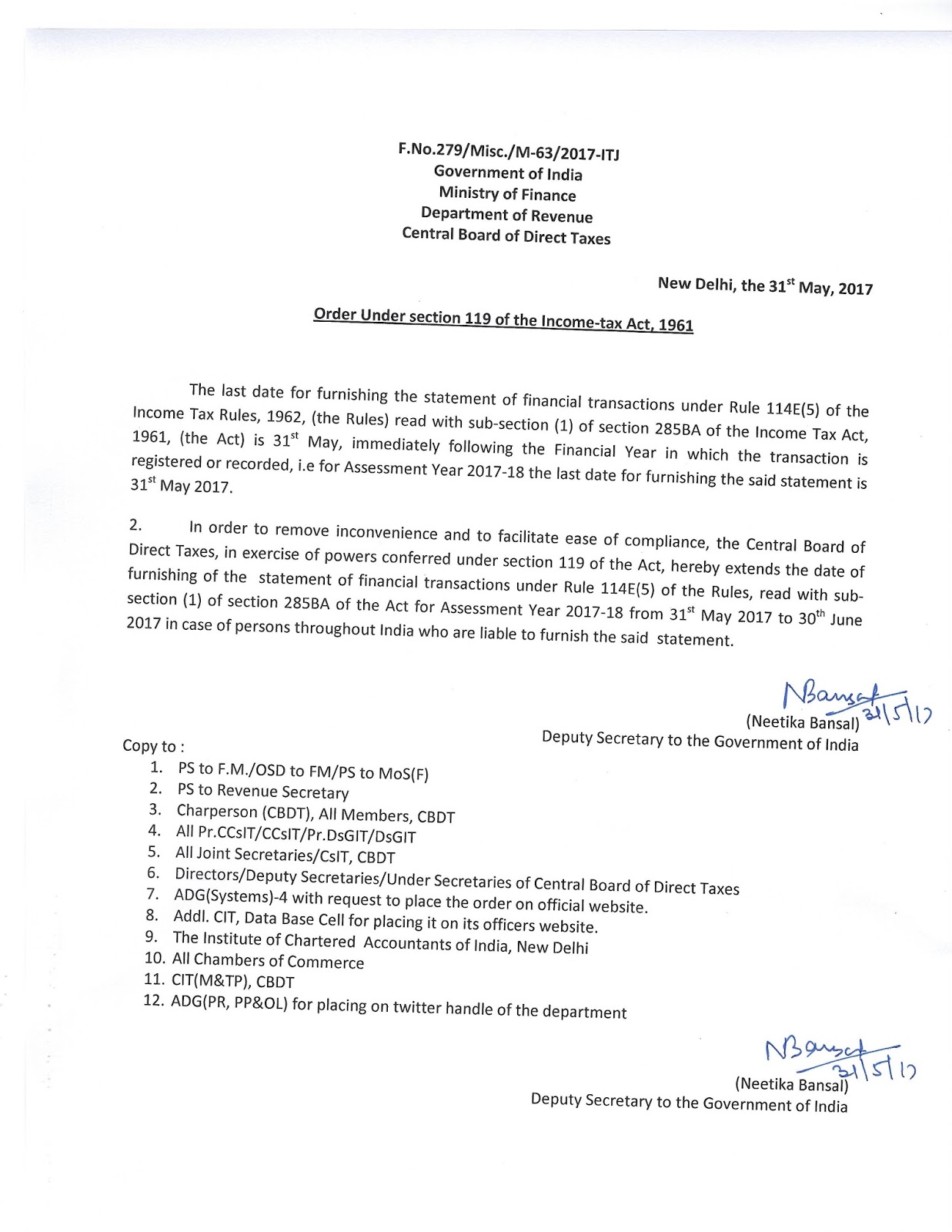
Due date of furnishing Statement of Financial Transaction extended to June 30, 2017


Government of India
Ministry of Finance
Department of Revenue
Central Board of Direct Taxes

New Delhi, 26th May, 2017.

PRESS RELEASE

CBDT Issues Clarification on furnishing Statement of Financial Transaction (SFT) & SFT Preliminary Response


Section 285BA of the Income-tax Act, 1961 requires furnishing of a statement of financial transaction (SFT) for transactions prescribed under Rule 114E of the Income-tax Rules, 1962. The due date for filing such SFT in Form 61A is 31st May 2017.

In case there are reportable transactions for the year, the reporting person/entity is required to register with the Income Tax Department and generate Income Tax Department Reporting Entity Identification Number (ITDREIN) The same can be generated by logging-in to the e-filing website (https://incometaxindiaefiling.gov.in/) with the log in ID used for the purpose of filing the Income Tax Return of the reporting person / entity. Entity having PAN can take only PAN based ITDREIN. Entity having TAN can generate an ITDREIN only when such TAN’s Organisational PAN is not available.

The registration of reporting person (ITDREIN registration) is mandatory only when at least one of the Transaction Type is reportable. A functionality “SFT Preliminary Response” has been provided on the e-Filing portal for the reporting persons to indicate that a specified transaction type is not reportable for the year.

Detailed procedure of ITDREIN registration and upload of Form 61A is available under the “Help” section and Form 61A utility and Schema are available under the download section of http://www.incometaxindiaefiling.gov.in and https://www.cleanmoney.gov.in. Online filing of form 61A requires a valid class 2 or 3 digital signature certificate of person responsible for filing the same. Please refer “DSC Management Utility” manual under help section on how to generate the signature file, attaching the XML with signature and uploading of XML with signature file in e-Filing portal.

(Meenakshi J Goswami)
Commissioner of Income Tax
(Media and Technical Policy)
Official Spokesperson, CBDT.

Ashtavakra Gita: Repose in the Self

Janaka Said:

19.6

Where is close or far,
in or out,
gross or subtle?
I abide in the glory of Self.

19.7

Where is life and death?
Where is the world and worldly relations?
Where is distraction and stillness?
I abide in the glory of Self.

19.8

There is no need to talk about
the three motivations of life(righteousness, wealth, enjoyment).
To talk of yoga is purposeless.
Even talking about Truth is irrelevant.
I rest in Self alone.